Showing posts with label climate change. Show all posts

Friday, October 2, 2020

Have You Seen This Movie Before? The Disaster of 2020


Scene 1:

A monkey dies an ugly death in a rainforest...

A woman swimming hears a crunching sound and disappears beneath the waves...

A menacing shadow crosses over the lunar surface...

People are enjoying themselves in a quiet park. Then thousands of birds (fly away/attack the crowd)...

A moderate earthquake causes some traffic snarls... 

Giant ice shelf breaks apart and floats away...


Scene 2: 

A scientist, or small scientific team, becomes curious about phenomenon in previous scene. They begin to study and become concerned...

Scene 3:

Scientists try to get attention of government official, often waving sheaves of paper. They have a solution...

Government official says "we'll look into it", sends scientists away...

Government official deals with sheaves of paper, either by putting in a file cabinet, or in a trash can...

Scene 4:

Examples of the phenomena described in scene 1 happen again, only more intense: larger earthquake, bigger meteorite strike, more people disappear, more bird attacks, giant hailstorm, tornadoes in odd places, etc...

Scene 5:

Scientists grow ever more concerned, visit government official with their solution and more sheaves of paper, who waves them off saying "we have all the top people working on it"...

Scene 6:

All hell breaks loose. Depending on phenomenon (and the director), (dozens/ hundreds/ thousands/ millions) of people die from a multitude of special effects. Government official is among the victims...

Scene 7:

Remaining government officials say "How could we have foreseen this phenomena? What can we do?"

Scientist, or group of scientists, devises a desperate solution that "might just work". Often includes nuclear bombs...

Scene 8:

Scientific solution works, and plucky bands of survivors survive. Remaining government officials say "We'll never ignore the scientists ever again."...

The Sequel:

The government ignores the scientists again...


So the thing is, I go to movies to be entertained, knowing that such things will never be part of my reality. Until this year...

As catastrophic unprecedented fires burn all around me here in California, we receive news that a major government official, actually the top government official and many of those around him have been felled by a disease that the scientists have been warning about since January. And the solution they were pressing was as simple as wearing a mask, and keeping six feet away from others. And yet so many people and officials ignored the scientists that now 200,000 people are dead in the United States, and a million are dead across the planet.

I'd like to hear a director yell "cut" about now, but that's not going to happen. We wait to see how this nightmare movie unfolds.

Vote like your life depends on it.

Monday, September 21, 2020

The Equinox of the Fall

I haven't been blogging much lately. It's probably not hard to guess why: I've been working harder than at any time aside from those crazy first semesters back in 1988 and 1989. From the sudden transition in less than a week back in the spring semester, intense training throughout the summer, and the onset of a new fall semester completely online pretty much explains the lack of leisure time for writing. But I was out yesterday evening on one of the myriad east-west roads that cross our valley, and I realized it was only one more day before the equinox. I stopped and photographed the setting of the sun.

We were in a similar situation six months ago, and I posted The First Day of an Uncertain Spring: This Too Shall Pass. I wrote at the time "Spring was always seen as a time of renewal when the cold winter is ending and the green shoots of new life are coming from the ground. Of course we know that it is a different situation as the world faces an invisible foe that brings sickness and death, and it's been many decades that we've needed to make sacrifices to fight it."

What a different and unpredictable time this turned out to be. Last March around 35,000 Americans had contracted the disease, and around 500 people had died. The death toll today is more than 200,000 Americans, and nearly a million around the world. 31 million have caught the disease, and around 23 million have recovered, but for many there will be health challenges for the the rest of their lives. The saddest part of this tragedy is that we could have prevented many tens of thousands of these deaths had there been a quick and orderly national response to the pandemic. This did not happen, and instead there were good responses in some states, and criminally negligent responses in others. As one state would seem to gain control, others lost control. We reached a peak and started to decline, but then it started to rise again. It's plateaued in the last few weeks, but there is no continued decline.

Who knew that an entire subset of the population would actively fight the restrictions needed to defeat the virus and prevent the deaths of tens of thousands of Americans? I understand the impatience and frustration of wearing a mask in public places and maintaining distance and not gathering in crowds. But to subvert these easy guidelines and to even deny that the disease exists? I cannot even begin to comprehend this mindset, the one that would sacrifice not only strangers, but one's own family members and friends.

In this national tragedy, I've lost two treasured people, my grandmother and my sister-in-law (not to covid, not that it matters). I had to watch one funeral over a phone, and the memorial service on zoom. It is hard beyond words to have to say good-bye in this way. I loved them both so much. This is the real tragedy. We can't come together and hold each other in the way that humans need to in times of great loss. We need to fight this thing with a united front and put it away for good. We need to do it together.
The sun set in a pall of smoke from the hundreds of fires blazing in California right now. We've lost so much, not just from a pandemic, but from changes in our climate that were predicted three decades ago, and are manifesting themselves on an accelerated time scale. Six months ago I wrote "this too shall pass", but some things will not pass without being inalterably changed. The changes are permanent and we have to prepare.

The sense of loss in my family this week has been sharp and painful, but it was compounded by the loss of some of my treasured places to the fires that have destroyed so much already.

So I mark the passage of another equinox. This moment of the year has had a magic quality for humans for thousands of years, for better or worse. Spring has been the time of birth and hope, and the fall is the time of death and consuming darkness. I can only repeat my words from six months ago: 

"Whatever takes place in the coming weeks and months, please be kind to one another. Look out for your neighbor, and remember that whatever you have, someone else has far less. Be generous as you are able, and remember that with all things, this too shall pass."


Saturday, November 9, 2019

Travels in Cascadia: Acrophobia, Glacierlets, and "Summer" in Whistler, B.C.

Inuksuk near the top of Whistler Mountain. See the note at the end of the post.
Acrophobia, the fear of heights, is an interesting phenomenon. I don't have it, I swear. I have no trouble standing on cliff edges, or climbing up in trees, or flying. Gondolas don't bother me. There are variations and subcategories though. I can stand on a high cliff and look over the edge, but I cannot abide watching someone else do it, especially my students. And I really don't like dangling.

There are lots of creepy heebie-jeebie moments in movies, like "Here's Johnny!", or "the call is coming from inside the house", but none gives me heart palpitations like the opening scene of "Cliffhanger" when Sylvester Stallone is trying to save a young women dangling from a rope over a vast chasm. She falls unfortunately, and I always drop the popcorn while covering my eyes. And then there is that first scene from "Vertical Limit", when not one, but three people fell down the cliff.

In my youth (roughly the ages 12 through 60 years) I was a regular peak bagger and rock clamberer. But I couldn't handle dangling from a rope. I only feel comfortable with solid rock or flooring under my feet. I rappelled down a cliff just once, I've never parachuted or gone hang-gliding, and rides at amusement parks that mimic the experience have never held any appeal for me.

This fact that I hate dangling is the background to today's description of our exploration of British Columbia that we undertook last summer in July. It's because I had to dangle over a cliff in order to see something I really wanted to see: a glacier from above.
Whistler Mountain from the Roundhouse Lodge at the top of the Whistler Gondola.
We were well into our trip by the time we reached the town of Whistler, BC. We had explored the Olympic Peninsula, parts of Vancouver Island, crossed the Strait of Georgia, and wandered for days in Howe Sound, the southernmost fjord on the west coast of North America. We drove there on a modern highway, much of which was stapled onto cliffs of Howe Sound. Before the highway was completed (in the 1960s) and improved and widened in the early 2000s (in preparation for the Winter Olympics of 2010), Whistler was an isolated logging community. Today it is a busy recreational center, winter and summer.

On the day we arrived in town it was a little hard to tell which season it was...it was July and it was cold and rainy. It could hardly be anything different (under the rules of Murphy's Law) since our weather thus far had been rather nice, and I was looking forward to seeing the spectacular alpine scenery around Whistler (my previous two visits had been in poor weather as well). We had scheduled only a few activities in the morning so the students could do some exploring on their own during the long afternoon.
The Peak Express ski lift leading to the summit of Whistler Mountain
As a major winter recreation site, the mountainsides are draped with all manner of gondolas and ski lifts, as well as some incredibly long ziplines. A single ticket provided access to most of the gondolas and the ski lifts that were running in the summer, so I headed up the Whistler Gondola, with the intention of riding and walking over a glacier for the first time (I've been to Athabasca Glacier, but not over it). There was also something up there called the Cloudraker Skybridge and the Raven's Eye that sounded worth checking out.

So this is where we talk about acrophobia. I had no problem with the gondola ride at all. It's in an enclosed space with seats and a floor and all that. But when I got out at the Roundhouse Lodge at 6,069 feet, I found that I was still 1,100 feet below the summit of Whistler Mountain. And I would have to get their via...a ski lift. A spindly rickety dangling ski lift. I know all you skiers out there are used to these things, but I'm not. I don't like them. But it was the only way to get to the top of Whistler Mountain within our time constraints, so I hiked over to the base of the cliff and loaded myself onto the lift.
The Cloudraker Skybridge and Raven's Eye (on the far right). The "snow" is actually the top of a glacier.
There are a few places I've been that feel like no human should really be there. At the very bottom of a huge open-pit mine, for instance. One looks at the rocks exposed for the first time in millions or billions of years, and it just doesn't feel comfortable. Standing two feet from flowing lava. And dangling from a thin cable over a cliff of crumbling rock. It just didn't feel right. But there I was, and soon I reached the top no worse for the wear.
Walking out onto the Cloudraker Skybridge. The Raven's Eye is in the distance, upper left.

Once I was on solid ground again I felt better. I walked over to the Skybridge and crossed it several times. It didn't bother me one bit, and I had a great view down the small glacier beneath my feet. Glacier is perhaps a strong word for what this icefield was. A glacier is defined mainly as a mass of ice large enough to flow under the influence of gravity, and this one qualified, but I suspect the rate of movement is on the order of a few inches or feet per year. The term glacierlet is sometimes applied to these ice fields (most Sierra Nevada glaciers are of about this magnitude in size).
It was immediately clear that this glacier was only a shadow of its former self. On the slope far below I could make out a barren ridge surrounding a turquoise lakelet with a couple of huge boulders. This was a very young terminal moraine, so young that plants had not had a chance to grow. The glacier ended down there only a hundred or so years ago. Although there is snow in the lower reaches, the actual glacier ends today hundreds of feet above the lake.
Terminal moraine and moraine lake at the former end of the glacier at Whistler Mountain.

The true size of the glacier today can be seen in a satellite image taken in the late summer when nearly all of the snow (but not glacial ice) has melted away (below). The loss of glacial ice is a worldwide phenomena indicating that the global climate is warming. When these glaciers disappear, their loss will have serious ramifications for the regional ecosystem. The glaciers serve as a dependable year-round water source for alpine creeks, and when that disappears, so will the animals and plants that are dependent on that water. They don't have anywhere else to retreat to.
Meanwhile, I had one more challenge. As physics tells us, what goes up must come down, and I had been procrastinating, walking around the nature trails around the peak of Whistler Mountain. I was out of time, and was going to have to take the ski lift back down. I'm glad no one was with me, because I was whimpering "oh, sh*t" over and over as the ski lift chair tipped over the edge of the void.
The arete on the east side of the glacier. The ski lift went right over it.
The scenery gave me something else to concentrate on, so I snapped lots and lots of mostly useless pictures, but I did get a decent perspective on the terminal moraine and small moraine lake behind it. The turquoise color is caused by clay-sized particles suspended in the water, derived from the grinding action of the glacier on the rocks at its base. An arete is a sharp jagged ridge that divides glacial valleys. The ski lift carried me right over the top of it.

You'll all be happy to know that I gathered myself together and was not whimpering by the time I reached the bottom of the lift.
In the end, the lousy weather mostly kept me from seeing the spectacular alpine scenery that surrounds Whistler. On the other hand I was able to see a glacier up close, and learned to live with my subtle form of acrophobia.
Google Earth image of the small glacier at Whistler Mountain. The cirque is the bowl-shaped valley where the glacier originates. The skybridge traverses the upper end of the cirque.
The Inuksuk at the beginning of the post was the icon of the 2010 Winter Olympics that were held in Vancouver and Whistler. The stone men have been a part of Inuit and other Arctic cultures for thousands of years. The use of the Inuksuk at the winter games was somewhat controversial, as no Inuits ever lived within hundreds of miles of the site of the games. The local First Nations people were the Squamish and Lil'wat.

Whistler refers to the Hoary Marmots found in the region. I saw one of them at the Roundhouse Lodge when I got back from the mountain.


Saturday, July 20, 2019

50th Anniversary of the Landing of Humans on the Moon, and the Human Adventure


The full Moon of July 16, 2019 
Today marks the 50th year since humans walked on the moon for the first time. The landing was an important part of my own life, and whenever I am reminded, I am taken back to my childhood. In 1969, I was at a scout camp high in the southern Sierra Nevada. I'm not sure whose screw-up it was that our troop was in the middle of nowhere at the moment of one of humanity's greatest achievements, but that was the way it was. I can remember walking through the pinyon forest between the dining hall and our campsite (they were pretty far apart). I was alone at the time, and I heard the camp loudspeakers crackle on (which was unusual; we usually only heard "taps" and other bugle calls, or the emergency alarm). I heard a scratchy voice say "That's one small step for a man, one giant leap for mankind", and I realized that humanity had just accomplished something big. Something that had never been done before. It had a profound effect on that scrawny kid in the pinyon forest at Circle B Scout Ranch.

I grew up in the early sixties fascinated by astronomy. But it was also frustrating that things were so distant and so unreachable by we earthbound humans. Our own moon seemed impossibly distant, despite the objective laid forth by JFK that we would reach it before 1970.
The other planets in our own Solar System were small disks in our best telescopes, and the moons that circled them mere points of light. At the time I had a postcard from the Palomar Observatory that had pictures of Jupiter and Saturn similar to those below. I spent hours staring at them with a hand lens and later on a microscope, hoping I could make out more detailed features to no avail. The other stars? They were so distant that even in our best telescopes they looked no different, just spots of light. The more I learned about the stars and galaxies of the cosmos, the more impossible it seemed that we could ever reach them. Neil Armstrong, Buzz Aldrin, and Michael Collins changed that. They are heroes of the best kind, courageous men who risked everything to do something that had never before been done.
Of course, Armstrong, Aldrin and Collins didn't build the Apollo Spacecraft, or the gigantic Saturn 5 rocket that sent them into space. They didn't navigate to the moon by themselves. There were thousands of engineers and scientists who did the calculations, designed the modules, and shepherded the spacecraft to the moon, and even more importantly, back home again. The vast majority of scientists and engineers were the product of an educational system that was the best the world had ever seen. And they were driven by a communal sense of purpose. They worked together towards a common goal, and their discoveries and innovations radically changed the world we live in.
Of course our cynicism allows us to point out that once we beat the Russians to the moon, the public pretty much lost interest in the space program. NASA started to fade from the public consciousness, but the system was in place that allowed a series of successful projects that have changed the way we view the cosmos and our place in it. We never sent astronauts to Mars, but we sent rovers. We sent the Voyagers to Jupiter, Saturn, Uranus and Neptune. In a wonderful case of over-engineering, the spacecraft outlived their expected missions by decades. Voyager 1 is in its 42nd year of operation...it is still sending data from 16.4 billion miles away (20 light-hours) with an onboard computer that is probably less powerful than one of those Commodore 64 models that I wrote my thesis on in 1985. It recently made a course correction using thrusters that hadn't been fired since 1980. Voyager 2 is also continuing to operate.
Today we see our Solar System in stunning detail, in a way that would have been unbelievable to that child of the sixties. We know the surface of Mars in more detail than we know the surface of our own planet. We've explored the moons of Jupiter and Saturn, discovering strange worlds with vast oceans hidden beneath icy crusts, volcanoes of molten sulfur, and lakes, rivers and oceans made of liquid methane. We've peered through the clouds of Venus, and just a few years ago, we photographed and analyzed the hidden side of Mercury that we missed on the first mission three decades ago. We saw Pluto up close for the first time only a few years ago, and we've orbited the two largest asteroids, Vesta and Ceres.
The Hubble Space Telescope was the other game-changer. It has shown us the rest of the Universe with a clarity that was unimaginable four decades ago. We can see star nurseries and nascent star systems that provide us visual evidence of how our own Solar System formed. The Hubble and other high-tech units have now seen objects that formed a mere half billion years after the origin of the Universe itself 14 billion years ago. And we are only a few years away from the launch of an even more powerful telescope, the Webb Space Telescope.

This is the heritage of a country that undertook an audacious program of exploration under the leadership of JFK, and which succeeded through the exploits of courageous men like Neil Armstrong, Buzz Aldrin, and Michael Collins. What do our children dream of today? Is our education system inspiring them to strive for incredible things, or is it teaching them to be unquestioning automatons in a factory or office? Are we teaching them to be curious about the world, or teaching them how to take a multiple-choice assessment test?

I had the privilege today of offering a lecture on "Space Rocks" at the public library in Hemet, California. The audience turned to be mostly young women 6 to 9 years of age, so I changed gears and made it more of a talk about the adventures of scientific research, and how anyone, including them, could be the vanguard of our next journeys into the unknown.
We are in a time of even greater challenges as humans. We are entering a dark age where the US government is retreating into willful ignorance instead of the leading the world in the face of a planetary crisis. We are now living with the consequences of climate change that were predicted thirty years ago, and we are spiraling into even worse consequences in the near future. There are days when I feel absolute despair at the stupidity and greed of those in charge, and profound sadness at the gullibility of those who blindly accept the deceptions and lies of the present administration. I can't accept that our explorations are ending in a morass of corruption and lies.

In the words of the immortal folksinger Lee Hays (and no doubt others), all things, like a kidney stone, will pass. I believe that adventure still awaits us as a people. As I start a new school year next month, I am as excited as I have ever been to have the opportunity to introduce my students to an incredible Universe. And almost every teacher I know feels the same way.
This is a highly abridged and updated version of a post from August 25, 2012 marking the passing of astronaut Neil Armstrong.

Wednesday, August 22, 2018

Deep in the Hoh Rainforest of Olympic National Park in a Very Hot Summer


I am a mountain person. I'm a desert person. I like being in places where I can see vast distances, where I can navigate by prominent landmarks. I'm often spooked by dense forest environments where I can see only a few yards through the gloom and can't navigate well. I'm talking about map and compass orienteering, but I think a thick forest could disrupt GPS signals too. And what happens if the batteries go dead?
Just the same, when it came to choosing a vacation destination this summer, we headed to the northwest, and ultimately found ourselves camping in the Hoh Rainforest of Olympic National Park in Washington. In a summer of record-breaking heat, it was nice to find a cool and shady place. It was blissful.

The park was born out of controversy. The Olympic Peninsula is a mountainous landscape that captures vast amounts of precipitation from Pacific storms and the western side of the peninsula is especially lush with a temperate rainforest that was a magnet for timber interests. The huge trees were being harvested at a furious rate, and as the loggers worked their way farther into the interior, people became concerned about the wholesale destruction of the unique environment. Grover Cleveland established an Olympic Forest Reserve in 1897, and Theodore Roosevelt upgraded the status to a national monument in 1909. Congress acted in 1938 to designate the forest as a Olympic National Park. There is always a conflict between those who wish to make short-term profits versus those who recognize the need to preserve intact ecosystems with more intangible values such as clean air and water, wildlife diversity, education, recreation, and national pride.
We were lucky in our timing. We traveled in the middle of July instead of August. I was watching reports this week of a dense blanket of smoke from hundreds of fires in British Columbia covering the Pacific Northwest. And of course we haven't been spared here in California. We've had another horrific year of gigantic wildfires that have affected hundreds of thousands of acres, and we had weeks of smoky conditions related to the Ferguson Fire, the Donnell Fire, and dozens of others. There have also been firestorms of political controversy swirling about these fires.
Biologic and climate systems are complex, of course, but there are also some fundamental clear truths: the climate is getting warmer, and wildfires are getting worse. We are living the changes that were predicted thirty or more years ago by climate scientists, and the time we have for confronting the problems associated with warming is limited.
Unfortunately we also live in a time when politicians are in charge who deny climate change despite the overwhelming evidence that proves it is happening. The president says that climate change is not a factor in forest fires, that this is a "management situation", and that we need to "beautifully" remove fallen trees. Secretary of the Interior Zinke says we "have been held hostage by these environmental terrorist groups...that have refused to allow harvest of timber". These statements are highly misleading at best and display ignorance of the science.

Forests have been mismanaged. For more than a century a misunderstanding of how fire interacts with a forest environment has meant that fire suppression at all costs was the method of choice. This has indeed allowed overgrowth of young trees and a buildup of fuel on the forest floors. It is a problem though that has been exacerbated by the effects of drought and warming temperatures.
There are good ways of dealing with forests on public lands, and there are poor choices that allow a few to profit to the detriment of the rest of us. Clearing out fuel is needed given the new environmental regime that we now live in, but the best approaches will involve prescribed fires that burn out the undergrowth and allow mature trees to thrive, along with other more innovative approaches. Timber companies will say they can clear out the forests, but they invariably favor the big mature trees (that can better survive wildfires), or clear-cut the slopes and replant a single species of tree. This is tree-farming, not forest management. There are big changes coming in our beautiful forests, and a lot of them are not good. The last thing we need to be doing is letting a few people profit, leaving the forests in worse shape than they are now. Denying climate change is simply a pretext to allow a few people to profit from a resource that belongs to all of us.
That wasn't on my mind last month, though. I was instead reveling in the coolness and quiet of the trail we were following. It was late in the afternoon and we had the forest to ourselves (aside from a few deer and a smattering of birds...and a gross slug). It was a blessing to experience the living example of a great idea: to preserve parts of the primeval landscapes of our country for the good of all.


Wednesday, December 13, 2017

Fire in the Sky: The Perspective That Comes When Time is Running Out


It was nothing more than the evening commute to school to give a final examination in my Earth Science course. It was a bit after 4 PM and the sun was settling into the horizon, and the spectacle of it all caused me to pull to the side of the road. I have a habit of taking my camera with me everywhere, so I was able to snap a few pictures of the seemingly striped orb. It was also a moment of reflection.

It was a beautiful sight, but it was tinged with great sadness. The color is coming from the homes and dreams of a lot of people in Southern California who are battling a devastating wildfire that has consumed nearly 250,000 acres (that's nearly 400 square miles). At least 700 homes have been lost already. The flames, driven by a severe Santa Ana Wind event, produced volcano-like plumes of smoke and ash that flowed out to sea and then up the coast of Central and Northern California. There is a ridge of high pressure out there, parked over an exceedingly warm Pacific Ocean that is diverting the normal late fall and early winter rainstorms far to the north. There has been no precipitation in our area for weeks, and none in the long-range forecast. The fires in SoCal come on the heels of the even more devastating fires that swept through the wine country a few weeks back, destroying thousands of homes, and killing several dozen people. The drought and the attendant wildfire intensity is seemingly back after a brief one year respite.
Source: www.latimes.com/local/lanow/la-me-fire-ledeall-20171213-story.html

It's hard to convince skeptics of climate change if they are not living in the path of the worst effects. But the effects are extending to more and more people as the decades slip by. There were warnings of mega-droughts and longer fire seasons in the west and southwest years ago. There were predictions of hurricanes amped up by warmer ocean water. There were the obvious forecasts of sea-level rise that are now having a visible impact in coastal cities like Miami, Florida and Venice, Italy. And the glaciers and icecaps are continuing to melt away as they were decades ago, and at an accelerating pace. Unprecedented record-setting heatwaves are becoming distressingly commonplace. The evidence of global climate change is becoming ever more apparent to people around the world, and to their leaders as well, all of whom are signatories to the Paris Climate Accords. Every country, that is, except one. The United States of America.

Many people, probably most, don't consider science when they stand in the voting booth and make their choices. A distressing number of people end up never standing in the booth for one reason or another, but too often because of voter suppression activity. The rest are thinking about the "issues" like standing for national anthems (or kneeling), or building walls, or any one of dozens of temporary controversies (look up Willie Horton ads some day). Perhaps most think about misogyny, racism, taxes, or the economy. These things are important, of course, because these are issues of life, and quality of life. But few think about science, the environment, and the long term effects of what we are doing with the choices that we make. In the long run, these are some of the most important things that impact our lives. But our political representatives can only think in time frames of two, four, and six years, the length of their terms in office. We need to hold their feet to the fire (figuratively) to make choices that benefit us all long after their terms have ended.

Perhaps the most important game in town right now is education. It is only through education that people can make the right choices that will secure their future and the future of their children and their grandchildren. An educated populace is not going to be hoodwinked and cheated by charlatans and con-men running for public office. And education never stops in high school or college. It is a life-long skill, especially now when the entire breadth and depth of human knowledge can be accessed by the phone in your pocket. Take advantage of it.

The sun doesn't seem to move all that fast when it is high in the sky and hours are left in the day. But when the end of the day is near, and one has the perspective of the horizon, the darkness comes quickly. We are being given that "gift" (or warning, if you wish) of perspective concerning climate change. We've been given the predictions and projections from twenty and thirty years ago, with results that are sometimes off by a bit, but almost invariably worse than expected. I don't know when it is too late; it is different for different groups of people and different biomes and ecosystems. But we have been warned.

In any case, that's what I thought about while the sun sank below the horizon and the darkness set in.

Wednesday, November 29, 2017

Our Children Will Say "Why Didn't You Tell Us?", and We'll Say We Tried: The Government Isn't Just Denying Climate Change.

I'm reposting my blog from January 27 of this year. It is a story that needs to be told again. At the time I wrote it shortly after the inauguration, it could have been described as alarmist...that I wasn't giving the new president a chance. But the reality is that after 10 months, we are being endangered by the actions of this administration. Word comes today from National Public Radio that scientists applying for grants from the National Science Foundation are removing the words "global warming" or "climate change" from their proposals. They are censoring themselves. This is beyond concerning.

The budgets at NASA, NOAA, the National Weather Service, and the National Park Service have been deeply slashed to literally blind us to the effects of climate change. Those who work for these agencies doing climate change research have been marginalized if not outright fired. The appointees to the EPA, the Department of Energy and other agencies are climate change deniers. And yet the effects of climate change continued unabated during the past year. We have seen the amped up hurricanes that devastated Texas, Florida, and Puerto Rico. We saw the worst fires in California history destroy thousands of homes. We have sweltered through unprecedented heat waves.We see entire forests dying from the attacks of bugs that are normally killed in cold winter conditions. The Great Barrier Reef in Australia is dying in front of our eyes. The Arctic ice is at record low levels and declining. Sea level continues to rise. And we are in the process of withdrawing from the Paris Climate Accords, the only country in the world that is doing so.

I am not a major voice in the political debate. My blog reaches hundreds of people, although on a good day it will reach thousands. But we have to stand up to this denial, and I hope that those of you who have followed my blog over the years will make your voice heard. We still have tools, we can still protest, we can still contact those who "represent" us in Congress. In many cases, we still have the right to vote (although that right is seriously threatened as well).

Please read what follows to understand why we must stand up to this administration:

Is Trumpism/Pencism the New Lysenkoism? The Need to Defend Science From "Alternative Facts"
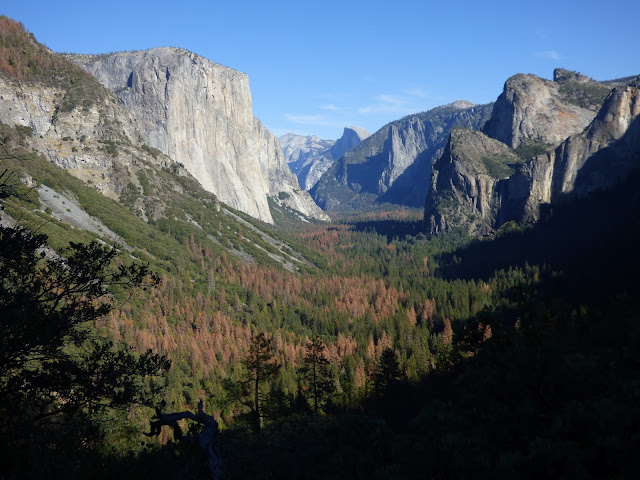
Drought-killed trees in Yosemite Valley, California

Imagine what it must have been like living under communist rule in the Soviet Union during Joseph Stalin's regime. I can't even begin to imagine the unspeakable horrors that led to the deaths of tens of millions of people for a variety of reasons, but events this week have brought to mind a particular episode that is unfamiliar to the public at large, but which had a profound effect on Soviet agriculture. It was no doubt among the reasons for the failure of the totalitarian rule over the Soviet Union. Why? Because they were never really able to feed their own people, especially wheat. The Soviets had plenty of arable land. Why did this happen? There were always profound inefficiencies in the Soviet economy, but the heart of the problem was a single man: Trofim Denisovich Lysenko.
Trofim Denisovich Lysenko, 1898-1976. Source: https://en.wikipedia.org/wiki/Trofim_Lysenko
How could one man do so much damage? It had to do with how science was done in the Soviet Union under communist rule. Scientific research, at least in agriculture, was done from the top down. The government decided what was true, and directed that research must confirm what the government knew was true. If that didn't happen, scientists and researchers faced arrest, re-education, and possible death. And in the Soviet Union, from the 1920s until 1965, Lysenko was in charge of agriculture.

Simply stated, Lysenko didn't accept the theory of evolution by natural selection. He denied Mendelian genetics or even the presence of genes in plants and animals. He instead believed an earlier hypothesis called Lamarkism as well as his own bizarre ideas about inheritance. In essence, he believed that organisms could pass down their experiences to their offspring. A simple model to illustrate this would be an experiment in which dogs had their tails surgically removed, generation after generation. After enough time had passed, puppies would start being born without tails. These were called acquired characteristics. In essence, he insisted that the best strains of cold-weather wheat could be achieved by repeatedly subjecting the seeds of warmer climate strains with cold temperatures. They would then acquire the ability to grow in colder climates.

And so, under his direction, farmers were ordered to grow inferior wheat strains for decades, and the results were no surprise. Production suffered, and over the years the Soviets had to import wheat from other countries, including the United States. The study of DNA, genetics, and natural selection continued unabated in other parts of the world, and agricultural yields ballooned as a result. Yet despite these failures, Lysenko continued as the Director of Genetics for the Academy of Sciences for decades. And he had true power. Under his reign, more than 3,000 geneticists who didn't toe the Lysenko line were arrested, and many of them were executed.
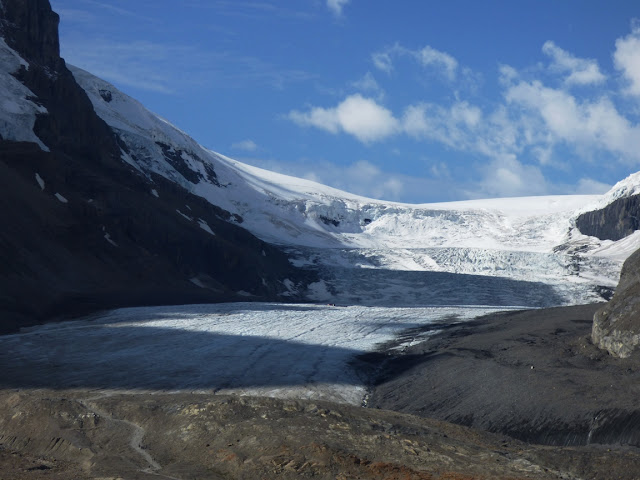
Athabasca Glacier in Jasper National Park in Alberta, Canada. The glacier has been receding for decades

So why are we talking about Lysenko tonight? I can barely keep up with the daily outrages of the new Trump/Pence administration, but one of the most chilling news stories during the transition period and inaugural week has been the attack on science and scientific research. Global warming and climate change have been declared to be false, and Trump officials have taken steps to end government research into this most pressing environmental issue. They have demanded the names of climate researchers at the Environmental Protection Agency, the National Park Service and other departments, suggesting a coming purge (update: this has happened). They announced a gag order on dissemination of the results of research by government experts, even outside of government channels. They have attempted to restrict information flow via the social media. There have been hints of draconian budget cuts in scientific research.
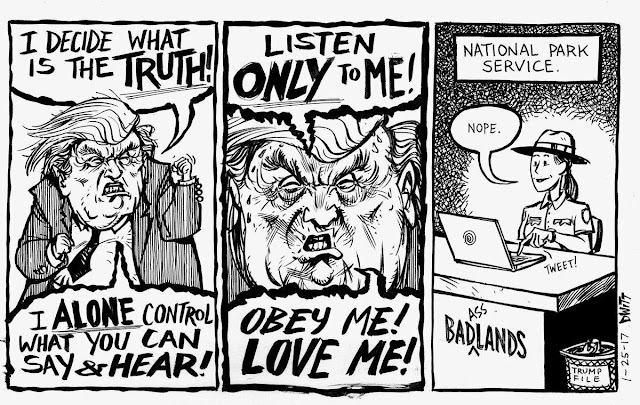
The cause, of course, is not a belief in some other cause of warming. Many of Trump's followers deny that warming is even happening. Because Trump, Pence, and the others in the administration do not believe in global warming, they have decided that it must not be investigated. They are trying to use their position of power to alter the direction of scientific research to conform to their own preconceived beliefs. That runs absolutely counter to the trajectory and goal of scientific exploration, and very much counter to the role of science in America throughout its history. Scientific research and discovery has been a driver that has allowed the American economy to thrive. For a country to promote scientific research that is directed from above towards categorically wrong conclusions is courting disaster, and the implications are worldwide in scope.

I am encouraged at the response of the scientific community. There has been a concerted effort to protect and preserve the research that has been conducted in the past, and researchers are beginning to realize that they will have to become politically active, despite a tendency to avoid it in the past. Resistance has been growing in the social media. To be clear, this is not a Democratic-Republican issue, or a liberal-conservative issue. It is a battle between factual truths and willful ignorance. It is also an economic issue, as the opposition is richly funded by corporations who stand to profit handsomely by denying the existence of global warming. Unfortunately, we will all lose in the end.

I've tended to avoid politics in this blog, but that has to change now. Until the Trump/Pence administration acknowledges the critical role of independent scientific research, they must be challenged at every turn. The stakes are simply too high for Americans and the rest of the world. It doesn't matter what Trump and Pence believe. They may believe warming hasn't happened, but sea level will continue to rise anyway. Coral reefs will continue to die off. Glaciers will continue to melt. Storms will become more intense, as will droughts. The world will get hotter, and each year will decrease our chances to deal effectively with the issue. For Pence and Trump to be willfully ignorant about science is appalling. To ignore the advice and counsel of experts in the many fields of science is absolute folly.
Source: https://www.earthmagazine.org/article/comment-crazy-times-arctic

I fear we have entered into a new age of Lysenkoism. Yes, that is a term. And it would be a tragedy.

Friday, October 20, 2017

Can't See the Forest for the Creek; Or is it the Other Way Around? California's Mega-droughts


The eastern Sierra Nevada is home to one of the strangest forests I know of. It's not the species of tree that is odd; they are mostly Ponderosa, a pretty but unremarkable tree which can also be found on the adjacent slopes. What's strange is that these trees are dead. Not the "recent forest fire" kind of dead. It's that they have been dead for the nearly a thousand years. Oh, and they are still standing, and are located in the middle of a good sized river.

The West Walker River drains a rather large region in the vicinity of Leavitt Meadows and Sonora Pass. Several forks come together near the junction of Highways 108 and 395, and the river plunges into a narrow gorge before spreading out into the Antelope Valley near Topaz Lake on the Nevada border. The trees, and there are several dozen, are found at the head of the gorge near the campground at Chris Flat. Studies have found that these trees sprouted, grew to maturity, and died within a relatively limited period of time between about 800 and 1350 C.E. (common era, equivalent to A.D.).

The weird part is that the trees pretty much filled the entire canyon bottom. They don't do well immersed in water, which seems to suggest that there was almost no room for a river channel when these trees were growing. This implies that the river was much smaller and therefore there were two crippling droughts that lasted on the order of 200 years  and 140 years respectively. Once the droughts ended, the river filled the channel with sediment again, perhaps supplemented by outwash gravels from the Matthes glaciation (the Little Ice Age).


These ghostly forests exist in other parts of the Sierra Nevada. Tenaya Lake, Lake Tahoe, and Fallen Leaf Lake all have submerged forests that grew to maturity during these periods when the lakes didn't have enough water to flow through their outlets. Oral histories of California's Native Americans also hint at terrible droughts.

In human time frames, droughts are a fact of life here in California. We had extended droughts from 1928-1934, 1960-61, 1976-77, 1988-92, and most notably, from 2011-2016.  Our population has grown so large that each drought becomes more problematic, and we muddle through on the strength of a few extraordinary precipitation years like 2017 that fill reservoirs for a time. What would we do if another century-long drought were to come? And what role will anthropogenic global warming play? I might not be here to find out, but my grandchildren might have a real struggle.