Showing posts with label climate change deniers. Show all posts

Saturday, July 20, 2019

50th Anniversary of the Landing of Humans on the Moon, and the Human Adventure


The full Moon of July 16, 2019 
Today marks the 50th year since humans walked on the moon for the first time. The landing was an important part of my own life, and whenever I am reminded, I am taken back to my childhood. In 1969, I was at a scout camp high in the southern Sierra Nevada. I'm not sure whose screw-up it was that our troop was in the middle of nowhere at the moment of one of humanity's greatest achievements, but that was the way it was. I can remember walking through the pinyon forest between the dining hall and our campsite (they were pretty far apart). I was alone at the time, and I heard the camp loudspeakers crackle on (which was unusual; we usually only heard "taps" and other bugle calls, or the emergency alarm). I heard a scratchy voice say "That's one small step for a man, one giant leap for mankind", and I realized that humanity had just accomplished something big. Something that had never been done before. It had a profound effect on that scrawny kid in the pinyon forest at Circle B Scout Ranch.

I grew up in the early sixties fascinated by astronomy. But it was also frustrating that things were so distant and so unreachable by we earthbound humans. Our own moon seemed impossibly distant, despite the objective laid forth by JFK that we would reach it before 1970.
The other planets in our own Solar System were small disks in our best telescopes, and the moons that circled them mere points of light. At the time I had a postcard from the Palomar Observatory that had pictures of Jupiter and Saturn similar to those below. I spent hours staring at them with a hand lens and later on a microscope, hoping I could make out more detailed features to no avail. The other stars? They were so distant that even in our best telescopes they looked no different, just spots of light. The more I learned about the stars and galaxies of the cosmos, the more impossible it seemed that we could ever reach them. Neil Armstrong, Buzz Aldrin, and Michael Collins changed that. They are heroes of the best kind, courageous men who risked everything to do something that had never before been done.
Of course, Armstrong, Aldrin and Collins didn't build the Apollo Spacecraft, or the gigantic Saturn 5 rocket that sent them into space. They didn't navigate to the moon by themselves. There were thousands of engineers and scientists who did the calculations, designed the modules, and shepherded the spacecraft to the moon, and even more importantly, back home again. The vast majority of scientists and engineers were the product of an educational system that was the best the world had ever seen. And they were driven by a communal sense of purpose. They worked together towards a common goal, and their discoveries and innovations radically changed the world we live in.
Of course our cynicism allows us to point out that once we beat the Russians to the moon, the public pretty much lost interest in the space program. NASA started to fade from the public consciousness, but the system was in place that allowed a series of successful projects that have changed the way we view the cosmos and our place in it. We never sent astronauts to Mars, but we sent rovers. We sent the Voyagers to Jupiter, Saturn, Uranus and Neptune. In a wonderful case of over-engineering, the spacecraft outlived their expected missions by decades. Voyager 1 is in its 42nd year of operation...it is still sending data from 16.4 billion miles away (20 light-hours) with an onboard computer that is probably less powerful than one of those Commodore 64 models that I wrote my thesis on in 1985. It recently made a course correction using thrusters that hadn't been fired since 1980. Voyager 2 is also continuing to operate.
Today we see our Solar System in stunning detail, in a way that would have been unbelievable to that child of the sixties. We know the surface of Mars in more detail than we know the surface of our own planet. We've explored the moons of Jupiter and Saturn, discovering strange worlds with vast oceans hidden beneath icy crusts, volcanoes of molten sulfur, and lakes, rivers and oceans made of liquid methane. We've peered through the clouds of Venus, and just a few years ago, we photographed and analyzed the hidden side of Mercury that we missed on the first mission three decades ago. We saw Pluto up close for the first time only a few years ago, and we've orbited the two largest asteroids, Vesta and Ceres.
The Hubble Space Telescope was the other game-changer. It has shown us the rest of the Universe with a clarity that was unimaginable four decades ago. We can see star nurseries and nascent star systems that provide us visual evidence of how our own Solar System formed. The Hubble and other high-tech units have now seen objects that formed a mere half billion years after the origin of the Universe itself 14 billion years ago. And we are only a few years away from the launch of an even more powerful telescope, the Webb Space Telescope.

This is the heritage of a country that undertook an audacious program of exploration under the leadership of JFK, and which succeeded through the exploits of courageous men like Neil Armstrong, Buzz Aldrin, and Michael Collins. What do our children dream of today? Is our education system inspiring them to strive for incredible things, or is it teaching them to be unquestioning automatons in a factory or office? Are we teaching them to be curious about the world, or teaching them how to take a multiple-choice assessment test?

I had the privilege today of offering a lecture on "Space Rocks" at the public library in Hemet, California. The audience turned to be mostly young women 6 to 9 years of age, so I changed gears and made it more of a talk about the adventures of scientific research, and how anyone, including them, could be the vanguard of our next journeys into the unknown.
We are in a time of even greater challenges as humans. We are entering a dark age where the US government is retreating into willful ignorance instead of the leading the world in the face of a planetary crisis. We are now living with the consequences of climate change that were predicted thirty years ago, and we are spiraling into even worse consequences in the near future. There are days when I feel absolute despair at the stupidity and greed of those in charge, and profound sadness at the gullibility of those who blindly accept the deceptions and lies of the present administration. I can't accept that our explorations are ending in a morass of corruption and lies.

In the words of the immortal folksinger Lee Hays (and no doubt others), all things, like a kidney stone, will pass. I believe that adventure still awaits us as a people. As I start a new school year next month, I am as excited as I have ever been to have the opportunity to introduce my students to an incredible Universe. And almost every teacher I know feels the same way.
This is a highly abridged and updated version of a post from August 25, 2012 marking the passing of astronaut Neil Armstrong.

Wednesday, November 29, 2017

Our Children Will Say "Why Didn't You Tell Us?", and We'll Say We Tried: The Government Isn't Just Denying Climate Change.

I'm reposting my blog from January 27 of this year. It is a story that needs to be told again. At the time I wrote it shortly after the inauguration, it could have been described as alarmist...that I wasn't giving the new president a chance. But the reality is that after 10 months, we are being endangered by the actions of this administration. Word comes today from National Public Radio that scientists applying for grants from the National Science Foundation are removing the words "global warming" or "climate change" from their proposals. They are censoring themselves. This is beyond concerning.

The budgets at NASA, NOAA, the National Weather Service, and the National Park Service have been deeply slashed to literally blind us to the effects of climate change. Those who work for these agencies doing climate change research have been marginalized if not outright fired. The appointees to the EPA, the Department of Energy and other agencies are climate change deniers. And yet the effects of climate change continued unabated during the past year. We have seen the amped up hurricanes that devastated Texas, Florida, and Puerto Rico. We saw the worst fires in California history destroy thousands of homes. We have sweltered through unprecedented heat waves.We see entire forests dying from the attacks of bugs that are normally killed in cold winter conditions. The Great Barrier Reef in Australia is dying in front of our eyes. The Arctic ice is at record low levels and declining. Sea level continues to rise. And we are in the process of withdrawing from the Paris Climate Accords, the only country in the world that is doing so.

I am not a major voice in the political debate. My blog reaches hundreds of people, although on a good day it will reach thousands. But we have to stand up to this denial, and I hope that those of you who have followed my blog over the years will make your voice heard. We still have tools, we can still protest, we can still contact those who "represent" us in Congress. In many cases, we still have the right to vote (although that right is seriously threatened as well).

Please read what follows to understand why we must stand up to this administration:

Is Trumpism/Pencism the New Lysenkoism? The Need to Defend Science From "Alternative Facts"
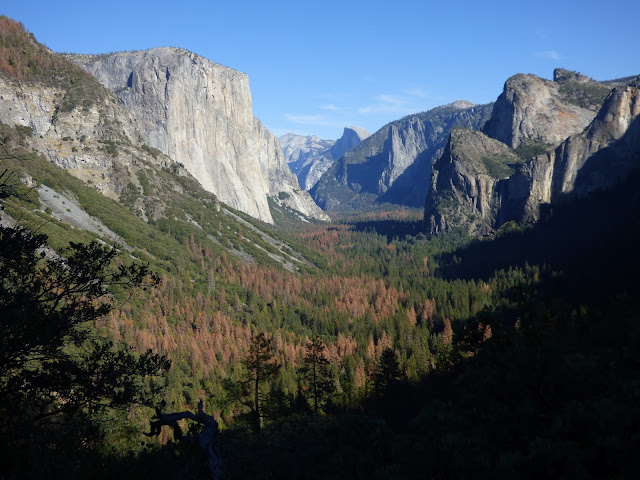
Drought-killed trees in Yosemite Valley, California

Imagine what it must have been like living under communist rule in the Soviet Union during Joseph Stalin's regime. I can't even begin to imagine the unspeakable horrors that led to the deaths of tens of millions of people for a variety of reasons, but events this week have brought to mind a particular episode that is unfamiliar to the public at large, but which had a profound effect on Soviet agriculture. It was no doubt among the reasons for the failure of the totalitarian rule over the Soviet Union. Why? Because they were never really able to feed their own people, especially wheat. The Soviets had plenty of arable land. Why did this happen? There were always profound inefficiencies in the Soviet economy, but the heart of the problem was a single man: Trofim Denisovich Lysenko.
Trofim Denisovich Lysenko, 1898-1976. Source: https://en.wikipedia.org/wiki/Trofim_Lysenko
How could one man do so much damage? It had to do with how science was done in the Soviet Union under communist rule. Scientific research, at least in agriculture, was done from the top down. The government decided what was true, and directed that research must confirm what the government knew was true. If that didn't happen, scientists and researchers faced arrest, re-education, and possible death. And in the Soviet Union, from the 1920s until 1965, Lysenko was in charge of agriculture.

Simply stated, Lysenko didn't accept the theory of evolution by natural selection. He denied Mendelian genetics or even the presence of genes in plants and animals. He instead believed an earlier hypothesis called Lamarkism as well as his own bizarre ideas about inheritance. In essence, he believed that organisms could pass down their experiences to their offspring. A simple model to illustrate this would be an experiment in which dogs had their tails surgically removed, generation after generation. After enough time had passed, puppies would start being born without tails. These were called acquired characteristics. In essence, he insisted that the best strains of cold-weather wheat could be achieved by repeatedly subjecting the seeds of warmer climate strains with cold temperatures. They would then acquire the ability to grow in colder climates.

And so, under his direction, farmers were ordered to grow inferior wheat strains for decades, and the results were no surprise. Production suffered, and over the years the Soviets had to import wheat from other countries, including the United States. The study of DNA, genetics, and natural selection continued unabated in other parts of the world, and agricultural yields ballooned as a result. Yet despite these failures, Lysenko continued as the Director of Genetics for the Academy of Sciences for decades. And he had true power. Under his reign, more than 3,000 geneticists who didn't toe the Lysenko line were arrested, and many of them were executed.
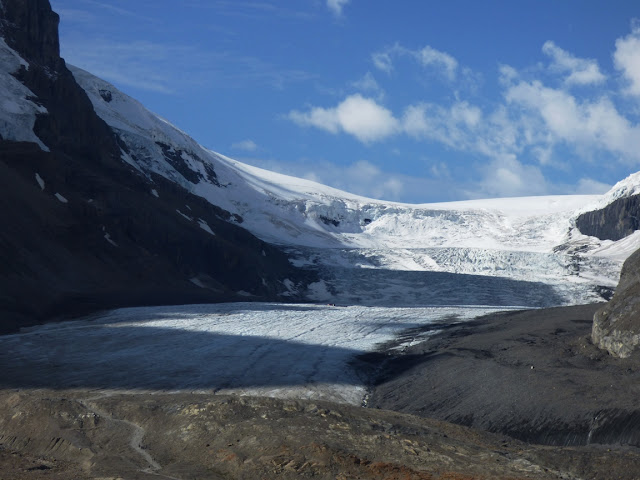
Athabasca Glacier in Jasper National Park in Alberta, Canada. The glacier has been receding for decades

So why are we talking about Lysenko tonight? I can barely keep up with the daily outrages of the new Trump/Pence administration, but one of the most chilling news stories during the transition period and inaugural week has been the attack on science and scientific research. Global warming and climate change have been declared to be false, and Trump officials have taken steps to end government research into this most pressing environmental issue. They have demanded the names of climate researchers at the Environmental Protection Agency, the National Park Service and other departments, suggesting a coming purge (update: this has happened). They announced a gag order on dissemination of the results of research by government experts, even outside of government channels. They have attempted to restrict information flow via the social media. There have been hints of draconian budget cuts in scientific research.

The cause, of course, is not a belief in some other cause of warming. Many of Trump's followers deny that warming is even happening. Because Trump, Pence, and the others in the administration do not believe in global warming, they have decided that it must not be investigated. They are trying to use their position of power to alter the direction of scientific research to conform to their own preconceived beliefs. That runs absolutely counter to the trajectory and goal of scientific exploration, and very much counter to the role of science in America throughout its history. Scientific research and discovery has been a driver that has allowed the American economy to thrive. For a country to promote scientific research that is directed from above towards categorically wrong conclusions is courting disaster, and the implications are worldwide in scope.

I am encouraged at the response of the scientific community. There has been a concerted effort to protect and preserve the research that has been conducted in the past, and researchers are beginning to realize that they will have to become politically active, despite a tendency to avoid it in the past. Resistance has been growing in the social media. To be clear, this is not a Democratic-Republican issue, or a liberal-conservative issue. It is a battle between factual truths and willful ignorance. It is also an economic issue, as the opposition is richly funded by corporations who stand to profit handsomely by denying the existence of global warming. Unfortunately, we will all lose in the end.

I've tended to avoid politics in this blog, but that has to change now. Until the Trump/Pence administration acknowledges the critical role of independent scientific research, they must be challenged at every turn. The stakes are simply too high for Americans and the rest of the world. It doesn't matter what Trump and Pence believe. They may believe warming hasn't happened, but sea level will continue to rise anyway. Coral reefs will continue to die off. Glaciers will continue to melt. Storms will become more intense, as will droughts. The world will get hotter, and each year will decrease our chances to deal effectively with the issue. For Pence and Trump to be willfully ignorant about science is appalling. To ignore the advice and counsel of experts in the many fields of science is absolute folly.
Source: https://www.earthmagazine.org/article/comment-crazy-times-arctic

I fear we have entered into a new age of Lysenkoism. Yes, that is a term. And it would be a tragedy.

Friday, January 27, 2017

Is Trumpism/Pencism the New Lysenkoism? The Need to Defend Science From "Alternative Facts"

Drought-killed trees in Yosemite Valley, California

Imagine what it must have been like living under communist rule in the Soviet Union during Joseph Stalin's regime. I can't even begin to imagine the unspeakable horrors that led to the deaths of tens of millions of people for a variety of reasons, but events this week have brought to mind a particular episode that is unfamiliar to the public at large, but which had a profound effect on Soviet agriculture. It was no doubt among the reasons for the failure of the totalitarian rule over the Soviet Union. Why? Because they were never really able to feed their own people, especially wheat. The Soviets had plenty of arable land. Why did this happen? There were always profound inefficiencies in the Soviet economy, but the heart of the problem was a single man: Trofim Denisovich Lysenko.
Trofim Denisovich Lysenko, 1898-1976. Source: https://en.wikipedia.org/wiki/Trofim_Lysenko
How could one man do so much damage? It had to do with how science was done in the Soviet Union under communist rule. Scientific research, at least in agriculture, was done from the top down. The government decided what was true, and directed that research must confirm what the government knew was true. If that didn't happen, scientists and researchers faced arrest, re-education, and possible death. And in the Soviet Union, from the 1920s until 1965, Lysenko was in charge of agriculture.

Simply stated, Lysenko didn't accept the theory of evolution by natural selection. He denied Mendelian genetics or even the presence of genes in plants and animals. He instead believed an earlier hypothesis called Lamarkism as well as his own bizarre ideas about inheritance. In essence, he believed that organisms could pass down their experiences to their offspring. A simple model to illustrate this would be an experiment in which dogs had their tails surgically removed, generation after generation. After enough time had passed, puppies would start being born without tails. These were called acquired characteristics. In essence, he insisted that the best strains of cold-weather wheat could be achieved by repeatedly subjecting the seeds of warmer climate strains with cold temperatures. They would then acquire the ability to grow in colder climates.

And so, under his direction, farmers were ordered to grow inferior wheat strains for decades, and the results were no surprise. Production suffered, and over the years the Soviets had to import wheat from other countries, including the United States. The study of DNA, genetics, and natural selection continued unabated in other parts of the world, and agricultural yields ballooned as a result. Yet despite these failures, Lysenko continued as the Director of Genetics for the Academy of Sciences for decades. And he had true power. Under his reign, more than 3,000 geneticists who didn't toe the Lysenko line were arrested, and many of them were executed.
Athabasca Glacier in Jasper National Park in Alberta, Canada. The glacier has been receding for decades

So why are we talking about Lysenko tonight? I can barely keep up with the daily outrages of the new Trump/Pence administration, but one of the most chilling news during the transition period and inaugural week has been the attack on science and scientific research. Global warming and climate change have been declared to be false, and Trump officials have taken steps to end government research into this most pressing environmental issue. They have demanded the names of climate researchers at the Environmental Protection Agency, the National Park Service and other departments, suggesting a coming purge. They announced a gag order on dissemination of the results of research by government experts, even outside of government channels. They have attempted to restrict information flow via the social media. There have been hints of draconian budget cuts in scientific research.

The cause, of course, is not a belief in some other cause of warming. Many of Trump's followers deny that warming is even happening. Because Trump, Pence, and the others in the administration do not believe in global warming, they have decided that it must not be investigated. They are trying to use their position of power to alter the direction of scientific research to conform to their own preconceived beliefs. That runs absolutely counter to the trajectory and goal of scientific exploration, and very much counter to the role of science in America throughout its history. Scientific research and discovery has been a driver that has allowed the American economy to thrive. For a country to promote scientific research that is directed from above towards categorically wrong conclusions is courting disaster, and the implications are worldwide in scope.

I am encouraged at the response of the scientific community. There has been a concerted effort to protect and preserve the research that has been conducted in the past, and researchers are beginning to realize that they will have to become politically active, despite a tendency to avoid it in the past. Resistance has been growing in the social media. To be clear, this is not a Democratic-Republican issue, or a liberal-conservative issue. It is a battle between factual truths and willful ignorance. It is also an economic issue, as the opposition is richly funded by corporations who stand to profit handsomely by denying the existence of global warming. Unfortunately, we will all lose in the end.

I've tended to avoid politics in this blog, but that has to change now. Until the Trump/Pence administration acknowledges the critical role of independent scientific research, they must be challenged at every turn. The stakes are simply too high for Americans and the rest of the world. It doesn't matter what Trump and Pence believe. They may believe warming hasn't happened, but sea level will continue to rise anyway. Coral reefs will continue to die off. Glaciers will continue to melt. Storms will become more intense, as will droughts. The world will get hotter, and each year will decrease our chances to deal effectively with the issue. For Pence and Trump to be willfully ignorant about science is appalling. To ignore the advice and counsel of experts in the many fields of science is absolute folly.
Source: https://www.earthmagazine.org/article/comment-crazy-times-arctic

I fear we have entered into a new age of Lysenkoism. Yes, that is a term. And it would be a tragedy.

Monday, November 7, 2016

I'm With Science, I'm With the Wild Places, and Therefore I'm With Her

Athabasca Glacier in Alberta, Canada
By and large, I avoid politics on my blog. I'm motivated in my writing to explore the beautiful places of the planet, and to enlarge our view of the geological forces that influence our lives. If you want the day to day political brawls I get involved in, you can find my Facebook pages, or Twitter. But here, on the eve of what I consider to be one of the most important presidential elections in my life, I need to talk about science. And the sanctity of our wild places. For all the arguments that could be made by the different parties for their respective candidates, there are some that have been largely ignored by the candidates and the mass media.

In my travels, I've seen directly the effects that global warming is having on our planet. I've seen the shrinking glaciers of Greenland (from above), and in Alberta, Canada (from the ground-see the picture above). I've been privileged to see the world's greatest coral reef complex, the Great Barrier Reef, which has been severely damaged by warming waters. It may die out in our lifetimes. I've seen the death of millions, perhaps billions of trees in places like Aspen, Colorado, and in Sequoia National Park, brought about by drought and the attack of boring beetles.

I've read the research of climate scientists, who have been documented the devastating changes we are causing on our planet for many decades. The science is clear, and the science is alarming.
Drought-killed conifers in Sequoia National Park

I've seen the deplorable actions of our elected officials, who protect corporations and prevent our conversion to a carbon-neutral society for purely political reasons. Because the science does not conform to their preconceived political beliefs, they have set our society back by decades. Market forces are slowly bringing changes that are lessening our addiction to oil, but they should have been encouraged decades ago. There is so much that we could have done. It is a tragedy that will haunt our children for generations.

So, we have a choice to make tomorrow. We can choose a man who has proven too lazy to actually read the science. Depending on those who whisper things in his ears, he decries climate change and global warming as a Chinese hoax, despite the fact that we have been living through the hottest years ever recorded. He says there is no drought in California. He suggests that he somehow knows more about climate science than people who have actually taken the trouble to educate themselves, and to get actually get degrees in science. On the other hand, we have a woman who is smart enough to learn the basics of climate science, and who listens to those who know more than she does about what has to be done. She has plans and proposals that could make an actual difference.
Small coral reef in Fiji

There are so many arguments that could be made in regards to the candidates for the presidency. We've spent (wasted) a great deal of time on peripheral issues that don't mean much in the bigger picture, and there has been some discussion of important issues like the place of the United States of America in the world, and our response to global challenges like Russia and terrorism. Those issues are indeed important, and I found my choice easy to make on the basis of the statements and actions of the candidates in those areas. But climate change and global warming are one of the greatest challenges facing not just the USA, but of citizens of the entire world. We need to have a president who understands and appreciates the need for action, and not one who denies the problem exists in the face of all evidence to the contrary. For that reason, I have voted for Hillary Clinton, and though I know that many minds will not be changed in the next 24 hours, I will hope you will consider these issues as you vote tomorrow.

Thursday, January 30, 2014

0.42 Inches of Rain Last Night! California's Long Drought is Over! Wait a Minute...The Problem of Day to Day Perception

No, the drought is not over. More on that in a minute...
I've been waxing eloquently (I hope, but whatever) about how thrilling it has been to be teaching in our new Science Community Center on the campus of Modesto Junior College.  The geology labs were placed on the third floor, much to my delight. I've spent the last two decades of my career ensconced in a windowless office and laboratory.

It's really cruel and unusual punishment to leave a geologist/earth scientist in a dungeon. We need to see the planet in action. One of my greatest delights has been the ability to look out my lab windows and get instant confirmation about atmospheric conditions. And today was special. It rained.
I'm sure there are those who don't think rain is all that remarkable, but this rainstorm was. It has not rained in most of California since Dec. 7, and that was barely a sprinkle. The only significant storm was in November, and our total before yesterday was about 1.3 inches. It should be around 7. By those standards, last night's 0.45 inches was a huge thing. But unfortunately it's not.

A normal year in our area will see around 13 inches of rainfall. The worst ever, in 1913, was 4.3 inches. We may be on track to do worse, and this is after two previous dry years. We are in trouble if some big storms don't develop soon. And there is no real sign yet that anything like that is happening. A hugely resilient high pressure cell, driven by exceptionally warm northern Pacific water is driving our storms north into Alaska, and apparently sending masses of arctic air into the rest of the country.

It's really easy to experience a rainstorm and think "the drought is over". But rain happens during droughts, just not enough of it. There is a lesson here for the politicians who earlier this month were experiencing frigid conditions of the the Polar Vortex and declared that global warming was a scam and a hoax. It still gets cold in winter despite global warming. But not as cold, and not as often. We are in the midst of global climate change, and the effects are very real. Sea level is rising, glaciers are melting, spring is arriving earlier (trees are blooming all over Modesto right now in January), and there are crippling droughts and heat waves (we've had 70 degrees days for weeks now in our area). I've been pleased by polls that show that vast majorities of the American people accept the fact of global warming and climate change, even in the most conservative of states like Oklahoma. If only their chosen leaders were as smart as their constituents. We are not the frogs in the boiling water; our politicians are.

It was a thrill to walk on the roof of the building and take pictures of the Coast Ranges, which I haven't seen clearly in weeks because of the constant dust in the air. Our politicians in Washington feel the cold air and say global warming isn't happening. By that standard, the air was clear today and therefore we have beaten air pollution. Our children won't get asthma anymore. Hooray!

Saturday, November 3, 2012

"Civilization Exists by Geological Consent": Hurricane Sandy, Climate Change, and the 2012 Elections

"Civilization exists by geological consent, subject to change without notice" Will Durant
The opposite side of the country, and the opposite problem. A decade-long drought plagues the southwest, as shown in this low-water picture of Lake Mead on the Arizona-Nevada border.
Watching the tragedy unfold along the eastern seaboard, I was struck by the tenuousness of the existence of our society. It is simply unbelievable how quickly things can fall apart when the water rises and the power goes out for more than a few hours. The fragile infrastructure that keeps society going is stressed beyond limits, lives are disrupted, and people start to die.

Anybody who thinks they are somehow immune to natural disasters is deluding themselves. No matter where one lives there are dangers, whether earthquakes, flash floods, hurricanes, tornadoes, volcanic eruptions, heat waves or droughts. With the exception of earthquakes and eruptions, these dangers are related to climate, and they are inextricably related to the changing climate brought about by the buildup of greenhouse gases in our atmosphere.

People can choose to "believe" that global warming isn't happening. But that won't change the reality of the phenomenon. They can also chose to not believe in gravity, but that won't keep them from falling off a cliff. Global warming is real, and climate change is happening now, just as predicted (and sometimes with greater intensity than the early predictions of climate scientists).

Knowledge of a threat allows for preparation to meet the threat. Politicians have used and overused this principle in relation to terrorism and national defense throughout our nation's history. Sometimes the threat was real, and sometimes it was exaggerated or even imaginary (weapons of mass destruction in Iraq, anyone?).

Today, unfortunately, the politicians on one side of the aisle in Congress are in a near total state of denial on global climate change. They deny global warming in the face of terrifying heat waves and droughts that have caused havoc in their own states and congressional districts. They deny it in the face of disappearing icecaps and glaciers around the world. And they deny it even as some of America's most iconic cities suffer profound damage from unprecedented storms. The few in their party who understand and accept the findings of climate scientists are not allowed to act for the common good on legislation at the cost of tea-party challenges in subsequent elections.

One of the most stunning moments of the current presidential campaign came when Mitt Romney stood in front of his supporters at the Republican convention and "I'm not in this race to slow the rise of the oceans or to heal the planet" to huge cheers from the crowd. Since Hurricane Sandy devastated the eastern seaboard, he has refused to say anything on climate change, for fear of losing his Tea Party support, or for fear of losing votes from the two-thirds of the U.S. population that accepts the phenomenon of human-induced climate change. His failure to take a clear stand on this issue does not encourage confidence in his leadership abilities.

If we as a society deny the reality of global warming, we will not prepare for the coming changes that will happen, and that is a prescription for disaster. Climate change is one of the most important issues of our time. One party denies its existence. What will they do (or not do) if they are given the reins of government? We lost eight years under the Bush administration, and Republicans put up every possible roadblock to climate legislation during the last four years of the Obama administration.

People have a great many reasons for voting the way that they do. Sometimes the reasons are logical, and sometimes they are emotional. Sometimes their reasons are economic or self-serving (the undue influence of anonymous corporate money is another disturbing issue). I will be voting for science, and the politicians who understand their responsibility to consider science as they vote on legislation concerning global climate change, energy issues, and education. There is one major political party in our country that has lost its way in this regard, and as such, they are supremely unqualified to govern our country as we face one of the major issues of our generation.

Wednesday, October 31, 2012

"I'm not in this race to slow the rise of the oceans or to heal the planet"

Picture from The Message
If there is any justice, this quote by Mitt Romney will hang about his neck like the proverbial albatross until his sad excuse of a presidential campaign is consigned to the dustbin of history. Global warming and climate change have become one of the most profound issues of our history as a civilized society, and it has been all but ignored by the presidential campaigns and most congressional races.

Hurricane Sandy did not result solely from global warming. As climate scientists have made clear, storms and hurricanes are not caused by warming, but they are intensified and strengthened by warmer ocean temperatures. The best analogy I've heard about this subject is the steroid scandal that infected professional baseball a few years ago. No single home run was caused by steroids, but the total number of home runs rose as players juiced up on the drugs. 

It is one thing to disagree about the dilemmas we face concerning global warming, whether we try to change the trajectory of the build-up of greenhouse gases, or whether we simply prepare ourselves for the inevitable effects of the rise of sea level. It is quite another to completely deny the existence of global warming as Senator James Inhofe does, even as his Oklahoma constituents broil in the unprecedented heat waves of the last few years. And it is even worse that presidential candidate Mitt Romney, who once agreed that global warming was a serious concern, pandered to the worst impulses of his political party by mocking President Obama, saying "I'm not in this race to slow the rise of the oceans or to heal the planet". And climate scientists are harassed and threatened by ignorant fools.

Global warming is no longer a prediction of future effects. It is with us now. Many of the projections that were made a decade or more ago are not only coming true, but they are coming true at higher rates than predicted. I'm not here to argue the point; people who have dedicated their lives to the study of our climate have made all the arguments that need to be made. They simply need to be heard, and our politicians need to seek knowledge about issue rather than rejecting it out of hand under the direction of their corporate contributors.

And now this horrific storm has strewn destruction across our eastern seaboard: What will it take to raise awareness, if not this?