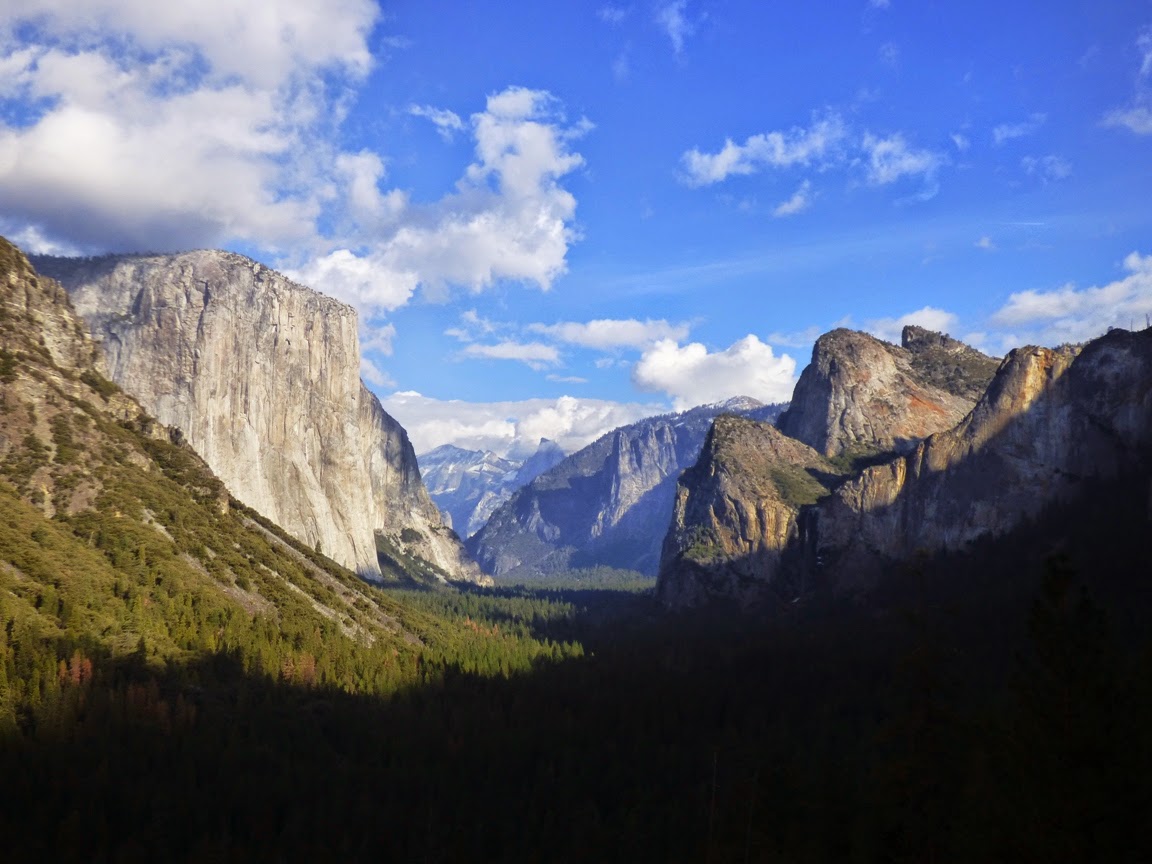
October is nominally an autumn month, a time of falling leaves and low-flowing rivers after a dry summer and above-average temperatures. In Yosemite Valley, the waterfalls are dry. It might not be the best time of year for drawing tourists to the valley, but it's a fine time for a field trip. Well, maybe...
It's a given that if one schedules a field trip and reserves a bus months in advance that the weather is going to be a wild card. And it was definitely wild. The weather forecasts all week pointed to a 100% chance of rain essentially all day, and as we left town, the rain was indeed falling. All the way up the hill, all the way into the valley. I gave lectures from the bus, watching water pour out of the sky. I had 30 students, some of whom were expecting to see Yosemite Valley for the first time in their lives. I was clenching my teeth, worried that we would arrive in the valley and the walls would be hidden behind the clouds. We arrived at Tunnel View, and I was slightly relieved to see that the cliffs were just barely distinguishable through the rain squalls (see the top picture). At least we could say that we saw something. We got back into the bus, to go make more stops in the rain. Then something wondrous happened.
I glanced behind me as I climbed into the bus and realized that the rain had stopped, and that the cliffs of Yosemite Valley were emerging from the storm. We got back out, and started enjoying the gift of a 90 minute break in the storm. The valley was a glorious sight for those few precious minutes. El Capitan, the 3,000 granite monolith, loomed high above us.
Fall colors were visible all across the valley; oaks, cottonwoods and dogwoods were all at their late season best. We here in California can't compete with the pageantry of the show in the eastern United States (or even the aspen groves of the eastern Sierra Nevada), but ours comes later, and the trees back east don't have a backdrop of stunning granite cliffs.
The most incredible moment of the day came as we realized that with the rain, every waterfall in the valley was flowing. And not just flowing, but surging. Waterfalls were coming from cliffs that never have waterfalls. It could have been spring of a wet year. There was a lot of water falling from the skies above Yosemite today.
Yosemite Falls were especially spectacular. I strolled past lower Yosemite Creek, and it was flooding.
The Merced River was surging as well. It was spilling over its banks, which was enough to get me on my phone to check the flows today. It was pretty impressive. Normal flow for this time of year is about 30 cubic feet per second. A week ago the river was running 100 cubic feet per second. With two big storms this week, the river has risen to over 3,000 cubic feet per second! In the last year, a fairly good year for precipitation, the flow of the Merced exceeded 3,000 cfs only a few times.
It was an impressive day, and a really blessing to have a break in the storm. After 90 minutes, the rain squalls returned, and followed us most of the way home.
Showing posts with label Tunnel View. Show all posts
Sunday, October 30, 2016
Thursday, May 14, 2015
Is This the Best View from a Tunnel Anywhere? And Other Slightly Unfamiliar Views of Yosemite (and Gratuitous Bear Cub)
I did something a little different this last weekend for Mother's Day. I found there was a single campsite available in Yosemite Valley on Sunday night, so we headed there for a little explore. I also did something just a little bit different at Tunnel View, and walked a bit into the tunnel to get the iconic view of Yosemite Valley framed by the arching granite of the tunnel entrance. Is there a tunnel exit anywhere in the world with a more incredible sight at the end? I'd love to hear any ideas.
I found out something about sound in tunnels. A car or truck can be a quarter mile away in the tunnel, but the sound of the engine is funneled and reflected to the point that it sounds like a jet plane right behind you. It was mildly terrifying.
In any case, we concentrated on visiting some of the spots I don't get to see when I take students there on a field excursion. Those spots include the Mariposa Grove of Sequoia Trees from the last post, Glacier Point, Washburn Point, and Mirror Lake. The picture above is the view of Yosemite Valley from the slopes of Turtleback Dome just west of the tunnel. I don't enter the valley from that direction as often, so the iconic rocks like Half Dome and El Capitan seem just a tad less familiar, and thus all the more spectacular.
Mirror Lake is a deep bend in Tenaya Creek that backs up during the spring runoff to flood the adjacent meadow and form a wonderful reflecting pond. The pond formed because of a huge prehistoric rockfall that blocked much of the canyon floor. It is probably the largest slide documented in Yosemite Valley. A number of rockfalls have occurred in historic time as well. In March 2009, the Ahwiyah Point rock fall left the white scars on the cliff in the picture above on the right. It involved 46,700 cubic meters of granitic rock. Fortunately the slide occurred early in the morning and no one was injured.
Cathedral Rocks are very famous and familiar from the west side where Bridalveil Falls spill over the cliffs. From the east, they are sometimes overlooked as the cliffs across the valley from El Capitan. In any other setting in the world, these rocks would be as iconic as El Capitan or Half Dome.
People who are on short trips miss out when they only visit the valley floor. An excursion to Glacier Point offers one of the greatest panoramas in the world, seeing the entire extent of Yosemite Valley from 3,000 feet above. The video below shows part of the sweeping view. But if you make the time to see Glacier Point, don't miss Washburn Point. It gives an entirely different perspective of "Half Dome". What works better? Four-fifths Dome? Three-quarters Dome?
As promised, here is the gratuitous bear cub. The bears are emerging from hibernation, and we saw a mother Black Bear and her cub above the highway near Chinquapin (the turnoff to Glacier Point). They were being good and doing bear things in the forest instead of breaking into cars in a campground. It's taken a few years, but most of the tourists have finally been trained to stop luring bears into the campgrounds, and the crafty old campground bears have died off or retired, and there aren't new mama bears teaching their cubs how to break in. In the late 1990s nearly a million dollars of damage was done by the bears, but in the most recent year the damage was only about $5,000. For the record, although the bears are incredibly strong and heavily armed (clawed), they have been very patient with humans. There has not been a single fatality in the Sierra Nevada that can be attributed to a Black Bear. We have unfortunately killed lots of them, mostly with traffic collisions. The extinct California Grizzly Bears were a different story.
Only a fraction of the Black Bears in Yosemite are actually black. They range from black to brown to blonde. If the cub above is looking a bit bedraggled, it is losing its winter coat. I may seem close from this view, but I was a good 200 feet away and across the road. A zoom lens is a wonderful thing in wildlife photography!
I found out something about sound in tunnels. A car or truck can be a quarter mile away in the tunnel, but the sound of the engine is funneled and reflected to the point that it sounds like a jet plane right behind you. It was mildly terrifying.
In any case, we concentrated on visiting some of the spots I don't get to see when I take students there on a field excursion. Those spots include the Mariposa Grove of Sequoia Trees from the last post, Glacier Point, Washburn Point, and Mirror Lake. The picture above is the view of Yosemite Valley from the slopes of Turtleback Dome just west of the tunnel. I don't enter the valley from that direction as often, so the iconic rocks like Half Dome and El Capitan seem just a tad less familiar, and thus all the more spectacular.
Mirror Lake is a deep bend in Tenaya Creek that backs up during the spring runoff to flood the adjacent meadow and form a wonderful reflecting pond. The pond formed because of a huge prehistoric rockfall that blocked much of the canyon floor. It is probably the largest slide documented in Yosemite Valley. A number of rockfalls have occurred in historic time as well. In March 2009, the Ahwiyah Point rock fall left the white scars on the cliff in the picture above on the right. It involved 46,700 cubic meters of granitic rock. Fortunately the slide occurred early in the morning and no one was injured.
Cathedral Rocks are very famous and familiar from the west side where Bridalveil Falls spill over the cliffs. From the east, they are sometimes overlooked as the cliffs across the valley from El Capitan. In any other setting in the world, these rocks would be as iconic as El Capitan or Half Dome.
As promised, here is the gratuitous bear cub. The bears are emerging from hibernation, and we saw a mother Black Bear and her cub above the highway near Chinquapin (the turnoff to Glacier Point). They were being good and doing bear things in the forest instead of breaking into cars in a campground. It's taken a few years, but most of the tourists have finally been trained to stop luring bears into the campgrounds, and the crafty old campground bears have died off or retired, and there aren't new mama bears teaching their cubs how to break in. In the late 1990s nearly a million dollars of damage was done by the bears, but in the most recent year the damage was only about $5,000. For the record, although the bears are incredibly strong and heavily armed (clawed), they have been very patient with humans. There has not been a single fatality in the Sierra Nevada that can be attributed to a Black Bear. We have unfortunately killed lots of them, mostly with traffic collisions. The extinct California Grizzly Bears were a different story.
Only a fraction of the Black Bears in Yosemite are actually black. They range from black to brown to blonde. If the cub above is looking a bit bedraggled, it is losing its winter coat. I may seem close from this view, but I was a good 200 feet away and across the road. A zoom lens is a wonderful thing in wildlife photography!
Wednesday, April 15, 2015
A Fleeting Spring in a Horrible Drought: A Day in Yosemite Valley
There are so many moments when I want to deny the reality of the California drought. It has been relentless, the winter air warm and dry, the soil crunching under my feet at a time when it should be muddy and covered with vegetation. Even though my backyard rain gauge says we've had a normal year for precipitation, the reality is that it almost all fell in December, and almost none fell as snow in the Sierra Nevada. The snowpack is 5% of normal. Five percent! It's still April, and the main pulse of snowmelt in the mountains has already taken place when it should be happening in May and June. The spring season is fleeting this year, and that's the background to my trip to Yosemite Valley last weekend.
It was incredibly beautiful up there as it always is, but there were signs of a stressed environment. The forest is showing large patches of dead and dying trees. Dry spring conditions mean the trees have less sap to fight off pine-borer beetles which are then able to kill the trees. The valley does in fact have too many trees, but I'd rather not see them die off this way.
There is still water in the waterfalls, but of course they should be booming and flooding, not merely falling. Visitors in the height of summer this year need to scale back some of their expectations. Yosemite without waterfalls is still an incredible place, but they shouldn't be dry by May.
I was able to get a unique view of the Cathedral Rocks from the middle of the Merced River. At this time of year I should have been drowning in the flood, not standing on a rock.
A very pretty sight for this time of year is the blooming of the Dogwood trees in the valley. The white "petals" aren't actually flowers, they are modified leaves. The actual flowers are at the center. I have to admit it's been awhile since I've seen such a colorful explosion of the flowers.
The Redbuds were mostly past their main blooming period, but there were still a few of them around.
The rocks are more or less eternal, though, at least from human standards. They could care less whether there is a drought or not. Some rocks will come tumbling down here and there, but in a thousand years, the valley walls will look pretty much the same. Below is North Dome from Curry Village.
The meadows are green, but are already showing a bit of brown in places. It's really been dry. Below is Stoneman Meadow, with Royal Arches, North Dome, and Washington Column behind.
The bridges of Yosemite Valley are beautiful human works of art. The placid Merced River flows under Stoneman Bridge with the bright green of newly awakened Cottonwood trees in the background. As pretty as it is, the river should be surging and flooding right now, not flowing gently.
And that's why I want to deny the reality of the horrific drought. I don't want the summer to come, I don't want the rivers to be dry, I don't want the forests dying from beetle kills or from apocalyptic wildfires. Changes are coming to this beautiful valley that I don't really want to contemplate. I want it to thrive. But we'll see. The walls of rock will always be there no matter what happens, standing like sentries over the plants, trees, and animals on the valley floor below. Including the only slightly furry ape-like creatures running around in bermuda shorts with cameras in hand.
It was incredibly beautiful up there as it always is, but there were signs of a stressed environment. The forest is showing large patches of dead and dying trees. Dry spring conditions mean the trees have less sap to fight off pine-borer beetles which are then able to kill the trees. The valley does in fact have too many trees, but I'd rather not see them die off this way.
![]() |
| Bridalveil Fall and the Leaning Tower |
I was able to get a unique view of the Cathedral Rocks from the middle of the Merced River. At this time of year I should have been drowning in the flood, not standing on a rock.
A very pretty sight for this time of year is the blooming of the Dogwood trees in the valley. The white "petals" aren't actually flowers, they are modified leaves. The actual flowers are at the center. I have to admit it's been awhile since I've seen such a colorful explosion of the flowers.
The Redbuds were mostly past their main blooming period, but there were still a few of them around.
The rocks are more or less eternal, though, at least from human standards. They could care less whether there is a drought or not. Some rocks will come tumbling down here and there, but in a thousand years, the valley walls will look pretty much the same. Below is North Dome from Curry Village.
The meadows are green, but are already showing a bit of brown in places. It's really been dry. Below is Stoneman Meadow, with Royal Arches, North Dome, and Washington Column behind.
The bridges of Yosemite Valley are beautiful human works of art. The placid Merced River flows under Stoneman Bridge with the bright green of newly awakened Cottonwood trees in the background. As pretty as it is, the river should be surging and flooding right now, not flowing gently.
And that's why I want to deny the reality of the horrific drought. I don't want the summer to come, I don't want the rivers to be dry, I don't want the forests dying from beetle kills or from apocalyptic wildfires. Changes are coming to this beautiful valley that I don't really want to contemplate. I want it to thrive. But we'll see. The walls of rock will always be there no matter what happens, standing like sentries over the plants, trees, and animals on the valley floor below. Including the only slightly furry ape-like creatures running around in bermuda shorts with cameras in hand.
Saturday, January 17, 2015
The Way it Was This Week: Winter in the Valley of the Ah-wah-nee
Is there a more beautiful place than this, the Ah-wah-nee, or the Yosemite as some chose to call it years ago? I'm sure that everyone who explores the outdoors has "that place", the spot that represents the highest attainment of their personal concept of beauty in nature. In my life so far, there is no place more beautiful than this.
It's a rarely fulfilled desire, the dream to have the most beautiful place in the world to myself. It's just a little selfish too, but hey, I wasn't keeping anyone else from visiting that day. Most seasons it is quite hard to imagine Yosemite Valley as a wilderness. It hasn't been a wilderness for nearly two centuries. But on Sunday, here and there, it was possible to envision the wildness.
After a long dry spell, Yosemite Falls began to flow again a few weeks ago after our December storms. I hope we will have some more storms soon. After a record-setting December, January has been dry. How dry? Zilch, not a drop of rain in the San Joaquin Valley, and none in the 10 day forecast. It is a bit worrisome. Three years of record-setting drought, and this year has the makings of a fourth.
We don't usually stop at the Swinging Bridge Picnic Area, as it is usually packed with people, but not Sunday. It offered wonderful views of Upper Yosemite Falls, and one of Yosemite's less familiar peaks, North Dome (above). I'm pretty sure that if Half Dome didn't exist, or Yosemite Falls, or El Capitan, or Sentinel Rock, or Cathedral Rocks, well then, I am sure that North Dome would be one of the most famous landmarks in Yosemite Valley.
Late in the day we found ourselves in the meadow below El Capitan looking for the free-climbers as they worked their way up the cliff. The few people who were still there were looking up so intently that it took a few moments for anyone to notice that a coyote was standing among us.
I took a moment to look at the oft-ignored cliff across from El Capitan, the wall of spires between Cathedral Rocks and Sentinel Rock. The names are less familiar to most park visitors, Crocker Point, Stanford Point, Taft Fissures, and again, in any other setting, these peaks and cliffs would be the focus of a national park, rather than the relatively unknown cliffs that they are. If the panorama shot below seems a bit less sharp, it's because it was done with my smart phone rather than my usual camera.
It was a beautiful day in a beautiful place. I'm anxious to return.
Where is your most beautiful place?
Sunday, November 2, 2014
The Way it Was Today: Fall (and a bit of Winter) in Yosemite Valley
It always comes back to Yosemite. I travel many places, explore many mountains, see the most incredible geology, but the circle of my life always involves a valley of granite in the Sierra Nevada. I was thinking about why this afternoon during a bit of free time while my students were on a project. I was walking from Yosemite Lodge to Happy Isles, a stroll of three miles or so, and I realized it was this: there are the memorable spots you will visit once or twice in a lifetime to be impressed by, and there are those special places that by circumstance you are allowed to return to time and time again. I live just a two hour drive from Yosemite National Park. I'm guessing I've been there at least 80 times in the last quarter century. I've explored it in every season of the year, in wet years and dry, recently burned and recently flooded. And every time there is something new.
Today I was walking across Cook Meadow near Sentinel Bridge when I heard someone pad up behind me on the boardwalk and then jump off into the meadow. I was about to tell them to stay off the meadow grass when I realized it wasn't a person, it was a coyote, and I was in its way. It trotted around me and back onto the boardwalk and into the forest. We were going the same way so I followed for awhile until it passed some fawns, a doe, and buck in the forest. They ignored me too
The fall colors were stunning (yes easterners, I know that word should only be reserved for New England and such places, but in California any bright colors impress). The Merced River was at the seasonal low point and the surface of the river was a mirror.
We had arrived literally on the heels of the first major storm of the year which overnight had dropped an inch or more of rain in the valley and a foot of snow in the high country. It was still drizzling and the clouds obscured the cliffs, so my attention was mostly on things close at hand.
It wasn't much, but the rain rejuvenated Yosemite Falls for the first time in many months. A trickle is barely visible in the picture above.
The Oaks and Dogwood trees added a splash of yellow, orange and pink to the scenery.
Cottonwood, birch and aspen were also turning.
The clouds started to lift and move on, revealing ghostly cliffs and stony ramparts up above. Sentinel Rock appeared first (above). Snow clung to every tree branch in the forest above.
Finally the skies started to clear over the monarch of the upper valley, Half Dome.
Closer at hand a Raven was watching for any dropped tidbits from the students who were waiting for the tram.
We stopped near Yosemite Falls to talk about hanging valleys, but Half Dome still captured most of the attention. It gains new depth when wreathed in clouds.
We had skipped Tunnel View at the beginning of the day because nothing would have been visible. The situation was different in the late afternoon. We headed up for a look, and it was nothing short of spectacular. I've got only a few (okay, many) hundreds of pictures from this spot and it is never the same. Today was special.
The last rays of the sun were vanishing as we left the valley for home.
And that's the way it was today in Yosemite, my special place. Come and see it when you can!
Labels:
Coyote,
deer fawns,
El Capitan,
Fall colors,
Half Dome,
raven,
Sentinel Rock,
Tunnel View,
Yosemite Valley
Saturday, April 3, 2010
The way it was today: Yosemite Valley
My field studies course took in Yosemite Valley and the Merced River today; we had about 18 students, at least four of whom had never been to Yosemite before. It was a beautiful day in a sense, but challenging for photography; it was overcast and gray, and all the colors were muted. Even worse, the contrast between land and sky was almost impossible to compensate for. I've had to either remove color entirely (black and white) or saturate the colors almost beyond the reality of the day. Our first stop was the famous tunnel view. The parking lot was nicely renovated, but the view is much as it always has been: spectacular! Half Dome was hidden in the clouds.
I calculated recently that I have been to Yosemite Valley at least sixty times in the last twenty years, yet I never tire of the place. When you have seen the iconic domes and cliffs and waterfalls this many times, you may find your eyes wandering from the familiar outlines, and looking for the unfamiliar; I was captured by the cloudy mist flowing down a section of the Rockslides, a slope ignored by most people at the Tunnel View.
There are cliffs at Yosemite Valley which seen in isolation would merit attention at any other place in the world, maybe gaining some special status as a park or monument. Here, these spectacular cliffs have a name, but I had to look it up: the right-hand cliff is Stanford Point.
Bridalveil Fall plummets 620 feet over a sheer cliff. This classic glacial hanging valley is famous enough to merit a crowded parking lot and trail, but I found myself drawn to the huge cliffs that surround it. The high tower in the background is one of the Cathedral Rocks.
The valley today was on the cusp of a spring eruption. Green shoots are just beginning to show in the meadows, but the winter snows still cling to the high country. The waterfalls are flowing, but nowhere near the discharges that will be here in early May. We've come through three tough drought years, but this year the precipitation was almost normal, aided in part by El Nino conditions in the Pacific Ocean. It won't be enough to fill the half-empty reservoirs but the soil water may be replenished enough that more trees will be able to resist when the pine beetles attack...
Subscribe to:
Posts (Atom)