Sunday, December 24, 2017

Happy Holidays from the Geotripper Gang.

Merry Christmas and Happy Holidays to all from the gang at Geotripper (that would be me and Mrs. Geotripper, and two cats)! As is our tradition, we offer up once again a very big Christmas tree, the General Grant Tree in Kings Canyon National Park. The tree is so large (268 feet high, 40 feet across at the base) that it took three pictures for me to capture it.

The tree was declared by Calvin Coolidge in 1926 to be the nation's Christmas Tree. At an early ceremony, park superintendent Colonel John White said ""We are gathered here around a tree that is worthy of representing the spirit of America on Christmas Day. That spirit is best expressed in the plain things of life, the love of the family circle, the simple life of the out-of-doors. The tree is a pillar that is a testimony that things of the spirit transcend those of the flesh."
I don't have a shot of the General Grant all dressed in snow, so here is another Sequoia after a surprise storm during an April trip some years ago.
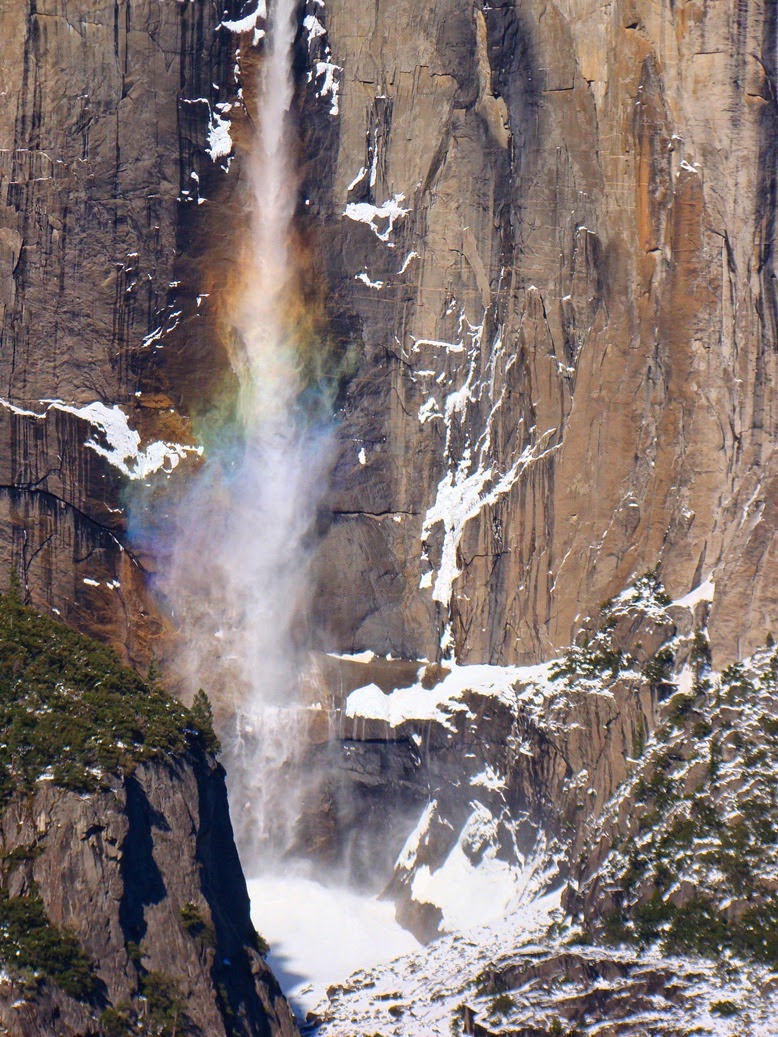
Upper Yosemite Falls with a rainbow
The Sierra Nevada, as exemplified by Kings Canyon and Yosemite Valley, is the kind of place we think of when we dream of a white Christmas. We try to get up there whenever we can at this time of year.
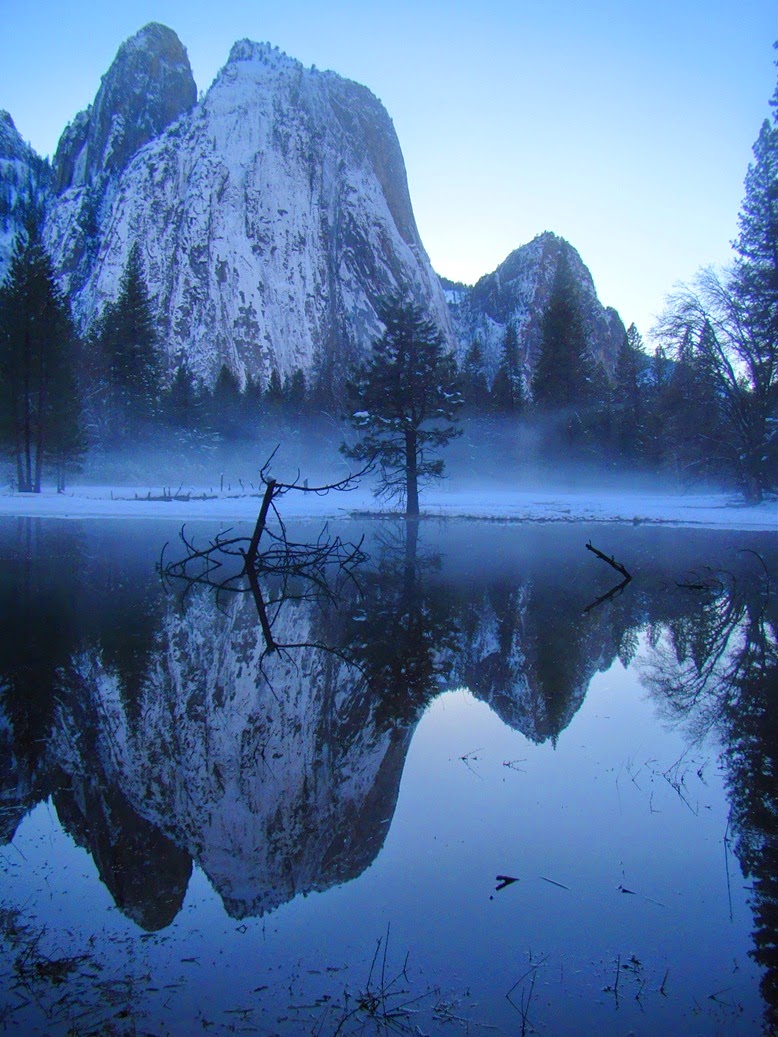
The Cathedral Rocks
Christmas season is a time of gifts, and year by year I think more of the gifts that come from somewhere besides a store. One of the most precious gifts in my life is that I am able to live near places like these, and that I have the health and ability to visit them often. In places like Kings Canyon and Yosemite, we have a precious gift of nature. There are places near you that are gifts as well. It might be another national park, or it could be a state park. It could simply be a river, or a spot of forest surrounded by a city. My wish for you is that you can discover and explore a new place in the coming year. And if it is threatened, I wish that you will have the resources to help protect it. I have a feeling that we will need to fight for many of our precious wild places in the coming years.
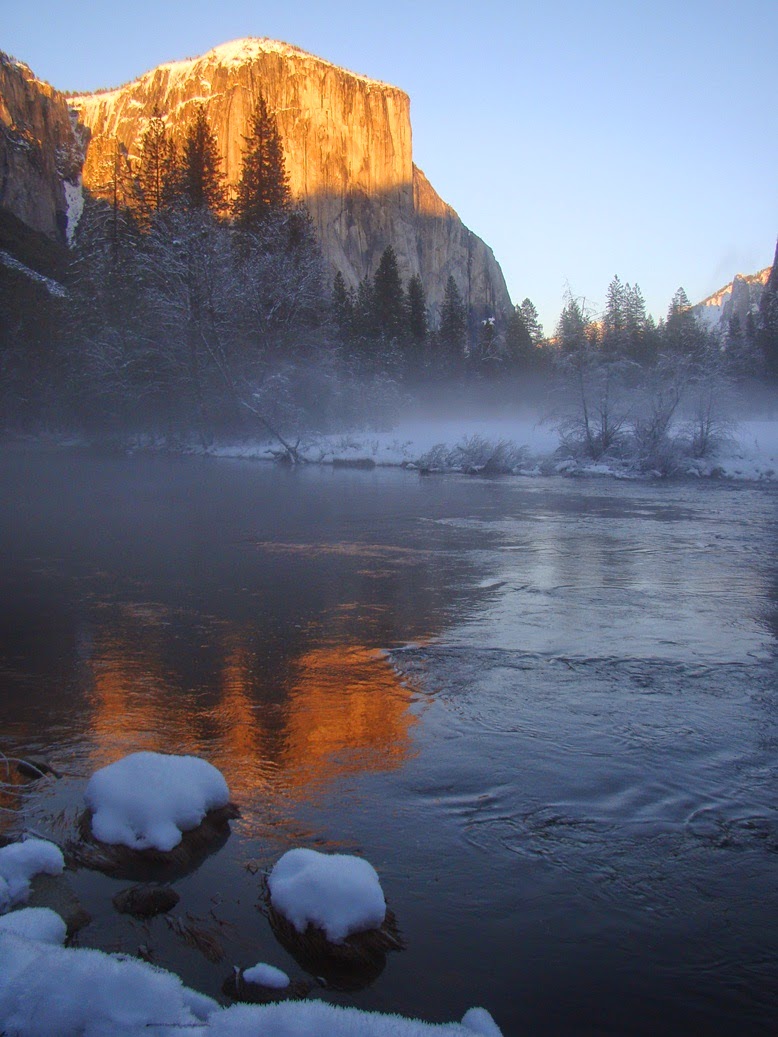
El Capitan
I want to thank all of my readers, new and old, for your attention and kind comments over the last ten years that I've been blogging (that's 1,970 posts now, not that anyone is counting). I've always enjoyed hearing from you, and appreciate getting to know new friends from all over the world. I wish a wondrous season to you all!
Although this is a repeat of my traditional Christmas message, I can't help but add a bit the beauty I've experienced this evening, my first white Christmas in many, many years. The snow began here in the Seattle region in the afternoon, and now late in the evening there are a few inches on the ground. I had to relearn my snow-driving skills in a hurry. My friends in snow country might not understand the thrill, but my California friends who never see the stuff up close will understand completely. Have a wonderful holiday season!


Friday, December 22, 2017

Travels in the Northern Hinterlands of California

The holiday season often means the special moments with family and decorations and Santa Claus, but when your family is spread out in a thin line running the entire length of the west coast of the United States, it also means some time on the road. We have had a long way to go in the past few days, but we stopped a few times and took in some of the extraordinary geography of California's isolated north coast.

Getting to the coast from our home in the Great Valley requires crossing the Coast Ranges first. Our preferred route is through the Clear Lake region. Clear Lake itself is a huge natural lake formed by lava flows and landslides that altered and blocked water course flowing into the Russian River. It covers 68 square miles, which makes it the largest natural lake entirely within California (Lake Tahoe is larger, but is partly in Nevada. The prominent peak on the lakeshore (above) is Mt. Konocti (4,721'), which is a potentially active volcano with eruptions as recent as 10,000 years ago. Hot springs and earthquakes attest to the continued existence of magma chambers in the region.
We reached the coast in the vicinity of Eureka and Arcata and headed north on Highway 101. We soon passed an incredible sight at Humboldt Lagoons State Park. The growth of hooked spits (long linear sand bars) has led to the formation of a series of baymouth bars which isolate the coastal estuaries from the open sea (there are no big rivers in the immediate area to flush out the sand. The bars are only a few hundred feet wide at most and one extends for three miles. There are a total of four lagoons.
The lagoons are a unique ecosystem. Because they are breached only on an irregular basis, salmon and other creatures have adapted in interesting ways. Young salmon migrate downstream to find their way to the sea blocked. They live in the lagoons for extra months or even years, gaining size that may enhance their chances of survival in the open sea. On the other hand, breeding salmon may have difficulty getting into the estuaries.
Soon we were deep into the Redwood forest. The Coast Redwood only grows along the coast of California and in a tiny part of southern Oregon. They are extraordinarily large with the giants reaching heights of nearly 400 feet. They are related to the Sequoias of the Sierra Nevada, and the Dawn Redwood of China (and ornamental landscapes). The Redwoods are the tallest, but the Sequoias have the greater bulk. The Redwoods make for excellent lumber, while the Sequoias do not. It was almost their undoing.
The Redwoods once existed as an unbroken forest from the Big Sur Coast to Oregon, topping out at some 2 million acres. More than 90% of the old-growth forests were cut down during the last century, and it was only through the foresight of the founders of Save the Redwoods and other organizations that old-growth groves were purchased and given over to the state of California for permanent protection from logging. As recognition grew of the need to preserve not just patches but entire ecosystems, Redwood National Park was established in 1968 and expanded in 1978. It protects an entire watershed (Redwood Creek) that has old-growth forests as well as second-growth tracts.
We didn't have very much time, but we stopped at Humboldt Redwoods State Park, and at the visitor center for Redwood National Park as we passed through. We hated to move on, but a storm was coming and our families were awaiting our arrival. One could spend weeks among these beautiful trees and the stunning coastline. Which we intend to do as soon as possible.

Sunday, December 17, 2017

Every Victory is Fragile, Every Loss is Catastrophic: The Ruins of Bear's Ears National Monument

House on Fire Ruin in Bear's Ears. I wasn't smart enough to catch the "fire" in the rocks at the time.
There are a lot of pictures in this post, and I hope you will enjoy them. They are the ones most precious to me, the product of two hikes into the heart of Bear's Ears National Monument in the years before it was established as a monument by President Obama in 2016.
National monuments are a bit different than national parks or national recreational areas. Parks (and recreational areas) are established by Congress. They may preserve vast scenic landscapes like Yosemite or Grand Canyon, or may be declared because of their potential for, well, recreation (examples are Golden Gate Park in San Francisco, Oregon Dunes, or Lake Powell).
The origin of national monuments is by presidential proclamation. Under the Antiquities Act of 1906, presidents can declare monuments of areas with archaeological, historical, or scientific value that are threatened with destruction through looting, mining, logging, or urban development (some monuments are as small as single houses in big cities). They are often controversial, because somebody was to profit off the exploitation of the resource in question, but they are always federal lands that are supposed to be administered to the benefit of all citizens, not the select few. They aren't "land grabs".
Controversial or not, many monuments are eventually transformed into national parks by Congress as the representatives come to realize the value of protecting a resource (or more cynically, how the surrounding towns benefit monetarily). This happened with Grand Canyon, Zion, Olympic, Arches, Death Valley, Joshua Tree, and quite a few others. It would be unthinkable today that someone would want to eliminate national parks from our country's heritage. And that is what is so disturbing about the present administration...they are trying to eliminate protections from a series of national monuments, and invariably it is for the purpose of mining (coal and uranium) or logging, or quite seriously, to make it easier to plunder archaeological sites and rob graves.
I am trying to imagine the protests that would arise if a Civil War battleground were to be eliminated from its status as a monument so that a housing development could be constructed (it's happened). Or digging up an English Castle ruin because coal beds were underneath. Or an ancient Hebrew temple ruin being bulldozed in Israel for a shopping center to be built. These kinds of historical sites are valued by the dominant culture or majority population, and it is easy to understand why people would be upset. What's less easy to understand is why it is so much easier for some to destroy the remains of ancestral Pueblo culture in the American Southwest. The lands at Bear's Ears are held sacred by not one, but five different tribal nations, and they have tried for decades to get this monument established. A great deal of planning and negotiation went into determining the boundaries. There are around 100,000 archaeological sites within the monument, and the vast majority have never been investigated or studied in detail (most should remain undisturbed).
I have only barely begun to explore the riches of the Bear's Ears, having walked through maybe half a dozen canyons that have been carved into the plateaus within the park. These pictures were taken in two forks of a single canyon at the north end of Cedar Mesa within Bear's Ears. A single canyon of perhaps a hundred or more canyons in the monument. And these are just some of the pictures. This land is a precious treasure of sacredness and knowledge of the past.
J.R.R. Tolkien said in the forward to his Lord of the Rings trilogy that he "disliked allegory in all its forms", and I've seen some clumsy ones over the years, but I was looking at the pictographs in the picture above, and noticed how parts of the figures have been destroyed, either by vandalism or eroson (I suspect the former). I couldn't help think that this is a metaphor for what Secretary Zinke and the president are doing to Bear's Ears as they carve it up to make it easier to mine uranium. So much history is lost when lands are not given the protection they preserve.
No, I didn't dig up this bit of what was probably a moccasin. It was already sitting out on a rock.
Cedar Mesa (which makes up a huge part of the southern part of the monument) is a plateau that rises out of the desert above Bluff and Mexican Hat. It is more of a semi-arid landscape that is covered today by a pinyon-juniper forest, and in the highest reaches, ponderosa pine. It is desolate and lonely, crossed by a single paved highway, with not a single development or habitation. A thousand years ago, it was home for thousands of Ancestral Puebloans (once called the Anasazi), and a visit at that time would have revealed thousands of acres under cultivation for maize and beans. It was one of the most important agricultural regions in the entire southwest. Remains of villages lie scattered across the plateau and in the gulches and valleys below. As I understand it, the area once supported a population much higher than the one that exists today.
Early on, and for most of the history of the region, people lived in the open on the plateau surface. Towards the end, just before the abandonment of the region, the situation had changed and people began to construct literal fortresses in the alcoves of the sandstone canyons. One ruin I saw was simply astounding. It was built flush with the wall of the canyon and was mostly invisible, aside from a single structure (above). A closer inspection revealed seven or eight rooms hidden behind a façade (on the right side).
Even more extraordinary was a granary or additional room about fifteen or twenty feet higher up the sheer cliff. It was completely inaccessible by any means that I could see. At best, I could guess that access was possible only by placing logs into the cliff to make steps, or a large ladder, but it would be a terrifying climb in any instance. One has to wonder what had changed to make these people so scared, and so defensive? There are all kinds of clues in the ruins and hints in the oral histories of the people in the region, but no definitive answers.

The interior walls are astounding as well. Soot from years fires covers the plaster they used to fill cracks in the rocks. After eight hundred years, one can still make out the fingerprints of those who came before (above). It is an incredibly intimate connection to the past.
Every victory is fragile, every loss is catastrophic. These ruins sat undisturbed for 600-700 years before Europeans moved into the region in the 1800s and started plundering. It was the destruction of ruins like these that caused the passage of the Antiquities Act in 1906, and Bear's Ears is one of the last regions that needs to be part of the monument system. I "assume that some of them are good people" (to paraphrase the current occupant of the White House), but some the people living in the area are part of the network of grave robbers and plunderers. There have been arrests, but for the most part these "thieves of time" (as Tony Hillerman so aptly put it) steal with impunity. They feel free to threaten the overextended federal officers who are trying to patrol the lands and protect them. Some have told me personally about having mummified bodies in their garages, or described the use of heavy equipment to tear down the walls of ruins or digging pits to get at artifacts. Without adequate protection, the loss to humanity will be incalculable.
In a sense, I am preaching to the choir. When Zinke allowed comments on his proposal to gut the monument, they ran 98% to 2% in favor of preserving the monument as is. Most of those who would take the time to read this are the people who also know the importance of preserving the past.
If you can, see these places before they fall to the vandals and grave-robbers. If you aren't able to see them, work towards their preservation from a distance. Support those who are involved in the lawsuits against the president's illegal actions. Make your voices heard...
...because those who plunder these lands can't hear the voices of those lived and died here for thousands of years. Nor will those in power listen to their descendants. We only have the times we are living in to do our part to preserve the stories and artifacts of this bygone past. In so many ways it is a gift to be able to play a part in doing the right thing.

Some of the parties to the lawsuits over the national monument reductions are included in the article found here. The clothing manufacturer Patagonia deserves credit as well. They have taken a very public stand in favor of the monuments (information here).

Wednesday, December 13, 2017

Fire in the Sky: The Perspective That Comes When Time is Running Out


It was nothing more than the evening commute to school to give a final examination in my Earth Science course. It was a bit after 4 PM and the sun was settling into the horizon, and the spectacle of it all caused me to pull to the side of the road. I have a habit of taking my camera with me everywhere, so I was able to snap a few pictures of the seemingly striped orb. It was also a moment of reflection.

It was a beautiful sight, but it was tinged with great sadness. The color is coming from the homes and dreams of a lot of people in Southern California who are battling a devastating wildfire that has consumed nearly 250,000 acres (that's nearly 400 square miles). At least 700 homes have been lost already. The flames, driven by a severe Santa Ana Wind event, produced volcano-like plumes of smoke and ash that flowed out to sea and then up the coast of Central and Northern California. There is a ridge of high pressure out there, parked over an exceedingly warm Pacific Ocean that is diverting the normal late fall and early winter rainstorms far to the north. There has been no precipitation in our area for weeks, and none in the long-range forecast. The fires in SoCal come on the heels of the even more devastating fires that swept through the wine country a few weeks back, destroying thousands of homes, and killing several dozen people. The drought and the attendant wildfire intensity is seemingly back after a brief one year respite.
Source: www.latimes.com/local/lanow/la-me-fire-ledeall-20171213-story.html

It's hard to convince skeptics of climate change if they are not living in the path of the worst effects. But the effects are extending to more and more people as the decades slip by. There were warnings of mega-droughts and longer fire seasons in the west and southwest years ago. There were predictions of hurricanes amped up by warmer ocean water. There were the obvious forecasts of sea-level rise that are now having a visible impact in coastal cities like Miami, Florida and Venice, Italy. And the glaciers and icecaps are continuing to melt away as they were decades ago, and at an accelerating pace. Unprecedented record-setting heatwaves are becoming distressingly commonplace. The evidence of global climate change is becoming ever more apparent to people around the world, and to their leaders as well, all of whom are signatories to the Paris Climate Accords. Every country, that is, except one. The United States of America.

Many people, probably most, don't consider science when they stand in the voting booth and make their choices. A distressing number of people end up never standing in the booth for one reason or another, but too often because of voter suppression activity. The rest are thinking about the "issues" like standing for national anthems (or kneeling), or building walls, or any one of dozens of temporary controversies (look up Willie Horton ads some day). Perhaps most think about misogyny, racism, taxes, or the economy. These things are important, of course, because these are issues of life, and quality of life. But few think about science, the environment, and the long term effects of what we are doing with the choices that we make. In the long run, these are some of the most important things that impact our lives. But our political representatives can only think in time frames of two, four, and six years, the length of their terms in office. We need to hold their feet to the fire (figuratively) to make choices that benefit us all long after their terms have ended.

Perhaps the most important game in town right now is education. It is only through education that people can make the right choices that will secure their future and the future of their children and their grandchildren. An educated populace is not going to be hoodwinked and cheated by charlatans and con-men running for public office. And education never stops in high school or college. It is a life-long skill, especially now when the entire breadth and depth of human knowledge can be accessed by the phone in your pocket. Take advantage of it.

The sun doesn't seem to move all that fast when it is high in the sky and hours are left in the day. But when the end of the day is near, and one has the perspective of the horizon, the darkness comes quickly. We are being given that "gift" (or warning, if you wish) of perspective concerning climate change. We've been given the predictions and projections from twenty and thirty years ago, with results that are sometimes off by a bit, but almost invariably worse than expected. I don't know when it is too late; it is different for different groups of people and different biomes and ecosystems. But we have been warned.

In any case, that's what I thought about while the sun sank below the horizon and the darkness set in.

Monday, December 11, 2017

Every Victory is Fragile, Every Loss is Catastrophic: Bear's Ears National Monument and the Valley of the Gods


Bear's Ears National Monument is a magical place. It is a place of mystery and vast vistas, a place of sacredness to many people. It is one of our country's most precious treasures. When President Obama accepted years of negotiation and work by "stakeholders" in the region and established the monument in 2016, I rejoiced. But I knew that the victory would be fleeting because of the election of rapacious vile people who only understand dollar signs. Bear's Ears National Monument is under an existential threat by Secretary of the Interior Zinke, Trump, and certain local officials. Trump recently exceeded his authority and tried to shrink the monument by 85%, and the matter is now in court. New documents suggest that Zinke used recommendations by Canadian uranium mining companies to redraw the boundaries, which just happened to remove monument protection from potential uranium ore-bearing formations. It is a "land grab" of breath-taking proportions, and not in a good way.
Monument Valley from the edge of Cedar Mesa at Muley Point
We need to know what we are losing, and so I've been doing a couple of posts on the monuments that are threatened by the robber barons who are threatening our most beautiful and sacred places. This is an abridged version of a post from February of 2014:

Pareidolia is a very human tendency to perceive faces and significant forms in unlikely places, like on oddly shaped potatoes and burnt tortillas. It is what allows us to see the "Man in the Moon". It's hardwired into our brains, and I wouldn't be surprised if it arose out of a need to recognize the eyes and faces of creatures that in a past era would have eaten us.

We journeyed to the region in 2013, and we were headed into one of the more isolated corners of the Colorado Plateau. After traveling through Monument Valley, we turned north into Mexican Hat, Utah, and headed up a gravel road into Valley of the Gods. This was new for me; in a quarter of a century, I somehow had never found the time to explore the 17 mile loop through a series of amphitheaters along the eastern margin of Cedar Mesa. It was a magical place, and in 2016 it was included within the boundaries of Bear's Ears National Monument. In 2017 it was removed from protection.

The Sitting Hen at Valley of the Gods, from the back

I find myself speculating about the connections between magic and science when I am in a place like Valley of the Gods. Science has given us a "creation myth" about how these rock pedestals formed.  The cliff-forming unit is the Cedar Mesa Sandstone, which formed in coastal dunes and beaches in Permian time perhaps 270 million years ago. The underlying ledge-forming rock is the Halgaito Shale, which formed in coastal deltas and shallow marine conditions somewhat earlier in the Permian Period. The spires formed from cliff retreat as the softer Halgaito rock undercut the sandstone cliffs (I described the process in an earlier post). Tricks and variations in the erosional process formed the hollows and shadows that give the pedestals their eyes and faces.
The Sitting Hen, or as I like to call it, the Rubber Ducky at Valley of the Gods.
So, who is to say that science has a better explanation for the origin of these features than others who see the shapes and ascribe their origin to gods or aliens or whatever? In ages past there was no technology to truly study the origin of these rocks, and no cultural experience with deltas, or river floodplains, or beaches. The people who observed these towers thousands of years ago were just as intelligent (if not more so) than people today, but they had no experience or written history that could record the appearance of rocks forming today in the environments listed above. So they described the rocks in a way that best explained what they saw within the limits of their technology. They saw people, animals, and monsters, and produced stories and adventures that explained how they could be turned to stone.
The Battleship, right out of Monopoly!

Does science deny the possibility of aliens carving these exquisite sculptures, or that gods turned miscreant humans into stone? Actually, science doesn't. It does in fact state that these other explanations could be true but that the probability is extremely low, based on the absolute paucity of supporting evidence. The scientific explanation is supported by extensive and overwhelming evidence. Scientists would acknowledge that the presently accepted explanation could be supplanted were new evidence were to emerge. Indeed they expect such changes in the fullness of time.

Compare this attitude to that of someone who has decided on an explanation, truly believes it, and chooses to ignore any contrary evidence. There is no growth, no increase in knowledge in such an person. Belief doesn't make it real, but evidence makes an explanation more likely.

Some might say that science removes the excitement and mystery of a good creation story. I would respectfully disagree. I would say that an understanding of geologic processes leads to more mystery and wonder. Consider the rocks; once one realizes that these rocks were part of a coastal complex, the question arises: where was the ocean and why was it in this place? Today the oceans are a thousand miles away. These rocks were eroded from a mountain range somewhere. Could we find where that mountain range was? Why did those mountains rise? What forces were acting on the crust to cause them to develop? What kinds of creatures lived on these floodplains and deltas? Where did they come from? What happened to them? As it turns out, the world was only a few million years from the worst extinction event ever to take place on planet Earth. Some 95% of all species on the planet vanished 252 million years ago. All these questions invite further study and further growth. Each effort to answer these questions adds to the body of human knowledge. It is a creation story that grows and changes with the addition of new data.

On the other hand, it's fun to play games with these fascinating forms of nature. What do you think they are?

I know this: they are beautiful to gaze upon, even if beauty is a subjective judgement. Did the humans who first saw these desert monuments see them as beautiful? Or were they simply part of a rugged harsh landscape that may or may not be hiding a resource that could extend human life in this tough land?
I definitely see a huge mechanical hand rising out of the ground.

We passed the base of Lady in a Bathtub (picture below) and drove back down to Mexican Hat for one last stop in civilization. We were headed onto Cedar Mesa, another special place that was protected under the monument status of Bear's Ears, and which illegally lost protection under the new directives from the administration.
The Lady in the Bathtub.

The loop road through Valley of the Gods is accessed from US 163 out of Mexican Hat, Utah, while the west entrance is on US 261 near the base of the Moki Dugway. There are no facilities along the loop, which is managed and maintained by the Bureau of Land Management. There is a small campsite at nearby Goosenecks of the San Juan State Park, but no water is available. If you go, bring a camera or sketchpad. Even if you never go, fight for the protection of these lands by contacting your representatives in Congress, and support the organizations who are suing the administration over its illegal actions.

Thursday, December 7, 2017

Every Victory is Fragile, Every Loss is Catastrophic: Grand Staircase-Escalante National Monument

There are times when I hate perspective. I really do. I came of age in the 1970s during that turbulent time when we as a society realized that we were poisoning ourselves to death, that our air was putrid, that our water was contaminated, and that our lands were not infinite. The Wilderness Act of 1964 was not yet a decade old, and new wilderness areas were being established.. A great battle was fought over the wilderness lands of Alaska, and at least in small ways, one came into the 1980s thinking there was some hope for the future.
The victories were in many ways illusory. Corporations that contributed to pollution of our air and water made changes, yes, and our air and water got cleaner. So much so that in many cases we came to take it for granted (don't ask Flint, Michigan about this). Wilderness areas were established, national monuments were declared, and one could look to a future where these lands would be permanently protected.
The problem with complacency is that often the opposition is not being equally complacent. The very moment a victory was achieved, when another little corner of the country was "saved", those who lost their potential to profit off of national resources began plotting ways to undermine the victories. They knew how to play the long game, so they paid their political bribes and bided their time.
So as I look back on the changes in the last forty years, I start to realize how much we have lost. The rise of population has caused cities to spread into formerly wild lands with horrifying efficiency. Species have been lost and threatened due to loss of habitat world-wide. Old-growth forests continue to be cut down (yes, we need wood, but it can be grown in a sustainable way). And a new threat manifested itself in the thermometers around the planet. Climate change and global warming threaten to overwhelm our ecosystems. So much of the planet's resources are strained to the breaking point. But I hold on to those few places that haven't been paved over, logged, or strip-mined. I find this little bit of hope in the wild places that are left.
And that is what is so depressing about the events in the past couple of weeks. In 1996, President Clinton used his prerogative under the Antiquities Act of 1906 to put a stop to a proposed coal strip-mine on the Kaiparowits Plateau in southern Utah. He established a national monument, Grand Staircase-Escalante, to protect the plateau as well as the spectacular drainage of the Escalante River, and the unique geologic feature called the Grand Staircase. It was controversial, yes, but it was also farsighted. As geologists and biologists began to assess the resources of the park, they discovered unique treasures. Paleontologists began discovering new dinosaur species as well as a host of other fossilized animals and plants. The uniqueness of this incredible landscape gained wider recognition, and tourists and adventurers tired of the crowds in the small confined parts of Zion and Bryce Canyon National Parks came to love the wide-open spaces of Grand Staircase-Escalante. The local towns and villages, initially disappointed at the apparent loss of jobs, began to see an uptick in their economies, and employment increased in the tourist trade.
But then catastrophic things happened, culminating in the election of the most environmentally ignorant man ever to hold public office in America. The coal companies, the uranium miners, and the oil drillers had been waiting for the chance to take over the public lands that they wanted for themselves, and they greased the palms of enough politicians to make sure that Donald Trump was convinced to try and rescind the establishment of the monument. There was a sham of an evaluation period that included public comments running 98 to 2 in favor of maintaining the boundaries of the monument. 98%! In a politically divided time, how many issues have the literally unanimous support of our citizens? But it wasn't enough. Interior Secretary Ryan Zinke said flat out that he would ignore the desires of the American people because the comments were part of a "well-organized campaign". Would it have helped if it wasn't organized?
The vultures in the Trump administration are insisting that they will split the monument into three much smaller units, and delete nearly half of the monument from any protection at all. By some incredible coincidence, the unprotected lands happen to be on the site of that prohibited coal mine, as well as uranium prospects, and potential oil drilling sites. Keep in mind that these sites were ignored and unutilized for a century before Clinton made his proclamation official. But on an even more fundamental level, what justification exists to give over precious public lands, under legal protection for twenty years, over to the profit for a handful of people? Here's a hint: there is none. These lands belong to all of us, and 98% of us say "no".

The attempt by Zinke and Trump to steal our lands, both here at Grand Staircase-Escalante and at Bear's Ears, as well as the other monuments scattered across the country, will be judged in a court of law. One of the lawsuits can be reviewed here. Congress needs to know that we want these lands protected, too. There is an effort to make these changes in the legislature, and that effort needs to fail.

I hope that you will have a chance to see and explore these lands before they are despoiled by economic parasites and vultures. Even more importantly, I hope that you will join the efforts to protect these lands. A good place to start is with any of the parties to the lawsuit listed above. They are included in the article found here. The clothing manufacturer Patagonia deserves credit as well. They have taken a very public stand in favor of the monuments (information here).

In the meantime, please enjoy these images of some of my explorations of the monument.