Showing posts with label cliff retreat. Show all posts

Monday, December 11, 2017

Every Victory is Fragile, Every Loss is Catastrophic: Bear's Ears National Monument and the Valley of the Gods


Bear's Ears National Monument is a magical place. It is a place of mystery and vast vistas, a place of sacredness to many people. It is one of our country's most precious treasures. When President Obama accepted years of negotiation and work by "stakeholders" in the region and established the monument in 2016, I rejoiced. But I knew that the victory would be fleeting because of the election of rapacious vile people who only understand dollar signs. Bear's Ears National Monument is under an existential threat by Secretary of the Interior Zinke, Trump, and certain local officials. Trump recently exceeded his authority and tried to shrink the monument by 85%, and the matter is now in court. New documents suggest that Zinke used recommendations by Canadian uranium mining companies to redraw the boundaries, which just happened to remove monument protection from potential uranium ore-bearing formations. It is a "land grab" of breath-taking proportions, and not in a good way.
Monument Valley from the edge of Cedar Mesa at Muley Point
We need to know what we are losing, and so I've been doing a couple of posts on the monuments that are threatened by the robber barons who are threatening our most beautiful and sacred places. This is an abridged version of a post from February of 2014:

Pareidolia is a very human tendency to perceive faces and significant forms in unlikely places, like on oddly shaped potatoes and burnt tortillas. It is what allows us to see the "Man in the Moon". It's hardwired into our brains, and I wouldn't be surprised if it arose out of a need to recognize the eyes and faces of creatures that in a past era would have eaten us.

We journeyed to the region in 2013, and we were headed into one of the more isolated corners of the Colorado Plateau. After traveling through Monument Valley, we turned north into Mexican Hat, Utah, and headed up a gravel road into Valley of the Gods. This was new for me; in a quarter of a century, I somehow had never found the time to explore the 17 mile loop through a series of amphitheaters along the eastern margin of Cedar Mesa. It was a magical place, and in 2016 it was included within the boundaries of Bear's Ears National Monument. In 2017 it was removed from protection.

The Sitting Hen at Valley of the Gods, from the back

I find myself speculating about the connections between magic and science when I am in a place like Valley of the Gods. Science has given us a "creation myth" about how these rock pedestals formed.  The cliff-forming unit is the Cedar Mesa Sandstone, which formed in coastal dunes and beaches in Permian time perhaps 270 million years ago. The underlying ledge-forming rock is the Halgaito Shale, which formed in coastal deltas and shallow marine conditions somewhat earlier in the Permian Period. The spires formed from cliff retreat as the softer Halgaito rock undercut the sandstone cliffs (I described the process in an earlier post). Tricks and variations in the erosional process formed the hollows and shadows that give the pedestals their eyes and faces.
The Sitting Hen, or as I like to call it, the Rubber Ducky at Valley of the Gods.
So, who is to say that science has a better explanation for the origin of these features than others who see the shapes and ascribe their origin to gods or aliens or whatever? In ages past there was no technology to truly study the origin of these rocks, and no cultural experience with deltas, or river floodplains, or beaches. The people who observed these towers thousands of years ago were just as intelligent (if not more so) than people today, but they had no experience or written history that could record the appearance of rocks forming today in the environments listed above. So they described the rocks in a way that best explained what they saw within the limits of their technology. They saw people, animals, and monsters, and produced stories and adventures that explained how they could be turned to stone.
The Battleship, right out of Monopoly!

Does science deny the possibility of aliens carving these exquisite sculptures, or that gods turned miscreant humans into stone? Actually, science doesn't. It does in fact state that these other explanations could be true but that the probability is extremely low, based on the absolute paucity of supporting evidence. The scientific explanation is supported by extensive and overwhelming evidence. Scientists would acknowledge that the presently accepted explanation could be supplanted were new evidence were to emerge. Indeed they expect such changes in the fullness of time.

Compare this attitude to that of someone who has decided on an explanation, truly believes it, and chooses to ignore any contrary evidence. There is no growth, no increase in knowledge in such an person. Belief doesn't make it real, but evidence makes an explanation more likely.

Some might say that science removes the excitement and mystery of a good creation story. I would respectfully disagree. I would say that an understanding of geologic processes leads to more mystery and wonder. Consider the rocks; once one realizes that these rocks were part of a coastal complex, the question arises: where was the ocean and why was it in this place? Today the oceans are a thousand miles away. These rocks were eroded from a mountain range somewhere. Could we find where that mountain range was? Why did those mountains rise? What forces were acting on the crust to cause them to develop? What kinds of creatures lived on these floodplains and deltas? Where did they come from? What happened to them? As it turns out, the world was only a few million years from the worst extinction event ever to take place on planet Earth. Some 95% of all species on the planet vanished 252 million years ago. All these questions invite further study and further growth. Each effort to answer these questions adds to the body of human knowledge. It is a creation story that grows and changes with the addition of new data.
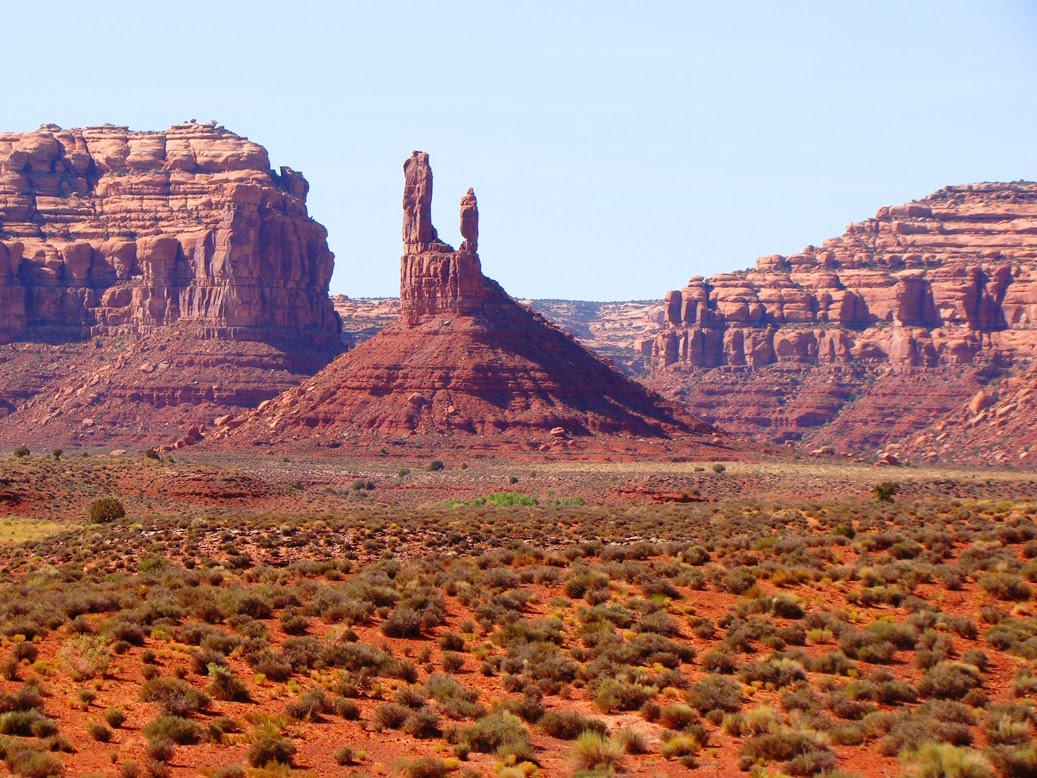
On the other hand, it's fun to play games with these fascinating forms of nature. What do you think they are?

I know this: they are beautiful to gaze upon, even if beauty is a subjective judgement. Did the humans who first saw these desert monuments see them as beautiful? Or were they simply part of a rugged harsh landscape that may or may not be hiding a resource that could extend human life in this tough land?
I definitely see a huge mechanical hand rising out of the ground.

We passed the base of Lady in a Bathtub (picture below) and drove back down to Mexican Hat for one last stop in civilization. We were headed onto Cedar Mesa, another special place that was protected under the monument status of Bear's Ears, and which illegally lost protection under the new directives from the administration.
The Lady in the Bathtub.

The loop road through Valley of the Gods is accessed from US 163 out of Mexican Hat, Utah, while the west entrance is on US 261 near the base of the Moki Dugway. There are no facilities along the loop, which is managed and maintained by the Bureau of Land Management. There is a small campsite at nearby Goosenecks of the San Juan State Park, but no water is available. If you go, bring a camera or sketchpad. Even if you never go, fight for the protection of these lands by contacting your representatives in Congress, and support the organizations who are suing the administration over its illegal actions.

Wednesday, February 12, 2014

Out in America's Never Never: Valley of the Gods, where pareidolia runs rampant

Pareidolia is a very human tendency to perceive faces and significant forms in unlikely places, like on oddly shaped potatoes and burnt tortillas. It is what allows us to see the "Man in the Moon", and what gives rise to names like Owl Rock (in our last post). It's hardwired into our brains, and I wouldn't be surprised if it arose out of a need to recognize the eyes and faces of creatures that in a past era would have eaten us.

Our journey through America's Never Never was in its sixth day, and we were headed into one of the more isolated corners of the Colorado Plateau. After traveling through Monument Valley, we turned north into Mexican Hat, Utah, and headed up a gravel road into Valley of the Gods. This was new for me; in a quarter of a century, I somehow had never found the time to explore the 17 mile loop through a series of amphitheaters along the eastern margin of Cedar Mesa. It was a magical place.

The Sitting Hen at Valley of the Gods, from the back

I find myself speculating about the connections between magic and science when I am in a place like Valley of the Gods. Science has given us a "creation myth" about how these rock pedestals formed.  The cliff-forming unit is the Cedar Mesa Sandstone, which formed in coastal dunes and beaches in Permian time perhaps 270 million years ago. The underlying ledge-forming rock is the Halgaito Shale, which formed in coastal deltas and shallow marine conditions somewhat earlier in the Permian Period. The spires formed from cliff retreat as the softer Halgaito rock undercut the sandstone cliffs (I described the process in the previous post). Tricks and variations in the erosional process formed the hollows and shadows that give the pedestals their eyes and faces.
The Sitting Hen, or as I like to call it, the Rubber Ducky at Valley of the Gods.
So, who is to say that science has a better explanation for the origin of these features than others who see the shapes and ascribe their origin to gods or aliens or whatever? In ages past there was no technology to truly study the origin of these rocks, and no cultural experience with deltas, or river floodplains, or beaches. The people who observed these towers thousands of years ago were just as intelligent (if not more so) than people today, but they had no experience or written history that could record the appearance of rocks forming today in the environments listed above. So they described the rocks in a way that best explained what they saw within the limits of their technology. They saw people, animals, and monsters, and produced stories and adventures that explained how they could be turned to stone.
The Battleship, right out of Monopoly!

Does science deny the possibility of aliens carving these exquisite sculptures, or that gods turned miscreant humans into stone? Actually, science doesn't. It does in fact state that these other explanations could be true but that the probability is extremely low, based on the absolute paucity of supporting evidence. The scientific explanation is supported by extensive and overwhelming evidence. Scientists would acknowledge that the presently accepted explanation could be supplanted were new evidence were to emerge. Indeed they expect such changes in the fullness of time.

Compare this attitude to that of someone who has decided on an explanation, truly believes it, and chooses to ignore any contrary evidence. There is no growth, no increase in knowledge in such an person. Belief doesn't make it real, but evidence makes an explanation more likely.

Some might say that science removes the excitement and mystery of a good creation story. I would respectfully disagree. I would say that an understanding of geologic processes leads to more mystery and wonder. Consider the rocks; once one realizes that these rocks were part of a coastal complex, the question arises: where was the ocean and why was it in this place? Today the oceans are a thousand miles away. These rocks were eroded from a mountain range somewhere. Could we find where that mountain range was? Why did those mountains rise? What forces were acting on the crust to cause them to develop? What kinds of creatures lived on these floodplains and deltas? Where did they come from? What happened to them? As it turns out, the world was only a few million years from the worst extinction event ever to take place on planet Earth. Some 95% of all species on the planet vanished 252 million years ago. All these questions invite further study and further growth. Each effort to answer these questions adds to the body of human knowledge. It is a creation story that grows and changes with the addition of new data.

On the other hand, it's fun to play games with these fascinating forms of nature. What do you think they are?

I know this: they are beautiful to gaze upon, even if beauty is a subjective judgement. Did the humans who first saw these desert monuments see them as beautiful? Or were they simply part of a rugged harsh landscape that may or may not be hiding a resource that could extend human life in this tough land?
I definitely see a huge mechanical hand rising out of the ground.

We passed the base of Lady in a Bathtub (picture below) and drove back down to Mexican Hat for one last stop in civilization. We were headed onto Cedar Mesa, one of my favorite places, and perhaps the spiritual center of my personal Universe. More as this blog series continues.
The Lady in the Bathtub.

The loop road through Valley of the Gods is accessed from US 163 out of Mexican Hat, Utah, while the west entrance is on US 261 near the base of the Moki Dugway. There are no facilities along the loop, which is managed and maintained by the Bureau of Land Management. There is a small campsite at nearby Goosenecks of the San Juan State Park, but no water is available. But bring a camera or sketchpad!

Sunday, February 9, 2014

Out in America's Never Never: A Tale of Two Towers (and a few more)

Agathla Peak north of Kayenta, Arizona
America's Never Never is full of strange and wonderful sights. We had left the forested Black Mesa and its rather depressing strip mines and headed east to the village of Kayenta on the Navajo Reservation, then turned north towards Utah. We had dropped several thousand feet and were traveling through a more barren landscape (the barrenness exacerbated by the ongoing drought).

Now, before I go much farther, I need to talk about childhood cartoons. I surely date myself severely when I note that my favorites were the Looney Tunes, especially Bugs Bunny, but there was a special place in my heart for Wile E. Coyote and that nefarious arrogant Roadrunner.  I had been to places like Joshua Tree National Park and the Mojave Desert, so I knew that no desert really looked at all like those cliffs and spires that Wile E. was always falling off of.

At least not until I reached the Navajo Country around Kayenta and Monument Valley. Suddenly I was standing not only in a Roadrunner cartoon, but John Wayne would be riding up any moment in a stagecoach. There really were towering spires in the desert!

I was pretty lucky in that my parents were the ones who originally introduced me to this country on our family vacations. I learned about these deserts in my childhood, but I was left with a lot of questions not readily answered. It wasn't until I became a geologist that I fully appreciated the processes and history that produced these incredible landscapes. And I've been bringing my students here ever since to show them that deserts aren't just cacti and sand dunes.
Agathla Peak just north of Kayenta
There are different kinds of "towers" in Navajo country produced by quite different processes. There is a great spot on Highway 163 about ten miles north of Kayenta to compare the two. To the east is Agathla Peak (or "El Capitan") standing some 1,300 feet over the highway (above). To the west stands Owl Rock (below).

Agathla is one of the more spectacular examples in the Navajo country of a volcanic neck or diatreme, the core of a deeply eroded volcano. Although the towering spire appears dark it is mostly composed of large chunks of sandstone that collapsed into the interior of the volcano after a violent explosive eruption. One can see dark dikes of basaltic-looking volcanic material; the rock is called minette, which is a relatively rare potassium-rich volcanic rock. The network of dikes protected the core of the volcano while the remainder was eroded away. The intrusion is just one of dozens covering an area of around 20,000 square kilometers around Four Corners called the Navajo Volcanic Field. Shiprock is perhaps the most familiar of these features.
Owl Rock, the tower on the other side of the highway,  is quite different. It is clearly layered, and the layers are horizontal. It is an erosional outlier of the same sequence of sandstone, siltstone and shale that can be found in many of the cliffs throughout the region. Sedimentary rocks are not known for producing towers and spires under "normal" conditions (read "characteristically humid conditions where most people live"). In the dry desert environment of the Colorado Plateau, resistant rocks such as lava flows or in this case quartz sandstone will form a protective cap that generally prevents the otherwise rapid erosion of the softer underlying sediments.

The tower is composed of Triassic and Jurassic-aged rocks of the Kayenta and Navajo Sandstone formations. Beneath the tower are the siltstone and clays of the Triassic Chinle Formation (or Group). The Chinle was laid down in floodplains and lakes in the earliest years of the dinosaurs. Distant volcanic eruptions (some near my own Sierra Nevada) laid down ash deposits that have oxidized into colorful red, brown, yellow, and lavender clay-rich strata. Some of the ash layers are famous for their petrified logs, most notably at Petrified Forest National Park in Arizona. We have seen logs in the vicinity of Agathla Peak and Owl Rock as well.
But what about the cliffs? How did they form?

The Navajo Sandstone is a solid rock but when it is stressed by regional deformation it tends to develop vertical fractures called joints. The Navajo may prevent the rapid erosion of the underlying shale layers, but the rocks do eventually get eaten away, undercutting the sandstone. The rock falls away along the joints in a process called cliff retreat. In this way a plateau shrinks to become a mesa, a mesa becomes a butte, and eventually only a spire remains.

It turns out that Owl Rock is simply a foreshadowing of the incredible sights ahead. As we passed into Utah we reached Monument Valley, a place where cliff retreat has produced a spectacular array of mesas, buttes and spires. The formations are different because we have crossed onto a deformed section of crust called the Monument Upwarp. We have reached rocks that are late Paleozoic in age (Permian), between around 250-300 million years.
At Monument Valley, the vertical sandstone cliffs are composed of the DeChelly Sandstone. A thin layer called the Shinarump Member of the Chinle Formation forms the top layer of many of the spires and buttes. The gentler slopes below the cliffs are the finer sediments of the Organ Rock Shale. The Permian Period was a time of reptiles, but not dinosaurs. The terrestrial environments were dominated by a group called the Therapsids, or "Mammal-like" Reptiles. These animals had a more vertical stance that distinguished them from the sprawling gait of other reptiles, and a number of other features that are mammalian in nature, including differentiated teeth. They gave rise to the mammals in Triassic time. The region has yielded up a number of specimens.

Monument Valley is a tribal park administered by the Navajo people. Many people (who don't know who John Wayne was) will know the place as the spot where Forrest Gump decided to stop running across America ("What are we supposed to do now?").

We had a lecture at the overlook and headed up the highway to a sight that was an absolute first for me, the Valley of the Gods. More on that in the next post!