Showing posts with label Antiquities Act. Show all posts

Sunday, December 17, 2017

Every Victory is Fragile, Every Loss is Catastrophic: The Ruins of Bear's Ears National Monument

House on Fire Ruin in Bear's Ears. I wasn't smart enough to catch the "fire" in the rocks at the time.
There are a lot of pictures in this post, and I hope you will enjoy them. They are the ones most precious to me, the product of two hikes into the heart of Bear's Ears National Monument in the years before it was established as a monument by President Obama in 2016.
National monuments are a bit different than national parks or national recreational areas. Parks (and recreational areas) are established by Congress. They may preserve vast scenic landscapes like Yosemite or Grand Canyon, or may be declared because of their potential for, well, recreation (examples are Golden Gate Park in San Francisco, Oregon Dunes, or Lake Powell).
The origin of national monuments is by presidential proclamation. Under the Antiquities Act of 1906, presidents can declare monuments of areas with archaeological, historical, or scientific value that are threatened with destruction through looting, mining, logging, or urban development (some monuments are as small as single houses in big cities). They are often controversial, because somebody was to profit off the exploitation of the resource in question, but they are always federal lands that are supposed to be administered to the benefit of all citizens, not the select few. They aren't "land grabs".
Controversial or not, many monuments are eventually transformed into national parks by Congress as the representatives come to realize the value of protecting a resource (or more cynically, how the surrounding towns benefit monetarily). This happened with Grand Canyon, Zion, Olympic, Arches, Death Valley, Joshua Tree, and quite a few others. It would be unthinkable today that someone would want to eliminate national parks from our country's heritage. And that is what is so disturbing about the present administration...they are trying to eliminate protections from a series of national monuments, and invariably it is for the purpose of mining (coal and uranium) or logging, or quite seriously, to make it easier to plunder archaeological sites and rob graves.
I am trying to imagine the protests that would arise if a Civil War battleground were to be eliminated from its status as a monument so that a housing development could be constructed (it's happened). Or digging up an English Castle ruin because coal beds were underneath. Or an ancient Hebrew temple ruin being bulldozed in Israel for a shopping center to be built. These kinds of historical sites are valued by the dominant culture or majority population, and it is easy to understand why people would be upset. What's less easy to understand is why it is so much easier for some to destroy the remains of ancestral Pueblo culture in the American Southwest. The lands at Bear's Ears are held sacred by not one, but five different tribal nations, and they have tried for decades to get this monument established. A great deal of planning and negotiation went into determining the boundaries. There are around 100,000 archaeological sites within the monument, and the vast majority have never been investigated or studied in detail (most should remain undisturbed).
I have only barely begun to explore the riches of the Bear's Ears, having walked through maybe half a dozen canyons that have been carved into the plateaus within the park. These pictures were taken in two forks of a single canyon at the north end of Cedar Mesa within Bear's Ears. A single canyon of perhaps a hundred or more canyons in the monument. And these are just some of the pictures. This land is a precious treasure of sacredness and knowledge of the past.
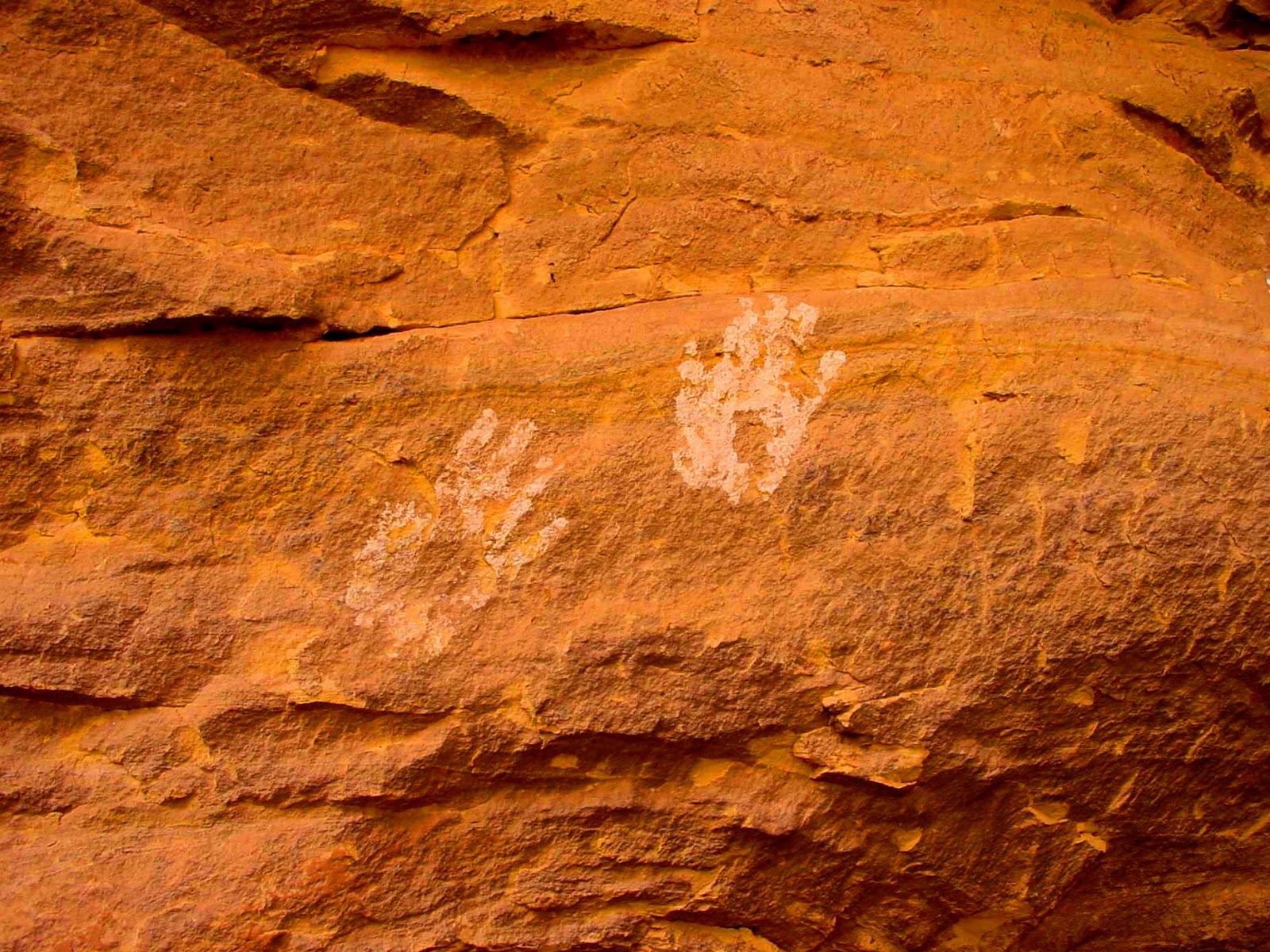
J.R.R. Tolkien said in the forward to his Lord of the Rings trilogy that he "disliked allegory in all its forms", and I've seen some clumsy ones over the years, but I was looking at the pictographs in the picture above, and noticed how parts of the figures have been destroyed, either by vandalism or eroson (I suspect the former). I couldn't help think that this is a metaphor for what Secretary Zinke and the president are doing to Bear's Ears as they carve it up to make it easier to mine uranium. So much history is lost when lands are not given the protection they preserve.
No, I didn't dig up this bit of what was probably a moccasin. It was already sitting out on a rock.
Cedar Mesa (which makes up a huge part of the southern part of the monument) is a plateau that rises out of the desert above Bluff and Mexican Hat. It is more of a semi-arid landscape that is covered today by a pinyon-juniper forest, and in the highest reaches, ponderosa pine. It is desolate and lonely, crossed by a single paved highway, with not a single development or habitation. A thousand years ago, it was home for thousands of Ancestral Puebloans (once called the Anasazi), and a visit at that time would have revealed thousands of acres under cultivation for maize and beans. It was one of the most important agricultural regions in the entire southwest. Remains of villages lie scattered across the plateau and in the gulches and valleys below. As I understand it, the area once supported a population much higher than the one that exists today.
Early on, and for most of the history of the region, people lived in the open on the plateau surface. Towards the end, just before the abandonment of the region, the situation had changed and people began to construct literal fortresses in the alcoves of the sandstone canyons. One ruin I saw was simply astounding. It was built flush with the wall of the canyon and was mostly invisible, aside from a single structure (above). A closer inspection revealed seven or eight rooms hidden behind a façade (on the right side).
Even more extraordinary was a granary or additional room about fifteen or twenty feet higher up the sheer cliff. It was completely inaccessible by any means that I could see. At best, I could guess that access was possible only by placing logs into the cliff to make steps, or a large ladder, but it would be a terrifying climb in any instance. One has to wonder what had changed to make these people so scared, and so defensive? There are all kinds of clues in the ruins and hints in the oral histories of the people in the region, but no definitive answers.

The interior walls are astounding as well. Soot from years fires covers the plaster they used to fill cracks in the rocks. After eight hundred years, one can still make out the fingerprints of those who came before (above). It is an incredibly intimate connection to the past.
Every victory is fragile, every loss is catastrophic. These ruins sat undisturbed for 600-700 years before Europeans moved into the region in the 1800s and started plundering. It was the destruction of ruins like these that caused the passage of the Antiquities Act in 1906, and Bear's Ears is one of the last regions that needs to be part of the monument system. I "assume that some of them are good people" (to paraphrase the current occupant of the White House), but some the people living in the area are part of the network of grave robbers and plunderers. There have been arrests, but for the most part these "thieves of time" (as Tony Hillerman so aptly put it) steal with impunity. They feel free to threaten the overextended federal officers who are trying to patrol the lands and protect them. Some have told me personally about having mummified bodies in their garages, or described the use of heavy equipment to tear down the walls of ruins or digging pits to get at artifacts. Without adequate protection, the loss to humanity will be incalculable.
In a sense, I am preaching to the choir. When Zinke allowed comments on his proposal to gut the monument, they ran 98% to 2% in favor of preserving the monument as is. Most of those who would take the time to read this are the people who also know the importance of preserving the past.
If you can, see these places before they fall to the vandals and grave-robbers. If you aren't able to see them, work towards their preservation from a distance. Support those who are involved in the lawsuits against the president's illegal actions. Make your voices heard...
...because those who plunder these lands can't hear the voices of those lived and died here for thousands of years. Nor will those in power listen to their descendants. We only have the times we are living in to do our part to preserve the stories and artifacts of this bygone past. In so many ways it is a gift to be able to play a part in doing the right thing.

Some of the parties to the lawsuits over the national monument reductions are included in the article found here. The clothing manufacturer Patagonia deserves credit as well. They have taken a very public stand in favor of the monuments (information here).

Thursday, December 7, 2017

Every Victory is Fragile, Every Loss is Catastrophic: Grand Staircase-Escalante National Monument

There are times when I hate perspective. I really do. I came of age in the 1970s during that turbulent time when we as a society realized that we were poisoning ourselves to death, that our air was putrid, that our water was contaminated, and that our lands were not infinite. The Wilderness Act of 1964 was not yet a decade old, and new wilderness areas were being established.. A great battle was fought over the wilderness lands of Alaska, and at least in small ways, one came into the 1980s thinking there was some hope for the future.
The victories were in many ways illusory. Corporations that contributed to pollution of our air and water made changes, yes, and our air and water got cleaner. So much so that in many cases we came to take it for granted (don't ask Flint, Michigan about this). Wilderness areas were established, national monuments were declared, and one could look to a future where these lands would be permanently protected.
The problem with complacency is that often the opposition is not being equally complacent. The very moment a victory was achieved, when another little corner of the country was "saved", those who lost their potential to profit off of national resources began plotting ways to undermine the victories. They knew how to play the long game, so they paid their political bribes and bided their time.
So as I look back on the changes in the last forty years, I start to realize how much we have lost. The rise of population has caused cities to spread into formerly wild lands with horrifying efficiency. Species have been lost and threatened due to loss of habitat world-wide. Old-growth forests continue to be cut down (yes, we need wood, but it can be grown in a sustainable way). And a new threat manifested itself in the thermometers around the planet. Climate change and global warming threaten to overwhelm our ecosystems. So much of the planet's resources are strained to the breaking point. But I hold on to those few places that haven't been paved over, logged, or strip-mined. I find this little bit of hope in the wild places that are left.
And that is what is so depressing about the events in the past couple of weeks. In 1996, President Clinton used his prerogative under the Antiquities Act of 1906 to put a stop to a proposed coal strip-mine on the Kaiparowits Plateau in southern Utah. He established a national monument, Grand Staircase-Escalante, to protect the plateau as well as the spectacular drainage of the Escalante River, and the unique geologic feature called the Grand Staircase. It was controversial, yes, but it was also farsighted. As geologists and biologists began to assess the resources of the park, they discovered unique treasures. Paleontologists began discovering new dinosaur species as well as a host of other fossilized animals and plants. The uniqueness of this incredible landscape gained wider recognition, and tourists and adventurers tired of the crowds in the small confined parts of Zion and Bryce Canyon National Parks came to love the wide-open spaces of Grand Staircase-Escalante. The local towns and villages, initially disappointed at the apparent loss of jobs, began to see an uptick in their economies, and employment increased in the tourist trade.
But then catastrophic things happened, culminating in the election of the most environmentally ignorant man ever to hold public office in America. The coal companies, the uranium miners, and the oil drillers had been waiting for the chance to take over the public lands that they wanted for themselves, and they greased the palms of enough politicians to make sure that Donald Trump was convinced to try and rescind the establishment of the monument. There was a sham of an evaluation period that included public comments running 98 to 2 in favor of maintaining the boundaries of the monument. 98%! In a politically divided time, how many issues have the literally unanimous support of our citizens? But it wasn't enough. Interior Secretary Ryan Zinke said flat out that he would ignore the desires of the American people because the comments were part of a "well-organized campaign". Would it have helped if it wasn't organized?
The vultures in the Trump administration are insisting that they will split the monument into three much smaller units, and delete nearly half of the monument from any protection at all. By some incredible coincidence, the unprotected lands happen to be on the site of that prohibited coal mine, as well as uranium prospects, and potential oil drilling sites. Keep in mind that these sites were ignored and unutilized for a century before Clinton made his proclamation official. But on an even more fundamental level, what justification exists to give over precious public lands, under legal protection for twenty years, over to the profit for a handful of people? Here's a hint: there is none. These lands belong to all of us, and 98% of us say "no".

The attempt by Zinke and Trump to steal our lands, both here at Grand Staircase-Escalante and at Bear's Ears, as well as the other monuments scattered across the country, will be judged in a court of law. One of the lawsuits can be reviewed here. Congress needs to know that we want these lands protected, too. There is an effort to make these changes in the legislature, and that effort needs to fail.

I hope that you will have a chance to see and explore these lands before they are despoiled by economic parasites and vultures. Even more importantly, I hope that you will join the efforts to protect these lands. A good place to start is with any of the parties to the lawsuit listed above. They are included in the article found here. The clothing manufacturer Patagonia deserves credit as well. They have taken a very public stand in favor of the monuments (information here).

In the meantime, please enjoy these images of some of my explorations of the monument.

Friday, October 27, 2017

Trump Demonstrates the Need for the Antiquities Act: Fighting for the Bear's Ears and Grand Staircase-Escalante


It's not complicated. It's called the Antiquities Act, and the law has but four sections, and no subsections. You can read it in its entirety below. It lays out the process by which the president of the United States can establish a national monument to protect endangered historic landmarks, historic and prehistoric structures, and other objects of historic or scientific interest that are situated upon the lands owned or controlled by the Government of the United States. The law was passed in 1906 because of the wholesale destruction of archaeological sites taking place across the western United States at that time.

American Antiquities Act of 1906 


Be it enacted by the Senate and House of Representatives of the United States of America in Congress assembled, That any person who shall appropriate, excavate, injure, or destroy any historic or prehistoric ruin or monument, or any object of antiquity, situated on lands owned or controlled by the Government of the United States, without the permission of the Secretary of the Department of the Government having jurisdiction over the lands on which said antiquities are situated, shall, upon conviction, be fined in a sum of not more than five hundred dollars or be imprisoned for a period of not more than ninety days, or shall suffer both fine and imprisonment, in the discretion of the court.

Sec. 2. That the President of the United States is hereby authorized, in his discretion, to declare by public proclamation historic landmarks, historic and prehistoric structures, and other objects of historic or scientific interest that are situated upon the lands owned or controlled by the Government of the United States to be national monuments, and may reserve as a part thereof parcels of land, the limits of which in all cases shall be confined to the smallest area compatible with proper care and management of the objects to be protected: Provided, That when such objects are situated upon a tract covered by a bona fide unperfected claim or held in private ownership, the tract, or so much thereof as may be necessary for the proper care and management of the object, may be relinquished to the Government, and the Secretary of the Interior is hereby authorized to accept the relinquishment of such tracts in behalf of the Government of the United States.

Sec. 3. That permits for the examination of ruins, the excavation of archaeological sites, and the gathering of objects of antiquity upon the lands under their respective jurisdictions may be granted by the Secretaries of the Interior, Agriculture, and War to institutions which the may deem properly qualified to conduct such examination, excavation, or gathering, subject to such rules and regulation as they may prescribe: Provided, That the examinations, excavations, and gatherings are undertaken for the benefit of reputable museums, universities, colleges, or other recognized scientific or educational institutions, with a view to increasing the knowledge of such objects, and that the gatherings shall be made for permanent preservation in public museums.

Sec. 4. That the Secretaries of the Departments aforesaid shall make and publish from time to time uniform rules and regulations for the purpose of carrying out the provisions of this Act. Approved, June 8, 1906 

It might be hard to believe, but there was a time when certain people thought the Grand Canyon was not worthy of preservation as a national park. There was a time when the protection of Zion Canyon was controversial. It was the same for Olympic National Park. Arches National Park. Death Valley National Park. Joshua Tree National Park. It may be hard to believe, but it took the actions of a president to save these crown jewels of our national park system from destruction by using the Antiquities Act. It sometimes took time for it to dawn on people that these lands were national treasures and worthy of protection. At a more mercenary level, it took time for some people to realize that more money could be made by protecting the land than could be made by consumptive uses like logging or mining. Eventually Congress named these monuments as national parks, and they are the most precious parts of the American landscape.
The history of the Antiquities Act has thus been controversial at times, but in the end, the monuments that have been established by presidents, both Democrat and Republican, have ultimately been recognized as important parts of our national heritage. These lands are the best of what our country has to offer. And that is what makes developments in the last few months so distressing. Our country has been hijacked by robber barons who think only in terms of personal profit from public lands at the expense of our citizens. Ground Zero lies in southern Utah and northern Arizona at Grand Staircase-Escalante National Monument, and Bear's Ears National Monument. We have a president who is illegally trying to undo the declarations of earlier presidents.
Grand Staircase-Escalante National Monument was established by President Bill Clinton in 1996, It was controversial because it was established in part to preclude strip-mining for coal on the Kaiparowits Plateau. The park protects 1.8 million acres of spectacular plateaus and slickrock canyons, and has come to be recognized as one of the most important paleontology parks in the nation. New dinosaur species continue to be discovered within lands protected by the monument. It seems ironic to me that towns and villages adjacent to the park have prospered because of tourism in this park. If they had built the coal mine, the coal itself would be giving out by now, and the towns would be in decline. Instead, as long as there is a monument these towns will do well. Given the issue of rampant overcrowding in nearby Zion National Park, Grand Staircase-Escalante provides a lot of wide-open space and recreational opportunities.
Bear's Ears National Monument is a special place. It had been proposed for decades, as it has the largest concentration of archaeological sites in the Four Corners region. Negotiations had gone on for years, and local tribes were unified in asking protection of the region, as were numerous environmental organizations. Grazing and certain other historical activities were to be allowed to continue. But greed won out and the negotiations faltered. President Barack Obama stepped in and established the monument, which was smaller than the most ambitious proposals, but which still included 1.4 million acres.
Cedar Mesa, the central feature in the southern part of the monument, was a critically important part of the "fertile crescent" that supported Ancestral Pueblo communities for more than a thousand years. Earlier cultures have lived in the region for thousands of years, and archaeological investigations have only scratched the surface of the stories to be told here. This land is sacred to the Native Americans who live in the region today, and many of their cultural activities take place in the monument.
Unfortunately, many of the present-day inhabitants of the region have no appreciation or respect for the cultural value of this region other than the price that they can get on the black market for pottery, fabrics, and other artifacts that they are stealing on an ongoing basis throughout the monument. The rangers of the Bureau of Land Management and Forest Service have been threatened with violence for doing their job of protecting these lands, and they are overextended. Trump and his Interior Secretary Zinke don't care that this is going on. They are now working to undo the work of decades of negotiation and compromise, and are trying to open these lands to even more exploitation and damage with their efforts this week. Most residents of Utah are in support of the monument, but they are being ignored by their own government.
I have a personal connection to the Bear's Ears. I have been bringing students into this region for thirty years, guiding them to understand the geology, archaeology, and natural history of this incredible region. All of these pictures were taken on these trips. Besides the cultural and archaeological value of this region, it is also a land of incredible vistas and spectacular scenery. With parks like Arches, Zion and Grand Canyon bursting at the seams with visitors, we need more protected lands, not less.
The president's actions are clearly illegal, and I hope that anyone who loves this country will oppose him in this terrible venture. I cannot accept that this land will be given back to the pothunters and grave robbers. The local people who argue that these lands should be given over to the state because they and their ancestors have lived there for a whole century rarely note the irony of their attitude. The local people whose ancestors lived here for thousands of years want this land protected.

Even more, I hope that more people from other parts of the world will visit, explore, and make their own personal discoveries. People who love a land will fight to protect it from exploitation. If these issues concern you, please consider contacting your own representatives in Congress, and if they don't listen to you, consider working hard to replace them in coming elections. Government officials in Utah should also be hearing from us. They need to know that losing tourism dollars may hurt more than any short-term profits to be gained by destroying the monuments.
Yes, I'm angrier than usual tonight. These lands that I love more than almost any other are under attack, and I fear that greed and money will win out over what is right and good. Trump and Zinke are proving the wisdom of the Antiquities Act, as they the exploiters the act was meant to stop.

Friday, May 20, 2011

Taking Granite for Granted? Quick, Name a National Park in California!

Quick, name a national park in California...

Which ones appeared first in your mind? Yosemite? Sequoia? Maybe Death Valley? There are a few others, depending where you live, so Channel Islands, Redwood, or Lassen Volcanic might have been a first response. But who among you thought first of Joshua Tree National Park?

As a native-born and bred Southern California, I am guilty of ignoring the treasure that existed in my backyard. National monuments often get short shrift as part of our nation's national park system, and I am not totally sure why. Many people don't even know the difference, but somehow assume that monuments are somehow a second-tier series of parks, places that are almost as good as national parks, but not quite. Under law, national monuments are the equivalent of national parks, but monuments are declared by Presidents under the terms of the National Antiquities Act, and national parks can only be established by Congress. What this has meant in practice is that Congress has often been reticent about establishing national parks, given the many pressures exerted by special interest groups and lobbyists. Presidents, acting as a representative of all the people in the country, have recognized the national value and significance of these sites, and have declared them to be national monuments to provide protection of the resource.

Often, when a national monument has been in existence for a few years or decades, Congress finally comes around and establishes the monument as a national park. This is true even for some of our most iconic parks; both Grand Canyon and Zion were first declared national monuments before Congress acted in 1919 to make them national parks. There are numerous other examples.

So, why am I talking about national monuments? Joshua Tree is a national park. It turns out, though, that Joshua Tree followed a similar arc of many other park areas around the country. It was established as a national monument by FDR in the 1930s, and still was a monument when I was growing up in SoCal in the 60s and 70s. And I was guilty of thinking of monuments as second-class parks. When I dreamed of traveling, my heart was up in the Sierra Nevada somewhere, and I really didn't get to know Joshua Tree all that well, my trips being mostly confined to a handful of scout camping trips. I remembered a lot of big boulders, joshua trees, and vicious jumping cholla.

Joshua Tree achieved status as a national park in 1994, along with Death Valley, another longtime national monument. And I was by then living elsewhere. These last few years I have been working to rediscover some of these places of my youth that I took for granted. So I made a trip out there last week to check things out and found out that I was also taking the park for granite, too.

What did I learn? The first thing was an eye-popper...having thought the park was made entirely of granitic boulders, I didn't know about the rich variety of other rocks found there, and how they relate to each other. The picture above is one of the starkest examples. Click on it and enjoy a unique panorama; you are looking at a scene from miles within the crust of the earth. This is the roof of a granitic magma chamber, where it was intruding into the surrounding older rocks. Yosemite is famous for its exposures of granitic rock, but you can't see stuff like this in the Sierra. Once I saw this exposure, I knew we were in for an interesting day! More to follow...