Saturday, November 15, 2014

Why did the San Andreas Fault Cross the Road? Why did the Road Cross the San Andreas Fault? 12 Years of Geologic Change

2002
First off, I've been leading geology field studies trips to lots of places in the American West for 26 years. Second, I entered the digital age of photography in 2001, which led to a personal renaissance in picture-taking. I sometimes struggle to find new things to photograph when I visit a place for the 26th time, but in some cases it is not a problem. There are geologic changes that happen on a yearly basis, and with twelve years of photos, the changes become obvious.
2004
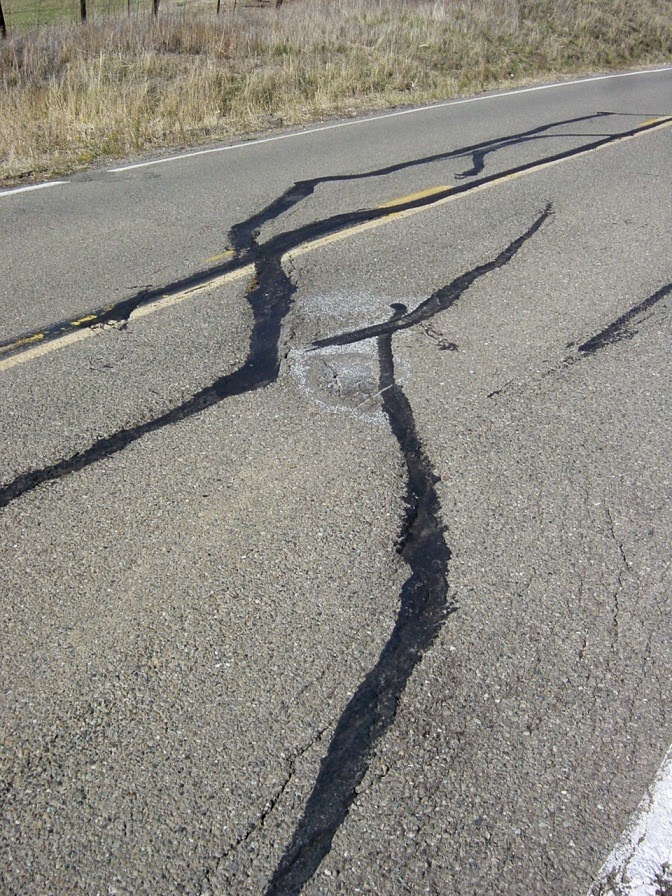
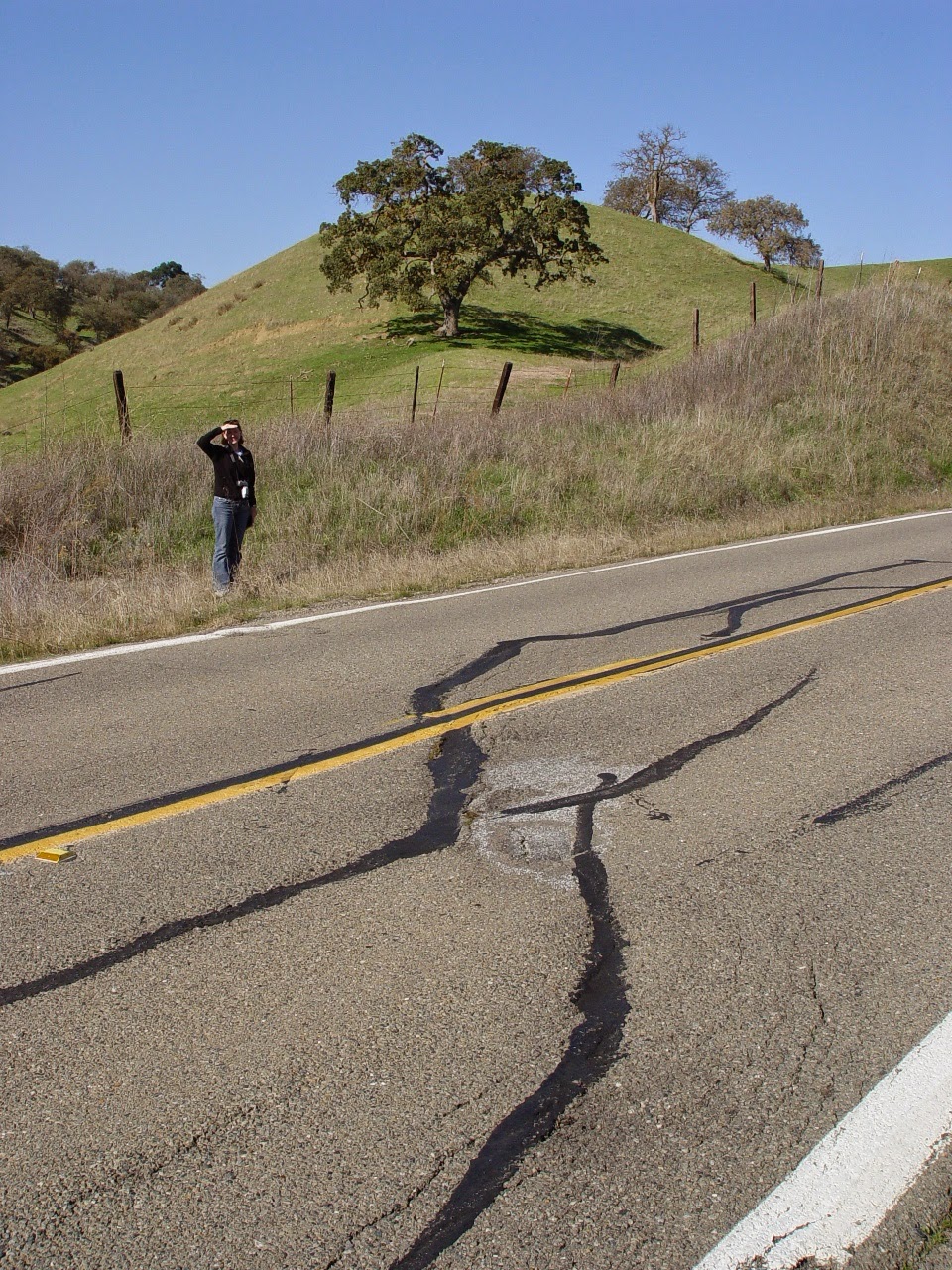
Highway 25 in the California Coast Ranges connects the town of Hollister with the access road to Pinnacles National Park (formerly Pinnacles National Monument). Along the way the highway crosses the San Andreas fault in a section where the fault creeps an inch or two each year. Most years we've stopped to have a look at the effect the movement has on the pavement. In 2002 and 2004, the damage was obvious.
2008
By 2008 someone had patched the road, and no fault motion was evident.
2009
Little damage was evident in 2009 either. But by 2010 en echelon cracks had begun to appear as the fault stressed the pavement. And the rubber marks for the hard brake in 2009 had almost faded. I'm guessing another geologist saw the fault and hit the brakes. I did the first time I saw it!
2010
The fact that the fault creeps in this region is a good thing. It means that stress is not building along the fault surface, but instead is being released gradually. The sections of the fault to the north and south of the creeping section are locked by friction, and are building up the ominous stress that will eventually produce quakes with magnitudes in the range of 7.5 to 8.0. The quakes are coming and we need to be as prepared as possible.
2012
By 2012, the road had been completely repaved, and  yet the shearing was already evident.
2013
It became even more pronounced by 2013, and then we passed the fault today. The break was obvious. Just by chance, the person working as a scale was the same individual as in 2004. I've got some great people who volunteer and make these trips possible
2014

These changes that happen at a rate visible in human lifetimes add up to huge changes when multiplied by thousands or millions of years. The nearby eroded volcano of Pinnacles National Park has been displaced 195 miles (315 kilometers) in the last 20 million years or so by movement along the San Andreas.

Friday, November 14, 2014

"Science" Doesn't Have to be Craptacular

Source: http://www.esa.int/Our_Activities/Space_Science/Rosetta/J_marks_the_spot_for_Rosetta_s_lander
I get so depressed sometimes...

We live in the most spectacular of times, and in so many ways humans have accomplished incredible feats, with explorations out to the voids of space and into the micro-world of atoms, quarks, and strings. What happened this week? Humans built a machine, threw it into space and let it drift for ten years through intense radiation fields, turned it on, and orbited a comet. They let loose a lander that, despite glitches (like bouncing a kilometer or more), landed and conducted observations and experiments.
Source: http://www.nasa.gov/mission_pages/cassini/main/#.VGb0Wsm9aSo

We've landed on other planets. We've put telescopes into space that act like time machines, looking back to the early years of the existence of the Universe. We are about to place machines in orbit around Pluto, and around the largest asteroid (2015 is going to be a good year). The Cassini has been orbiting Saturn for years, taking incredible images, like those of the sun reflecting off the seas of Titan. And Jupiter and Mars before that. We've been back to Mercury.
Source: http://www.nasa.gov/jpl/cassini-sees-sunny-seas-on-titan/

We are learning more about the Cosmos, the Earth, life, and ourselves than has ever been known. Every field of science is a continuing adventure, each week an odyssey of discovery. New dinosaurs, cures for diseases, new insights to the nature of matter itself.

And then there is my own community, continually on the lists of the worst places to live in the country, with the least educated population, the worst air, and the worst unemployment rate. Is there a more hopeless situation? And yet...we voted to build for ourselves what may be the finest science teaching facility on any community college campus in the state. A planetarium, an observatory, a hugely expanded science museum, and state of the art laboratories. It is something to be proud of, and our community knows it.
Telescope night on the roof of the Science Community Center

Our community knows what they have. Our telescope nights, our planetarium shows, our science lectures, our tours, they are all well attended, sometimes sold out, sometimes standing room only. I was at a telescope viewing and planetarium show tonight, feeling proud of the community I'm living in.

So why depressed? It's this: in the most exciting times of history, when the greatest discoveries of the human adventure are being made, popular media, the best possibility of educating the people who live on the planet, is a visual sewer. The Discovery Channel, the Learning Channel, the History Channel, and others keep putting up tripe of the worst kind, material that reaches for the lowest common denominator: ghost-hunting, paranormal, sasquatch-hunting, hollow-earth documentaries, and now megalodon-hunting. And they work. An uneducated public, apparently incapable of critical thinking, swallows the bait hook, line and sinker. The Discover Channel ran their fake documentary and convinced nearly three quarters of their audience that a creature that went extinct millions of years ago was still living in the seas today.
Source: http://www.businessinsider.com/majority-of-discovery-channel-viewers-believe-megaldon-exists-2013-8
This tirade is all over the place, I know. That's why I am a blogger and not a journalist with editors, deadlines, and overseers. It's just that these three themes seemed to dominate my attention the last few days, the idea that there is some incredible science exploration being done, that the regular people of our community hunger for scientific knowledge of their world, and that popular media is failing miserably to communicate the fascinating and spectacular things that are happening, and instead is chasing ratings by putting up, well, stupid dimwitted programing.

We have gigantic challenges ahead of us. The climate, affected by global warming, is changing our world in ways that no humans have ever experienced. We are using up critical resources and not finding new ones. We continue to pollute our air and water, and politicians seem hell-bent these days on making things worse ("burn more coal!"). Our hope lies in knowledge, and in an informed and engaged populace who will put pressure on those in power to make things work.

Ignorance can be defeated. Popular media like the Discovery Channel have it in their power to help, and not make things worse.

Tirade over. I wrote fast and angry, and will probably have to fix parts of it, but that's what is nice about blogging. I make my own rules! I'd love to hear your take on the quality of science programming in the popular media today, and what could be done about it.

If These Cliffs Could Talk: Tis-sa-ack and Tu-tok-a-nu-la (A Geologic Love Story)

Tis-sa-ack (Half Dome) from near Yosemite Falls

A love story...

Unnumbered snows have come and gone since The Great Spirit led a band of his favorite children into the mountains, and bade them rest in this beautiful Valley of Ah-wah-nee. They were weary and footsore, and were glad to rest after their long journey. Here they found food in abundance. The streams held swarms of fish, meadows were knee-deep in sweet clover, great herds of deer roamed the forests in the Valley, and on the high mountains, oak trees were bending under the weight of their acorns, grass seeds and wild fruits and berries grew in bountiful profusion. Here they stayed and built their villages. They were happy, and multiplied, and prospered and became a great nation.

North Dome, Washington Column, and Half Dome in the clouds

How many stories begin in paradise?

I find the myths of different cultures to be fascinating. They provided their people with an explanation of the unexplainable, a comforting story that suggests there is order in the apparent chaos of the universe. In the perspective of geology, we can sometimes see the whispers of eyewitnesses to significant geologic events: the eruption of Mt. Mazama, for instance, which resulted in the formation of Crater Lake, is described in Native American oral histories. In this post we see one of the legends of Yosemite Valley, with all the embellishments and cultural biases of a 1922 narrative. Still, it's a good story

To their chief came a little son to gladden his heart. They wanted this son to become a great chief, capable of the leadership of a great people. He was made to sleep in the robes of the skins of the beaver and the coyote, that he might grow wise in building and keen of scent. As he grew older he was fed the meat of the fish, that he might become a strong swimmer, and the flesh of the deer, that he might be light and swift of foot. He was made to eat the eggs of the great crane, that he might be keen of sight. He was wrapped in the skin of the monarch of the forest, the grizzly bear, that he might grow up fearless and strong in combat. 


So many stories come with the hero, and the most interesting stories have heroes with flaws...they had everything. But then things happen. The world and the people who live in it are not perfect. And frankly, life would not be interesting.

And, when he grew to manhood, he was a great chief and beloved of all the people. His people prepared for him a lofty throne on the crown of the great rock which guards The Gateway of the Valley, and he was called Tu-tok-a-nu-la, after the great cranes that lived in the meadow near the top. The people of Ah-wah-nee were happy, for Tu-tok-a-nu-la was a wise and a good ruler. From his high rocky throne he kept watch over the Valley and the people whom he loved. He called on The Great Spirit who sent timely rains, so that the acorns grew in abundance, the hunters returned from the forests with game, and the fishermen from the streams with fish. There was peace and plenty throughout the Valley of Ah-wah-nee, and when Tu-tok-a-nu-la held speech with his people from his high throne his voice was deep and strong like the deep sound of the waterfall.

Tis-sa-ack from Sentinel Bridge

But paradise can't last forever. Trouble was coming, or more to the point, the trouble lay hidden in the heart of the hero, and it was about to be made manifest. There were no doubt all kinds of communications between the many Native American bands in California, and the trading of knowledge and technology. I'm sure this led to problems at times as well.

One day as Tu-tok-a-nu-la sat gazing into the glowing colors of the west, he saw approaching his valley a strange people, led by a maiden of wondrous loveliness. He called to them and the maiden answered him, saying, "It is I, Tis-sa-ack. We have come from the land of my people in the far south to visit with you. We have heard of the great and good chief, Tu-tok-a-nu-la, of his great people and his wonderful valley. We bring presents of baskets and beads and skins. After we have rested we will return to my people in the far south." Tu-tok-a-nu-la welcomed the fair visitor from the land to the
south and had prepared for her and her people a home on the summit of the great dome at the eastern end of the Valley. There she stayed and taught the women of Ah-wah-nee the arts of her people. Tu-tok-a-nu-la visited her often in her mountain home. He was charmed by her wonderful beauty and sweetness, and begged her to stay and become his wife, but she denied him, saying: "No, I must soon return with my people to their home in the far south." And, when Tu-tok-a-nu-la grew importunate in his wooing, she left her home in the night and was never seen again.
 
To-ko-ya (North Dome), Nangas (Washington Column) and Tis-sa-ack (Half Dome) from Glacier Point. The Ahwiyah Point rockfall scar is visible just right of center below Half Dome.

The perfect women, the Helen of Troy, the Eve. Of course, perfection is a tricky concept, subject to many biases and assumptions. It doesn't much take into account the actual relationship between those involved. As Mr. Spock mentioned in a famous episode of Star Trek: "After a time, you may find that having is not so pleasing a thing after all as wanting". Bad things are about to happen.

I admit, I've never heard the word importunate before. 

When the great chief knew that she was gone, a terrible loneliness and sorrow came to him, and he wandered away through the forests in search of her, forgetting his people in Ah-wah-nee. So strong was his love for her, and so deep his sorrow, that he forgot to call upon The Great Spirit to send the timely rains. So great was his neglect that the streams grew smaller and smaller and finally became dry. The crops failed. The hunters came back from the forests without meat, and the fishermen returned from the streams empty-handed. The leaves and the green acorns fell from the trees, and the bright flowers and green grasses became dry and brown.

From Washburn Point it is obvious that Half Dome isn't just a boring name, it is a mathematically wrong name. Three-Quarter Dome, maybe. I would just go with Tis-sa-ack

This is where the geologist in me starts paying attention. California has droughts, and there is evidence of mega-droughts that lasted more than a century. Check out this post for some of the striking evidence. These droughts both occurred within the last 2,000 years, recently enough to be remembered in the oral histories of a people.

And then things get interesting in a hurry...

The Great Spirit became very angry with Tu-tok-a-nu-la. The earth trembled with his wrath so that the rocks fell down into the Valley from the surrounding cliffs. The sky and the mountains belched forth smoke and flame. The great dome that had been the home of Tis-sa-ack, was rent asunder and half of it fell into the Valley. The melting snows from the high mountains came down into the Valley in a flood and drowned hundreds of the people. But the wrath of The Great Spirit was quickly spent, and the heavens again grew quiet. The floods receded, the sun shone, and once more peace and calm reigned over Ah-wah-nee. The life-giving moisture from the renewed streams crept into the parched soil. The oak trees put on new leaves and acorns. The grasses again became fresh and green, the flowers lifted their drooping heads and took on their old gay colors. The fish came back to the streams, and the game to the forests.

Wow.

"The earth trembled...so that the rocks fell down into the Valley from the surrounding cliffs". Earthquakes have rocked California for a lot longer than humans have been around, and no doubt played an important part in causing mass wasting within the valley. John Muir experienced the 1872 Lone Pine earthquake while in Yosemite Valley (magnitude 7.8 or higher) and witnessed the collapse of a cliff. I've witnessed a few small rockfalls that I will never forget. Imagine the impact of a really large quake and the accompanying rock falls on the collective memory of a people.

"The sky and mountains belched forth smoke and flame". Yosemite lies just west of the Long Valley Caldera and the Mono Craters, and eruptions have occurred there as recently as a few hundred years ago. Imagine the impact of a fair-sized eruption over the mountains on a people who maybe had never witnessed such a thing, or only heard about it in legends.

"The melting snows from the high mountains came down into the Valley in a flood and drowned hundreds of the people." It's not hard to imagine the impact of a Pineapple Express (an atmospheric river storm) falling onto a thick snowpack in the mountains above Yosemite Valley. Such an event took place in 1997 (be sure to check out the video). Much of the valley floor was covered by as much as 6-8 feet of water, and the event was devastating to the human developments in Yosemite Valley.


Ironically, the natural environment was far less devastated. The ecosystem of Yosemite evolved in an environment of occasional huge floods, and life sprang back quickly.

And, when the Valley was once again clothed in beauty and plenty, there appeared on the rent face of the dome which had been her home, the beautiful face of Tis-sa-ack, where it can still be seen to this day. And the dome was named Tis-sa-ack, in memory of the fair visitor who had been loved by all the people of Ah-wah-nee. At the same time, that all might hold his memory in their hearts, there appeared on the face of the great rock supporting his throne, the majestic figure of the great chief, dressed in a flowing robe and pointing a finger to where he had gone, to El-o-win, the happy land beyond the setting sun.

And thus we have the story of how Half Dome, Washington Column, and North Dome came to be. I am struck by how lifeless these names actually are, and I wish we could see their names changed to reflect the very interesting stories of their origins.


We have stories too of the formation of how these rocks came to be. They involve the formation of granitic magma deep in the hellish regions of the Earth's crust, the intrusion and cooling of the granite, the uplift and erosion of the rocks by rivers and glaciers, and the shaping of the rocks by the working of jointing, exfoliation, ice, and mass wasting. It's a good story, based on careful observations, but the ancient legends? They were based on careful observations as well. The Native Americans maybe didn't have the technology we have today, but they did a pretty good job of describing the phenomena, and designing models to explain their observations. 
 
This version of the Half Dome story is from The Lore and the Lure of The Yosemite by Herbert Earl Wilson, published in 1922. Another legend of Half Dome involves an argument between a husband and wife, with thrown baskets and other unpleasantness. I like the story above better!

Tuesday, November 11, 2014

If These Cliffs Could Talk: A Sentinel People Sometimes Miss in Yosemite

If you saw this picture out of context, perhaps in the opening frames of an adventure movie, you might think of this cliff as being an otherworldly precipice full of allure and mystery. Maybe dragons perch on its summit, maybe buried treasure lies in a cave at its base. It's an incredible rock tower.

To back up and look at this cloud filled world from a distance takes away none of the mystery. Here is a spectacularly deep gorge with dark forested slopes and vertical rock cliffs. What kind of place is this? Who's been keeping it such a secret? Shouldn't it be a national park or something?

Well, actually it is, and upwards of four million people look at this cliff tower every year. They just don't quite see it as it gets lost in the multitudes of other more iconic cliffs like Half Dome, El Capitan, and Cathedral Rocks. Half Dome would be in the picture above were it not for the clouds.

We are looking at Sentinel Rock, and it is the hard-to-see tower in the dead center of the picture below. Can you see how easy it is to lose it in the grandeur of the cliffs that surround it on all sides? I was taking advantage of the cloud cover to get a photo from Tunnel View that highlights the cliff.
How could you miss it? It's in the dead center of the photograph! (May 2014)
Sentinel Rock is composed of the Sentinel Granodiorite, which was intruded about 95 million years ago, making it one of the younger intrusive rocks exposed in Yosemite Valley.It is a gray colored rock composed mostly of plagioclase feldspar with lesser amounts of orthoclase feldspar and quartz. The black specks in the rock are biotite mica and hornblende.
As pointed out in the previous posts of this short series on the cliffs of Yosemite Valley, joints are vertical or nearly vertical fractures that can result from stresses on the rock at shallow depths in the crust. Rocks like the Half Dome granodiorite and El Capitan granite are sparsely jointed and stand as bold cliffs that stand out from the valley walls. The Sentinel granodiorite is somewhat more jointed, so it stands more as a tower than a large cliff. It is surrounded by spires and fissures, including the Taft Fissures that can be accessed by trail above the rim of the valley.

Sentinel Rock soars 3,000 feet above the valley floor with an elevation of 7,038 ft (2,165 m). It is a popular climbing challenge. No trails reach the summit, but the Four-Mile Trail to Glacier Point winds across the slopes below. There is a separate peak called Sentinel Dome behind the rim above Sentinel Rock that is a popular hiking destination.
Sentinel stands out in the boldest relief when viewed from Cook Meadow where most everyone stares at Yosemite Falls directly across the canyon. If you are ever lucky enough to visit Yosemite and are standing in awe below the falls, don't forget to look behind you!
There are several other pullouts on the valley loop road that offer good viewpoints, especially with the Merced River in the foreground. If you've been up the Four-Mile Trail or the trail to Yosemite Falls, I'd love to see some of your pictures! I hate to say it, but I've been halfway up the falls trail, snapping pictures right and left, but I didn't get a single shot of Sentinel. Half Dome, yes. Yosemite Falls, upper, middle and lower, yes, selfies, yes, but no Sentinel. It hides in plain sight.
A wonderful rock!

Monday, November 10, 2014

To Explore a Wild Cave: The Underground Wilderness of the Sierra Nevada

There is a treasure in the Mother Lode of California's Sierra Nevada. It lies hidden beneath the surface, but it's not gold. It is a wilderness, but has no beautiful trees or distant vistas. It is dark and sometimes can be a bit creepy, but it is a place of incredible beauty as well. It is a network of caverns, hundreds of them. A half-dozen are tourist destinations, with lighting, pathways, and guided tours. The rest lie hidden, protected from vandals and abuse only by their secrecy.
I had the pleasant opportunity of introducing some of my students to the Sierra Nevada Underground today, exploring a pair of small caves in the Mother Lode on the slopes above the Stanislaus River. Many of the caves in the Sierra are dangerous, with steep drop-offs, impossibly tight passageways, and even bad air at times. Every cave, like any wilderness, can be dangerous, but the caves we were exploring were less intimidating than most. Falls were possible in these caves, but they would be on the order of six feet instead of forty feet, or a hundred. We headed for the hills above Columbia, stopping in the historical town for a few moments to enjoy the fall colors (and to use the facilities).
A nearly empty New Melones Reservoir and the gray marble of the Calaveras Complex.
We crossed the Stanislaus River and the frighteningly empty New Melones Reservior. The marble, a part of a metamorphic terrane called the Calaveras Complex (late Paleozoic-early Mesozoic), could be seen as gray slopes in the distance upstream. There are over a thousand caverns in the Sierra Nevada, and dozens of them are in the slopes above the Stanislaus River. Many incredible caves were drowned by the waters of the reservoir. Others open out into sheer cliffs above. Few are easily accessible, and many of these have been heavily damaged by vandals and ignorant visitors.
Oak woodland in the vicinity of the caves
That's what makes these caves special. They are at the end of a pretty stiff hike, but they have accessibility, and are relatively undamaged (this concept is relative; some would call them heavily damaged, but many parts are in good shape). One of them is relatively small, but has some good places to practice crawling, and has enough passageways to give a sense of exploring.
Signing the cave register
Most of the caves in the Sierra are monitored by the local speleological society, and they contain a register so visitation levels can be estimated. A party had been in these caves a week previous, but it had been several months since any earlier visits.
The features and "decorations" of caves are called speleothems. The familiar stalactites, stalagmites, and columns are called dripstone speleothems. As the name suggests, these form when calcium carbonate rich water drips from fractures in the ceiling of the cave. A little bit of calcite precipitates out as the water evaporates.

Other speleothems are called flowstone features. These are cave decorations that develop as water flows out the walls of a cavern. These might include draperies, shields, or rimstone pools.
We finished our spelunking practice at the small cave, and moved on towards the larger, more challenging cave. Accessing the cave required first descending between huge fallen boulders. The cave had grown so large that portions of the roof had collapsed to form sinkholes. We found a spot with good footholds and climbed into the darkness.
The second challenge was getting into the main cave via a narrow passageway at the base of the rockfall. One has to push upwards and twist through the tight little space. Some of the students described it as being "born again". Not everyone gets through, but we had a stubborn crew, and they all successfully negotiated the passage.
The entrance merges into a more open room that serves as the "subway" into the largest room in the cave. This passage is where most of the cavern damage has occurred. It's not clear whether this is the work of vandals, or more likely, the breaking of the formations to forge an easier passage into the room beyond. This kind of thing happened to many caves discovered in older days (I don't know the history of these particular caverns though).
I was still helping students get through the entrance when I heard the others exclaiming in delight at the first view of the big room. There is a rather stunning collection of stalactites hanging from the ceiling, the majority of which are unbroken.
The big room is almost 100 feet long and 30-40 feet wide. It is richly decorated with all kinds of dripstone and flowstone features. Some are brown from torches of the early explorers, or from mud seeping through the cracks above. Other features show evidence of recovery from the "dirty early years". The adoption of clean caving techniques in the last few decades shows as some of the cave features are covered with a thin layer of pure white calcite. Some of the caves are being cleaned by volunteers as well. In some cases, people haul gallons of water down difficult trails, set up hoses into the caves, and then spray mud off of damaged speleothems.
There are all kinds of nooks and crannies to explore. There is a false floor in the cave that offers a loop crawl. There is a small passageway called the bedroom and another called the jail room. Openings high on the walls and ceiling hint at other passageways.
What about cave life? We saw spiders near the entrance, and an unusual looking snail. In previous trips we have seen six inch long centipedes, and Ensatina salamanders. There have been a couple of bats. The total darkness of caverns offers little in the way of food, so the biomass quantity of the cave is very low. The creatures that do exist are highly adapted to environment of the caves.
An Ensatina Salamander from a trip to the cave in 2003.

The wilderness caverns of the Sierra Nevada are a precious and irreplaceable resource. The breaking of any speleothem destroys the result of thousands, even tens of thousands of years of slow development. They can never be replaced in any kind of human lifetime. A major part of our preparation for this trip was instruction in the ways of clean caving, conducting ourselves in such a way as to protect the cave to the greatest extent possible (the simple act of exploring has effects).
It was a rare privilege to be able to explore this underground wilderness, and it was a privilege for me to introduce my students to this strange new world. We finished up and started to climb back into the entrance chamber.
I lingered for a few minutes after the others had left. I wanted to hear the silence and just feel the pulse of the cave. A cave is such a strange and alien world for a human being, at least the deeper parts away from the light. No wonder that some of our first art was scrawled on cavern walls as sort of drug-free hallucination of alternate worlds. Caves were portals to lower worlds, or were the avenues for emergence into our current world. Sitting in the darkness, I felt a connection to my ancestors.
And then I looked up, over my head. Oh crap, I'm in a dark cave alone with gigantic spikes just waiting for an earthquake to drop them on me! I quietly excused myself and caught up with the rest of the crew (of course, given the number of earthquakes here over the course of geologic time, the likelihood of these things falling is nil).

We climbed out of the cave and headed back up the long hill. It had been a great day in the Sierra Underground. You have no doubt noted that I have not provided the names of the caves we explored. If you want to get involved in cave exploration, you should contact your local grotto of the National Speleological Society. They provide instruction and training, as well as chances to clean and rehabilitate caves that have been damaged by vandals and overuse. They are great people. And don't forget, the tourist caves in the Mother Lode are wonderful. They are safe and easy to explore. Check them out!
Saturday, November 8, 2014

A Different Canada Goose, the Cackling Kind: Evolution on the Continent

Isolation brings about evolutionary change, and the Canada Goose clan has been doing some changing over the last few thousand years, especially in Hawaii, but also here in California. Today's blog is cross-posted from my new birding blog, Geotripper's California Birds.
If you've ever been accosted by a Canada Goose at the local park, pictures like these might give you the shivers. If one of them can deliver a nasty bite, just imagine what a few thousand of them can do. But take heart, these scenes are no nightmare. They aren't even Canada Geese. The birds occupying this field in the San Joaquin National Wildlife Refuge west of Modesto are Aleutian Cackling Geese (Branta hutchinsii). It's true, though, that before 2005 they were Canada Geese. Allow me to explain.
The Canada Goose lives in many environments, and in some cases particular flocks broke away and colonized different islands or territories (see yesterday's post for an extreme example). The presence or lack of food sources or differences in the nature of predators favored certain traits (size and behavior, for instance) in the young. The geese who summered on the Aleutian Islands were long recognized as a smaller subspecies of the Canada Goose, but recent DNA analysis has led researchers to consider these birds an entirely different species. And so these birds are not Canada Geese, they are the much smaller Aleutian Cackling Geese, which are genetically distinct from the Canada Goose.
The Cackling Geese winter by the tens of thousands in the wildlife refuge a few miles west of my home. It is a stunning sight to see so many of the birds in one place. From the observation deck on Beckwith Road, one can see and hear thousands of birds taking off and landing, and in general making a racket (cackling, as it were). They have been encouraged to stay here instead of nearby agricultural fields through the planting of corn and other food plants. In April they will pick up and leave, headed north to breed in the Arctic.
The refuge is also home to thousands of lesser Sandhill Cranes. We could just make out a flock of them in the far distance. Snow Geese also winter in the area. There were five of them among the thousands of Cackling Geese yesterday, looking mildly confused. They usually arrive in large numbers in late November or early December.
"George, are you SURE this is the right place? Shouldn't you have asked directions in Oregon?"
As we were standing and watching the flocks there was a tremendous BOOM, and thousands of the geese immediately took flight. A huge dust plume over to the west revealed where the explosion had come from. And why.

It was a huge net. Several dozen of the birds had been trapped and for the next few minutes we could see Fish and Wildlife employees tagging them.

As usual, the picture quality from YouTube sucks (the compression process I suppose), but you can get a sense of the cacophony of sound from the flying geese from the short video below.