Showing posts with label Science Community Center. Show all posts

Monday, March 13, 2017

New Exhibit at the Great Valley Museum: Homo Naledi and MJC's Dr. Debi Bolter

If you've read my blog for any amount of time, you know that I work in a wonderful Science Community Center, which has a the marvelous Great Valley Museum (the GVM) taking up most of the bottom floor. The museum has existed for more than thirty years, but spent most of that time in a cramped 1930's vintage house. It had been a dream for decades that the museum could grow into a larger facility, but it wasn't until about three years ago that it finally happened.

The museum is equipped with a world-class planetarium, a Science on a Sphere, a live animal exhibit, and a permanent set of exhibits on the natural history of the Great Valley. There is a nice storage facility and curation laboratory, and quite soon there will be an Outdoor Education Laboratory (you'll be hearing lots more about this part). It also has a large space for rotating exhibits, and I'm happy to report on the latest: A New Star in the Ancient Human Family: Homo naledi and Modesto Junior College's Dr. Debi Bolter.
You may have heard the news about the discoveries of a new Hominin species in the Rising Star Cave in South Africa. It was in the headlines in 2014, and was a cover story in National Geographic. Fewer people may realize the close connection between the discovery and one of the anthropology professors at Modesto Junior College. Dr. Debi Bolter was part of the team who analyzed the teeth and skeletal elements found in the cave.
Dr. Debi Bolter of Modesto Junior College

Denise Godbout-Avant has worked with MJC and the GVM for many years, and lately as a volunteer has been collaborating with Dr. Bolter and other professors across our campus to produce a comprehensive exhibit about the discovery of Homo naledi. I was privileged to be in attendance at a sneak preview of the exhibit this evening.
Denise Godbout-Avant, curator of the Homo naledi exhibit
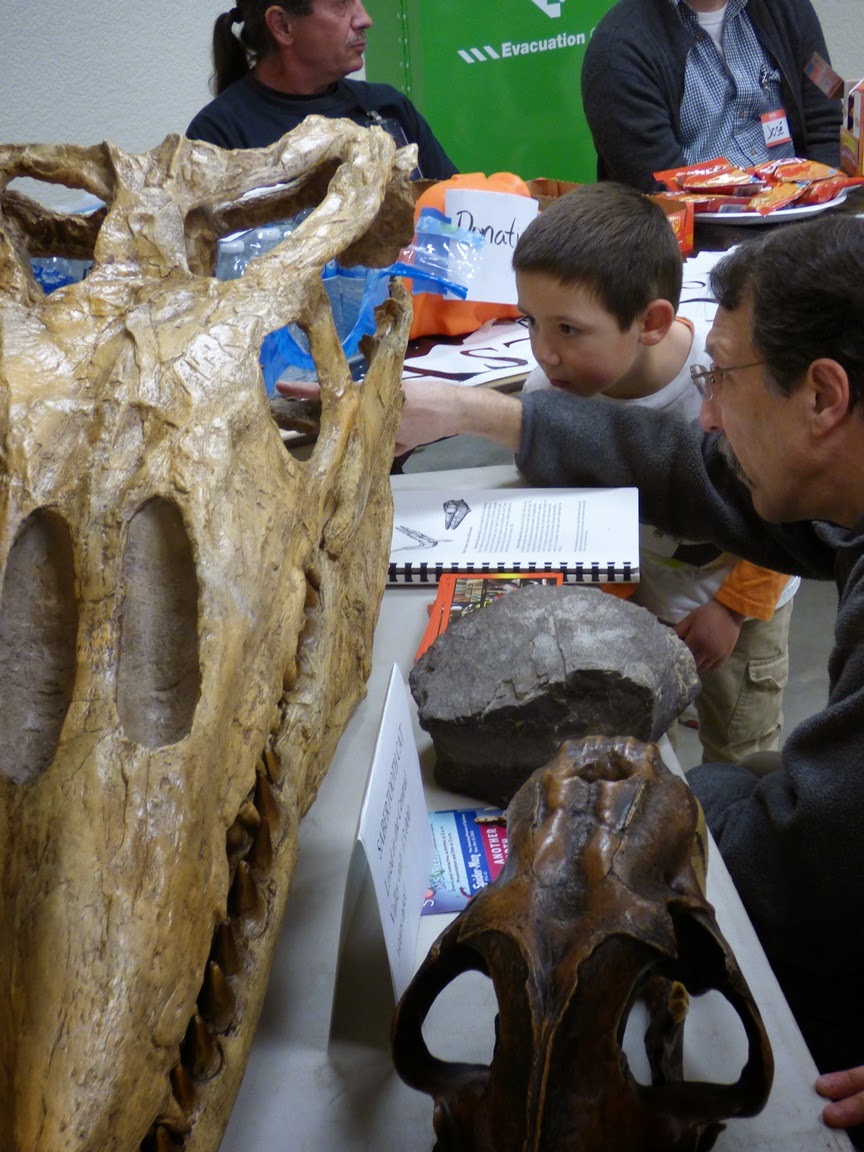
One of the unique aspects of the exhibit has been the use of some very complex 3-D printing to produce very detailed models of some of the skeletal material discovered in the Rising Star Cave. It was one of the unusual aspects of the research that the programs for the detailed scans was made available freely to other researchers. Printing these bones is a long and arduous process undertaken by MJC professors Joel Hagen and Dave Martin. Richard Avant painted and prepared the samples, while a number of MJC students assisted in other aspects of the exhibit.
Homo naledi is the middle skull, with a modern human on the right


The geology of the site is an important aspect of the research, as the cave is uniquely inaccessible. The bones lie in a chamber at the end of the "Superman Crawl" and the "Dragon's Back", extremely narrow passageways that make the accumulation of the bones in the particular chamber somewhat of a mystery. How did they get in there? Did they crawl in? Were they thrown into the chamber? Was there another entrance at one time or another?
The Great Valley Museum is a scientific treasure in a region that is often lagging in scientific education. The people of our region voted to support science education when they passed a bond issue a decade ago that resulted in the construction of the Science Community Center and the expansion of the Great Valley Museum. If you have not yet had an opportunity to visit the museum and take in the exhibits and maybe even a planetarium show, now is a great time to stop by! Bring the kids, for there is plenty for them to do as well. Information on hours and location can be found on the museum website at http://www.mjc.edu/instruction/sme/gvm/index.php. Follow the GVM on Twitter at https://twitter.com/GVMatMJC

Thursday, December 3, 2015

Moment of Pure Beauty on a Horrific Day

It's hard not to feel depressed or hopeless when terrible things happen, when people do horrible things to those around them, and when innocent people die needlessly. The latest of far too many attacks hit close to home, near where I grew up, and where I still have connections. 
I have no profound words or insights, there have been plenty of such discussions on the social media that I follow. I do hope that some action will finally be taken to prevent future massacres. It's so easy to feel hopeless.
Sometimes, the Earth presents us with such beauty that we can forget the evil for a few moments. It was raining today, a blessing in itself after four years of lingering drought. The sky seemed to be completely overcast, but out west, the light from the setting sun found a path through the clouds, and for a few short moments we had a spectacular rainbow, a double bow that extended across the sky. We don't really get a lot of them around here (given the general rarity of storms, period), so this was  kind of an exceptional moment.
I don't know where our sense of beauty comes from, but there is something so pleasing about the spectrum of color that appears when sunlight is refracted through water droplets. It's high in the sky, and seemingly distant and unattainable, kind of like the ideals of being human. There is a sort of perfection we can hope to reach as individuals and as a society. I don't mean this in the sense of some religious belief that is "better" than the belief of someone else. There's too much conflict there. I mean it in the sense that we might one day find a way to treat each other with kindness, respect and equality, a recognition that we have a limited time in our own existence to make the world a slightly better place.
It's maybe kind of odd to think of it this way, but in geology we describe a form of "perfection". We call it a "graded stream". Rivers flow to the sea. The longer a river exists, the more it molds a landscape so as to achieve the most efficient flow, using the least amount of energy. If there is an obstruction, a landslide, say, or a dam, such things are ultimately removed by the erosive force of the fast-moving water. If there are pools, the stream slows, and dumps sediment in such a way as to fill in the gaps. As long as the water moves, the river approaches a form of physical perfection, with a channel that transports water to the sea in the smoothest manner possible (subject to the laws of physics). Perfection is never reached, because landslides and earthquakes will always happen, but the river works through these interruptions. It never stops changing the channel through which it flows.

Humans can never be perfect. But we can change the world we live in. We can choose to be the disasters, the landslides and other catastrophes, or we can be part of the constant never-ending flow that smooths out the imperfections. We can take away the hate. It takes patience, courage, and empathy for others.

The Great Valley Museum at Modesto Junior College is Seeking a Director

This is a reposting of my note from last month. The deadline for applying is Friday, Dec. 4! From personal experience, I can say that Modesto Junior College is a pretty nice place for a career.

The Science Community Center at Modesto Junior College is a monument to the importance of science education, with state-of-the-art labs and classrooms for biology, astronomy, chemistry, physics, and the earth sciences, as well as a fully equipped observatory, and the most technically advanced planetarium projector in the United States (seriously, it's the newest generation, and we were the first to have it installed). The Great Valley Museum has exhibits emphasizing the unique biology, paleontology and geology of the Great Valley, and includes the unique teaching tool called Science on a Sphere. Construction will begin soon on the Outdoor Education Laboratory in the open space north of the Science Building.

We are currently seeking a permanent director of the museum

The position announcement can be found here: https://yosemite.peopleadmin.com/postings/1826. If you are a talented person who knows and loves science, but can also navigate the depths and passages of a college and state bureaucracy as well as excelling at fundraising, you may be the person we need to lead our school and our valley into a new era of science excellence. Contact the Human Resources office at Yosemite Community College District if you have questions.

Thursday, November 12, 2015

The Great Valley Museum at Modesto Junior College is Seeking a Director

The Science Community Center at Modesto Junior College is a monument to the importance of science education, with state-of-the-art labs and classrooms for biology, astronomy, chemistry, physics, and the earth sciences, as well as a fully equipped observatory, and the most technically advanced planetarium projector in the United States (seriously, it's the newest generation, and we were the first to have it installed). The Great Valley Museum has exhibits emphasizing the unique biology, paleontology and geology of the Great Valley, and includes the unique teaching tool called Science on a Sphere. Construction will begin soon on the Outdoor Education Laboratory in the open space north of the Science Building.

We are currently seeking a permanent director of the museum

The position announcement can be found here: https://yosemite.peopleadmin.com/postings/1826. If you are a talented person who knows and loves science, but can also navigate the depths and passages of a college and state bureaucracy as well as excelling at fundraising, you may be the person we need to lead our school and our valley into a new era of science excellence. Contact the Human Resources office at Yosemite Community College District if you have questions.

Tuesday, September 15, 2015

Can You See It? Seeking a Natural World in an Urban Setting

Can you see it? Look carefully, it's easy to miss...

We have a drainage pond on our west campus at the edge of town. It's been a mostly neglected corner of the campus, used occasionally to graze sheep from our agricultural unit. I've been exploring it for the last two years looking to photograph birds (forty species and counting). It's not far from our Science Community Center and Great Valley Museum. The museum and science teaching facility are new, and have garnered a great deal of community interest, with a planetarium, observatory, Science on a Sphere, and all kinds of science-related exhibits. The final jewel in the crown, an outdoor education laboratory, was sort of a political football in the last year or two as the bond issue that paid for these incredible educational facilities started to run short.

Luckily, there is funding in place to build the outdoor lab, with plans in place to plant native vegetation and habitat for animals that could thrive there. The California Drought, about to enter a fifth year, put the kibosh on what was to be a central attraction, a pond. No new water features, they said.

We're going to let nature decide that issue for us. We will be designing an artificial vernal pool, a habitat almost unique to our valley. Such pools only hold water after storms in the winter and spring, and give rise to a number of endemic plants and animals. In the meantime, our attention shifted to the drainage pond. It's been there since World War II and has evolved into a natural habitat, sort of a mini-wilderness on the edge of our campus. Since we can't make new ponds, we are going to make improvements to the old one, putting in walkways, and adding a platform that students and visitors can use to take water samples and observe wildlife.

It's always a thrill to see a bit of wildness in the middle of an urban environment. That's what the picture above is about. I had my own thrill of discovery as I was taking an evening walk before class. If you look at the left side of the picture, you'll see a bit of nature staring back at me.
I've seen this beautiful fox (or a parent or sibling) on just one other occasion. It's been said it was living in one of the abandoned buildings nearby, although there seems plenty of shelter in the pond area. It was comforting to know that a bit of wildness still exists nearby. The children in our region need to know that they are part of a larger environment, and it's wonderful that they just might have a chance to see a creature such as this. It might be something else, squirrels, muskrats, turtles or birds, but it will be something. I'm looking forward to the future on this campus!

Postscript: As cute as they are, the Red Foxes are not native to California. There is a threatened subspecies, the Sierra Red Fox, that lives in the higher parts of the Sierra Nevada and the Cascade Range. All others across the state were introduced more than a century ago and have proved a problem in many ecosystems, as they eat just about anything and adapt easily to new environments at the expense of native species. I don't know what role they play in our area, or if they are a problem. My feeling is that they help control rodent populations on the campus, but I'm no biologist!

Tuesday, May 5, 2015

Sharing Science in the Local Community: What Ideas Do You Have?

How often do you wish you had a blank slate? The term can have many meanings and contexts, but most often it means the chance to start over, or to start a project free of restrictions. That in essence is what you see in the pictures in this post. After 10 years of uncertainty and doubt, we have received the green light to begin planning and designing the last component of our Science Community Center at Modesto Junior College.. What you see in the pictures above and below are views of what is almost literally a blank slate. It's made of clay (and silt), the same material that slate starts with, but it hasn't been compressed yet. It the footprint of  the future Outdoor Education Laboratory.
This last piece of the puzzle is part of a science education complex that includes teaching laboratories for biology, astronomy, chemistry, physics and geology, a planetarium, an observatory, and a wonderful new museum based on the natural history of the Great Valley in California. The building on the left in the picture above is a new museum storage structure, and the buildings in the background are condemned and will be removed, probably to become an eventual parking lot. We were worried for some time that the parking lot was going to be put on the site of the outdoor lab.
I hate committee meetings. A lot. I find that many of them don't accomplish much. But today's meeting was fun. It was a gathering of professors and museum staff to decide the shape and nature of the Outdoor Education area. We had a lot of discussion about how it would be laid out and what it would include. It is meant to be an area that will be utilized by students for research, and by the school children of our region to learn about the biology and geology of our region. Our only restriction is that because of the horrific drought, we can't include new water features.

The water restriction was a sour note (even though it was understandable), but it turns out that a pond is already in place, and it's not really using up any water. It's actually capturing used water. If you've followed my blog for any period of time, or if you follow my birding adventures over at Geotripper's California Birds, you would know that an old drainage pond exists just a few hundred feet away from the future outdoor lab, and that it is shaded by mature oak and cottonwood trees. We will probably adapt it for use as an education feature.
So my question to you is this: What would you do with a barren stretch of ground, an adequate (but not infinite) budget, and a commission to enhance the natural science education of our students (both young and "mature")? What would you include in the plans? We had some long discussions today, but I'm wondering what we might have missed. What would you do?

By the way, if we seem somehow privileged to be doing this, it might help to know that all of these wonderful improvements to our campus are not funded by the state or the federal government. They were paid for by the voters and taxpayers in our own economically distressed community. We have one of the highest unemployment rates and the highest poverty rates in the entire country, but our citizens saw their way to support the future of our children by producing some of the finest teaching facilities possible, not just in the sciences, but across the entire college. I'm really proud of my community these days.

Wednesday, April 22, 2015

A Teacher of Astronomy? Have we got a place for you!

I don't know if astronomers love geology as much as a geologist like myself loves astronomy. But if you are a teacher of astronomy and you are good at it, have we got a place for you! Modesto Junior College has an opening for a full-time tenure-track astronomy-physics instructor. Just imagine working in our wonderful new Science Community Center! We also have one of the finest planetariums in the country, and a fully-equipped observatory. Full information about the position can be found at https://yosemite.peopleadmin.com/postings/1531.
I don't know if I can fully convey the excitement of teaching at this facility. The local community is crazy for science education. Our telescope nights, held once a month, draw hundreds of people. The planetarium shows are often sold out. It's hard to imagine a better place for a great teacher who loves conveying science to others.

Thursday, April 2, 2015

The Great Valley Museum at Modesto Junior College Opens THIS WEEK! Come and Join Us!

It's been a long time coming, but the day is finally upon us! The Great Valley Museum Grand Opening takes place this weekend! The museum opens to the public from 10 to 4 on Saturday, April 4, and it's going to be fun. I hope I'll see some of you there.

The Great Valley Museum has actually existed for more than thirty years, but during that time it occupied a small dilapidated building on the East Campus of Modesto Junior College. The facility was never the equal of the volunteers and employees who have kept the programs of the museum running, but this week that is changing. The museum floorspace is five times larger than the original museum, and there is now a state-of-the-art planetarium as well. The only missing piece is the Outdoor Education Laboratory, slated to be constructed on the north side of the Science Community Center, if all goes right.

Science and natural history permeate the new facility. Outside the building are fountains displaying  mathematical relationships and physics phenomena. There is a scale model of the Solar System on the ceiling of the museum entrance area. There is a Foucault Pendulum in the Observatory tower on the north side of the building.

The William Luebke Planetarium has the most advanced star projection system in the country (the new generation unit is the first to be installed in the United States). The planetarium shows have been offered for several months and have generally been sold out each time. 

The Great Valley is one of the most diverse ecosystems in the American West despite the almost total conversion of the valley floor to agricultural development. More than 400 bird species are known to live in or visit over the course of the year. A system of wildlife refuges protects the birds, amphibians, reptiles, mammals, fish, and invertebrate species, and the museum does a great job of displaying the different ecological environments with full scale dioramas.
The museum creates an environment of learning for our local students who might never actually explore the natural ecosystem that surrounds them. The daily school tours are scheduled months in advance as our local schools try to utilize this wonderful new resource.

Geology and paleontology have not been left out of the exhibits, but they are a work in progress. The Great Valley has a rich fossil heritage, including some incredible finds, such as the first dinosaur ever discovered in the state of California (in our county), and a new species of the ferocious mosasaur (a representative skull of one of these 35 foot long marine predators is on display).
This is an important week for Modesto and Stanislaus County. We have at last achieved the goal of opening an excellent natural history museum for our community, paid for by our community. It's an auspicious moment for a part of the country that is economically and educationally challenged. It feels like we've reached a moment when that is changing. Come and check it out this weekend!


For more information, check out the links below. And consider becoming a member of the museum!
https://www.facebook.com/GreatValleyMuseum?fref=ts
http://www.mjc.edu/instruction/sme/gvm/

And a sneaky bonus: The MJC Astronomy Club will be doing a telescope night on Friday night, April 3, from 8-10 PM with sky viewing on the fourth floor platform, planetarium shows (8:10-9:10 PM), and sneak-peek tours of the museum.

Saturday, March 7, 2015

Harmonic Tremor? Volcanoes under Modesto? Nah, It's Kids and Science


Earthquakes? Volcanoes? Not this time, anyway...
The seismometer on our campus was going crazy today. Usually such high levels of seismic activity are cause for great concern, due to the rapid movement of magma in the crust, or an impending "big one". But there was no such concern today. The seismic action was due to kids running back and forth down the hallways of our Science Community Center. And they were doing science!
Our campus has been invaded...
Today's Science Olympiad brought together hundreds of students and adult volunteers in a competitive event that drew on all the fields of science: physics, chemistry, earth science, geography, geology, anatomy, biology, engineering, and more. Local junior high and senior high schools fielded teams competing for the chance to move up to the statewide meet. Few football games provide the level of intensity that I saw today.

Admittedly I didn't see a heck of a lot. I was responsible for hosting the "Fossils" event, which had teams competing in all four time slots during the morning and early afternoon. It left me no opportunity to wander through some of the other events, or the newly opening Great Valley Museum, or the Planetarium shows. But I did get to see some intense trench competition among the students in my event. To explain, there are glamor events like robot building or bottle rockets that garner lots of attention. The students in events like mine are the quiet ones who make up the bulk of the teams, and earn most of the points for their schools. The competition is not won or lost in the handful of big events, but in the many "lesser" topics. What's nice about it? The quiet kids, the introverted kids, they get to be heroes at times like this. An unexpected win in an event like Fossils may be the ticket for their school to advance to the state level.
Yes, this is trench competition...
Such events are not possible without the work of many dozens of volunteers. Each school has coaches, teachers and aides who have taken on the extra work of coaching their school's teams. There are the event coordinators and judges, experts in their different fields who design and conduct the competitive events. There are the many others who tabulate the results and organize the food and equipment for the other volunteers. There were hosts for the museum tours and planetarium shows. The picture below from the morning meeting gives a small hint of how many people are involved.
It takes a community to raise a community up.
I can't end this without mentioning our campus Geology Club. They were out in force today running a barbecue selling "Brontoburgers", "Fernburgers", and "Raptor Dogs" to the hungry kids. They were raising money to help anthropology and geology students attend our summer field studies course this year.

I'm so proud of my school and community, that they continue to sponsor the Science Olympiad year after year, despite recessions and limited resources. The county office of education continues to devote resources to the event as well. Do I sound like a cheerleader? I am. If we are to provide for a secure future for our county, state and country, we need to promote and encourage events like this. I was glad to be a part.

Wednesday, February 11, 2015

Tenure-track Instructor of Chemistry position at Modesto Junior College

It's not geology, but if there are any great chemistry professors out there who've been impressed with what I've been writing about our incredible Science Community Center, we might have a place for you here. The college will be hiring for a tenure-track position at Modesto Junior College in California's Great Valley. Information can be found here: https://yosemite.peopleadmin.com/postings/1474.

The school is a nice environment to work, with new facilities and some great fellow professors. There are two positions for Instructors of Mathematics (although they'll be on the east campus). Check for other openings at https://yosemite.peopleadmin.com/.

Friday, November 14, 2014

"Science" Doesn't Have to be Craptacular

Source: http://www.esa.int/Our_Activities/Space_Science/Rosetta/J_marks_the_spot_for_Rosetta_s_lander
I get so depressed sometimes...

We live in the most spectacular of times, and in so many ways humans have accomplished incredible feats, with explorations out to the voids of space and into the micro-world of atoms, quarks, and strings. What happened this week? Humans built a machine, threw it into space and let it drift for ten years through intense radiation fields, turned it on, and orbited a comet. They let loose a lander that, despite glitches (like bouncing a kilometer or more), landed and conducted observations and experiments.
Source: http://www.nasa.gov/mission_pages/cassini/main/#.VGb0Wsm9aSo

We've landed on other planets. We've put telescopes into space that act like time machines, looking back to the early years of the existence of the Universe. We are about to place machines in orbit around Pluto, and around the largest asteroid (2015 is going to be a good year). The Cassini has been orbiting Saturn for years, taking incredible images, like those of the sun reflecting off the seas of Titan. And Jupiter and Mars before that. We've been back to Mercury.
Source: http://www.nasa.gov/jpl/cassini-sees-sunny-seas-on-titan/

We are learning more about the Cosmos, the Earth, life, and ourselves than has ever been known. Every field of science is a continuing adventure, each week an odyssey of discovery. New dinosaurs, cures for diseases, new insights to the nature of matter itself.

And then there is my own community, continually on the lists of the worst places to live in the country, with the least educated population, the worst air, and the worst unemployment rate. Is there a more hopeless situation? And yet...we voted to build for ourselves what may be the finest science teaching facility on any community college campus in the state. A planetarium, an observatory, a hugely expanded science museum, and state of the art laboratories. It is something to be proud of, and our community knows it.
Telescope night on the roof of the Science Community Center

Our community knows what they have. Our telescope nights, our planetarium shows, our science lectures, our tours, they are all well attended, sometimes sold out, sometimes standing room only. I was at a telescope viewing and planetarium show tonight, feeling proud of the community I'm living in.

So why depressed? It's this: in the most exciting times of history, when the greatest discoveries of the human adventure are being made, popular media, the best possibility of educating the people who live on the planet, is a visual sewer. The Discovery Channel, the Learning Channel, the History Channel, and others keep putting up tripe of the worst kind, material that reaches for the lowest common denominator: ghost-hunting, paranormal, sasquatch-hunting, hollow-earth documentaries, and now megalodon-hunting. And they work. An uneducated public, apparently incapable of critical thinking, swallows the bait hook, line and sinker. The Discover Channel ran their fake documentary and convinced nearly three quarters of their audience that a creature that went extinct millions of years ago was still living in the seas today.
Source: http://www.businessinsider.com/majority-of-discovery-channel-viewers-believe-megaldon-exists-2013-8
This tirade is all over the place, I know. That's why I am a blogger and not a journalist with editors, deadlines, and overseers. It's just that these three themes seemed to dominate my attention the last few days, the idea that there is some incredible science exploration being done, that the regular people of our community hunger for scientific knowledge of their world, and that popular media is failing miserably to communicate the fascinating and spectacular things that are happening, and instead is chasing ratings by putting up, well, stupid dimwitted programing.

We have gigantic challenges ahead of us. The climate, affected by global warming, is changing our world in ways that no humans have ever experienced. We are using up critical resources and not finding new ones. We continue to pollute our air and water, and politicians seem hell-bent these days on making things worse ("burn more coal!"). Our hope lies in knowledge, and in an informed and engaged populace who will put pressure on those in power to make things work.

Ignorance can be defeated. Popular media like the Discovery Channel have it in their power to help, and not make things worse.

Tirade over. I wrote fast and angry, and will probably have to fix parts of it, but that's what is nice about blogging. I make my own rules! I'd love to hear your take on the quality of science programming in the popular media today, and what could be done about it.

Thursday, October 23, 2014

Partial Solar Eclipse from California (and What a Sunspot!)

Wow. Just wow. Yes there was a partial solar eclipse today that was visible across much of the country, and yes, it was pretty spectacular. But what caught my attention was the huge sunspot. It is the first time I've ever seen a sunspot with the naked eye, and it was incredible in the zoom lens. I'm told that it is more than 90,000 miles across, the width of 12 Earths. Sunspots are essentially gigantic solar storms. They look dark, but they are simply a bit less bright than the rest of the Sun's surface.
It was so big that even my camera was able to catch some detail. I had my camera on a tripod, and held a solar telescope filter over the end to catch these shots. The zoom was about 60x.
There was a lot of interest on campus, and so our astronomers and Astronomy Club had a number of scopes set out on the roof of the new Science Community Center. I wish I could have photographed one of the views through the most powerful scope. We could see the granules of the Sun's surface, and solar prominences, the arcing jets of plasma shooting out from the surface.
A great day!