Showing posts with label astronomy. Show all posts

Thursday, December 8, 2016

Where are the Heroes Anymore?...RIP John Glenn

Hero: a person who is admired or idealized for courage, outstanding achievements, or noble qualities
Photo from NASA
It's hard to find heroes today, although they most certainly exist. 

Some people maintain that people who can catch footballs or swings bats are heroes, but those athletes are well paid in money and accolades. It really just means they catch footballs or swing bats well and provide us some entertainment. They're not heroes, though. Some people call musicians heroes, but they get a lot of money and accolades too. These people are simply famous. They do little to make life better for others (though some of them do donate their money). And people who are famous for being rich? Forget it.

Some of the best of heroes today exist in obscurity and in darkness, working to make life better for the sick and injured in the kind of places where humanity is at its worst. I think of the doctors and nurses who work in war-torn places like Syria and Iraq, or those who struggle against diseases in the worst hell-holes where pathogens like the Ebola virus lurk. I think of the heroes that struggle to educate our children despite desperate teaching conditions and insanely deficient budgets, along with scorn from politicians and administrators. These are the kinds of people we should all aspire to be. 

What seems to be missing in this period of history are national heroes. I'm sure I'm missing something here, perhaps, but there have been times in our history when people did the really big things, the dangerous adventures where the outcome was truly in doubt. There were people who risked everything to walk to the poles, or to climb the highest mountains against impossible odds. Sometimes, like Mallory (on Everest) or Scott (at the south pole), they ultimately failed, and yet still loom large in the history of human exploration. It's true that they might have been seeking after glory, but they bet everything on an uncertain outcome.

And so we come to the events of this week. When I was a child of 4, the first American, Alan Shepard, went into space (the Russian Yuri Gigaran was the first person in space, but somehow we forget that sometimes). I barely understood the significance, but when John Glenn became the first American to orbit the Earth in 1962, I did know what was going on, and why it was important. From that time on, I was fascinated with space travel, the Moon, and astronomy in general. I had every reason to think that space travel was something that even I would be able to do in another thirty or forty years (that seemed like forever back then). I followed the Mercury missions, the Gemini missions and the Apollo missions. In 1969, I stood in a pinyon forest in the southern Sierra Nevada listening to the scout camp loudspeakers broadcasting the Moon landing. The country seemed to lose interest in space travel once we beat the Russians, but I never did. I followed the Voyager missions to the outer planets like a child even though I was in my twenties. And today, in my fifties, I've eagerly followed the missions to Mars, Mercury, the Asteroids Vesta and Ceres, and finally, Pluto. It's been a grand adventure, one that can only happen once. I'm glad I was privileged to be a witness.

This week we have to say good-bye to a true American hero and a true explorer. It's true that hundreds of people actually made the adventure possible, but John Glenn was the one who was courageous enough to strap himself into a small capsule on top of a rocket that had only successfully been fired four out of six tries. He gambled everything, and ultimately succeeded. He was a hero for other reasons too, having flown 149 combat missions in World War II and the Korean War. He also served as a senator from Ohio for 24 years.

We need all kinds of heroes, including the quiet unsung heroes who labor among us every day. But we also have a need for national and world heroes, those who expand our world and our Universe through their daring adventures at the edge of impossibility. John Glenn lived a full life, and will be remembered long after our society has forgotten the names of steroidal athletes and drunken media stars.

Monday, June 29, 2015

Look West, Young Man (and Everyone Else): It's a Conjunction!

There are interesting things happening in the western skies this week. All month, there have been two bright objects in the evening sky, getting closer and closer. They aren't really getting physically closer, as Jupiter is far beyond Venus, but their line of sight is making them appear close together. Such "near-misses" are called conjunctions. They will appear closest on June 30 and July 1, so be sure to check it out!

It's been a long time since I've been able to photograph two planets in one frame at a magnification high enough to catch Jupiter's moons. Maybe tomorrow I'll even try a tripod (tonight I was just leaning on the hood of the car in the front yard).
I've been watching the dance of the planets for two weeks now. At Natural Bridges National Monument on the Summer Solstice, I caught the new moon adjacent to the planets. The Ancestral Puebloans were keen astronomers, designing their cities in the desert to align with astronomical and seasonal phenomena. Something like this in 1150 AD would most certainly have caught their attention.
It was a real privilege to be in a series of parks that are so remote from human light sources. The night skies were brilliant. The nights were nearly as interesting as the days at times. Not only is there the sky with the stars, planets, and Milky Way, but the night sounds and odors as well.

Get more information about the conjunction from EarthSky at http://earthsky.org/tonight/watch-the-great-race-of-venus-and-jupiter-in-june-2015.

Wednesday, April 22, 2015

A Teacher of Astronomy? Have we got a place for you!

I don't know if astronomers love geology as much as a geologist like myself loves astronomy. But if you are a teacher of astronomy and you are good at it, have we got a place for you! Modesto Junior College has an opening for a full-time tenure-track astronomy-physics instructor. Just imagine working in our wonderful new Science Community Center! We also have one of the finest planetariums in the country, and a fully-equipped observatory. Full information about the position can be found at https://yosemite.peopleadmin.com/postings/1531.
I don't know if I can fully convey the excitement of teaching at this facility. The local community is crazy for science education. Our telescope nights, held once a month, draw hundreds of people. The planetarium shows are often sold out. It's hard to imagine a better place for a great teacher who loves conveying science to others.

Wednesday, January 21, 2009

The Others Aren't, But This Test is Really Important!


The NerdTests' Space Quiz says I'm an Uber Space Nerd's Mentor.  What kind of space geek are you?  Click here!


These things are absolutely silly...until you do well on one, and then they are extremely significant and important. I got lucky on some of the questions; I've always known Sputnik went into space during the year of my birth, for instance. I don't do as well on computer-speak tests, but astronomy and the space sciences were literally the underpinning of my life as a child. Actually the quality of the questions was pretty good, and I have been declared to be Uber Space Nerd's Mentor!

I often quiz my students early in the semester on the stereotypes they have about science, and two words that come up consistently are that doing science is "hard" and "boring". That allows me to "launch" into a discussion of how privileged we are to be living in the time we are living in. The riches of new data that have emerged in the last decade or two because of the Hubble Space Telescope, or the Spitzer Infrared, or the Mars Rovers, or the Saturn Cassini orbiter leave me awestruck, being someone who grew up in a time when the telescope images of the planets revealed only fuzzy featureless disks.

And the accessibility! Gone is the time when the spectacular images could only be taken by multi-million dollar machines...technology has advanced to the point that my colleagues at the college have now produced images of planets and galaxies with their own equipment that rival the best stuff that Palomar ever did a few decades ago. A year or two ago, I was at Death Valley and an astronomy buff had set up his equipment, and started projecting the images he was taking in real time on a sheet on the side of a truck. On a sheet, and it was spectacular!

And to top things off, we have a president who thinks science should have some influence over policy decisions! That may be the most amazing development of all...

Monday, March 3, 2008

Speaking of Landslides caught on film (disk?).....

And speaking of being in the right place at the right time...the pictures coming back from the HiRESE Orbiter over Mars are just spectacular. Read the story of this photo at http://hirise.lpl.arizona.edu/PSP_007338_2640, and more than 2,500 other images were released today at http://hirise.lpl.arizona.edu/pds_release_mar_08.php. Thanks to Arizona Geology (http://arizonageology.blogspot.com/) for the links.

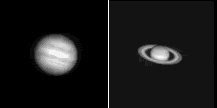
I am once again reminded of how lucky I am to be alive these days, and how little we knew of the Solar System in the days of my youth. I waited for months for the chance of getting a telescope for Christmas when I was 11 or 12 years old. It was a bit like Ralphy hoping for the BB gun in Christmas Story. As luck would have it, the arrival of my beloved telescope coincided with the flooding in southern California in 1969, and it was actually weeks before I was able to actually look at stellar objects with my new pride and joy. And truth be told, I was a little disappointed, since stars looked just the same in the telescope as they did with the naked eye. I could see moons around Jupiter, and Saturn's rings, but not much else (and I certainly didn't take these pictures, however fuzzy).


I was consumed with curiousity about the other planets in our neighborhood, and all the science books could offer were small fuzzy pictures of Mercury, Mars, Jupiter, Saturn, and Venus. Uranus, Neptune, and Pluto (the dwarf formerly known as the 9th planet) appeared as only dots of light. With the arrival of the first pictures from Voyager and all the other planetary explorers, our world was changed, and we are richer for it.

Everyday, the people who do science, and their technological advances provide us with beauty and fascination, as exemplified by the continuing saga of the Mars Rovers and the Orbiters. Thanks to those who persevere in the face of budget cuts, and keep up the great work!