Showing posts with label Mosasaur. Show all posts

Wednesday, June 27, 2018

Jurassic World - Fallen Kingdom: A Geologist's Review


To be sure, I enjoyed myself.

It was about 5:45 in the afternoon and we were out and about doing errands. I had been called into an emergency meeting about the soon to be constructed outdoor education lab at my campus. It turns out that bids came in way too high so we had to start making a list of things that we were going to have to give up in order to get the project built. It was a series of difficult choices. To blow off steam, we decided to see what was being shown at the local cinema. The next movie, at 6:35, was Jurassic World: Fallen Kingdom. We got our popcorn and soda and headed in. After 30 minutes of trailers, the lights dimmed and the movie began. As scenes unfolded, I imagined the meeting that went on before this movie was greenlighted: "we have millions and millions of dollars, how many things can we throw up on the screen?" In other words, the direct opposite of my meeting.
It's almost as if we've lost our fascination with dinosaurs, so we needed our film to be spiced up with all kinds of movie tropes: volcanoes, lava flows, pyroclastic surges, gothic mansions, secret underground laboratories, not one, but three or four dastardly villains, and deeply hidden family secrets. There was the obligatory child in distress. And (spoilers ahead!) some people get eaten, others almost get eaten, lava almost eats somebody, and there was an unusually moral component in the character of those who ended up as part of the dinosaur buffet. And the poor Brachiosaurus brought a tear to my eye.

But I am a geologist, so let's get to the important part of the review: did they get the geology right?

No, of course not.

But taken as individual scenes, some of the geology was okay.

As in practically all Hollywood movies, the director mixes up his volcano genres. Isla Sorna, 120 miles off the coast of Costa Rica, is a volcano without an origin (the island doesn't exist of course, but the location doesn't make much geologic sense unless it resulted from a hot spot).

When deciding the mayhem to be produced by a volcano, one must choose: is it an oceanic hot spot that produces shield volcanoes and basaltic lava flows and, as Kilauea has shown us these last few months, the occasional phreatic (groundwater) explosion? Or is it an island arc stratovolcano, whose andesitic or rhyolitic magmas produce violent caldera eruptions?  The movie cannot make up its mind: there are scenes of basalt flows and Hawaii-like scenery, but on the other hand, the climactic eruption is composed of explosive ash columns and pyroclastic surges.

The climactic volcano scenes have the heroes outrunning (or out-rolling) the pyroclastic surge which would seem highly unlikely in real life. The Chris Pratt character looks to have inhaled some of the ash which should have caused him some severe respiratory problems later on in the movie. He also should have experienced some severe burns from his close encounter with flowing radiant lava.

I was actually bothered a bit about how the ferry was able to get underway without damage from the incandescent pyroclastic flow on the dock. It was necessary I guess to get the emotional impact over the demise of the aforementioned Brachiosaurus.

But my biggest beef is the failure in imagination concerning the "extinction-level" volcanic event. The eruption that is supposed to have destroyed all living things on the island was kind of underwhelming.  A ferry boat was able to outrun it. There was (to my memory anyway) the barest of an eruption column. If this was really the kind of volcanic event that would erase all life from the island, there should have been a caldera-forming eruption like that of Krakatoa (1883) or Tambora (1815). The sky should have been blotted out and the ship should have been enveloped in darkness.

Maybe next time they should consult with me, because I have a great idea about how the island could have been destroyed, and it would have had some great visuals. Some irresponsible websites have been criticized for suggesting that the Big Island of Hawaii could suffer unprecedented catastrophic damage caused by the collapse of a flank of the island into the ocean. Such an event is simply not in the cards for Hawaii right now, but some memorable slides have happened in prehistoric times. The long runout debris avalanches caused thousand foot high tsunamis that would have ravaged many coastlines around the Pacific Ocean rim (not to mention in the Hawaiian islands themselves). Imagine a gigantic eruption column with ash flows spreading over the entire island and then an entire flank sinking into the ocean producing a gigantic tsunami that nearly destroys the escaping ship.

But almost no one ever thinks to ask me (believe it or not I did scout out shooting localities for a proposed Hollywood movie once).
The dinosaurs in the movie are fine, although there were exaggerations of scale, especially with the Mosasaur (oh, and the Mosasaurs and Pteranodons in the movie aren't dinosaurs; they occupy separate lineages within the reptile clan). The one in the movie was WAY too big. Mosasaurs have been found as fossils in our region and many others, and they're no larger than 35 feet or so. Terrifying, yes, but not the behemoth that existed in the movie's universe. And where did they get Mosasaur DNA? I don't think mosquitos had much of the chance to bite these deep-diving marine creatures.

There's a larger issue though. A central tenet of the movie was the desire of the movie's protagonists to let the dinosaurs live together in a big happy stable ecosystem. The problem is that the dinosaurs they resurrected never lived together in an ecosystem. They would have all technically have been invasive species. Many or most of the interactions between these species and their environment would have been problematic, including food sources for the herbivores (no grass or flowers during the Jurassic, for instance), and no evolved defenses against viruses and other disease-causing organisms. Our present-day efforts to bring back mammoths make a bit more sense since they've been extinct for only a few thousand years, and they lived in ecosystems much like those that exist today.

But still, all in all I enjoyed the movie. Geology criticisms aside, I'd give it a B+.

All pictures are courtesy of Universal Studios

Sunday, September 24, 2017

Say Hello to California's New State Dinosaur: Augustynolophus morrisi

This one really got past me. I have to admit that the whole business of establishing a California State Dinosaur flew way under my radar. But it happened, Jerry Brown signed the bill, and Augustynolophus morrisi is our newest state emblem (along with our state fabric, denim). Although much of the attention on this Saurolophus species is directed towards two specimens found in the Panoche Hills of Fresno County in 1939-40, few people are aware of the story of California's first dinosaur discovery. It happened in 1936, and it was found in our own county of Stanislaus. I've written about this story before, so what follows is an abridged version.

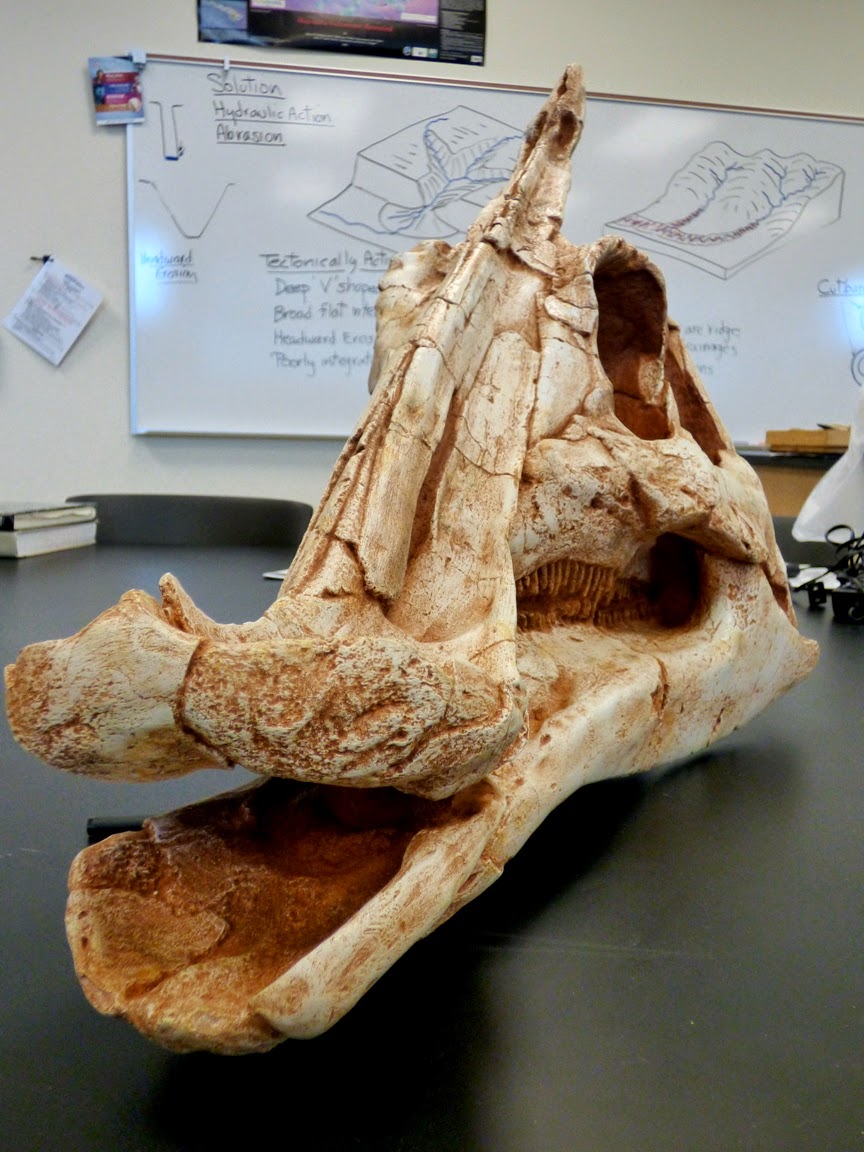
OMG! Somebody caught Jar Jar Binks! Okay, not really. But what the heck is this thing?
This is a skull replica of Saurolophus angustirostris, a closely related species from Mongolia
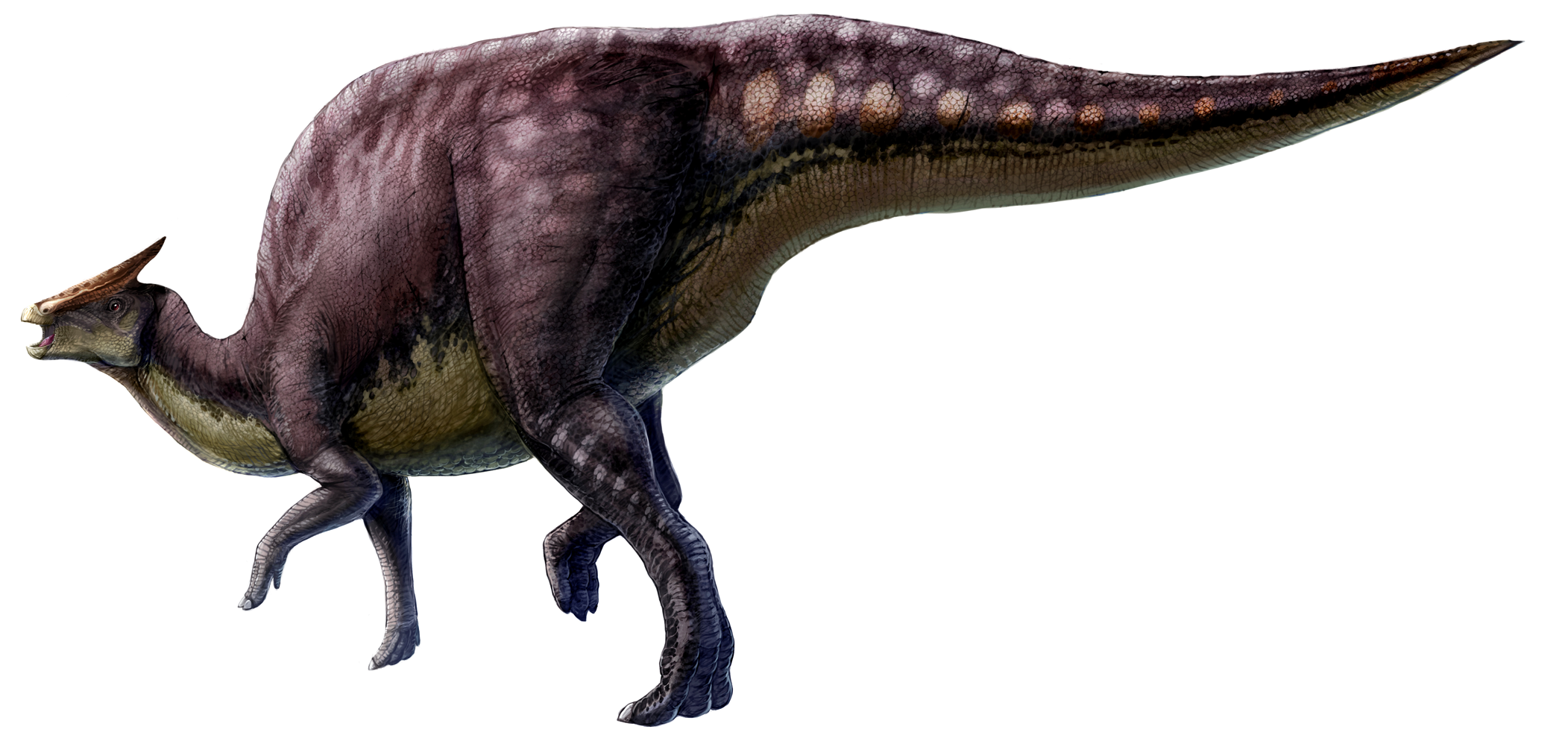
Say hello (sort of, since my skull is a closely related species) to Augustynolophus morrisi, our newly designated official state dinosaur!

We have half a million people in our county, and I'm willing to bet that 99% of them don't know what it is or why it's important to them. Only one person got to be the first to find a dinosaur bone in California, and that was 17-year-old Al Bennison in 1936. He was exploring Del Puerto Canyon in the Coast Ranges along the western part of Stanislaus County looking for shell fossils when he found bones scattered on a slope. He showed them to his science teacher who reported them to the paleontologists at U.C. Berkeley. A year later Bennison discovered the most complete mosasaur skull ever found in California (see below). The mosasaur species even bears his name. It may not be much of a surprise that he went on to become a paleontologist. I had the privilege of meeting him in 1996, when he took us to his original discovery site, shown above.
The Saurolophus was one of the last dinosaurs that ever lived on our planet, one the last groups in existence when the gigantic asteroid hit the planet (or when the volcanoes blew, or whatever else did them in). They lived in the latest part of the Cretaceous Period, which is well represented by sedimentary rocks in our region. The rocks are marine in origin, which tend not to be good places to search for dinosaurs, but sometimes a carcass would float out to sea.
Source: http://en.wikipedia.org/wiki/Saurolophus

The creatures were gigantic, on the order of thirty to forty feet long, weighing several tons. They were plant-eaters, with teeth well-adapted to grinding twigs and leaves. Whether they swam or not has been a topic of discussion and debate. Some argue that they had few other defenses from predators, so that swimming was necessary to escape from being eaten. Others suggest that they lived in herds that provided protection.
Our skull collection is now a powerful tool for teaching the students in our region about the heritage of the land that they live on. In the picture above, one can compare the Cretaceous plant-eater with the skull of a Short-faced Bear, which lived in our area during the Ice Ages during the last two million years. It may have been the single largest mammalian land predator that ever lived, with a standing height of 11 feet. It would have made a grizzly bear look small in comparison.
The picture above shows our other recent arrival, the Mosasaur, similar to the one found by Al Bennison during the 1950s in the Coast Ranges just south of our county. It was not a dinosaur but was instead a seagoing reptile from the Cretaceous Period that may have snacked on sharks. It was around thirty feet long. It is probably the most formidable predator ever to inhabit our region.
To give a sense of scale, we have the Mosasaur nosing an Ice Age Sabertooth Cat skull (the cats weighed 700 pounds), and one of those wimps of the early Cretaceous, Velociraptor (which came out of Mongolia, not the Americas).

Dinosaurs certainly capture the imagination of our children (and not a few of our adults), and it is a good thing for our students to know that our county played an important part in the paleontological discoveries in our state. When students realize that one of their own (however long ago) made an important find, they also can visualize themselves as a paleontologist or geologist making important contributions to science.


Source: http://upload.wikimedia.org/wikipedia/commons/4/4b/Saurolophus_scalation.png


Augustynolophus has its own Twitter handle, so check out developments at https://twitter.com/augustynolophus/. The Wikipedia page has been updated as well. For the best source of information on dinosaurs and other Mesozoic reptiles of California, check out this book by Richard Hilton of Sierra College.

Monday, December 14, 2015

Driving to the Center of the Earth in Del Puerto Canyon...Sideways

Okay, not really to the center, but deeper than any drill or mine shaft ever went. Del Puerto Canyon in the California Coast Ranges provides a window into the Earth's mantle, while passing through more than ten miles of crustal material. Allow me to explain! We were there last weekend, a group of our students gathered together after finals to explore the canyon.

The Great Valley began as a forearc basin, a sequence of sedimentary layers lying on oceanic crust between a subducting trench and the edge of the North American continent. The sediments were derived from the erosion of the Ancestral Sierra Nevada, which at the time was a string of volcanoes not unlike the Andes or Cascades of today.
Source: https://commons.wikimedia.org/wiki/File:Franciscan_subduction_model.gif

What a fascinating time this was! Huge volcanoes were erupting every few decades, while large rivers were constantly eating away at the mountains. A diverse group of dinosaurs roamed the forests on the flanks of the volcanoes including hadrosaurs (duckbilled dinosaurs). Raptors and carnivores similar to T-rex and Deinonychus (the American version of the velociraptors) lurked in the trees and along the rivers. Various species of Pterosaurs flew overhead.
The first dinosaur found in California was discovered on this ridge above the landslide.
The very first dinosaur fossil ever discovered in California was found in this very canyon, by a teen named Al Bennison in 1936. The creature was a Saurolophus, a plant-eater that had been caught in a river flood. The carcass floated out to sea, and was eventually entombed in the sediments of the Great Valley forearc basin.
Fall colors in Del Puerto Canyon. Unlike the rest of the country, we believe in enjoying the fall until winter actually begins on the calendar.
Like the adjacent coastline, the sea teemed with life. There were creatures much like those of today, clams and snails (pelecypods and gastropods), fish, and sharks. And then there were the sea-going reptiles: the Plesiosaurs (the suspected "Loch Ness Monster" creature, unfortunately), the Ichthyosaurs (large dolphin-like reptiles), and Mosasaurs (35-foot-long swimming Komodo Dragon relatives). A new species of Mosasaur was discovered by Al Bennison just a few miles away from Del Puerto Canyon.


The sediments accumulated to an incredible thickness, more than 25,000 feet. The sediments were later twisted upwards to form the eastern flank of the Coast Ranges. The road in Del Puerto Canyon winds for more than 10 miles through the sandstone, siltstone, and shale that once formed the ocean floor. We were driving up canyon, but deeper down into the crust. We were looking for the Tesla-Ortigalita fault that marks the boundary between the so-called Great Valley Group, and the underlying Coast Range Ophiolite, a slice of oceanic crust.
We soon reached the rocks near the base of the Great Valley Group, and found the exposure of the fault zone (it cuts diagonally upwards to the left in the picture above). I visited this spot nearly twenty years ago with Al Bennison, who by then was long retired. He described the structural relationships to us, and pointed out that ammonite fossils (cephalopods related to the Pearly Nautilus and the Octopus) could sometimes be found in the shale on the right side of the fault. He walked over, glanced at the cliff for a moment and said "here's one", handing me the delicate fossil. I've been to that darned outcrop another twenty times or so over the years, and I've never found one for myself!
So of course, what happens when I take our Geology Club students to the outcrop last Saturday, students who have never seen this spot, some of whom haven't even learned about ammonites yet? Yes, they found one. Durn it all....
At this point we've driven 10 miles into the canyon, and passed through five miles of seafloor sediments. We've reached the top of the oceanic crust, known in this area as the Coast Range Ophiolite, one of the most complete such sequences in all of California. For the next part of the journey we sought to pierce the crust and travel into the Earth's mantle below. We continued up the canyon...

Tuesday, October 13, 2015

National Fossil Day is Tomorrow! Do You Know the Paleontological Heritage of Your Region?

A hadrosaur skull similar to Saurolophus, the first dinosaur ever found in California
Tomorrow is National Fossil Day, which if anything, is of far greater interest than a holiday concerning an Italian explorer discovering a Caribbean island a few hundred years ago. One of the really exciting changes in our region is that our fossil heritage is being celebrated, pretty much for the first time. We finally have a museum with the room to adequately showcase the incredible paleontological history of the Great Valley of California. If you've read my blog at all, you'll know it's the Great Valley Museum at Modesto Junior College.
Two fossils here, but one of them isn't quite dead yet. The other is a Mosasaur
The Great Valley of California has a rich history of fossil discovery. Sediments were accumulating here in Jurassic and Cretaceous time, so dinosaurs and other reptiles have been discovered here, although not in concentrations like those of the continental interior. The first dinosaur ever discovered in California was found in our county. It was a Saurolophus, a variety of duck-billed dinosaur (the hadrosaurs). It was found by a teenager exploring Del Puerto Canyon in the 1930s.
Even more interesting, especially in light of a certain dinosaur movie last summer, are the Mosasaurs, large marine reptiles that were the terrors of the Cretaceous seas. One of them, Plotosaurus bennisoni, was discovered by the same kid who found the Saurolophus. It may have been 35 feet or longer in length.
Some fossils are more mundane, but they're exciting because I found them. Those would include these Jurassic wood fragments from the Sierra Nevada foothills. They were carried into the ocean by turbidity currents in the vicinity of the subduction zone that was once active here.
The most diverse and plentiful fossils are those of the creatures that grazed and hunted up and down our valley in Pleistocene time. The Fossil Discovery Center in the Madera area a few miles south of us has the best collection on display of these animals. The animals include the sometimes terrifying Short-faced Bear, Saber-tooth Cat, American Lion, and Dire Wolf. The grazers included a number of species of horse, camel and antelope, as well as mammoths and giant ground sloths. Many other smaller animals have been found in the quarry at Madera (which doubles as the sanitary waste disposal pit).
Few people in our county and region have had a venue in which they could learn about this fascinating fossil history, which is why the newly opened Great Valley Museum is such a wonderful opportunity. We have a full-sized skeleton of a Saber-tooth Cat, and a life-sized Mosasaur skull.
The newest exhibit highlights the research being done in Miocene sediments of the Mehrten Formation near Turlock Lake by the faculty and students of California State University, Stanislaus. Former MJC student Jake Biewer designed the current exhibit. The students are investigating some of the fossil sites where six-foot long "saber-toothed" salmon remains were found, along with tortoises the size of those found on the Galapagos Islands. Other exhibits are currently in the planning stages.
It's hard to describe how exciting it is to finally have a place to tell the story of the fascinating animals that lived here before us. The response from the children of our valley has been infectious. They love finding out that their home was once the home of that terrifying creature from the dinosaur movie, but also that they themselves could be the one who makes the next great discovery.

Have a great fossil day tomorrow! Learn something new about the place that you live!

Monday, May 18, 2015

Driving Through the Most Dangerous Plate Boundary in the World: Into the Realm of the Drowning Dinosaurs

The sediments of the Great Valley Group form the parallel ridges trending diagonally across the photograph.
California has a lot of potential for geological mayhem, with the San Andreas and many other faults, mountain-building, and volcanoes of many kinds. But it once was worse. During the Mesozoic era and the early part of the Cenozoic, the entire California coast was rimmed by a massive subduction zone. The huge earthquakes produced as the plate sank beneath the western edge of the continent would have produced horrific tsunamis. The sinking plate eventually produced bodies of molten rock that found their way to the surface, producing huge volcanoes, much like those found in the Andes Mountains today.

We've been making our way on a blog journey through this most dangerous plate boundary. The remains of the subduction zone have been lifted and exposed by erosion in the Coast Ranges. So far we have been observing the rocks of the accretionary wedge, the intensely deformed material that has been churned up within the trench of the subduction zone (see this post for an example). In our last post, we crossed through the oceanic crust of the Coast Range Ophiolite in Del Puerto Canyon in the Diablo Range. At the end of that post we crossed the Tesla-Ortigalita fault and entered into the exposures of the sediments of the Great Valley Group. We are now in the rain shadow of the Coast Ranges, and the slopes are barren of trees.
This large slump in the lower part of Del Puerto Canyon is the location of the discovery of the first dinosaur fossil ever found in California, in 1937.
The rocks of the Great Valley Group were deposited in a sea that lay between the trench and the western shoreline of the North American continent. The shallow ocean environment is called a forearc basin. The sediments consist of primarily of sandstone, siltstone, and shale that cascaded off the submerged edge of river deltas along the shoreline. The underwater landslides were called turbidity currents. The sediments pushed on the crust, and subsidence allowed vast thicknesses of sediment to accumulate. In the region around Del Puerto Canyon east of the Bay area, the layers total as much 25,000 feet. At the south end of the valley near Bakersfield, the rocks are around twice that.
All in all it doesn't sound like a good place to search for dinosaur fossils. The rocks are the right age, Cretaceous, but the dinosaurs were terrestrial creatures. They no doubt roamed the slopes of the the volcanoes and coastal plains of the continent, but few are known to have spent much time in the oceans. Finding a dinosaur fossil here seems about as likely as finding a cow or coyote skeleton at the bottom of the sea in the modern day. 
So, a hypothetical question: what if you did find a cow or a coyote skeleton on the sea floor? Could you explain it? It might take a moment, but one could imagine an intense flash flood along one of the rivers that flow off the Sierra Nevada and through the Great Valley, trapping and drowning a few cows or other creatures along the way. Their carcasses would have floated downstream, and eventually the bones could have sunk to the sea floor. I bring up this point because the sediments of the Great Valley Group have in fact yielded a few dinosaur fossils, and they probably did originate in a river flood.
Source: http://upload.wikimedia.org/wikipedia/commons/4/4b/Saurolophus_scalation.png
The first dinosaur ever found in the state was found in 1936 in our own county, Stanislaus, by a 17 year old boy named Al Bennison. He was searching for shell fossils in Del Puerto Canyon near the landslide seen in the photo above when he found some bone fragments on the hillside. They proved to be the remains of a duck-billed dinosaur (or hadrosaur), possibly a creature called a Saurolophus.
These were big creatures, as much as 30 or 35 feet long. They were plant-eaters, and were among the last of the dinosaurs, along with Triceratops and the tyrannosaurs. Bennison's discovery made news at the time, but few people in our county are aware of the awesome paleontological heritage of our region today. I'm hoping that will be changing soon as we prepare a display for the new Great Valley Museum of Natural History at Modesto Junior College.
Source: http://en.wikipedia.org/wiki/Saurolophus
But Bennison wasn't done yet. A year later in another canyon nearby he found the remains of a fearsome marine reptile called a mosasaur. Mosasaurs were probably the top predators of the Late Cretaceous seas, possibly even consuming sharks (yeah, that's a mosasaur you are seeing in the Jurassic World movie trailers, acting like a Sea World Orca). They are descended from ancient terrestrial lizards similar to the Komodo Dragon.
Bennison's mosasaur was a new species and now bears his name: Plotosaurus bennisoni. Like the hadrosaur, few people are aware that they once lived in this region. We have a four-foot long skull of a mosasaur on display in the museum, and a more extensive display is in the planning stages.
Another species of mosasaur, Plotosaurus Tuckeri, was found a few years later a bit further to the south. As can be seen in the diagram below, these creatures approached the size of whales, and would be a terror if they lived in today's oceans.

There have been many other discoveries of Mesozoic dinosaurs and other reptiles like plesiosaurs and ichthyosaurs. The best resource for learning about these fascinating creatures is the book Dinosaurs and Other Mesozoic Reptiles of California by Richard Hilton of Sierra College. Check it out!
From Dinosaurs and other Mesozoic Reptiles of California, by Richard Hilton
I reached the mouth of Del Puerto Canyon and was met with a disturbing sight that was emblematic of the conflict between humans and the natural landscape that we inhabit. More on that in the next post.


Tuesday, April 14, 2015

Incredible New Fossils Acquired for the Department! But...

During our field trip last weekend, we stopped briefly at a mineral show in the Sierra foothills. I wasn't going to buy anything, but then I saw some specimens that made my jaw drop, and they were available for an incredibly low price. I couldn't resist adding these beautiful pieces to my teaching collection at the college.

The first was a giant trilobite fossil from Morocco. Trilobites were ancient arthropods, among the first of the complex lifeforms to inhabit the Paleozoic seas. They had brains, eyes, legs, and survived in numerous different habitats. But most trilobites are very small, maybe an inch or two long. This monster was huge! And the seller was willing to part with it for only $30! I snapped it up.
I was headed back to vehicles when I saw the second incredible specimen. It was the tooth of a Mosasaur, one of the most terrifying predators in the Mesozoic seas. It was even in matrix, along with a fragment of the jawbone. And for just $12, how could I pass it up? Another specimen purchased.

Why the excitement over a Mosasaur? It's because they were one of the most interesting creatures ever found in our region. A local boy found the fossil in the foothills of the Coast Ranges just twenty miles or so from our campus. We've already acquired a skull of the 30-foot long creature for demonstrating our local paleontology finds.
An old dinosaur, along with a Mosasaur skull replica
I know some of you are already squirming just a little bit wanting to tell me that I was duped, and the fossils I purchased are fakes. Actually I already knew that. There's an old adage that if it's too good to be true, than it probably is. Producing fake specimens is an art that began just minutes after fossil collecting became "a thing" several hundred years ago. The trilobites and ammonites coming out of Morocco are particularly egregious examples. Genuine specimens have come from the region, but they are relatively rare and very expensive. Plenty of nearly worthless fragments exist, and people soon found they could mount partial and broken specimens in a matrix and sell them for a decent price. I imagine quite a few people have managed to eke out a living doing so.

If dealers were honest about such things, it wouldn't bother me too much. I wanted a large trilobite replica that I could use while discussing paleontology, and this specimen fit the bill pretty well. The ironic thing is that the dealer clearly marked some of his specimens of smaller trilobites as "copies", but he basically told me "why buy these smaller fakes when you could have the real thing right here for only $30?" As a replica, the price was pretty cheap. A genuine sample of this size could probably run into four figures, and sometimes these fakes carry such price tags. That's a pretty handy profit margin, courtesy of some poor uninformed person with too much money on hand.

The tooth is most likely the real thing, but was probably damaged on the back side. The root is probably left over from the faker's lunch, a piece of cow or sheep bone glued to the tooth. Sometimes they make entire jaw bones out of this stuff.
If you want to see our latest genuine fossil acquisition, here it is: plant fragments in a slab of sandstone. It's remarkable because it comes from the Western Metamorphic Belt of the Sierra Nevada, and metamorphic rocks don't often preserve fossils, but it happened here. It dates from the Jurassic period, a time when dinosaurs wandered the nearby landmass. Leaves and fragments of wood flowed into the nearby shoreline and came to be preserved in the sandy layers.

How do I know it is genuine? Well, I found it myself. That's the best way to confirm such things, and it's fun to boot.

For more information about these faked specimens, check out http://www.fossilmuseum.net/collect/fake-trilobites.htm

Thursday, April 2, 2015

The Great Valley Museum at Modesto Junior College Opens THIS WEEK! Come and Join Us!

It's been a long time coming, but the day is finally upon us! The Great Valley Museum Grand Opening takes place this weekend! The museum opens to the public from 10 to 4 on Saturday, April 4, and it's going to be fun. I hope I'll see some of you there.

The Great Valley Museum has actually existed for more than thirty years, but during that time it occupied a small dilapidated building on the East Campus of Modesto Junior College. The facility was never the equal of the volunteers and employees who have kept the programs of the museum running, but this week that is changing. The museum floorspace is five times larger than the original museum, and there is now a state-of-the-art planetarium as well. The only missing piece is the Outdoor Education Laboratory, slated to be constructed on the north side of the Science Community Center, if all goes right.

Science and natural history permeate the new facility. Outside the building are fountains displaying  mathematical relationships and physics phenomena. There is a scale model of the Solar System on the ceiling of the museum entrance area. There is a Foucault Pendulum in the Observatory tower on the north side of the building.

The William Luebke Planetarium has the most advanced star projection system in the country (the new generation unit is the first to be installed in the United States). The planetarium shows have been offered for several months and have generally been sold out each time. 

The Great Valley is one of the most diverse ecosystems in the American West despite the almost total conversion of the valley floor to agricultural development. More than 400 bird species are known to live in or visit over the course of the year. A system of wildlife refuges protects the birds, amphibians, reptiles, mammals, fish, and invertebrate species, and the museum does a great job of displaying the different ecological environments with full scale dioramas.
The museum creates an environment of learning for our local students who might never actually explore the natural ecosystem that surrounds them. The daily school tours are scheduled months in advance as our local schools try to utilize this wonderful new resource.

Geology and paleontology have not been left out of the exhibits, but they are a work in progress. The Great Valley has a rich fossil heritage, including some incredible finds, such as the first dinosaur ever discovered in the state of California (in our county), and a new species of the ferocious mosasaur (a representative skull of one of these 35 foot long marine predators is on display).
This is an important week for Modesto and Stanislaus County. We have at last achieved the goal of opening an excellent natural history museum for our community, paid for by our community. It's an auspicious moment for a part of the country that is economically and educationally challenged. It feels like we've reached a moment when that is changing. Come and check it out this weekend!


For more information, check out the links below. And consider becoming a member of the museum!
https://www.facebook.com/GreatValleyMuseum?fref=ts
http://www.mjc.edu/instruction/sme/gvm/

And a sneaky bonus: The MJC Astronomy Club will be doing a telescope night on Friday night, April 3, from 8-10 PM with sky viewing on the fourth floor platform, planetarium shows (8:10-9:10 PM), and sneak-peek tours of the museum.