Showing posts with label Sentinel Falls. Show all posts

Thursday, May 10, 2018

The Sentinels of Yosemite Valley: Giving Them a Bit of Respect

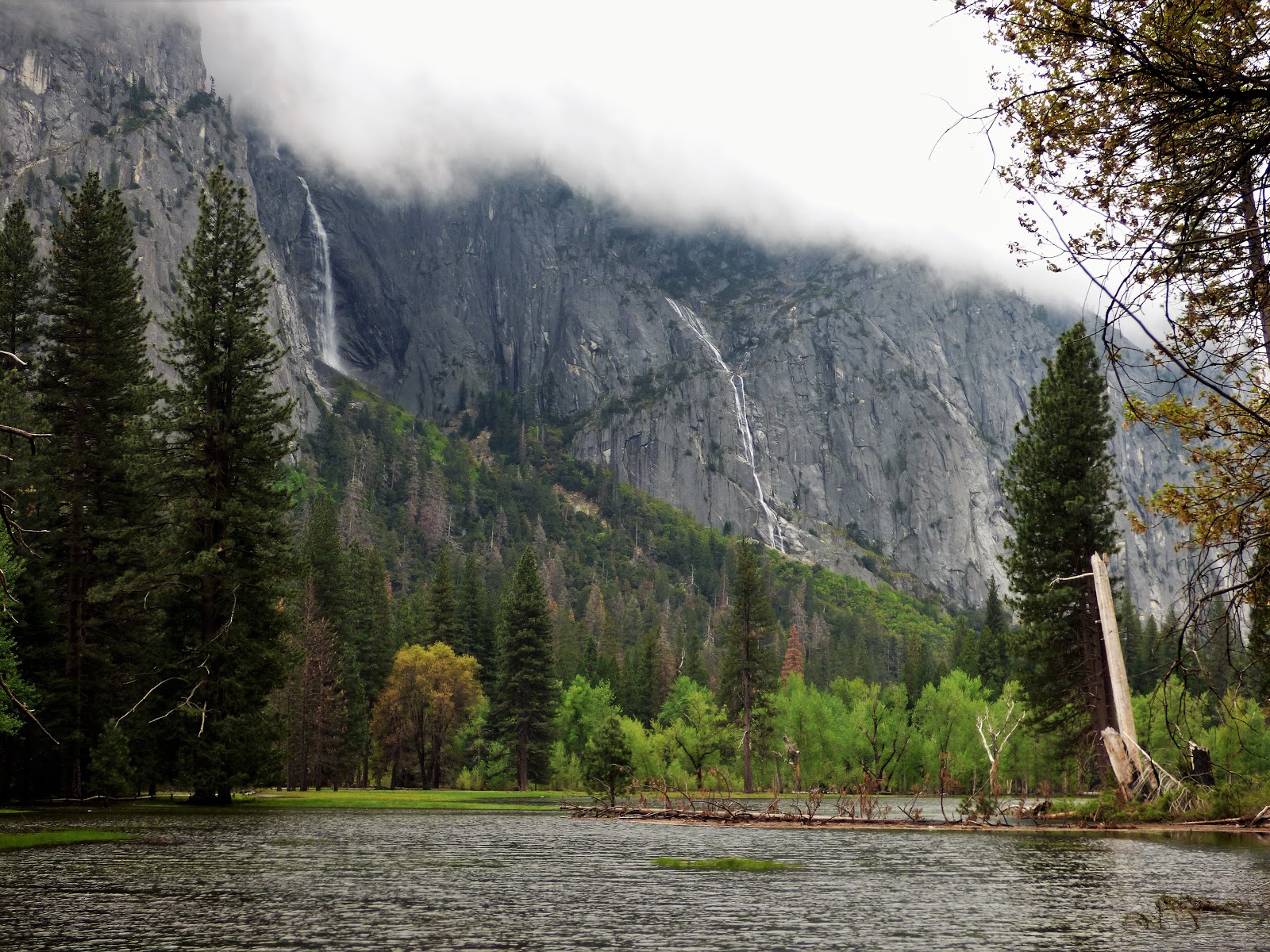
Let's consider for a moment that this is anyplace else in the world. You look up and see a waterfall that is 1,920 feet high, falling in six major steps. In what place in the world would this not be a notable feature with a state or national park designation? In what place would there not be thousands of people visiting every day, snapping pictures and oohing and aahing?
There are no parking lots and viewpoint for this waterfall. As a rule people barely notice that it exists. If that seems astounding, then take this as evidence of the extraordinary nature of Yosemite Valley. 2,000 foot high waterfalls disappear into the scenery. The name of this particular one is Sentinel Falls.
I admit that part of the reason Sentinel Falls is not as celebrated as some is that it is seasonal, flowing principally in the spring season. It's usually dry by the beginning of summer when most tourists visit the valley. But when it is flowing, it is spectacular.
Sentinel Rock suffers the same kind of locational insignificance. In any other part of the world, a 3,000 foot high sheer cliff would elicit awe and wonder. In Yosemite Valley there are so many dramatic cliffs that Sentinel gets lost because people are trying to get a glimpse of Yosemite Falls on the north rim of the valley. Sentinel Rock and the adjacent Sentinel Falls are on the south side of Yosemite Valley, almost directly across from Yosemite Falls. Yosemite is the waterfall that catches their attention.
That's not to suggest that Yosemite Falls doesn't deserve the adulation it receives. The waterfall is 2,425 feet tall, somewhere around the fifth to seventh highest in the world. It always has more water than Sentinel does, and in many ways it is more dramatic. But when I was taking pictures of Sentinel last week in the rainstorm, I was the only person standing in my little corner of the floor of Yosemite Valley. I didn't have to share my moment with throngs of tourists all staring at the same feature and snapping the same pictures from the same angle. It was just me and a quiet moment in an often crowded and hectic place.

Wednesday, May 17, 2017

The Unsung Waterfalls of Yosemite Valley

One takes their chance when deciding to visit Yosemite Valley in the springtime. The storms of winter are never quite done by then, and you may find yourself in a valley full of clouds. That's where I found myself a week back, touring the Yosemite region with my students. It had been two weeks of no precipitation, but on Saturday, the storms came back for a day.
Sentinel Falls (left) and unnamed fall (right)
So it was that we were playing hide and seek with the iconic peaks and waterfalls of Yosemite. We did get to see most of them, with Half Dome being the notable no-show. Still, clouds add a wonderful aura of mystery if they are scattered enough to reveal bits and pieces (like a feather boa dancer). It's on such days that a person can realize the full richness of waterfalls in Yosemite.
Lower Sentinel Falls
Yosemite is famous for Bridalveil Fall, Yosemite Falls, along with Nevada and Vernal Falls on the main channel of the Merced River. But in spring when the snowmelt is high or if there is heavy rain, the valley walls come alive with falling water. Sentinel Falls (above) would be world-famous were it not on the valley wall opposite Yosemite Falls, and if it didn't dry up most years before June. It falls 1,920 feet in a series of drops, of which the longest is about 500 feet. There is an equally high fall to the west.
Royal Arches Cascades
Royal Arches Cascades are on the cliffs behind the Ahwahnee Lodge (currently called the Grand Majestic or something like that). They have a total drop of about 1,250 feet. Unlike most of the others, it's not overly hard to scramble to the base of the falls in the forest east of the lodge.
Staircase Falls
A number of times I've been eating pizza at Curry Village (now called Half Dome Village because of a copyright fight), and noticed the sound of falling water. A little searching of the cliffs reveals Staircase Falls, which drop over a series of jointed ledges of granitic rock below Glacier Point. They total 1,300 feet, but like the others they are often dry by early summer.
Staircase Falls from Curry Village
There are lots of other waterfalls to discover this time of year. These are just the ones that chose to reveal themselves to us during our brief visit under the clouds. You'll be able to find plenty of others if you can get here.

I'm hard put to describe my favorite time at Yosemite Valley. Winter, for the snow and the quiet, spring for the greenery and the Dogwoods blooming and the full waterfalls, fall for the bright colors, or summer for the access. If there is a least favorite time, it's probably August when the crowds are at their greatest but the waterfalls aren't. But you know what? It's worth a visit any time you can get there.

Wednesday, May 11, 2016

Yosemite's Waterfall Riches: When the Junior Varsity Team Outdoes Everyone Else's Varsity

Ribbon Falls (1,612 feet) just west of El Capitan. The colorful red trees aren't fall colors; they're conifers killed by California's extended drought.
You wouldn't know it from the fine physique I carry around on my middle, but I once had an exciting career in high school track and field, and also cross-country running. I was even one leg of a relay race against a relay team with Steve Scott, one of America's greatest milers (yes, our team lost). I learned a lot from that experience, the most important being that I was too lazy to be a world-class athlete, and too slow. But the other thing I learned was that some teams were so good that their junior varsity teams could beat any other varsity team in the district.

Which brings us to Yosemite Valley. I've been up to the park twice in the last month, but Mrs. Geotripper wasn't able to come along, so I didn't argue at all on Sunday when she said "Let's go". I wrote a recent blog showing off some of the beautiful waterfalls that made the valley famous ("Yosemite's Dance of the Seven Veils"), but this trip I was realizing that Yosemite's junior varsity waterfalls are as good as any other valley around. You might miss them if you visit in the summer, but they are stunning when you get a chance to see them.
Ribbon Fall
One of them has the greatest free-fall of any waterfall in the valley (and probably in the United States). Called Ribbon Fall, it drops 1,612 foot (491 meters). Because it is one of the first ones seen by visitors arriving in the valley (it's west of El Capitan near the entrance to the valley), it's often mistaken for Yosemite Falls. Yosemite Falls is technically a taller waterfall at 2,425 feet (739 meters), but it's broken into three parts with the Upper Falls having the greatest free-fall at 1,430 feet (440 meters). Ribbon is an incredible sight at this time of year, but it dries up quickly in the spring, as it has a very small watershed.
I showed off Sentinel Falls in the last post about Yosemite, but I got closer this time and got a picture from a different angle. The falls are on the south side of the valley near Sentinel Rock and drop 1,920 feet (590 m). 
Yosemite Falls (2,425 feet/739 meters) are of course the waterfall of Yosemite Valley, but few people notice that there is another fall visible in the same scene. If you look in the distance on the right, you can just make out Lehamite Falls (1,180 feet/360 m), the only waterfall in Yosemite that retains an original Ahwaneechee name ("Arrowwood Fall"). It's true that the falls are a bit less spectacular than others in the valley, but were it not for a quirk of the glaciers, Yosemite Falls would have been very similar in appearance to Lehamite. Yosemite Creek was diverted by a glacial moraine and forced to its present location on the sheer cliff.
Lehamite Falls (1,180 feet/360 m)
People who arrive at Yosemite by way of Highway 140 through the Merced River Gorge are treated to a pair of waterfalls, one that is hard to miss and another that is hard to find. Cascade Creek and Tamarack Creek join together a thousand or so feet above the river and form Cascade Falls, with a drop of about 500 feet or so. There is a pullout and a parking area, so this one is hard to miss. 
Cascade Falls
There is a slightly "off" interpretive sign at the falls. It doesn't make clear that these are the Cascades, and a map suggests that one might be standing under Wildcat Falls. I noticed the discrepancy and looked around, believe it or not, for the first time in 80+ visits to the park and tried to see Wildcat Falls (720 feet/219 meters). It wasn't that easy, but hidden off in the trees to the west was a multi-tiered waterfall. I didn't have time to see the grotto at the base, but I got the shot below of the biggest single drop.
Upper Wildcat Falls
One more easy-to-miss fall in the valley is Silver Strand. The reason is that it above and slightly behind the awe-struck visitors standing at Tunnel View, perhaps the most famous vista in the park. The fall drops 574 feet (175 m), and often completely freezes over in winter, becoming an ice fall.

Silver Strand was almost completely obscured by the low cloud deck on Sunday, so I've included a picture from our trip a week ago when the skies were clear.
Silver Strand falls in the sunlight (sort of)

Yosemite's waterfalls are without compare. There are many more that I didn't get pictures of last week, including the Widow's Tears (1,170 feet/360 m), Horsetail Falls (2,130 feet/650 m), Illilouette Fall (370 feet/110 m), Snow Creek Falls (2,140 feet/653 m), Nevada Fall (594-foot/181 m), Vernal Fall (317-foot/96.6 m), and the many unnamed falls and cascades that occur at this time of year. It's like they say, "when it rains (or snows), they pour"!

Saturday, May 7, 2016

Yosemite's Dance of the Seven Veils: The Valley on a Rainy Day

She freed and floated on the air her arms
Above dim veils that hid her bosom's charms...
The veils fell round her like thin coiling mists
Shot through by topaz suns and amethysts

 "The Daughter of Herodias" by Arthur O'Shaughnessy

It goes without saying, but when the rain falls, Yosemite is a different place.  When storms are moving up the western slope of the Sierra Nevada, Yosemite Valley produces strange cloud effects, due to a half-mile deep cleft that has warmer air currents rising into the storm clouds. The familiar big rocks like Half Dome or El Capitan may be hidden completely, or they may reveal themselves in small bits at a time, like the dancer Salome or her many successors throughout time.
Upper Yosemite Falls
I took two trips to Yosemite Valley in April. The second trip on the 30th was clear and sparkling like a diamond. You can see the spectacular beauty in the previous post about the centennial of the National Park Service. The weather forecasts for the first trip back on the 9th weren't so promising. They suggested precipitation all morning with a chance of clearing in the afternoon. The "clearing" part wasn't to be. The rain never stopped from the time we arrived until the moment we left. It ebbed and flowed, sometimes declining to a light drizzle that allowed us to make note stops. But we never saw the whole valley that day. Just little bits at a time.
Staircase Falls from near Curry Village
A disappointment? Oh, not at all. Clouds give the cliffs a sense of perspective and depth that is not always possible on a clear day. The cliffs can seem higher, appearing above the clouds. And the waterfalls...on a rainy day, there are waterfalls everywhere, in the most unlikely spots, and many are impossibly high, rivaling Yosemite Falls in some cases. And the familiar falls are booming.

Staircase Falls come off the cliffs near Glacier Point above Curry Village (yeah, I know, it's called Half Dome Village at the moment). The falls last only a few weeks in the spring and during storms, but fall in a series of steps for a combined drop of 1,300 feet (400 meters). On a quiet day one can hear the water splattering on the cliffs while munching pizzas in the village (always a happy memory!). The "staircase" is formed by a series of prominent diagonal joints (pressure-release fractures) that run across the nearly sheer cliff.
Upper Yosemite Falls
Yosemite Falls are the most famous and iconic of the falls in the valley. They include the upper falls with a drop of 1,430 feet (440 meters), the Middle Cascades at 635 feet (206 meters), and the Lower Falls at 320 feet (98 meters). The total drop is 2,425 feet (739 meters), making Yosemite Falls somewhere around the 5th to 7th highest waterfall in the world.

Yosemite Falls are unique, owing to the extreme drop off of an illogically placed stream channel. It turns out the falls were once flowing down a far less spectacular channel just to the west, but a glacial moraine upstream diverted the original creek to its present-day location.
Royal Arches Cascade
The Royal Arches Cascades plummet about 1,250 feet (381 meters) from the north wall of the valley just west of the arches. They are another ephemeral waterfall seen only in the spring or during rainstorms. They are truly unique in one respect, in that you can easily reach the base of the falls within a short walk of the Ahwahnee Hotel (yes, I know, the "Majestic Yosemite" Hotel, but whatever). The trail, part of the North Valley Loop, takes off from the parking lot, and the base of the falls are just a short scramble up the slope.

Sentinel Falls (left) and maybe Fissure Falls (right)
There are two waterfalls on the south side of Yosemite Valley that are rarely seen by summer visitors to the park, Sentinel Falls (1,920 feet/585 meters), and the falls on the right in the picture above, which may be Fissure Falls, but I am not at all sure. They may not have a name at all (Fissure Falls is an informal name anyway). Sentinel Falls may be the most spectacular waterfall that no one has ever heard of. Can you imagine how famous they would be if they were in any other setting?
Bridalveil Falls
Our short tour of the "seven veils" wouldn't be complete without a feature that actually has "veil" in its name. Bridalveil Fall is often the first waterfall seen by park visitors, being quite obvious from Tunnel View and many other vantage points on the west side of the valley. It drops 620 feet (190 meters from the valley between Cathedral Rocks and Leaning Tower. A short trail from a crowded parking lot leads to near the base of the fall. This time of year, you will get very wet. It didn't matter all that much to my students that day, since they were already wet to start with.

If you visit Yosemite on a rainy day, you are quite likely to miss something. Our students never got a clear view of Half Dome or Ribbon Falls, or the panorama from Tunnel View. But they got to see a different Yosemite, one in which water was pouring everywhere off high cliffs in unnamed waterfalls, and cliffs playing hide and seek with the clouds. It was good enough!

Saturday, December 20, 2014

If These Cliffs Could Talk: The Cliffs of the Ah-wah-nee that Never Got Legends


Do you know these places? Would a place that has cliffs like these merit being declared a national park?

Thankfully, these rocky precipices are in a national park already. But these are not the iconic features that end up in the photo collections of the millions of tourists that visit this place every year. But these cliffs contribute to the awesome scenery by serving as the backdrop for some very famous rocks. They serve as the supporting chorus behind the hardrock band, so to speak. They are the unsung cliffs of Yosemite Valley (the Ah-wah-nee). As far as I know, few of these escarpments have a mythical legend that celebrates their existence.

If these cliffs of Yosemite Valley could talk, they would have something to say about my recent little miniseries on the most famous rocks that can be seen from the valley floor. They would say "but, none of these cliffs could be famous without the un-famous cliffs and slopes that lay between".

The first picture in this post has a waterfall that is usually dry by the time most tourists begin arriving in June or July. When it is running it is often mistaken for Yosemite Falls by first-time visitors (until they see Yosemite Falls anyway). It is Ribbon Falls, which is actually the waterfall at Yosemite with the greatest unbroken drop (1,612 feet; 491 meters). Compare that to Upper Yosemite Falls at 1,430 feet (436 meters). The total drop of the three steps of Yosemite Falls totals 2,425 feet (735 meters), making the better-known fall one of the top ten highest falls in the world. Ribbon is apparently 99th. But imagine if it were the only fall at Yosemite. How famous it would be! It doesn't always get noticed because it lies just west of the boldest cliff of El Capitan.
The cliff in the picture above is an unnamed spire in the vicinity of Sentinel Rock. Although the cliff is thousands of feet tall, it is less imposing than Sentinel because it is more highly jointed (fractured). The rocks have been darkened by lichens and staining and thus appear darker than most of the granite cliffs (fresh exposures from more recent rockfalls reveal the lighter rock).
The partly rounded rock on the left in the picture above is the familiar Leaning Tower, although the lean is not so prominent from this angle. The rugged cliffs on the right include Dewey, Crocker, and Stanford Points, but the cliffs have no particular name. Like the previous photo, the rocks are more highly jointed, resulting in a recessed cliff face with talus (slopes of fallen boulders) covering the lower portions.
To me, one of the most striking features of Yosemite Valley is the total non-cliff that lies just west of Ribbon Falls and El Capitan. Instead of a vertical precipice, the slope is almost entirely buried in talus from the constant collapse of what cliffs there are. The dark-colored plutonic rock is called, not too surprisingly, the Diorite of the Rockslides. It is the most highly jointed of all the rocks in Yosemite Valley.
The next picture is a familiar view to anyone who has visited Glacier Point. Yosemite Falls is apparent on the left, and the Royal Arches are partly visible on the right, but the cliffs in-between are less familiar, in part because of the intense jointing that has led to a less bold appearance. The deep cleft in the center of the photo is Indian Creek, and the crenelated cliffs to the left of the creek are called the Castle Cliffs.
Panorama Cliff appears in many photographs taken from the vicinity of the Ahwahnee Hotel, but few know the name. It forms the south wall of the Merced River canyon where it emerges from Little Yosemite Valley.

One would think that waterfalls thousands of feet high would get more attention, but these two are very seasonal, generally drying up by late May or early June. The one above is the Widow's Tears, a 1,170 foot high waterfall tucked into the cliffs near Crocker and Stanford Points west of Leaning Tower. It has been mistaken for and mislabeled as Silver Strand Fall, which is much shorter.
And finally, there is Sentinel Falls, a 1,920 ft (590 m) fall on the west flank of Sentinel Rock. Like the other less famous waterfalls, it is ephemeral, and often dry by early summer. The biggest drop among the many cascades is about 500 feet high.

Light and shadow. Positive and negative.Yin and yang.

Mrs. Geotripper, the artist, tells me that yin and yang can be thought of as complementary (rather than opposing) forces that interact to form a dynamic system in which the whole is greater than the assembled parts. That is what these cliffs accomplish at Yosemite Valley. For every bold cliff like El Capitan, Half Dome, or Sentinel Rock, there are recessed cliffs that lie in the shadows. Hidden among these recessed cliffs are beautiful waterfalls that during the right time of year rank as some of the world's highest and most dramatic. If we could just find them among the richness of features at Yosemite Valley!

Tuesday, June 15, 2010

Omigosh, They Sold Yosemite Falls to Retire the National Debt! Whatever Will We Do??

I think they're gonna use it in a new amusement park!I'M KIDDING! I just wanted you to think about something. Yosemite Falls is just spectacular this time of year, but would you visit Yosemite Valley if you didn't get to see it? Is there another reason to visit the valley, waterfall-wise? I got to see two nice candidates during the high runoff last week. It is true that both of these falls dry up relatively quickly in the late spring or early summer, but when they flow, they are world-class. I saw the first of these from a new spot last week...somehow, I've never stopped at Bridalveil Meadow before (in 80 trips!!). Viewed from the southwest edge of the meadow, Ribbon Fall leaps off the cliff and falls for 1,612 feet, making it the highest single drop of any waterfall in the valley (Yosemite Falls drops 2,425 feet, but does so in three parts, the tallest being 1,430 feet). Combined with the west face of El Capitan, it makes for a memorable view.

Here is a closer view from Bridalveil Meadow. The entire fall can be seen from the large pullout at Bridalveil Falls view. You just have to turn around and look away from Bridalveil Fall, and many people seem to miss it.


Another fall that reaches for majesty in the spring runoff is Sentinel Falls, which drops 1,920 feet in five steps, the largest of which is 500 or so feet. It is accompanied by the incredible Sentinel Rock, to the left in the picture below, one of the other "not always noticed" rocks in Yosemite. I call it that because to see it, you have to turn and look away from Yosemite Falls, if you can. It's behind you!
If you ever have a chance to see Yosemite in the spring, go for it! If not, enjoy the pictures, it's the reason I put them up (and I would like to see some more spring pictures from the places I can't get to, too).

Thursday, April 17, 2008

Under the Volcano: Changing the Emphasis -Part 3

Yosemite Valley is one of the most familiar of our national parks, but this week I have been trying to tease out some of the valley sights that are overshadowed by the famous iconic domes and waterfalls like Half Dome, El Capitan and Bridalveil Falls. In any other setting around the planet, these little-known cliffs and falls would be renowned. This beautiful wispy waterfall is not visible from the Wawona Tunnel View (unlike the features of the last few postings), but instead lies hidden between Sentinel Rock and Cathedral Rocks. It is called the Sentinel Falls, and like before, is one of those relatively unknown treasures that is usually trumped by a stunning view of Yosemite Falls, which lie on the opposite side of the valley. In other words, everyone looks the wrong way. The falls drop about 2,000 feet, although no single drop is more than a few hundred feet. It also evident from the limited discharge that the falls dry up relatively early in the summer. The rock over which the falls plunge is the Sentinel granodiorite, which was described in yesterday's post.