Showing posts with label Black Chasm Cavern. Show all posts

Tuesday, January 1, 2019

Good-bye to 2018: 12 Months of the Joy of Geology


Mesa Arch in Canyonlands National Park
It's been a year. There are lots of ways of looking at the events of 2018 and so many of them are tragic and unjust. But there is always hope as well. There are still the beautiful places of the Earth, and always a chance to seek them out, no matter where you are. That's the joy of being a geologist and a teacher. Or being anyone with a curiosity about our planet. What follows are twelve months of exploring our planet from my base in California's Great Valley.
Merced National Wildlife Refuge, south of the city of Merced.
Where does one go in January? So much of the countryside is covered in snow, but California is kind of special in that regard. We get to visit the snow if we want and then we can go home to our valleys and coastlines. The migrant birds know all about this. Millions of geese and other species spend their summers in the Arctic, but when the snows come they fly south and spend the winter in a series of wetlands and prairies that have been preserved in places like the Great Valley. Our destination in January was the Merced National Wildlife Refuge. There were thousands of Sandhill Cranes, Snow Geese, Ross's Geese, and multitudes of ducks. It is an overwhelming experience to stand at the edge of the wetlands and imagine this valley hundreds of years ago before agricultural development took over 95% of the landscape.
Zabriskie Point and Manly Beacon in Death Valley National Park
The most satisfying aspect of a teaching position in geology is the chance I have to share the incredible planet with my students in my classroom of course, but also in the field. In February our intrepid crew headed out to Death Valley National Park in the Basin and Range Province of eastern California. The valley is a vast fault graben with 11,000 foot peaks next to valley floors below sea level. It is the hottest place in the world and the driest place in North America, yet 20,000 years ago it contained a 100-mile long freshwater lake and grassy savannas with horses, camels, and mammoths. Some of the fish who inhabited the lake still survive today in isolated spring-fed ponds.
Natural Bridge in Death Valley National Park
Death Valley is recognized as the premier geology park in the national park system, containing rocks as old as 1.7 billion years, and including layers and intrusions from every period in Earth history ever since.

We survived a phenomenal windstorm on the last night of our trip. I hate to say I littered in a national park, but somewhere out on the dunes there is a tarp that blew away from under my tent in the night.
The Ghirardelli Store in Hornitos within the Sierra Nevada Mother Lode
Our field studies in March were closer to home. We journeyed through the southern Mother Lode of the Sierra Nevada. We saw ghost towns, old mines, and the quartz veins that were the source of the ores of the California Gold Rush in 1848. The ruins in the picture above are the Ghirardelli Store in Hornitos. Before he made chocolate in San Francisco, the man sold supplies to the miners in the Mother Lode.
Yosemite Falls in Yosemite Valley
In April, Yosemite National Park took center stage, as we took two field studies trips there. One of them was the morning after an epic flood that closed the park for a day or two. When we got there, the Merced River was still at flood stage and the waterfalls were booming.
Mt. Rainier in Washington
In May, family matters found us on a plane out of Seattle, Washington. We left for home in the early evening while Mt. Rainier was capturing the last rays of the sun. As you may have read in the last post, Rainier (14,411 feet) is the tallest volcano in the Cascade Range, and has more glacial ice than any mountain in the Pacific Northwest. The potential of eruptions happening under the ice makes Rainier one of the most dangerous volcanoes on the planet. Lahars (volcanic mudflows) could overwhelm some of the cities of the Puget Sound.
Horseshoe Bend on the Colorado downstream of Lake Powell and Glen Canyon Dam
One of the greatest adventures one could ever experience is an in-depth exploration of the Colorado Plateau. It is a showcase of geology with a treasure trove of national parks and monuments. In June, our intrepid crew headed out to plateau country where we explored Grand Canyon, Zion, Bryce Canyon, Black Canyon of the Gunnison, Mesa Verde, Arches, Canyonlands, Capitol Reef and Great Basin National Parks. The region is so extraordinary that a place like Horseshoe Bend on the Colorado River isn't even in a national park or monument.
House on Fire Ruin in Bear's Ears National Monument
One of the great crimes of the present administration in Washington D.C. was the attack upon the Bear's Ears National Monument. Even though the law didn't allow it, the park was reduced in size to 15% of what it had been before. And for the sole purpose of money, i.e. oil drilling and uranium mining. I hope the courts do the right thing this year.
Hurricane Ridge in Olympic National Park
In July Mrs. Geotripper and I escaped the heat and dust of the Great Valley and headed north along the coast, eventually reaching Olympic National Park in Washington. Hurricane Ridge is one of the most stunning viewpoints in America. The views take in the alpine peaks glaciers of Mt. Olympus, the temperate rainforests of the valleys, and the coastlines around Port Angeles. The mountains are composed of oceanic sediments and seafloor crust pushed upwards by the motions of the Cascadia Subduction Zone.
We stayed close to home in August, but almost every morning found me walking the Parkway Trail along the Tuolumne River where it flows from the Sierra Nevada foothills onto the floor of the Great Valley. Birders (including me) discovered 115 species on this trail over the course of the year.
Valentine Cave in Lava Beds National Monument
The resumption of classes in August and September found me and my students on the road again. We explored the Cascades Volcanoes, including Mt. Shasta, Lassen Peak, Medicine Lake Highland and Lava Beds National Monument. Lava Beds has miles of lava tubes, one of the greatest concentrations in the world.
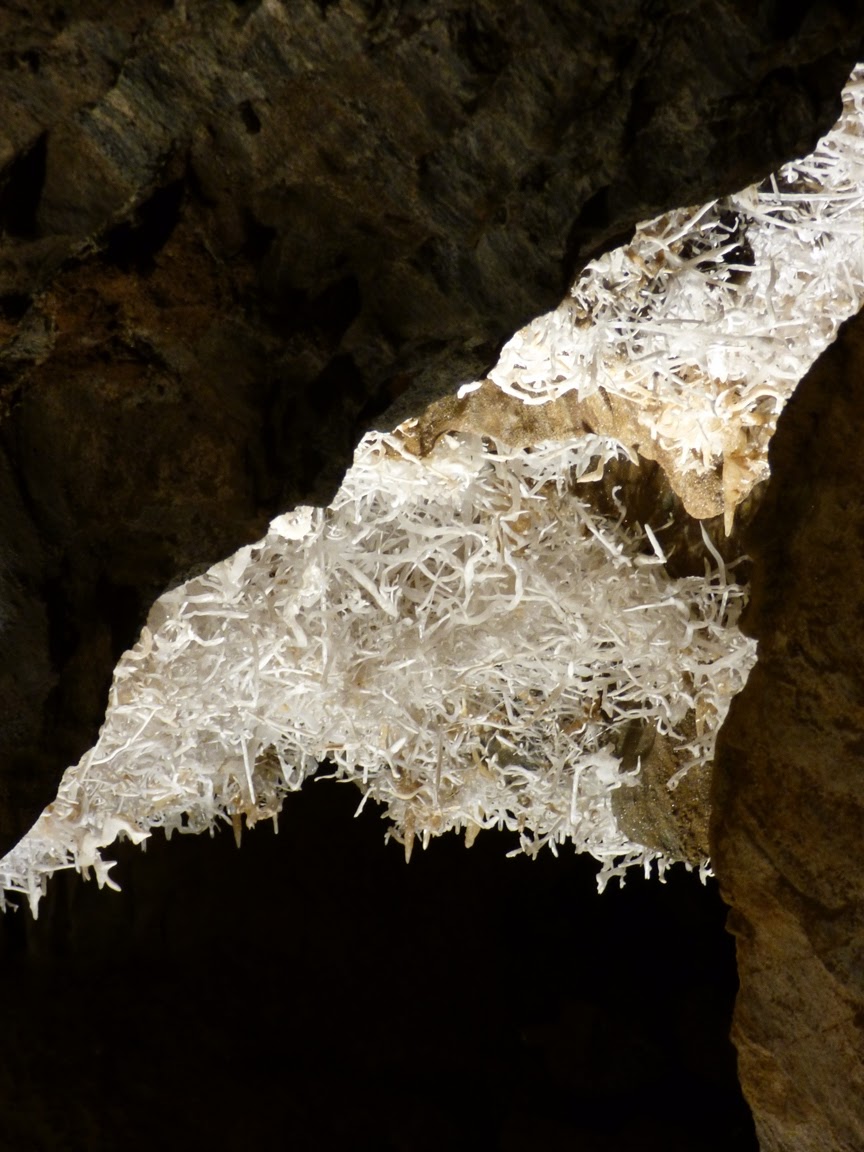
In October we went underground again with an exploration of Black Chasm Cavern. The cave has been carefully managed so that visitors can see cave decorations that are absolutely pristine. The cave has thousands of fragile speleothems called helictites. I call them stalactites on acid...
November was the lost month. The horrific fire in Paradise caused air quality to suffer throughout the state and the school shut down for a week and a half. It's the first time this has happened, and our scheduled field trip to Pinnacles National Park was postponed to the beginning of December. We went underground again, in yet another kind of cave. It wasn't limestone or marble, and it was a lava tube even though the Pinnacles are volcanic. It's a talus cave, one caused by giant boulders falling into and covering a narrow canyon. Hikers are in near total darkness for upwards of a quarter mile.

December arrived and along with it came the holidays. We have family all along the coast from California to Washington, so Christmas for us was a very long road trip. On our last night we stayed near Mt. Shasta in Northern California. The sunset provided beautiful lenticular clouds around the summit of the second and third highest volcanoes in the Cascades (you'll have to check out the last post to learn about that one).

And that was the story of my year and that of my students and Mrs. Geotripper. We saw a lot of incredible things, and my whole purpose in describing these places is to encourage you to explore them for yourselves. I know that this is impossible for many, which is quite literally why I write this blog. But if you can make time and get away, seek out the wild places where you live. If your local college offers field studies courses, consider getting back into school for some personal enrichment. I guarantee you won't regret it.

If you live in the vicinity of Modesto, the Modesto Junior College Geology Department will be offering a great line-up of field studies courses. We'll explore Death Valley again in February, the Southern Mother Lode in March, and Yosemite Valley in April. In September we'll head out to the Eastern Sierra Nevada and Owens Valley. In October we'll travel through the Mother Lode, and in November we'll be back to Pinnacles National Park.

But our premier trip with be on June 26-July 10 when we head to British Columbia and the Pacific Northwest. We'll be exploring Olympic and North Cascades National Parks, Vancouver Island, and the Coastal Mountain Ranges around Whistler and Pemberton. It will be a memorable experience. If you are interested, keep an eye on this blog, follow our Facebook page at https://www.facebook.com/groups/1920712791360611/, or the class web page (soon to be updated) at http://hayesg.faculty.mjc.edu/GeologyPacificNorthwest.html.

See you on the road!

Sunday, October 28, 2018

The Magic of a Pristine Cave: Wanderings in the Black Chasm

The miners were not kind to the caverns of the Sierra Nevada.

The search for gold in the foothills led fortune-seekers all over the hills and valleys of the Mother Lode in the Sierra Nevada, and practically every slope and hollow was prospected for the elusive metal. They usually came up empty of the riches they sought so eagerly, but many times the miners would encounter an unexpected opening in the outcrops of marble that occurred here and there in the Calaveras Complex. They discovered dozens of caverns.
Helictites at Black Chasm cave
For light they used torches and candles, and they didn't hesitate to break off cave decorations (speleothems) as souvenirs. A few enterprising miners realized they wouldn't get rich with gold so they charged admission to their caverns and made money from tourism instead. But they didn't control the behavior of their guests, and more speleothems disappeared. The once beautiful and intricate caverns were reduced to mere holes in the ground, and what decorations remained were grimy with soot and muddy fingerprints from visitors using them as handholds.
The "dragon" at Black Chasm
To be sure, times haven't changed that much. Spelunkers learned long ago that publicizing a newly discovered cave was often a death knell, so locations are kept a highly-guarded secret, and when possible vulnerable caves are fitted with locking gates. But there are two exceptions. California Caverns and Black Chasm cave have rooms that were inaccessible and undiscovered during the Gold Rush, and these have been developed carefully in such a way that the original appearance of the cave has been preserved. We visited Black Chasm today as part of my field class on the caverns and karst topography of the Mother Lode
Soda straws (straight) and helictites (twisted) at Black Chasm cave
Folks are sometimes surprised to find out the true color of stalactites and other speleothems; they're pure white. And they are so incredibly delicate. So-called soda straws and helictites are so fragile that a single touch will break them off, destroying thousands of years of exceedingly slow growth.
Soda straws (straight) and helictites (twisted) at Black Chasm cave
The helictites of Black Chasm are particularly memorable. There are thousands and thousands of them, possibly the greatest accumulation of any cave in the country. The room where the visitors can view them is just one of several. The others are off-limits, and appropriately so. The origin of the helictites is obscure and is debated by cave researchers (speleologists). They obviously ignore gravity.
Black Chasm cave is privately owned and offers tours (for a fee of course) all year long. They are located adjacent to the village of Volcano a few miles up the hill from Jackson on Highway 88. There are other "attractions" for kids at the site (panning for gems, breaking open geodes and that kind of thing), but they also offer some surprising sophisticated cave research publications for sale. They have always been very cooperative about arranging tours for our college groups. If you are ever in the Mother Lode, don't pass up this opportunity to see some truly pristine caverns.

Sunday, October 22, 2017

How Does a Pristine Cavern Look? Black Chasm Provides a Clue

Some things can only be experienced once. The discovery of a new plant or animal that no one has ever seen, a new mineral, a new planet in space, to see a vista that no one has witnessed before. Exploration of new things is one of the great joys of being human. One of the saddest lines I've ever seen in a move was from The Truman Show (1998):

Young Truman: I'd like to be an explorer, like the great Magellan.
Teacher: [rolling down a map of the world] Oh, you're too late. There's really nothing left to explore.
Entrance room of Black Chasm cave. The dirt on the decorations is from soil seeping in from above, but many of them are broken from early explorers and visitors.

And there are things that can be destroyed only once. The extinction of a species, a beautiful canyon marred by a poorly-planned development, the destruction of a culture or a people.
If there is anything I have learned as a scientist and a teacher, it is that there is never an end to exploration. I was reminded of this as I took a group of students on a field studies journey on Saturday. Ostensibly the trip was about caverns and karst topography in the Sierra Nevada Mother Lode, although it included a great deal of information about the 1848 Gold Rush as well. We toured Highway 49 between Jackson and Columbia, but included an excursion through Black Chasm Cave near the village of Volcano.
Helictites in Black Chasm Cave
So many caves that are known today were discovered in previous centuries, and have been explored and vandalized to a shocking degree. My opening point about a single moment of discovery and a single final moment of destruction applies in many ways to caverns. A cavern can only be discovered and explored once. From that time on, in human terms, it is moving inexorably towards destruction. Caverns cannot recover from the damage inflicted by human visitors in any kind of time frame that people would recognize.
Helictites in Black Chasm Cave
Non-cavers are often confused or bemused by the nearly maniacal lengths that cavers take to prevent causing damage to pristine caves. But the cavers themselves understand. Many experienced cavers have watched some of their favorite places turn from a mystical underground fairyland to a dark dirty troll's den in the space of a few years. Research literature documents the destruction of caves as their location becomes known to the public at large. For this reason, the location of the vast majority of caverns is a closely held secret. A pristine cave is a rare and precious resource that is too easily lost to vandals. As a consequence, most casual cave visitors will never know the experience of a newly discovered cave. But there is a way that they can come close.
Helictites and stalactites in Black Chasm Cave
There are around a thousand known caves in the Sierra Nevada, and six are open for tours: Crystal (in Sequoia National Park), Boyden (just outside Kings Canyon National Park), Moaning (near Columbia), California (outside San Andreas), Mercer (near Murphys), and Black Chasm. Each of them have their charms and educational value, but Black Chasm stands out. It is one of the few that has the feel of an undefiled cave, at least once you've crossed the "chasm".
The "Dragon", mascot of Black Chasm. That's not the normal color...the guide was using a laser pointer on it.
The miners who discovered most of the Sierra caves explored them with smoky torches or candles, and they as well as those who followed over the years had no compunctions about touching and breaking off the speleothems (cave decorations) found in the caves. Owners even encouraged visitors to take a souvenir, thinking that the stalactites would grow back within a few years. These caves ended up with dirty walls and ceilings, and the only stalactites left were those that were out of reach of visitors. This also happened at Black Chasm.
But a short distance into the steep cave entrance the rocks drop off into the inky darkness of the chasm itself. It's around 90 feet deep with sheer walls and a series of small lakes or ponds at the bottom. Getting to the rooms beyond required technical climbing skills that weren't practical until the 1960s and 1970s. Those who were then able to explore deeper into the cave were careful spelunkers, not vandals, and the rooms they found were spectacular.
When the owners decided to develop the cave, they constructed a series of stairs and bridges that provided access to the back rooms of the cave, but the stairwells also prevent tourists from getting too close to the pristine decorations. And what wonderful decorations they are! The first thing I always notice is the pearly white color of the dripstone and flowstone features. They don't have any soot or dirt on them at all. The next thing that comes to my attention is the total lack of broken features. They quite literally look the way they did when they were first discovered except for the lighting. Because the flowstone and other features are translucent, the owners were able to place the lighting behind the features so the light could glow through. The photographic results sans flash are wonderful. Flash pictures always seem to make the speleothems look flat and featureless.
The crowning feature of Black Chasm Cave is the number and variety of helictites. They can be thought of as stalactites on drugs. They don't believe in gravity and have instead grown in all kinds of directions, almost as if someone took handfuls of spaghetti noodles and tossed them onto the wall. They are rare in caves, especially those open to tourists, in part because of their incredibly fragile nature. A single touch would be more than enough to snap them off. But it hasn't happened at Black Chasm. The sheer number on some walls (thousands of them) have resulted in the cave being declared a National Natural Landmark, a federal program that encourages owners of outstanding natural features to protect their resource (of course it doesn't hurt their public relations).
The owners of Black Chasm Cave have done a great job of protecting their resource, and their tours are done well. In addition, they encourage educational groups by offering steep discounts, so I have no problem recommending them to my fellow educators. Information about visitation and tours can be found on their website at https://caverntours.com/black-chasm-cavern-national-natural-landmark/. They also have an excellent nature trail on the property (that will be in the next post), plus a curio shop with some surprisingly sophisticated speleology texts for sale, along with the usual geodes and t-shirts.

Don't ever stop exploring!

Thursday, November 12, 2015

The Karst Topography...of California? Into the Black Chasm

California is not really known for her expanses of karst topography, the landscapes that develop where limestone or marble lies underground. In my short mini-series about the karst of California, we've seen the gold-fields of Columbia State Historical Park, the grinding stones at Chaw'se State Park, and the Natural Bridges of Coyote Creek. Today we are going underground to see the reason for the sinkholes and disappearing streams: the caverns of California. Believe it or not, there are more than a thousand of them! There are about eight of them that have been developed for tours. We'll have a look at some them over the next few posts.
On our recent trip exploring the karst topography of the Sierra Nevada Mother Lode, we visited one of the most unique: Black Chasm Cavern, near the Gold Rush town of Volcano. Black Chasm was opened for tours around 1990, but it has been known since the Gold Rush days.
An early discovery by miners is usually the death-knell for a cave. The early explorers tended to be careless, and they thought nothing of breaking off cave decorations (speleothems). Such caves eventually became muddy holes in the ground, bereft of any beauty. But Black Chasm had something going for it, something that protected the cave: it was the Black Chasm itself.
Just inside the very step entry passage, there is a 100 foot deep fracture that halted any further exploration of the cave unless the spelunkers had technical climbing gear. Far down at the bottom of the chasm, there is a turquoise colored lake. When the cave was developed, the owners affixed a stairwell across the upper part of the chasm, providing access to the Landmark Room at the far end of the cave (the tour covers several hundred feet of the cave, which has a total of about 4,000 feet of passageways).
The Landmark Room is a true revelation for cave enthusiasts: it's almost completely untouched by vandals and sloppy cavers. The speleothems (cave decorations like stalactites, stalagmites, columns, draperies, and flowstone) have never been snapped off or otherwise damaged.
The stalactites and draperies are spectacular. The owners have done a good job of lighting the cave to highlight the most interesting decorations. I've toured the cave a dozen times or more, and I always find something else to photograph.
It's quite amazing to see draperies that have never been stained by the grime of torches and candle lanterns.
The speleothems could be easily snapped off, but it has not happened. It's a marvelous privilege to see untouched caves. But Black Chasm has achieved National Natural Landmark status for a different reason: the helictites. National natural landmarks are established by the federal government, but the land where these landmarks have been established are privately owned. The status represents an agreement to protect the landmark from damage or development. 
The helictites at Black Chasm are extraordinary. They can be thought of as stalactites on an acid trip, as they seemingly have completely disregarded gravity as they have grown. They may start growing in the style of stalactites, but water can be squeezed from the interior under hydrostatic pressure, and grow in random directions. They aren't immediately apparent on the conducted tour, because they actually keep the lights in that corner of the cave off (we look where we are directed, after all). One begins to notice the helictites here and there in dark corners, a few dozen on the cavern walls. I'm perhaps giving something away here, but I am surprised every time the lights come on.
Because that's what happens. The lights come up, and there is a wall covered by thousands upon thousands of helictites in a chaotic pattern that is simply stunning.
Helictites are among the most delicate of cave decorations, the first to be destroyed by vandals and careless cavers. But this cave was protected for a century by the Black Chasm, and the owners have been careful to preserve this incredible resource. They were never broken off, and as such, this wall of crazy stalactites is probably the most complex and spectacular group of helictites that can be seen in any show cave in the country, maybe in the world.
The cave is operated by the Sierra Nevada Recreation Corporation, and the cave is generally open all year for tours. They offer discounts for educational tours like the one we took two weeks ago. If you get a chance to tour the Mother Lode, Black Chasm is certainly worth a look. For more information, check out their website at http://caverntours.com/black-chasm-cavern-national-natural-landmark
The

Sunday, October 19, 2014

The Sierra Nevada Underground: How does a newly discovered pristine cave look? Finding out at Black Chasm

There are caves and there are caves. Many of them were discovered long ago, and the easily accessible ones suffered grievous damage. In earlier days, cave decorations (speleothems) were broken off as souvenirs in the sadly mistaken belief that they would grow back quickly. Today's cave vandals have no such excuse. They break and destroy for sheer maliciousness. It's sad either way because caves don't recover, not in any kind of human time-frame. Their special kind of beauty is lost to us.
That's what makes a few caves extra precious. A few weeks ago, I explored Crystal Cave in Sequoia, which by virtue of being in a national park and being discovered by park personnel, was protected before catastrophic damage was done. It was developed for tourism, and millions of people have walked its passageways and yet it was protected by and large from the worst abuses.
The tour I was on yesterday was a different circumstance. Black Chasm cave near the Gold Rush town of Volcano in the Sierra Nevada Mother Lode is a privately owned cavern. It was discovered in the 1800s but the "chasm", a ninety foot deep crevice, prevented the miners from ever getting into the remote reaches of the cave. Access required technical climbing skills, and people who go through that much trouble rarely have vandalism in mind.
A decision was reached in the 1990s to develop the cave for tourism, making a total of six such caves in the Sierra Nevada: Crystal Cave, Boyden Cavern, Mercer Caverns, Moaning Cavern, California Cavern, and Black Chasm. A stairwell and boardwalk were pinned to the edge of the chasm, allowing for access to the nicely decorated room beyond. A room never despoiled by vandals, or dirtied by sooty lanterns and torches.
For those who have only seen the usual soiled yellow-brown stalactites and stalagmites, the pearly white formations are a revelation about what a cave can look like. Beautiful examples festoon the walls. But Black Chasm has an additional feature that is astounding. Stalactites on LSD!
Growing out of the walls at odd angles, and growing in totally random orientations, helictites are strange and rare cave formations. They are easily broken off, and are undoubtedly one of the first formations to disappear from caves. They are present in Black Chasm in, shall we say, large numbers. Really large numbers, enough that the cavern was granted National Natural Landmark status, a federal designation that recognizes the value of natural features on private lands, including agreements to protect the resource.
The exact process by which helictites form is not clearly known. They are most likely related to capillary action of water squeezing out of microscopic openings in small stalactites and precipitating small amounts of calcite. Because water under pressure can be squeezed upwards, the development of the helictites is not governed by gravity.
The number and variety of helictites in the Landmark Room of Black Chasm is simply stunning. I haven't been to every cave in the world, but I would not be surprised if these are some of finest examples in existence (although I am always open to correction on such issues).
Black Chasm Cave, as noted before, is a privately owned business. They are there to make a profit, but they have done a good job of protecting their cave, and I recommend a visit. They offer discounts for educational groups (they can accommodate up to 22 people at a time, so large classes would need to split into two tours). More information about the cave can be found here. Tell them Geotripper sent you!