Showing posts with label soda straws. Show all posts

Sunday, October 28, 2018

The Magic of a Pristine Cave: Wanderings in the Black Chasm

The miners were not kind to the caverns of the Sierra Nevada.

The search for gold in the foothills led fortune-seekers all over the hills and valleys of the Mother Lode in the Sierra Nevada, and practically every slope and hollow was prospected for the elusive metal. They usually came up empty of the riches they sought so eagerly, but many times the miners would encounter an unexpected opening in the outcrops of marble that occurred here and there in the Calaveras Complex. They discovered dozens of caverns.
Helictites at Black Chasm cave
For light they used torches and candles, and they didn't hesitate to break off cave decorations (speleothems) as souvenirs. A few enterprising miners realized they wouldn't get rich with gold so they charged admission to their caverns and made money from tourism instead. But they didn't control the behavior of their guests, and more speleothems disappeared. The once beautiful and intricate caverns were reduced to mere holes in the ground, and what decorations remained were grimy with soot and muddy fingerprints from visitors using them as handholds.
The "dragon" at Black Chasm
To be sure, times haven't changed that much. Spelunkers learned long ago that publicizing a newly discovered cave was often a death knell, so locations are kept a highly-guarded secret, and when possible vulnerable caves are fitted with locking gates. But there are two exceptions. California Caverns and Black Chasm cave have rooms that were inaccessible and undiscovered during the Gold Rush, and these have been developed carefully in such a way that the original appearance of the cave has been preserved. We visited Black Chasm today as part of my field class on the caverns and karst topography of the Mother Lode
Soda straws (straight) and helictites (twisted) at Black Chasm cave
Folks are sometimes surprised to find out the true color of stalactites and other speleothems; they're pure white. And they are so incredibly delicate. So-called soda straws and helictites are so fragile that a single touch will break them off, destroying thousands of years of exceedingly slow growth.
Soda straws (straight) and helictites (twisted) at Black Chasm cave
The helictites of Black Chasm are particularly memorable. There are thousands and thousands of them, possibly the greatest accumulation of any cave in the country. The room where the visitors can view them is just one of several. The others are off-limits, and appropriately so. The origin of the helictites is obscure and is debated by cave researchers (speleologists). They obviously ignore gravity.
Black Chasm cave is privately owned and offers tours (for a fee of course) all year long. They are located adjacent to the village of Volcano a few miles up the hill from Jackson on Highway 88. There are other "attractions" for kids at the site (panning for gems, breaking open geodes and that kind of thing), but they also offer some surprising sophisticated cave research publications for sale. They have always been very cooperative about arranging tours for our college groups. If you are ever in the Mother Lode, don't pass up this opportunity to see some truly pristine caverns.

Sunday, October 20, 2013

It's Just a Damned Rock...or Stalactite...or Wolf...or National Park. Where does it stop?


The subject of today's post grew out of several news items from the past few weeks, and a walk underground that I took yesterday.

I'm going to start with a bit of a mental exercise. Imagine a cavern in a place like the Sierra Nevada foothills, a cave that was discovered by miners in the 1850s, and offered up as tourist stop for the next 30 years or so. Think how attitudes about caves differed in those days. Visitors regularly broke off stalactites as souvenirs, and many carved or wrote their names on the walls. Imagine a cave where such activities continued until few speleothems (cave decorations like stalactites and stalagmites) were left, and people lost interest in visiting the site. It fell into disuse and was abandoned, forgotten by all but a few spelunkers, and even they rarely visited.

Skip forward a century or so. Spelunkers explore the cave, and find some indications of deeper passageways, maybe a pile of rubble, or perhaps a cool breeze coming from a small crack in the wall. They start removing the rubble, and realize that a narrow passage may reach into deeper recesses never discovered by the miners and early tourists. Weeks of work and they break through into a new room, a room never before seen by human eyes. A room full of stalactites and other features never broken off or smudged by soot. As a geologist and explorer of the Earth, I've dreamed of doing something like this, but I can't quite fit in the tight passages the way I used to in my youth (not to mention a sense of claustrophobia!). Luckily we can experience something like this discovery in several of California's beautiful caverns, especially Black Chasm, and the subject of today's photography, California Cavern. We visited yesterday as part of a field studies class in the Sierra Nevada foothills.

California Cavern is owned and operated privately, and some parts of the cavern system are utilized extensively for recreation, but they've done a good job of protecting the gem of a room that was discovered in the late 1980's. It's called the Jungle Room and it is full of some of the most delicate speleothems I've ever seen. The most extraordinary are the soda straws, thin long stalactites that look so delicate that a single touch could break them off. And they haven't been broken.
The tour guides spend their time in the first barren looking rooms talking about how the miners and early tourists used to use this room for court, that room for meetings and this other room for preaching or marriage ceremonies. They point out the carvings and other graffiti on the walls, but mostly what I see is destruction of anything within the reach of hands or long sticks. It is sad to think of what was lost in the inkling of time, those few years out of hundreds of thousands that humans entered into these underground openings.
I don't think that the early visitors acted out of maliciousness, just ignorance, but I am seeing a new class of people these days, destructive people who wish only to destroy, for reasons I cannot begin to fathom. I think of the arsonists who would destroy ancient forests, and people who would take advantage of a government shutdown to invade and destroy the beautiful parts of our national parks and monuments.

I wonder if that idiot Representative Randy Neugebauer, who berated a park ranger who was (unhappily) erecting barriers at one of our war memorials, gave even a moment's thought to what could have happened if the park service left the memorials unprotected and unpatrolled. All over the country, terrible people wandered into parks, leaving behind vandalized facilities and obscene messages.
Caves can sometimes be protected behind locked doors, but other caves are unprotected. Every year more damage is done. And sometimes those responsible will say things like "it's just a single damned stalactite, it's just a single rock, it's just a single wolf I shot", it's whatever someone felt justified in destroying. And since we find that corporations are "people too", we have corporations who say "it's just another damn forest, or river, or meadow" that we want to develop, or log, or mine. What will it hurt to destroy just one more?
I love seeing perfection. It happens so rarely, and it is always so fragile. That's what I was able to observe yesterday, deep inside the mountainside. Our Earth is fragile too, and we've already done so much damage.
On the way out of the cave after our tour I noticed something that I hadn't seen before. Some of the stalactites were repairing themselves! It was only the littlest change, but some of the soda straws and stalactites were growing again, and I realized that in at least some caves, the features may return, probably long after we humans have become extinct and perhaps replaced by beings with a better sense of beauty. It left me with a little bit of hope.

So I end with the morons in Utah's beautiful Goblin Valley, one of my favorite places to visit. Yeah, it's just another damned rock. Who really cares if we push it over? There are hundreds of others. What will it hurt? And besides, they were "saving lives". They are morons, maybe, and deserving of punishment. Because I love places like Goblin Valley, my first impulse is that they ought to go to prison, but on second thought, it might be better if they get a sentence of community service, hopefully teaching others the importance of protecting the wild places instead of destroying them. It's not likely that the message will sink in, but one can hope.
 

Wednesday, October 26, 2011

California has Caverns? Really? Exploring the California Underground

They are not as well-known as some other tourist attractions in the state, but California has a marvelous selection of limestone and marble caverns that are open for tours. Most of the tourist caves are privately owned, but one is in a national park (Crystal Cave in Sequoia), and another is in a state park (Mitchell Caverns in the Providence Mountains; soon to be closed due to budget cuts). There are wild caves in the Klamath Mountains, the Mojave Desert, and even a few in the Coast Ranges, but most of California's caves are found in the Mother Lode of the western Sierra Nevada and in Sequoia and Kings Canyon. There are around 1,000 known caverns, and some are world class in their features: one has more than 17 miles of passageways (Lilburn Cave in Kings Canyon).
Last weekend I returned to a cave that I haven't visited in a decade, California Caverns near the town of San Andreas in the Mother Lode. We were on geology field studies trip, and 26 students were along for the ride. I've always liked California Caverns, but scheduling considerations have usually made Black Chasm Cave our preferred choice. I looked forward to returning after a long absence. There are certain things about California Caverns that make them pretty special.

The caves were among the earliest to be discovered, in 1849 or 1850, and under the name Mammoth Cave became the first commercial cave in the state. John Muir visited in the 1890s, and found the experience inspiring:

"It was delightful to witness here the infinite deliberation of Nature, and the simplicity of her methods in the production of such mighty results, such perfect repose combined with restless enthusiastic energy. Though cold and bloodless as a landscape of polar ice, building was going on in the dark with incessant activity. The archways and ceilings were everywhere hung with down-growing crystals, like inverted groves of leafless saplings, some of them large, others delicately attenuated, each tipped with a single drop of water, like the terminal bud of a pine-tree. The only appreciable sounds were the dripping and tinkling of water falling into pools or faintly plashing on the crystal floors."


We hiked to the shed at the cave exit where we donned hardhats (for good reason it turned out), and turning around I saw a number of turkeys wandering by. I snapped a quick shot, and later on found what camouflage is. How many turkeys can you see in the picture? I count two...
After a few comments by our guide outside the cave, we entered the historic entrance, used since the original discovery of the cave by miners. No matter how many times I walk into a cave, I get a sense of anticipation, the knowledge that I about to see something new and different. And I always seem to.
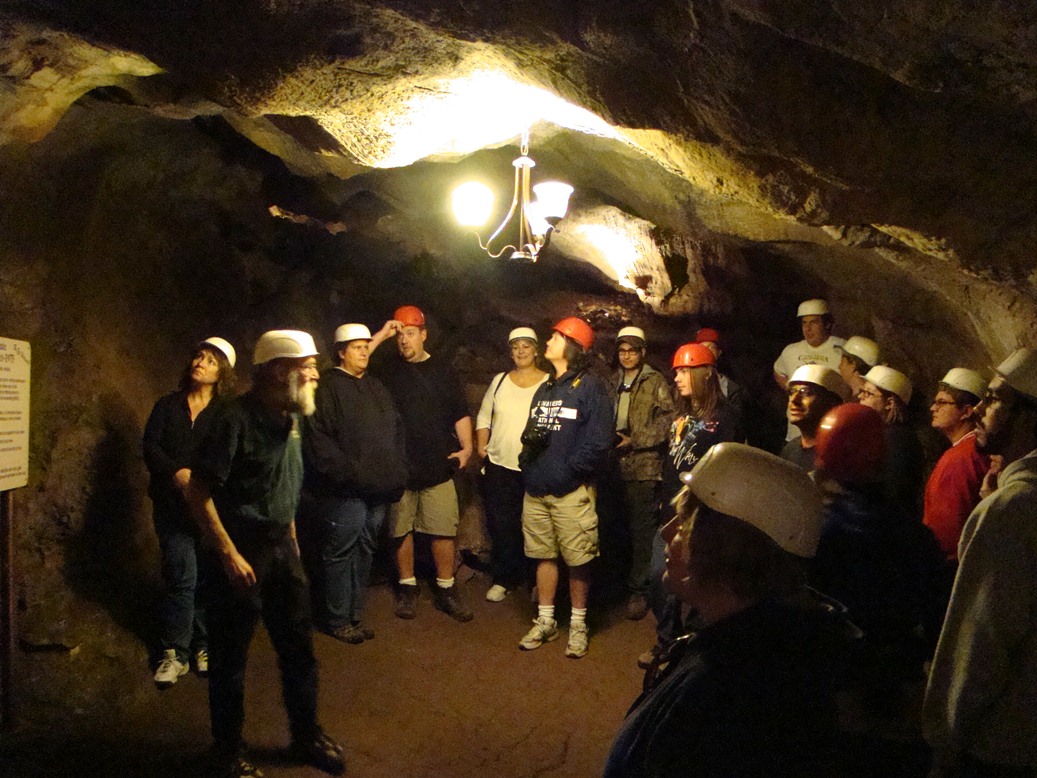
With a history of 150 years of visitors, more than a few left behind evidence of their passing; one of the outer rooms has lots of historical inscriptions, otherwise known as old graffiti. I think that this is the first time I have ever seen a chandelier in a cave...

I was beginning to be disturbed by something. The cave seemed to be lacking decorations, the stalactites, stalagmites and flowstone features that one expects to be lining the walls and ceilings of the cave.
There were certainly a number of speleothems (cave decorations) in several spots; there was an ornate cave popcorn feature in one passageway. The origin of popcorn is not completely understood; it may form when the cave is still immersed in water.
A particularly beautiful cave decoration is a drapery. These form as water flows along the edge of a fin of rock. The thin formations are often translucent, and are sometimes referred to as "cave bacon".
Overall, though, the passageways seemed bereft of the stalactites and soda straws one would expect to see. In the Bishop's Palace (below), one can see a few large stalactites hanging down, but few delicate ones. It's not too hard to understand why...a century ago, it was considered OK to break off a stalactite to take home as a souvenir. I wonder how long it took before cave operators realized their visitors were destroying the very thing that made caves an interesting place to explore?
As we went deeper into the cave, I could see some delicate soda straws on the ceiling. This may have been in the Bed of Nails Room (corrections welcome if I am wrong in my cave geography). I was pleased to see these fragile features remaining from the depredations of the early cave explorers. A closer look told a different story...
Many of these inch-long soda straws were the growths of new material starting to replace those that were broken off a century ago. These small speleothems show the infinite slowness with which these features develop. Once a stalactite has been broken off, it will never be replaced in our lifetimes.
Still, a fascinating sight, and a challenge to photograph without a tripod! One thing I have learned is to take the shots on a two-second delay, so my finger doesn't shake the camera in the dim light. I try to avoid using the flash, as it washes out colors and shadows.
In the back of the historical reaches of the cave, we found the Bridal Chamber, where a massive stalagmite-slash-flowstone monument dominates the room. It is one of the cleaner, more interesting speleothems that we had yet seen, but there was still a certain sadness in my mind. The unfortunate cave has suffered a lot of abuse over the years. It certainly is not the fault of the present operators; they have worked hard to protect what is left, and have allowed many of the damaged features to start recovering (note how clean the flowstone is in the picture below). But the damage is still there, from decades of ignorance and even vandalism.

We had reached the back of the cave, at least as far into the cave as the miners and early tourists ever explored. Something special that was about to happen...which we will talk about in the next post!
California Cavern is operated by the Sierra Nevada Recreation Corporation. Information about tours can be found here.