Showing posts with label Helictites. Show all posts

Sunday, October 28, 2018

The Magic of a Pristine Cave: Wanderings in the Black Chasm

The miners were not kind to the caverns of the Sierra Nevada.

The search for gold in the foothills led fortune-seekers all over the hills and valleys of the Mother Lode in the Sierra Nevada, and practically every slope and hollow was prospected for the elusive metal. They usually came up empty of the riches they sought so eagerly, but many times the miners would encounter an unexpected opening in the outcrops of marble that occurred here and there in the Calaveras Complex. They discovered dozens of caverns.
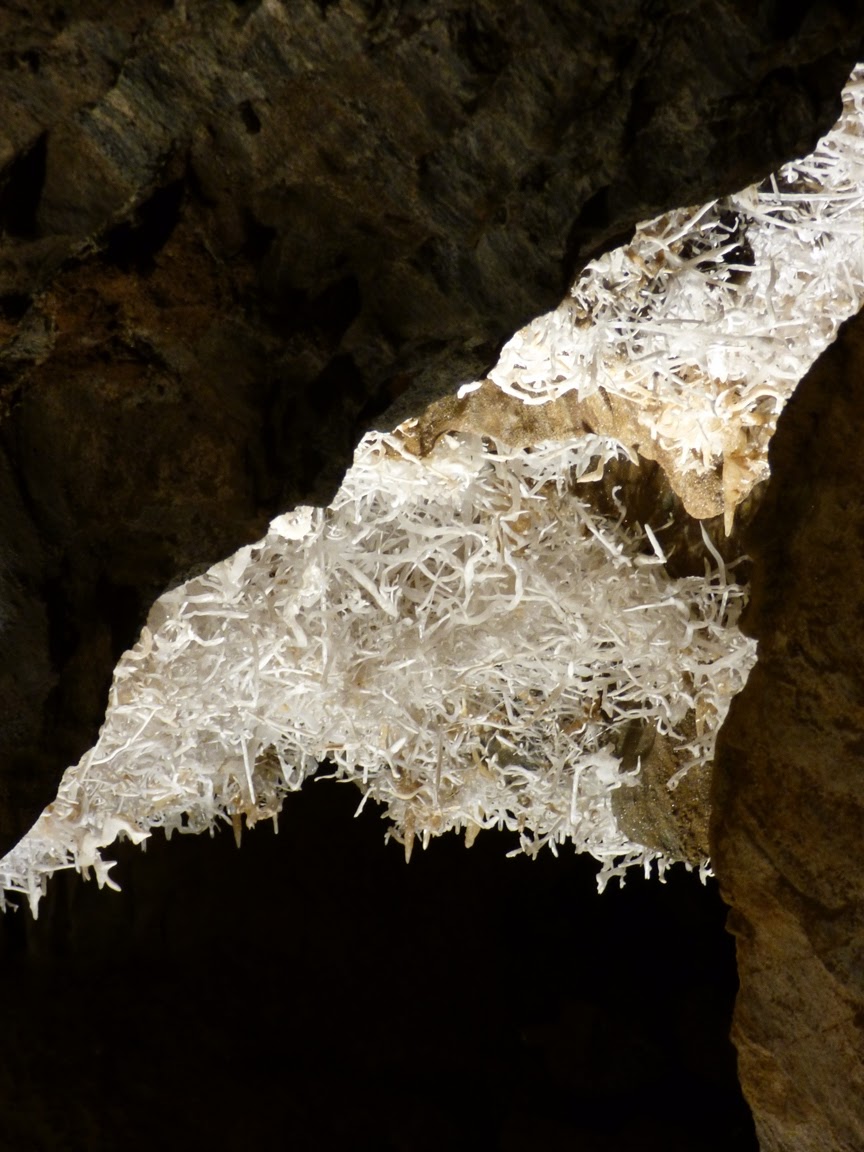
Helictites at Black Chasm cave
For light they used torches and candles, and they didn't hesitate to break off cave decorations (speleothems) as souvenirs. A few enterprising miners realized they wouldn't get rich with gold so they charged admission to their caverns and made money from tourism instead. But they didn't control the behavior of their guests, and more speleothems disappeared. The once beautiful and intricate caverns were reduced to mere holes in the ground, and what decorations remained were grimy with soot and muddy fingerprints from visitors using them as handholds.
The "dragon" at Black Chasm
To be sure, times haven't changed that much. Spelunkers learned long ago that publicizing a newly discovered cave was often a death knell, so locations are kept a highly-guarded secret, and when possible vulnerable caves are fitted with locking gates. But there are two exceptions. California Caverns and Black Chasm cave have rooms that were inaccessible and undiscovered during the Gold Rush, and these have been developed carefully in such a way that the original appearance of the cave has been preserved. We visited Black Chasm today as part of my field class on the caverns and karst topography of the Mother Lode
Soda straws (straight) and helictites (twisted) at Black Chasm cave
Folks are sometimes surprised to find out the true color of stalactites and other speleothems; they're pure white. And they are so incredibly delicate. So-called soda straws and helictites are so fragile that a single touch will break them off, destroying thousands of years of exceedingly slow growth.
Soda straws (straight) and helictites (twisted) at Black Chasm cave
The helictites of Black Chasm are particularly memorable. There are thousands and thousands of them, possibly the greatest accumulation of any cave in the country. The room where the visitors can view them is just one of several. The others are off-limits, and appropriately so. The origin of the helictites is obscure and is debated by cave researchers (speleologists). They obviously ignore gravity.
Black Chasm cave is privately owned and offers tours (for a fee of course) all year long. They are located adjacent to the village of Volcano a few miles up the hill from Jackson on Highway 88. There are other "attractions" for kids at the site (panning for gems, breaking open geodes and that kind of thing), but they also offer some surprising sophisticated cave research publications for sale. They have always been very cooperative about arranging tours for our college groups. If you are ever in the Mother Lode, don't pass up this opportunity to see some truly pristine caverns.

Sunday, October 22, 2017

How Does a Pristine Cavern Look? Black Chasm Provides a Clue

Some things can only be experienced once. The discovery of a new plant or animal that no one has ever seen, a new mineral, a new planet in space, to see a vista that no one has witnessed before. Exploration of new things is one of the great joys of being human. One of the saddest lines I've ever seen in a move was from The Truman Show (1998):

Young Truman: I'd like to be an explorer, like the great Magellan.
Teacher: [rolling down a map of the world] Oh, you're too late. There's really nothing left to explore.
Entrance room of Black Chasm cave. The dirt on the decorations is from soil seeping in from above, but many of them are broken from early explorers and visitors.

And there are things that can be destroyed only once. The extinction of a species, a beautiful canyon marred by a poorly-planned development, the destruction of a culture or a people.
If there is anything I have learned as a scientist and a teacher, it is that there is never an end to exploration. I was reminded of this as I took a group of students on a field studies journey on Saturday. Ostensibly the trip was about caverns and karst topography in the Sierra Nevada Mother Lode, although it included a great deal of information about the 1848 Gold Rush as well. We toured Highway 49 between Jackson and Columbia, but included an excursion through Black Chasm Cave near the village of Volcano.
Helictites in Black Chasm Cave
So many caves that are known today were discovered in previous centuries, and have been explored and vandalized to a shocking degree. My opening point about a single moment of discovery and a single final moment of destruction applies in many ways to caverns. A cavern can only be discovered and explored once. From that time on, in human terms, it is moving inexorably towards destruction. Caverns cannot recover from the damage inflicted by human visitors in any kind of time frame that people would recognize.
Helictites in Black Chasm Cave
Non-cavers are often confused or bemused by the nearly maniacal lengths that cavers take to prevent causing damage to pristine caves. But the cavers themselves understand. Many experienced cavers have watched some of their favorite places turn from a mystical underground fairyland to a dark dirty troll's den in the space of a few years. Research literature documents the destruction of caves as their location becomes known to the public at large. For this reason, the location of the vast majority of caverns is a closely held secret. A pristine cave is a rare and precious resource that is too easily lost to vandals. As a consequence, most casual cave visitors will never know the experience of a newly discovered cave. But there is a way that they can come close.
Helictites and stalactites in Black Chasm Cave
There are around a thousand known caves in the Sierra Nevada, and six are open for tours: Crystal (in Sequoia National Park), Boyden (just outside Kings Canyon National Park), Moaning (near Columbia), California (outside San Andreas), Mercer (near Murphys), and Black Chasm. Each of them have their charms and educational value, but Black Chasm stands out. It is one of the few that has the feel of an undefiled cave, at least once you've crossed the "chasm".
The "Dragon", mascot of Black Chasm. That's not the normal color...the guide was using a laser pointer on it.
The miners who discovered most of the Sierra caves explored them with smoky torches or candles, and they as well as those who followed over the years had no compunctions about touching and breaking off the speleothems (cave decorations) found in the caves. Owners even encouraged visitors to take a souvenir, thinking that the stalactites would grow back within a few years. These caves ended up with dirty walls and ceilings, and the only stalactites left were those that were out of reach of visitors. This also happened at Black Chasm.
But a short distance into the steep cave entrance the rocks drop off into the inky darkness of the chasm itself. It's around 90 feet deep with sheer walls and a series of small lakes or ponds at the bottom. Getting to the rooms beyond required technical climbing skills that weren't practical until the 1960s and 1970s. Those who were then able to explore deeper into the cave were careful spelunkers, not vandals, and the rooms they found were spectacular.
When the owners decided to develop the cave, they constructed a series of stairs and bridges that provided access to the back rooms of the cave, but the stairwells also prevent tourists from getting too close to the pristine decorations. And what wonderful decorations they are! The first thing I always notice is the pearly white color of the dripstone and flowstone features. They don't have any soot or dirt on them at all. The next thing that comes to my attention is the total lack of broken features. They quite literally look the way they did when they were first discovered except for the lighting. Because the flowstone and other features are translucent, the owners were able to place the lighting behind the features so the light could glow through. The photographic results sans flash are wonderful. Flash pictures always seem to make the speleothems look flat and featureless.
The crowning feature of Black Chasm Cave is the number and variety of helictites. They can be thought of as stalactites on drugs. They don't believe in gravity and have instead grown in all kinds of directions, almost as if someone took handfuls of spaghetti noodles and tossed them onto the wall. They are rare in caves, especially those open to tourists, in part because of their incredibly fragile nature. A single touch would be more than enough to snap them off. But it hasn't happened at Black Chasm. The sheer number on some walls (thousands of them) have resulted in the cave being declared a National Natural Landmark, a federal program that encourages owners of outstanding natural features to protect their resource (of course it doesn't hurt their public relations).
The owners of Black Chasm Cave have done a great job of protecting their resource, and their tours are done well. In addition, they encourage educational groups by offering steep discounts, so I have no problem recommending them to my fellow educators. Information about visitation and tours can be found on their website at https://caverntours.com/black-chasm-cavern-national-natural-landmark/. They also have an excellent nature trail on the property (that will be in the next post), plus a curio shop with some surprisingly sophisticated speleology texts for sale, along with the usual geodes and t-shirts.

Don't ever stop exploring!

Thursday, November 12, 2015

The Karst Topography...of California? Into the Black Chasm

California is not really known for her expanses of karst topography, the landscapes that develop where limestone or marble lies underground. In my short mini-series about the karst of California, we've seen the gold-fields of Columbia State Historical Park, the grinding stones at Chaw'se State Park, and the Natural Bridges of Coyote Creek. Today we are going underground to see the reason for the sinkholes and disappearing streams: the caverns of California. Believe it or not, there are more than a thousand of them! There are about eight of them that have been developed for tours. We'll have a look at some them over the next few posts.
On our recent trip exploring the karst topography of the Sierra Nevada Mother Lode, we visited one of the most unique: Black Chasm Cavern, near the Gold Rush town of Volcano. Black Chasm was opened for tours around 1990, but it has been known since the Gold Rush days.
An early discovery by miners is usually the death-knell for a cave. The early explorers tended to be careless, and they thought nothing of breaking off cave decorations (speleothems). Such caves eventually became muddy holes in the ground, bereft of any beauty. But Black Chasm had something going for it, something that protected the cave: it was the Black Chasm itself.
Just inside the very step entry passage, there is a 100 foot deep fracture that halted any further exploration of the cave unless the spelunkers had technical climbing gear. Far down at the bottom of the chasm, there is a turquoise colored lake. When the cave was developed, the owners affixed a stairwell across the upper part of the chasm, providing access to the Landmark Room at the far end of the cave (the tour covers several hundred feet of the cave, which has a total of about 4,000 feet of passageways).
The Landmark Room is a true revelation for cave enthusiasts: it's almost completely untouched by vandals and sloppy cavers. The speleothems (cave decorations like stalactites, stalagmites, columns, draperies, and flowstone) have never been snapped off or otherwise damaged.
The stalactites and draperies are spectacular. The owners have done a good job of lighting the cave to highlight the most interesting decorations. I've toured the cave a dozen times or more, and I always find something else to photograph.
It's quite amazing to see draperies that have never been stained by the grime of torches and candle lanterns.
The speleothems could be easily snapped off, but it has not happened. It's a marvelous privilege to see untouched caves. But Black Chasm has achieved National Natural Landmark status for a different reason: the helictites. National natural landmarks are established by the federal government, but the land where these landmarks have been established are privately owned. The status represents an agreement to protect the landmark from damage or development. 
The helictites at Black Chasm are extraordinary. They can be thought of as stalactites on an acid trip, as they seemingly have completely disregarded gravity as they have grown. They may start growing in the style of stalactites, but water can be squeezed from the interior under hydrostatic pressure, and grow in random directions. They aren't immediately apparent on the conducted tour, because they actually keep the lights in that corner of the cave off (we look where we are directed, after all). One begins to notice the helictites here and there in dark corners, a few dozen on the cavern walls. I'm perhaps giving something away here, but I am surprised every time the lights come on.
Because that's what happens. The lights come up, and there is a wall covered by thousands upon thousands of helictites in a chaotic pattern that is simply stunning.
Helictites are among the most delicate of cave decorations, the first to be destroyed by vandals and careless cavers. But this cave was protected for a century by the Black Chasm, and the owners have been careful to preserve this incredible resource. They were never broken off, and as such, this wall of crazy stalactites is probably the most complex and spectacular group of helictites that can be seen in any show cave in the country, maybe in the world.
The cave is operated by the Sierra Nevada Recreation Corporation, and the cave is generally open all year for tours. They offer discounts for educational tours like the one we took two weeks ago. If you get a chance to tour the Mother Lode, Black Chasm is certainly worth a look. For more information, check out their website at http://caverntours.com/black-chasm-cavern-national-natural-landmark
The

Sunday, October 19, 2014

The Sierra Nevada Underground: How does a newly discovered pristine cave look? Finding out at Black Chasm

There are caves and there are caves. Many of them were discovered long ago, and the easily accessible ones suffered grievous damage. In earlier days, cave decorations (speleothems) were broken off as souvenirs in the sadly mistaken belief that they would grow back quickly. Today's cave vandals have no such excuse. They break and destroy for sheer maliciousness. It's sad either way because caves don't recover, not in any kind of human time-frame. Their special kind of beauty is lost to us.
That's what makes a few caves extra precious. A few weeks ago, I explored Crystal Cave in Sequoia, which by virtue of being in a national park and being discovered by park personnel, was protected before catastrophic damage was done. It was developed for tourism, and millions of people have walked its passageways and yet it was protected by and large from the worst abuses.
The tour I was on yesterday was a different circumstance. Black Chasm cave near the Gold Rush town of Volcano in the Sierra Nevada Mother Lode is a privately owned cavern. It was discovered in the 1800s but the "chasm", a ninety foot deep crevice, prevented the miners from ever getting into the remote reaches of the cave. Access required technical climbing skills, and people who go through that much trouble rarely have vandalism in mind.
A decision was reached in the 1990s to develop the cave for tourism, making a total of six such caves in the Sierra Nevada: Crystal Cave, Boyden Cavern, Mercer Caverns, Moaning Cavern, California Cavern, and Black Chasm. A stairwell and boardwalk were pinned to the edge of the chasm, allowing for access to the nicely decorated room beyond. A room never despoiled by vandals, or dirtied by sooty lanterns and torches.
For those who have only seen the usual soiled yellow-brown stalactites and stalagmites, the pearly white formations are a revelation about what a cave can look like. Beautiful examples festoon the walls. But Black Chasm has an additional feature that is astounding. Stalactites on LSD!
Growing out of the walls at odd angles, and growing in totally random orientations, helictites are strange and rare cave formations. They are easily broken off, and are undoubtedly one of the first formations to disappear from caves. They are present in Black Chasm in, shall we say, large numbers. Really large numbers, enough that the cavern was granted National Natural Landmark status, a federal designation that recognizes the value of natural features on private lands, including agreements to protect the resource.
The exact process by which helictites form is not clearly known. They are most likely related to capillary action of water squeezing out of microscopic openings in small stalactites and precipitating small amounts of calcite. Because water under pressure can be squeezed upwards, the development of the helictites is not governed by gravity.
The number and variety of helictites in the Landmark Room of Black Chasm is simply stunning. I haven't been to every cave in the world, but I would not be surprised if these are some of finest examples in existence (although I am always open to correction on such issues).
Black Chasm Cave, as noted before, is a privately owned business. They are there to make a profit, but they have done a good job of protecting their cave, and I recommend a visit. They offer discounts for educational groups (they can accommodate up to 22 people at a time, so large classes would need to split into two tours). More information about the cave can be found here. Tell them Geotripper sent you!

Sunday, October 21, 2012

The Sierra Nevada Underground: Into the Black Chasm

California is full of delightful geological surprises. Mention "caverns" and most Americans will think of places like Mammoth Cave, Kentucky, or Carlsbad Caverns in New Mexico. Not too many people will think of California, but California does have an unexpected number of world-class cavern systems.

The state has such a complex geologic history involving granite intrusions, volcanic eruptions and earthquakes that it is easy to forget that for vast stretches of geologic time, California was stunningly boring passive continental margin. In Paleozoic time, the region was a shallow sea, slowly collecting mud and lime deposits in a tropical environment. In some cases, the tropical islands and shorelines were elsewhere, but the rocks were transported to California on the giant conveyor belt of the Pacific and Farallon tectonic plates. As the Farallon plate was subducted beneath the continental margin, the limestone sequences were scraped off and added to the metamorphic sequences of the western Cordillera.

The limestone was baked and transformed into marble, and a great deal of marble was preserved in a tract of crust (or terrane) in the western Sierra Nevada Metamorphic Belt called the Calaveras Complex. The Calaveras hosts many of the caverns found in the state; there are hundreds of them. Unless I lost count somewhere along the line, six caverns in the Sierra Nevada have been developed for public tours: Crystal Cave in Sequoia National Park, Boyden Cave in Kings Canyon, and four caves in the Mother Lode: Moaning Cave, Mercer Cavern, California Caverns, and today's destination, Black Chasm Cavern.
I was at Black Chasm yesterday with twenty of my students, on a field studies trip through a portion of the Mother Lode. The cave is privately owned, but it has been granted National Landmark Status, a designation that recognizes the geologic or historic importance of the cave, and encourages the preservation of the feature. The owners have done an good job at Black Chasm. It is one of the best places I know of that gives the casual visitor the experience of seeing a cave that is close to pristine condition, much as when it was first discovered.

The problem is that many Sierra caves were discovered by miners in the 1850s, and they became well-known and well-visited. It was not at all unusual for the cave owners to encourage their visitors to take a stalactite as a memento of their visit, and the caves were stripped of their decorations (speleothems would be the proper term for the stalactites and other features of caves). The early explorers often used torches for light, and the soot left its mark on the remaining speleothems.
Black Chasm was discovered early on, but it was the cave's namesake that protected it from the worst damage. The entrance into the cave is very steep, and after clambering down the steep slope, probably hanging onto a rope, the early visitors passed through one interesting room, but then found themselves perched on the brink of an eighty foot cliff that ended in the darkness below. Without technical equipment there was no going forward or going down. The interior passages of the cave were protected from vandals by inaccessibility.

When the owners of Black Chasm decided to open the cave for tourism, they constructed a walkway that clings to the wall of the Black Chasm and passes into the rooms beyond. The contrast between the first room of the cave and the last room is striking. Many of the stalactites and other speleothems are broken off, and the remaining ones have a patina of orange-red mud that comes from seepage of iron oxides from soils above, but also from soot and dirt from the early visitors. The room is still pretty, but not exceptional to anyone who has visited other caverns.
Then you pass through the namesake chasm. The walls on both sides are vertical, and in the inky darkness below there is a deep lake. The cave is host to a unique species of amphipod, which I hope is immune to the effects of fallen eyeglasses, cameras and other paraphernalia dropped by visitors. The owners clean up what they can, but cave diving is a seriously dangerous business, and I don't think they do it casually for cleaning things up.They warn you to hold onto your valuables...
And then you start to see what an undamaged and pristine cave is really like...the parallel fins are referred to as cave bacon.
The natural color of most speleothems is a pearly shade of white. It's truly hard to resist touching these decorations, especially since they are so close to the walkway. I trust you won't do it if you visit. It is far too easy to cause damage or mar the appearance. It is such a privilege to be able to see things like this without a plastic screen blocking the way...
The cavern has some nice examples of soda straws (above), which are very thin stalactites that are among the first speleothems to disappear in unprotected caverns. One touch would be enough to break them off. I've seen some in Kartchner Cavern in Arizona that broke off without being even touched. The just broke off, maybe from something as weak as wind currents or the shaking of a distant earthquake (the effects of quakes are muted in caves, as they are much less affected by surface wave shaking).
The draperies in the far room of the tour are nothing short of fantastic. The lighting is nicely placed to allow for back-lighting. Flash photography from handheld cameras almost never works in caverns. The flash washes out any contrasts in color, and without shadows, the features lack depth. I get a lot of non-flash pictures that I have to delete because I shake too much, but the few I get with the back-lighting are far more satisfying.

The final room of the tour is exceptional because of one particular kind of speleothem: helictites. Helictites can be characterized as stalactites that refuse to recognize the law of gravity, or by some descriptions, stalactites on acid. They have grown in random directions, perhaps because the water that formed them was driven as much by capillary action as it was by gravity.
From a distance, the wall looks fuzzy with white "stuff"...
Up closer, the fuzz resolves into thousands of individual helictites.
I can almost imagine them wiggling about and forming into a tourist-eating cave monster...
The complexity of the helictites is just stunning. I never get tired of trying to get another shot. Shawndee, the manager at the cave, probably thinks I'm ignoring her while she is talking to my students, but I do listen. I'm just multitasking, trying to get the perfect shot!
I always see something new whenever I go into Black Chasm. This time it was the dogtooth spar crystals in an obscure cavity along the walkway. Dogtooth spar is a crystal form of calcite, which along with aragonite is the mineral that makes up most of the speleothems in the cave.
Black Chasm Cave, as noted before, is a privately owned business. They are there to make a profit, but they have done a good job of protecting their cave, and I recommend a visit. They offer discounts for educational groups (they can accommodate up to 22 people at a time, so large classes would need to split into two tours). More information about the cave can be found here. Tell them Geotripper sent you!