Showing posts sorted by relevance for query hawaii tsunami. Sort by date Show all posts

Sunday, February 28, 2010

The Hawaii Tsunami a "Non-Event"? I Don't Think So...


I know that the Hawaii tsunami is now officially old news, but it was an important geological lesson. Why does it take amateur video to adequately explain what was happening? As I watched cable news yesterday, the activity was hidden by screen banners and obscured by blathering newsreaders who didn't have enough knowledge to realize what was happening on the screen in front of them. I've been complaining about it for the last 24 hours, so I thought I should mention what incredible things we did see yesterday.

It boils down to the fact that there was a very thin line between a geologic curiosity and a geologic disaster in Hawaii yesterday. Think what a remarkable thing was happening in the video: a normally placid ocean bay protected from wave action by a long sea wall was suddenly full of mud, and was flowing. First one direction, then the other. How extraordinary is this?

Normal waves are a surface phenomena. Anyone playing in the waves at the beach knows they can avoid being mashed by a big wave by diving under it. The waves form up only a few hundred feet offshore and break against the beach. They involve a limited part of the water column, and the energy level, while high at the point of impact, is also limited. The swells that form up into waves may be generated hundreds or thousands of miles away by storm winds, but the swells travel only a few tens of miles an hour, and the turbulence extends only a few tens of feet beneath the surface of the ocean.

Tsunamis are not at all like normal waves. They are generated by a displacement of the water on the ocean floor by large earthquakes, volcanic eruptions or underwater landslides. They travel hundreds of miles an hour (roughly the speed of a jet airliner), and they affect the entire water column from the seafloor to the surface. They don't even really affect boats on the open ocean, as the boats simply rise and fall a few feet over a twenty minute time span. But the seafloor is affected by the passage. The dangerous aspect of a tsunami is what happens when the waves encounter shallow water along a shoreline. In essence, the energy of the wave that has been dispersed across the whole water column is compressed into a smaller and smaller space. The wave builds, and either draws water away from the coast, or surges into the coast without warning.

The activity at Hilo Bay is a wonderful example of the process. All the water in the bay was in motion, from the surface to the base, and this is what kicked up all the mud in the water. The water was surging in and then out again, explaining the strange currents around Coconut Island, seen in the video above. The total height of the tsunami surge was about three feet.

This was a huge earthquake in Chile, the fifth largest ever recorded. It was reasonable to expect a colossal tsunami, but tsunamis are subject to many variables. Smaller earthquakes have generated larger tsunamis in Hawaii (the worst tsunami to strike Hawaii, in 1946, was from a smaller earthquake that took place in Alaska). The largest earthquake ever recorded, from Chile in 1960, produced a devastating tsunami in Hilo, but the second largest, the Alaska quake of 1964 (magnitude 9.3) caused all of $60,000 in damage and killed no one in Hawaii (16 people died in California and Oregon, and 106 in Alaska). In other words, tsunamis are inherently unpredictable. In the worst tsunamis, of 1946 and 1960, the surge reached depths of 30 feet or more.

A warning system has been present in the Pacific Ocean basin since 1946, and the system was upgraded in the last few years, but has only been tested in a few recent large seismic events.

What I really wish is that the newreaders (er, um, excuse me, anchorpersons and reporters) at the cable networks would take the time to truly educate themselves in the basics of geology. As a teacher of geology, I shiver at the thought of standing up in a classroom of philosophy students and lecturing on philosophy without any time to prepare. These newspeople are standing up in front of millions of people and displaying their appalling ignorance of geology. The other problem, of course, is that their audience is not aware of it.

UPDATE: Chris at goodSchist is collecting some of the mainstream media crimes against geologic understanding here. Be sure to contribute if you see something!

I Have a Dream...in which the 24 Hour Cable News Networks Serve a Useful Purpose


Photo of tsunami surge from West Hawaii Today

I have a dream, or more a fantasy, because dreams are more likely to come true. I fantasize about the day that a cable network newsreader (I know they like to call themselves "anchorpeople", but forget it) stands up in front of the television cameras and says, "I'm sorry, but I and the entire news team in this room and on the site of the geological event out there haven't got the faintest idea of what we are babbling about. So we are going to suspend our coverage until we have hired a correspondent who has the scientific education to give us a cogent and reasoned explanation of what is going on."

My dream isn't going to come true, is it? As I noted yesterday, the networks will spend tens of millions of dollars to cover minute aspects of sporting events, but they can't shell out, say, $90,000 a year to a competent geologist/earth scientist who can warn them that they have gone overboard on the hype, and to calm down.

What was the real story yesterday? There was a massive earthquake in Chile yesterday, an 8.8 magnitude monster that was the fifth biggest tremor in recorded (i.e. on a seismometer) history. It produced a tsunami that would affect the entire Pacific Ocean basin. The coverage of the earthquake itself earns the news networks a C+, because they apparently still remember some of the science they learned six weeks ago in Haiti.

But...their coverage of the effects of the quake on the Pacific Basin and Hawaii? An F. Not even a gentleman's F+. They've done grievous damage to the entire concept of responsible journalism. They hated that the Indonesian tsunami struck without warning so that they couldn't plan for their coverage of a tragic human event. So this quake hits, and they have a half day's warning to prepare for the event in Hawaii. They were so incompetent that they could position stationary cameras in what seemed to be only three locations (including what seemed hours of pictures of one moronic surfer), and then breathlessly babbled for hours about the approaching maelstrom. The tsunami arrived, and they didn't recognize it happening in front of them. Then they acted disappointed that it wasn't the disaster they had been building up for hours. And they cut to commercials. This, of course, is what I was raging about yesterday.

The story they missed? A giant earthquake produced what could very well have been a colossal tsunami. The civil defense apparatus of the state of Hawaii gears up for the event, sounding the warning sirens hours ahead of the arrival of the tsunami surge, and doing an incredible job of warning the population of what could be coming. The people of Hawaii do the right thing, stocking up on emergency supplies and taking shelter in the appropriate locations. The evacuations run smoothly, from what little I hear, and if a monster tsunami had hit, the death toll would have been very low. The tsunami hits with an intensity at the lower end of the predictions, and a number of fascinating phenomena take place (and I am still waiting for some decent coverage of what actually happened). There was a collective sigh of relief, and life returns to normal, after a brief interruption and a little inconvenience. That was the real story, and it was for the most part untold.

The damage they have done? By building up the story to a fever pitch, they could have caused unnecessary panic and worry, and when they expressed their disappointment (in their attitude, if not their words) at the outcome, they set up a situation in the future where people might not take tsunami warnings seriously. They have turned this into a "Peter cries Wolf" story in which the civil defense people actually seem to be apologizing for overestimating the size of the waves (and please follow and read the link). The Pacific Tsunami Warning Center has nothing to apologize for; they acted appropriately for the situation, and the population responded well. I can only pray that in future events they will also respond correctly.

My friend at Phreatic Ramblings captures a particularly inane conversation that took place yesterday. I normally like Rick Sanchez if he is talking about politics, but he didn't do so well here.

UPDATE: Sorry Rick, but your cartography ain't so good either (Thanks, Rebecca)

Saturday, February 27, 2010

Liveblogging a Tsunami

I take back the nice things I said about the media coverage. They have the tsunami directly affecting Hilo Bay, but they keep putting their "breaking news" banner right over the most visible aspect of the receding water as the tsunami hits (see the unblocked picture above). And then they keep going back to Oahu where absolutely nothing is happening, or repeating pictures of the same stupid surfer from three hours ago. They have a tsunami happening in front of them and don't seem to realize it. A big learning moment is passing them (and us) by.

A reporter on one of those channels says they are hoping for the best...but to be cynical, if the best happens, I suspect there will be much gnashing of teeth about Chicken Little and "inaccurate" predictions of an inherently unpredictable event.

Updated Note 2:30 PST:

The photo is Coconut Island in Hilo Bay. In 1946, a horrendous tsunami overran the small island, and swept into downtown Hilo, killing more than 100 people. Today's event is thankfully much smaller, though it is not over with yet.

Update 2:55 PST:

All the news networks went to commercials. I guess the tsunami is over (it's not, but it wasn't big enough to keep their interest).

Update 3:05 PST:

The tsunami has in fact caused at least some fatalities, just not in Hawaii, and notably not mentioned on the networks that I can tell (on islands closer to Chile). A more comprehensive live blog about the earthquake and tsunami on a more worldwide basis can be found at EnduringAmerica. I suggest checking there for some straight blogging without my opinions of the media coverage.

Update 3:37 PST:

MEASUREMENTS OR REPORTS OF TSUNAMI WAVE ACTIVITY

(from the Pacific Tsunami Warning Center)

GAUGE LOCATION
------------------- ----- ------ ----- --------------- -----
KAWAIHAE HAWAII 0.52M / 1.7FT
BARBERS PT HI 0.19M / 0.6FT
KAUMALAPAU HAWAII 0.18M / 0.6FT
KAHULUI MAUI 0.98M / 3.2FT
NAWILIWILI KAUAI 0.28M / 0.9FT
HILO HI 0.86M / 2.8FT
PAGO PAGO AS 0.66M / 2.2FT

Also, as predicted, the weasels in the media are complaining about a "false alarm". They seem almost disappointed that there wasn't any widespread death and destruction in Hawaii. At the end of the interview with someone from the Warning Center the newsreader admitted that the waves actually did reach the proportions predicted, just at the lower end of the prediction range.

(PS: I like weasels. It's just an expression)

Thursday, March 10, 2011

8.9 Earthquake in Japan

We are learning more about a massive quake in Japan, with an estimated magnitude of 8.9 offshore of Sendai, Honshu. A major tsunami has been generated and the cable news shows are showing aerial shots of an extraordinary wave spreading across agricultural fields, overwhelming roads and villages. From the maps, it appears that the quake was generated in the subduction zone on the Pacific side. There is a good chance that a tsunami could be spreading through the Pacific, but I have not heard any confirmation. I would only say that if the authorities issue a warning, take it seriously and get to a safe place.

The most stunning aspect so far has been the aerial perspective of the tsunami spreading across the landscape. The 2004 tsunami in Indonesia was documented better than any previous event, but I don't recall seeing any aerial shots like this. Tsunamis are not really waves, they are surges of water that rush inland at speeds sometimes approaching 100 mph. The surge picks up debris and uses it as a battering ram. It is terrifying to see.

The TV commentators are starting to get up to speed, but for the best information from seismologists, check out the U.S. Geological Survey here. They have links to the current tsunami conditions in the Pacific basin.

My night class watched the 7.2 quake on Tuesday on our teaching seismograph, and I assume it was a foreshock to this event. Ironically, the subject of the day in my physical geology class was the types of damage caused by quakes. We mentioned tsunamis...

I pray for those in the path of the devastation.

UPDATE #1: A tsunami watch has been issued for the Hawaiian Islands. If a wave has been generated, it will arrive about 3 am Hawaii time.

UPDATE #2: The tsunami watch has been upgraded to a tsunami warning in Hawaii. Please take it seriously. The waves, if any, will reach the coast of California and Oregon around 7-7:30 am local time. At that distance, I don't expect much, but things can change overnight.

UPDATE #3: If 8.9 magnitude becomes official, this is the 5th largest quake in the world since 1900. Chile 1960, 9.5; Alaska 1964, 9.2; Sumatra 2004, 9.1; Kamchatka, Russia, 1952, 9.0. I finally hear an MSNBC commentator get the energy numbers right: the difference in energy between this and the Haiti quake at 7.0 is closer to 1,000 times, not 100 times. The equivalent of 1,000 Haiti quakes just hit offshore of Japan.

UPDATE #4: A tsunami watch has been announced for the coast of California. Take it seriously if you live in coastal areas. If it comes, it will arrive around 7:30-7:45 am in the morning. Listen for official warnings and obey them! Don't do the California thing and wander down to the beach to look for it.

UPDATE #5: The Pacific Coast is now under a tsunami warning, with expected wave heights of 3 feet or so, arriving around 8 in the morning depending on location. Take it seriously; if you are on the beach, you could easily be swept away by such waves. Follow official warnings; emergency personnel know what they are doing!

UPDATE #6: Some damage is now being reported in California as surges of water hit Crescent City and other coastal towns. Damage is "significant", not major, mostly along the lines of boats being jostled and ripped from moorings. I'm hearing of waves 5-6 feet high along parts of the California coast, and of 8 foot waves in Hawaii. 11 people were killed at Crescent City in 1964 from a tsunami of 12 feet, in part because they didn't realize the waves come in groups, and the first wave is not necessarily the largest. It is a cautionary tale for all the people rushing out to the beach to "see the tsunami". It might not be a good idea to become, literally, part of the story. Stay out of coastal areas until an "all clear" signal is given.

UPDATE #7: Silver Fox at Looking for Detachment has a list of the geoblogosphere's response to the Japan earthquake here.

UPDATE #8: Both the USGS and Japanese geologists have upgraded the magnitude of the quake to 9.0, making it the 4th largest ever recorded.

Monday, March 1, 2010

Words That Have Meaning: False Alarm and Warning (A Tsunami Wrap-up)


This was a false alarm? Photographs from CBS News and AP

Two situations:

In the first, it's a school day, and some kid pulls the fire alarm. Bells ring and students have to evacuate even though there is no evidence of a fire and everyone knows it was a prank. This is a false alarm.

In the second, a teller pushes the alarm button. There's a man demanding money. No one knows if the man is armed or not. The police evacuate the neighborhood, surround the bank, and ultimately arrest the man. If the man turns out to be unarmed, it makes the whole thing a false alarm, right? No? I don't think so either. The police and the people of the neighborhood were warned of a possible dangerous situation. There could have been a deadly shootout. Will anyone fault the police for doing their job?

So why are scientists being forced to defend themselves for their warnings about a tsunami? Just because the tsunami proved to have less violence than expected doesn't mean they should have acted any differently. The media bean-counters are probably sorry they didn't get the death and disaster in Hawaii and other Pacific Islands that would have driven up ratings (sorry for the cynicism), but the seismologists did nothing improper. And I was personally impressed that Hawaiians and others did such a fine job of responding. They know from experience what could have happened. And in the end, there was a tsunami that extended from Chile all the way to Japan where the pictures above were taken. There was a fine line between an interesting geologic event and a worldwide disaster. There is disaster enough in Chile, where the death toll continues to climb.

With that in mind, I'm glad to see the Pacific Tsunami Warning Center is not caving in to media accusations of a "false alarm":
"It's a key point to remember that we cannot under-warn. Failure to warn is not an option for us," said Dai Lin Wang, an oceanographer at the Pacific Tsunami Warning Center in Hawaii. "We cannot have a situation that we thought was no problem and then it's devastating. That just cannot happen."
The media should know better than to loosely toss the words "false alarm" in their wrap-up stories about the tsunami. Words have meaning, and "false alarm" sends the wrong message, a sort of "boy who cried wolf" attitude. Millions of people across the Pacific have now experienced an evacuation, and will know what to do the next time. Unless they think of the seismologists as boys crying wolf. These men and women take their jobs seriously, and will never play such games with the public.

Don't forget to donate to relief efforts in Chile, and in Haiti. It's so easy to forget a tragedy when another one crowds out the headlines.


UPDATE #2: More people may have been killed in Chile by the tsunami than by the earthquake itself. Magma Cum Laude provides a nice example of good media coverage on the tsunami, with Dr. Chuck Bailey at William and Mary College. Nice catch!

UPDATE #3: Earth Magazine checks in with a good analysis of the quake and tsunami and links to some excellent media coverage by PBS News Hour (and thanks for the shout out for Geotripper, Magma Cum Laude, and Goodschist!)

Tuesday, July 28, 2009

Tso, can you Tsurf a Tsunami?


Hokusai's 1831 "Great Wave off Kanagawa" and a picture of the Hilo Pier in 1946. The man (who did not survive) was named Antone Aguiar. According to the story at the Tsunami Museum in Hilo, he cut the ship Brigham Victory free from the dock, allowing it to ride out the disaster. The picture is from the archives at NOAA.

There are two main kinds of waves, those that are produced by winds blowing over the ocean surface, the subject of the last two posts on the huge waves that struck Southern California last week, and those that are produced by massive disturbances of the ocean floor, either by earthquake, volcanic eruption, or landslides. These are tsunamis, often (incorrectly) called tidal waves (there are tidal waves of a sort, called tidal bores, but they cannot be mistaken for a tsunami).

After my adventures this summer, which included a grand tour of the Hawaiian Islands with two dozen of my students, and a mini-vacation in Southern California that coincided with the arrival of unusually large waves along the coast, I am writing a short blog series on the dynamics and geology of waves. Tsunamis have been on my mind, having seen perhaps hundreds of tsunami warning signs all over the coastal areas of Hawaii, and seeing, for the first time, tsunami warning signs in Southern California. I don't know when they started appearing (I suspect in 2004), but they certainly weren't there in the years when I was growing up in the southland.

I used to have a more difficult time teaching about tsunamis, but that changed in 2004 when the Indonesian Earthquake produced the tsunami in the Indian Ocean that killed around 230,000 people. Because it hit tourist beaches, thousands of videos and photographs documented the event, and international media coverage was intense. Prior to that event there were not a great many photographs that documented what a tsunami could do, and the really tragic events, like those in 1946 and 1960 in Hawaii, had receded into ancient history for most people.

Wind-driven waves and tsunamis are very different. Waves travel as swells across the seas, with turbulent water extending only a short distance beneath the surface (about half the wavelength). They travel slowly, a few tens of miles per hour, so they can take a week to cross an ocean, as the Tahitian waves did on their way to California this last week. The energy of the wave is expended only in shallow water at the coast, as the waves build up and fall over as rolling breakers. The amount of energy in a storm or typhoon is immense, but the energy is transferred to the water over time, and is dissipated over a period of days and weeks.

A tsunami is generated in a moment, as an earthquake shifts the ocean floor, or a volcanic caldera collapses. Large landslides off of islands sometimes generate tsunamis as well. The disturbance affects the entire column of ocean water, from surface to seafloor, and all of the energy begins traveling very fast outwards from the point of the disturbance. Very fast. As in the speed of an airliner, around 500 miles per hour. In open water, they may pass without notice, as the wavecrests may be a hundred miles apart, and only rise and fall a few feet. Ships at sea are rarely affected by tsunamis.

At shorelines, the story is vastly different. The oncoming waves hit the shallows at a high rate of speed, and friction slows the forward motion, but the energy is still there and it must be expended. The water surface rises and surges forward, quickly inundated the low coastal areas to depths ranging from a few feet to more than a hundred in some of the most disastrous events. The first indication that something is amiss often is a sudden emptying of shallow bays and a drop in sea level lasting several minutes. The surge follows shortly after. Other times, the sea just suddenly surges forward without warning.

Even when warnings are given, people can make bad choices based on misinformation. They may evacuate as ordered, but may enter the devastated area after the first wave recedes, only to be swept away by the second or third wave they didn't know was coming. Of course the millions of people living along the shoreline of the Indian Ocean didn't even get the chance to make those kinds of mistakes in 2004. Since 1946 there has been a Pacific Ocean-wide warning system that has given people many hours notice that a tsunami was approaching. The poorer countries bordering the Indian Ocean have never had such a system, even though it was well known that tsunamis were a distinct possibility. A horrific injustice...

So, does California have to worry about tsunamis? The good news (sort of): we have big earthquakes on the San Andreas and other faults offshore, but they usually involve lateral motion that does not disturb the sea floor in such a way as to cause tsunamis. The bad news is that the northernmost coast of the state is close to the Cascadia Subduction Zone that is very much capable of producing huge tsunamis, and did in the year 1700. And of course as noted above, tsunamis can cross entire oceans, so large quakes in Mexico, South America, Alaska, Kamchatka, Japan, and all the other major seismic zones in the Pacific Rim can cause tsunamis that could reach the California coast. In 1964, the magnitude 9 Alaska quake produced a tsunami that killed a dozen people in Crescent City on the far north coast.

Southern California is perhaps a bit more protected because of the presence of the Channel Islands, which would tend to break up some of the wave energy. But major tsunamis coming out of the south and west have some potential of reaching parts of the coast. And thus, the tsunami warning signs that have appeared.

I don't advise surfing a tsunami...it's hard to avoid breaking the third-story windows of the building you will be mashing into....

One last comment: when I lived in Santa Barbara many years ago, there was a tsunami warning based on the major quake that had devastated parts of Mexico City in 1985. Of course, people evacuated and headed for high ground, right? Of course not. They went down to the beach to watch. Thank goodness the tsunami was a dud in that case.

Saturday, February 27, 2010

What? You Were Expecting This?

If you were watching the coverage of today's tsunami in the Pacific Ocean basin, you could be forgiven for thinking that this was what was converging on Waikiki, given the breathless reporting that took place on the cable networks. This photo began life as a photoshop effort that circulated on the internet in the days following the Indonesian earthquake and tsunami of 2004. It wasn't enough that the tsunami killed hundreds of thousands of people throughout the Indian Ocean. Someone had to try and make it seem bigger (if someone actually wants to admit owning a copyright to the photo, let me know and I will take it down if you wish).

I began the day being somewhat impressed with the quality of the discussion of the massive earthquake in Chile. Some of the newsreaders displayed some level of knowledge about just how big the quake was (the 5th largest ever recorded in the last hundred years or so) and something of how quakes are assessed and measured. But then the scene shifted to Hawaii and I became more and more disillusioned.

What a wonderful opportunity to educate an audience on the nature of geologic hazards and processes! A tsunami was coming and the story would unfold in front of the world. We would be able to see it happen and even better understand what was happening. What took place instead? Four or five wasted hours of breathless useless words, an unrealistic build-up to a climax that wasn't going to happen, and a near total misunderstanding of the extraordinary thing that did happen right there on the screen in front of us. The arrival of the tsunami was obscured by one of those ridiculous banners (which I could almost swear said "BREAKING STORY: HAWAII ABOUT TO WASH INTO THE SEA", but I could be mistaken). The newsreaders went on babbling, blithly unaware of what was happening on the screen. Because it wasn't killing anyone, I guess.

But I forget myself...of course television exists only to sell commercial products, and the only way products will be sold is if millions upon millions of people are watching. News is merely a means to an end, and the end has little to do with educating the public. But who am I to complain? I'm just a geologist and teacher who felt horribly disappointed today at what could have been.

I think about the Olympics I've been watching this week...tens of millions of dollars were spent designing a media extravaganza in which every aspect of every sporting event could be seen from three or four different camera angles. There seemed to be hundreds of expert commentators who could describe every single move made by every single athlete. Every triple-toe-lutz, every slalom turn.

But to describe a geologic event of worldwide importance and interest? With twelve hours of lead time, the networks got all of one camera pointed to Hilo Bay?? As far as I am concerned, the day was an epic fail by the news media.

I see little evidence that the cable networks employ even a single scientist. The only scientists ever in evidence are the "meteorologists" but does anyone think they were chosen for their expertise? Screen presence is everything, of course. Most of the weather people show a shocking ignorance of climate science and the issues involved in global warming and climate change. Of course when a volcano erupts or a fault slips to produce an earthquake, the network newsreaders interview volcanologists and geologists. But they almost never ask the right questions, and half the time they are looking for the answers that feed their preconceptions and the need to increase viewership.

Am I being too tough on the cable networks? What do you think?

When a Magnitude 6.9 Earthquake is an Aftershock....

There wasn't a whole lot of information when I wrote about the 8.8 earthquake in Chile in the earliest hours of the morning. Information is starting to flood in now from many sources, and my first impression is media coverage is a bit better than it was for the Haiti quake and other earlier events. When I say "better", I don't mean more cameras, I mean evidence of an effort by the reporters to educate themselves about the basic science of earthquakes.

My first thought is for the people who have been affected, both in Chile and across the Pacific basin. A quake this big is going to have huge impacts. The aftershocks are going to be an issue: my USGS notifications are set for any quakes bigger than 5.5 and there have been 11 of them so far, with the largest at 6.9. For perspective, 6.9 is the size of the Loma Prieta earthquake here in California from 1989. It killed 4 dozen people and did around $10 billion in damage. The quake in Haiti was a somewhat larger 7.0. Aftershocks are going to continue for a long time, over a region about 600 miles long (the size of the fault zone that shifted in this quake).

The tsunami is a huge threat. The size of a tsunami in any particular place is dependent on many factors, including the size of the earthquake (which was colossal), how the quake transferred energy to the ocean water (unknown to me at this point), and the shape and depth of the coastline where the tsunami strikes. All I can say to my Pacific Basin friends is that when the Civil Defense folks set off the sirens, take it seriously! Hawaii in particular has a tragic history with tsunamis, and there has been a vast amount of coastal development since the last major tsunami (in 1960, also caused by an earthquake in Chile). There will be a big problem of people wandering down to the beach to watch the tsunami, which can only be described as an act of idiocy. Get to higher ground or higher floors. If the warnings are inaccurate, you've only lost a bit of time, but if they are accurate, your life will be saved. Don't go to the coast until the "all clear" is given, because there will be more than one surge of water. You can't swim your way out of a tsunami; they are one of the most dangerous of geologic events, as the Indonesian tsunami of 2004 demonstrated.

Wednesday, June 27, 2018

Jurassic World - Fallen Kingdom: A Geologist's Review


To be sure, I enjoyed myself.

It was about 5:45 in the afternoon and we were out and about doing errands. I had been called into an emergency meeting about the soon to be constructed outdoor education lab at my campus. It turns out that bids came in way too high so we had to start making a list of things that we were going to have to give up in order to get the project built. It was a series of difficult choices. To blow off steam, we decided to see what was being shown at the local cinema. The next movie, at 6:35, was Jurassic World: Fallen Kingdom. We got our popcorn and soda and headed in. After 30 minutes of trailers, the lights dimmed and the movie began. As scenes unfolded, I imagined the meeting that went on before this movie was greenlighted: "we have millions and millions of dollars, how many things can we throw up on the screen?" In other words, the direct opposite of my meeting.
It's almost as if we've lost our fascination with dinosaurs, so we needed our film to be spiced up with all kinds of movie tropes: volcanoes, lava flows, pyroclastic surges, gothic mansions, secret underground laboratories, not one, but three or four dastardly villains, and deeply hidden family secrets. There was the obligatory child in distress. And (spoilers ahead!) some people get eaten, others almost get eaten, lava almost eats somebody, and there was an unusually moral component in the character of those who ended up as part of the dinosaur buffet. And the poor Brachiosaurus brought a tear to my eye.

But I am a geologist, so let's get to the important part of the review: did they get the geology right?

No, of course not.

But taken as individual scenes, some of the geology was okay.

As in practically all Hollywood movies, the director mixes up his volcano genres. Isla Sorna, 120 miles off the coast of Costa Rica, is a volcano without an origin (the island doesn't exist of course, but the location doesn't make much geologic sense unless it resulted from a hot spot).

When deciding the mayhem to be produced by a volcano, one must choose: is it an oceanic hot spot that produces shield volcanoes and basaltic lava flows and, as Kilauea has shown us these last few months, the occasional phreatic (groundwater) explosion? Or is it an island arc stratovolcano, whose andesitic or rhyolitic magmas produce violent caldera eruptions?  The movie cannot make up its mind: there are scenes of basalt flows and Hawaii-like scenery, but on the other hand, the climactic eruption is composed of explosive ash columns and pyroclastic surges.

The climactic volcano scenes have the heroes outrunning (or out-rolling) the pyroclastic surge which would seem highly unlikely in real life. The Chris Pratt character looks to have inhaled some of the ash which should have caused him some severe respiratory problems later on in the movie. He also should have experienced some severe burns from his close encounter with flowing radiant lava.

I was actually bothered a bit about how the ferry was able to get underway without damage from the incandescent pyroclastic flow on the dock. It was necessary I guess to get the emotional impact over the demise of the aforementioned Brachiosaurus.

But my biggest beef is the failure in imagination concerning the "extinction-level" volcanic event. The eruption that is supposed to have destroyed all living things on the island was kind of underwhelming.  A ferry boat was able to outrun it. There was (to my memory anyway) the barest of an eruption column. If this was really the kind of volcanic event that would erase all life from the island, there should have been a caldera-forming eruption like that of Krakatoa (1883) or Tambora (1815). The sky should have been blotted out and the ship should have been enveloped in darkness.

Maybe next time they should consult with me, because I have a great idea about how the island could have been destroyed, and it would have had some great visuals. Some irresponsible websites have been criticized for suggesting that the Big Island of Hawaii could suffer unprecedented catastrophic damage caused by the collapse of a flank of the island into the ocean. Such an event is simply not in the cards for Hawaii right now, but some memorable slides have happened in prehistoric times. The long runout debris avalanches caused thousand foot high tsunamis that would have ravaged many coastlines around the Pacific Ocean rim (not to mention in the Hawaiian islands themselves). Imagine a gigantic eruption column with ash flows spreading over the entire island and then an entire flank sinking into the ocean producing a gigantic tsunami that nearly destroys the escaping ship.

But almost no one ever thinks to ask me (believe it or not I did scout out shooting localities for a proposed Hollywood movie once).
The dinosaurs in the movie are fine, although there were exaggerations of scale, especially with the Mosasaur (oh, and the Mosasaurs and Pteranodons in the movie aren't dinosaurs; they occupy separate lineages within the reptile clan). The one in the movie was WAY too big. Mosasaurs have been found as fossils in our region and many others, and they're no larger than 35 feet or so. Terrifying, yes, but not the behemoth that existed in the movie's universe. And where did they get Mosasaur DNA? I don't think mosquitos had much of the chance to bite these deep-diving marine creatures.

There's a larger issue though. A central tenet of the movie was the desire of the movie's protagonists to let the dinosaurs live together in a big happy stable ecosystem. The problem is that the dinosaurs they resurrected never lived together in an ecosystem. They would have all technically have been invasive species. Many or most of the interactions between these species and their environment would have been problematic, including food sources for the herbivores (no grass or flowers during the Jurassic, for instance), and no evolved defenses against viruses and other disease-causing organisms. Our present-day efforts to bring back mammoths make a bit more sense since they've been extinct for only a few thousand years, and they lived in ecosystems much like those that exist today.

But still, all in all I enjoyed the movie. Geology criticisms aside, I'd give it a B+.

All pictures are courtesy of Universal Studios

Friday, October 7, 2011

Psychics (and Animals) Predict Earthquakes: True or False? What Everyone "Knows" About Earthquakes


Comic art by Zeo (with slight modifications by Geotripper)
Well, let's see if I can't make a few (seismic) waves here. It's question number five in our brief quiz on what everybody "knows" about earthquakes in California (those things that are thought to be known, but which might not actually be true). These questions were the basis of a community lecture I gave last week. The question in this post is really about two different issues, so I am going to discuss the animals in the next post. So here is today's test question:

Psychics predict earthquakes: true or false?

The audience at the lecture last week was filled with skeptics and non-believers, to be frank, and came down firmly in favor of "false" for an answer. So they were a little surprised when I told them the actual answer:

TRUE!

They thought about it a moment, and realized that the statement is in fact true. Psychics predict earthquakes all the time. All the time, and then some more. Earthquakes are one of their most common predictions, more popular I think than predictions about aliens.

That leads to a revised question: Do psychic predictions about earthquakes come true?

My audience was on to me now, and there was a general murmer that psychic predictions are invariably wrong. I set them straight. I said "Psychics predict earthquakes all the time, and are almost invariably correct". I'm pretty sure there was a moment of silence before the audience started arguing the point with me.

I support my contention with a collection of predictions that I googled in about five minutes. I refuse to link to each of them because I have no interested in promoting their websites. If you want to find them, google the statement and it shouldn't take long to dig them up.

  • Both earthquake and out of control fires will effect California causing devastation and loss [of] life. 
  • There will be a violent earthquake, one of the strongest on record.[no location noted]
  • My California earthquake prediction: yes, there WILL be an earthquake in California. I am not saying it will be along the San Andreas Fault or that it will be major. …I am also not saying when.
  • I keep seeing the year 2011 like a pulsating animation within visions of major earth shifts in my home state of California. Dates perceived in months or years could be argued to have limited value in forecasting a time because we psychics move our consciousness in large spans of time and cover broad areas of locations and events.
Note how every one of these predictions came true. Oh, and my favorite, the shotgun prediction....

Wild Weather Predictions
  1. Category five hurricane wipes out Miami.
  2. The worst mudslides in California’s history will occur.
  3. Mount St. Helens erupting.
  4. Earthquake Seattle, Washington.
  5. Earthquake Chicago, Illinois.
  6. Part of the polar ice cap melts.
  7. Wildfires spread to Beverley Hills and Los Angeles, Brentwood.
  8. More tsunamis Sumatra Indonesia, Alaska, Hawaii and Japan.
  9. A great earthquake in Los Angeles, San Francisco and San Diego.
  10. Earthquake Lake Tahoe.
  11. Earthquake Toronto and Quebec.
  12. Earthquake Oregon.
  13. Earthquake Grand Canyon.
  14. Earthquake New York, Alaska, Japan, Greece.
  15. Earthquake British Columbia, China and Iran.
  16. Tornado in California.
  17. Floods Amsterdam, Holland, Rhine River, Germany, Bangladesh, Great Britain. Venice, Italy, Gulf Coast of Florida and France.
  18. Tsunami Malibu, California.
  19. Wildfires Greece, Australia, Texas, Hawaii.
  20. Mudslides in India, California.
  21. Typhoon in Taiwan.
  22. Tornadoes Oklahoma, Indiana, Texas, Illinois, Tennessee.
  23. Great earthquake Rome and Naples, Italy.
  24. Huge snowstorm and blizzards up the eastern seaboard affecting the great lakes – Toronto, Chicago, New York, Boston, etc.
  25. Earthquake Yosemite and Yellowstone Park.
Note how many of these predictions haven't happened yet. Still, many will absolutely take place, allowing the psychic responsible for this list to claim broad success in his or her psychic powers.

Soooo...psychics accurately predict earthquakes. Well, guess what? I can predict earthquakes too! And I can be more specific than the average psychic. Here goes..

I predict that within the next week:
  • 200 earthquakes will occur in California,
  • Of these, there will be a magnitude 4 quake in southern California, most likely in the Colorado Desert near Salton Sea.
  • There will be a magnitude 3 earthquake in northern California, most likely north of the Bay Area, somewhere around Clear Lake.
  • There will be a larger quake at the Vanuatu Islands in the Pacific Ocean, quite possibly in the magnitude 6 range.
  • There will be a magnitude 6 earthquake offshore of Japan.
I think I am going to be right. You are welcome to keep count and when the quakes happen you can hail me as a psychic earthquake predictor.

You can do that, but please note that my predictions have something in common with psychic predictions: the predictions are totally and absolutely useless to anybody.  They are about as useful as predicting that the sun will rise in the east tomorrow. Why? Because like the sun rising, earthquakes happen all the time, and they tend to happen in the same general places, mainly along tectonic plate boundaries (along with a few near hot spots like Hawaii or Yellowstone). It sounds impressive that 200 earthquakes will happen over the next week in California, but that happens nearly every week. Last week there were actually more, about 370.

Earthquake prediction is a serious business. On the one hand, a timely prediction can save lives. But a prediction made by a credible source that doesn't come to pass is a real problem. Like the boy who called "wolf" once too often, later predictions would be ignored. Charlatans who make spurious predictions can cause panic and unnecessary stress in an uninformed population (such a prediction in 1990 caused the population of St. Louis and surrounding region to close down businesses and leave town, and also caused a media circus).

An earthquake prediction, in order to save lives, must have three elements:
  • the time (within a few days at most)
  • the location (specific)
  • the magnitude and depth
No psychic ever provides such information, which proves the useless nature of their "predictions". No one is in a position to predict earthquakes with such precision, including seismologists. Anyone who claims some special power of prediction is lying or deluded. No one has ever once saved lives with such predictions (the one successful prediction,ever, of a quake that saved lives, in China in 1975, was based on tangible evidence, and no psychic powers were claimed or invoked).

There is a form of a useful prediction regarding earthquakes. That will be discussed in a post in the very near future (that's a prediction that I am making!)

Psychics: give up the earthquakes. Stick to the lives of the Hollywood stars. They're more predictable anyway.

Saturday, March 6, 2010

Earth: The Alternative Story


I look at my posts for the last week and I see that I have been on quite a rampage of "munching Cheetos in the basement" blogging, complaining about treatment of geologic topics in the media. It was set off when I experienced the full brunt the appalling coverage of the impending tsunami in Hawaii (and the aftermath), and soon after came comments on headlines about the demise of the dinosaurs, the continuing lack of full opportunity for women (and minorities) in geology-related industries, and finally a bit on the manufactured doubt industry and climate change deniers.

Truth be told, people who know me well know that I am a pretty even-tempered person in person, and very few of my students have ever seen me angry. Those who have seen me angry have remarked about what a quiet experience it is. Very...quiet. But a couple of things brought me to a slow simmer and the tsunami business just caused my temper to boil over. I am reminded of an old Gary Larson Far Side cartoon about a herpetologist that gets an accumulated case of the willies after working for decades in the reptile house of a zoo. Or even better, the famous XKCD comic "Someone is wrong on the Internet". One doesn't want to be shrill, but things have just gotten so...ridiculous.

Like the denizen of the insane asylum who is "feeling MUCH better now", I'm beginning to think about returning to the Other California series, but I just wanted to deal with one more of THOSE topics. It's like I want to kick the beehive one more time...it has to do with the value of a good science education.

A poll by the University of Texas/Texas Tribune published a couple of weeks ago indicated that 30% of Texans believe that humans and dinosaurs coexisted, and another 30% don't know. This is a sad commentary on the state of education in Texas, not to mention the rest of the country, and is obviously a religious issue as well (people who reject basic scientific knowledge on this topic generally do so because of a conflict with their religious beliefs).

We discussed this topic in my historical geology class this week. We've had seven weeks of basic stratigraphic principles, rock identification, analysis of sedimentary structures and environments, and some background material on paleontology. Evolution was the topic at hand, and being that I live in an exceedingly conservative part of California, I am quite sure I have some religiously conservative students. I've never tried to squelch their questions, nor have I attacked their beliefs, but I do insist that they at least understand why geologists, biologists and paleontologists accept evolutionary theory (and that's theory, mind you, not hypothesis). Our interactions are generally congenial.

I did try something new this week though. In an act that would make a creation-scientist proud (or perhaps very nervous), I presented the entire creation-science model to a classroom full of students with a certain level of geologic expertise. This has always been the wish of the creation-science community, that teachers "teach both sides of the issue". I don't think they've ever fully considered the ramifications of what happens when people with just a minimum of geologic knowledge hear the whole story. Keep in mind, we aren't "introducing God" into the science classroom, this is all "science".

Let's see, the earth starts. That's right, it starts, because it all happened only 6,000 years ago, and there was no evolution of the crust or anything like that. Life is present from the very beginning, and all life is living under a cloud. Well, actually a canopy of lots and lots of water vapor. The vapor prevents bad energy rays from the sun from striking the living things, so the living things live much longer, the humans for nearly a thousand years. There weren't any carnivores; T-rex ate leaves, and so did every other creature that we think of as animal devourers. The canopy also screws up radioactive carbon, so carbon-dating is inaccurate (unless it gives the right dates, that is). It's not clear how uranium, rubidium and potassium dating methods were affected. The surface of the earth is very smooth and covered with vegetation. If there are any seas at all, they are shallow. No major mountains to speak of.

Then something goes very wrong, and, well, all hell breaks loose. The canopy collapses into an incredibly vast rainstorm that goes on for several weeks (40 days maybe? Can't say for sure). A vast amount of water that was stored within the earth becomes superheated and blasts to steam at various seams in the crust as supersonic geysers shoot even more water in the atmosphere. The earth's crust destabilizes, and vast amounts of basalt come pouring out, producing what would become oceanic crust at a rate of around 3 feet per second, roughly 50 miles a day. In just a few months, this is enough to form our ocean basins. The smooth crust is broken up, and lots and lots of mud swirls around in the maelstrom of water, laying down tens of thousands of feet of sediment in just a few weeks or months. The continents rise, crash into each other, form giant mountain ranges, and deep subduction zones start swallowing up the crust. Water drained off the higher areas, carving deep canyons (like the Grand Canyon) in a few days, while the mud and lime layers were still soft.

Meanwhile, everything and everyone dies. All those things that died were left behind as fossils. The fact that there seems to be an order to the appearance of species in the rocks (fish first, amphibians later, reptiles after that) is an artifact due to the fact that the more intelligent species knew to climb hills while the water was rising, so they didn't get entombed until later in the flood. Of course, life still exists on the planet, so somehow all the species survived the "hydraulic cataclysm". One suggestion is that some humans gathered all the species on a big boat of some sort, and released the animals after the water drained away from the higher parts of the continents. The strange distribution of animals (marsupials in Australia, giraffes in Africa, llamas in South America) resulted from various humans taking their favorite animals with them as they repopulated the earth.

Now, a boat containing all the millions of species on the planet is an impossibility that even a young child can figure out. So it wasn't "species" that went on the boat, it was "kinds". Species are an artificial human convention anyway; they don't have meaning in the real world. These "kinds", or baramin, included a dog kind, a cat kind, a sauropod kind, and so on. In the aftermath of the flood, the dog kind diverged genetically (but not evolved; this isn't evolution) into foxes, wolves, coyotes and...good ole dogs. The cats changed into tigers, lions, and jaguars. And so on. This happened in a few centuries after the "hydraulic cataclysm". The dinosaurs lived on, too, but then there was another disaster.

Because the vapor canopy was gone, the sun was shining on the earth surface and the climate became exceedingly unstable. Within a few hundred years of the flood, an ice age covered much of the planet, and wiped out the dinosaurs and a whole bunch of other strange beasts that we only find as fossils today. Other incredible canyons in the world, like Yosemite, were carved by the glaciers in a few tens of years through solid granite.

Finally things settle down, maybe 3,500 years ago. Volcanoes slow down, earthquakes happen less often, sea-floor spreading declines to a few inches a year. And that's all you need to know.

If I have gotten some minor details wrong, don't bother me about it because life is too short to argue endlessly. It it seems fanciful, you can check out the details with groups like the Institute for Creation Research. But for some reason, they never seem to put the whole story in one place. It might draw too much attention towards the conflicts this story has with the basic laws of astronomy, physics, chemistry, geology, and logic. And it will draw lots of derision too, just like it did in my historical geology class last week. You have work very hard to "believe" this model, much less accept the so-called evidence.

If you feel I have insulted your religious beliefs, you would be wrong. This isn't about religion. This is about an alternative "scientific" history of earth and life that would be taught in public schools under the banner of "equal time" if local governmental entities like the Texas Board of Education had free rein on their collective desire to stop the teaching of evolution (I am happy to hear that the worst member of the creation-science faction lost his primary race to someone else a few days ago).

Once again, this is also a rant of sorts about media treatment of science. I have grown accustomed to seeing stories of evolution "balanced" by an interview with a creation-scientist as if their model has some kind equivalency with actual science. It doesn't. Not even close. And believing really, really hard won't make it so either.

UPDATE: One of my students (commenting on my Facebook version) makes a really good point: "You know how little kids sometimes play pretend, and as they get more competitive with one another, they backtrack and add stuff to the game, changing the original 'rules'? Creation 'science' reminds me a lot of that... "

Wednesday, June 1, 2016

A Most Misunderstood Island: One of the Most Diverse Landscapes on Earth

Shall we start with a stereotypical Hawaiian beach?
One can certainly be forgiven for thinking that Hawai'i is a group of high-rise hotels next to a wide sandy beach. It isn't as if a string of television shows (Magnum, P.I. and Hawaii 5-0 for example) have spent decades putting that stereotype into our heads. And the majority of tourists never venture beyond the hotel row at Waikiki and Honolulu. A visit to some of the other islands can be a real revelation (and adventure). The Hawaiian Islands, and especially the Big Island, are one of the most diverse landscapes on planet Earth.
The view from Pu'u Huluhulu at Saddle Road summit

Not convinced? Here is a selection of pictures taken over just two days of reconnaissance on the Big Island. How about an African savanna? A lone Koa tree (I think, I'm still learning these!) overlooks the plains along the summit of Saddle Road, a highway that links the two sides of the island. There are even grazing cattle, sheep, pigs, and goats (which are doing terrible things to the natural ecosystems).

Perhaps an archaeological site in the wilds of the Sinai Desert? The great heiaus on the Big Island served a variety of purposes, including refuges, sacrificial sites, and temples. They date back hundreds of years. This one can be seen at Pu'ukohola Heiau National Historical Site on the dry side of the island in the rain shadow of the Kohala volcano. Rainfall averages less than 20 inches a year, compared to more than a hundred just a few miles away.

A recovering mesic coastal forest? Not a desert, not a rainforest, but somewhere in-between (mostly on the dry side) We are looking at the Lapakahi State Historical Park on the west slope of Kohala. The original forest was cut down for a number of reasons, but humans lived in this village for hundreds of years.

How about the high plains prairie? One of the largest privately owned ranches in the United States is found on the Big Island (the Parker Ranch). The cattle graze on rich grasslands that cover some of the older volcanoes. When they reach the right age, they fly in a 747 to the mainland. As a guide to Hawaii mentions, they probably enjoy more foot room than the average tourist in coach...

 As can be seen, some of the grasslands are windy.

Big Sur on the Big Island? Sure. This Big Island is not as famed for the coastal cliffs like those in Kaua'i and Molokai, but several tens of thousands of years ago, a large part of the northern coastline of the island collapsed into the sea. It probably produced a mega-tsunami in the local islands that had run-ups amounting to hundreds of feet in elevation.The Pololu Valley and coast is stunning.
The Pololu coast is also known for the gorgeous river valleys that extend into the Kohala volcano ("gorgeous"; Did you get it?). The canyons are hundreds of feet deep, and were once even deeper, but the islands are slowly sinking and the valleys fill with sediment.

I doubt that Sauron would have ever established Mordor in a place like this. These a'a lava flows from Mauna Loa are only a few decades old, and are practically impossible to traverse. Somehow a highway got built across part of it, and there is even a strange housing complex in the immediate vicinity. The few trees are the native Ohi'a, a tree that can grow from coastal environments to as high as 10,000 feet or so. I don't believe there is another tree on the planet that can do that.

And how about glacial environments? Yes, Hawai'i had glaciers during the Ice Ages! The top of Mauna Kea was mantled with flowing ice only a few thousand years ago. There are glacial moraines, and even a small lake that is the third highest in United States. Eruptions happening in the ice produced a glassy form of basalt that was much harder than normal, so the native Hawaiians would climb to the summit of the mountain to gather the rock for tool-making.

And finally, yes, there are rainforests! Beautiful green forests filled with rare and endemic plants found nowhere else on the planet. Don't tell anyone about this, but I see scenes like this and think of the Jungle Cruise at Disneyland! But these forests are real.

There are even more ecosystems and biomes on the island that we just didn't happen to see on our short excursions. Expect to see some more as the week progresses. We've got two more weeks on the islands, and lots of exploring to do!

Thursday, October 17, 2024

What We All Think We Know: Myths and Misconceptions about California and Earthquakes for the Day of the Great Shake-Out!

Today is the Great Shake-Out in California: At 10:17 AM, around 10.5 MILLION people will participate in a statewide earthquake drill. This is also the 35th anniversary of the Loma Prieta earthquake that caused so much damage in the San Francisco Bay-Santa Cruz region, and given that many people in northern California weren't even born by then, and others have moved in, it helps to be reminded that earthquakes are a fact of life in our fair state (and our state is quite fair because of the long-term activity of earthquakes: it's how our mountains formed). 

It starts with a modest little quiz....

True or False?
  • California is going to fall into the Pacific Ocean
  • The San Andreas fault causes all California earthquakes
  • California has more earthquakes and bigger earthquakes than anywhere else
  • The ground opens up and swallows people during earthquakes
  • Psychics and animals predict earthquakes
  • We in California are waiting for the "BIG ONE"
Let's work through some of the answers...
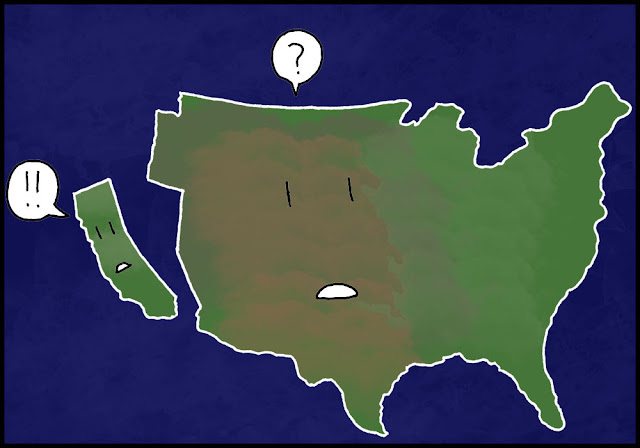
Comic art courtesy of Zeo

California is going to fall into the sea: true or false?

This is one of those persistent statements about California earthquakes that everyone "knows", even if they live in New Jersey. Many people would say: false.

Here's the correct answer:
True!

In fact, not only is it going to happen, it already has.

Check out the NASA photo above. When we speak of California, we often forget that most people are only thinking of one part of California: Alta California (upper California). The image above reminds us that Baja ("Lower") California is also part of our geography. And Baja has already "fallen" into the Pacific Ocean, in a reasonable interpretation of the statement. Baja was once connected to the Mexican mainland, and has been a peninsula for only the last four million years or so. It is the beginning of a massive rift that will ultimately tear Alta California apart, and send it traveling northwest at all of two inches a year. The two inches per year will actually be taken up by large earthquakes shifting the landscape 10-15 feet every century or so.

In 20 million years, the Dodgers and Giants will again be crosstown rivals (yes, I stole this joke from the DVD "Planet Earth"). In 70 million years, California may slam into the south margin of Alaska, pushing up another high mountain range.

Want to see how this happened? Tanya Atwater of UCSB, the plate tectonics pioneer who figured out the origin of the San Andreas fault, has a series of excellent animations available for download at this site. If you have a fast connection, try this one (50 mb).
Courtesy of Tanya Atwater. See the animation here.
If you have a slower connection, this animation is 20 mb. Both animations show the complex interactions of the continental margin, with some parts being rotated, and others moving northwest along the San Andreas. And Baja California opening up to form a new seaway, the Gulf of California.

So indeed, it could be a good idea to buy up some property in the western Mojave Desert to be ready for your oceanfront views...in ten million years...if you want to wait that long.

What? You thought the question was about California falling into the sea during one earthquake? Really? Like the movie 2012? Not gonna happen. That's tabloid stuff. Aliens kidnapped me last week too.
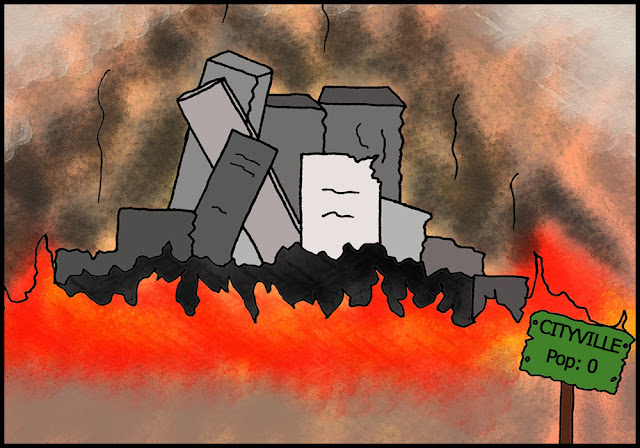
Art by Zeo
By the way, please don't think that the comic art above is belittling the loss of life and property in horrible events like that which struck Japan last year. It is actually a critique of the way that news is reported in American media, especially cable news (I'm talking about you, CNN and FOX), and local news outlets.

Question #2 on our short quiz is:

All California earthquakes happen on the San Andreas fault - True or False?


A crowd at a recent lecture I gave, California residents all, were up to date on this one. Not a single audience member said "true", and they were right. On the other hand, lots of people don't live in California, and they might not be quite as knowledgeable about all of California's faults (double entendre intended). So a few illustrations may be helpful. First of all, where do the earthquakes in California happen? See the map below...
Map courtesy of NDEDC, UC Berkeley.  Follow the link for an interactive version.
A quick look at the seismicity between 1970 and 2003 shows that earthquakes occur over much of California, and that the San Andreas fault is not even one of the most active. Long sections show little or no activity, meaning that stress is building up, leading to powerful quakes in the future.

But what about the biggest quakes? A map that concentrates only on larger quakes, magnitude 5 and above, shows that large damaging quakes also happen on faults other than the San Andreas (see the map below). Of California's three biggest historical quakes, only two were on the San Andreas. The 1872 Lone Pine quake resulted from movement on the Owens Valley fault east of the Sierra Nevada.
Map courtesy of NCNDE, UC Berkeley. Follow the link for an interactive map.
The good news for those of us who live in the flat, dusty, boring Central Valley is to note how few earthquakes, big or little, ever happen near us. I haven't actually felt an earthquake here since the early 1990s, although most of my students felt one during a class break in 2007. Read the story here, and realize my explanation of magnitude and intensity was misunderstood (magnitude and intensity are two entirely different ways of measuring earthquakes).

Question three: California has the biggest and the mostest earthquakes in the world. True or False?

I know that "mostest" is not really a word, but it somehow seems to fit well in the question of the day (a little like Stephen Colbert's 'truthiness'). So, what is the answer? My California audience is usually a little divided on this one, but mostly fall into the "false" camp.

So let's check on some data. If you look at the maps above, you can see that California certainly has a great many earthquakes, perhaps 10,000-15,000 year, and some of them are rather considerable.

There have been three earthquakes in the last 150 years that are thought to have approached magnitude 8 in size: 1857 at Fort Tejon, 1872 at Lone Pine, and 1906 in San Francisco.
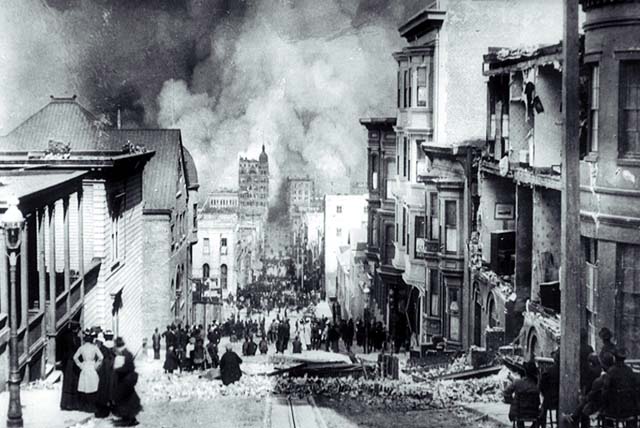
San Francisco earthquake of 1906
There have been about two dozen magnitude 7 quakes in the same time period, including last year's El Mayor-Cucapah quake in Baja (7.2), the 1999 Hector quake (7.1), and the 1992 Landers quake (7.3).
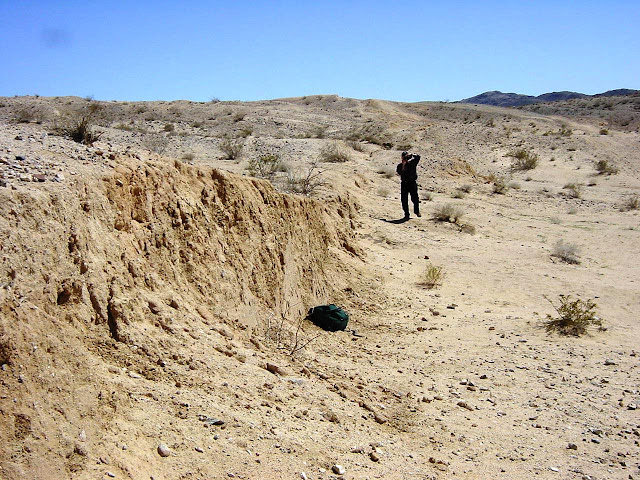
Fault scarp from 1992 Landers earthquake. Photo by Garry Hayes
There have been at least 50 quakes greater than magnitude 6.5, meaning that a potentially damaging quake occurs somewhere in California roughly every two or three years. The 1989 Loma Prieta quake and 1994 Northridge quakes caused damage measured in the tens of billions of dollars, and killed dozens of people.

Those are a lot of earthquakes. So let's take the "biggest" issue first. The quake in Japan that destroyed the nuclear power plant and produced the Pacific-wide tsunami was magnitude 9.0. The quake in Sumatra in 2004 that produced the horrific tsunami in the Indian Ocean was magnitude 9.1. So, California doesn't have the biggest earthquakes. Not even close (but check for the wild card issue below, however).

There is a great deal of confusion about the nature of the magnitude scale for measuring earthquakes. It is not a 1-10 scale, for instance, even though literally all recorded earthquakes fall within that range. It is open-ended, and quakes of greater than magnitude 10 are technically possible, but not likely from terrestrial origin. It would take the impact of an asteroid miles across to cause a quake larger than about 9.5 on the magnitude scale.

The biggest confusion concerns the relative size of quakes. Magnitude is a measure of the energy released when an earthquake strikes. A magnitude 9 quake is not just a little bit bigger than a magnitude 8. It is exponentially larger, by a factor of 32.  To put it a different way, a magnitude 9 quake releases an amount of energy that is equivalent to 32 magnitude 8 earthquakes!

It gets worse: Since a 9 is 32 times more than an 8, and an 8 is 32 times bigger than a 7, a magnitude 9 quake is more than 1000 times larger than a 7 (32x32).

A magnitude 9 quake is the energy equivalent of more than 1,000 magnitude 7 earthquakes...

Put another way: the Japan 9.0 quake released more energy than all of California's historical earthquakes combined.

The story is pretty much the same with the total number of earthquakes. California has a great many smaller quakes, but just about any subduction zone around the world has more. Even in the United States, Alaska has more earthquakes than California (as well as the second-largest earthquake ever recorded in the world, the 9.3 magnitude Good Friday quake of 1964).

So why does California get this reputation of having an inordinate number of earthquakes? I feel compelled to blame the way news is reported in this country. Cable and local news coverage of earthquakes is atrocious for the most part, with badly misinformed reporters and news-readers (I don't consider them to be news anchors or journalists anymore). There is a tendency to display blood and gore over actual conditions on the ground. The media will spend weeks talking about an earthquake in Los Angeles or San Francisco that kills a few people and practically ignore monumental tragedies in Pakistan or Iran where tens of thousands of people have died.

As mentioned above, there is one wild card in the possibility of large earthquakes hitting California. The state does in fact have a subduction zone that is active north of Fortuna and Eureka. It is part of the Cascadia subduction zone that threatens Oregon and Washington. There is good evidence that a magnitude 9 earthquake took place along the system in 1700, and there is no reason to think that the fault system is any less dangerous now.
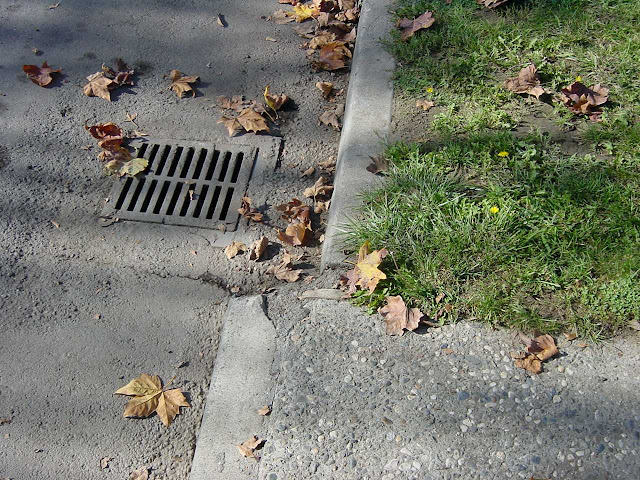
An offset curb on the Calaveras fault in Hollister, CA. It isn't the San Andreas...
Question #4: In an earthquake, the ground opens up and swallows people: true or false?

True, but only in Hollywood....
Indeed, it is a staple that if an earthquake happens in a movie, somebody is going to be hanging by their fingernails on the edge of a vast deep chasm that has opened up beneath their feet. In the third Indiana Jones movie, for instance, and in last year's 2012, again, and again, and again. And again.
For the reality-based world, the possibility of being swallowed up in the earth during an earthquake is far more unlikely. The problem is that earthquakes are generated by the stress built up along fault lines where vast blocks of rocky crust are in contact. The shaking begins when the rocks rupture and begin slipping. They don't separate. In some faults (thrusts) the stress is compressional and in others (strike-slip) the stress is lateral. Not much chance of openings occurring in either situation. The third type of fault, termed normal faulting, the stress is extensional, which could conceivably result in the stretching of the crust and formation of fissures, but more often, one side slips downward, as can be seen in the picture below, from the 1954 Fairview Peak earthquake in Nevada.
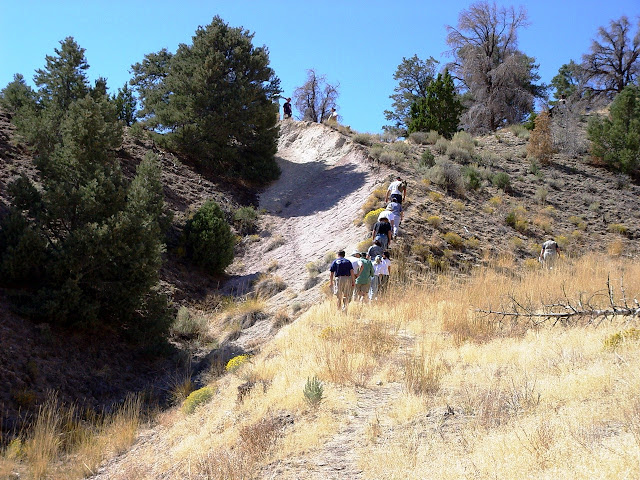
It is true that small fissures will open along fault ruptures in some situations. I saw many of these when I visited the Landers area a week after the 7.3 magnitude earthquake in 1992. The fissures were only a few inches across and no more than a foot or so in depth. Geologist Mary Hill does mention one instance where someone was killed in a fissure that opened up in a 1948 quake in Japan, but that hardly represents a pattern.

One other effect of large earthquakes is the production of slope failures and landslides, during which large fissures might open up. The Turnagain Heights liquefaction event during the Alaska earthquake of 1964 is a stunning example. Weak saturated sediments underneath the housing project were severely shaken, causing the whole landscape to break up and flow towards the adjacent bay, destroying the dwellings at the surface (I've included two pictures derived from my old slide collection, but I'm afraid I don't know who to attribute them to; I will add credit if someone can clue me in. They may be from a USGS collection).

In the 1906 San Francisco earthquake, there were not any claims of swallowed people that I know of, but there is the famous tail/tale of Shafter's cow, which was swallowed up by the San Andreas fault. In the aftermath, only the poor bovine's tail could be seen at the surface. The story apparently became widespread, but in a letter from 1966, some locals recalled that the poor cow had actually died the night before. The earthquake produced a convenient fissure, the farmer tossed in the carcass, and when reporters showed up asking questions about the poor animal, farmer Shafter decided not to kill a "good story".

Question 5: Psychics predict earthquakes: true or false?
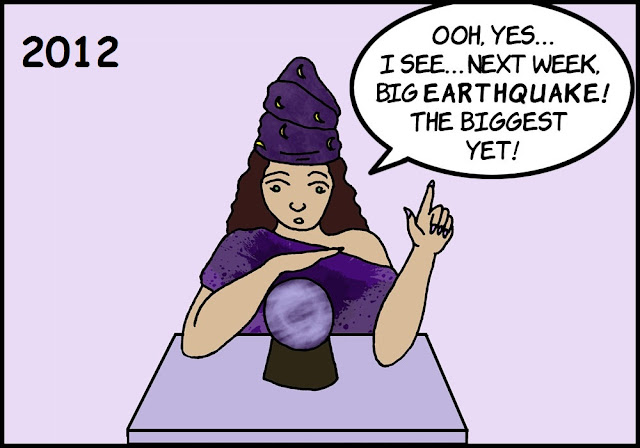

Comic art by Zeo (with slight modifications by Geotripper)
Well, let's see if I can't make a few (seismic) waves here.

My audiences and readers are skeptics and non-believers, to be frank, and usually come down firmly in favor of "false" for an answer. So they are a little surprised when I tell them the actual answer:

TRUE!

Think about it a moment, and you will realize that the statement is in fact true. Psychics predict earthquakes all the time. All the time, and then some more. Earthquakes are one of their most common predictions, more popular I think than predictions about aliens.

That leads to a revised question: Do psychic predictions about earthquakes come true?

My readers are usually onto me by now, and they will say that psychic predictions are invariably wrong. I set them straight. I say "Psychics predict earthquakes all the time, and are almost invariably correct".

I support my contention with a collection of predictions that I googled in about five minutes. I refuse to link to each of them because I have no interest in promoting their websites. If you want to find them, google the statement and it shouldn't take long to dig them up.


  • Both earthquake and out of control fires will effect California causing devastation and loss [of] life. 
  • There will be a violent earthquake, one of the strongest on record.[no location noted]
  • My California earthquake prediction: yes, there WILL be an earthquake in California. I am not saying it will be along the San Andreas Fault or that it will be major. …I am also not saying when.
  • I keep seeing the year 2011 like a pulsating animation within visions of major earth shifts in my home state of California. Dates perceived in months or years could be argued to have limited value in forecasting a time because we psychics move our consciousness in large spans of time and cover broad areas of locations and events.
Note how every one of these predictions came true. Oh, and my favorite, the shotgun prediction....

Wild Weather Predictions

  1. Category five hurricane wipes out Miami.
  2. The worst mudslides in California’s history will occur.
  3. Mount St. Helens erupting.
  4. Earthquake Seattle, Washington.
  5. Earthquake Chicago, Illinois.
  6. Part of the polar ice cap melts.
  7. Wildfires spread to Beverley Hills and Los Angeles, Brentwood.
  8. More tsunamis Sumatra Indonesia, Alaska, Hawaii and Japan.
  9. A great earthquake in Los Angeles, San Francisco and San Diego.
  10. Earthquake Lake Tahoe.
  11. Earthquake Toronto and Quebec.
  12. Earthquake Oregon.
  13. Earthquake Grand Canyon.
  14. Earthquake New York, Alaska, Japan, Greece.
  15. Earthquake British Columbia, China and Iran.
  16. Tornado in California.
  17. Floods Amsterdam, Holland, Rhine River, Germany, Bangladesh, Great Britain. Venice, Italy, Gulf Coast of Florida and France.
  18. Tsunami Malibu, California.
  19. Wildfires Greece, Australia, Texas, Hawaii.
  20. Mudslides in India, California.
  21. Typhoon in Taiwan.
  22. Tornadoes Oklahoma, Indiana, Texas, Illinois, Tennessee.
  23. Great earthquake Rome and Naples, Italy.
  24. Huge snowstorm and blizzards up the eastern seaboard affecting the great lakes – Toronto, Chicago, New York, Boston, etc.
  25. Earthquake Yosemite and Yellowstone Park.
Note how many of these predictions haven't happened yet. Still, many will absolutely take place, allowing the psychic responsible for this list to claim broad success in his or her psychic powers.

Soooo...psychics accurately predict earthquakes. Well, guess what? I can predict earthquakes too! And I can be more specific than the average psychic. Here goes..

I predict that within the next week:
  • 200 earthquakes will occur in California,
  • Of these, there will be a magnitude 4 quake in southern California, most likely in the Colorado Desert near Salton Sea.
  • There will be a magnitude 3 earthquake in northern California, most likely north of the Bay Area, somewhere around Clear Lake.
  • There will be a larger quake at the Vanuatu Islands in the Pacific Ocean, quite possibly in the magnitude 6 range.
  • There will be a magnitude 5 earthquake offshore of Japan.
I think I am going to be right. You are welcome to keep count and when the quakes happen you can hail me as a psychic earthquake predictor.

You can do that, but please note that my predictions have something in common with psychic predictions: the predictions are totally and absolutely useless to anybody.  They are about as useful as predicting that the sun will rise in the east tomorrow. Why? Because like the sun rising, earthquakes happen all the time, and they tend to happen in the same general places, mainly along tectonic plate boundaries (along with a few near hot spots like Hawaii or Yellowstone). It sounds impressive that 200 earthquakes will happen over the next week in California, but that happens nearly every week.

Earthquake prediction is a serious business. On the one hand, a timely prediction can save lives. But a prediction made by a credible source that doesn't come to pass is a real problem. Like the boy who called "wolf" once too often, later predictions would be ignored. Charlatans who make spurious predictions can cause panic and unnecessary stress in an uninformed population (such a prediction in 1990 caused the population of St. Louis and surrounding region to close down businesses and leave town, and also caused a media circus).

An earthquake prediction, in order to save lives, must have three elements:
  • the time (within a few days at most)
  • the location (specific)
  • the magnitude and depth
No psychic ever provides such information, which proves the useless nature of their "predictions". No one is in a position to predict earthquakes with such precision, including seismologists. Anyone who claims some special power of prediction is lying or deluded. No one has ever once saved lives with such predictions (the one successful prediction,ever, of a quake that saved lives, in China in 1975, was based on tangible evidence, and no psychic powers were claimed or invoked).

Psychics: give up the earthquakes. Stick to the lives of the Hollywood stars. They're more predictable anyway.


Question 5 B: Animals predict earthquakes...true or false?

My answer to this one?

??? Who knows???

The problem is perceived cause and effect. Many people who experience strong earthquakes recall strange behaviour by their animals, and link that behaviour to the quake. The problem is that animals may behave strangely in many circumstances that are not followed by a strong earthquake, but the behaviour is not noticed or remarked.

This animal is clearly predicting an earthquake. Or is about to attack.
The other problem is how to quantify strange acts by animals. What specific animal behaviour constitutes a prediction of an earthquake? At what point do authorities declare that animals have predicted a quake?

There are many anecdotal stories about unusual activity by animals going back hundreds of years, so I for one cannot completely dismiss the idea out of hand. Animals sense the world differently than humans, and there could in fact be some sort of electromagnetic or vibrational effect that researchers have not yet detected.

A reasonable response on earthquakes and animal behaviour by the U.S. Geological Survey can be read here, and a good article by the National Geographic can be found here. Geologists around the world have been following a story coming out of Italy regarding the failure of seismologists for failing to predict or warn the local populace before a deadly earthquake in Italy that killed several hundred people in 2009. It's one thing to say geologists can't predict earthquakes, and quite another to say they didn't predict it enough in the aftermath. Seismologists walk a fine line.

Speaking of kitties and strange behaviour, if you see these eyes, run for your life. Aliens have taken over your cat's soul....

Comic art by Zeo

Question 6: In California, we are waiting for the BIG ONE! True or False??

When I talk to groups about this question, I make sure to say "the BIG ONE" in capital letters. How do you say something in capital letters? You do it in a deep baritone voice with your hand cupping the microphone; it's very dramatic.

So what is the answer? Well, actually the question is wrong and requires a bit of modification. Let's try it again, and in that deep baritone voice:

In California, we are waiting for the BIG ONES!

There, that's better. If we can't predict earthquakes, then how can this statement be possible? Doesn't it require the ability to predict earthquakes? Yes, it does. So the statement must be false. But it is not. The answer is TRUE!

Predicting earthquakes is not possible in the short term, as in hours or days, but a great deal can be said about the probability of earthquakes in a particular area over a period of decades. We can do this on the basis of the historical and prehistorical record of earthquakes along a particular fault zone, and by analysis of building stresses and tilting over a large region, as revealed by GPS stations and other related technology Check out the methodology of the 2007 Working Group on California Earthquake Probabilities in this USGS PDF file.
As can be found on the map above, numerous fault zones represent a threat to the state of California. The fault zones are of different lengths, and therefore some will produce smaller quakes, but several are capable of producing large shocks approaching magnitude 7, and maybe even larger. These include the San Jacinto fault, the Owens Valley fault, the Hayward and Calaveras faults, and others. Even more important is the fact that the San Andreas itself is not a single monolithic fault zone. It has segments that behave independently. This was shown in 1857 and 1906, when completely different sections of the fault gave way, producing shocks that approached magnitude 8.

The most recently published studies show that earthquakes of 6.7 magnitude or greater are a virtual certainty over the next 30 years. The chance for an even greater quake is ominous, exceeding 70% for a magnitude 7.0, and a lesser, but still significant chance of even larger events. In a way, one of these quakes has already occurred, even though it was just south of the state: the El Mayor-Cucapah quake this year in northern Baja California was a magnitude 7.2 event.

Another wild card is the possibility of a large quake along the Cascadia subduction zone in the northernmost part of the state. It was not included in the probabilities, but numerous magnitude 7 quakes have taken place in that region in recent decades.

The lesson to be drawn from these predictions is that damaging earthquakes have happened all over California, and they will continue to do so in the future. Some of these quakes will be major events, causing many deaths and massive damage over large areas. The probability forecasts have great value in the sense that they are a warning to residents across the the state to be prepared at all times for earthquakes. We cannot know the precise moment that a large earthquake will strike, but we do know where they will happen, and how big they can be.