Showing posts with label Hawaii. Show all posts

Wednesday, May 23, 2018

It's World Turtle Day! Honu, the Hawaiian Green Sea Turtle

It's World Turtle Day! That's nice because last May I paid a visit to the Hawaiian Islands and got these pictures and I've been looking for an excuse to post them somewhere. We saw the Hawaiian Green Sea Turtles (Chelonia mydas) while we toured the North Shore near Waimea. There's a fairly quiet stretch of beach where they like to pull up and rest. They spend the rest of their time feeding on sea grass and algae.
The Hawaiians called the turtle Honu, and it is held in high regard by the islanders. They were important animal spirits but also provided food and tools made from their shells. Their harvesting was carefully controlled by the local chiefs and the kapu system. The collision of Hawaiian culture with Europeans was a disaster in many, many ways, but it was especially bad for the turtles. They were harvested almost to extinction. Their survival was in doubt until they came under the protection of state and federal laws. Today they are a highlight of a visit to the islands

Thursday, January 25, 2018

A Look Back at Ten Years of Geotripping: The Hawai'i That Was

This is one of my favorite bits of writing from Geotripper. I didn't actually write it until 2016-17, but I actually sketched it out way back in 2009 while sitting in a Mexican Restaurant in Bakersfield on a 112 degree day. On that day we were in no hurry to leave, so I was reading about the presence of the Gardner Pinnacles, a seven acre island that is the oldest bit of exposed volcanic rock in the Hawaiian Island chain. As I worked my way through a delicious three-entrée plate of tacos and enchiladas, I was imagining how many species of animals and plants might have existed there, including many that would have disappeared along with most of the island itself. My musings ended up as several handwritten pages of text that would eventually become the first post of the series. I lost the pages somewhere within a few days, but I never forgot the desire to write a series of posts on this incredible place. An extended visit and field class in the summer of 2016 finally gave me the inspiration to get the whole project off the ground. Instead of describing the beaches and tourist hotels, I was seeking to understand the ancient Hawai'i, the one that existed before European contact, and the one that existed before Polynesian contact.

This has been a continuing series of my personal celebration of ten years of blogging. The compilation below appeared on May 5, 2017.

Since last summer I've been working on a blog series based on the geology, natural history, and anthropology of the Hawaiian Islands, loosely based on our field studies class last summer. There are a lot of stories told by these isolated islands in the middle of the Pacific Ocean. I finally reached the (possible) end of the series yesterday, and so today I'm putting together a compilation of the posts (click on the titles to get to each blog).

The Hawai'i That Was: A New Blog Series
This was the opening post that described what I hoped to do with the series. It included a picture of the Gardiner Pinnacles, the last bit of volcanic rock in the Hawaiian chain of islands. This bit of rock is the final remnant of an island that may have rivaled Kaua'i or Maui in size.

The Hawai'i That Was: To know what was we need to know Hawai'i today
I remember that the location and relative size of the islands meant little to me until I actually visited. In this post I laid out the geography of the main islands of the chain.

The Hawai'i That Was: Why Should We Care?
We are often far too ignorant of our dependence on the land and resources, and forget that they can be abused and wasted. All human societies alter the landscapes that they occupy to increase their chances for survival, and some are more successful than others. Hawai'i is a microcosm of the human experience on Earth.

The Hawai'i That Was: The Beginning of All Things, (Ba)salt of the Earth
Hawai'i begins and ends with basalt, the product of the partial melting in the mantle of the Earth. Basalt is the foundation on which the entire story of Hawai'i is written.

The Hawai'i That Was: The Abode of the Gods and Creation at Kilauea
Kilauea is the site of Hawaii's ongoing eruptive active, 33 years and counting. We saw some spectacular spattering when we visited at night. The video is in this post.
The lava lake in Kilauea Iki in 1959. We walked across it last summer

The Hawai'i That Was: Walking a Lake of Fire in "the Little Source of Great Spewing"
In 1959, a huge eruption produced gigantic columns of spewing lava and filled a depression creating a lake of fire. It's still hot today nearly 60 years later. We walked across the abyss.

The Hawai'i That Was: Pu'u O'o, the Volcano We Couldn't See
The present day lava flows at Kilauea originate at a vent called Pu'u O'o a few miles east of the summit. We didn't get to see it on this trip, but I flew right over it in 2009. Here are the pictures!


The Hawai'i That Was: Living on Uncertain Ground - The First Human Wave Arrives
Hawai'i was one of the last uninhabited places on planet Earth. We get a first look at what life was like for the earliest colonizers, and begin to understand how they changed the islands.

The Hawai'i That Was: How Can the Biggest Mountain in the World Stay So Hidden?
It was a bit strange that we were on Mauna Loa, the world's biggest mountain, and barely ever saw it. The weather on the Big Island can be fickle! No worries though, I found a lot of images in the archives.

The Hawai'i That Was: Mauna O Wakea, the Opening to the Heavens, and the Realm of Ice
There is a second gigantic volcano on the Big Island that is taller than Mauna Loa, but of somewhat less bulk. Mauna Kea is considered the realm of the gods, and in a sense modern technology reflects this as some of the world's most powerful observatories on the summit search the Universe for understanding.

The Hawai'i That Was: A Tale of Two Kipukas, and Thoughts on the Rarest Plants in the World
Ever wondered about the world's rarest plant? How about one that existed as a single specimen? That died? Someone preserved just a few seeds, so it may come back (there are about 200 planted in the kipuka today). The role of kipukas in preserving the Hawai'i that was is described in this post.

The Hawai'i That Had Never Been: A Mountain That is Younger Than Me, Mauna Ulu
An exploration of a mountain that didn't exist when I was in grade school, along with another of Hawai'i's fascinating kipukas. Mauna Ulu is a fascinating place to explore.

The Hawai'i That Was: There was a Monster in the Water at Laupahoehoe
The tragedy of the 1946 tsunami at Laupahoehoe, and how it saved hundreds of thousands in the Pacific Ocean later on, but didn't in the Indian Ocean in 2004.

The Hawai'i That Was: Where are the Rivers? Waterfalls on the Big Island
Many parts of the Big Island have no rivers despite near constant rainfall. In other places, there are some really nice waterfalls! We explore some of them in this post.


The Hawai'i That Was: A Veritable Rainbow of Sand (and cute gratuitous sea turtles)
Did you know that there are beaches in Hawai'i that are made of gemstones? Or that beaches range in color from black to white with a whole rainbow in-between? Lets explore a few.

The Hawai'i That Was: Look at the Cute Squirrel! (NOT a squirrel)
You will no doubt see a squirrel-like creature on some the Hawaiian Islands. It's not, it's a mongoose, which is an important control on pests in other lands. In Hawai'i it IS the pest. It's had a devastating affect on the native birds of the islands.

The Hawai'i That Was: Exploring Pololu Valley on an Unstable "Dead" Volcano
The Big Island is not noted for having huge coastal cliffs, but there are some nice ones on the northeast coastline. The origin of the cliff is a notable story as well, that of a gigantic prehistoric landslide.

The Hawai'i That Was: What Happened to the Stones of Pololu? A Look at Pu'ukohala Heiau
This is the story of the Pu'ukohala Heiau, one of the most intriguing archaeological sites in the Hawaiian Islands. It was built by King Kamehameha I prior to his uniting of the islands under single rule. The stones they used to build it came from the other side of the island.

The Hawai'i That Was: Lapakahi, the Kind of Place Where the Rest of Them Lived 
History seems to always be about the kings and presidents. We usually hear little about what life was like for the "commoners". Lapakahi is an archaeological site that protects a commoner's village on the northeast coast of the Big Island.

The Hawai'i That Was: Have We Got Some Real Estate for You! Exploring Kaloko-Honokohau National Historical Park
Hawai'i has a number of national parks, and one of them seems a strange choice, backed up against a Costo store near Kona. It's a barren lava flow, but treasures are hidden within its boundaries.

The Hawai'i That Was: Pu'uhonua o Honaunau, the Place of Sanctuary That Might Not Be So Safe (Geologically)
Can you ever feel safe? There are different kinds of 'safe' in Hawai'i. A few hundred years ago, small infractions could get you killed, but you could find safety and forgiveness if you could make it to a place like Pu'uhonua o Honaunau. Geologically though? Maybe not so much.

The Hawai'i That Was: Watching the Destruction of the Islands in Real Time
Flying from the Big Island to Kaua'i is like riding a time machine both backwards and forwards. We see the progression of the erosion and subsidence of the islands over the last 5 million years, but we are also seeing the future of the Big Island, five million years into the future.

The Hawai'i That Was: We Arrive on Kaua'i and Find the Beauty of Age
The Big Island and Kaua'i are separated by only a few hundred miles, but they might as well be worlds apart. They are different from each other in many ways. We begin an exploration of the oldest of the main Hawaiian Islands.

The Hawai'i That Was: History and Beauty at Ke'e Beach and the Na Pali Coast.
On the north side of Hawai'i is a spectacular coast of some of the highest beach cliffs in the world, and the remains of a hula school that operated for perhaps 800 years. Not many universities in the world can make such a claim.

The Hawai'i That Was: An Idyllic Paradise on the North Shore of Kaua'i. Sort of.
Hanalei Bay is one of the most beautiful places on planet Earth. But even paradise can be a place of danger. Why are all the houses built on stilts?

The Hawai'i That Was: Hanalei, Where the Waterfalls Seem to Stream From the Clouds
The north side of Kaua'i captures the warm moist tropical trade winds, and collects prodigious amounts of rainfall. The mountains here are the wettest places on Earth, with one spot that gets nearly 500 inches of rain per year.

The Hawai'i That Was: Rising Out of Depression on Kaua'i, and Sleeping Giants
Have you ever wondered where that unique mountain in the opening of "Raiders of the Lost Ark" was located? Actually dozens of movies have been filmed on Kaua'i somewhere. We also climb the Sleeping Giant, a slumbering hero of the native Hawaiians.


The Hawai'i That Was: Into the Last Stand of Wilderness in Kaua'i, the Alaka'i Swamp
We take a hike into the last refuge of many of the native species of the Hawaiian Islands, a high-altitude "swamp" on the Alaka'i Plateau. It is an absolutely unique environment, unlike any on Earth.


The Hawai'i That Was: What the Worst Disaster You Can Think of? The Terror of Na Pali...
The cliffs of the Na Pali is one of the most incredible shorelines in the world, and are stunningly beautiful. On the other hand, they are evidence of one of the most violent of disasters, one that was so intense that it sent waves crashing against the other islands more than a thousand feet high.

The Hawai'i That Was: The Lost Wetlands of the Mana Plain on Kaua'i
A portion of the west coast of Kaua'i exemplifies the conflict between the modern world and the natural environment that existed before. Volunteers are attempting to rebuild some of the wetlands that once existed on the Mana Plain.

The Hawai'i That Was: Waimea Canyon, the View You "Have" to Earn...
Our trip was near an end, and we took one last hike, one that end at the brink of a place so spectacular that it's been called the "Grand Canyon of the Pacific". We learned about the need to "earn" a view.


The Hawai'i That Was: The Final Refuge
For the our final blog in the series (for now at least), we have a look at Waimea Canyon, a deep gorge produced when half the island threatened to collapse and sink into the sea. We end with the realization that the natural environment that once existed in Hawai'i still survives in isolated corners here and there. These are the last refuge for many species, and many of us.

Friday, May 5, 2017

The Hawai'i That Was: A Geological and Anthropological Exploration of the Islands


Since last summer I've been working on a blog series based on the geology, natural history, and anthropology of the Hawaiian Islands, loosely based on our field studies class last summer. There are a lot of stories told by these isolated islands in the middle of the Pacific Ocean. I finally reached the (possible) end of the series yesterday, and so today I'm putting together a compilation of the posts (click on the titles to get to each blog).

The Hawai'i That Was: A New Blog Series
This was the opening post that described what I hoped to do with the series. It included a picture of the Gardiner Pinnacles, the last bit of volcanic rock in the Hawaiian chain of islands. This bit of rock is the final remnant of an island that may have rivaled Kaua'i or Maui in size.

The Hawai'i That Was: To know what was we need to know Hawai'i today
I remember that the location and relative size of the islands meant little to me until I actually visited. In this post I laid out the geography of the main islands of the chain.

The Hawai'i That Was: Why Should We Care?
We are often far too ignorant of our dependence on the land and resources, and forget that they can be abused and wasted. All human societies alter the landscapes that they occupy to increase their chances for survival, and some are more successful than others. Hawai'i is a microcosm of the human experience on Earth.

The Hawai'i That Was: The Beginning of All Things, (Ba)salt of the Earth
Hawai'i begins and ends with basalt, the product of the partial melting in the mantle of the Earth. Basalt is the foundation on which the entire story of Hawai'i is written.

The Hawai'i That Was: The Abode of the Gods and Creation at Kilauea
Kilauea is the site of Hawaii's ongoing eruptive active, 33 years and counting. We saw some spectacular spattering when we visited at night. The video is in this post.
The lava lake in Kilauea Iki in 1959. We walked across it last summer

The Hawai'i That Was: Walking a Lake of Fire in "the Little Source of Great Spewing"
In 1959, a huge eruption produced gigantic columns of spewing lava and filled a depression creating a lake of fire. It's still hot today nearly 60 years later. We walked across the abyss.

The Hawai'i That Was: Pu'u O'o, the Volcano We Couldn't See
The present day lava flows at Kilauea originate at a vent called Pu'u O'o a few miles east of the summit. We didn't get to see it on this trip, but I flew right over it in 2009. Here are the pictures!


The Hawai'i That Was: Living on Uncertain Ground - The First Human Wave Arrives
Hawai'i was one of the last uninhabited places on planet Earth. We get a first look at what life was like for the earliest colonizers, and begin to understand how they changed the islands.

The Hawai'i That Was: How Can the Biggest Mountain in the World Stay So Hidden?
It was a bit strange that we were on Mauna Loa, the world's biggest mountain, and barely ever saw it. The weather on the Big Island can be fickle! No worries though, I found a lot of images in the archives.

The Hawai'i That Was: Mauna O Wakea, the Opening to the Heavens, and the Realm of Ice
There is a second gigantic volcano on the Big Island that is taller than Mauna Loa, but of somewhat less bulk. Mauna Kea is considered the realm of the gods, and in a sense modern technology reflects this as some of the world's most powerful observatories on the summit search the Universe for understanding.

The Hawai'i That Was: A Tale of Two Kipukas, and Thoughts on the Rarest Plants in the World
Ever wondered about the world's rarest plant? How about one that existed as a single specimen? That died? Someone preserved just a few seeds, so it may come back (there are about 200 planted in the kipuka today). The role of kipukas in preserving the Hawai'i that was is described in this post.

The Hawai'i That Had Never Been: A Mountain That is Younger Than Me, Mauna Ulu
An exploration of a mountain that didn't exist when I was in grade school, along with another of Hawai'i's fascinating kipukas. Mauna Ulu is a fascinating place to explore.

The Hawai'i That Was: There was a Monster in the Water at Laupahoehoe
The tragedy of the 1946 tsunami at Laupahoehoe, and how it saved hundreds of thousands in the Pacific Ocean later on, but didn't in the Indian Ocean in 2004.

The Hawai'i That Was: Where are the Rivers? Waterfalls on the Big Island
Many parts of the Big Island have no rivers despite near constant rainfall. In other places, there are some really nice waterfalls! We explore some of them in this post.


The Hawai'i That Was: A Veritable Rainbow of Sand (and cute gratuitous sea turtles)
Did you know that there are beaches in Hawai'i that are made of gemstones? Or that beaches range in color from black to white with a whole rainbow in-between? Lets explore a few.

The Hawai'i That Was: Look at the Cute Squirrel! (NOT a squirrel)
You will no doubt see a squirrel-like creature on some the Hawaiian Islands. It's not, it's a mongoose, which is an important control on pests in other lands. In Hawai'i it IS the pest. It's had a devastating affect on the native birds of the islands.

The Hawai'i That Was: Exploring Pololu Valley on an Unstable "Dead" Volcano
The Big Island is not noted for having huge coastal cliffs, but there are some nice ones on the northeast coastline. The origin of the cliff is a notable story as well, that of a gigantic prehistoric landslide.

The Hawai'i That Was: What Happened to the Stones of Pololu? A Look at Pu'ukohala Heiau
This is the story of the Pu'ukohala Heiau, one of the most intriguing archaeological sites in the Hawaiian Islands. It was built by King Kamehameha I prior to his uniting of the islands under single rule. The stones they used to build it came from the other side of the island.

The Hawai'i That Was: Lapakahi, the Kind of Place Where the Rest of Them Lived 
History seems to always be about the kings and presidents. We usually hear little about what life was like for the "commoners". Lapakahi is an archaeological site that protects a commoner's village on the northeast coast of the Big Island.

The Hawai'i That Was: Have We Got Some Real Estate for You! Exploring Kaloko-Honokohau National Historical Park
Hawai'i has a number of national parks, and one of them seems a strange choice, backed up against a Costo store near Kona. It's a barren lava flow, but treasures are hidden within its boundaries.

The Hawai'i That Was: Pu'uhonua o Honaunau, the Place of Sanctuary That Might Not Be So Safe (Geologically)
Can you ever feel safe? There are different kinds of 'safe' in Hawai'i. A few hundred years ago, small infractions could get you killed, but you could find safety and forgiveness if you could make it to a place like Pu'uhonua o Honaunau. Geologically though? Maybe not so much.

The Hawai'i That Was: Watching the Destruction of the Islands in Real Time
Flying from the Big Island to Kaua'i is like riding a time machine both backwards and forwards. We see the progression of the erosion and subsidence of the islands over the last 5 million years, but we are also seeing the future of the Big Island, five million years into the future.

The Hawai'i That Was: We Arrive on Kaua'i and Find the Beauty of Age
The Big Island and Kaua'i are separated by only a few hundred miles, but they might as well be worlds apart. They are different from each other in many ways. We begin an exploration of the oldest of the main Hawaiian Islands.

The Hawai'i That Was: History and Beauty at Ke'e Beach and the Na Pali Coast.
On the north side of Hawai'i is a spectacular coast of some of the highest beach cliffs in the world, and the remains of a hula school that operated for perhaps 800 years. Not many universities in the world can make such a claim.

The Hawai'i That Was: An Idyllic Paradise on the North Shore of Kaua'i. Sort of.
Hanalei Bay is one of the most beautiful places on planet Earth. But even paradise can be a place of danger. Why are all the houses built on stilts?

The Hawai'i That Was: Hanalei, Where the Waterfalls Seem to Stream From the Clouds
The north side of Kaua'i captures the warm moist tropical trade winds, and collects prodigious amounts of rainfall. The mountains here are the wettest places on Earth, with one spot that gets nearly 500 inches of rain per year.

The Hawai'i That Was: Rising Out of Depression on Kaua'i, and Sleeping Giants
Have you ever wondered where that unique mountain in the opening of "Raiders of the Lost Ark" was located? Actually dozens of movies have been filmed on Kaua'i somewhere. We also climb the Sleeping Giant, a slumbering hero of the native Hawaiians.


The Hawai'i That Was: Into the Last Stand of Wilderness in Kaua'i, the Alaka'i Swamp
We take a hike into the last refuge of many of the native species of the Hawaiian Islands, a high-altitude "swamp" on the Alaka'i Plateau. It is an absolutely unique environment, unlike any on Earth.


The Hawai'i That Was: What the Worst Disaster You Can Think of? The Terror of Na Pali...
The cliffs of the Na Pali is one of the most incredible shorelines in the world, and are stunningly beautiful. On the other hand, they are evidence of one of the most violent of disasters, one that was so intense that it sent waves crashing against the other islands more than a thousand feet high.

The Hawai'i That Was: The Lost Wetlands of the Mana Plain on Kaua'i
A portion of the west coast of Kaua'i exemplifies the conflict between the modern world and the natural environment that existed before. Volunteers are attempting to rebuild some of the wetlands that once existed on the Mana Plain.

The Hawai'i That Was: Waimea Canyon, the View You "Have" to Earn...
Our trip was near an end, and we took one last hike, one that end at the brink of a place so spectacular that it's been called the "Grand Canyon of the Pacific". We learned about the need to "earn" a view.


The Hawai'i That Was: The Final Refuge
For the our final blog in the series (for now at least), we have a look at Waimea Canyon, a deep gorge produced when half the island threatened to collapse and sink into the sea. We end with the realization that the natural environment that once existed in Hawai'i still survives in isolated corners here and there. These are the last refuge for many species, and many of us.

Sunday, May 22, 2016

Pele is a Capricious Goddess...Part Three, a Precious Gift from a Mysterious Woman


One of the most awe-inspiring moments of my life
I've been celebrating my impending return to the Hawaiian Islands by revising and expanded a few posts I did in 2009 about the volcano goddess Pele, and my experiences with the ongoing eruption of Kilauea.  My third chance to see Pele's beauty came about in 2006 as a result of a family reunion that included a cruise of four of the Hawaiian islands. We arrived a few days early on the off-chance that there would be something to see on the Pu'u O'o flow that continued to erupt over the years. It had been a mostly quiet year, with lava flowing through tubes for seven miles before spilling into the sea.
The 2006 lava flow ocean entry from 3,000 feet above and 20 miles away on Chain of Craters Road

I was not really expecting to see much. The problem is that the coastal cliffs around a lava entry are dangerously unstable. As the lava hits the water, it shatters and forms thick layers of unstable cinders while being covered by lava flows. Every so often, the cinders slide downward, and the lava bench suddenly collapses into the sea. A number of people have been killed because they were standing on the benches when they collapsed. So, the national park service had erected a rope barrier to keep people from the most dangerous areas. Unfortunately, there was no view possible of the lava itself, according to reports. Just the bright orange glow of the steam rising from the turmoil below the coastal cliff.
The glow of moonlight on the ocean, and the glow of lava on the steam.

Still, it was worth a try. I told my wife and son and nephews that I would hike out, be safe, look at the glow of the invisible lava, and be back to the hotel by 9 PM or so. I took water, a flashlight, extra batteries, and my brand-new camera that I had bought that morning, and was just beginning to learn to use.

The hike was longer than I expected. There were so many people parked at the end of Chain of Craters Road that I literally had to walk an extra mile just to reach the trailhead. The flows were entering the sea two miles away, over trail-less pahoehoe flows. The sun set way too quickly and for route-finding I was down to my flashlight, and flashing beacons set up every quarter mile or so. Plenty of people were walking back with their flashlights, so the route was clearly evident. Most of the people I talked to expressed disappointment. Nothing to see but glowing steam. There were a few idiots who crossed the barriers, but even they couldn't get close enough to see anything. I was getting very tired. Pahoehoe may be smooth, but is still very uneven, and it only takes a single misstep to twist or break an ankle. I made it to the rope barrier, and could now see the glow and the steam. It was actually an awe-inspiring moment, as the moon had risen and was reflecting off the ocean behind the steam plumes. But no lava.
And then things got different in a hurry

I realized that it had become very lonely. The only others about were four people in a party, and a single flashlight off in the distance headed back to the road. I hung with the four people and a lady appeared out of the darkness (it only occurred to me later that she didn't have a flashlight). She hinted that we might want to walk to the far eastern end of the rope barrier, another quarter mile away. And then she disappeared into the darkness again. I looked at my watch. Already 9:00 PM. I was going to be way overdue. But, what was out there? What was the lady talking about?

Curiosity got the best of me, and I set off for the far end of the barrier. After 20 minutes or so, I surmounted a small cliff and looked down, and saw one of the most beautiful sights I have ever seen.

I was standing at the top of a thirty-foot cliff that marked the edge of the latest bench collapse (The safe edge, if you are wondering). No more than 30 minutes earlier, a lava tube had broken through, and lava was starting to pour across the bench to the 15-foot high beach cliff a mere hundred yards away. I stood entranced as the lava flowed like syrup across the slope below me. The finger of lava flowed slowly to the edge of the cliff and spilled over into the surf.

The five of us were the only people out of hundreds of visitors that day who saw the glorious scene before us. Except that mysterious woman...Needless to say, I was in a heap o' trouble when I walked into the hotel lobby after midnight. But I can never forget the incredible gift of that magical sight of lava pouring into the sea. And that mysterious woman in the darkness.

PS: I found a USGS photograph of the coast taken on the same day I was there. The parking was in the distant brown area, the black is recent lava flows, and the gray foreground area is the active lava delta. The rope barrier is hard to see, but it was uphill from the lava delta. The new lava breakout that I saw happened at the bottom of the picture at the edge of the gray delta.

PSS: I did manage to figure out the video function on the new camera, but of course I should have taken more.

Saturday, May 21, 2016

Pele is a Capricious Goddess (reprised)...Part Two

Continuing the story from the previous post, I had a second chance to see a volcano in action in 2004. I was the newly elected president of the Far West Section of the National Association of Geoscience Teachers, and for my first conference, I had persuaded someone to sponsor a meeting in Hilo, Hawaii. The volcano on the Big Island at Pu'u O'o had continued to be active over the previous two years and was still going strong as the date of the conference approached. Lava was still traveling from the cinder cone on the east rift zone of Kilauea and traveling through lava tubes to the ocean. I was thrilled that a bunch of fellow teachers would be able to see an active lava flow!
Except (and there always seems to be some kind of terrible "except" to stories like this)...as the final days approached, the flow activity started to wane. The HVO reported that blockages had started to occur in the upper reaches of the lava tubes that were feeding the ocean entries, and the lava flows were slowing considerably, declining to almost nothing. Every morning I went online to check on the latest HVO reports, and got a sinking feeling.
My daughter arrived on the island a day before me, and hiked out to see the lava flows. It was down to a single dribble, no wider than a pencil, falling into the sea. No wider than a pencil. And then it stopped...
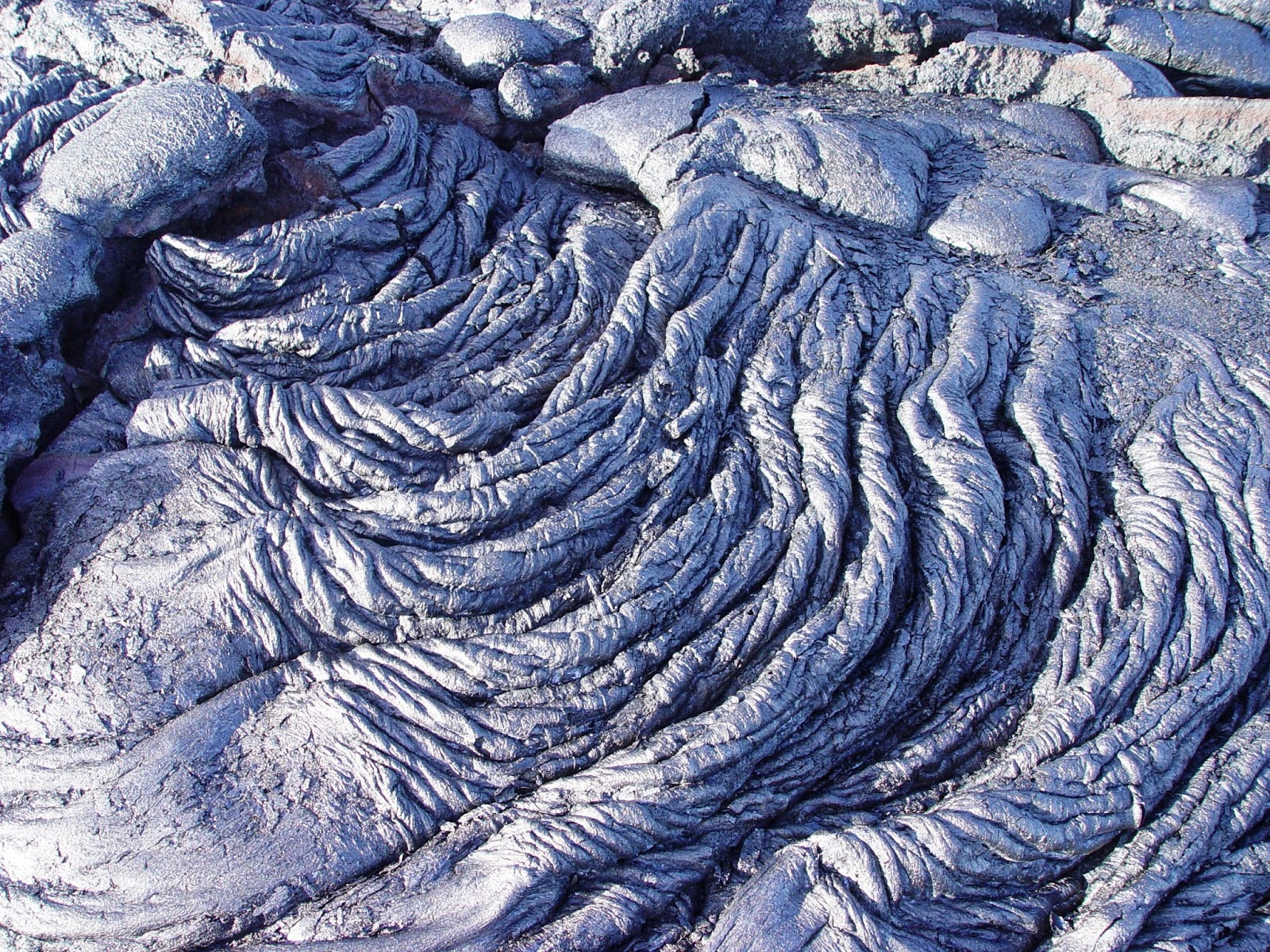
The next day, I hiked out to the flow as fast as I could, and saw...well, I saw what you can see in the picture above: steam from a recently ended flow. I searched desperately for any kind of small break out, any sign of active lava, but all there was was steam rising from cracks here and there. All I got for my trouble was a badly scraped arm and palm when I slipped and fell onto a day-old lava flow. I was not aware until that day that fresh basalt flows are usually covered with a thin veneer of obsidian (volcanic glass) that gives the lava flow a silvery metallic appearance. The glass starts to break up right away, forming jagged shards that are like small razors lying about the surface.
Still, there is great beauty in new rock. The patterns in the pahoehoe lava surfaces are endlessly fascinating, and there is a grandeur in the barren surfaces of a day old lava flow. It is an absolutely sterile surface that has never before existed. A new beginning...
Lava flowing into seawater has a tendency to explode on contact, forming fine sand-sized particles. Kilauea had already destroyed one of the most cherished black sand beaches in Hawaii, but a new beach, however impermanent, had appeared to replace it.

Pele had given the gift of new land on the island, but I was not privileged in this instance to see it happen. But patience is a virtue. It would be another two years before I made it to the islands, but it was worth the wait. That story will have to wait for the next post!
This is an expanded version of a 2009 blog post that preceded the first field studies course that I ever taught on the Hawaiian Islands. We're leaving in a week for the islands for our second-ever course, so I'm thinking volcanic subjects these days.