Showing posts with label Hawaii Volcanoes National Park. Show all posts

Monday, June 6, 2016

Pele is a Capricious Goddess...Today She Dispensed a Gift

Halemaumau, on the Kilauea volcano in Hawaii, is a crater within a caldera that has been simmering away for most of the last seven years. The pit is around 600 feet across, and a few hundred feet down (on most days) there is a roiling lake of molten basalt. On the rarest of occasions the level of the lava lake will rise, and some basalt will flow across the flats, but most of the time the lava lies hidden.

Halemaumau is said to be the habitation of Pele, the volcano goddess of the islands. I've had just enough interesting experiences with flowing lava to think of Pele as a tangible personality with moments of jealousy, but also with a penchant for granting precious gifts at particular moments.

By day, little can be seen of the lava. What glow there is is crowded out completely by sunlight, and although our students were sufficiently impressed by the sight, I was hoping that an opportunity would arise for the group to see Halemaumau at night. The weather was not being cooperative, with a constant threat of rain the last few days, but we took the gamble and headed up to Hawaii Volcanoes National Park in the late afternoon to see if the rain clouds would clear for us a bit. It turned out that Pele had a grand surprise ready for us.
The glow was there, as expected, and it was spectacular, literally filling the sky with color. But as we watched we realized that something else was happening: there was some fountaining going on, and lava was exploding into the air above the crater rim. This is not a common sight, so it was a thrill to see it happening. Given the low ebb of activity on the volcano over the last several months, I was pretty sure our students wouldn't see any actual lava at all. I was wonderfully wrong!
It's hard to catch a fountain of lava with a still photo, so I took a minute of video (actually seven of  them, but only one turned out) to give you a feel for the action. Enjoy! We did...

Friday, June 3, 2016

When You Say "He's Older Than the Hills" and You're Right....Pu'u Pua'i in Kilauea Iki

It's true! I am two years older than the mountain behind me. This is Pu'u Pua'i, a cinder cone that grew during the Kilauea Iki eruptions of 1959 in Hawaii Volcanoes National Park on the Big Island of Hawaii. It must have been a sight to see. At times during the eruption, basalt was fountaining to a height of 1,900 feet. The prevailing winds blew the cinders and lapilli to the southeast, building up the 900 foot high edifice.

I'm in Hawaii, and we've just finished the first day of our 12 day exploration of the Big Island and Kaua'i. Most of the students explored the Thurston Lava Tube, and then took the 3-4 mile trail loop through the crater of Kilauea Iki and the below the imposing cone. It is an awesome experience to stand below these giant creations of nature.
Given our busy schedule, posts will be sporadic. We'll be headed down Chain of Craters Road tomorrow for some archaeological explorations on the coastal plain.

Saturday, May 21, 2016

Pele is a Capricious Goddess (reprised)...Part Two

Continuing the story from the previous post, I had a second chance to see a volcano in action in 2004. I was the newly elected president of the Far West Section of the National Association of Geoscience Teachers, and for my first conference, I had persuaded someone to sponsor a meeting in Hilo, Hawaii. The volcano on the Big Island at Pu'u O'o had continued to be active over the previous two years and was still going strong as the date of the conference approached. Lava was still traveling from the cinder cone on the east rift zone of Kilauea and traveling through lava tubes to the ocean. I was thrilled that a bunch of fellow teachers would be able to see an active lava flow!
Except (and there always seems to be some kind of terrible "except" to stories like this)...as the final days approached, the flow activity started to wane. The HVO reported that blockages had started to occur in the upper reaches of the lava tubes that were feeding the ocean entries, and the lava flows were slowing considerably, declining to almost nothing. Every morning I went online to check on the latest HVO reports, and got a sinking feeling.
My daughter arrived on the island a day before me, and hiked out to see the lava flows. It was down to a single dribble, no wider than a pencil, falling into the sea. No wider than a pencil. And then it stopped...
The next day, I hiked out to the flow as fast as I could, and saw...well, I saw what you can see in the picture above: steam from a recently ended flow. I searched desperately for any kind of small break out, any sign of active lava, but all there was was steam rising from cracks here and there. All I got for my trouble was a badly scraped arm and palm when I slipped and fell onto a day-old lava flow. I was not aware until that day that fresh basalt flows are usually covered with a thin veneer of obsidian (volcanic glass) that gives the lava flow a silvery metallic appearance. The glass starts to break up right away, forming jagged shards that are like small razors lying about the surface.
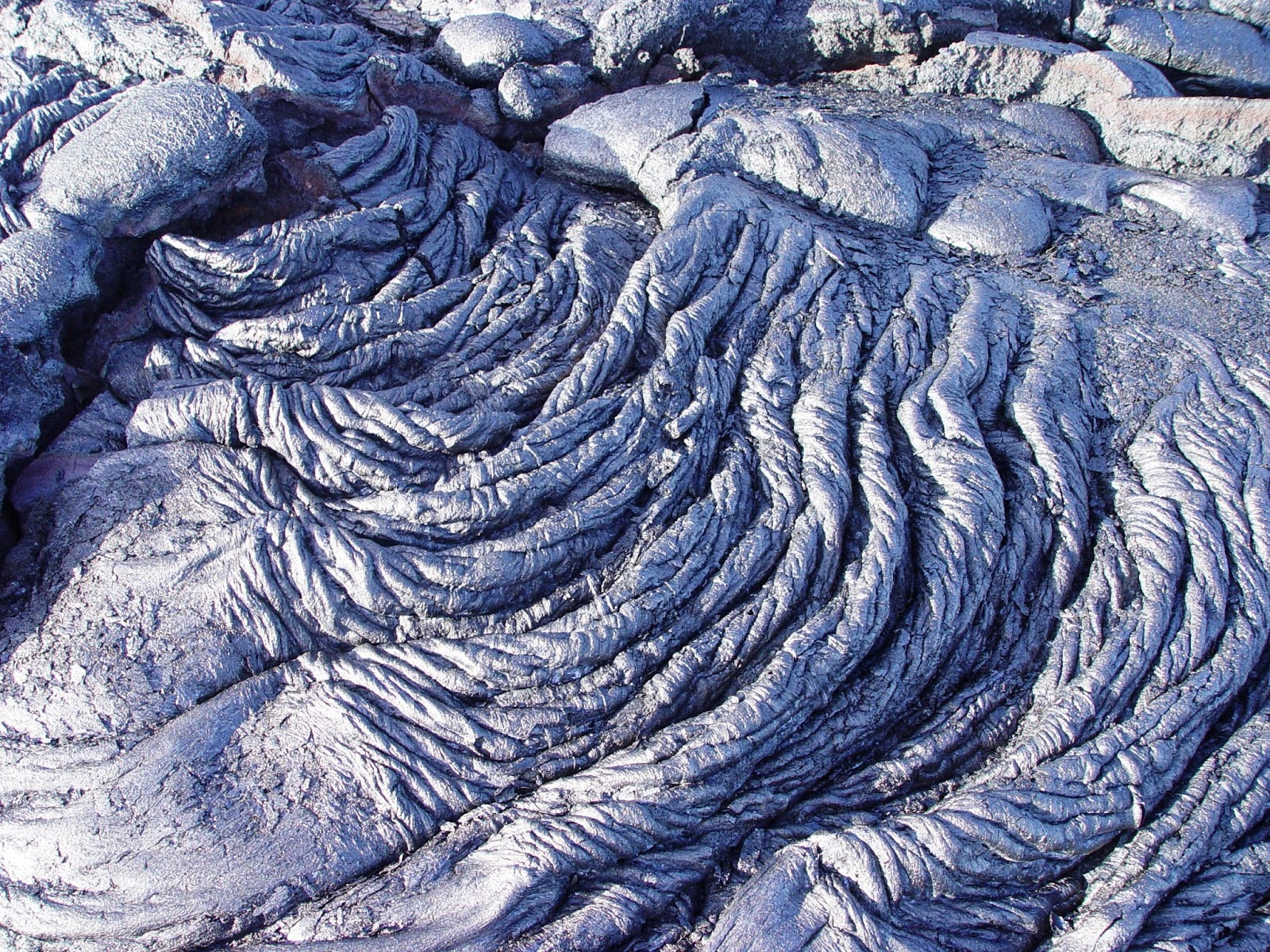
Still, there is great beauty in new rock. The patterns in the pahoehoe lava surfaces are endlessly fascinating, and there is a grandeur in the barren surfaces of a day old lava flow. It is an absolutely sterile surface that has never before existed. A new beginning...
Lava flowing into seawater has a tendency to explode on contact, forming fine sand-sized particles. Kilauea had already destroyed one of the most cherished black sand beaches in Hawaii, but a new beach, however impermanent, had appeared to replace it.

Pele had given the gift of new land on the island, but I was not privileged in this instance to see it happen. But patience is a virtue. It would be another two years before I made it to the islands, but it was worth the wait. That story will have to wait for the next post!
This is an expanded version of a 2009 blog post that preceded the first field studies course that I ever taught on the Hawaiian Islands. We're leaving in a week for the islands for our second-ever course, so I'm thinking volcanic subjects these days.

Friday, May 20, 2016

Pele is a Capricious Goddess...Part One (A Return to the Realm of Fire)

Note to my Geology 190 Students: this IS NOT a picture from my current visit. Lava is NOT flowing this way right now. I offer NO GUARANTEES that anything we see on our trip in two weeks will be anything like this. The reasons are described below....
That's a much younger version of myself, from 2002
For everyone else: I wish you could join us! We are headed to the Hawaiian Islands in a few weeks so I am revisiting some posts from 2009, when our students last joined me. I've made some changes to the original post and added lots of photos. 
My very first sight of flowing lava, 2002, Chain of Craters Road

Pele is the volcano goddess on the Hawaiian Islands, and she is a powerful deity in the lives of the islanders. Think about it: the only substantial piece of land above sea level for thousands of miles in all directions is the result of volcanic eruptions that built the islands up from ocean crust lying beneath 3 miles of ocean water. All existence on the islands starts with volcanic creation, and all is lost when the volcanoes ultimately die out and fall prey to the waves and weathering. These beliefs demand a certain amount of respect when paying a visit to the islands.
An offering to Pele at Halemaumau, 2002

The title of my post is meant in a slightly humorous vein, but my experiences in four trips make me start to wonder. Let me explain...

My first trip to the islands was in 2002, and I was full of hope that I would get a chance to see a lava flow, even though there seemed little chance of it from reading the 2002 status reports from the Hawaii Volcanoes Observatory. Lava had not reached the ocean for many months, with activity confined to the region around Pu'u O'o many miles from any roads or trails. Then, just prior to my plane flight, lava started flowing rapidly down the slopes of the shield, and began pouring in a spectacular manner over the Pulama Pali (a 500 foot fault scarp/cliff) and onto the coastal plain...only a mile from the end of Chain of Craters Road! At one point seven streams of lava were pouring over the cliff! And the lava was now crossing the coastal plain on the way to the sea. I was going to see an incredible show!
The U.S. Geological Survey took this photo the day I arrived on Hawai'i, June 11, 2002.

But....

The lava flow had started the largest forest fire to occur in the park in 15 years. And the fire fighters had to close Chain of Craters Road to provide access for their fire-fighting equipment. I was not going to see the lava flow! I was crushed, frustrated beyond reason!
One day later, it was still spectacular to see.

But...

Being a Californian, I expect that firefighters work day and night to fight fires, but Hawaii was different. The crews shut down at 5:00 PM, and went home for a nap. The road opened. I, and hundreds of other people drove the road in one long stream of cars, and started hiking over the older flows towards the new flows, now only a quarter mile from the ocean. We could walk right up to the edge of the oncoming flow and feel the intense heat. It was not moving fast, only a few inches a minute, but it was hypnotic. There is nothing quite like standing at the edge of a new creation, knowing that this was how these islands came to exist, one flow after another, after another until they are tens of thousands of feet thick, finally emerging from the sea. The new land provided a platform for the survival of the living flotsam and jetsam that once every few thousand years washed up on the island. These pioneers eventually evolved into the complex ecosystem we see today in Hawai'i.
Lava at night is other-worldly

This was not the first time I would experience Pele's fire. I've made a number of journeys to the islands in the years since, and every visit to Pele's realm was unique, and in one particular instance, downright mysterious and a bit mystical.

In the next post: Pele gets moody...

Tuesday, July 23, 2013

There Will Be Signs: This Month's Accretionary Wedge!

This month's Accretionary Wedge, sponsored by Evelyn Mervine at Georneys, is on the subject of geology-related signs. The subject is a good one, and it rang a little bell in my memory circuits; I remembered doing something on signs a LONG time ago, during the early Mesozoic era of geo-blogging, circa 2008. I did a little digging and came up with this post from March 6, 2008 (only two months after starting Geotripper):
Soon after posting a few death-defying pictures, Julian at Harmonic Tremors posted an additional photo of an "Unsafe Rock Area" (Danger danger danger! ), which brought to mind two of my favorite geology-related caution signs...the picture above is a sign warning of falling rocks at the base of a 400 foot "cliff" in southern England called Salisbury Cathedral!
The other sign may be familiar to travelers at Hawaii Volcanoes National Park. Just in case anyone feels uncomfortable passing such a sign, the park was kind enough to announce....


2013 addendum: I later found out that the "fault zone" in question suddenly split open a decade or two ago (in front of a geologist), and a short episode of lava extrusion and flow ensued. Then it stopped and has been quiet since.