Showing posts with label Yosemite Point. Show all posts

Sunday, October 30, 2022

How It Was Today: Fall in Yosemite Valley

How it ended...

How it began...
I woke up late this morning. Mrs. Geotripper was finishing breakfast and asked if I'd like "to go up the river a little ways and find some fall colors". I had lots of grading to get through, so obviously I said yes, and around 11 or so we jumped in the car and headed up the Tuolumne River to see what we would find. There wasn't much, at least not in terms of fall color. So we went a little farther...
We followed Highway 132 up past Coulterville and on to Greeley Hill at a bit above 3,000 feet. Still not much in the way of fall color. So we went a bit farther up the hill and found ourselves at the Yosemite National Park entrance station at Big Oak Flat at 4,000 feet. We finally found a bit of color, although not at the intensity that a few more days of cold weather might bring. 
And we had made it this far, and Yosemite Valley was only 15 miles away. How could we pass it up? 
So on we went into the awesome gorge of the Merced River and into the valley itself. There was the first look at the distant cliffs of El Capitan (left), Half Dome (center), and Sentinel Rock and Dome (right).
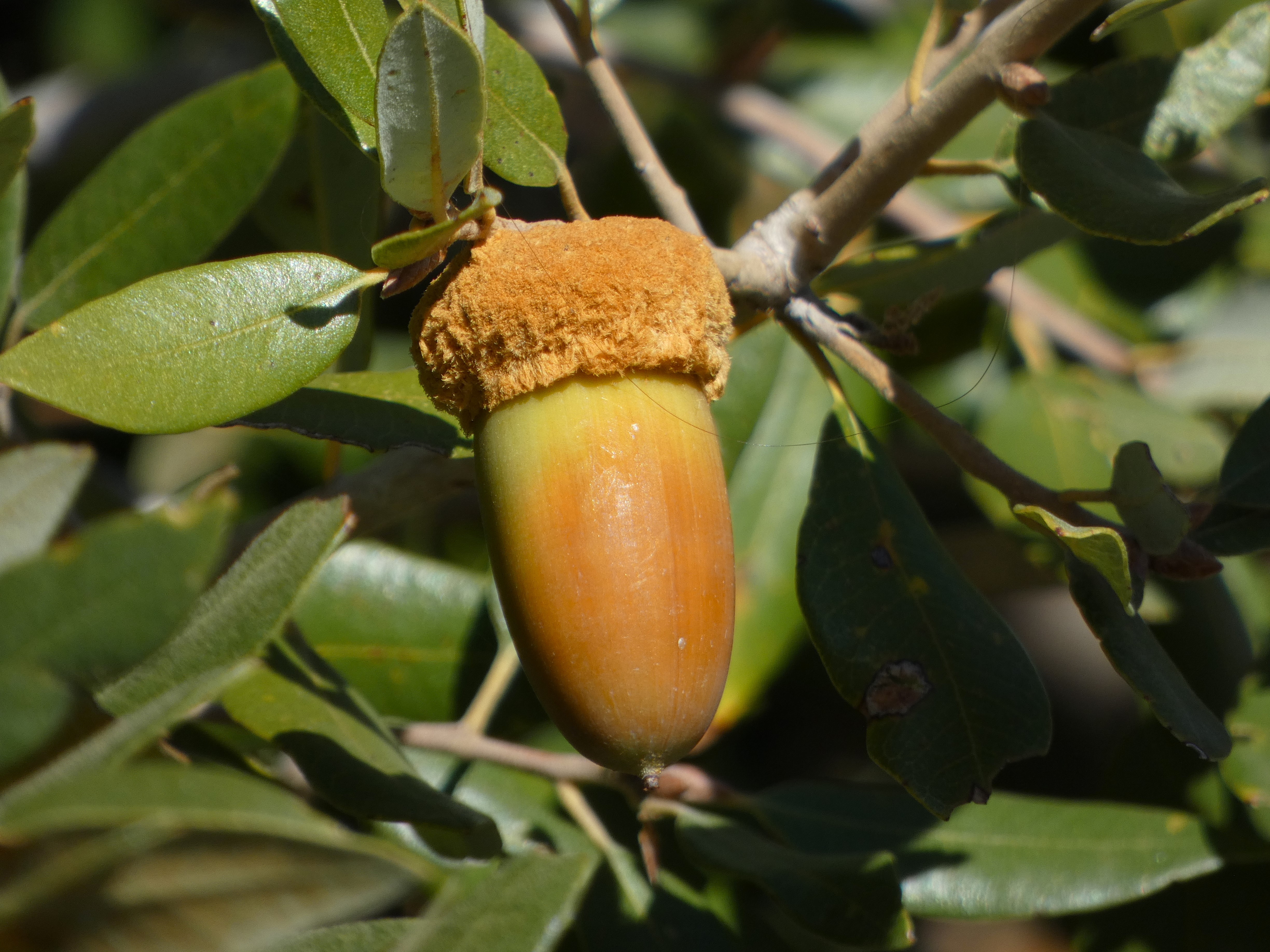
Closer at hand were a lot of ripening acorns. The bears and woodpeckers will be happy.
We reached the valley floor and started our tour of Yosemite's greatest hits. We were surprised to find some wispy curtains of water flowing over Bridalveil Falls. The 620 foot-high waterfall is a classic example of a glacial hanging valley. The main trunk glacier flowing through Yosemite Valley was able to erode a much deeper trough than the small glacier in Bridalveil Creek, so the floor of the creek was left hanging high above the main valley floor.
It was not a cold day, mostly in the sixties, but the sun was intense. It brought out what colors there were in the oaks and dogwood trees.
We didn't see a great many varieties of birds, but there were some Acorn Woodpeckers busy collecting acorns and hiding them in tree "granaries". Such trees can have tens of thousands of drilled holes that can hold a single acorn each. The birds live in loose family groups who search for and guard their food supplies.
Yosemite Valley is not a 'typical' glacially-carved valley. Most such valleys have a U-shaped profile, and are relatively straight. Yosemite Valley is characterized instead by bold cliffs that extend out into the valley with dark recesses in-between. This is the result of having eight distinct intrusions of granitic rock, ranging in composition from 'true' granite to granodiorite, tonalite, and diorite. They differ from each other in the proportions of the minerals quartz, potassium feldspar, and plagioclase. They also vary in the amount of dark minerals they contain including biotite mica, hornblende, and a little augite. They also vary in their pattern of fracturing (jointing), and this is expressed in differing vulnerability to erosion by ice, water, and mass wasting (landsliding and rock falls).
Sentinel Dome (above) is a good example. It is composed of fairly resistant Sentinel granodiorite, but it is jointed and thus forms a somewhat narrow high cliff that looms over the valley.
Yosemite Point on the other hand is composed mostly of unjointed El Capitan granite and forms a wide bold cliff. Sometimes people sort of 'miss' this incredible cliff because much of the time there is a stunning waterfall pouring off the west flank of the precipice (the dark mark on the left side in the picture below). That waterfall is only fifth or seventh highest waterfall in the world, and is known by the moniker of Yosemite Falls, measuring in at 2,425 feet. It wasn't actually dry today, but one needed binoculars to see the small trickle at the top of the cliff.
The autumn season is one of the best times to view Half Dome from the middle of Sentinel Bridge. The Merced River is flowing at a low ebb and the still waters make for memorable reflections. Half Dome is another example of an unjointed monolith of granitic rock called the Half Dome granodiorite. It is the youngest of the igneous intrusions exposed in the valley, with an age of about 84 million years. The Sentinel granodiorite is about 88 million years, and the El Capitan granite around 103 million years. These dates fall within the Cretaceous period, which means that when these molten masses were intruding the crust, there were dinosaurs wandering the surface four or five miles above. The dinosaurs would have experienced occasional volcanic eruptions when some of the intruding magma escaped to the surface.

In the years since, erosion has removed the miles of overlying rock and dumped it into the Central Valley or the waters off the coast of ancient California. The region seems to have been eroded to a low elevation landscape that was later uplifted to form the modern Sierra Nevada.
We wandered around Cook's Meadow and stopped into the store at Curry Village to replenish my t-shirt collection. The sun was starting to get low, so we made our way west to our favorite evening viewpoint, Valley View.
Valley View is almost a secret to Yosemite visitors because it has a small parking lot (maybe room for ten cars) at a blind curve so that if you are in the right-hand lane you might miss it. Since the road is one-way at that point, you would have to repeat a five mile loop to get back. The small parking lot is a blessing because it limits the size of the crowd. It's a quiet spot to enjoy the fading light on the cliffs of El Capitan and the Cathedral Rocks. The river usually flows slowly here making for memorable reflections of the cliffs above. We enjoyed the few moments of peace, and then headed home.
And that's the way it was today...
 

Tuesday, October 31, 2017

Finding Peace in the Nation's Most Crowded Park: A Walk Through Yosemite Valley

If you've read my previous couple of posts, you know I was in Yosemite Valley over the weekend. I was guiding my students on a field trip up the Merced River and into the park on Saturday, and I came back on Sunday seeking some better pictures of the recent rockfall at El Capitan.
We can't park a big bus just anywhere on the floor of Yosemite Valley, so I had to let my students loose to find their way to the upper end of the valley using the free trams. There was enough time that I decided to walk the three or so miles from Yosemite Lodge to Happy Isles, picking whatever winding combination of roads, trails, or sandy river shoreline I could find (there's a direct route, but why stick to that?). I was almost immediately awarded with a nice view of Yosemite Falls, which at 2,425 feet is about the seventh highest waterfall in the world. To my surprise, there was a bit of water flowing, kind of unusual this late in the fall.
The fall colors may not match the technicolor splendor that happens in the hardwood forests of the eastern U.S., but then those forests don't have the backdrop of vertical granite walls that Yosemite has. I was reveling in the splash of color here and there. I often think that fall is my favorite time of year here.

I made my way across the meadow trail to Sentinel Bridge. The cliffs of Glacier Point loomed high above. I didn't realize that I'd be up there looking down the very next day (that will be another post).
Half Dome seems to loom over every meadow view in the valley. It rises 4,800 feet above the valley floor. Although glacial ice filled the valley to the rim, Half Dome stood above the frozen rivers. It was shaped by exfoliation sheeting (corners and edges snapping off), as well as a bit of undercutting from the glaciers below. As you will see in a near future post, Half Dome would better be called Four-fifths Dome, but that doesn't flow so well. Actually I prefer the Native American name of Tis-sa-ack ("Crying Girl").
Because people tend to stare at Yosemite Falls when they are flowing, they find it easy to miss the prominent cliff of Yosemite Point and the Castle Cliffs (below).
I crossed the Merced River at Sentinel Bridge, and got a colorful version of the iconic view of Tis-sa-ack reflected in the still water.
It's the funniest thing...the seven square miles of the floor of Yosemite Valley may very well be the most crowded real estate in the national park system. The park doesn't get the highest number of visitors in the system, but it does get five million, and something like 90% of them spend their visit in the valley. And yet, despite the crowds on the day I was there, the moment I got off the road, I invariably found myself alone. Finding peace in the middle of tourist chaos is a precious gift, and I soaked it in.
Approaching the footbridge near the empty Curry Housekeeping Camp, I had a fine view towards Yosemite Point and the Castle Cliffs reflected on the Merced River.
I quickly walked through the gaggle of people at the stores in Curry Village (I'm not a purist; I stopped for a Gatorade at the store). I headed up the trail to Happy Isles. I started to find more and more Dogwood trees turning shades of pink and yellow. I made it to the Nature Center and met with my students to talk about geology, and then we made our way back to Yosemite Lodge.
While I was talking to the students one last time, I happened to turn and saw the Moon rising along the cliffs off to the southeast. I snapped some zoomed pictures, only to find later that I was aiming directly at Glacier Point. If you look closely, you can see the fencing and people gathered on the edge of the precipice. I was pleased with the effect.

We got on the bus and headed home, and despite the hubbub of running around with students all day, it was one of the most serene experiences I've had in a while. And best of all, I would be up there again the next day!

Sunday, January 11, 2015

Land of Shadows and Reflections: A Winter Day at Yosemite

Yosemite is simply a magical place. No matter when one visits, something incredible is to be seen. I'm always hard put to select my favorite time of year, but usually the answer ends up along the lines of "whenever I happen to be there" (though crowded, hot, and dry August is probably my least favorite).
On a whim, Mrs. Geotripper and I decided to go visit the valley today (and believe me when I say I never take it for granted that I can go to Yosemite on a whim). After a smashing start to the water year, it's been dry for several weeks, so we weren't expecting snow and neither were we expecting to see waterfalls. Yosemite and Bridalveil falls were doing okay, but the lesser-known smaller falls like Sentinel, Ribbon and Silver Strand were dry or nearly so. But we weren't disappointed at all. The air was crisp and transparent, and the winter light brought out contrasts that are sometimes missing at other times of the year (like the smog of summer caused by hundreds of campfires).
So, today's photographs offer up some of the beauty of shadows and reflections. The first picture is of course Upper Yosemite Falls reflected in the Merced River at Swinging Bridge. We don't stop there often because most times of the year the parking lot is more than full and people are everywhere. Today it was the busiest spot we saw, but on this winter's day (with football playoffs going on) that meant maybe one or two dozen people spread out along the river and picnic area. Looking west we could see the Cathedral Rocks in shadow (the second picture). Sentinel Rock towered over us (the third shot).
A bit later we had circled the valley and stopped at Sentinel Bridge, which to my great surprise and delight had but a single car in the parking lot! We quite literally had the meadow, usually one of the single most crowded spots in Yosemite Valley, to ourselves. We spent a peaceful hour wandering the meadow and taking pictures of the Cathedral Rocks again, and reflections in the Merced River.
Many people like spring in Yosemite. The meadows are turning green, the waterfalls are booming, and the Merced River swells to fill the meadows. The dogwoods are blooming. Some people like fall the best, as the dogwood, oak, and cottonwood trees are aflame with yellow, orange, and red. Some people like summer, because that's the only chance they have to see the place, and the high country (Tuolumne Meadows and Glacier Point) is available. Winter is a special time, especially when new snowfall graces the valley floor.

But what about the dry days of winter after the snow has melted away, and all the deciduous trees are barren of leaves and the falls are barely trickling? All I can say is that of all my visits over the years, this quick excursion was one of my favorites. It isn't often that one has a place like Yosemite to one's self, and there was more than enough beauty to go around.
More pictures to come!

Saturday, December 6, 2014

If These Cliffs Could Talk: The Legend of Kos-su-kah, Tee-hee-nay, and Hum-mo in the Valley of the Ah-wah-nee


I've done a lot of traveling in the last month, from Arizona and back, to Pinnacles National Park, and then through Northern California to the Oregon Coast. In the blogging sense, I got distracted from a little mini-blog-series I was doing on Yosemite Valley, but today we're back among some of the most beautiful cliffs in the world.

There is a spire kind of hidden in plain view among the high precipices near Yosemite Falls, the Three Brothers and Yosemite Point. It's more prominent from some angles than others, but it helps if some clouds are pouring over the high cliffs, defining it. The spire is called the Lost Arrow. It formed in the El Capitan granite and Sentinel granodiorite where vertical joints have caused the rocks around the spire to fall away (joints are straight fractures in the rock caused by the release of pressure as the rocks are exposed by erosion).
This is what joints look like if there isn't an adjacent 3,000 foot cliff (Tokopah Valley in Sequoia National Park)
As with many of the distinctive rocks of the valley, there is a Miwok legend told of it, not so much as its origin, but of an event to which it is related. As I read this narrative, I was struck by the sensitivity and heart of the story. It has a bit less of the fantastical mythological aspects that often accompany such stories, and thus in a way seems grounded in possible real events. In a biblical setting, this would be like comparing the narratives of Genesis floods and Egyptian Plagues with their apocalyptic themes to the later stories of King David and his relationships with Jonathan or Bathsheba. Or maybe the narratives concerning Ruth and Boaz.

We pick up the story as it is related by Galen Clark in The Indians of the Yosemite Valley and Vicinity (1904):
Tee-hee'-nay was a beautiful Ah-wah-nee maiden, said to be the most beautiful of her tribe, and she was beloved by Kos-su'-kah, a strong and valiant young brave. Valuable presents had been made to the bride's parents, and they had given their consent to an early marriage, which was to be celebrated by a great feast.

To provide an abundance of venison and other meat for this banquet, Kos-su'-kah gathered together his young companions and went into the mountains in search of game. In order that Tee-hee'-nay might know of his welfare and the success of the hunt, it was agreed between the lovers that at sunset Kos-su'-kah should go to the high rock to the east of Cho'-lack (Yosemite Falls), and should shoot an arrow into the Valley, to which should be attached a number of grouse feathers corresponding to the number of deer that had fallen before the skill of the hunters.

At the time appointed Tee-hee'-nay went near the foot of the great cliff and waited, with her eyes raised to the towering rocks above, hoping with her keen sight to see the form of her lover outlined against the sky, but no form could she see, and no arrow fell into the Valley. As darkness gathered, gloomy forebodings took possession of her, and she climbed part way up the canyon called Le-ham'-i-tee because the arrow-wood grew there, and finally she stood at the very foot of the rocky wall which rose to dizzy heights above her, and there she waited through the long night.
The Miwoks and other First Nation people who utilized Yosemite Valley for thousands of years no doubt had a good understanding of the geologic hazards of the valley. In about eighty visits to Yosemite Valley, I've seen two rockfalls, and heard several others. They are common events in the glacially steepened valley. Joints and exfoliation fractures provide the loosened rock, while ice wedging or earthquakes provide the tipping point that sends the rocks plummeting to the valley floor.
With the first streak of dawn she bounded swiftly up the rough canyon, for she was fully convinced that some terrible fate had overtaken the brave Kos-su'-kah, and soon she -stood upon the lofty summit, where she found her lover's footsteps leading towards the edge of the precipice. Drawing nearer she was startled to find that a portion of the cliff had given way, and, upon peering over the brink, what was her horror to discover the blood-stained and lifeless body of Kos-su'-kah lying on a rocky ledge far beneath.
Summoning assistance by means of a signal fire, which was seen from the Valley below, a rope was made of sapling tamaracks lashed firmly together with thongs from one of the deer that was to have furnished the marriage feast, and Tee-hee'-nay herself insisted on being lowered over the precipice to recover the body of her lover. This was at last successfully accomplished, and when his ghastly form lay once more upon the rocky summit, she threw herself on his bosom and gave way to a passionate outburst of grief.
Finally she became quiet, but when they stooped to raise her they found that her spirit had fled to join the lost Kos-su'-kah, and that the lovers were re-united in death.

The fateful arrow that was the cause of so much sorrow could never be found, and the Indians believe that it was taken away by the spirits of Kos-su'-kah and Tee-hee'-nay. In memory of them, and of this tragedy, the slender spire of rock that rises heavenward near the top of the cliff at this point is known among the Indians as Hum-mo', or the Lost Arrow.
There are so many elements of humanity in this legend, even to the echoes of the ending of Romeo and Juliet (there is also a favorite folk song of the eastern Sierra Nevada with a similar tragic ending: Darcy Farrow). After all, what is the role of a myth but to teach us about life, both the happy parts and the tragic ones? This is one of my favorite Sierra legends.

I couldn't help but notice that in the legend it is a remarkable thing to have descended a vertical cliff, something that today is considered a form of recreation. One year I caught sight of someone tight-rope walking from the Lost Arrow back to the main cliff. Times are different...