Showing posts with label Taft Point. Show all posts

Sunday, November 5, 2017

Looking Down on Yosemite: A Return to Taft Point

I don't know how it happened, but somehow 12 years slipped by since I last made the hike out to Taft Point above the floor of Yosemite Valley. It's not that tough of a hike, only 1.1 miles with just a bit of climbing on the way back. But what a payoff at the end. There is nothing quite like standing on the brink of the ultimate abyss.
The trail begins at a parking lot about two miles up the road from Glacier Point. Parking is limited and fills quickly, so be sure to arrive early in the day, or you'll be walking a lot farther from your parking spot. Or you can do what I did and wait until about the last day of the season before a major snowstorm, and come at the end of the day when the sun is quickly sinking below the horizon.

The beginning of the trail in the deep Red Fir forest gives few hints of the grandeur that lies beyond. It almost immediately passes an unusual outcrop of almost pure quartz (remember y'all, it's a national park; no collecting!). The trail plunges into the forest and crosses Sentinel Creek, which a short distance downstream falls over the brink of Sentinel Falls, more than 1,000 feet high.
The trail breaks into the open, and one can sense the edge of nothingness that lies beyond. And then there's a distraction! There are huge open cracks near the cliff edge that split the rock for hundreds of feet. These are called the Taft Fissures, and they are a bit of evidence for the geology that led to the formation Yosemite Valley itself. The fissures follow distinct cracks in the granitic rock that makes up the cliffs in this area.

One of the Taft Fissures. The "layers" are exfoliation fractures, a process related to jointing.
Granite forms miles below the surface as molten magma within the crust cools slowly, forming a coarsely crystalline rock. The rocks are under tremendous pressure from the overlying rock, but over time the rocks are uplifted and erosion strips away the "overburden". As the rocks approach the surface, they expand in volume, but being solid, they crack to form joints. On the scale of Yosemite Valley, the joints were points of weakness that could be exploited by flowing glaciers to carve and cut away at the cliffs. Many of the sheer cliffs of Yosemite are joint surfaces. Unfortunately, many rockfalls begin with joints that give way along the vertical cliffs.
At Taft Fissures, the joints allowed water and ice to get into the interior of the rocks, causing the minerals on the surface of the rock to crumble to quartz gravel and clay dust. As the cracks widened, boulders would occasionally fall in and become wedged inside, as seen in the picture above.
Just beyond the fissures, the world ends...the cliff edge is the beginning of a sheer 3,000 foot drop to the valley floor below. The perspective is both stunning and dizzying. It's hard to believe, but the viewpoint makes El Capitan look almost...small. It's scattered in with so many other steep cliffs.
The fast-setting sun illuminated the cliff of El Capitan and the scar of the September rockfall from the cliff at Horsetail Fall. The first view in the picture above is not actually Taft Point. The point is on the upper left. I would have to head up there to get the entire view.

There are four stunning viewpoints within a short walk of Glacier Point Road. Washburn Point, seen in the last post, emphasizes the wilderness lands upstream of Yosemite Valley (and a side view of Half Dome). Glacier Point provides a look straight down into the upper end of the valley, extending from Half Dome and Tenaya Creek Canyon to the area around Yosemite Falls. Sentinel Dome provides a 360 degree panorama of the entire region, but without the dizzying look straight down sheer cliffs. It is accessed from the same trailhead as Taft Point.


Taft Point picks up the view of the valley floor at Yosemite Falls and provides a panorama of the western parts of the Yosemite Valley, taking in the Three Brothers, El Capitan, and the Cathedral Rocks which soar above Bridalveil Falls (which are hidden on the far side). The sweeping view also takes in the western slope of the Sierra Nevada, leading down to the Mother Lode foothills and the Great Valley beyond.
Although the rockfall at Horsetail Falls in September has garnered all the news these last few weeks, the view from Taft Point takes in a perspective on the largest historic slide in the valley, which happened in 1987. An estimated 600,000 cubic meters of rock came down the cliff of Middle Brother (on the right side of the picture above). Luckily, no one was hurt as the Park Service had shut down the road when loud sounds of fracturing rock were reported coming from the cliffs above. The September rockfall, in contrast, was a bit over 10,000 cubic meters.

The cliff of El Capitan and the sheer cliffs of the Cathedral Rocks form a constriction in the western part of Yosemite Valley. Sometimes called the "Gateway", the rocks stand out because they are relatively unjointed, and thus were more resistant to the cutting and quarrying action of the glacial ice. The barrier even extends underground. Beneath the cliffs, the sediments are only about 300 feet deep. Farther up the valley, the sediments are around 2,000 feet deep. The glaciers at times had to flow up and over the sill of granite.
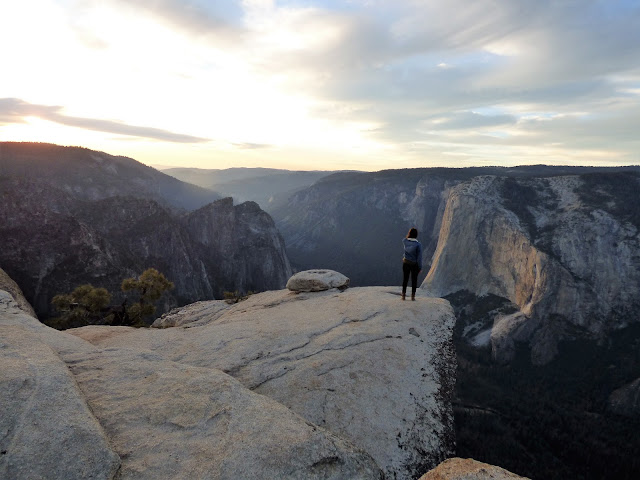
Taft Point is an amazing place. If you have a fear of heights, this will be a good place to either cure it forever, or amplify the condition to the point that you will be a whimpering mass of a nervous wreck. I don't mind looking over the edges of cliffs myself, although it will sometimes be on my belly. One never knows when one might have a fainting spell, after all. But I cannot watch others standing on cliff edges, especially if they are my students. I tell them to do their antics on their own time.

The sun hit the horizon and the sky exploded into flaming orange and pink. I quickly headed up the trail and back to the car so Mrs. Geotripper and I could have a nice dinner back down on the valley floor. It didn't matter that it was dark. The moon was up and we could still see the cliffs above, including a constellation of lights from at least fourteen climbing parties on El Capitan.

Monday, October 30, 2017

El Capitan Rockfall: Alternate Views, and a Realization That This Wasn't the First TIme

El Capitan and the September rockfall from Taft Point on Oct. 29, 2017
Yosemite Valley changed geologically on September 27 and 28, and as I noted in my previous post, the valley will never look the same again. A series of rock falls resulted in a new scar on the east face of the east wall of the El Capitan cliff that can be seen from many points within the valley, including the iconic Tunnel View.
September rockfall from Taft Point on Oct. 29, 2017
I finally got to Yosemite Valley on Saturday, and got a few photos from the Tunnel View that I posted yesterday, but I was with students on a bus. Buses aren't allowed to stop just anywhere in the valley, so I was anxious to get back to the valley in my own car, and Mrs. Geotripper was all for visiting the valley, so we went back up there yesterday. The question, of course, was where to go for a good look? I definitely wanted an aerial view, so we headed up Glacier Point Road, the only route that allows for views from the rim of Yosemite Valley. Glacier Point offers views beyond belief, but only of the upper end of the valley. For a view of El Capitan, the "easy" choices are to hike to the top of Sentinel Dome, or to hike to Taft Point. Both hikes are about a mile and are not overly difficult. Sentinel is farther to the east and doesn't provide as good an angle on the cliff face that fell, so I headed out to Taft Point as the sun approached the western horizon.
The view is striking. The rocks let loose from well over a thousand feet over the valley floor. According to Greg Stock, geologist for Yosemite National Park, the biggest slab (out of seven total), was 394 feet long, 148 feet wide, and between 8 and 28 feet thick. That's bigger than a football field. It had a volume of 10,250 cubic meters, and weighed about 27,675 metric tons. If these numbers and dimensions seem incredibly exact, there's a reason. As Greg Stock explains, in an informative research paper, the walls have been mapped in three dimensions by a form of radar (lidar), and in the aftermath of the rockfall, the walls at the site of the fall were mapped again. The difference in volume could then be calculated.
El Capitan from Taft Point in 2005
I was at Taft Point in 2005, taking pictures of course, and one can compare the appearance of the cliff prior to the event in September.
Horsetail Falls area and future site of rockfall in 2005
The rockfall is also apparent from many spots on the valley floor. We headed to El Capitan Bridge, which offers an excellent straight-on view with the Merced River in the foreground. The white scar is unmistakable.
The Horsetail Falls cliff on Oct. 29, 2017
The difference between before and after couldn't be clearer. It's easy to miss the scale on cliffs this grand...remember, the missing slab of rock was bigger than a football field.
The cliff near Horsetail Falls in 2016
Another way to get a sense of scale is to add the 3,000 foot cliff of El Capitan to the scene...
El Capitan and the Horsetail Falls cliff on October 30, 2017

As I was going through my old pictures, I came to realize that slides have come off this particular cliff in the past. I actually witnessed one of them in 2010 when I was lounging on the granite near the top of Sentinel Dome across the valley. When I say "witnessed" I mean I heard the commotion first, took a moment to realize what I was hearing, jumped up, scanned up and down the valley, and finally thought to turn on the camera and take a few pictures of the rising dust plume.
Dust plume from the 2010 rockfall east of El Capitan
My account of that event can be found here: http://geotripper.blogspot.com/2010/10/rock-fall-near-el-capitan-in-yosemite.html. One can see in the picture below that the 2010 fall was just below the slab of rock that came down in 2017. One can imagine that the stresses on the cliff above were complicated by the event several years earlier.

Wednesday, May 7, 2008

Staring into the Abyss #3 - Yosemite as you (maybe) have never seen it

If you go back to my original post and series debut of the under-rated places of Yosemite Valley, you will remember the classic view of Yosemite Valley from the Wawona Tunnel exit. This picture is looking west from Taft Point on the rim of the valley back towards the Tunnel View, with the Cathedral Rocks and Spires forming the dominant cliffs in the center of the photo.

El Capitan Meadow is visible on the valley floor. One of the most prominent Tioga Stage glacial moraines lies just west of the meadow. It dates to about 13,000 years before present. For thousands of years, natural wildfires and intentional burnings by Native-Americans cleared the conifers from the valley floor, and over time it evolved into an open oak woodland with wide meadows and a few widely scattered conifer trees. The size of meadows in Yosemite Valley has dramatically decreased in the past century. Josiah Whitney and his crew calculated meadow area in 1866 to be 745 acres. By 1937, meadow area had dwindled to 327 acres. Today, meadows cover 65 acres, leaving only 6.8% of the original 1866 meadow area. With the advent of national park status, fires were suppressed and the shade-loving conifers flourished. The forest is now dense with young trees, and the possibility of disastrous wildfires is very real.

The distant skyline shows the relatively gentle westward slope of the mountain range, leading into the Central Valley. The mountains have risen by fault motions on the eastern margin of the range, leading to a westward tilt that has mostly developed within the last 9-10 million years.

Saturday, May 3, 2008

Staring into the Abyss - Yosemite as you (maybe) have never seen it

Yosemite National Park is simply one of the most extraordinary landscapes on the planet, and I have been trying for several weeks to highlight some of the lesser-known parts of the valley, the kinds of places that the average visitor might overlook while staring at the more famous wonders in stone and water that grace the park. Today I am starting a journey to a different place, the rim of the valley. 90% of the visitors to the park congregate on the valley floor, and a significant number of them drive the paved road to Washburn and Glacier Points. These two sites must be some of the most spectacular viewpoints in the world, and a visit to Yosemite is not complete without stopping at both of them. If you are visiting Yosemite anytime soon, the road has just been opened.

Still, they are crowded, noisy and fences and paved trails make it clear where you have to go. There is nothing quite like standing on the brink and staring into the abyss below, alone, with nothing between you and the whole expanse of cliff and valley floor but empty vast space. I am only beginning to discover those places. Today's pictures are taken from Taft Point, a viewpoint at the end of an easy one mile trail. Although the trailhead parking lot is often full, when I was there I saw only 3 or 4 other people on the trail, and I had the clifftop view all to myself (I think most people must have been climbing Sentinel Dome; more on it later).

Yosemite Valley is abrupt. There is no other way to put it. One walks through a gentle landscape of soil and forest, the occasional outcrop of weathered granitic rock, noticing flowers and greenery. A few steps later comes several feet of barren horizontal rock, and then suddenly the world falls away into oblivion. The land is of two ages. The flatness is old and gentle, ancient and unglaciated, a hint of the shape of the land before the mountains began their long and relentless rise into the sky. The other is youthful, brash, a place of action and change. First carved by river, then undercut by glacier, and shaped finally by mass wasting, the cliff is a temporary adjustment, a stand off between shear forces, friction and gravity. It is hard to stand on two feet and look over this edge; the feeling is to crawl towards the cliff, a form of supplication to the vast forces at work here.

The cliff across the valley in the picture above, if you don't recognize it, is El Capitan, the 3,000 foot-high cliff that dominates the west opening to the valley. The chockstones in the photo below have dropped into the Taft Fissures, joint openings caused when the previously deeply buried granitic rock expanded and cracked. The drop-off below the fissures is thousands of feet.