Wednesday, February 12, 2014

Out in America's Never Never: Valley of the Gods, where pareidolia runs rampant

Pareidolia is a very human tendency to perceive faces and significant forms in unlikely places, like on oddly shaped potatoes and burnt tortillas. It is what allows us to see the "Man in the Moon", and what gives rise to names like Owl Rock (in our last post). It's hardwired into our brains, and I wouldn't be surprised if it arose out of a need to recognize the eyes and faces of creatures that in a past era would have eaten us.

Our journey through America's Never Never was in its sixth day, and we were headed into one of the more isolated corners of the Colorado Plateau. After traveling through Monument Valley, we turned north into Mexican Hat, Utah, and headed up a gravel road into Valley of the Gods. This was new for me; in a quarter of a century, I somehow had never found the time to explore the 17 mile loop through a series of amphitheaters along the eastern margin of Cedar Mesa. It was a magical place.

The Sitting Hen at Valley of the Gods, from the back

I find myself speculating about the connections between magic and science when I am in a place like Valley of the Gods. Science has given us a "creation myth" about how these rock pedestals formed.  The cliff-forming unit is the Cedar Mesa Sandstone, which formed in coastal dunes and beaches in Permian time perhaps 270 million years ago. The underlying ledge-forming rock is the Halgaito Shale, which formed in coastal deltas and shallow marine conditions somewhat earlier in the Permian Period. The spires formed from cliff retreat as the softer Halgaito rock undercut the sandstone cliffs (I described the process in the previous post). Tricks and variations in the erosional process formed the hollows and shadows that give the pedestals their eyes and faces.
The Sitting Hen, or as I like to call it, the Rubber Ducky at Valley of the Gods.
So, who is to say that science has a better explanation for the origin of these features than others who see the shapes and ascribe their origin to gods or aliens or whatever? In ages past there was no technology to truly study the origin of these rocks, and no cultural experience with deltas, or river floodplains, or beaches. The people who observed these towers thousands of years ago were just as intelligent (if not more so) than people today, but they had no experience or written history that could record the appearance of rocks forming today in the environments listed above. So they described the rocks in a way that best explained what they saw within the limits of their technology. They saw people, animals, and monsters, and produced stories and adventures that explained how they could be turned to stone.
The Battleship, right out of Monopoly!

Does science deny the possibility of aliens carving these exquisite sculptures, or that gods turned miscreant humans into stone? Actually, science doesn't. It does in fact state that these other explanations could be true but that the probability is extremely low, based on the absolute paucity of supporting evidence. The scientific explanation is supported by extensive and overwhelming evidence. Scientists would acknowledge that the presently accepted explanation could be supplanted were new evidence were to emerge. Indeed they expect such changes in the fullness of time.

Compare this attitude to that of someone who has decided on an explanation, truly believes it, and chooses to ignore any contrary evidence. There is no growth, no increase in knowledge in such an person. Belief doesn't make it real, but evidence makes an explanation more likely.

Some might say that science removes the excitement and mystery of a good creation story. I would respectfully disagree. I would say that an understanding of geologic processes leads to more mystery and wonder. Consider the rocks; once one realizes that these rocks were part of a coastal complex, the question arises: where was the ocean and why was it in this place? Today the oceans are a thousand miles away. These rocks were eroded from a mountain range somewhere. Could we find where that mountain range was? Why did those mountains rise? What forces were acting on the crust to cause them to develop? What kinds of creatures lived on these floodplains and deltas? Where did they come from? What happened to them? As it turns out, the world was only a few million years from the worst extinction event ever to take place on planet Earth. Some 95% of all species on the planet vanished 252 million years ago. All these questions invite further study and further growth. Each effort to answer these questions adds to the body of human knowledge. It is a creation story that grows and changes with the addition of new data.
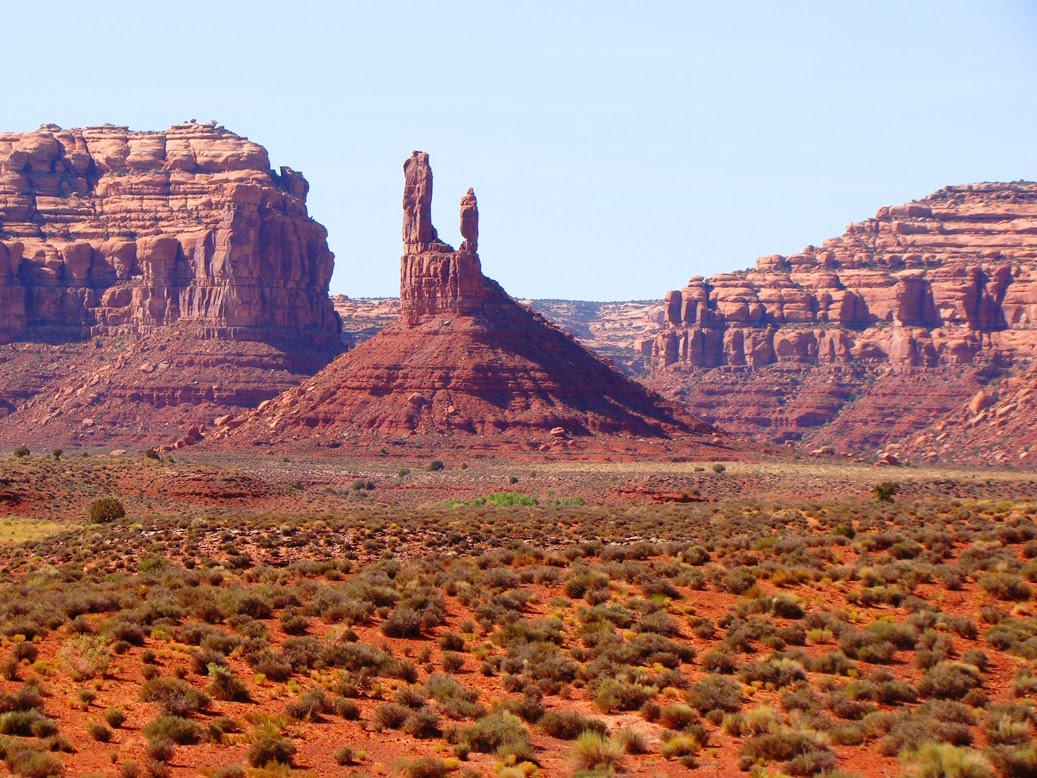
On the other hand, it's fun to play games with these fascinating forms of nature. What do you think they are?

I know this: they are beautiful to gaze upon, even if beauty is a subjective judgement. Did the humans who first saw these desert monuments see them as beautiful? Or were they simply part of a rugged harsh landscape that may or may not be hiding a resource that could extend human life in this tough land?
I definitely see a huge mechanical hand rising out of the ground.

We passed the base of Lady in a Bathtub (picture below) and drove back down to Mexican Hat for one last stop in civilization. We were headed onto Cedar Mesa, one of my favorite places, and perhaps the spiritual center of my personal Universe. More as this blog series continues.
The Lady in the Bathtub.

The loop road through Valley of the Gods is accessed from US 163 out of Mexican Hat, Utah, while the west entrance is on US 261 near the base of the Moki Dugway. There are no facilities along the loop, which is managed and maintained by the Bureau of Land Management. There is a small campsite at nearby Goosenecks of the San Juan State Park, but no water is available. But bring a camera or sketchpad!

Sunday, February 9, 2014

Out in America's Never Never: A Tale of Two Towers (and a few more)

Agathla Peak north of Kayenta, Arizona
America's Never Never is full of strange and wonderful sights. We had left the forested Black Mesa and its rather depressing strip mines and headed east to the village of Kayenta on the Navajo Reservation, then turned north towards Utah. We had dropped several thousand feet and were traveling through a more barren landscape (the barrenness exacerbated by the ongoing drought).

Now, before I go much farther, I need to talk about childhood cartoons. I surely date myself severely when I note that my favorites were the Looney Tunes, especially Bugs Bunny, but there was a special place in my heart for Wile E. Coyote and that nefarious arrogant Roadrunner.  I had been to places like Joshua Tree National Park and the Mojave Desert, so I knew that no desert really looked at all like those cliffs and spires that Wile E. was always falling off of.

At least not until I reached the Navajo Country around Kayenta and Monument Valley. Suddenly I was standing not only in a Roadrunner cartoon, but John Wayne would be riding up any moment in a stagecoach. There really were towering spires in the desert!

I was pretty lucky in that my parents were the ones who originally introduced me to this country on our family vacations. I learned about these deserts in my childhood, but I was left with a lot of questions not readily answered. It wasn't until I became a geologist that I fully appreciated the processes and history that produced these incredible landscapes. And I've been bringing my students here ever since to show them that deserts aren't just cacti and sand dunes.
Agathla Peak just north of Kayenta
There are different kinds of "towers" in Navajo country produced by quite different processes. There is a great spot on Highway 163 about ten miles north of Kayenta to compare the two. To the east is Agathla Peak (or "El Capitan") standing some 1,300 feet over the highway (above). To the west stands Owl Rock (below).

Agathla is one of the more spectacular examples in the Navajo country of a volcanic neck or diatreme, the core of a deeply eroded volcano. Although the towering spire appears dark it is mostly composed of large chunks of sandstone that collapsed into the interior of the volcano after a violent explosive eruption. One can see dark dikes of basaltic-looking volcanic material; the rock is called minette, which is a relatively rare potassium-rich volcanic rock. The network of dikes protected the core of the volcano while the remainder was eroded away. The intrusion is just one of dozens covering an area of around 20,000 square kilometers around Four Corners called the Navajo Volcanic Field. Shiprock is perhaps the most familiar of these features.
Owl Rock, the tower on the other side of the highway,  is quite different. It is clearly layered, and the layers are horizontal. It is an erosional outlier of the same sequence of sandstone, siltstone and shale that can be found in many of the cliffs throughout the region. Sedimentary rocks are not known for producing towers and spires under "normal" conditions (read "characteristically humid conditions where most people live"). In the dry desert environment of the Colorado Plateau, resistant rocks such as lava flows or in this case quartz sandstone will form a protective cap that generally prevents the otherwise rapid erosion of the softer underlying sediments.

The tower is composed of Triassic and Jurassic-aged rocks of the Kayenta and Navajo Sandstone formations. Beneath the tower are the siltstone and clays of the Triassic Chinle Formation (or Group). The Chinle was laid down in floodplains and lakes in the earliest years of the dinosaurs. Distant volcanic eruptions (some near my own Sierra Nevada) laid down ash deposits that have oxidized into colorful red, brown, yellow, and lavender clay-rich strata. Some of the ash layers are famous for their petrified logs, most notably at Petrified Forest National Park in Arizona. We have seen logs in the vicinity of Agathla Peak and Owl Rock as well.
But what about the cliffs? How did they form?

The Navajo Sandstone is a solid rock but when it is stressed by regional deformation it tends to develop vertical fractures called joints. The Navajo may prevent the rapid erosion of the underlying shale layers, but the rocks do eventually get eaten away, undercutting the sandstone. The rock falls away along the joints in a process called cliff retreat. In this way a plateau shrinks to become a mesa, a mesa becomes a butte, and eventually only a spire remains.

It turns out that Owl Rock is simply a foreshadowing of the incredible sights ahead. As we passed into Utah we reached Monument Valley, a place where cliff retreat has produced a spectacular array of mesas, buttes and spires. The formations are different because we have crossed onto a deformed section of crust called the Monument Upwarp. We have reached rocks that are late Paleozoic in age (Permian), between around 250-300 million years.
At Monument Valley, the vertical sandstone cliffs are composed of the DeChelly Sandstone. A thin layer called the Shinarump Member of the Chinle Formation forms the top layer of many of the spires and buttes. The gentler slopes below the cliffs are the finer sediments of the Organ Rock Shale. The Permian Period was a time of reptiles, but not dinosaurs. The terrestrial environments were dominated by a group called the Therapsids, or "Mammal-like" Reptiles. These animals had a more vertical stance that distinguished them from the sprawling gait of other reptiles, and a number of other features that are mammalian in nature, including differentiated teeth. They gave rise to the mammals in Triassic time. The region has yielded up a number of specimens.

Monument Valley is a tribal park administered by the Navajo people. Many people (who don't know who John Wayne was) will know the place as the spot where Forrest Gump decided to stop running across America ("What are we supposed to do now?").

We had a lecture at the overlook and headed up the highway to a sight that was an absolute first for me, the Valley of the Gods. More on that in the next post!

Friday, February 7, 2014

I'm Glad Movies Like "Avatar" Aren't Metaphors or Anything: Exploring Black Mesa in America's Never Never

It's the stuff of science fiction movies. A pastoral peaceful society is overwhelmed by a technologically superior and more numerous invader because they were unlucky to be living on top of something valuable to the invader. Movies like Independence Day, Avatar, Cowboys and Aliens, War of the Worlds and so many others. In these movies the plucky group of survivors usually manage to fight back and somehow destroy or beat back the offending culture, because, well,  that's the way these stories are supposed to end.

This is a continuation of our exploration of America's Never Never, the vast desert lands of the Colorado Plateau that we explored last summer. Our previous entry was a trip into the world of the Ancestral Puebloans at Navajo National Monument. A few minutes after leaving the quiet serenity of a park preserving a part of the past we were thrust very much into the present at Black Mesa.

So how is this for a plot line for a movie?

A high plateau in the wilds of the American west. The escarpment rises dramatically out of the desert floor, with an extensive forest of Pinyon Pine and Juniper across the summit. A pair of ancient cultures calls the mesa home,  They've had their differences over the centuries but by and large they get along with each other. They make their homes on this beautiful mesa, subsisting on corn, squash, beans, and herding sheep. A few scattered springs provide life-giving water, enough to meet their modest needs.

Cue the darkened boardroom. Camera pans back to reveal a group of wizened old white men. They're discussing their plan.

"We are here to discuss the vast coal resource that underlies the mesa. There are billions of dollars just waiting to be dug up, and we must have that money..."

A voice from the back of the room: "But the mesa is in the middle of nowhere. There's no infrastructure. Where can we burn the coal?"

"But that's the wonder of our plan. There is a coal burning plant on the Colorado River 270 miles away, and another just 70 miles away. A railroad will suffice for the closer power plant, but for the more distant plant we have devised an ingenious plan. A pipeline!"

"A what? Pipelines carry liquids, not rocks! What madness is this?

"That's just it. We'll grind the coal into little bits, pump a bunch of water from the ground, and make a slurry mix! We'll be able to mine all the coal we want!"

The intern spoke up: "But sir, that's an arid environment. The water resources are limited. And people live there! They've lived there for hundreds of years! You'll be destroying a way of life". His voice wavered as he realized the mistake he had just made. A few eyes rolled, but mostly there was a quiet agreement throughout the room that this young man would not be in the organization for much longer.

The CEO spoke, and all eyes turned his way: "Forgive the young man's innocence. I'm sure we've all experienced moments of empathy, but luckily we've moved on from that. But he speaks to an important issue. Those people do technically own the land above our coal, and they need to be dealt with. What plans do we have?"

"The usual payoffs, sir. Offers of money and jobs. But here's the best part: the lawyer negotiating on behalf of those people? He's on our payroll! You may be assured that the royalties we pay will be a fraction of the usual rate!"

And the gigantic digging machines bit into the earth and rock....
This is of course a simplistic description of a very complex series of events that led to the development of two major strip mines on the northern end of Black Mesa. But the railroad is real (that's the storage silo that loads the railroad cars at the top of the post). And the slurry pipeline, the first and only of its kind was built and was used for several decades (one of the mines was shut down in 2005). The royalties paid for both coal and water were indeed far less than those paid at other mines, and the lawyer negotiating on behalf of the Hopi people, John Sterling Boyden, was indeed on the payroll of Peabody Coal. I've written on the issue previously; you can read it here.
The scale of the mining is hard to take in. You can watch the beautiful pictures and videos published by Peabody Coal (like this one) that tout the benefits of the coal mine, the jobs, and the reclamation of the landscape after the coal has been removed. I certainly can't speak to the feelings and thoughts of the Navajo and Hopi people whose land was exploited for the purpose of producing electrical power for the likes of Los Angeles, Phoenix and Las Vegas. There was certainly fierce opposition at all stages of mine development. I can't help but notice that the air pollution produced by the burning of coal did not foul the air of the three urban regions listed above, but instead contributed to smog across the Colorado Plateau, including the obscuring of the views from the rims of Grand Canyon and Bryce Canyon. And the real profits did not accrue to the people who were the stewards and owners of the land, they went instead to Peabody Coal.

Every time I see these mines, I hear the voice of John Prine and his immortal words in "Paradise":

"Then the coal company came with the world's largest shovel
And they tortured the timber and stripped all the land
Well, they dug for their coal till the land was forsaken
Then they wrote it all down as the progress of man."

Wednesday, February 5, 2014

When His Horizon Fell Dark, His Dream, Unfinished, Morphed...Finding Beauty in Vacant Lots

Most of the time readers are hearing of my adventures of teaching at Modesto Junior College, but few know that I have also been teaching classes at California State University, Stanislaus down in Turlock, and in fact I've been there since 1991. There have been many changes on the CSU campus over the decades. Because I've nearly always taught a night class, I haven't had many chances to explore the campus. I have an afternoon class this semester so I'm getting a chance to discover a few interesting corners.
Today I found a river runs through it! Or more properly, a sort of symbolic artificial river flows through what will eventually be a transect through California's natural vegetation communities. It's been in place for only a few months, and most of the vegetation is still in the seedling stage. Still, there is a walkway and benches, and in a few years I imagine this as a contemplative place in the midst of an urban campus.
There are some mature Valley Oaks at the pond where the stream ends, and it was here I found out the heartening story. One of the long-time botany professors had been planting the oaks over the years in hopes of forming a "natural" woodland on the campus (which is notably bereft of natural landscapes). Dr. Pierce passed on before completing his dream, but it is being carried on by others. The poem on the interpretative sign was written by one of my long-time colleagues Lynn Hansen, who taught at MJC for many years.

A vacant lot morphing into a bit of the natural world. It's so good to see dreams being fulfilled. We have a similar dream for the vacant lot on the north side of our new Science Community Center at MJC. It's slated to become an outdoor education laboratory with a similar layout of native vegetation, pond and stream, along with a rock garden reflects the diverse geology of our region.
Lynn Hansen is an accomplished poet, by the way. If you enjoy poetry with a strong sense of place, check out her recently published book, Flicker by clicking here. It's good reading!

Cigarettes Don't Cause Cancer. "Cigarette-Science" Tells Us So

Credit: Lady Grey
The non-tobacconists have constructed a complicated and massive program to brainwash you into thinking that cigarette smoking will give you cancer and other horrible diseases. This pernicious plot has happened because the "scientists" who work for the non-tobacconists are trying to make sure they get lots of grant money to keep studying the so-called problem. If you are a smoker and you feel uncomfortable with this state of affairs, don't worry. You can choose to believe in "cigarette-science".

We, the practitioners of "cigarette-science", know right from the start that cigarettes can't cause cancer, and we carefully design our reports and our scientific experiments to prove this. And we are very good at showing that the so-called "science" of the non-tobacconists is faulty because one of their researchers twenty years ago said "we aren't totally sure that cigarettes are the sole cause of cancer". And there was a spelling error on one of the graphs they published fifteen years ago.

Best of all, we can prove we are right because we are great debaters, especially when we face off against a non-tobacconist in a room full of smokers. Those non-tobacconists keep trying to produce "facts" and "evidence", but we know how to "play the room", er, excuse me, "speak to the true believers". Our smoking friends want to believe that smoking cigarettes won't kill them. They need to hear that smoking cigarettes won't kill them. So we can never lose.

People hate ambiguity. They like firm statements like "cigarettes don't cause cancer" and hate the uncertainty inherent in a statement like "the available evidence strongly suggests a link between smoking and cancer".

Your blog author steps back and takes a deep breath (of fresh clean air):

Yes, of course I am talking about "creation-science" and the essentially useless "debate" that took place last night between creationist Ken Ham, and Bill Nye, the "Science Guy". I didn't watch it, not because I have a closed mind about such things, but because I have been studying and following the tactics of the creation-science community for the last twenty-five years, and I have seen in person the tactics used by them in debates (oh, and I was teaching a class last night. On science). I'm hearing that Bill did okay from those who have a scientific background, but I have no doubt that Ken Ham is celebrating his "victory", just as he has done with every other "debate" he has ever had. The problem with the whole concept is that debates aren't science. They are carnival side-shows. The debates are often held in churches and in front of audiences of religious believers who aren't about to listen to facts or evidence. They are there to see their champion slay the dragon of secular science.

Science is the pursuit of knowledge about the physical Universe, and the methodology of science is to achieve that knowledge in the most objective way possible. Ideally, people solve a problem or a mystery by gathering all the relevant evidence, analyze the evidence, and proposing as many hypotheses (plausible explanations) as they can to explain the mystery. They then set up experiments to test each hypothesis and hopefully eliminate those that cannot work as an explanation. When a specific hypothesis withstands all experimental challenges while all other hypotheses have been eliminated, it may be elevated to the level of being a scientific fact or theory. Atomic theory, plate tectonics theory, and evolutionary theory have reached this level of confirmation, along with many others.

Young Earth creationism starts with the conclusion ("the Earth was created 6,000 years ago") and uses the words of science to try and prove this conclusion. To put it succinctly, no. Science does not and cannot work this way. One cannot identify the person you want to convict of a crime and then garner only the evidence that he is the perpetrator. One cannot decide that vaccines cause autism, and then only collect anecdotal evidence to prove one's case. One cannot decide that the profits of the tobacco industry are more important than the health of smokers and set out to "scientifically" prove the lack of a link between cigarettes and cancer. And companies cannot decide that the profits of the fossil fuels industry are more important than the health of the planet and thus sow "scientific" doubt about global warming and climate change.

Or can they?

Monday, February 3, 2014

Out in America's Never Never: A Corner of the Navajo Nation Where the Ancient Ones Dwelt

One thing I love about blogging is the total freedom be distracted and leave projects unfinished. This is something I inadvertently did six months ago. I got distracted by a river trip down the Grand Canyon and four field trip classes to the Cascades, the Sierra, and the California Coast. But I'm back to try and finish a series on my other incredible trip this last year: a journey through America's Never Never with a group of my geology students. You can catch up with the earlier posts by clicking here.

As I said in the original post, the Never Never is a remote and largely inaccessible part of the Northern Territory and Queensland of Australia's Outback. To some, it is a place that one would "never, never" want to go (despite this neat-sounding trip). To some of those who live there, it is a place one would never, never want to leave.

There are many parallels between Australia's Outback and the American Southwest, especially the Colorado Plateau. Most of the local populations live on the margins of the region, and until recent decades many parts remained unexplored by people of European descent. To others it has been home for thousands of years. The lands are ancient, each part revealing a fascinating geological story. And so it is that I refer to the Colorado Plateau as America's Never Never.

When we last left off the story we had explored Antelope Canyon, a deep slot canyon near Page Arizona. It was late by the time we finished our tour so the sun had set long before we arrived at our next campsite at Navajo National Monument on the lands of the Navajo people.
It was hard to get a sense of the country we had reached in the dark of the night, but when the sun rose I set out across the plateau to get a view of the countryside. Navajo National Monument is actually composed of three different units several miles apart: Inscription House, Keet Seel, and our location, Betatakin. Each of the units protects the ruins of an ancient people, the Ancestral Puebloans (once called the Anasazi). They were the "ancient ones" who lived on this land before the Navajo arrived hundreds of years ago. They abandoned the region 700 years ago; Their descendents live on the Hopi Reservation and the pueblos of New Mexico.

The land is unique. It is a high plateau called the Shonto that reaches elevations of more than 7,000 feet, which is high enough to support a forest of juniper and pinyon pines. The cooler forested highland is a stark contrast to the mostly barren deserts that surround the uplift. The plateau exposes Triassic and Jurassic aged sedimentary rocks, primarily the Navajo Sandstone. The Navajo is a major scenery maker in the region, responsible for the incredible cliffs in such places as Zion and Capitol Reef National Parks. The main drainage of this part of the Shonto Plateau is Tsegi Canyon, a deep gorge with an intricate maze of side canyons. Alcoves in the deep canyons protect some of the most perfectly preserved cliff dwellings to be found anywhere.
The alcoves are especially striking. There are impermeable layers of shale and siltstone within the Kayenta formation which underlies the Navajo Sandstone. Groundwater seeps downward through the Navajo and then encounters an impermeable layer. The water is forced to flow sideways until it breaches the surface at the base of a Navajo cliff. The cement holding the sandstone together dissolves and an alcove begins to form. It gets larger as slabs fall from the arch-shaped cavern. The alcoves turned out to be ideal spots for constructing villages. They are dry, protected from the worst of the weather, often have seeps or springs as a secure water supply, and offer superb defensive positions.
Defense? From what or whom? The Ancestral Puebloans lived in the region for well over a thousand years, but did not build the defensible cliff dwellings until very close to the time of regional abandonment. It's ironic that the most iconic remains of their culture represented not the pinnacle of their success, but the harbinger of their doom. It has long been the subject of speculation as to why the Ancestral Puebloans left the Four Corners area (except for the Hopi who continue to live in the general area). The speculation centers on a horrific drought that gripped the region in the late 1200s. Persistent drought would have led to ongoing crop failures and soil loss (as wind blew away dry topsoil). Starvation would presumably have led in turn to raiding and warfare.
Anthropologists, archaeologists, and the descendants of the Ancestral Puebloans have differences of opinion as to the reasons for the abandonment, but drought and resource depletion must have played a role. The villages at Keet Seel and Betatakin (in the pictures above and below) look like their inhabitants simply walked away, and the buildings have persisted in their protective alcoves through the intervening centuries.

We like to think in our technological bubble that we are somehow immune from such problems, but the need for water and food is still fundamental, and we are once again seeing the story unfold in the Colorado Plateau region of persistent decades-long drought. The present drought has now lasted 14 years, not far off from the 25 year drought that forced the Ancestral Puebloans to leave. The big difference is that the population that depends on water from the Colorado River now numbers in the millions, not the thousands. We can draw water from elsewhere, but drought is gripping California as well. It is a worrisome time.

One cannot explore the villages of Navajo National Monument without taking a stiff hike and the presence of a ranger/guide (Inscription House is closed to all visitation), but a short trail winds across the plateau surface from the visitor center to an overlook hundreds of feet above Betatakin. The preservation of the village is truly astounding, given our sorry penchant for destruction of all things ancient. It's a fascinating place to visit.

Saturday, February 1, 2014

South Dakota Senate Proposes to Allow the Teaching of the Great Spaghetti Monster Model in Science Courses!

Via Wikipedia
Via Phil Plait at Bad Astronomy and from the South Dakota State Senate website itself, we find that a bill has been proposed that will make law the statement that "no school board or school administrator may prohibit a teacher in public or nonpublic school from providing instruction on intelligent design or other related topics" (italics mine). That's actually the whole law. I would really be interested in seeing this pass the state legislature and get enacted into law. One can only notice that "intelligent design" is not defined, and that "related topics" covers a great deal of scientific and religious ground. The fact that it would be constitutionally illegal is beside the point.

The ramifications are fascinating. This would mean that at last biology and earth science teachers in South Dakota would no longer be shackled by the confines of "science" in their teaching. Anything that they believe explains the origin of the Earth or the evolution of life would be fair game. Science class could be fun again! I would of course expect that along with the teachings of Noah's Ark and the great flood of Genesis from the Bible that teachers will in all fairness include the story of the Great Spaghetti Monster in space hypothesis. It explains the world we see at least as well as any other creation story, and in many instances explains it better.

It is such a shame that the people who desire most to be elected as the representatives of our state and country often are the most ignorant of fundamentally important scientific principles. We see this in their foolish attitudes towards global warming and climate change, and we see it in their failure to understand the difference between religious belief and scientific evidence. And to be clear: "intelligent design" is ultimately a religious belief, not a scientific discipline. This is true whether a badly written law in South Dakota defines it or not. It is highly unlikely that the bill would become law, and lawsuits would assuredly follow, wasting a great deal of time and money. And in the end, I would hope that I never have to place my life in the hands of person schooled in "science" in the state of South Dakota. What an embarrassment.

Rock on, Pastafarians!