Tuesday, December 9, 2008

A December Meme: First Things First....

I've been missing in action for a few days...it's finals week and very hectic, so I have a few posts with a story left hanging, which shall resume soon as things settle down (for Christmas holiday, right). So I don't have time for this, this or this, which has been moving through the tubes and seemed harmless enough: take the first line from first post of each month and string them together...it seemed a nice way to look back in my new world of geoblogging, since I started Geotripper last January. So here goes....

January: I hope that this blog will be a clearinghouse for information on geology, earth science education, and the exploration of the beautiful places of the earth! (comment: my very first blog entry)

February: If anyone wonders why I teach at a community college, and why I don't dabble much in research, it would be because I have a scientific version of attention-deficit disorder: as soon as I start concentrating on one subject, something interesting pops up somewhere else, and I explore it for a few weeks, and then get distracted by something else. (comment: for some reason, this entry, concerning marsupials and Australia has been my most-visited post on a continuing basis)

March: Death Valley and environs is an unendingly fascinating collection of naked rock exposures.

April: Was this done in a few weeks? (comment: I waded into the creation science bizarro-world in this entry; the picture was of Grand Canyon)


May: I kind of started this photo-essay about Yosemite Valley by promising myself that I wouldn't be showing the hundreds of pictures that I've taken of the most familiar sights in the park, like El Capitan, Half Dome, and Yosemite Falls.

June: I need to echo the comments of Chris at Highly Allochthonous about the extraordinary picture of the descent of the Phoenix onto the surface of Mars.

July: Still decompressing after a "long" trip of two weeks through geologic time on the Colorado Plateau. (comment: the beginning of my "long" sequence on the history of the Colorado Plateau)

August: John Shelton passed away on July 24th at his home in La Jolla, California.(comment: I have been reminded several times this past year of those who paved the way for our education, and the heritage they left behind)

September: Today we make a return to our series on the geologic story of the Colorado Plateau. (comment: I didn't think my series on the Colorado Plateau was going to last for months! I bet you were moaning about that too)

October: Welcome to one of the most unusual (and most isolated) parks in the American Southwest, Goblin Valley State Park. (comment: yes, the series continues, but heck, I'm enjoying it and it is MY blog)

November: I was in Yosemite Valley yesterday with our campus Geology Club; it was raining, rather heavily at times. (comment: the story of a really special day in one of my favorite places)

December: Well, yeah, except that it isn't the Cedar Mountain Formation, and it's not on the Colorado Plateau, and it isn't a park of any kind. (comment: one of my favorite opening lines as the title of the post referred to parks, the Colorado Plateau, and the Cedar Mountain Formation; this is false advertising at its best. Still, the beginning of the story of one of my finest field experiences)


Almost an entire year blogging! It has been fascinating to watch the growth of the geoblogosphere during this time, and it has been a lot of fun communicating about our earth with the those who work closely with it.


Thursday, December 4, 2008

The Cretaceous Parks of the Colorado Plateau: Every Cloud has a Golden Lining


Following up on today's earlier post, we picked up the debris of our devastated campsite at Grand Tetons, and headed a few miles north to Yellowstone National Park. As if to make up for our rude reception the previous night, the rain gods gave us a tremendously beautiful sunset, and the geothermal gods provided an eruption of Old Faithful at the precise moment the sun hit the horizon. It felt magical.


The next morning, following what must have been the shortest, quickest field trip through Yellowstone National Park in geological field trip history, we made our way north to Bozeman, Montana, and visited the Museum of the Rockies, which has some of the finer dinosaur exhibits to be seen anywhere. I'm not sure if it helped our expectations to see the full mounted specimen of a deinonychus although it did give us an idea of what pieces we would be looking for at the quarry site. The early scenes of dinosaur digging in the movie Jurassic Park may have shaded our expectations a little bit, too. Intellectually, we knew that full complete articulated skeletons of dinos are very rarely ever found. Still, we were going to be digging in a place where relatively complete skeletons had been found in the past (more on this in future posts).


Somehow, distances on the maps of Montana don't quite add up to the distances on the actual roads in Montana, and we pulled into the Montana metropolis of Bridger (population 700) about four hours late to meet the quarry director (aren't first impressions the greatest thing?), and then followed the "road" for seven or eight miles to the quarry site. I use the term "road" only in the sense that the sagebrush was beaten down in such a way that an excellent tracker would be able to discern that a vehicle may have passed this way at some indeterminate time in the past. We crossed a creek, and floored the accelerator to make it up the other side, and pulled into camp....


More tomorrow!

The Cretaceous Parks of the Colorado Plateau: the Story of a DinoDig


To continue our story of the Cretaceous history of the Colorado Plateau, we have taken a slight detour to the north to Montana, where the Cloverly Formation stands in for the Cedar Mountain Formation as the critical link between the late Jurassic ecosystems of the Morrison Formation and the later more widespread late Cretaceous formations. As explained in a previous post, this is because I've dug in the Cloverly, but have never seen (or at least recognized) the Cedar Mountain Formation to the south.

Lots of people participate in dinosaur digs, either as researchers, as students, or as paying volunteers through any number of commercial excavators. Our opportunity arose in 1993 when Jack Horner gave a lecture at Modesto Junior College on Tyrannosaurus rex (thus, the photo above). You may recall that at the time the movie Jurassic Park had pretty much re-ignited dinosaur-mania around the country, and Horner had gained some notoriety as a technical advisor for the film-makers. He had also garnered popular attention as the author of several great books about parenting dinosaurs (the Maiasaurs), and T-Rex (horrible predator or scavenger?). So his arrival at MJC caused quite a stir among my geology students, and they (and me too, I guess) hung around him like a bunch of groupies.

Over beer and pizza the next day, Mr. Horner suggested that we could help with one of his digs that coming summer in Montana, if we were at all interested. He stipulated that we could include 7-8 students, we would have to feed ourselves, provide all our camping supplies, get to Montana at our own expense, and that we would be diggers, not brushers and excavators. It would be hot and dusty or rainy and windy, or even snowy. There would be cows. Starstruck, we said yes, sounds fun!

Over the following months, the list of students crept up to 17 (lots of delicate e-mail negotiations), and they worked hard raising funds with burger sales and yard sales. Eventually they raised something like $5,000 to fund our expedition. So, early in June we set forth in our vans on the way to Bridger, Montana. The first day we slogged our way 550 miles to Angel Lake in the Humboldt Range of Nevada, and the next day traveled to Grand Tetons National Park, where we set up camp in the Gros Ventre Group Campground.

What happened that particular evening became one of our department legends for the ages. One our students had a knack for fomenting trouble with the powers-that-be in the Universe. On various previous trips he had speculated about what it would be like to get stung by a scorpion, and within a day, he had been (unwillingly) stung by a scorpion. At a stop, he asked if we would see any rattlesnakes. He stepped on one moments later. There was a karma that hung about Craig like a hangman's noose.


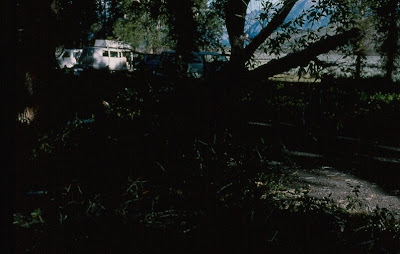
There was a discussion that evening at Grand Tetons in the twilight about whether we would experience any bad weather on our journey. The skies were clear that night with just a few puffy clouds about. For some reason, Craig looked at towards the heavens, raised a rock hammer towards the sky, and said "I dare the gods to make it rain!". I'm not kidding about what followed. Within ten minutes of his brash statement, our campground was enveloped in a violent storm, our vision obscured by thick blowing dust, and high winds were knocking down old cottonwood trees all around us. Fifteen minutes later the winds died, the dust cleared, and the camp was a shambles. Tents were ripped apart, and branches were down all over our camp. Our vans were undamaged, but a tree had crushed a van in the other part of the campground (people were in it, but were unhurt). We thought we had been hit by a tornado, but more likely it was a microburst from a storm that approached us unseen from the east.


Needless to say, Craig spent much of the rest of the trip muzzled....and this story will be continued.


Wednesday, December 3, 2008

Taking Things Literally...

With a hat-tip to GeoChristian, I am linking to an ad for the Atlas of True Names, which provides world maps with the names of features in their literally English translations. As can be seen by clicking the map above, it is a fun read.

Looking at the map reminds me of the rather fascinating names for the towns and features where I live, places like Lard (Manteca), The Bathrooms (Los Banos), Salt (Salida), Modest (Modesto), Grizzley Valley (Yosemite), The River of our Lady of Mercy (Merced River), the River of the Land of Mountain Lions and Straight Up Steep (Tuolumne River).

I think my favorite literal name is actually over in Kim Hannula's territory in southern Colorado, the River of the Lost Souls (Animas River).

Some of our California towns are perfectly literal in their names; Weed, Weedpatch, Greenacres, Greenfield, Farmersville and Red Bluff come to mind. And at least one doesn't really have translation, at least from what I heard (I'm open to correction on this), but Yreka got it's name when someone saw a bakery sign backwards with the "b" missing. Who knows?

Any other great literal names out there?

BTW, this is my 200th blog entry. I appreciate all the support in my first (almost) year in the geoblogosphere!

Tuesday, December 2, 2008

The Cretaceous Parks of the Colorado Plateau: the Cedar Mountain Formation

Well, yeah, except that it isn't the Cedar Mountain Formation, and it's not on the Colorado Plateau, and it isn't a park of any kind. If I may explain, the Cedar Mountain Formation is an exceedingly important part of the geological history of the Colorado Plateau, being the only representative layer in the region dating from the early/middle Cretaceous Period. It has also turned out to be a treasure trove of fossils with a rich collection of dinosaurian and other species preserving a time when animals were mixing or being separated from related species in Europe and Asia. So it is really important and all, and every geology field trip should stop and have a look at it and take lots of pictures and stuff. Except that I haven't done so on all of my many trips onto the plateau.

Extensive work on the Cedar Mountain Formation does not seem to have begun until the early 1990's (compare to the Morrison Formation, which was being excavated for dinosaurs in the 1870's). Some two dozen dinosaur species have been found in the unit, including several sauropods, iguanadons, troodons, one of the earliest hadrosaurs (eolambia), and my personal favorites, deinonychus, utahraptor, tenontosaurus, and a zephyrosaurus. At different levels in the formation these dinosaurs share affinities with European faunas while others are related to faunas from Asia. These connections reveal the severing of North America from the former and the linking to the latter during early and middle Cretaceous time.

So what's with the picture above? It is an exposure of the Cloverly Formation near Bridger, Montana. The Cloverly is nearly contemporaneous with the Cedar Mountain Formation, and many of the fossils found within it are similar as well. And I have actually been there, and participated in a dinosaur dig that was a defining life event for me and many of my students. So a few posts will soon follow, describing what we did there back in 1994. Please excuse the somewhat diminished quality of the photography, as these are scans of slides that were taken by a grossly incompetent photographer (me) back in the dark days before digital imaging.

These stories will also serve as my contribution to this month's Accretionary Wedge, hosted by Dave Shumaker at Geology News. The topic of the month is our favorite places to do field work, and was this ever it!

More soon!

Sunday, November 30, 2008

The REAL Jurassic Parks were really Cretaceous

As any knowledgeable fifth-grader could tell you, few of the dinosaurs in the movie Jurassic Park had anything to do with the Jurassic Period. Most of the species in the movie lived during the Cretaceous Period, many millions of years later, including the velociraptors, tyrannosaurs, triceratops, and the ornithomimus herd. Offhand the only Jurassic dinosaurs I can recall from the movie were the massive brachiosaurs that occupied just a few scenes. The premise (from the sequels anyway) of the animals living in some kind of ecologically balanced paradise would be unlikely at best. The mixing of predator and prey species from long separated periods would lead to disaster, as most of the species would have no evolved defenses to predator attack methods. And of course, the whole "reconstitute a dinosaur" from old dinosaur DNA mixed with frog DNA idea is a real stretch anyway, although interesting results are coming from research with wooly mammoth DNA.

In any case, we continue onwards on our march through the geology of the Colorado Plateau. Cretaceous sediments are an important part of the Colorado Plateau sequence, and they reveal a changing world, including new plants (the angiosperms), a host of diverse new dinosaur species and many other animals. At the end of the period, the dinosaurs (and many other species) disappeared forever and a new world emerged in the Plateau country. A final transgression and regression of a shallow sea was followed by widespread deformation of the crust, and the rise of the region above sea level. The most recent era, the Cenozoic, our own time period, was beginning.

The Cretaceous formations of the Colorado Plateau are not as colorful as the Jurassic and Triassic sediments, but several national parks and monuments have been established in areas containing Cretaceous sediments, and in some cases the scenery is quite spectacular. Grand Staircase-Escalante National Monument and Capitol Reef National Park are two of the more striking examples, but other parks that are not really known for their rocks are also notable, including Mesa Verde National Park, Chaco Culture National Historical Park, Hovenweep National Monument, and Canyons of the Ancients National Monument. Important formations include the Cedar Mountain Formation, the Dakota Sandstone, the Mancos Shale, and the Mesa Verde Group.

Today's photograph is a sunset view of Fajada Butte in Chaco Canyon, one of the eeriest (but not in the scary sense) parks I've ever visited on the Plateau. The rocks are part of the Mesa Verde Group.

More soon!

Tuesday, November 25, 2008

Rhyolite in the California Coast Ranges? And Happy Thanksgiving...


I only provided one picture of Pinnacles National Monument in California's Coast Ranges in my previous post, and it showed none of the scenery that makes the park a special place. So here are two views of the 22 million-year-old rhyolite composite volcano that was erupted, sliced in half by the San Andreas fault, faulted into a graben structure, exhumed by uplift, and eroded by water and wind and mass-wasting into a beautiful parkland.


The first photo is a view from the High Peaks Trail, a marvelous 5 mile loop through the heart of the park. The walk across the ridgeline is just stunning. In many places, footholds had to be scooped out of the rock to provide access, although the exposure level is not too frightening (nothing like Angels Landing in Zion, for instance). On a clear day, the far ridges extend forever into the distance, while the giant monoliths of rhyolite dominate the foreground. This hike, along with the trail to Delicate Arch, and the climb of Angels Landing, is one of my favorite hikes in the world.


The second shot is a view of the previously mentioned high peaks from the perspective of the south end of the park on the trail to the Chalone Peaks. The High Peaks Trail winds along the spine of the ridge in the center of the photo, and has connecting points to trailheads on both sides of the park (no roads cross the park, so one must choose to visit from the west or the east side).


The third photo is one of the wild denizens of the park, an old Tom Turkey. I have a feeling this bird would have issues with a certain recent vice-presidential candidate. I have seen a lot of wildlife in the park, include a huge flock of wild turkeys, four or five California Condors, huge numbers of woodpeckers, the standard deer and various rodents, and my favorite, a huge bobcat. The cat was hanging out near the edge of the campground near the road, and as we approached on the highway, what I thought was a feral kitty-cat seemed to grow larger and larger until I finally realized what it was and grabbed for my camera. Too late of course. And I can't help but look for the cat at the same spot every time I pass by during subsequent trips, camera ready in hand.

I hope everyone in the geoblogosphere has a fine Thanksgiving, even if you are not in the particular country that celebrates the day. Times are toughening up for many of us, but here's wishing that we all weather the storm, and that the job situation brightens for those of you who are between jobs and searching for employment. Best wishes to all of you.