Wednesday, March 5, 2008

Picture of the Day - A Great Outcrop, Part 3


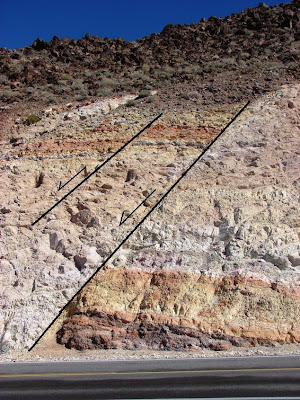
Apologies to Ron and Silver Fox for the delay revisiting last weekend's outcrop; all that death defying stuff distracted me. This is a well-known stop for many Death Valley field trippers at the south end of the Resting Springs Mountains just west of Shoshone. It is a marvelous site for teaching about faulting and aspects of volcanism. The prominent fault appears at first glance to be a classic reverse fault because of a tendency in one's mind to link the orange layers. The layer in the footwall (right) includes a dark lavender layer that is not present in the headwall, and thus the layers do not correlate. The smaller fault shows the correct offset.


The rocks in the outcrop are primarily air fall tuffs, although a megabreccia is exposed nearby. The rocks have clearly been tilted a bit.


Once my students finish looking at and sketching the faults, their attention is drawn to the dark layer to the left. It is a vitrophyre, a rhyolite ash flow that was so hot when it was erupted that it remelted to obsidian in the middle. A close inspection of the outcrop shows pumice pyroclasts that are progressively flattened towards the dark obsidian in the center of the flow. The upper part of the flow shows vesicularity as gases moved upwards during the cooling phase. Apparently the flow is in the original orientation; it was not tilted, but was instead plastered against a sloping hillside. The vugs contain interesting minerals, including zeolites and other silicates.


I wasn't so smart with this outcrop the first time I saw it. My instructor convinced us first that it was a reverse fault next to a coal seam, and then pointed out the inconsistency of the fault interpretation. Then it was hmmm? maybe not a coal seam, could it be a lava flow? Was it a dike? Oh dear, maybe we would have to figure out this whole thing ourselves.


Researchers much more talented then myself have published a tract about the outcrop that has been reprinted and is on sale at the Shoshone museum, which is also worth a stop if you are in the region. They have an excellent exhibit on the mammoths and other creatures that have been excavated in the region. Check it out!
  • Troxel, B.W., and Heydari, E., 1982, Basin and Range geology in a roadcut, in Cooper, John D., Troxel, Bennie W., and Wright, Lauren A., Editors, Geology of selected areas in the San Bernardino Mountains, Western Mojave Desert, and southern Great Basin, California: Volume and guidebook for field trip no. 9, 78th Anniversary Meeting of Cordilleran Section, Geological Society of America: Shoshone CA 92384, Death Valley Publishing Company, p. 91-96, 202 p.

Tuesday, March 4, 2008

A Carnival of Death-Defying Geologists


Well, I've just sat down to relax after a long day of work, and find out there's a kind of geological meme going around about death-defying geological experiences. Geotripper, what have you started?! (Silver Fox at http://highway8a.blogspot.com/)
Well, this has been a lot of fun seeing this meme take life and bounce around the geoblogosphere! I had no idea I was starting something...I will go ahead and call it a one-day long Accretionary Wedge Carnival (the Special Edition?) and tabulate the responses I have come across:

Silver Fox, in Defying Death? (noted above) tells a story of scary helicopter rides, and spending a night stranded on a cold mountainside in Nevada...

Chris talks about getting stuck on cliffs with Geologists in peril - and liking it?...his post includes a number of additional stories in the comments section...including one or two souls from outside geology who sound jealous...

Mel at Ripples in Sand has some links to pics of one of the most hair-raising trails in China that I've ever seen (More on Death Defying Feats )...

Kim in That geologic death wish... relates some adventures trying to cross a snow-swollen river while doing research...


If there are other stories out there that I missed, I will be glad to update the list. Thank you everyone! I enjoyed the adventures...

Update:

Our Lost Geologist barely avoids inundation in Aquatic Geologist facing the tides...

Tuff Cookie shows off in a variety of environments, and faces down a really big spider in Living dangerously...is totally fun (http://magmacumlaude.blogspot.com/2008/03/living-dangerouslyis-totally-fun.html)...

Julian adds a rather terrifying picture (Off the freeway and into the fault trace...) of a field-trip related car wreck, and a collection of cars-on-faults pictures...

Julian's story reminds me of the nearest geology-related brush-with-death events that I can recall. The summer of 1994 was one of my greatest years, and yet one in which disaster followed me everywhere. Almost lost my wife, almost lost a student, almost stepped on three rattlesnakes simultaneously (WHAT were they up to?). The same day I lost the student and stepped on the snake, we were driving north on Utah State Highway 191 near the town of Blanding at approximately 55 mph, when our Ford Astro Van made contact with a deer that jumped over the crash barrier without warning. Neither the deer nor the van could be regarded the winner of the encounter. The driver of the van kept us in a straight line (avoiding a head-on collision with opposing traffic), but the radiator, air conditioner, water pump and various sundry engine parts were destroyed. To their credit, the mechanics in Blanding got the van running again for only $1,300 (which by amazing coincidence was how much in cash and travelers checks I was carrying at the time!). We got the van back, drove out to meet the rest of the crew, and promptly ran over a rock, busting the exhaust manifold. We sounded like a dragster the entire 1,500 mile trip home. And the transportation office at school was not too happy with us.

Maria at Green Gabbro (Delicious Internet Noms) adds a photo of lava escapades; and those lava benches actually are kind of terrifying...we know that they won't collapse when WE are on them, but......

And a late update...check out one of our newest geobloggers at Death defying geologists. As Geology Happens! says, he's new at blogging, unlike, say, me who has been haunting the geoblogosphere now for an entire two months. Watch out for falling rocks!

Monday, March 3, 2008

Speaking of Landslides caught on film (disk?).....

And speaking of being in the right place at the right time...the pictures coming back from the HiRESE Orbiter over Mars are just spectacular. Read the story of this photo at http://hirise.lpl.arizona.edu/PSP_007338_2640, and more than 2,500 other images were released today at http://hirise.lpl.arizona.edu/pds_release_mar_08.php. Thanks to Arizona Geology (http://arizonageology.blogspot.com/) for the links.

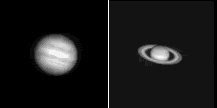
I am once again reminded of how lucky I am to be alive these days, and how little we knew of the Solar System in the days of my youth. I waited for months for the chance of getting a telescope for Christmas when I was 11 or 12 years old. It was a bit like Ralphy hoping for the BB gun in Christmas Story. As luck would have it, the arrival of my beloved telescope coincided with the flooding in southern California in 1969, and it was actually weeks before I was able to actually look at stellar objects with my new pride and joy. And truth be told, I was a little disappointed, since stars looked just the same in the telescope as they did with the naked eye. I could see moons around Jupiter, and Saturn's rings, but not much else (and I certainly didn't take these pictures, however fuzzy).


I was consumed with curiousity about the other planets in our neighborhood, and all the science books could offer were small fuzzy pictures of Mercury, Mars, Jupiter, Saturn, and Venus. Uranus, Neptune, and Pluto (the dwarf formerly known as the 9th planet) appeared as only dots of light. With the arrival of the first pictures from Voyager and all the other planetary explorers, our world was changed, and we are richer for it.

Everyday, the people who do science, and their technological advances provide us with beauty and fascination, as exemplified by the continuing saga of the Mars Rovers and the Orbiters. Thanks to those who persevere in the face of budget cuts, and keep up the great work!

Sunday, March 2, 2008

Do Geologists Have a Death Wish?

Something about having a huge pile of laboratory notebooks to grade on a tight deadline brings out the sloth in me, and suddenly every little distraction takes on monumental proportions, and I just have to share. I just looked at, courtesy of Geology.com (http://geology.com/articles/yosemite-rockfall.shtml), a spectacular series of photos of a 2006 rockslide at Elephant Rock above the Merced River on Highway 140 just west of Yosemite, taken by Herb Dunn (http://herbdunn.com/). I am trying to imagine the excitement of witnessing significant geological events in action, and Herb had a seat right behind the plate so to speak. Check out the photos, they are spectacular.

The photo above, taken by yours truly, is decidedly not spectacular, but it represents the only time I have seen a rock fall in Yosemite, despite something like 50 or 60 visits over the last 20 years. It happened on April Fool's Day in 2000, and I only had a cheap film camera at the time (my digital age began in 2001). And what did I do? Immediately drove as close to the impact site as I could so I could check out any damage.

Seeing Herb's viewpoint (he actually didn't have much choice, with steep slopes and boulders all around), I considered what happens when events like this happen to geologists. We run for a better look! A landslide, a volcanic eruption, an earthquake, it seems like we can't resist; while others run away in a wild panic, I imagine many or most of us will be scrabbling for a camera and running towards whatever is going on.


It isn't a death wish, of course. Many times (but not all), geologists may have a different understanding of the risks involved (the story of Maurice and Katia Krafft and the events at Galeras volcano in Colombia do provide a cautionary tale). I, for one, find earth processes in all forms endlessly fascinating, and we geologists have a perspective that tells us that what we see may be a once-in-a-lifetime event. At the very least, we want to share our excitement with others. Then again, maybe we are crazy...


Geotripper, acting perfectly safe and sane....

Picture of the Day - A Great Outcrop, Part 2

Today is the broader look at the outcrop in yesterday's post. It doesn't stop with the faults! What the heck is going on with the left side? Please feel free to guess in the comments section, but I'm not trying to make things mysterious or difficult; if you e-mail me I will explain it all to you. I am just wanting to show some examples of the really great teaching moments and places to be had in a treasure like the eastern California desert. If you are curious, this particular roadcut is about 4 miles east of the town of Shoshone on Highway 178 (the Charles E. Brown Highway, hence the Charlie Brown Outcrop).

Geology through the Eyes of an Artist

Joel Hagen is a fellow community college teacher at my school (computer graphics) who has attended enough of my field trips to qualify as a field geologist (he does, in fact work with NASA, the Mars rovers, and geochemical analysis). I invite you to see his incredible field notes, in the form of drawings and sketches that he has done in the Colorado Plateau and other venues...see them at http://virtual.mjc.edu/jhagen/geo-plateau/.

Saturday, March 1, 2008

Picture of the Day - A Great Outcrop

Death Valley and environs is an unendingly fascinating collection of naked rock exposures. The next post or two concentrates on a particularly instructive roadside classroom east of the park near the Nevada border. It is rather famous amongst Death Valley travelers, and has been featured in a few textbooks as well. With a caption that as often as not is incorrect!

Clearly a fault exposure....what kind of fault is it? It is a problem my first year students get to deal with on the second day of their field trip to Death Valley. If you know this outcrop well, hold back a few hours and let others give it a shot.