Showing posts with label birds. Show all posts

Monday, January 27, 2014

Rebuilding What Was Lost: Wildlife Refuges in California's Great Valley

Yeah, I live in one of the most boring geologic landscapes imaginable. California's Central Valley (or Great Valley when we are suffering from low self-esteem) is one of the flattest places in the country, and it's dry and dusty most of the year (and with the extreme drought this year, it's been dusty for more than a year). Our geology is basically clay mixed with sand. And some caliche layers. How much bleaker can it get?
Well, how about the trees? Tangled chaotic woodlands that hobbits and elves would avoid. Broken branches, barren of leaves, what is there to love here?

And once you leave the confines of the river floodplains there is not even enough water to support brush let alone trees. Flat grassland plains that reach to the horizon. Okay, it's true that the origin of the Great Valley is rooted in geological violence. The valley is the remnant of a gigantic forearc basin that lay between the trench of the great Cascadia subduction zone and the Sierra Nevada magmatic arc. Volcanic eruptions once coated the region in thick ash layers, and intense earthquakes 30 times more powerful than the San Francisco earthquake of 1906 happened tens of thousands of times over millions of years. But now. Nothingness. So, I ask who could love such a place?

Well, it's for the birds. For them, this bleak environment is survival. As I have mentioned in recent posts, 95% of the original natural environment of the Great Valley has been co-opted for agricultural and urban development. Millions upon millions of birds once used the valley as a wintering ground or for critical food-gathering during their migrations elsewhere.

This week I was continuing my for-the-first-time exploration of one of the most spectacular displays of nature by paying visits to the San Joaquin River National Wildlife Refuge. I'm still sort of stunned that this has been in my own backyard, but was so easy to overlook (I should add that I never learned to surf despite living in Santa Barbara at one time, and never learned to ski despite living next to Lake Tahoe for a time; I just sorta miss stuff). Like the San Luis and Merced refuges, The San Joaquin River NWR provides year-round habitat for the local native species (not just the birds), but in winter it is home for thousands upon thousands of Snow Geese, Ross's Geese, Aleutian Cackling Geese, Sandhill Cranes and many others.

The San Joaquin River NWR is notable for the role it has played in the recovery of the Aleutian Cackling Geese, a species that was down to around 300 individuals in 1963 (foxes had been introduced on the islands where they nested). Many of them winter at San Joaquin, and in recent years they have numbered in the tens of thousands. Thousands of Sandhill Cranes can also be found there.

There are two main ways to explore the San Joaquin River NWR. There is a wildlife viewing platform on Beckwith Road about 8 miles west of Modesto. It makes absolute sense that people wouldn't be allowed to tramp all over the fields where the birds eat and roost, so the platform offers a high viewing point, and when I was there, thousands of birds were visible. Mrs. Geotripper was kind enough to make her video available of thousands of birds swarming around the plowed corn crops that were grown to feed the birds. It may recall the incredible flight of the Snow Geese at the Merced NWRI posted the other day.

Our other exploration was much quieter and intimate. South of Highway 132 and off of River Road and Dairy Road, there is a recently constructed foot trail that winds through 4 miles of fields and river woodlands. The seasonal wetland had not been flooded yet (if it will be at all, given the drought), so the vast flocks of migratory birds weren't present. On the other hand, we had a chance to seek out the resident year-round species.
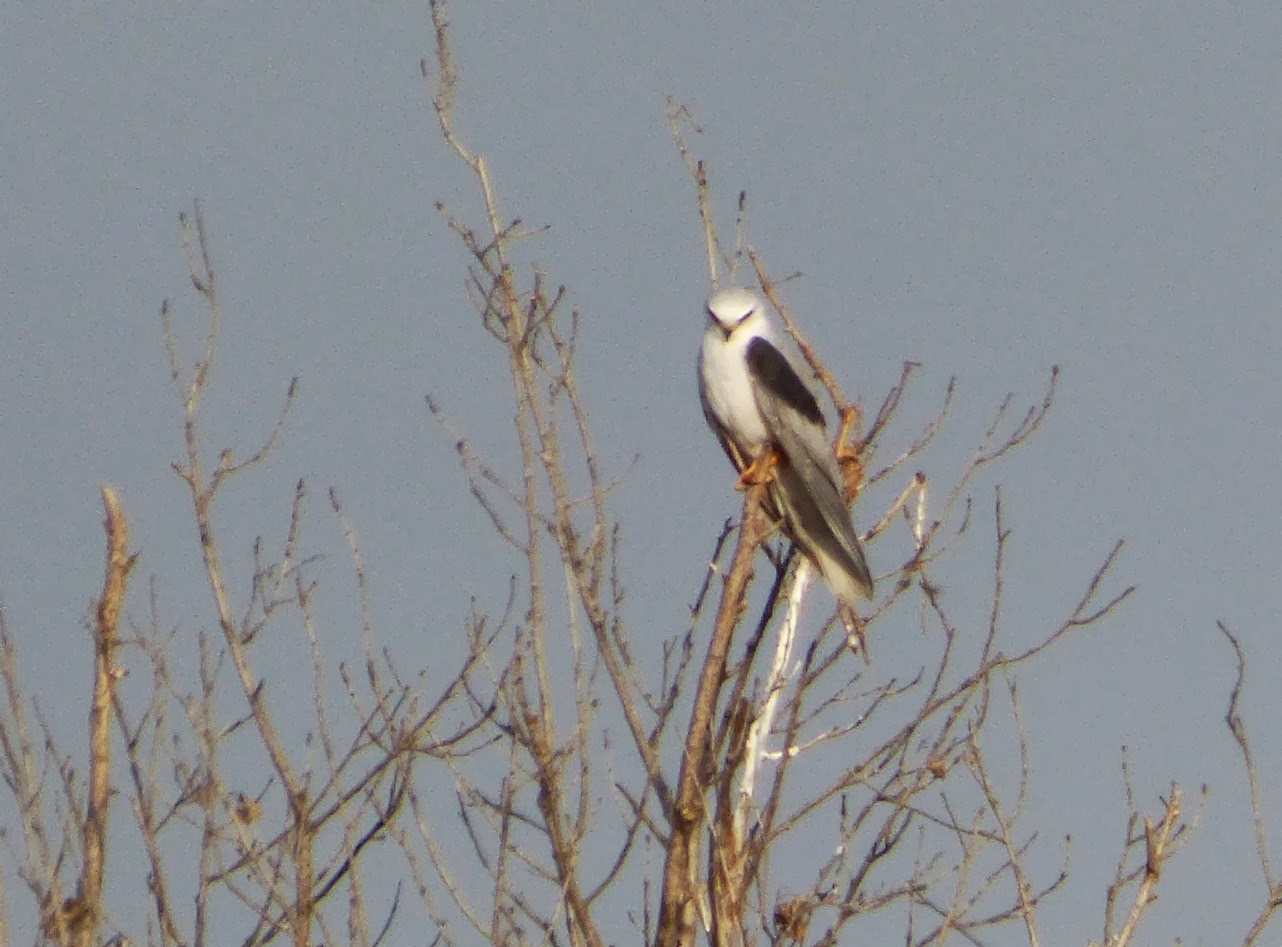
White-tailed Kite (Elanus leucurus)
The caretakers of the refuge are in the process of reconstructing and rebuilding the habitat that existed prior to settlement by Europeans in the 1800s. Floodplains and riparian woodlands are being replanted with tens of thousands of trees, and former wetlands are being flooded regularly in an effort to reproduce seasonal flooding that took place prior to agricultural development. The squarish property/refuge boundaries and canals belie a complete return to a natural environment, but it is a richer environment than existed before.
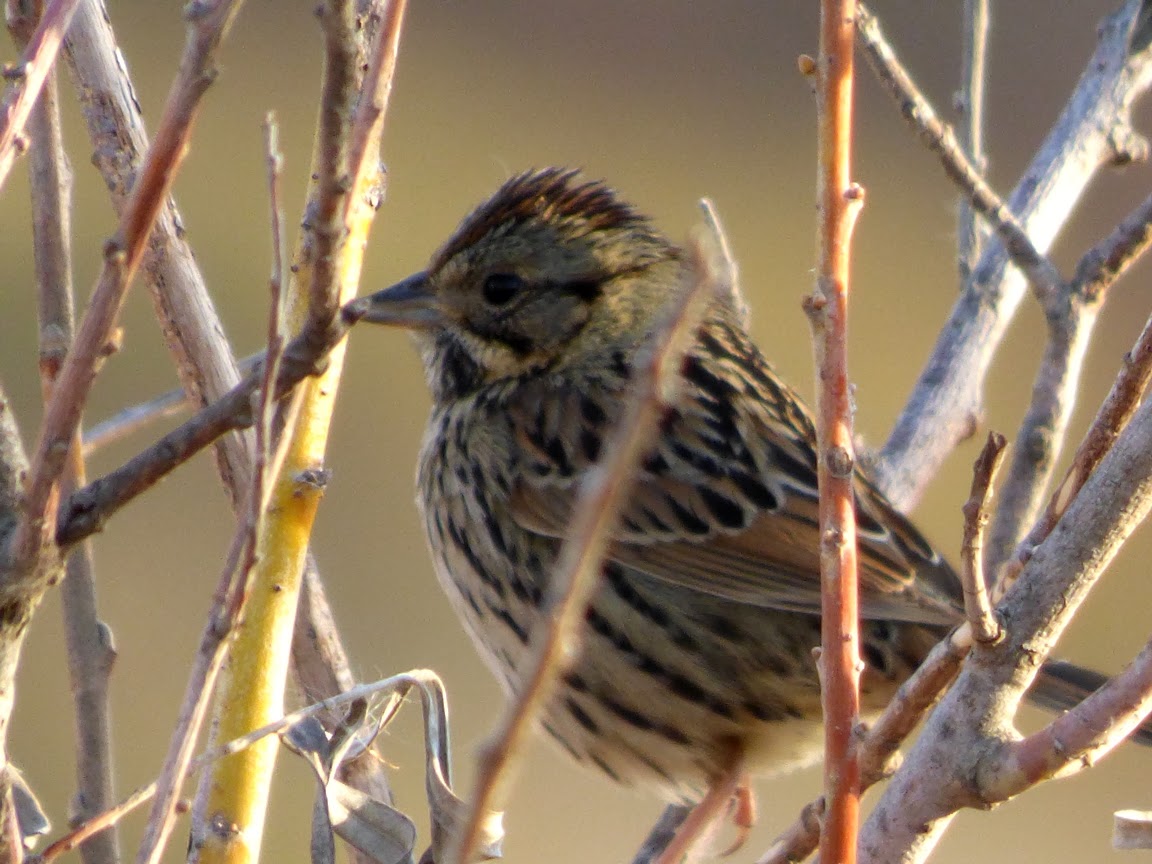
A Song Sparrow (Melospiza melodia), perhaps?
We only had a short time to explore, covering only a mile of trail, and we didn't quite reach the section of the trail that parallels the San Joaquin River. A fair number of bird species were present, and a few allowed us to snap a few shots before they hopped into the underbrush.
Hermit Thrush (Catharus guttatus)
Being a rank amateur in the birding business, this was the first time I've ever identified a Hermit Thrush. Some people may have hundreds of birds on their life lists, but at least, I have an easier time adding new birds! A gentleman at the wildlife platform on Beckwith told us that dozens or hundreds of birders came out a few weeks back when someone spotted a rare Bunting species next to the platform. Some folks came from out-of-state for the chance to see it.
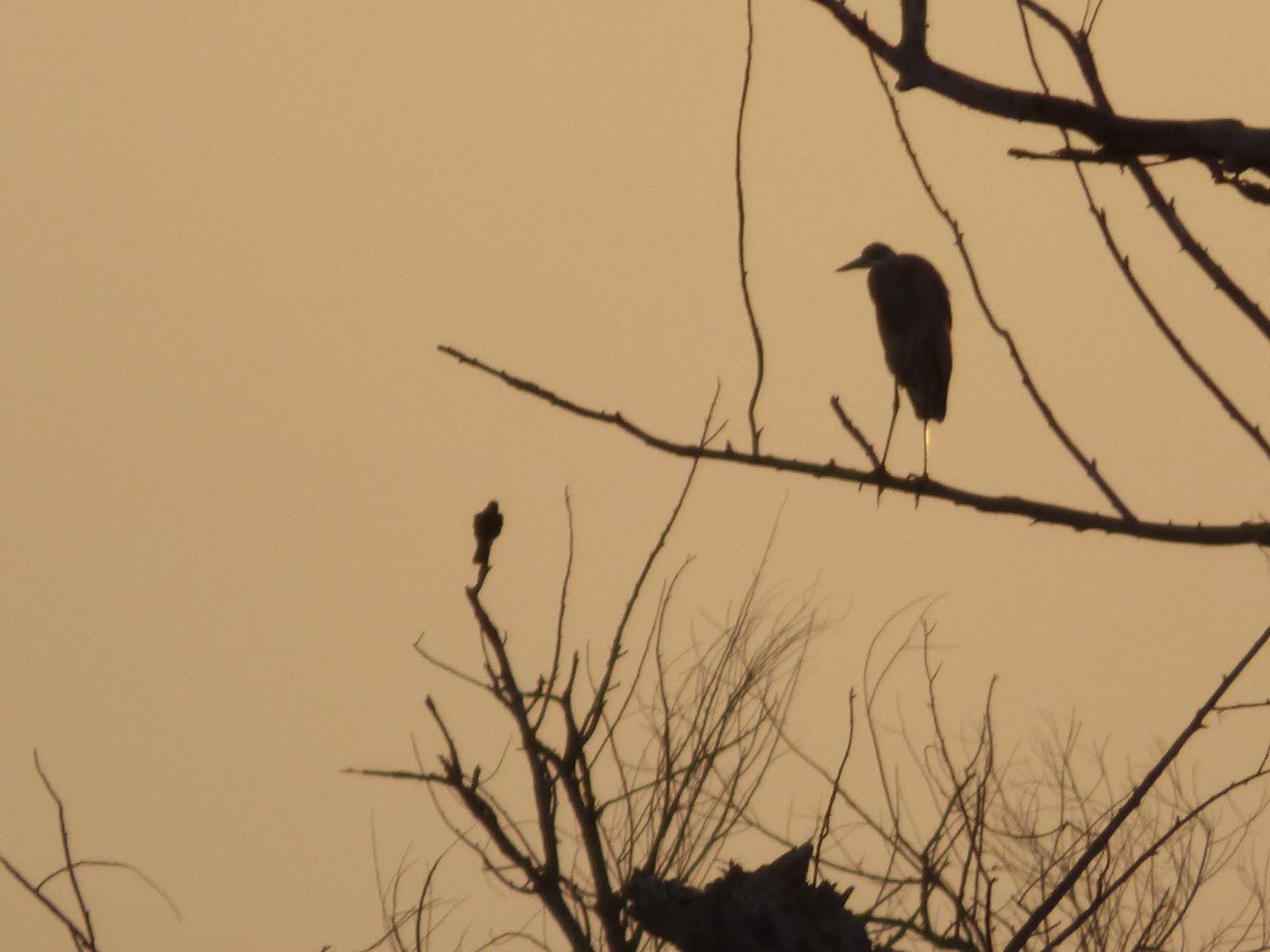
Egret in a tree at sunset

We didn't arrive until around four o'clock in the afternoon, so the sun was sinking fast as we made our way back to the parking lot walking atop the levee that protects some of the regional farmlands from flooding. A thicket of trees and brush kept us from seeing very far, but the chirping and hooting told us that numerous birds were hiding there.


One last Redwing Blackbird greeted us as we got back to the car and headed home. The San Joaquin River National Wildlife Refuge will be on our list for further exploration if the rains ever come and replenish the grasslands!

Wednesday, January 1, 2014

Happy New Year From Geotripper! A Resolution: Follow Those Dreams!

I've never been one for resolutions. Changes in my life tend to happen at the various times when the need for change becomes apparent and I try acting on them as a result. That being said, the new year began a few moments ago, and a few things occurred to me.

First off, go and check out Andrew Alden's blog post on geological resolutions (click here). There is some great advice there.

And then consider Ollie Hopnoodle's Haven of Bliss. Never heard of it? That's a shame, because it was a gem of a movie, written by Jean Shepherd, who also wrote "Christmas Story", the classic tale of Ralphy and his quest to get hold of a Red Ryder BB Rifle ("You'll shoot your eye out!"). "Ollie Hopnoodle" follows the same characters a few years later as they take their family vacation. The thing is, they always went to Haven of Bliss, a fishing lake up in Minnesota somewhere. Year and after year. The story was great, but don't do that! Don't get caught up in sameness and habit!
The world is so big and there are so many wonderful things out there to explore. Some are far away, but some as as close as your own backyard. Resolve to try something new, and to see someplace new. This has been one of the greatest years in my life. I was given the precious opportunity to float down the Colorado River with my brother and his family, and every minute of each of the 17 days was a gift that I can never forget. There were moments of unspeakable terror, but hours and days of bliss as well, as I finally achieved one of the great dreams of my life.
But here's the thing: the second great discovery of my past year was a big surprise, because it was literally in my backyard. I've always kind of liked birds, but never really learned much about them, and knew little of the species that live in my area.

A new camera with a pretty good zoom lens has taught me that there are many discoveries to be made just outside your door. I've been amazed at the variety of birds that live where I do. It's a new favorite activity these days, photographing the little avian dinosaurs.
So the thing is, if you think in terms of resolutions, I say try something new and different. It can be one of the big dreams you've always had, but never believed it could be achieved; you can start right now to make it happen. Or make a small change and discover something new about where you live, whether it's to learn something geological, or ornithological, or biological. Your life will be richer either way.

Tuesday, August 24, 2010

Dispatches from the Road: An Invasive Species? That's a Bunch of Bulbul!

Who are you calling "invasive"?

The Hawaiian Islands are a crucible of natural selection, and a laboratory for studying evolution. The islands spawned dozens and dozens of new species from the few original species that found their way to the isolated volcanic landscape over several million years (a successful new arrival on average every 20,000 years; these things don't happen fast), and in the present day, we are observing intense competition between native species and introduced species that piggy-backed with humans, in the first Polynesian wave more than a thousand years ago, and in the current wave of the last two hundred years. Unfortunately, it is the native species that tend to lose out.

The natives have been battered by introduced diseases, especially mosquito-borne bird malaria, predation by mongooses, cats, dogs, and rats, and by severe loss of habitat due to grazing, agriculture and urbanization. Most of the native species survive in high-altitude forests above 4,000 feet (too cold for mosquitos), and they can be difficult to see. I know, because I try to photograph them on every trip and for the most part I am stunningly unsuccessful. Especially this last week.

Still, the invaders are a beautiful and diverse lot, and it's not their fault for being here; I do enjoy getting close-ups of them when I can. I "collected" some new species this week, in the digital sense. The first two photos are of some Red-Vented Bulbuls (Pycnonotus cafer), an Asian species that arrived on the islands in the 1950's, probably as escaped pets. They were cute and friendly with us in Waimea Canyon on Oahu, but they love orchid buds and fresh fruits, and as such are an agricultural pest.

We heard beautiful songbirds in Waimea, and the singers were probably White-Rumped Shamas (Copsychus malabricus), a species of thrush from Malaysia who arrived on Oahu in 1940. They aren't described as pests, but they have penetrated deep into the native forests and probably compete with the native species for food and territory. I had a hard time getting a sharp shot of the adult Shama, but the juvenile came right out in the open for me (below).

There are three species of cardinals on the islands, including the familiar American version that people see on St. Louis baseball caps. They are one of the most colorful birds that are commonly seen. I knew of the Northern Cardinal (the American one), and the Red-Crested Cardinal from Brazil, but I hadn't seen the one below on my previous trips. It doesn't have the crest like the others.

It's called the Yellow-Billed Cardinal (Paroaria capitata), and it is a fairly recent arrival from South America, having first been observed in 1973. It's spreading out from the Kona area on the Big Island.

Um...do my pits smell??

Another colorful pest in urban areas in the Java Sparrow (Padda oryzivora), which arrived from India in 1867. We saw a lot of them in Kona on the Big Island. The one below hung out on our lanai looking for handouts (not this time...).

And finally, we have the Saffron Finch (Sicalis flaveola). The one I captured is probably a juvenile, as the adults have a orange blush about the head. They arrived in the 1960's from South America.
When you ever make it to the islands, don't hang out in Waikiki! There is so much more to see. A valuable resource for bird-hunting is the book Hawaii's Birds, published by the Hawaii Audubon Society. It is my best source about the birds, both native and invasive. And since I really am a geologist and not an ornithologist, I am open to corrections on my bird identifications!

Friday, July 9, 2010

Theropods in the Backyard: Dinosaurian Drama on my Porch

Apologies to Harper Lee, but if she had come to have known the mockingbird in my backyard, she would have called her classic story "To Kill a Yellow Finch". Or, she would have written a totally different story under the original name, a horror novel that Alfred Hitchcock would have been comfortable making a movie from.

I don't want to make light of Lee's novel. I watched the movie "To Kill a Mockingbird" the other night, and was reminded again of its great emotional impact. In this day when bigots are once again feeling free to spew their hatred on the right-wing airwaves, it was a reminder of what a fragile thing justice and equality is in our society, and how easily we could lose it.

On the other hand, that mockingbird in our backyard is more reminiscent of the velociraptors in "Jurassic Park". No hauntingly lyrical song from this one; it's a screech that would put cold fear into anything small enough to be hunted. It has a bravado that has to be seen to be believed. It's attacked our cats, our dog, my wife, and my son. I think I'm the only one big enough to make it think twice.

On the other hand, there's the T-rex or Allosaur of today's dinosaurian world, the hawk. This juvenile Redtail (?) was hanging out in my mom's backyard these last few weeks. It still begs for food from momma, just like any teenager, but is getting better and better at flying, and soon will be striking fear into the local rodent population, just as its ancestors have been doing for 200 million years.