Showing posts with label San Joaquin River National Wildlife Refuge. Show all posts

Wednesday, December 30, 2020

A Reminder of What Once Was: An Evening at the San Joaquin River National Wildlife Refuge

What is it like to see ten thousand birds take to the sky all at once? Do you have to live on the African Savanna to find out? Sometimes one has to merely look in one's backyard (so to speak) to rediscover the extraordinary nature of where one lives. For instance, my home is in California's Great Valley (called by some the Central Valley). The valley is sometimes derided as a boring place to live, an endlessly flat expanse of agribusiness farms and poorly planned urban centers, and there is certainly a truth to that idea. A full 95% of the valley has been altered by humans from the original prairies and wetlands.

But the other 5%? Astounding at times.

The valley was once an expanse of open prairies, riparian corridors, and vast shallow lakes. A diverse fauna grazed the flatlands, Tule Elk, deer, antelope, horses, camels, bison, mammoths, mastodons, and giant ground sloths. They were preyed upon by a fearful assemblage of carnivores: Saber-toothed Cats, Jaguars, American Lions, Dire Wolves, Coyotes, Black Bears, Grizzly Bears, and huge Short-faced Bears (nothing else was short about them; they stood 12 feet tall). Much of the megafauna disappeared around 10,000 years ago for reasons that are still debated, but the valley still supported a healthy ecosystem when the European colonizers arrived and started changing things.
The valley supported millions upon millions of migratory birds. The valley for a variety of reasons has some of the mildest winter weather in North America, and arctic species for millennia utilized the wetlands for a winter home. Agricultural development deeply altered the available habitat and the birds suffered for it, but a string of wildlife refuges were established decades ago to help them survive. I'd love to say it was for preserving the natural habitat, but it was often to provide the birds a place where they wouldn't destroy crops, and to provide hunters a dependable target. But still, the refuges are islands of relative safety for the birds, and many species have thrived. 

The Aleutian Cackling Goose was once thought to be a subspecies of the similar Canada Goose, but they are now considered a distinct species. They were decimated by changes in their winter refuge, but also in their breeding grounds in the Aleutian Islands, were introduced foxes had exterminated most of them. By 1936 they were thought to be extinct. In 1962 a few hundred were found on an isolated island, and they received protection under the Endangered Species Act in 1973. Since then their numbers have rebounded, with a population today of nearly 200,000. And a very large percentage of them spend their winters only eight miles west of the biggest shopping center in my town.
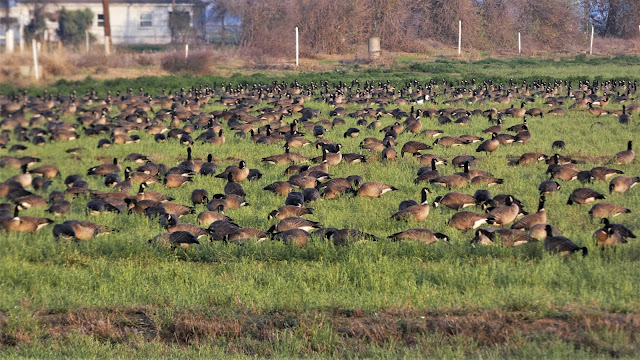
We had a package to pick up at that shopping center today, so Mrs. Geotripper and I decided to run out to the viewing platform on Beckwith Road west of town. The platform overlooks the fields of the San Joaquin River National Wildlife Refuge. I have visited the spot dozens of times in the last six years, but I had never seen so many birds as were there this afternoon. I made a rough estimate of 4,000 Aleutian Cackling Geese, as well as around 12,000 of the white Snow and Ross's Geese. And as we watched, a large percentage of the geese took flight, which I caught in the video at the top of the post. It was an astounding sight.

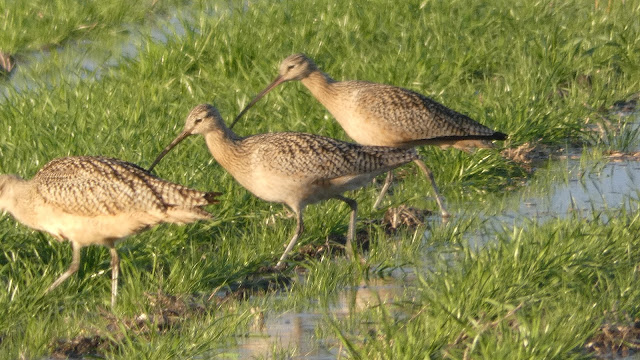
It's not just geese that call the Great Valley their home. There are a large number of other strange and exotic birds that can be found here. This evening we saw some other interesting species. There was a flock of 200 or 300 Long-billed Curlews in a field north of the road. They have impossibly long beaks for exploring the mud for worms and bugs.
There was also a flock of around a hundred White-faced Ibises. They look very dark from a distance, but closer observations reveals a colorful iridescence. The white face only shows up in breeding season. They are unique to the Americas, and apparently evolved from the far more widely distributed Glossy Ibises.
Photo by Mrs. Geotripper

I've lived in the Great Valley now for more than thirty years, and I've long extolled the fascinating geological story of the valley, including the extensive fossil record, but I was appallingly ignorant of the fascinating species that still call the valley home today. I had never seen the tens of thousands of geese take flight all at once until around six years ago. I now look forward to the privilege with the approach of every winter season.


Wednesday, January 24, 2018

Sandhill Cranes and the Great Valley That Once Was, and in Places, Still Is (An Apologetic)

There's a difference between apologetics and polemics. The latter is an attack, but the former is a defense. I was writing a piece at my other blog, Geotripper's Birds of California about Sandhill Cranes, and in a few paragraphs it turned into an apologetic for living in the Great Valley of California, a place that few people find attractive. The thing is, when one searches carefully, there is much to see here in the way of beauty and grandeur. The Sandhill Cranes are but a single aspect. The original post follows:
These beautiful birds are among the reasons I took up bird photography a couple of years ago. I was astounded to find that Sandhill Cranes (Grus Canadensis) congregated by the tens of thousands very close to where I live, and I was not the least bit aware of it.

Living in the Central Valley of California (which I agree should always be called the Great Valley) is an exercise in frustration and futility. The natural environment, the greatest savanna environment in the United States, was almost completely co-opted by agricultural development, and then by urban development. It's not a great place for people to live...most of the jobs are poorly-paid manual labor, the soil, air and water are infused with pesticides, herbicides, and particulate air pollution, and health problems, especially asthma and related respiratory illnesses are rampant. Education is a low priority to those in power. We are consistently the first to suffer in economic downturns, and the last region to recover from them.
And yet there is still a greatness to this valley. In terms of the natural environment, dedicated people have worked tirelessly for decades to preserve the remnants of the rich ecosystem, and have worked even harder to rebuild some of the habitats as abandoned farmlands have come available. Thousands of acres of river floodplains have been replanted with native vegetation. There is now a string of wildlife refuges along the 400 mile length of the valley that provide shelter for the millions of winter migrants, the Sandhill Cranes, the Aleutian Cackling Geese, the Snow and Ross's Geese, and many others.
The Great Valley that existed hundreds and thousands of years ago is still available to observe and enjoy, and often only a few miles from the homes of everyone who lives here. In the Modesto-Turlock area, there are the San Luis and San Joaquin River National Wildlife Refuges. The Beckwith Road viewing platform (part of the San Joaquin refuge) is only an eight mile excursion from Modesto's biggest shopping mall. I was there last night and had a real treat. The Sandhill Cranes are elegant large birds, beautiful to photograph, but they are a bit wary (with good reason) of human beings. They tend to stay towards the interior of the refuge, being heard more than seen off in the distance.
It's deep into winter now, and food stores are kind of low. The refuge managers grow fields of corn and other crops for the sole use of the birds, and they'll plow down the corn in sections so the birds can feed easily. Once those crops are gone, the birds make do, and last night they were roaming the plowed fields close to the road and viewing platform. I got some of my closest shots in a long time.

This is part of the valley as it once was, and still is. It belongs to all of us, and it is right in our own backyard. And to our coastal and urban center friends, don't forget that there are some incredible sights to see on the valley floor when you are on your way to Yosemite or to one of the Sierra ski resorts. For our international visitors, there are more places to see than the travel brochures hint at. If you are interested in the natural world want to see some of the real California, not just the tourist meccas, then check out these places. The refuges are worthy of a look.

Wednesday, February 15, 2017

Liveblogging the Deluge: San Joaquin River National Wildlife Refuge - What a difference a few months made (and Rabbits)

The San Joaquin River at the National Wildlife Refuge in November 2017
Just a few months ago, the San Joaquin River, and its major tributary the Tuolumne River, were in big trouble. The worst drought in California's recorded history had left the rivers at a mere trickle, and many parts of the San Joaquin were dry, despite recent efforts to bring back some sort of minimal flows to stretches of river that had been dry for decades (after dam and irrigation levee construction upstream). The invasive weed River Hyacinth had choked channels, crowding out native vegetation and making life difficult for fish and other organisms.

I hiked the Pelican Nature Trail in the San Joaquin River National Wildlife Refuge back in November, and despite a few early storms, dryness was the overwhelming feeling. Volunteers have put in a vast amount of work replanting former riparian woodlands, but it felt like the river overflow areas wouldn't see water any time soon. The river was flowing at a sluggish couple of hundred cubic feet per second.
The San Joaquin River in the same exact location on February 14, 2017
I returned to the Pelican Trail yesterday to a changed world. A series of atmospheric river storms over the last six weeks have dumped record amounts of precipitation across northern and central California. Watermasters at the reservoirs upstream joyfully let their dams fill with the prodigious amounts of water, but then the storms kept coming and they realized that some of the dams were in danger of overflowing. They ramped up flows out of the reservoirs and the rivers downstream swelled. The Tuolumne River, for instance, has been flowing at near flood levels (~9,000 cubic feet per second) for the last five weeks, and this week the flows were increased to over 11,000 cubic feet per second. Don Pedro Dam is only 2-3 feet below full capacity, and has only about 30,000 acre-feet of capacity (out of 2.03 million acre feet of storage space). The Merced River has been experiencing high flows as well, and water is high in the usually dry San Joaquin riverbed. Yesterday the river at Vernalis, just downstream of my trail, reached official flood state at 34,000 cubic feet per second.


It was rather stunning to stand on one bank of the San Joaquin, the neglected trickle of water from the southern Great Valley, and not be able to discern exactly where, off in the distance, the other bank was located. And there is this: the water level is probably going to rise soon. Yet another intense storm is headed towards California, and there is going to be another week of rainfall and snow in the mountains upstream. Don Pedro Lake, for one, is just about full and it is possible they will have to let additional water through the system to keep the lake from overflowing.

More than a month ago, on January 4, I wrote the first of a series of blogs that I soon called Liveblogging the Deluge. I quite honestly thought it was going to consist of four, maybe five posts as the first atmospheric river storm passed through California. But another storm soon followed, and then another. I look back now and see that I've published 24 posts on the storms, and they keep coming. This has been an extraordinary storm event and, for some people, a scary experience. Nature cares little for human beings and our puny attempts to control it can sometimes result in failure and tragedy. Despite the evacuation of 180,000 people because of an unstable situation at Oroville Dam, we've kind of held things together in the north part of the state, but the system is presently strained to the limits. Levees are showing signs of failure in places and reservoirs are getting dangerously full. It is imperative that residents in California keep their eyes open, and when the warnings come and evacuations are ordered that they comply as quickly and orderly as possible. Making a principled stand to defend your house against a rising flood is dangerous and may be deadly.

By the way, the other strange sight on the Pelican Nature Trail was the prevalence of Desert Cottontail Rabbits. There were perhaps hundreds of them along the trail. I assumed they had been flooded out of their habitat on the flats below and had gathered on the high ground of the levee where they were nibbling at the smallest shoots of grass, or reaching for leaves on the lower branches of the shrubs.

They barely seemed to register my presence. I was stepping only two or three feet away from them before they would move into the brush along the trail. They only scattered rapidly once, when a Northern Harrier flew overhead. Human beings are not the only beings who are affected by the floods.

I'm not going to be able to liveblog the coming storm, as I will be out in the middle of it. We're headed out to the Death Valley region where we will be navigating between storms and flash floods. I expect to have some interesting observations once the storm is past and we are home again. And yes, we will be careful out there. It's not often that one gets to observe rain in the driest place in North America. See you in a few days!

Wednesday, December 14, 2016

A California "Snow" Storm: A Winter Miracle in the Great Valley


People don't usually hear a great many good reasons to visit Modesto and environs. Forbes and others often put our Great Valley towns on the "worst places to live", but I think they really miss something when they do this sort of "expose". We grow most of the nation's food supply for one thing, so folks could be a little more appreciative of what we do. But it's really something else that few people are aware of, even those of us who live here. It's the magic of the season, the fact that we are a winter wonderland. The "snow" has nothing to do with precipitation, though, it has to do with millions of refugees from the snowbound northlands. They are Snow Geese. And Ross's Geese. And White-fronted and Aleutian Cackling geese. And thousands of Sandhill Cranes as well. In winter, the Great Valley becomes an American version of Africa's Serengeti Plain.
Snow Goose at the San Joaquin River National Wildlife Refuge

Hundreds of years ago, before the European invasion, the valley was home to tens of millions of migratory birds, but with settlement and development, 95% of their original grassland and river flood plain home disappeared. The birds could have been wiped out entirely, but a few visionary people worked to preserve a bit of the original valley habitat in an effort to save as many birds as possible. The result was a string of federal, state and non-profit run wildlife refuges that form a pathway down the 400 mile length of the valley. The birds will take refuge from October to March, when they begin making their way back north for breeding in the Arctic.
Aleutian Cackllng Goose (Branta hutchinsii) at the San Joaquin River National Wildlife Refuge. Several decades ago, there were only 600 of them left. Today there are around 200,000 because of conservation efforts in both Alaska and at the San Joaquin refuge (their primary winter home)
A great many people right here in the Modesto area are unaware of the Christmastime miracle that takes place each year. It's not hard to see incredible things just a short drive out of town. Only eight miles west of the biggest shopping mall in the region, on Beckwith Road, the San Joaquin River National Wildlife Refuge offers a viewing platform where one can see tens of thousands of migratory geese all at once. The best times are early in the morning and in the afternoon close to sundown. I took the video below at about 4:15 this afternoon during a short break from final exams at the college. Even with the YouTube compression, you can see tens of thousands of geese taking wing. You can hear the cacophony, but there is nothing like seeing and hearing it in person. The ground literally vibrates as the birds take to the air.


The spectacle is amazing, If you live here and you've never seen it, check it out right now! If you are from the Bay Area and are rushing to the Sierras for a ski day, take a short detour. It's worth your time. And if you are a birder, we are a winter paradise. More than 300 bird species have been documented in our area, and many of them can be seen during the winter season when the pickings are poor in other places (a lot of those disappearing birds come here!).

Monday, January 27, 2014

Rebuilding What Was Lost: Wildlife Refuges in California's Great Valley

Yeah, I live in one of the most boring geologic landscapes imaginable. California's Central Valley (or Great Valley when we are suffering from low self-esteem) is one of the flattest places in the country, and it's dry and dusty most of the year (and with the extreme drought this year, it's been dusty for more than a year). Our geology is basically clay mixed with sand. And some caliche layers. How much bleaker can it get?
Well, how about the trees? Tangled chaotic woodlands that hobbits and elves would avoid. Broken branches, barren of leaves, what is there to love here?

And once you leave the confines of the river floodplains there is not even enough water to support brush let alone trees. Flat grassland plains that reach to the horizon. Okay, it's true that the origin of the Great Valley is rooted in geological violence. The valley is the remnant of a gigantic forearc basin that lay between the trench of the great Cascadia subduction zone and the Sierra Nevada magmatic arc. Volcanic eruptions once coated the region in thick ash layers, and intense earthquakes 30 times more powerful than the San Francisco earthquake of 1906 happened tens of thousands of times over millions of years. But now. Nothingness. So, I ask who could love such a place?

Well, it's for the birds. For them, this bleak environment is survival. As I have mentioned in recent posts, 95% of the original natural environment of the Great Valley has been co-opted for agricultural and urban development. Millions upon millions of birds once used the valley as a wintering ground or for critical food-gathering during their migrations elsewhere.

This week I was continuing my for-the-first-time exploration of one of the most spectacular displays of nature by paying visits to the San Joaquin River National Wildlife Refuge. I'm still sort of stunned that this has been in my own backyard, but was so easy to overlook (I should add that I never learned to surf despite living in Santa Barbara at one time, and never learned to ski despite living next to Lake Tahoe for a time; I just sorta miss stuff). Like the San Luis and Merced refuges, The San Joaquin River NWR provides year-round habitat for the local native species (not just the birds), but in winter it is home for thousands upon thousands of Snow Geese, Ross's Geese, Aleutian Cackling Geese, Sandhill Cranes and many others.

The San Joaquin River NWR is notable for the role it has played in the recovery of the Aleutian Cackling Geese, a species that was down to around 300 individuals in 1963 (foxes had been introduced on the islands where they nested). Many of them winter at San Joaquin, and in recent years they have numbered in the tens of thousands. Thousands of Sandhill Cranes can also be found there.

There are two main ways to explore the San Joaquin River NWR. There is a wildlife viewing platform on Beckwith Road about 8 miles west of Modesto. It makes absolute sense that people wouldn't be allowed to tramp all over the fields where the birds eat and roost, so the platform offers a high viewing point, and when I was there, thousands of birds were visible. Mrs. Geotripper was kind enough to make her video available of thousands of birds swarming around the plowed corn crops that were grown to feed the birds. It may recall the incredible flight of the Snow Geese at the Merced NWRI posted the other day.

Our other exploration was much quieter and intimate. South of Highway 132 and off of River Road and Dairy Road, there is a recently constructed foot trail that winds through 4 miles of fields and river woodlands. The seasonal wetland had not been flooded yet (if it will be at all, given the drought), so the vast flocks of migratory birds weren't present. On the other hand, we had a chance to seek out the resident year-round species.
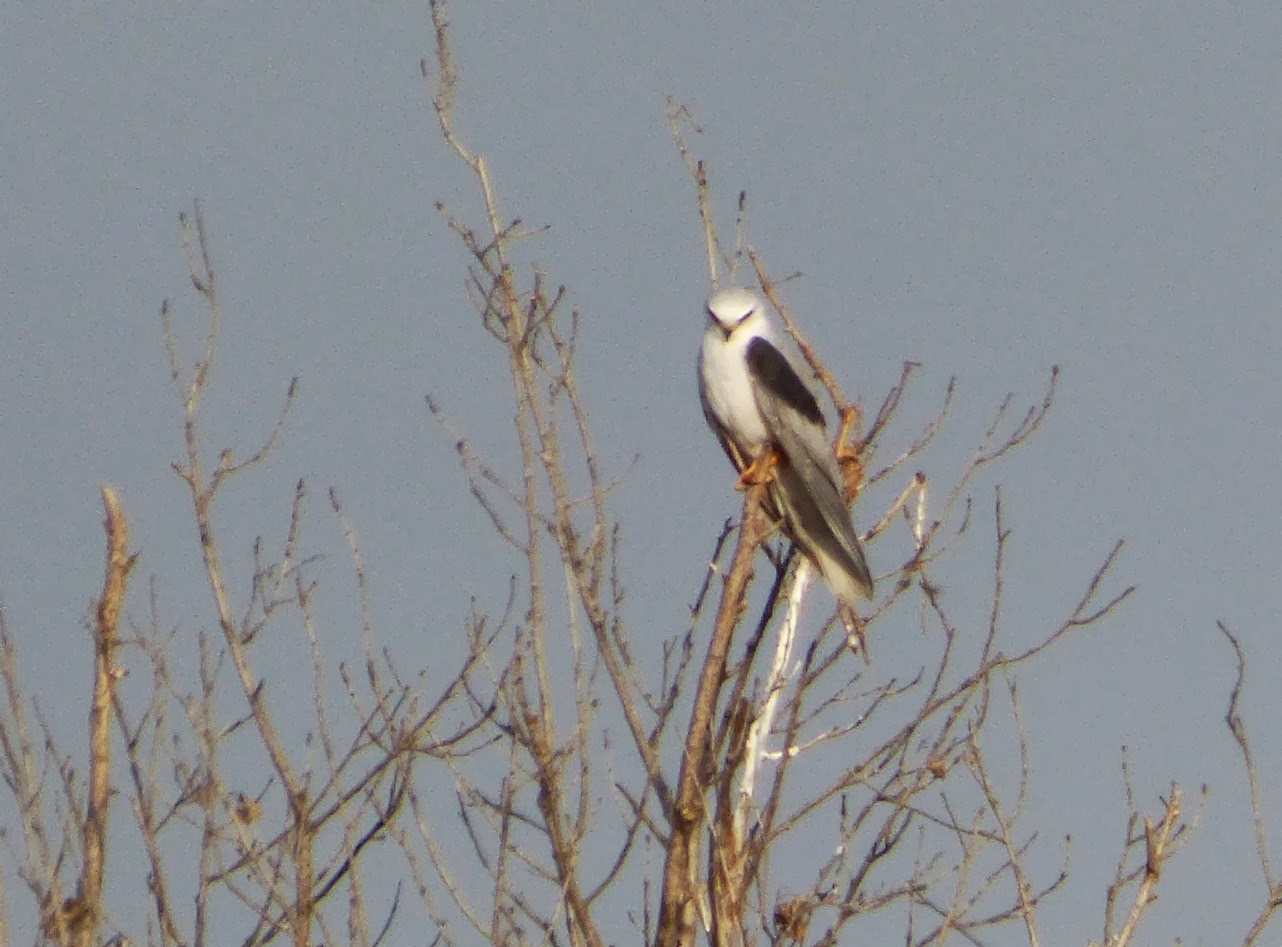
White-tailed Kite (Elanus leucurus)
The caretakers of the refuge are in the process of reconstructing and rebuilding the habitat that existed prior to settlement by Europeans in the 1800s. Floodplains and riparian woodlands are being replanted with tens of thousands of trees, and former wetlands are being flooded regularly in an effort to reproduce seasonal flooding that took place prior to agricultural development. The squarish property/refuge boundaries and canals belie a complete return to a natural environment, but it is a richer environment than existed before.
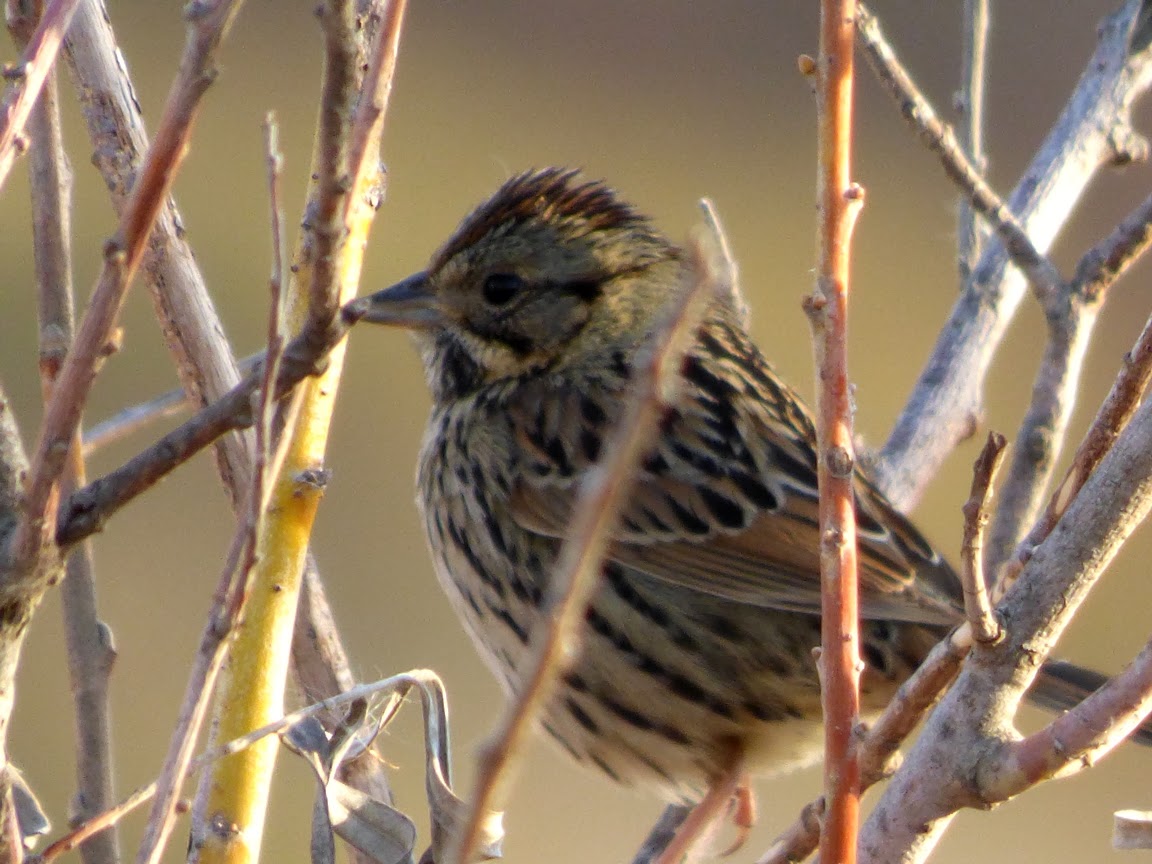
A Song Sparrow (Melospiza melodia), perhaps?
We only had a short time to explore, covering only a mile of trail, and we didn't quite reach the section of the trail that parallels the San Joaquin River. A fair number of bird species were present, and a few allowed us to snap a few shots before they hopped into the underbrush.
Hermit Thrush (Catharus guttatus)
Being a rank amateur in the birding business, this was the first time I've ever identified a Hermit Thrush. Some people may have hundreds of birds on their life lists, but at least, I have an easier time adding new birds! A gentleman at the wildlife platform on Beckwith told us that dozens or hundreds of birders came out a few weeks back when someone spotted a rare Bunting species next to the platform. Some folks came from out-of-state for the chance to see it.
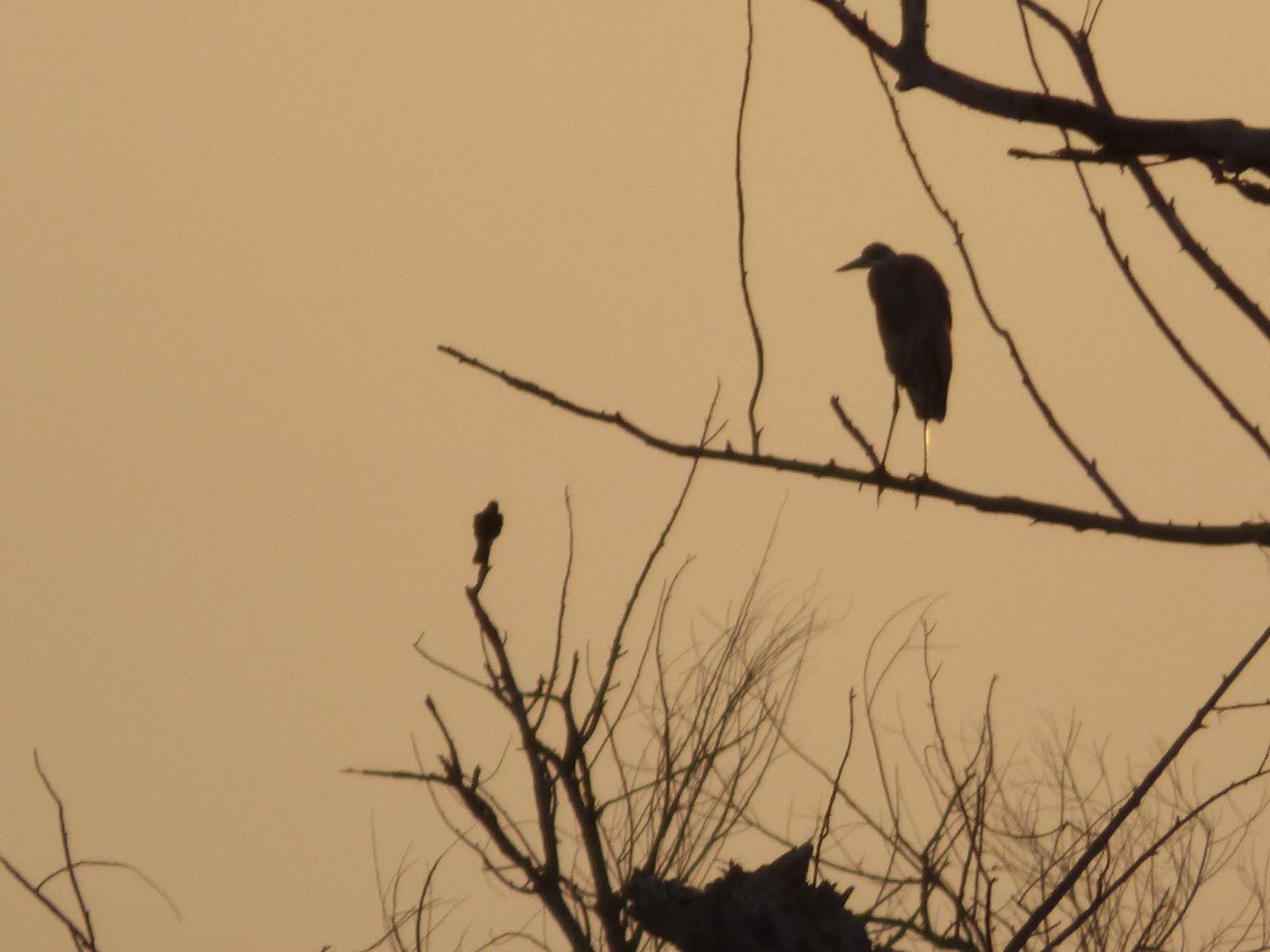
Egret in a tree at sunset

We didn't arrive until around four o'clock in the afternoon, so the sun was sinking fast as we made our way back to the parking lot walking atop the levee that protects some of the regional farmlands from flooding. A thicket of trees and brush kept us from seeing very far, but the chirping and hooting told us that numerous birds were hiding there.


One last Redwing Blackbird greeted us as we got back to the car and headed home. The San Joaquin River National Wildlife Refuge will be on our list for further exploration if the rains ever come and replenish the grasslands!