Showing posts with label Snow Goose. Show all posts

Wednesday, December 30, 2020

A Reminder of What Once Was: An Evening at the San Joaquin River National Wildlife Refuge

What is it like to see ten thousand birds take to the sky all at once? Do you have to live on the African Savanna to find out? Sometimes one has to merely look in one's backyard (so to speak) to rediscover the extraordinary nature of where one lives. For instance, my home is in California's Great Valley (called by some the Central Valley). The valley is sometimes derided as a boring place to live, an endlessly flat expanse of agribusiness farms and poorly planned urban centers, and there is certainly a truth to that idea. A full 95% of the valley has been altered by humans from the original prairies and wetlands.

But the other 5%? Astounding at times.

The valley was once an expanse of open prairies, riparian corridors, and vast shallow lakes. A diverse fauna grazed the flatlands, Tule Elk, deer, antelope, horses, camels, bison, mammoths, mastodons, and giant ground sloths. They were preyed upon by a fearful assemblage of carnivores: Saber-toothed Cats, Jaguars, American Lions, Dire Wolves, Coyotes, Black Bears, Grizzly Bears, and huge Short-faced Bears (nothing else was short about them; they stood 12 feet tall). Much of the megafauna disappeared around 10,000 years ago for reasons that are still debated, but the valley still supported a healthy ecosystem when the European colonizers arrived and started changing things.
The valley supported millions upon millions of migratory birds. The valley for a variety of reasons has some of the mildest winter weather in North America, and arctic species for millennia utilized the wetlands for a winter home. Agricultural development deeply altered the available habitat and the birds suffered for it, but a string of wildlife refuges were established decades ago to help them survive. I'd love to say it was for preserving the natural habitat, but it was often to provide the birds a place where they wouldn't destroy crops, and to provide hunters a dependable target. But still, the refuges are islands of relative safety for the birds, and many species have thrived. 

The Aleutian Cackling Goose was once thought to be a subspecies of the similar Canada Goose, but they are now considered a distinct species. They were decimated by changes in their winter refuge, but also in their breeding grounds in the Aleutian Islands, were introduced foxes had exterminated most of them. By 1936 they were thought to be extinct. In 1962 a few hundred were found on an isolated island, and they received protection under the Endangered Species Act in 1973. Since then their numbers have rebounded, with a population today of nearly 200,000. And a very large percentage of them spend their winters only eight miles west of the biggest shopping center in my town.
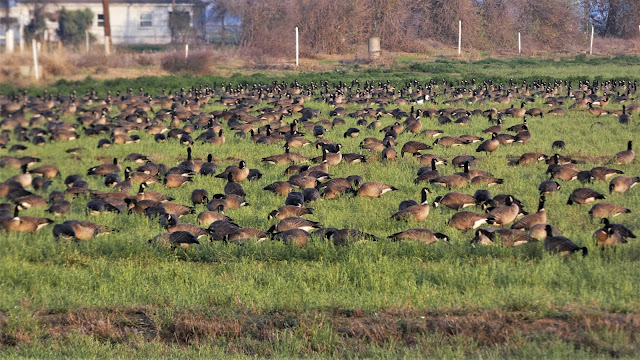
We had a package to pick up at that shopping center today, so Mrs. Geotripper and I decided to run out to the viewing platform on Beckwith Road west of town. The platform overlooks the fields of the San Joaquin River National Wildlife Refuge. I have visited the spot dozens of times in the last six years, but I had never seen so many birds as were there this afternoon. I made a rough estimate of 4,000 Aleutian Cackling Geese, as well as around 12,000 of the white Snow and Ross's Geese. And as we watched, a large percentage of the geese took flight, which I caught in the video at the top of the post. It was an astounding sight.

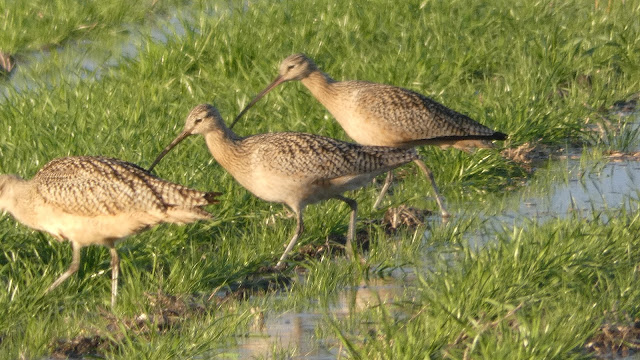
It's not just geese that call the Great Valley their home. There are a large number of other strange and exotic birds that can be found here. This evening we saw some other interesting species. There was a flock of 200 or 300 Long-billed Curlews in a field north of the road. They have impossibly long beaks for exploring the mud for worms and bugs.
There was also a flock of around a hundred White-faced Ibises. They look very dark from a distance, but closer observations reveals a colorful iridescence. The white face only shows up in breeding season. They are unique to the Americas, and apparently evolved from the far more widely distributed Glossy Ibises.
Photo by Mrs. Geotripper

I've lived in the Great Valley now for more than thirty years, and I've long extolled the fascinating geological story of the valley, including the extensive fossil record, but I was appallingly ignorant of the fascinating species that still call the valley home today. I had never seen the tens of thousands of geese take flight all at once until around six years ago. I now look forward to the privilege with the approach of every winter season.


Sunday, February 4, 2018

The California That Once Was: The San Luis National Wildlife Refuge

Great Blue Heron at the entrance to the San Luis NWR
I live in an extraordinary place, a place that does not always receive the respect that it deserves. In much the same way that travelers refer to the Midwest as "fly-over states", my home is the "drive-through valley".  The Great Valley (called by some the Central Valley) is a 400 mile long and 50 mile wide province that must be traversed by Southern Californians who want to reach the Pacific Northwest, or coastal Californians who want to reach Yosemite National Park or the Sierra Nevada ski resorts.
San Luis National Wildlife Refuge from above. It lies on the floodplain of the San Joaquin River.

Many people find the journey an arduous exercise in white-line fever, an endless flat region covered by millions of acres of orchards and fields of crops, or cattle stockyards, or used car lots on the edges of poor-looking towns. I'm willing to grant that it is often not a pretty sight. There is a reason that our cities often wind up last on the lists of "best places to live". Our skies are often the most polluted in the United States.

In the thirty years that I've lived here, I've come to discover a different Great Valley. It's the five percent of the valley that still retains the character of the land that existed before it was co-opted by agricultural development. It's a recurrent theme of my blogging adventures because each of these adventures expands my world just a little bit.
Today's journey was the auto-tour through the San Luis National Wildlife Refuge. The refuges range the length of the valley, providing winter sanctuary for migrating birds, but also providing a last stand for many native species of the valley from the smallest of bugs to the rodents and larger grazing animals to the largest remaining predators, the eagles, the hawks, the coyotes and foxes, and sometimes even mountain lions. The gigantic herds of Tule Elk and Bison have been gone for more than a century, although the elk are protected as a species in some of the refuges, including 60 of them at San Luis. Without the millions of grazing animals, the refuge managers allow limited grazing of the prairie by sheep and cattle to maintain the integrity of the grasslands. I imagined the scene above as a wolf patrolling the margins of a giant herd grazing elk, looking for a weak or sick individual to take down. The reality was the opposite, of course. The dog was watching over the sheep.

I don't see them often, but Mule Deer do inhabit the grasslands. We saw nearly a dozen of them today. I've mostly given up on trying to take decent pictures, but I really liked this one.
Red-tailed Hawk at the San Luis NWR

The stars of the refuge are the myriads of bird species that call them home. Some of them only stay for a few days or a few months as part of a long migration, while others stay year-round. Each refuge includes a wide range of habitats, including freshwater marshes, riparian areas (river channels), prairie grasslands, and alkali salt flats. The auto-tours at the refuge sample most of these environments, and several hiking trails are available as well.
In the first five miles of the tour we didn't see a great many migrant species, so I thought the Cinnamon Teal (above) and the Great Blue Heron (opening photo) that greeted us at the entrance to the refuge were going to be the avian stars of the day. But then we made the turn towards the Souza Marsh at the southeastern edge of the refuge. And everything changed in a moment. We had found the migrants.
There were hundreds of Snow Geese, Greater White-fronted Geese, Northern Shovelers, Cinnamon Teals, Northern Pintails, Mallards, American Coots, Pied-billed Grebes, and to our great delight, several dozen Tundra Swans (I count five of the species in this picture alone). The swans aren't rare, but Mrs. Geotripper and I have only found them once before on our travels. They dwarf the other birds in the marsh.
Last year was a good year for rain, and water was plentiful after five years of drought. Most of the marshlands were flooded, providing better than normal habitat for the birds. Unfortunately, the new year is proving much drier, with a near record low snowpack in the mountains upstream, and dry conditions in the long-range forecasts. Uncertainty lies ahead.
The prairies and river environments have always existed in a cycle of drought and flood. The biggest variable in the present day and in the future is the effect of global warming on the environment here. The predictions are for more drought, although some climate models suggest more rain in some years. Unfortunately that means less snow, and more variable river flows, heavier in the spring, and far less in the summer and fall. It's hard to predict the coming changes in the ecosystem that will follow. That ecosystem of course includes the species Homo sapiens, who despite their arrogance about "ruling over nature" and all that, are just as vulnerable to climate change as the rest of the species who live here. Their one advantage is the ability to recognize the situation they are in, to provide reasonably accurate predictions about the future, and the ability to affect the outcome.

Wednesday, December 14, 2016

A California "Snow" Storm: A Winter Miracle in the Great Valley


People don't usually hear a great many good reasons to visit Modesto and environs. Forbes and others often put our Great Valley towns on the "worst places to live", but I think they really miss something when they do this sort of "expose". We grow most of the nation's food supply for one thing, so folks could be a little more appreciative of what we do. But it's really something else that few people are aware of, even those of us who live here. It's the magic of the season, the fact that we are a winter wonderland. The "snow" has nothing to do with precipitation, though, it has to do with millions of refugees from the snowbound northlands. They are Snow Geese. And Ross's Geese. And White-fronted and Aleutian Cackling geese. And thousands of Sandhill Cranes as well. In winter, the Great Valley becomes an American version of Africa's Serengeti Plain.
Snow Goose at the San Joaquin River National Wildlife Refuge

Hundreds of years ago, before the European invasion, the valley was home to tens of millions of migratory birds, but with settlement and development, 95% of their original grassland and river flood plain home disappeared. The birds could have been wiped out entirely, but a few visionary people worked to preserve a bit of the original valley habitat in an effort to save as many birds as possible. The result was a string of federal, state and non-profit run wildlife refuges that form a pathway down the 400 mile length of the valley. The birds will take refuge from October to March, when they begin making their way back north for breeding in the Arctic.
Aleutian Cackllng Goose (Branta hutchinsii) at the San Joaquin River National Wildlife Refuge. Several decades ago, there were only 600 of them left. Today there are around 200,000 because of conservation efforts in both Alaska and at the San Joaquin refuge (their primary winter home)
A great many people right here in the Modesto area are unaware of the Christmastime miracle that takes place each year. It's not hard to see incredible things just a short drive out of town. Only eight miles west of the biggest shopping mall in the region, on Beckwith Road, the San Joaquin River National Wildlife Refuge offers a viewing platform where one can see tens of thousands of migratory geese all at once. The best times are early in the morning and in the afternoon close to sundown. I took the video below at about 4:15 this afternoon during a short break from final exams at the college. Even with the YouTube compression, you can see tens of thousands of geese taking wing. You can hear the cacophony, but there is nothing like seeing and hearing it in person. The ground literally vibrates as the birds take to the air.


The spectacle is amazing, If you live here and you've never seen it, check it out right now! If you are from the Bay Area and are rushing to the Sierras for a ski day, take a short detour. It's worth your time. And if you are a birder, we are a winter paradise. More than 300 bird species have been documented in our area, and many of them can be seen during the winter season when the pickings are poor in other places (a lot of those disappearing birds come here!).

Wednesday, November 4, 2015

Fixing What We Broke: A Few Scenes From America's Serengeti Plain


I live in California's Great Valley, also known as the Central Valley. It's one of the most important agricultural regions on Earth, in that it produces around a quarter of the nation's produce. It's an extraordinary geological province, 400 miles of almost perfect flatness. When I moved to the valley nearly thirty years ago, I thought I was moving to a boring place, featureless, and bereft of the kinds of terrain that makes a geologist's heart go pit-a-pat. I was wrong...
I must admit that an exploration of the valley can be a bit monotonous. Traveling Highway 99 or Interstate 5 involves hundreds of miles of featureless fields and orchards, interrupted now and then by towns whose cultural attractions consist of gas stations and fast food restaurants (don't get me wrong, some of our towns have fascinating cultures, but you may have to work to find them at times).

The valley environment ranges from oak woodlands in the north through semiarid prairie in the middle reaches to barren desert to the south. The land is actually well-watered, as the adjacent Sierra Nevada feeds numerous rivers that flow into the valley. The rivers have been mostly diverted for use in irrigation, but about 30% of the water continues on to the sea. About 95% of the land surface in the valley has been converted to agricultural and urban development.
What has enriched my life in recent years is seeing the valley the way our migrant birds see it: a series of "wilderness" islands that allow me to imagine the valley as it once was, America's version of the Serengeti Plains. The prairies and wetlands once supported millions of grazing animals and migrating bird species (along with the year-round resident species). Most of these "islands" are part of the National Wildlife Refuge system, while others are preserves administered by a variety of federal, state and private organizations. These refuges allow the preservation and survival of the remnants of the incredible ecosystem that once existed here. It took a long time to recognize what we were doing to these animals as we took away more and more of their habitat to grow our food, but now there is a movement towards rehabilitating some of the wetland environments. We are trying to undo the damage we've caused over the last century and a half.
I was reminded of these efforts this afternoon when I drove over to a viewing area at the San Joaquin National Wildlife Refuge, one of the main centers of the efforts to rebuild the wetlands (something like 400,000 trees have been planted in riparian habitats that had been converted to farmlands, later abandoned). I saw an astounding sight.
There were perhaps tens of thousands of Aleutian Cackling Geese (Branta hutchinsii leucopareia) gathered in a plowed cornfield (planted by the refuge employees to provide food for the birds). The birds are closely related to the Canada Goose, but are considered a separate species based on DNA analysis. The species had gone into a steep decline due to hunting, the introduction of foxes on the island where they bred, and loss of winter habitat in the Central Valley. They were actually thought to be extinct for twenty four years, as none were seen after 1938, but a group of several hundred were found on some isolated islands in 1962. They were listed officially as an endangered species in 1967.
Aggressive efforts began to protect the birds from extinction, and in fifty years, the results have been successful enough that the bird has been removed from endangered status. From a population of less than 1,000 birds, there are now more than 120,000. And I was looking at a large percentage of the entire population of these birds at the San Joaquin National Wildlife Refuge this afternoon. It was stunning.
The birds certainly still face problems. They are crowded onto relatively limited lands, and drought years can limit the amount of maize and wheat that can be planted on their behalf. The drought also limits that available wetlands that they prefer for roosting. But still for a few moments this afternoon, I was reminded how the valley used to support millions of geese and cranes. It may still do so again. It's possible to share the bounty of our valley with the original inhabitants.

I imagine some people would think I was exaggerating a bit when I said there were thousands, maybe tens of thousands of birds at the refuge this afternoon. I certainly couldn't fit them all into a single picture, so I invite you to see a video I took, sweeping across the crowd next to the road. Enjoy!


More on the recovery of the Aleutian Cackling Goose can be read here: http://www2.humboldt.edu/wildlife/faculty/black/pdf/Minietal2011_AleutiansWildfowl.pdf

Tuesday, December 30, 2014

Evening Scenes of a Primeval Landscape: The Great Valley as it was


It's my home, and I've been known to denigrate it for it's pollution, dust, and visual desolation (hundreds of miles of monotonous agricultural fields). Only 5% of the original landscape of California's Great Valley remains. But there are times when my travels take me to places where I can travel back in time, and the natural beauty of the valley shines through. This week it was a return to the Sacramento National Wildlife Refuge near the small town of Willows just off Interstate 5. A six mile self-guided auto tour provides access to the refuge, and a visitor center provides interpretation.

As I have noted many times, the valley was a originally an arid savanna environment, with vast prairies, oak woodlands, with miles of riparian (river) habitat, and associated floodplain wetlands. The valley provided a living for horses, camels, antelope, bison, mammoths, mastodons, sloths, bears, sabertooth cats, lions, and dire wolves. After the great extinction at the end of the last ice age, the valley still had vast herds of pronghorn antelope, deer, and tule elk who were hunted by wolves, coyotes, grizzly bears, and mountain lions, and the new arrivals, the humans. Today the valley supports vast herds of dairy cows, pigs, and sheep (along with the occasional small herds of horses or llamas).

We had already traveled 400 miles, and had 160 to go, and the sun had just slipped below the horizon when we arrived at the refuge. Yet we couldn't resist the urge to stop and have a look at this fascinating spot that we had discovered only a month earlier. We thought we would be alone, but there were a dozen other cars on the auto tour. The natural environment of the Great Valley has a lot of appeal.

After a week of hectic traveling all over the northwest, the peacefulness of the twilight was a welcome moment. The birds, thousands upon thousands of Snow Geese, Ross's Geese, and numerous species of ducks, were settling in for the night.

The valley serves as a winter haven for many dozens of species of birds who spend the summers far to the north, in Canada and Alaska. We rarely have freezing nights or snow, and the wetlands and grasslands provide a source of food during the lean months. The string of federal, state and private wildlands and refuges up and down the valley provide a piece of the original environment that allows the birds and other animals to survive.

The darkness was growing as we came around the final corner of the auto tour. We noticed for the first time the moon high in the sky above us. After a week of gloomy overcast skies, it was a surprise to see that the moon was already half full. We drove back onto the paved highway, and headed home.

Saturday, December 6, 2014

A Scarred and Beaten Ecosystem Persists: The Native Species of the Great Valley


I live in an extraordinary place! In my last post on the Great Valley I was discussing our use and abuse of our most precious resource, one of the richest soils on the planet. Some 95% of the original ecosystem has been manipulated by humans to achieve the highest biomass production possible. Our burgeoning population has to eat after all, and the amount of arable lands is declining worldwide, not expanding. I also posted a number of photographs that intimated what the Great Valley might have looked like prior to 200 or so years ago when European colonists began twisting the landscape to their desires. The valley must have been a fascinating sight in all seasons!
Cedar Waxwing (Bombycilla cedrorum). For more pictures of these beautiful birds, check out my post at Geotripper's California Birds.

Since arriving home after nearly two weeks of extensive travels, I finally had a chance to get out and check my walking routes, around the pasture near my home, and out by the "mini-wilderness" on the west campus of Modesto Junior College. We also stole a moment from our errands today and watched the sun set at the Beckwith unit of the San Joaquin National Wildlife Refuge, which has a viewing platform just eight miles west of town. There had been a lot of changes in the two weeks as a number of migrant species had arrived, including especially the Cedar Waxwings (above).
Nuttall's Woodpecker (Picoides nuttallii), a California endemic species.

Walking through my normal haunts, I was struck once more with a realization about the scarred and embattled ecosystem I live in. There are survivors of the apocalypse still living among us. Like a war zone, there are vast areas of destruction, and little enclaves where the native species still hang on. Sometimes it is in stretches of woodland along rivers where the ground was too uneven to plow. In other instances, the alien invaders happened to plant ornamental trees that produce just enough berries or fruits that the natives can thrive. In a few precious localities, the alien invaders set aside larger environments from abandoned farmlands (partly so they could hunt the natives species, but that's the Faustian bargain that had to be made). In any case, the walks and observations this week for some reason included no Pigeons, Starlings, or House Sparrows, all of whom are opportunistic alien species. The birds I saw were the native species that had found a way to survive in this new alien world. There was a Nuttall's Woodpecker, a California endemic (when one includes a portion of Baja California, anyway). It was hunting for insects on fenceposts instead of trees.
Yellow-billed Magpie (Pica nuttalli):  More on this California endemic can be seen in this post.

There was a small flock of Yellow-billed Magpies in the pasture. These striking birds are a wholly Californian endemic species, found only in our Great Valley. They were almost wiped out by the West Nile virus, but they are slowly making a comeback.
Western Bluebird (Sialia mexicana)

I see the Western Bluebirds on occasion throughout the winter and spring. I think they migrate up into the Sierra Nevada during the summer. 
Western Scrub Jay (Aphelocoma californica)

The Western Scrub Jay is a perennial visitor to the feeders in my backyard. They've done well in relation to agricultural development, especially with nut trees, as can be seen above. They'll often make noise on our roof as they peck at pecans (and a number have taken root in our yard after pecans being left behind by the jays)
Oak Titmouse (Baeolophus inornatus) on a west campus oak tree.

Another more-or-less California endemic is the Oak Titmouse (Baeolophus inornatus). It ranges a little into Baja California and Oregon. The acre or so of oak trees in the "mini-wilderness" provides them a bit of valley habitat in our area.

Sooty Fox Sparrow (Passerella iliaca unalaschcensis)

Finally, there is a Sooty Fox Sparrow (Passerella iliaca unalaschcensis) that I discovered Tuesday on the west campus of my school. I'm new at this birding business and so was not used to searching the leaf litter for what I always thought were House Sparrows. The Sooty is one of four subspecies of Fox Sparrows. The number and variety of American sparrows is incredible, and is a startling picture of ongoing evolution in action.

It's inspiring to find that some hint or echo of the Great Valley's natural heritage still survives here and there, especially when it is a short walking distance from home or work. More than anywhere else, though, the glory of the ancient days still lives on in the federal bird refuges that line our valley like a string of pearls. Last night we saw a sky filled with migratory birds, thousands of them, who still have a winter home on part of the valley floor (see the video at the top of the post). These are places that should be protected and cherished, and not criticized because they take up some of the water in these hard drought years. Although I understand farmer resentment in such situations, the total water devoted to wildlife survival is no doubt a small percentage of the total utilized, and I'd rather see a healthy population of native birds over an additional field of cabbage or corn.

Sunday, January 19, 2014

Birds of My Neighborhood: Geotripper Finds a Moment of Incredible Majesty Amid Environmental Devastation


A White-faced Ibis (Plegadis chihi) at the Merced National Wildlife Refuge
I wonder if you've noticed an additional aspect to my blogging in recent weeks. It wasn't a New Year's resolution because it started well before Christmas, but I realized that I needed to get rid of a few pounds, so I started walking once or twice a day. When a new and more powerful camera landed in my hands, I realized I could get some decent pictures of the numerous birds species I've been encountering during my explorations along the cow pastures and canal levees that are prevalent in my neighborhood.
A Black Phoebe (Sayornis nigricans) at the Merced National Wildlife Refuge

So I've started blogging bird pictures on occasion, such as here, here, and here (click on the words for the link). Is there a geological link in observing birds? I've decided there is, especially in California's Great Valley. The science of the Earth is eclectic, drawing on many different disciplines, including chemistry, physics, astronomy, oceanography, meteorology, and on occasion, biology (think especially of paleontology). Sometimes there is a direct connection, such as when overgrazing or removal of beavers changes the pattern of stream erosion. And land-use issues are one of those areas where geologists can provide an important perspective.
Artificially flooded ancestral wetlands at the Merced National Wildlife Refuge. These are reclaimed farmlands.

One of the most important land-use issues in the Great Valley involves agricultural and urban development and the conflict it causes with the natural habitat that existed prior to the arrival of European settlers. Some 95% of the valley has been plowed over, and all the major (and most of the minor) rivers have been dammed, diverted, or otherwise changed in the service of agriculture. In more recent years, urban growth has paved over prime agricultural acreage, creating a conflict within a conflict. The ramifications of these conflicts extend far beyond the Great Valley. They reach from the northernmost Arctic wastes to the equator, and into South America. The Great Valley, as it turns out, is one of the most critical stops on the migratory flyway for myriads of bird species. Our choices in the valley determine the health of ecosystems thousands of miles away. And most of the wetlands that made the valley such an important flyway stop were drained and plowed decades ago.
Black-necked Stilt (Himantopus mexicanus) at the Merced National Wildlife Refuge

That is why I am kind of thrilled to be writing today about the bird species of my home turf. I have driven by a couple of wildlife refuges for two decades without stopping (what can I say? I live next to the Sierra Nevada and the California Coast; they are a huge distraction). In the last few months, we've been stopping and having a look, and yesterday at the Merced National Wildlife Refuge I saw an incredible thing.
Great Egret (Ardea alba) at the Merced National Wildlife Refuge

The first thing to realize is that the destruction of wetlands has been recognized for many decades, and for years some visionaries have worked to establish protected wetlands. In some cases they have reclaimed former agricultural acreage in a concerted effort to reconstruct some of the original environment that once characterized the valley. There is now a mosaic of wildlife refuges surrounding my community, lined up like islands in a sea of farms and ranches reaching from one end of the valley to the other (a 400 mile stretch). We can never fully recover what was, and will never see the spectacle of millions upon millions of birds descending on the valley floor, but we can see the tens of thousands of the survivors.
Sandhill Cranes (Grus canadensis) at the Merced Refuge

That's what I saw yesterday. I'm admitting my own stupid ignorance here, but I had no idea that we had an American version of the Serengeti Plains a short way from my house. We've probably all seen television documentaries and footage of vast flocks of birds flying and flocking, but I'd never seen such a thing for myself. We headed out to the Merced National Wildlife Refuge because we'd heard they had flooded the wetlands, and that some Sandhill Cranes might be seen. We saw some cranes, but that's not what I found stunning. It was the Ross's (or maybe Snow) Geese.
Ross's Geese (Chen rossii) and Coots at the Merced Refuge

The Ross's Geese spend their summers in the far northern islands of Canada, and spend their winters in California. As we drove the loop road through the refuge, we could see vast flocks off in the distance, and from more than a mile away we could hear their noise. As we drew closer, we could see that there were thousands of them, maybe tens of thousands (some sources mention 60,000 geese). They were chattering and honking, and it was almost deafening. Then the extraordinary thing happened. There was a hush that made us look up, and then a sound like a jet engine began to roar. The ground actually seemed to tremble. Every single one of the ten thousand or so geese was taking flight at once. In less than 20 seconds they were all airborne. I have no idea what set them off, but it was like nothing I've ever seen in my life.
Ross's Geese taking flight

I got a good video of the event, but the compression process during uploading removes the high definition and makes it hard to easily visualize what was happening. I can only say to try and imagine what this piddly movie is showing, and then someday give yourself the opportunity to visit the wildlife refuge during the winter and see it happening for yourself. It's free!

Try something new each day. Your life will be richer for it!