Showing posts with label migratory flyway. Show all posts

Tuesday, October 6, 2015

Faulting, Volcanism, and Life in Northernmost California: the Tulelake Graben

Gillem's Bluff at Lava Beds National Monument
Lava Beds National Monument at the extreme north end of California is a fascinating place. It preserves hundreds of lava tubes and lava flows only a few thousand years old. It also preserves the memory of a people, the Modoc tribe, who were destroyed so settlers could raise alfalfa and potatoes. And there are lakes that formerly gave life to millions upon millions of birds. The smaller lake that persists (with human help) provides shelter for the migratory birds who remain. The lake basin below Lava Beds is protected as the Tulelake National Wildlife Refuge.
Multiple fault scarps (the shadowed terraces) cross the region north of Lava Beds National Monument
It began with faulting. The crust in this region has been stretched beyond the breaking point, and some of the fault blocks have sunk against the others, forming a series of horsts (the uplifted blocks), and one deep graben (the sunken block). The main fault scarp in the top picture is called Gillem's Bluff. One can just make out the waters of Tulelake at its base.
The faults provided an avenue for basaltic magma to reach the surface. The rough blocky a'a lava in these photographs is the Devil's Homestead flow, which emerged just over 10,000 years ago from fissures at the Fleener Chimneys in Lava Beds National Monument.
The graben became a collecting sump for waters in the Klamath River drainage. The present incarnation of Tulelake covers only about 15 square miles (five miles long and three miles wide), but the lake once extended across one hundred square miles. Diversions of the rivers that fed the lake caused vast portions of the lake to dry up and the new land was converted to agricultural fields. Not that the original European settlers particularly cared, but the lake was a critical stop where migratory birds rested and fed during their long journey between the Arctic regions and their winter homes in central and southern California. The topography literally funneled the birds through to Tulelake and  the Klamath Lakes a bit farther north. The lands here are mostly arid, and the water was a sanctuary.
The birds still come, Sandhill Cranes, Ross's and Snow Geese, Greater White-fronted Geese and many others, more than a million each year, but they face challenging conditions of overcrowding and disease, especially in dry years when there is less water and food (the lake is at the end of the receiving line in terms of water allotments). Avian cholera sometimes kills thousands of them. But they've survived, and I hope they will continue to do so.
Earthly violence in the form of earthquakes and volcanic eruptions created this strange landscape, but water made it productive and full of life. It's a fascinating place to visit, especially in spring and fall when the bird migrations peak.

Monday, January 27, 2014

Rebuilding What Was Lost: Wildlife Refuges in California's Great Valley

Yeah, I live in one of the most boring geologic landscapes imaginable. California's Central Valley (or Great Valley when we are suffering from low self-esteem) is one of the flattest places in the country, and it's dry and dusty most of the year (and with the extreme drought this year, it's been dusty for more than a year). Our geology is basically clay mixed with sand. And some caliche layers. How much bleaker can it get?
Well, how about the trees? Tangled chaotic woodlands that hobbits and elves would avoid. Broken branches, barren of leaves, what is there to love here?

And once you leave the confines of the river floodplains there is not even enough water to support brush let alone trees. Flat grassland plains that reach to the horizon. Okay, it's true that the origin of the Great Valley is rooted in geological violence. The valley is the remnant of a gigantic forearc basin that lay between the trench of the great Cascadia subduction zone and the Sierra Nevada magmatic arc. Volcanic eruptions once coated the region in thick ash layers, and intense earthquakes 30 times more powerful than the San Francisco earthquake of 1906 happened tens of thousands of times over millions of years. But now. Nothingness. So, I ask who could love such a place?

Well, it's for the birds. For them, this bleak environment is survival. As I have mentioned in recent posts, 95% of the original natural environment of the Great Valley has been co-opted for agricultural and urban development. Millions upon millions of birds once used the valley as a wintering ground or for critical food-gathering during their migrations elsewhere.

This week I was continuing my for-the-first-time exploration of one of the most spectacular displays of nature by paying visits to the San Joaquin River National Wildlife Refuge. I'm still sort of stunned that this has been in my own backyard, but was so easy to overlook (I should add that I never learned to surf despite living in Santa Barbara at one time, and never learned to ski despite living next to Lake Tahoe for a time; I just sorta miss stuff). Like the San Luis and Merced refuges, The San Joaquin River NWR provides year-round habitat for the local native species (not just the birds), but in winter it is home for thousands upon thousands of Snow Geese, Ross's Geese, Aleutian Cackling Geese, Sandhill Cranes and many others.

The San Joaquin River NWR is notable for the role it has played in the recovery of the Aleutian Cackling Geese, a species that was down to around 300 individuals in 1963 (foxes had been introduced on the islands where they nested). Many of them winter at San Joaquin, and in recent years they have numbered in the tens of thousands. Thousands of Sandhill Cranes can also be found there.

There are two main ways to explore the San Joaquin River NWR. There is a wildlife viewing platform on Beckwith Road about 8 miles west of Modesto. It makes absolute sense that people wouldn't be allowed to tramp all over the fields where the birds eat and roost, so the platform offers a high viewing point, and when I was there, thousands of birds were visible. Mrs. Geotripper was kind enough to make her video available of thousands of birds swarming around the plowed corn crops that were grown to feed the birds. It may recall the incredible flight of the Snow Geese at the Merced NWRI posted the other day.

Our other exploration was much quieter and intimate. South of Highway 132 and off of River Road and Dairy Road, there is a recently constructed foot trail that winds through 4 miles of fields and river woodlands. The seasonal wetland had not been flooded yet (if it will be at all, given the drought), so the vast flocks of migratory birds weren't present. On the other hand, we had a chance to seek out the resident year-round species.
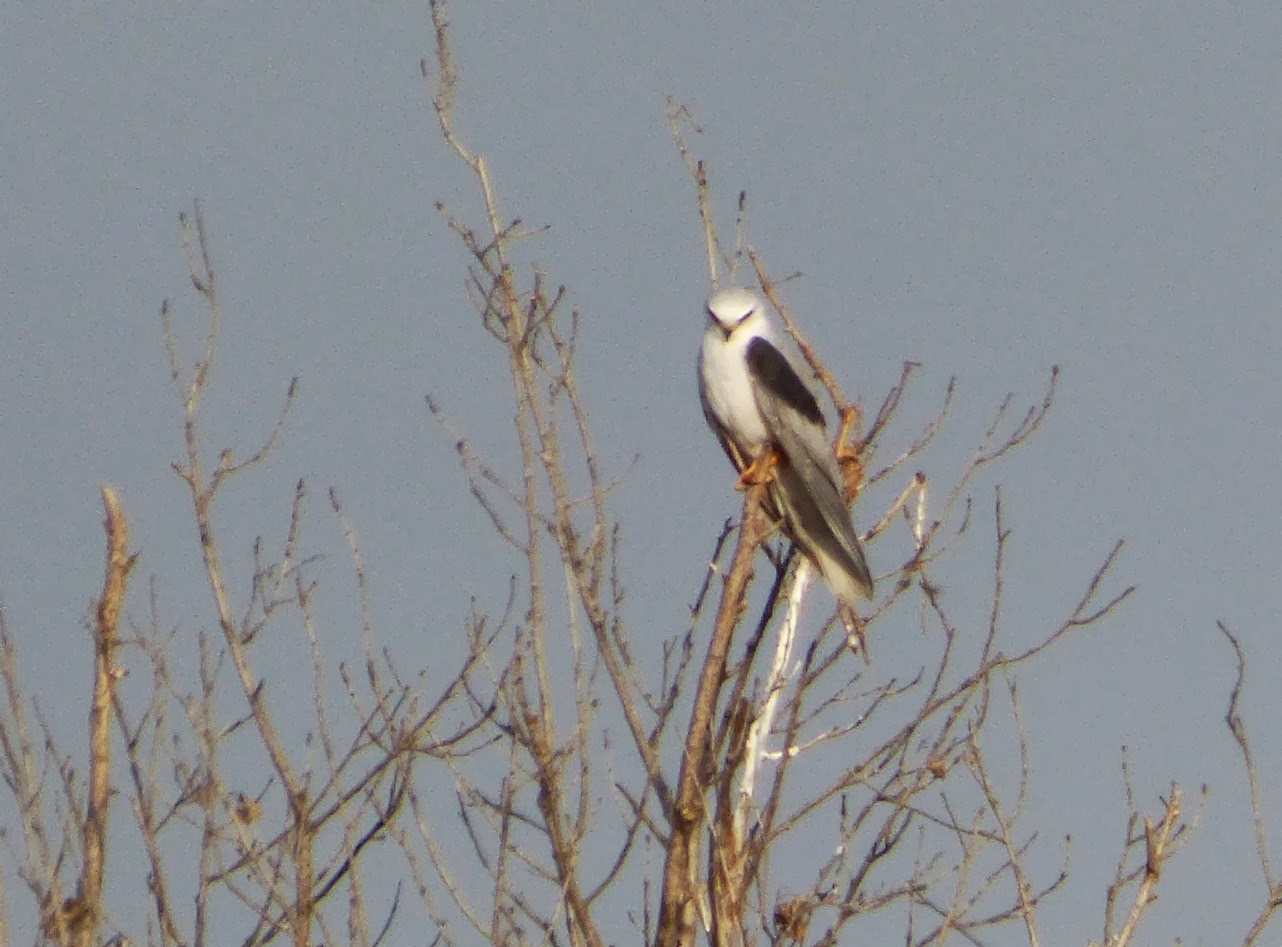
White-tailed Kite (Elanus leucurus)
The caretakers of the refuge are in the process of reconstructing and rebuilding the habitat that existed prior to settlement by Europeans in the 1800s. Floodplains and riparian woodlands are being replanted with tens of thousands of trees, and former wetlands are being flooded regularly in an effort to reproduce seasonal flooding that took place prior to agricultural development. The squarish property/refuge boundaries and canals belie a complete return to a natural environment, but it is a richer environment than existed before.
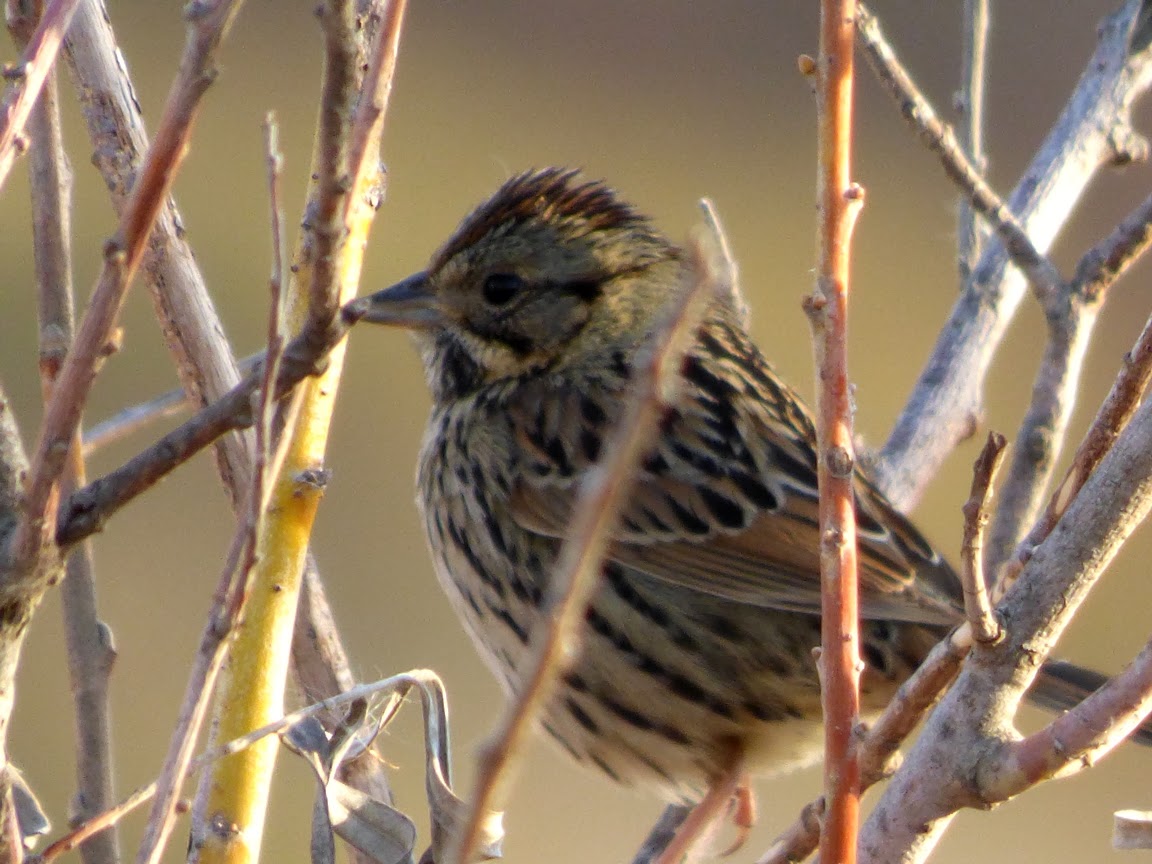
A Song Sparrow (Melospiza melodia), perhaps?
We only had a short time to explore, covering only a mile of trail, and we didn't quite reach the section of the trail that parallels the San Joaquin River. A fair number of bird species were present, and a few allowed us to snap a few shots before they hopped into the underbrush.
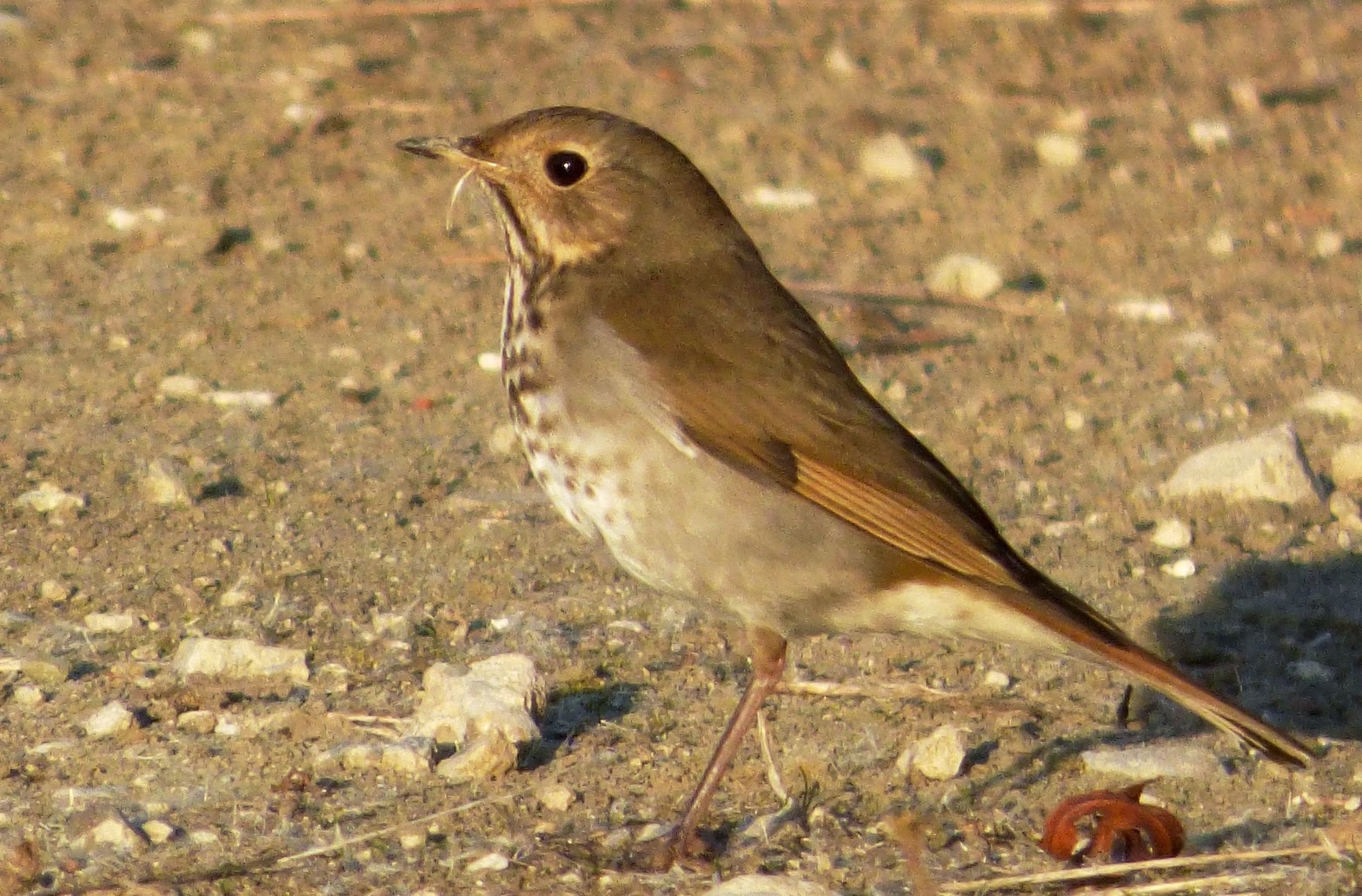
Hermit Thrush (Catharus guttatus)
Being a rank amateur in the birding business, this was the first time I've ever identified a Hermit Thrush. Some people may have hundreds of birds on their life lists, but at least, I have an easier time adding new birds! A gentleman at the wildlife platform on Beckwith told us that dozens or hundreds of birders came out a few weeks back when someone spotted a rare Bunting species next to the platform. Some folks came from out-of-state for the chance to see it.
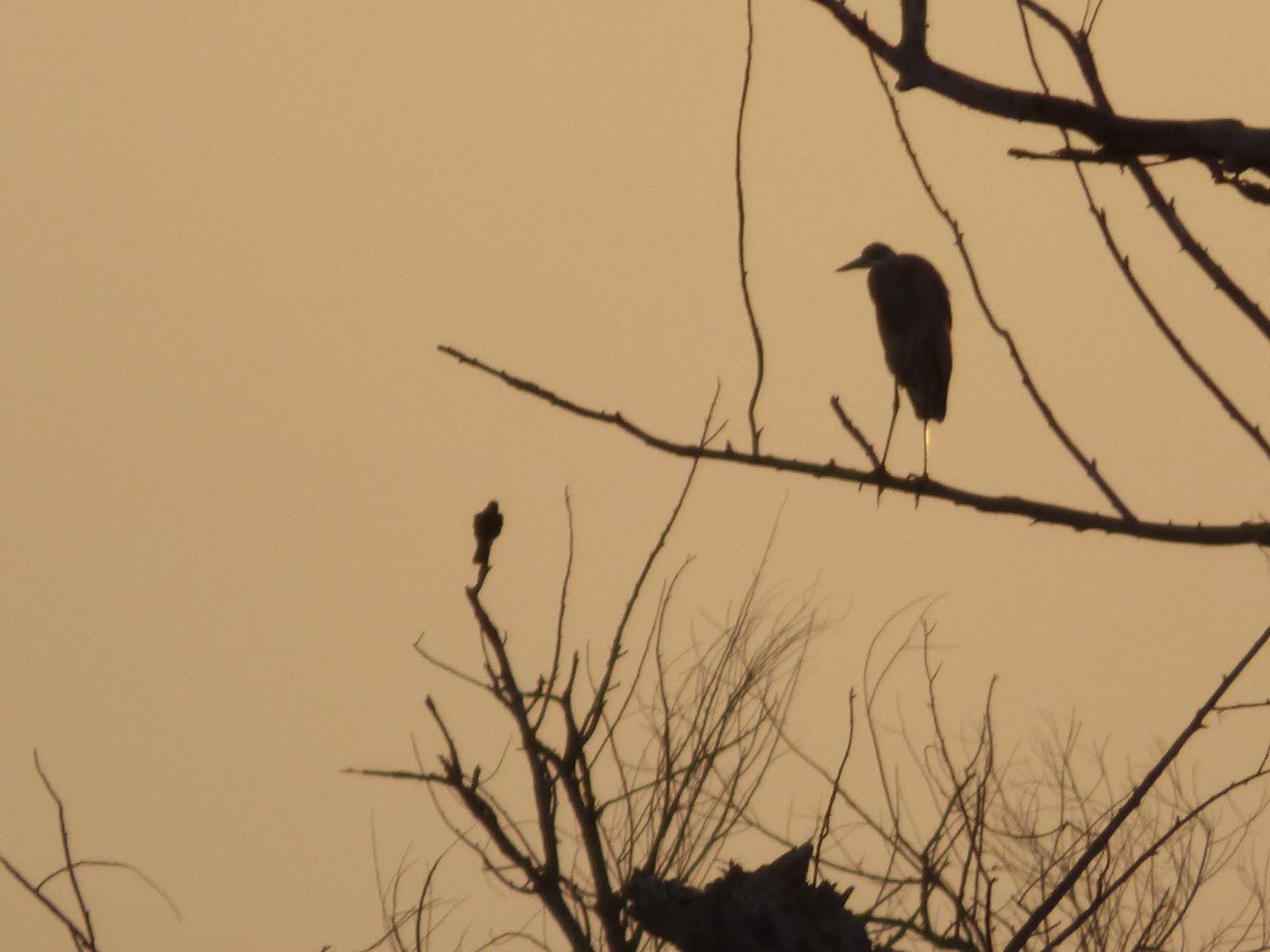
Egret in a tree at sunset

We didn't arrive until around four o'clock in the afternoon, so the sun was sinking fast as we made our way back to the parking lot walking atop the levee that protects some of the regional farmlands from flooding. A thicket of trees and brush kept us from seeing very far, but the chirping and hooting told us that numerous birds were hiding there.


One last Redwing Blackbird greeted us as we got back to the car and headed home. The San Joaquin River National Wildlife Refuge will be on our list for further exploration if the rains ever come and replenish the grasslands!

Sunday, January 19, 2014

Birds of My Neighborhood: Geotripper Finds a Moment of Incredible Majesty Amid Environmental Devastation


A White-faced Ibis (Plegadis chihi) at the Merced National Wildlife Refuge
I wonder if you've noticed an additional aspect to my blogging in recent weeks. It wasn't a New Year's resolution because it started well before Christmas, but I realized that I needed to get rid of a few pounds, so I started walking once or twice a day. When a new and more powerful camera landed in my hands, I realized I could get some decent pictures of the numerous birds species I've been encountering during my explorations along the cow pastures and canal levees that are prevalent in my neighborhood.
A Black Phoebe (Sayornis nigricans) at the Merced National Wildlife Refuge

So I've started blogging bird pictures on occasion, such as here, here, and here (click on the words for the link). Is there a geological link in observing birds? I've decided there is, especially in California's Great Valley. The science of the Earth is eclectic, drawing on many different disciplines, including chemistry, physics, astronomy, oceanography, meteorology, and on occasion, biology (think especially of paleontology). Sometimes there is a direct connection, such as when overgrazing or removal of beavers changes the pattern of stream erosion. And land-use issues are one of those areas where geologists can provide an important perspective.
Artificially flooded ancestral wetlands at the Merced National Wildlife Refuge. These are reclaimed farmlands.

One of the most important land-use issues in the Great Valley involves agricultural and urban development and the conflict it causes with the natural habitat that existed prior to the arrival of European settlers. Some 95% of the valley has been plowed over, and all the major (and most of the minor) rivers have been dammed, diverted, or otherwise changed in the service of agriculture. In more recent years, urban growth has paved over prime agricultural acreage, creating a conflict within a conflict. The ramifications of these conflicts extend far beyond the Great Valley. They reach from the northernmost Arctic wastes to the equator, and into South America. The Great Valley, as it turns out, is one of the most critical stops on the migratory flyway for myriads of bird species. Our choices in the valley determine the health of ecosystems thousands of miles away. And most of the wetlands that made the valley such an important flyway stop were drained and plowed decades ago.
Black-necked Stilt (Himantopus mexicanus) at the Merced National Wildlife Refuge

That is why I am kind of thrilled to be writing today about the bird species of my home turf. I have driven by a couple of wildlife refuges for two decades without stopping (what can I say? I live next to the Sierra Nevada and the California Coast; they are a huge distraction). In the last few months, we've been stopping and having a look, and yesterday at the Merced National Wildlife Refuge I saw an incredible thing.
Great Egret (Ardea alba) at the Merced National Wildlife Refuge

The first thing to realize is that the destruction of wetlands has been recognized for many decades, and for years some visionaries have worked to establish protected wetlands. In some cases they have reclaimed former agricultural acreage in a concerted effort to reconstruct some of the original environment that once characterized the valley. There is now a mosaic of wildlife refuges surrounding my community, lined up like islands in a sea of farms and ranches reaching from one end of the valley to the other (a 400 mile stretch). We can never fully recover what was, and will never see the spectacle of millions upon millions of birds descending on the valley floor, but we can see the tens of thousands of the survivors.
Sandhill Cranes (Grus canadensis) at the Merced Refuge

That's what I saw yesterday. I'm admitting my own stupid ignorance here, but I had no idea that we had an American version of the Serengeti Plains a short way from my house. We've probably all seen television documentaries and footage of vast flocks of birds flying and flocking, but I'd never seen such a thing for myself. We headed out to the Merced National Wildlife Refuge because we'd heard they had flooded the wetlands, and that some Sandhill Cranes might be seen. We saw some cranes, but that's not what I found stunning. It was the Ross's (or maybe Snow) Geese.
Ross's Geese (Chen rossii) and Coots at the Merced Refuge

The Ross's Geese spend their summers in the far northern islands of Canada, and spend their winters in California. As we drove the loop road through the refuge, we could see vast flocks off in the distance, and from more than a mile away we could hear their noise. As we drew closer, we could see that there were thousands of them, maybe tens of thousands (some sources mention 60,000 geese). They were chattering and honking, and it was almost deafening. Then the extraordinary thing happened. There was a hush that made us look up, and then a sound like a jet engine began to roar. The ground actually seemed to tremble. Every single one of the ten thousand or so geese was taking flight at once. In less than 20 seconds they were all airborne. I have no idea what set them off, but it was like nothing I've ever seen in my life.
Ross's Geese taking flight

I got a good video of the event, but the compression process during uploading removes the high definition and makes it hard to easily visualize what was happening. I can only say to try and imagine what this piddly movie is showing, and then someday give yourself the opportunity to visit the wildlife refuge during the winter and see it happening for yourself. It's free!

Try something new each day. Your life will be richer for it!

Thursday, July 11, 2013

Traveling in the Way-Back Machine: The Great Valley as it once was...

Sometimes the interesting revelations just happen. I haven't kept up with the America's Never Never because I was out of town doing something really strange: relaxing. As you might guess from the previous post, we spent a couple of days on the Big Sur coastline simply reveling in the cool air and enjoying a couple of beaches we had never visited before (more on them in later posts). The big surprise happened as we were leaving town: we got caught in a time machine and were transported a few hundred years into the past.
California's Great Valley is one of the most important agricultural regions on the planet. I've lamented a few times on the dreariness of living in the dust, the chemical pesticides, the fertilizers, and the horrible economic conditions (we still have poverty and unemployment at perhaps twice the national rate). But most of all I lament at how much we have changed the landscape, and co-opted the native environment and bent it to our own needs and desires. The California Prairie-lands barely exist anymore. When I've written on them in the past, I've explored the edges, the Sierra Nevada foothills where the soils are poor and therefore undeveloped except as grazing lands. In the interior parts of the valley, though, little of the original landscape remains, less than 5%.
 On our way to the coast, we discovered that it isn't all gone yet. Our route, Highway 165 south of Turlock, took us through the San Luis National Wildlife Refuge. The preserve covers 26,000 acres of San Joaquin River wetlands, grasslands, and vernal pools. We've always been in a hurry before, but not on Sunday. We saw a sign for an auto-tour route through part of the refuge, and we pulled off.
It truly was taking a time machine into the pre-European invasion of the Great Valley. The scene was peaceful, where the cacophony of bird calls almost drowned out the distant noise of highway traffic. One could look past the grasslands to the distant Coast Ranges and get a feel, if only for a moment, of how the valley once was. We actually stopped at the refuge twice, at mid-day on Sunday, and at sunset on Tuesday.
It would not be correct to say that we were standing in the middle of a pristine wilderness. Much of the land we were exploring was probably used for grazing and planting in the past. Many of the grasses are no doubt invasive species. And the water flows are managed. The administration of the wildlife refuge is attempting to maintain the wetlands and increase their area to reclaim a portion of the vast migratory flyway of California that has been co-opted in so many other parts of California. They are trying to restore some semblance of balance to the local ecosystem, because it has influences that stretch for thousands of miles from Central America to the Arctic. Untold millions of birds (and numerous other species in the ecosystem) are affected by our choices.
The heart of restoring this landscape is the San Joaquin River. For decades, long stretches of the river on the floor of the Great Valley were dry because of upstream diversions for irrigation. The last few years have seen a restoration of minimum flows of the river through the refuge, in part to reclaim wetland environments, and an effort to restore salmon habitat. It was good to see a river at work again for something besides an agricultural baron.

We'll be back. There are several other auto tours, including one that offers possible views of a tule elk herd, and a number of hiking trails. It's always a pleasure making new discoveries in one's back yard!