Showing posts with label San Luis National Wildlife Refuge. Show all posts

Saturday, October 14, 2023

A Great Valley View of the Eclipse

Today's eclipse at the greatest coverage of the Sun, about 80%

There was an eclipse today! This is perhaps not entirely news to my North American readers, as the eclipse was visible to some extent across the entire United States. The eclipse was not a total eclipse, as the Moon was farther from the Earth, and could not completely cover the disk of the Sun. This is called an annular eclipse. Those on the main path of the eclipse were treated with the "ring of fire" effect, as the edge of the Sun formed a perfect ring around the Moon. I didn't have the opportunity to be in that area, so I've settled for the "near miss" of about 80% coverage of the Sun.

To see the eclipse, one needed merely to go outside and hope it wasn't cloudy, but Mrs. Geotripper and I wanted to make the day a bit more special, so we headed out to the San Luis National Wildlife Refuge where we could see things in a setting resembling the primeval environment of California's Great Valley. We got to observe some of the early-arriving migrant birds like the Sandhill Cranes, Greater White-fronted Geese, and Snow Geese.
Sandhill Cranes at the San Luis National Wildlife Refuge

We were a bit curious if the bird behavior would be affected by the darkening skies, as sometimes happens with total eclipses, but we didn't notice anything unusual.

The entire affair unfolded over about two hours, so we drove the auto-tour route at the refuge, stopping to take pictures of the progress every fifteen minutes or so. This was far less stressful than my two experiences with total eclipses when totality lasted only a few short minutes, and much had to happen to get pictures. Our experience with the total eclipse in 2017 was stressful (and crowded), yet spectacular. Today was peaceful and we had the refuge to ourselves.
The sky must have darkened when 80% of the solar disk was covered by the Moon today, but it wasn't really noticeable. It happened so gradually. When we experienced a total eclipse in Baja in 1991 (see the pictures and story here), at totality the sky turned dark as night, stars became visible, and the temperature dropped around 20 degrees in mere moments. 
As the last hour progressed, more and more of the Sun became visible, and soon it seemed like a relatively normal day. The dragon had not consumed the life-giving Sun, and life could go on!


Saturday, January 1, 2022

For a Coming New Year of Challenges: River Otters!

There are so many challenges coming in this new year and the years that follow. Dealing with the worst pandemic in a century, protecting our democracy, and above all, working to mitigate the effects of climate change and global warming. Those of you on the front lines: you are making a difference. You may feel like you are burning out, but hang in there, and take a short sanity break. Here is something to help: River Otters (Lontra candensis).


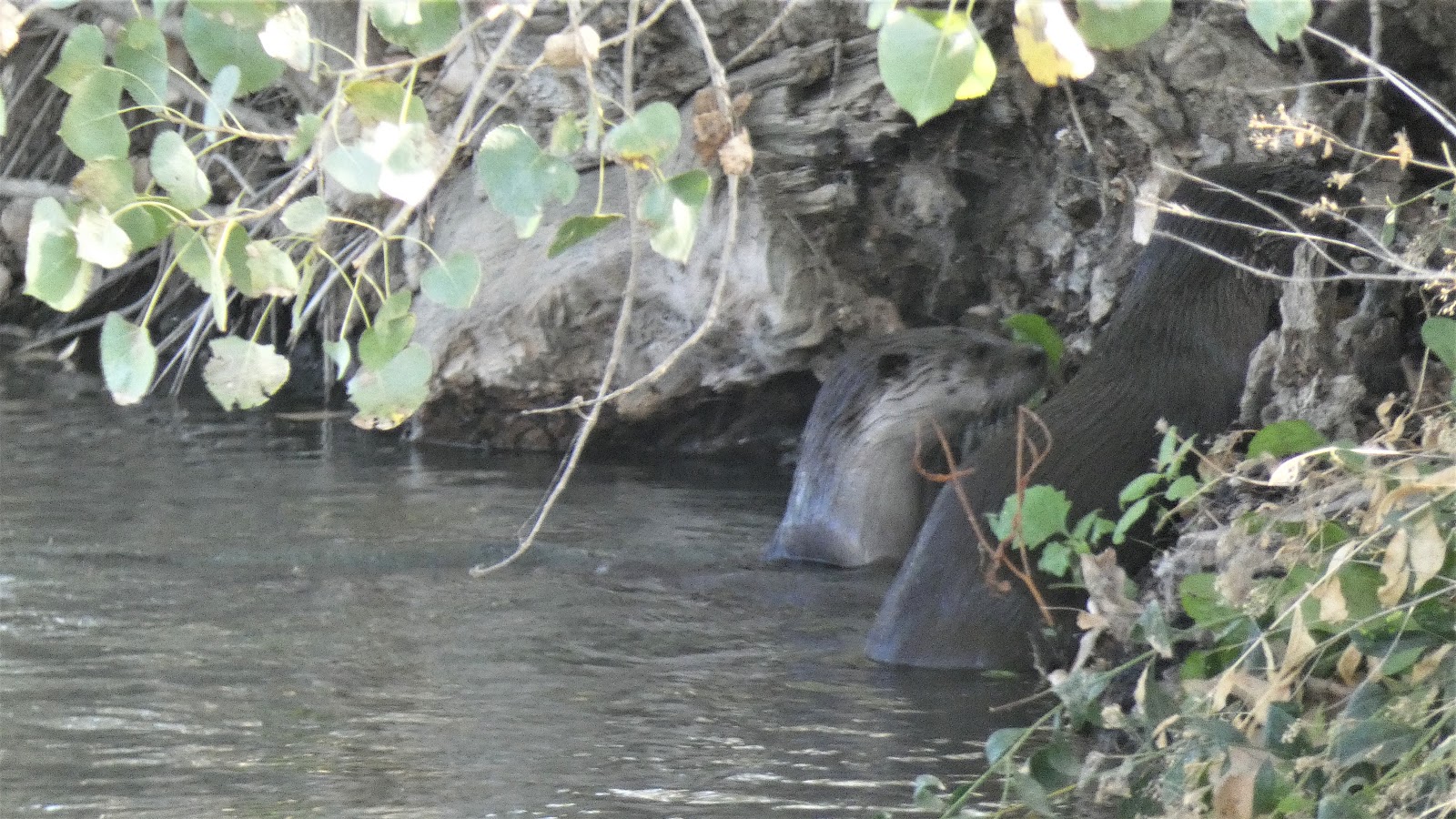
We were towards the end of the Waterfowl Auto Loop at the San Luis National Wildlife Refuge, and I saw something dive into the algae-covered slough. Sure enough a fur-covered head popped up, and then another. They seemed as interested in us as much as we were in them. So here is a 90-second moment of Zen for a New Year. I hope that yours is as good a year as possible in challenging times.

Saturday, October 9, 2021

The Prairies of California: the Most Extraordinary Landscape (and Ecosystem) in California

The Tuolumne River on the east side of the Great Valley

I admit this statement is a hard sell, especially among those who live here, but hear me out: the Great Valley prairie is the most extraordinary landscape and ecosystem in California

The Great Valley prairie remnant east of Modesto

"But", they will say, "the valley is boring. It is just one long flat plain full of farms, feedlots, oil derricks, and urban hellscapes. It's dusty and the air is bad. And there is nothing to do." And from their point of view, their statement is valid. But that's not the part that I am talking about. I'm talking about the valley that once was, and more importantly, the 5% of the valley that is not given over to agriculture and urban development. It is that small bit that teaches us what once was. 

I was thinking a lot about the original valley today.

Prairie and wetlands at the San Luis National Wildlife Refuge south of Turlock

The occasion was World Migratory Bird Day, Global Bird Weekend, and eBird's October Big Day. The purpose of the day is to gain a one-day snapshot of the world of birds, and birdwatchers all over the world contributed observations. For myself, I decided I wanted to capture as much of the primeval Great Valley prairie as I could, so I selected three habitats for the day: the valley wetlands and marshes, the riparian environment, and the dryland prairies that once filled the spaces between the rivers and wetlands. In the end Mrs. Geotripper and I explored the Merced National Wildlife Refuge and the San Luis National Wildlife Refuge, and in the afternoon I walked the Tuolumne River Parkway Trail (as I often do). As the sun began to set I took a drive through the prairies between the Tuolumne and Stanislaus Rivers east of Modesto. In all we saw nearly 60 species of birds.

One of the most extraordinary facts about the prairie lands of California is that they ever existed at all. The Great Valley is 400 miles long and 30-40 miles wide, and with the exception of a single volcanic center at Sutter Buttes, is as flat as any place on Earth. The entire American West is characterized by rugged mountainous topography, including the Coast Ranges and Sierra Nevada of California between which the Great Valley is sandwiched. Such a large mostly flat region is akin to finding a serene quiet lake surface in the midst of an intense hurricane.


The origin of the Great Valley lies in the violent tectonics of the subduction zone that existed off the coast of California for at least 200 million years. A region of oceanic crust was being driving beneath the western edge of the North American continent, forming a trench and a deformed mass of sediment called an accretionary wedge. Parts of the accretionary wedge were buoyed upwards to become the core of California's Coast Ranges.

As the slab of ocean crust sank into the Earth's mantle, portions of the plate melted and formed vast plutons of magma that melted their way through the overlying continental crust, forming an extensive volcanic chain called a magmatic arc. The deeper parts of the magmatic arc eventually cooled to become the granitic rocks of the Sierra Nevada.

Between the geologically violent wedge and arc though was a shallow sea that simply collected sediments washed off the land. This sedimentary trough is known as a forearc basin. As the sediments accumulated, they pressed the crust downwards, providing room for additional sediments. Eventually these silt and sand layers reached a thickness of 25,000 feet or more. These sediments became the floor of the Great Valley.

Source: National Park Service

The valley was below sea level for most of its first 140 million years, but in the last four or five million years the floor of the valley was lifted slightly above sea level to become the plain it is today. It is dry in large part because the adjacent Coast Ranges act as a barrier to incoming storms from the Pacific Ocean. It is literally a desert in the southern portions from Fresno to Bakersfield, but the dry plain is crossed by numerous rivers flowing out of the Sierra Nevada.

In antiquity the valley was a vast prairie, a grassland stretching 400 miles from what is now Bakersfield to Redding. The drylands were broken up by a system of rivers, marshes and wetlands that supported groves of oak, cottonwood, and sycamore and vast thickets of willows and shrubs. These plants supported a rich fauna.

Until roughly 12,000 years ago, the prairies were populated by millions of grazing animals including horses, camels, deer, elk, bison, and even elephant species like mammoths and mastodons. This megafauna was preyed upon by a terrifying roster of predators including saber-tooth cats, 
lions, cheetahs, dire wolves, and bears, including the California Grizzly and the even larger short-faced bear. The cause of the extinction of most of these species is still debated, but the prime suspects are climate change and overhunting by newly-arrived humans. A minority view argues for an asteroid impact that primarily affected North America.

Sandhill Crane and Great Egret at the Merced National Wildlife Refuge

In the aftermath of the extinctions, the valley still supported a robust ecosystem. The mild winters provided shelter for millions of migratory birds, and the grasslands were grazed by elk, deer, and antelope. Predators included wolves, coyotes, foxes, mountain lions, and bears. The Tule Elk were thought to have been hunted to extinction in the years after the Gold Rush, but a small remnant of the species survived on a single ranch at the south end of the valley. The California grizzly and wolves were eliminated in the early 1900s. 

Tule Elk bull at the San Luis National Wildlife Refuge. We didn't see any today so I borrowed a shot I took in 2016

Today the remaining original prairie and wetlands environments are present due to sheer luck, and from concerted efforts by many environmental organizations and government agencies. A series of national wildlife refuges have been established like a string of pearls up and down the valley to provide habitat for the millions of migrating cranes, geese, swans and other species.

The White-faced Ibis is a tropical species that looks almost black until the sun shines on the iridescent feathers. The white face appears in the breeding season.

Some grass prairies are preserved in state parks and national monuments (most notably Carrizo Plains National Monument). But most persist because they are on cattle ranch property. These private lands are threatened by the rapid expansion of almond groves into the foothills. In my county alone, tens of thousands of acres have been planted, with no secure irrigation sources for the thirsty trees. I'm pretty sure they'll be abandoned within a decade or so as the groundwater they are using dries up.

Dry Creek, shown here, has earned its name this year, although it is capable of serious flooding in wet years. An invading and misguided almond orchard can be seen at upper right.

The riparian habitats have their own problems. The river woodlands are among the least-affected environments as attempts to develop them as farmlands tended to fail because of repeated flooding. Still, much damage was done in the attempt, and current efforts are directed at replanting native species in floodplains that have reverted to government or conservancy ownership.

The Tuolumne River near the Sierra Nevada foothills.

It is the rivers themselves that face the biggest challenges. There is no more contentious issue in the Great Valley than water use and distribution, especially in severe drought years. All of the major rivers are dammed and strictly controlled except for the occasional exceptional flood. The Tuolumne has been kept at a minimal flow, enough to maintain a string of river water into the delta. The slow-moving water is subject to warming to a dangerous level for river species, and the expansion of invasive species like river hyacinth. Through it all the river is a beautiful walk at all times of the year.

Sandhill Cranes at the San Luis National Wildlife Refuge

It was a serene day, but it was also the calm before the storm. The migratory birds are beginning to arrive in greater numbers, and soon these pools will be filled with Snow and Ross's Geese, Tundra Swans, and Aleutian Cackling Geese. There is nothing quite like seeing a flock of 10,000 geese take off all at once. It becomes so easy to imagine what once was in this most extraordinary place.

Saturday, February 1, 2020

Pictorial Celebration of Wetlands Day: the Great Valley of California

Sunset at the San Joaquin River NWR near the Beckwith Road Viewing Platform
Before going any farther, please go over to Siera Nystrom's wonderful blog Natural History Journal for this excellent piece on World Wetlands Day, which is on February 2. She's delivered an excellent review about the meaning and value of wetlands to all of us.

Really! Go read it first!....okay, are you back now?
Snow and Ross's Geese taking flight at the San Joaquin River NWR
I wanted to add my own celebration of wetlands here at Geotripper because I happen to live adjacent to some of the most important wetlands in the world, and those wetlands are under attack. The Great Valley of California is to many a featureless plain 400 miles long that is covered by millions of acres of agricultural lands. That's true, but that reality obscures an even more important reality: the Great Valley is a critical and priceless link in the Pacific Migratory Flyway, and as such it provides shelter and food to millions upon millions of bird species who travel the region with the seasons.
Snow and Ross's Geese at the San Joaquin River NWR
95% of the original prairies and wetlands have been converted to agricultural development, but the 5% that remains includes critical habitat for these birds, preserved as a string of wildlife refuges and parks along the length of the valley. It's not enough, but over time as some farmlands are retired, the acreage for the birds slowly increases. There are a number of National Wildlife Refuges that I visit on a regular basis. The first, shown in the first four pictures above, is the San Joaquin River National Wildlife Refuge.
Aleutian Cackling Geese and Snow Geese at the Beckwith Road Viewing Platform
The refuge has two principle areas where observations and exploration are possible: a viewing platform at the western end of Beckwith Road about 7 miles west of the town of Modesto, and the Pelican Trail, a 4.5 mile long loop trail along the San Joaquin River south of Vernalis and Highway 132. The principle attraction during the winter are the huge flocks of Aleutian Cackling Geese (much or most of the world's population of the species), and tens of thousands of Sandhill Cranes, Snow Geese, Ross's Geese, and Greater White-fronted Geese. The diverse environments within the refuges support nearly 200 species of birds along with the mammals, reptiles, fish, and amphibians that form the complex web of life along the rivers and marshes.
Merced NWR at Sunset


The other main complex is the San Luis National Wildlife Refuge, which has several units along the San Joaquin River south of Turlock. The refuge includes the main San Luis refuge and Tule Elk Preserve, along with Bear Creek Unit and the Merced National Wildlife Refuge.
Sandhill Cranes at the Merced NWR

The Merced Unit is home to well over 200 species of birds, which in winter includes tens of thousands of Sandhill Cranes and Snow/Ross's Geese. There is a six mile auto tour that allows visitors to see vast numbers of birds in seasonal and permanent ponds. We were there on Friday for a few hours and recorded nearly fifty bird species, including my first decent pictures of a Common Yellowthroat (not so common for me!).
Common Yellowthroat at the Merced NWR
Along most of the tour visitors remain in their vehicles, which thus act as a sort of blind. Because of this, birds often remain close to the road and it is possible to get some extreme close-ups of some very colorful birds like those seen below. There are also three short hiking trails where one can stretch legs and get a chance to hear the quieter and more well-hidden bird species.
Gadwall at the Merced NWR
The main part of the San Luis NWR has two major auto-tours and an extensive new visitor center, along with a variety of hiking trails. A major attraction is the Tule Elk compound, a square mile area where the elk are free to roam about. Visitors can follow a road that completely surrounds the compound.
Tule Elk at the San Luis NWR

The Tule Elk have a tortured history in California. They are a distinct subspecies of the elk clan, native to the state. They were one of the most abundant large grazers on the California prairie prior to the arrival of European colonists, with numbers estimated at about 500,000. They were hunted literally to oblivion, and when hunting of the elk was outlawed in 1873 they were thought to be already extinct. A small number, either two or four according to the story, were found on Henry Miller's ranch in the south San Joaquin Valley, and Miller undertook to protect them. They hovered near extinction for the next several decades, but preserves have been established around the state and the herd has reached a population of more than 5,000 individuals. They are still threatened by lack of  genetic diversity, given that they are all descended from a single pair or two.
American Wigeon
The second auto-tour at the San Luis NWR, the Waterfowl Route, is a fascinating journey through a land that closely resembles the primeval appearance of the Great Valley, with stretches that include open prairie, marshes, and riparian (river) habitats. We see all manner of raptors such as Northern Harriers, White-tailed Kites, Red-tailed Hawks, and Great Horned Owls. There are thousands of geese, swans, ducks and coots in the ponds and marshes, and we've seen Muskrats, River Otters, Raccoons, Deer, and Coyotes.
Ruddy Duck at the Merced NWR
There is a less traveled part of the San Luis NWR called the Bear Creek Unit, accessed off of Highway 165 south of Turlock and Hilmar. There is a short two-mile auto-tour and two trails, but birders have only made about 150 reports there compared to over 1,000 at the Waterfowl Route, and more than 2,000 at the Merced NWR.
Green-winged Teal at the Merced NWR
The ponds are often dry and the birding can be sparse, but when the ponds are full there are thousands of Red-winged Blackbirds, and it is the only reliable spot where I've found Yellow-headed Blackbirds. These birds are incredibly beautiful to photograph, but their call is not nearly so attractive. To me it sounds a lot like scraping metal!
Yellow-headed Blackbird at the Bear Creek Unit of the San Luis NWR
There are other areas throughout our region that I have not had a chance to explore yet, including the Great Valley Grasslands State Park, the Kesterson Unit of the San Luis NWR, the Los Banos Wildlife Management Area, and the Merced Vernal Pools and Grasslands Reserve. Life is so short!
American Avocet at the Merced NWR
Unfortunately, in the midst of a celebration of the diversity of life and an appreciation for the beauty to be found in our wetlands, there is a tragic reality: our government is in the hands of those who see protection of wetlands as an impediment to their quest for profits, and that government is actively seeking to destroy our precious remaining wetlands in the name of unconstrained development. They literally want to poison our water for the sake of monetary gain.
Great Horned Owl at the Merced NWR

You can read some of the details in this article, but here is the main takeaway...

This sickening gift to polluters will allow wetlands, streams and rivers across a vast stretch of America to be obliterated with pollution," ... "People and wildlife need clean water to thrive. Destroying half of our nation's streams and wetlands will be one of Trump's ugliest legacies. We'll absolutely be fighting it in court.
After so much that has been lost, especially here in California, and here in my home in the Great Valley, I am sickened at heart that men so craven have been allowed to destroy so much that is good. I hope you can appreciate the incredible legacy we have in our valley, and that you might become part of the fight to preserve the small parts that remain.
Sunset at the Bear Creek Unit of the San Luis NWR

Sunday, November 3, 2019

A Bit of "Where's Waldo the River Otter?" at the San Luis National Wildlife Refuge

There are things in my life that are more thrilling than spotting River Otters (Lontra Canadensis), but there are not many of them. I spend a lot of time on the Tuolumne River where it flows through my town, and also at the local national wildlife refuges, including the Merced, the San Luis, and the San Joaquin. I'm usually searching for birds, but a bit of my attention is always watching for rarely seen mammals like beavers, foxes, and especially River Otters.
We were on the eastern leg of the San Luis NWR Waterfowl Auto-Tour when I spotted what I thought were four ducks bunched together. But they didn't look right, and after a moment I realized that it was a family of River Otters playing on the banks of the irrigation canal. We played a brief game of hide and seek (I mostly hid behind the car), and they eventually swam away downstream (down-canal?).

Most of the time I forget that I have a fully functional video with my camera, but I thought of video first this time around and got a short shot of the family swimming away together. Then I snapped pictures as I could in the dim shadows where they were hiding. What I noticed later is that in each picture of an individual, there was actually a second otter photo-bombing the shot. Can you find the extra otter in each picture?

River Otters in California took a real beating over the centuries of European occupation in California, with trapping and destruction of their habitat by gold mining, damming, and urbanization causing a drastic drop in their population and range. With efforts at reclaiming the river environments in the Bay Area and Central Valley, they have begun to spread out again. A pair of otters was even seen in Yosemite Valley a year or two ago.

I've seen otters on a number of occasions on the Tuolumne River, but this was my first sighting at the San Luis refuge, which is part of the San Joaquin River drainage. The river had been decimated by reservoir construction decades ago and the river was dry for many tens of miles in the San Joaquin Valley, but recent agreements have resulted in a new river, with the potential of even the return of the salmon. The otters will surely follow!

Monday, April 2, 2018

A Shaggy Sheepdog Story for an April Fool's Sunday

This was just a little fun I had today, although I had a moment of worry, wondering about the wrath of a wary guard dog. We've visited the San Luis National Wildlife Refuge several times in the last few weeks. The refuges seek to maintain an environment conducive to the survival of the native birds and other animals of the Central Valley. Unfortunately over the years, many of the native species have disappeared or have been displaced. This is especially true of the big grazers. The valley once hosted mammoths, mastodons, bison, horses, camels, and pronghorns.
So the rebuilding of the natural grasslands involves returning native species of grass, and to the extent possible, the return of larger grazing animals. The managers will often allow the limited grazing of the prairie by domestic sheep and cattle. We've been seeing a herd of sheep on our recent visits. We haven't seen the human shepherds, but we've noticed the herd's protectors: some rather large sheep dogs. I think they are a breed called Maremma or Great Pyrenees.
And the sheep do need protection. Their natural defensive nature has been largely bred out, and they don't really know how to face down predators like the coyotes we've seen in the vicinity of the sheep herds.

So, we were there again today, enjoying the beautiful spring weather and the birds, and even a few newly born lambs in the sheep herd. We got to the southeast corner of the Waterfowl Auto-tour, and found out that the sheep dogs recognized us as a possible threat to the sheep. They actually jumped a fence, slogged through an irrigation canal, and loudly barking and growling, chased our car down the road to the Souza Marsh. They finally seemed to lose interest and fell behind. We parked and I walked around for a few minutes. Then I turned to walk back to the car...and came face to face with a very large sheep dog! Those crafty little beasts had snuck up on us and had me trapped in the open.
I actually got bit by a panicked dog a couple of weeks ago, so I was painfully aware of what a dog bite can feel like. I was more than just a little nervous. Luckily, Mrs. Geotripper was already in the car, but I was frozen in place. I finally realized they weren't barking, just watching. I walked slowly to the car. The dogs allowed me to get in the car without making a sound. And then: they herded us out of the marsh and away from the sheep flock, with one dog on either side of the rear of the car. Not a growl or a bark between them. They walked us almost a quarter mile in a highly disciplined manner.

I fear for the well-being of the coyote who decides to go up against them.

So, there you go for an April Fool's Day, a shaggy dog story, but without the painfully stupid pun at the end. At least none that I could think of in the spur of the moment.

Monday, March 19, 2018

Mrs. Geotripper Faces Down the Wolf: Musings on the Canids of the Great Valley

Note: I know this is a coyote, not a wolf. But read on to see why I used the term
They've always been here.

They've always been here, even though we declared war on them, and have tried to exterminate them out of existence. No doubt they're been preying on our chickens, our sheep, our calves, or whatever, but they were here first and we were the interlopers, the invasive species. We came and plowed under the prairies and river floodplains that were the ancestral homes of these creatures.
Photo by Mrs. Geotripper
They've been here ever since the prairie rose from the sea sometime in the last 10 million years. At that time, volcanoes still erupted at the crest of the Sierra Nevada, sending lava flows and volcanic mudflows (lahars) down the western slope. The rock layers today are called the Mehrten Formation, and those rocks are the focus of a study published this week by among others, my colleague at CSU Stanislaus Julia Sankey, and a former student of mine, Jake Biewer. They were looking at the fossil canids reported from the Mehrten, and their work shows that the ecosystem at that time included at least four dog ancestors. There were two borophages (a primitive "bone-crushing dog" that is now extinct), an ancestral fox, and Eucyon davisi, a canid that is considered to be an ancestor of today's coyote.

During the ice ages, the ecosystem was dominated by Dire Wolves and Sabertooth Cats, but fossil discoveries show that the coyote was present as well 700,000 years ago. The big wolves and sabertooths could attack and take down the large grazing animals of the time, the camels, horses, and bison, but there was always a place in ecosystem for the smaller predators that could live on rabbits, rodents, and large birds.

At the end of the last ice age (or with the arrival of humans; there is a debate), the megafauna, the large grazing animals like the bison, the mammoth, the camel, the horse, and the sloth went extinct. Deprived of their prey, the large cats and Dire Wolves also disappeared into oblivion. But there was always a place for the coyote, and they prospered in the newly changed world. As humans moved into their environment, they adapted, and have continued to survive despite the war against them waged by ranchers.

So this thing happened today. Mrs. Geotripper and I were doing something we love, exploring the local wildlife refuge (the San Luis National Wildlife Refuge Waterfowl Auto-tour). We were looking for birds as we usually do, but I had just seen the article about the canids, and so I was also watching the prairie for coyotes (or foxes, I wasn't being choosy). And we saw one! It was wandering the grassland, and stayed close enough that we got pictures and video (below). We drove on. Towards the end of the auto-tour there is a hiking trail to a viewing platform. We got out and walked the trail.

Mrs. Geotripper and I have opposing methods of seeking birds. I like to cover as much ground as possible, constantly moving, while she prefers to remain stationary, letting the birds come to her. Both strategies work for us, and we usually get a different set of bird discoveries. So it was that she was situated on a folding chair at a bend in the trail, and I was a quarter mile away at the viewing platform. We were sort of nonplussed at a sign at the trailhead warning of Mountain Lion sightings, but we had phones so we could stay in touch.

I was up on the platform and was startled, yet pleased to see a coyote go loping by at a fast pace. I'm not even sure it saw me, because it never looked my direction. I snapped some pictures, including the ones above and below, as well as the opening picture at the top of the post. I paused and realized the animal was headed down the road towards Mrs. Geotripper's viewing spot, so I figured I would text her a warning. It read (and I quote): "Coyote might be running your way".

She didn't get the text.

The coyote was faster than my fingers and the mysterious ether of the internet, and so from Mrs. Geotripper's point of view things were a little different. She was photographing a Spotted Towhee, (and thinking just a little bit about mountain lions), when she heard something running through the underbrush. She thought "rabbit", but realized it was bigger. Much bigger. And it was coming closer and closer, and she couldn't see it.

Meanwhile, the coyote was taking a shortcut, probably one that it always took, and wasn't really on the hunt, so it wasn't trying to be stealthy. It was just in a hurry to get to wherever it was going, and it ran into the clearing that it always ran into. And found a large creature in the way.

Both of them were too shocked to react for several seconds, but to Mrs. Geotripper's credit, she didn't scream or panic. She just stared, uncertain what the heck to do next. Luckily, the coyote blinked first and ran down the road as fast as it could go. And then Mrs. Geotripper heard her phone ping with the message I had just sent.

She and I had just encountered a bit of the ancient world that existed long before we did. The wolves and coyotes (and domestic dogs) are closely related creatures, and are even capable of interbreeding. That gives them an incredible advantage in a changing environment, whether rapid climate change like the ending of an ice age, or the invasion of their lands by a new species that is as intelligent and crafty as they are. They can adapt quickly, and that's how they have survived for millions of years against many challenges.

Reference: Balisi, M., X. Wang, J. Sankey, J. Biewer, and D. Garber. 2018. Fossil canids from the Mehrten Formation, Late Cenozoic of Northern California. Journal of Vertebrate Paleontology. DOI: 10.1080/02724634.2017.1405009.