Showing posts with label Black Bear. Show all posts

Friday, August 7, 2020

The Way it Was: Yosemite in the Times of a Pandemic

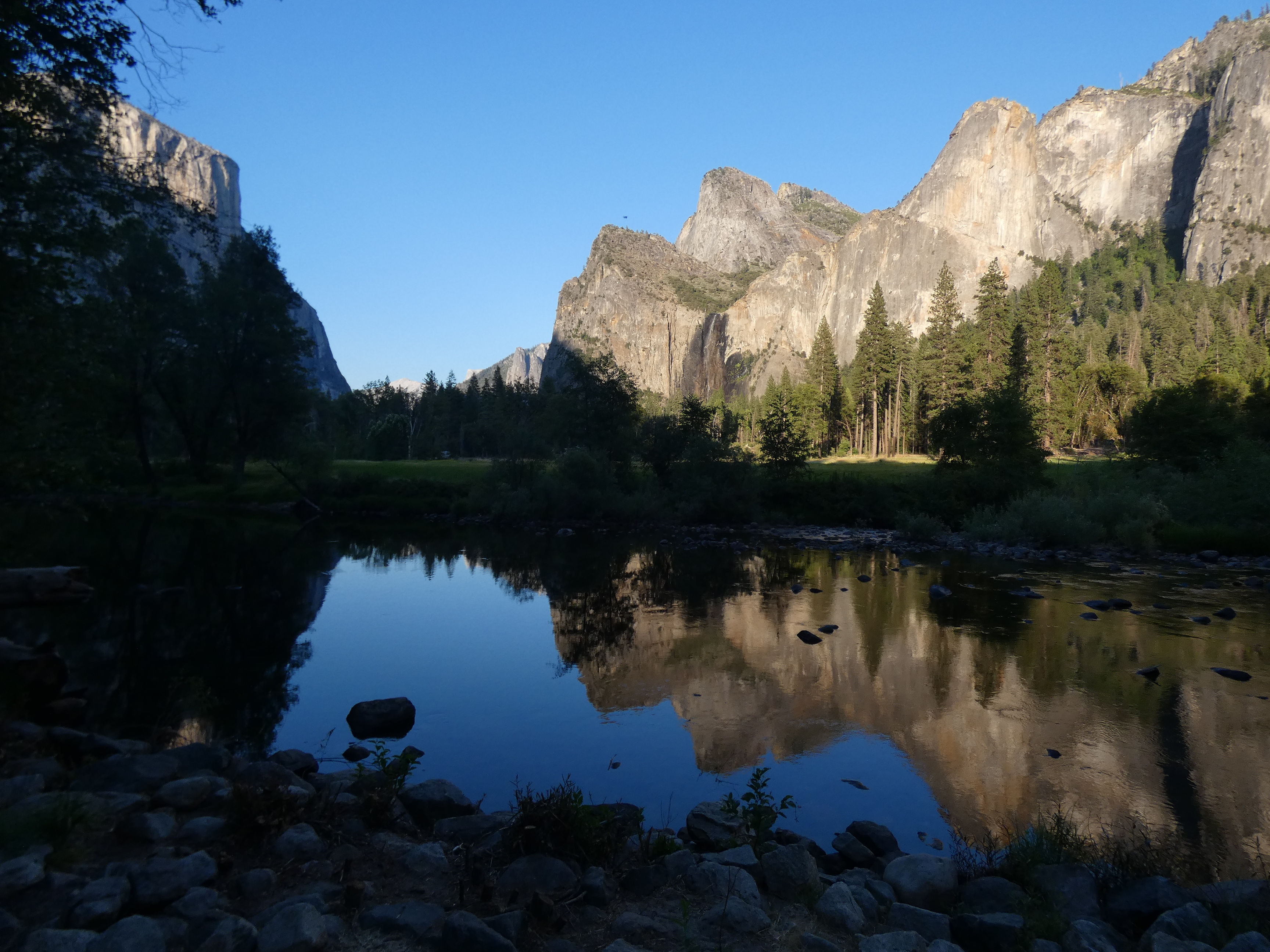
Tunnel View, close to the spot where the valley was first "discovered" by European colonizers

The pandemic rages on, and our lives have been upended in so many ways we could never have foreseen. My heart goes out to all of those whose lives have been devastated, whether by disease, unemployment, or fear. We've been fortunate so far, and we've been careful to stay out of harm's way, staying home for the most part, wearing masks in public, and always the social distancing. 

I walk along my river almost every day to maintain sanity and health, but except for a single short excursion up north for my grandmother's funeral, we've not been out of our county since March. But this week I went online and scored an E-ticket (you have to be an older person to understand that reference): a reservation for entry into Yosemite National Park.
The park has been trying to deal with two opposing directives: opening the park as much as possible, and maintaining some degree of safety in trying to prevent the spread of the coronavirus. They settled on limiting the number of visitors by instituting a reservation system (info at reservation.gov). The goal is to have the park at about 50% of usual visitation. 80% of the reservations are available a month in advance, while the other 20% come available two days before the visitor's arrival. That's the ticket I was able to get.
We headed up as early in the day as we could, intensely curious to see what things would be like. And out of the 100+ journeys we've made to the park in the last 30 years, it was unusual to say the least. There was a long wait at the entrance station like usual, but reason was different. There were fewer people, yes, but it took longer to confirm everyone's identity (the reservations aren't transferable). Once inside the park, the transformation was remarkable. There was very little traffic on the road, and there were spots available in every parking lot that we could see. The lot at Tunnel View (the top picture in this post) was only half full. And no buses were idling.
We headed up Glacier Point Road and had a long lunch at Summit Meadow, and we had it almost entirely to ourselves (admittedly not one of the 'destination spots' for visitors, but still...). We stopped at the nearly empty parking lot at Washburn Point, and then headed to Glacier Point, which was also only half full. It seemed a different world than from our 'normal' Yosemite experience. The picture below of Glacier Point was not cropped to remove people; that's how many were actually there.
After so many months of sheltering in place, it felt so good to get out of the valley and see the high country of the Sierra Nevada. We've missed it so much.
We drove back down to the floor of Yosemite Valley and found the valley to be equally devoid of crowds. There were a few gatherings near the taco trucks that are serving as food purveyors while parts of Curry Village are renovated. But again, most of the lots were uncrowded. The afternoon shadows were lengthening as we passed Sentinel Bridge and Lower Yosemite Falls (the merest trickle in this dry year), and we made our way down to Valley View.
When Yosemite Falls is dry, Yosemite Point takes on an entirely different perspective. It's the prominent cliff that is still lit by the sun on the right in the picture below. Yosemite National Park is like that...there are those most famous cliffs like El Capitan and Half Dome that dominate people's experiences, but there are dozens of lesser-known rock cliffs and spires that in any other place would be national parks and monuments in their own right.
The Cathedral Rocks are one of those cliffs. They are the incredible cliffs in the picture below. They are behind you when you stare up the vertical face of El Capitan. I don't recall ever seeing them on the t-shirts and coffee mugs in the curio shops (although I don't spend a lot of time in the shops when I'm in the valley).
We made our last stop at Valley View where we could enjoy the evening light on El Capitan, Bridalveil Falls, and the other (better-known) side of the Cathedral Rocks. The Merced River was a beautiful reflective pool at this time of low water.
We noticed an American Dipper foraging in the water. It's one of the few songbirds that regularly swims. Also called the Water Ouzel, it was one of John Muir's favorite Sierra birds. I've only seen them a few times.
We saw a Black Bear at Crane Flats. There has been a lot written about the resurgence of wildlife in the absence of the usual crowds of humanity at Yosemite. It was simply napping away at the edge of the meadow and no one was bothering it. On the whole, Yosemite National Park was a delightful place to visit that day, a far cry from what we experienced during our Labor Day visit a year ago when we experienced bumper-to-bumper traffic jams, no parking, and no chance to see the sights. It wasn't fun for anyone that day.

We need to reconsider the role of our national parks in our national life. They are precious places, and we are loving them to death. Yosemite certainly isn't alone in this regard. Arches and Zion national parks in Utah in particular have become so crowded that few are able to experience and enjoy them in any meaningful way. I hate to say we need to keep a reservation system like this in place, but at the same time we also need to make more places available to our population. 

One of the most egregious acts by the present administration was the destruction of two of our most significant national monuments, Bear's Ears, and Grand Staircase-Escalante. These parks are within an easy day's drive from Zion, and offer equally spectacular natural experiences. But they were eviscerated by the administration, Grand Staircase by 50%, and Bear's Ears by 90%. We need these parks, and more. It's something to consider as we enter into a bitter election season. Which party is better equipped to safeguard our national treasures?

And that's the way it was in Yosemite. Words can barely describe the beauty and serenity of the day.

Friday, July 5, 2019

Maybe I Need to Change My Spirit Animal...


The Geotripper Blog has been quiet for a few weeks, due to the fact that we have been conducting a field studies course on the geology and anthropology of British Columbia and the Pacific Northwest. It's been hectic, but also incredible. Today though, I just had to find a moment to post about my experience from this morning. It has to do with spirit animals.

I don't accept the claptrap that emanates from the psychic/new age community about such things because it is a form of cultural appropriation, but when I encounter indigenous people who have close ties to a landscape that they have occupied for millennia, I pay a lot more attention. It's one thing to be a member of a privileged group whose ancestors were responsible for genocide of entire cultures and then to pretend to take their religion seriously, and quite another to try and understand and respect these cultures that have existed for many centuries.

During this trip, I've been deciding what animal would represent my place in the cosmos, and because I have been seeing a great many Bald Eagles, I "picked" them (understood easily by our students, given the fact that I spend my time looking at the skies above for birds while talking about the rocks below). But this morning we were touring the Squamish Lil’wat Cultural Centre in Whistler, British Columbia. The Centre celebrates the peoples whose traditional boundaries straddled the passes around Whistler, the Squamish (Sk̲wx̲wú7mesh) and Lil'wat (Lil’wat7ul). It is a wonderful facility and includes an outdoor area showing a pithouse and longhouse, as well as a forest trail identifying culturally important plants and animals. Including the sign in the picture below...

And not more than 150 feet away, there it was...a Black Bear foraging along the trail. It was being a "good" bear, looking for food from the forest rather than from the trash cans and litter of the people in Whistler. Frankly, it was just a bit eerie, but only a bit. The bear was unconcerned with my presence. It was mainly a moment of contact with the natural world that is all too rare in our deeply insulated society.
The Squamish and Lil'wat people hold the bear in high esteem. To them the bear symbolizes family and strength through motherhood and teachings. Mother Bears are fierce defenders of their children and are great protectors. Bear is a well-respected member of the community and is sometimes referred to as the protector of the forests. They look to the Bear to show them how to fish and pick berries in their territory.


The meanings of the other animals and spirits can be found here: https://shop.slcc.ca/legends-symbology/

Sunday, August 20, 2017

Notes From the Eclipse Trail (with apologies to Ken Burns)

{Note: This may not work right unless as you read you hear the voices narrating a Ken Burns documentary, like the Civil War, or Baseball...}

Dearest Ones...

It is August 20, 2017. I pray that our missive arrives intact from the hinterlands of the Oregon Territory. Our journey has been long and arduous, and the outcome remains a great uncertainty. As you no doubt recall, we left the familiar fields and cities of our Central Valley home a week ago, but the time might as well have been a year. We are tattered and dirty, but we remain resolute in our goal of witnessing a total Solar eclipse.

Our progress slowed as we entered the great forests of what the local inhabitants call the "Redwood Trees". The trees were immense, and the forest dark. It was hard at most times to even know the location of the Sun in the sky above. We pressed on, looking for some kind of shelter or inn that would take us in for a night. We found accommodation at an outpost called Albee Creek, in the deep forest of Humboldt Redwoods State Park. We found ourselves surrounded by wagons once known to us as VW Microbuses. It was an uncomfortable and worrisome night in the dark forests, as we listened to the sounds of men, beasts, and air-cooled four stroke engines.
We explored this strange new environment following the mere traces of human pathways, which we found to be covered with potholes and twisting and turning through the forest in confusing fashion. Navigation by the sun or the stars was well-nigh impossible, as we could not see them through the forest canopy above. We did our best with tattered maps provided by the local constabulary called "park brochures".
We have been set upon by the beasts of the forest, who seem to track our every move. The night was filled with the rustlings of animals large and small. There was the snap of branches, the snuffling of noses, and the munching sound of apples being consumed nearby. We even witnessed one of the behemoths high in an apple tree, stripping it of its bounteous fruit.
It was becoming clear to us that the eclipse would never be visible to us in the deep forests of Northern California, and so we set forth with few provisions and even less knowledge over the borders of the land called Oregon. At first little seemed to have changed, but as we continued further into the wilds, we saw that the inhabitants of the land of Oregon were different. As we stopped to refuel our conveyance, we were not allowed to handle the mechanism for pumping the petrol. It was done for us, but not out of human kindness. It was because of statutory decree. What kind of tyrant controls these poor inhabitants?
Still, we pressed on deeper into the land of Oregon. We realized that our hope of witnessing an eclipse would require more open lands, so we worked our way down to the coastline where the restless waves lashed at the solid rock in a mighty conflict. Eventually we arrived at a small village called Florence, where we found shelter with some of the locals. They are a kind people, and generous in their sharing of their meager resources of ribs and Chinese cuisine. We have benefited from their generosity and have regained strength for the journey ahead.
There are rumors passed around the local peoples of the days ahead of giant crowds, clogged highways, and high costs of parking. We fear for the future, yet we face it with a steadfastness that grows from our intense desire to see the incredible event high in the morning sky of August 21st. From our base camp, we sent an exploratory party in search of potential viewing sites, and there is a discovery of potential spots in the coastal areas with such names as Waldport, Seal Rock and Forfar. Our strategy and only hope for success is that we can arise before the sun itself and set out for these choice viewing localities. And so it shall be done, and only Providence knows whether success can be had.
As for myself, dear ones, I press on. I am covered with scrapes and bruises, as I may have misinterpreted the advice of the sages, and put on the eclipse glasses a bit soon. I have been walking into trees and walls at a horrendous rate and our medical supplies are running low.

But through our trials and troubles, the goal remains true and we hope attainable. It is known that no American can hope to see such a spectacle on American soil again before 2024, no matter their bravery and skill. We can only hope to press on with fortitude and stubbornness born of being earth scientists and astronomers.

Yeah, we'll let you know if we make it...

Monday, August 14, 2017

What do Bears Do in the Redwood Forest? They Eat Apples...

California is the only state whose state designated mammal is extinct. The last California Grizzly Bear died in the 1920s. But we do have bears, but they just aren't quite as terrifying as an angry Grizzly. The only bears native to California today are the Black Bears, a species found all across North America. Those in the east tend to actually be black in color, but out west there tends to be more variation, from black to almost blond.
It's usually terrifying for people to see a bear for the first time when they are out camping or hiking, but California bears are fairly benign. They got kind of a fearsome reputation as car destroyers in Yosemite Valley, but an intense effort by rangers to train tourists has largely brought the problem under control. The bears are certainly a nuisance in some environments where natural food is scarce (especially during the recent drought). But my understanding is that Black Bears haven't killed anyone in California in a century, although I'm always open to correction (I've heard of one or two deaths in Wyoming or Montana). We unfortunately kill bears instead, either on purpose or by accident. If you are driving in Yosemite National Park and see a temporary sign that says "Speeding kills bears", it means that a bear died at that spot.
I'm out on my last journey of the summer, headed towards Oregon hoping to see the eclipse, and we spent a few nights camping at Albee Creek in Humboldt Redwoods State Park. It's a nice campground, too small for large RVs, and off the main highway. It's next to a meadow that was a homestead a century ago, and a large apple orchard still survives. The bears not too surprisingly love apples, and actually ignored the campground in favor of a few tasty treats from the apple trees. They've already stripped away the low-hanging fruit, so getting some required climbing into the trees. Most of the campers weren't even aware that there was a bear only a few hundred feet from their campsite. It was a pleasant way to spend the evening, watching bears be bears.


Yes, I got a bit of video too....

Tuesday, July 4, 2017

And...Geotripper is Back! What a Long Strange Journey it's Been...

I'm back from a journey to the Pacific Northwest and the Northern Rocky Mountains with 18 students and volunteers. We've been gone for two weeks, and Wi-Fi was practically nonexistent, and I was constantly on the run anyway, so total internet silence ensued. I'm a bit too tired to be doing any heavy writing, so I am starting out with a bunch of photographs of the our furred, feathered and scaled friends that we met while on the road...enjoy!