Showing posts sorted by relevance for query Cloverly formation. Sort by date Show all posts

Tuesday, December 2, 2008

The Cretaceous Parks of the Colorado Plateau: the Cedar Mountain Formation

Well, yeah, except that it isn't the Cedar Mountain Formation, and it's not on the Colorado Plateau, and it isn't a park of any kind. If I may explain, the Cedar Mountain Formation is an exceedingly important part of the geological history of the Colorado Plateau, being the only representative layer in the region dating from the early/middle Cretaceous Period. It has also turned out to be a treasure trove of fossils with a rich collection of dinosaurian and other species preserving a time when animals were mixing or being separated from related species in Europe and Asia. So it is really important and all, and every geology field trip should stop and have a look at it and take lots of pictures and stuff. Except that I haven't done so on all of my many trips onto the plateau.

Extensive work on the Cedar Mountain Formation does not seem to have begun until the early 1990's (compare to the Morrison Formation, which was being excavated for dinosaurs in the 1870's). Some two dozen dinosaur species have been found in the unit, including several sauropods, iguanadons, troodons, one of the earliest hadrosaurs (eolambia), and my personal favorites, deinonychus, utahraptor, tenontosaurus, and a zephyrosaurus. At different levels in the formation these dinosaurs share affinities with European faunas while others are related to faunas from Asia. These connections reveal the severing of North America from the former and the linking to the latter during early and middle Cretaceous time.

So what's with the picture above? It is an exposure of the Cloverly Formation near Bridger, Montana. The Cloverly is nearly contemporaneous with the Cedar Mountain Formation, and many of the fossils found within it are similar as well. And I have actually been there, and participated in a dinosaur dig that was a defining life event for me and many of my students. So a few posts will soon follow, describing what we did there back in 1994. Please excuse the somewhat diminished quality of the photography, as these are scans of slides that were taken by a grossly incompetent photographer (me) back in the dark days before digital imaging.

These stories will also serve as my contribution to this month's Accretionary Wedge, hosted by Dave Shumaker at Geology News. The topic of the month is our favorite places to do field work, and was this ever it!

More soon!

Thursday, December 4, 2008

The Cretaceous Parks of the Colorado Plateau: the Story of a DinoDig


To continue our story of the Cretaceous history of the Colorado Plateau, we have taken a slight detour to the north to Montana, where the Cloverly Formation stands in for the Cedar Mountain Formation as the critical link between the late Jurassic ecosystems of the Morrison Formation and the later more widespread late Cretaceous formations. As explained in a previous post, this is because I've dug in the Cloverly, but have never seen (or at least recognized) the Cedar Mountain Formation to the south.

Lots of people participate in dinosaur digs, either as researchers, as students, or as paying volunteers through any number of commercial excavators. Our opportunity arose in 1993 when Jack Horner gave a lecture at Modesto Junior College on Tyrannosaurus rex (thus, the photo above). You may recall that at the time the movie Jurassic Park had pretty much re-ignited dinosaur-mania around the country, and Horner had gained some notoriety as a technical advisor for the film-makers. He had also garnered popular attention as the author of several great books about parenting dinosaurs (the Maiasaurs), and T-Rex (horrible predator or scavenger?). So his arrival at MJC caused quite a stir among my geology students, and they (and me too, I guess) hung around him like a bunch of groupies.

Over beer and pizza the next day, Mr. Horner suggested that we could help with one of his digs that coming summer in Montana, if we were at all interested. He stipulated that we could include 7-8 students, we would have to feed ourselves, provide all our camping supplies, get to Montana at our own expense, and that we would be diggers, not brushers and excavators. It would be hot and dusty or rainy and windy, or even snowy. There would be cows. Starstruck, we said yes, sounds fun!

Over the following months, the list of students crept up to 17 (lots of delicate e-mail negotiations), and they worked hard raising funds with burger sales and yard sales. Eventually they raised something like $5,000 to fund our expedition. So, early in June we set forth in our vans on the way to Bridger, Montana. The first day we slogged our way 550 miles to Angel Lake in the Humboldt Range of Nevada, and the next day traveled to Grand Tetons National Park, where we set up camp in the Gros Ventre Group Campground.

What happened that particular evening became one of our department legends for the ages. One our students had a knack for fomenting trouble with the powers-that-be in the Universe. On various previous trips he had speculated about what it would be like to get stung by a scorpion, and within a day, he had been (unwillingly) stung by a scorpion. At a stop, he asked if we would see any rattlesnakes. He stepped on one moments later. There was a karma that hung about Craig like a hangman's noose.


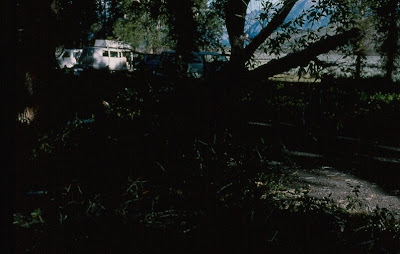
There was a discussion that evening at Grand Tetons in the twilight about whether we would experience any bad weather on our journey. The skies were clear that night with just a few puffy clouds about. For some reason, Craig looked at towards the heavens, raised a rock hammer towards the sky, and said "I dare the gods to make it rain!". I'm not kidding about what followed. Within ten minutes of his brash statement, our campground was enveloped in a violent storm, our vision obscured by thick blowing dust, and high winds were knocking down old cottonwood trees all around us. Fifteen minutes later the winds died, the dust cleared, and the camp was a shambles. Tents were ripped apart, and branches were down all over our camp. Our vans were undamaged, but a tree had crushed a van in the other part of the campground (people were in it, but were unhurt). We thought we had been hit by a tornado, but more likely it was a microburst from a storm that approached us unseen from the east.


Needless to say, Craig spent much of the rest of the trip muzzled....and this story will be continued.


Monday, January 5, 2009

The Cretaceous Parks of the Colorado Plateau: The View is Nice but Access is a Problem...


Looking for a good fixer-upper in Utah/Colorado? Have I got a place for you! This is one of a continuing series on the geology of the Colorado Plateau. It's taking a lot longer than I thought it would, and I thank you for your patience if you are still following the story! For several months we have been making our way forward through geologic time via some of the most beautiful places on the planet. For the early Cretaceous, we took a brief foray into Montana for a 1994 dinosaur dig in a layer (the Cloverly Formation) that was a substitute for the very similar Cedar Mountain Formation of the Colorado Plateau.

The remaining Cretaceous layers of the Colorado Plateau reveal events that ultimately separated the North American continent into two parts, with a shallow sea that ran from Canada to Mexico. The fluctuating shoreline left a mixture of sands, silt and mud that accumulated to depths of several thousand feet. When the land was exposed, plants grew in profusion in the tropical conditions. Coastal lagoons and swamps produced a rock that would eventually be a two-edged sword to the inhabitants of the region: coal. The formations include the Dakota Sandstone, the Mancos Shale, and the Mesa Verde Group (which includes a number of- formations that go by several names in different parts of the plateau region).

The story began with the rise of a mountain range in far west California and Nevada…where the Sierra Nevada stands today, a series of volcanoes spewed ash and lava. Deep underground, the magma cooled slowly to form the granitic rocks that make up the mountains we know today in places like Yosemite and Sequoia National Parks. Intense compression of the crust east of the Sierras in Nevada and western Utah caused huge sheets of crust to slide over each other forming a second series of mountains that shed vast amounts of sediment across what is now the plateau country.

The Dakota Sandstone and related formations are found across the region, from Montana to Arizona, and well into the Great Plains. It is usually exposed as a yellowish sandstone with prominent crossbedding. It formed as sea level rose and spread a blanket of beach sands across the region. Dinosaurs wandered across these beaches, but left only footprints and practically nothing else. No one would mistake it for a grand scenery-maker like the Navajo Sandstone, but it is a significant part of two unique national monuments: Hovenweep and Canyons of the Ancients.

Neither park is known for its geology; they were established for the Ancestral Puebloan (Anasazi) ruins that are found there. But geology played an important part in the life of the people who lived there centuries ago. At Hovenweep, the only layers are the Dakota Sandstone and the underlying Morrison Formation. The Dakota forms a resistant caprock that is topped by rich soils. In places, canyons have been carved into the softer rock underneath. The best-known ruins surround the head of Little Ruins Canyon, at the park visitor center and campground complex.

People live with the resources they have in the regions in they inhabit, and one can appreciate the difficulties of life in this harsh environment. But, despite the cold winters and hot summers, the soils were in an ideal location for growing beans and corn; high enough above the desert to get sufficient moisture, but low enough to have a longer growing season. Hovenweep sits in the middle of a “fertile crescent” that extended from Utah’s Cedar Mesa to Mesa Verde in Colorado. Thousands of people once lived here, and the land supported their needs, but droughts or other factors caused them to abandon the region in the 1300’s.

However much we may idealize their existence, one cannot deny the artistry of their architecture. Their structures follow the boulders and are built so well that they have perched there for centuries. So much is not known about their choices; why on the rocks? Defense seems the most logical reason, but defense from whom? And why put a four-story tower inside a canyon, rather than on the rim, where you could use it as a lookout?

Hovenweep is one of those overlooked gems of the National Park System. If you ever visit Mesa Verde National Park or Natural Bridges National Monument, it isn't much farther to get to Hovenweep, and is well worth the effort. Many of the ruins remain unexcavated, and the feel is far more wild than the paved trails of Mesa Verde.

Canyons of the Ancients will be covered in the next post!

Tuesday, December 16, 2008

The Cretaceous Parks of the Colorado Plateau: the story of a Dino-Dig


What was your favorite dinosaur when you were a kid growing up?

Before I distracted myself with a series of geo-memes, I was telling the story of my sole experience with a real dino-excavation, as part of my long-running "short" history of the Colorado Plateau. The first posts explained how we got invited to assist on the dig, and some of our adventures on the way to Montana. Today is an explanation of what we were looking for.

As far as I can tell, I am one of the old-timers of the geoblogosphere, so my childhood memories include T-Rex, stegosaurus, brontosaurus (yes, I know the name is wrong...), triceratops, and pteranodons (yes, I know the ptera-animals aren't dinosaurs, but I didn't know it at the time). As far as my five-year-old self was concerned, they all lived at the same time, fought with each other, were sluggish and cold-blooded, and died out because the superior mammals ate their eggs.

In the 1980's and 1990's, public perception of the dinosaurs was changing, due in part to the movie "Jurassic Park", but really because of the extensive work of numerous paleontologists, some of whom were talented at presenting their work to laypeople through such books as The Dinosaur Heresies (Robert Bakker), and Digging Dinosaurs (John Horner). A sort of dinosaur renaissance followed, and with a vast increase in research into the lives (and deaths) of the dinosaurs, the total number of dinosaur species was doubled.

One of the opening salvos in the new perception of the dinosaurs was a report by John Ostrom in 1969 about his discovery of deinonychus fossils in association with a tenontosaurus at a quarry near Bridger, Montana (the picture above is adapted from Ostrom's report; it was drawn by Robert Bakker, who was his research assistant for years). The velociraptors, popularized (and vastly enlarged) in the movie Jurassic Park, were actually no bigger than a german shepherd. The closely-related Deinonychus would have been a bit closer to the size of the creatures in the movie, although Utahraptor would have been even closer. At Ostrom's quarry, at least four individual raptors died along with the large plant-eating tenontosaur, leading to speculation that the predators had attacked the much larger creature together (and had died in the process). The result of Ostrom's analysis was that at least some of the dinosaurs were closely related to the birds, that they were agile and warm-blooded, and that some may have cooperated in bringing down prey. These were revolutionary and controversial ideas at the time.

So, what were we up to in 1994? We were going to help reopen John Ostrom's quarry! The distinctive hill is called the Shrine site (although we were also told it was named for a particular part of the original ranch owner's wife's anatomy), and is located in the badlands near Bridger, Montana. It is an exposure of the Cretaceous Cloverly Formation, which is related to the Cedar Mountain Formation on the Colorado Plateau, and is composed of sand and silt deposited on a muddy river floodplain. The idea of pack behaviour among dinosaurs remains a controversial subject, and by digging further into the side of the hill, we hoped to find more evidence concerning these predators of the early Cretaceous.

We couldn't have asked for a more dramatic setting. Besides the vivid colors of the nearby badlands, we had a skyline view of the high Beartooth Mountains that form the eastern edge of Yellowstone National Park. To the east rose the Pryor Mountains, and a few miles beyond, the Bighorn River (yeah, the Custer's Last Stand one). The picture of the camp above hardly does it justice (all that pre-digital photography with cheap cameras).

We met the professional crew, Geoff and Desmond, and a couple of amateur dino-diggers from the Bay Area, and starting looking over the quarry site. We knew our role; it was to remove the side of the mountain so the bone people could get to the bone layer with their brushes and dental picks. As Arlo Guthrie put it, we came armed with shovels and picks and implements of destruction. We set up camp, and made dinner. Work would commence the next morning....

Ostrom, J. H. (1969). "Osteology of Deinonychus antirrhopus, an unusual theropod from the Lower Cretaceous of Montana". Peabody Museum of Natural History Bulletin 30: 1–165.

Sunday, December 28, 2008

The Cretaceous Parks of the Colorado Plateau: the Final Discovery


In the last installment of our dinosaur-digging story, we had finally come across evidence that dinosaurs had, in fact, actually lived during the time of the deposition of the Cloverly Formation; we had found deinonychus claws, and bones of tenontosaurs and anklyosaurs. In the final days on the site, we had become fairly sharp at picking out bone fragments on the slopes of the dig site, and two of our party found a fairly significant bone scatter a few yards away from the main quarry.

By working their way up the slope, they found where the bones were emerging, and we started another (much smaller) quarry, and uncovered several dozen bones in situ, of a creature we could not immediately identify. It was smaller than the other species we were expecting to find, and was thus sort of mysterious. We delineated the bone area, and started the process of protecting the exposed bone with "butvar", coating the bones with paper towels and covering the entire mess with plaster. By our last day on the site, we had constructed a giant plaster monstrosity.

The paleo-experts on the dig looked bemusedly at our work, and very politely waited until we had said goodbye and started on our way home before they started tearing off all the plaster and carving the rock mass into smaller parts. The dig was nearly a quarter-mile from the vehicle, and our plaster monster must have weighed 300 pounds! No one wanted to carry it down that hill!

The experts also were nice enough to report on what they found once the specimen had been hauled off to the Museum of the Rockies. Our find turned out to be numerous fragments of a Zephyrosaurus, a species that had been found only once before, and had been named on the basis of a few pieces of the skull, and some vertebrae fragments. We had found leg and claw elements, pieces of a skull, and vertebrae and rib fragments. The animal was a small bipedal herbivore. If your fifth-grader has ever heard of it, it is probably because the kid has a Dinosaur A-to-Z book, and zephyrosaurs are one of the few "Z" dinosaurs!

Images of the bones could be accessed for some time on the Museum website, but they were eventually taken down, so I wonder if they have reconsidered the identification of the specimen. If anyone wants to track it down, it was MOR #759. I would love to know what our creature is up to these days!