Showing posts with label gold. Show all posts

Sunday, September 19, 2021

Yeah, I'm Rather Dense Too...A Weighty Matter in Mineralogy


All that glitters is not gold...and even if it is gold, there's no way I would pass a large nugget of it around the lab, no matter the teaching value of something that could illustrate density so well. That's hardly an issue of course, since the largest sample of gold that I have is only a gram (about 1/28 of an ounce). You can feel the heaviness a little, but not really. There's also a sample of crystalline gold, but it is so small that you can't really feel the weight of it at all.
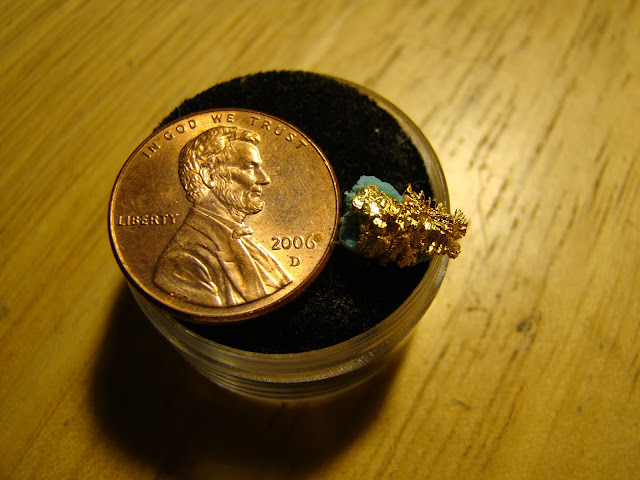
Still, it would be nice to have a sample like gold around in the classroom to provide a tactile example of extreme density. But even a single ounce of gold is just not feasible.

The density of a mineral is the ratio of mass to volume, often measured as grams per cubic centimeter. The higher the density, the heavier an object will feel. In a physical geology laboratory on minerals, we refer to the density as the "heft" of the mineral. In other words, does the mineral feel heavier or lighter than expected? We tend to expect metals to be heavier, and translucent or transparent minerals to feel lighter. Water has a density of 1 gram per centimeter, and most non-metallic minerals have a density of between 2.5 and 3.5. That is therefore close to the density of many rocks, since rocks are composed of a solid mixture of minerals most of the time. 

Galena, a sulfide of lead, is one of the densest of the reasonably common minerals, at 7.6 grams per cubic centimeter. Pyrite (otherwise known as fool's gold) is also relatively dense at 5.02. But none of those minerals come anywhere close to the density of the heaviest metals.
So why not some chunks of common metals? I have a 1-inch sphere of copper in the classroom and several samples of native copper. They're fairly hefty at 8.92, but that's barely ahead of the mineral galena. Iron is even less at 7.87. Silver and pure lead are getting up there at 10.49 and 11.34 respectively, but the toxic nature of lead is well-known. What I would hope for is something really heavy, among the most dense of all the metals.

What are those densest metals? And are any of them useful or appropriate for a classroom? Here are the ten densest metals:

Densest Metals

Mercury 13.55 g/cm3

Americium 13.67 g/cm3

Uranium 18.95 g/cm3

Gold 19.32 g/cm3

Tungsten 19.35 g/cm3

Plutonium 19.84 g/cm3

Neptunium 20.2 g/cm3

Platinum 21.45 g/cm3

Iridium 22.4 g/cm3

Osmium 22.6 g/cm3


It's an interesting list. I've wondered if any of them could ever be considered as a classroom demonstration model.

Mercury is the kind of stuff that kids aren't allowed to play around with for clear toxicological reasons, but in the days of my youth, it was far more accessible, but no less toxic. I had a toy once, a maze that had a bead of mercury in it that you would tilt back and forth. In high school, the chemistry lab storage area had a plastic flask containing several pounds of the stuff. The kids had full access to it if the teacher wasn't paying attention. It's amazing that any of us made it to adulthood, and mercury poisoning perhaps explains some of the strange quirks of my generation.

Americium is unique, as it only exists in human-made form. It's not found in nature, but it is probably present in your fire detector. Even if it were in a mass large enough to feel, it is clearly not appropriate for a classroom demonstration of heft!

Platinum, iridium and osmium are the densest of all, but all of them are rarer and more expensive than gold. They're out of the running in my lab...

Plutonium and neptunium are both highly radioactive and not natural to the Earth except in extremely small amounts. It is of note that I got to use some plutonium once in a chemistry lab. We irradiated something (copper, I think) with plutonium, and then recorded the decline of the radiation on a graph to better understand the concept of radioactive half-lives. The plutonium was highly shielded, however. We couldn't even actually see it.

There isn't much left, is there? Uranium seems a possibility in some respects since it is used in depleted form in weapons and armor. "Depleted" refers to the fact that it has been processed to remove the most radioactive isotope (Ur235, used in weapons. Isn't that comforting?). The Ur238 is less radioactive, but it is still radioactive. I got to hold a 1-lb slug of uranium once, and wished I could have one for the classroom, but it just isn't going to happen.
My new sample of tungsten with a stack of dimes (nickel-copper) and pennies (mostly zinc) that each weigh as much as the cube.
So it comes down to one last metal in the top ten, and example of how one can learn things even at such an advanced age of my own. I've known about tungsten for a very long time. As a teen I hiked through the grounds of Pine Creek tungsten mine in the Sierra Nevada that once provided more than 90% of U.S. production. Over the years I've enjoyed searching for the principle ore of tungsten, a unique fluorescent mineral called scheelite. I've known for years that it was used as the filament in incandescent light bulbs, and that it was alloyed with iron to make a stronger armor. But something I did not know until last month was that pure tungsten is denser than gold!

It's not only denser than gold, but it is not particularly toxic except in rare instances. And it's not overly expensive. I got a sample cube a half inch on the side for a few tens of dollars online, and ever since it arrived last week it has been my newest 'worry' stone. I can't help but heft it and realize that at long last I have a sample to demonstrate extreme density in the laboratory. 

That is, if I ever get to have a laboratory class again. I'm getting really tired of the pandemic.


Sunday, March 11, 2012

A Priceless Collection of Minerals: To see, or not to see

I was in the field yesterday with my students, and one of our stops was at the California State Mining and Mineral Museum in Mariposa at the south end of the California Mother Lode. I am offering up a selection of photos of some of the finest mineral specimens you will ever see anywhere, but I hope you will read to the end of this post as you look at them. Enjoy!

The first few images are some of the striking specimens of crystalline gold. Gold crystallizes in the isometric crystal system (three equal axes at ninety degrees), but the crystals themselves are rarely seen because gold is so malleable that the structure is lost the moment the mineral rolls in a stream.
Gold crystals, then, instead of gold nuggets. They are just gorgeous, and priceless, because the vast majority of crystal specimens were melted into bullion along with all the other gold during the gold rush days, even the biggest single nugget, one that weighed close to 200 pounds.
 You just don't expect gold to look like this.
Or this...when the Harvard open-pit mine was operating in the 1980's and was about to close down, the miners hit a rich pocket. Mine employees who had hardly ever seen even a small bit of gold in the disseminated ores were surprised to see a 60 pound chunk of gold pass by on the conveyor belt. It was composes of leaf gold, a crystalline variety composed of...um...leaf-like flakes of gold. The entire mass was preserved and can be seen at the Ironstone Winery at Murphys, but a large flake can be seen above.

And then there is the Fricot Nugget. The 13.6 pound nugget is the largest single gold mass preserved from the Gold Rush Days, having been discovered in 1865. It lay a long time in a safe deposit box, almost completely forgotten. It came to the state collection in 1943.
An exceedingly rare mineral is a beautiful blue sapphire-like gem called benitoite. It is found at a single mine in the California Coast Ranges. It was designated the California state gemstone in 1985.
The sample below includes two very rare minerals. The black mineral is neptunite, which is often found in association with the benitoite.
Another unique mineral assemblage in California comes from the pegmatite veins in San Diego and Riverside counties. These veins contain immense crystals of quartz, feldspar, muscovite mica, and a group of rare gemstones, most notably tourmaline. For a time in the early 1920's tourmaline was the most prized gem in China, and many incredible crystals were exported.
Other minerals came to the state from all over the world. Below is a striking example of beryl (aquamarine), a relative of emerald.
And sulfur crystals deposited on aragonite crystals...
And some beautiful crystallized azurite and malachite, ores of copper.
And opal from the Virgin Valley in Nevada...
Another example of pegmatite contains a form of feldspar called amazonite.
Some more spectacular azurite crystals.
The crystals below are wulfenite, an important ore of molybdenum and lead.
And finally, the museum has an excellent exhibit of meteorite specimens, including this cross-section of the crystallized elemental iron of the Giant Goose Meteorite, which fell in Modoc County in 1938. The original weighed over a ton.

Wouldn't you just love to see these incredible rare specimens for themselves? I can assure you that it is a great exhibit, quite worthy of a short diversion on your way to Yosemite National Park. But you don't get to see them. You may never get to see them ever again. Why? Because the California State Mining and Mineral Museum is on the state closure list, one of 70 parks to be closed and shuttered because of cuts of $22 million to the state park system, approximately 70 pennies for each inhabitant of the state. I am incensed that the people of our state legislature are so incredibly short-sighted as to allow this to happen.

I feel hopeless sometimes at the stupidity I see. State parks generate economic activity, they don't drain it. Closing these parks makes no sense at all. Mitchell Caverns has already closed, and vandals have already done grievous damage. It will cost so much more to re-open these parks once they have been degraded. And yet that is what our government has decided to do, come June. I don't quite know what would work to change this, but one can start by letting your legislators know how you feel about this. The parks have few friends in the legislature obviously, but the politicos might listen to someone besides their ever-present lobbyists if they heard from their constituents. Who knows? There is a facebook page for the California State Mines and Mineral Museum, and there is the California State Parks Foundation, the best place to get information on how to proceed politically.

I know that blogs are places for the writing of many words, but I have few enough words that can express my disgust at the members of the state legislature and government for allowing this to happen.

Monday, July 5, 2010

Throwing the Baby Out with the Bathwater: The Serpentine Issue in California

State senator Gloria Romero, defending her sponsorship of a bill (SB 624) to remove serpentine as the state rock of California, was quoted as saying: " “This bill is about raising awareness to protect the health of our citizens. Serpentine contains asbestos, a known carcinogen. Toxic materials have no place serving as emblems for the State.”
Consider some analogies: California Poppies, our state flower, contain some morphine and codeine, the raw materials for making heroin, an illegal drug. Therefore “This bill is about raising awareness to protect the health of our citizens. California Poppies contain morphine and codeine, illegal drugs. Illegal materials have no place serving as emblems for the State.” Let's get rid of poppies as our state flower.
Gold miners, breathing the dust of quartz in the milling and crushing of gold ores, died by the score in the mines during the Gold Rush, the event that led to the establishment of the state (gold mining also pretty much ended dozens of Native American cultures through direct violence and disease). So... “This bill is about raising awareness to protect the health of our citizens. Gold ore contains quartz, a known cause of silicosis. Toxic materials have no place serving as emblems for the State.” Let's eliminate gold as our state symbol.

Grizzly bears killed hundreds and hundreds of Native Californians and Mexican-Americans in the early history of the state. So... “This bill is about raising awareness to protect the health of our citizens. Grizzly bears contain teeth and claws, known killers of people. Toxic animals have no place serving as emblems for the State.” Let's eliminate the California Grizzly Bear as our state mammal. Oh, wait. We did one better: we eliminated the California Grizzly Bear instead. The last one was shot in the 1920's.

I've been on this topic for a week now (see here and here), and Silver Fox has a nice review of the many factual problems in the actual text of the bill (serpentine is not asbestos; it may contain an asbestiform crystal habit, but so do five other minerals, and it is they which are most implicated in causing disease), as well as a review of geobloggers who have been discussing the problem. Also, check out Andrew Alden's take on this at About Geology.

I do not want to belittle the problem of asbestos, lung cancer, and mesothelioma. These are serious enough issues, but going after serpentine is misguided, and I believe, actually hurting the effort at raising awareness of the connections between the two. The fracas going on today will be over, and in another month no one will remember the issue. But any child studying the state symbols over the coming decades will discover an interesting rock, but also the connection to asbestos and disease.

They're throwing the baby out with the bathwater, and since it has already passed the state senate, I fear they may succeed. If you are concerned about this, and you're in California, call your assembly representative or Governor Terminator with your views.

Thursday, December 17, 2009

Musings on Gold...GOLD! Buy GOLD! The World is Going to End Anyway

It seems like gold has been appearing everywhere of late, especially in those late-night commercials that ask you to pick up any loose gold that happens to be lying around the house, put it in an envelope, and send to those very nice sounding people who will send you a check for your trouble. The guy is strumming a banjo; how evil could he be? And I am absolutely sure they pay top dollar to the people desperate enough to fall for the scam.

On the other hand, the FOX Channel's Glenn Beck, fear-monger par excellence, has been shilling for a gold-selling company, while at the same time using his show to advise people to buy gold in these terrifying times. He tells us to "pray over it" ("Dear God and Jesus, should I use my money to give food to the poor, or buy gold???"; I wonder what voice speaks in his head, and what it says to him?). I'm sure there is no conflict of interest here...

I started thinking about gold because one of my very first efforts at web page design (1997, I think) still sits in a largely original state on my school website, a discussion about the history of the gold mining in the Mother Lode. It talks about the value of gold at the time, and the then current state of mining. A recent visitor to the site commented the price of gold had quadrupled since I wrote the piece, and suggested that interest in mining was up again (if you check out the site, be aware that some of my numbers are speculative).

First off, does anyone know of any ongoing interest in reopening any Mother Lode mines? I'd like to know about it. I must say, that if I were already operating a mine, I couldn't be happier. Great prices! But opening, or reopening a mine? Do mining companies trust that the price of gold is going to remain stable or continue to rise? Enough to make the incredible investments in equipment and regulatory paperwork? I've gotta say that the run-up in the price is very reminiscent of the dot.com craziness of the 1990's, the stock market craziness of the 2,000's, and the real estate insanity of the last 10 years. Wow...how'd they all do? What I remember the most was the maniacal exhortations to invest, invest, invest, even as prices started to fall.

If you are thinking of falling for one of these gold investment schemes, take a look at this article by Nouriel Roubini. For the record, he was one of those gloom and doom economists who predicted the ongoing recession-depression (does anyone believe it's over?) before it was fashionable. Can you spell "g-o-l-d b-u-b-b-l-e"? It may a good time to sell gold, but I wouldn't trust a banjo-strumming confidence man. See a reputable jeweler first. As for Glenn Beck and the other investment shills? Well, consider the source...


Late Add: Seems (surprise, surprise!) that some of those commercial gold buyers have gotten in trouble. Check out this report.

Tuesday, September 9, 2008

50 Minerals one must see....a geologic meme (and me too!)


Jumping on the bandwagon, here are the 50 minerals from Chuck's list that I have seen (See Lounge of the Lab Lemming and others here, here and here). Like Dave, I would have added more of my own, but I am at work after all. On the other hand, California is a dream site for finding strange and exotic minerals, and I am adding three to my list: Serpentine (yes, chrysotile, but I like the greasy form), because it is the California State Rock (legislature was supposed to call it serpentinite, but didn't know any better); gold, because it is our state mineral for obvious reasons, and seeing it in the wild is always a memorable experience; and benitoite, because it is our state gemstone, and it is found in gem quality specimens pretty much at a single mine in in San Benito County. It is also one of the first minerals discovered that crystallizes in the ditrigonal dipyramidal class, making for some beautiful triangular crystals. It is my picture of the day...


As Chuck says:


Use bold to indicate minerals you’ve seen in the wild. Italics is for those seen in laboratories, museums, stores, or other non field locations. Ex pet nerds may use underlining to indicate those that they’ve grown with their own two hands. And I won’t bother with stuff you intend on seeing- if you didn’t want to see all these minerals yourself, you’d be spending your precious lunch hour on a physics or biomedical blog.

Andalucite

Apatite

Barite

Beryl

Biotite

Chromite

Chrysotile

Cordierite

Corundum

Diamond

Dolomite

Florencite

Galena

Garnet

Graphite

Gypsum

Halite

Hematite

Hornblende

Illite

Illmenite

Kaolinite

Kyanite

Lepidolite

Limonite

Magnetite

Molybdenite

Monazite

Nepheline

Olivine

Omphacite

Opal

Perovskite

Plagioclase

Pyrite

Quartz

Rutile

Sanidine

Sillimanite

Silver (native)

Sphalerite

Staurolite

Sulphur (native)

Talc

Tourmaline

Tremolite

Turquoise

Vermiculite

Willemite

Zeolite

Zircon