Showing posts with label Willms Road. Show all posts

Friday, October 11, 2024

Twice in 2024! Auroras in Central California

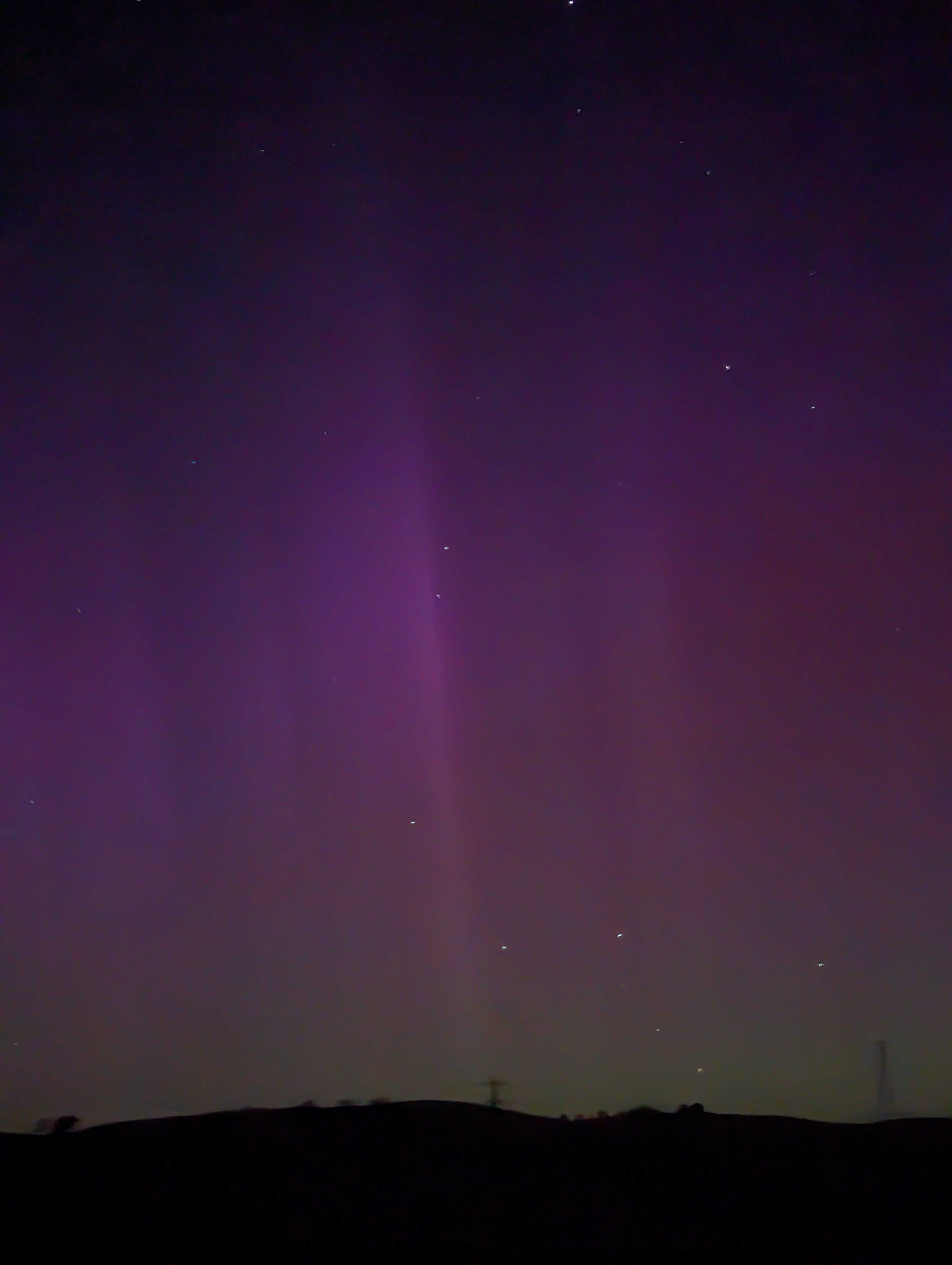
Back in May of this year, I saw something I had never seen before: the aurora borealis gracing the night sky over the prairie of the Sierra Nevada foothills. It was an astounding once-in-a-life event. Except it wasn't. The sun has been particularly active this year, and a coronal mass ejection occurred a few days ago that sent charged particles racing towards the Earth. For the second time in my life, I saw the aurora borealis from my home area.
I was teaching an online geology lab and happened across a report that auroras were being sighted in unusual places, and anxiously awaited for my students to finish their work. I checked out my front door and took a shot of the sky in the heavily light-polluted environment, and my phone camera caught the characteristic magenta-pink light. I talked Mrs. Geotripper into taking a late-night drive to the prairie-lands near Willms Road outside of Knight's Ferry on the Stanislaus River.
The lights were immediately evident in my phone camera pictures. They were very dim to the naked eye, but the night shot setting on my phone captured the detailed spires and structures in the lights quite well.
The intensity, color, and pattern of the light changed from moment to moment. It was a nice way to spend an evening!
The lights faded after about an hour and we went home. I hope you got a chance to see them, but if you didn't, please enjoy what we got to see!


The lights were not better or worse than those of last May. They were just different. It was a privilege to be able to view this gift of the cosmos.


Saturday, May 11, 2024

A Stunning Night: The Aurora Borealis from Central California

It has been a stunning night. I never believed the auroras would make it into Central California, and most of the predictions suggested it wouldn't. But then reports started pouring in; sightings in South Carolina, northwest Florida, Houston, and then Death Valley. I had to give it a chance. Mrs. Geotripper and I hopped in the car and headed out to the California Prairie south of Knights Ferry.
As we pulled up at the small stock pond on Willms Road, it didn't look like much was going on. I convinced myself that there was a bit of a red glow in the sky, and I started taking pictures with my phone (my regular camera turned out to be useless for once). On the screen it wasn't obvious, but there was indeed some color. 
I would have been satisfied with that, as I have seen the aurora only twice before. The first time was from within the Grand Canyon on my very first geology field studies trip in 1975. It was just a glow in the sky then, and we thought it was light pollution from Las Vegas or St. George, but it turned from red to green. We were awestruck, but there was no structure to be seen. The other time was in the late 1990s when we were in Montana on a mostly rainy night, but for a short moment a filament appeared through the clouds. And that was that.
Having so little experience with the phenomena, I simply didn't know what to expect, but we were becoming aware that the lights were changing as we watched. Spires came and went, and the glow moved to different parts of the sky. The colors were changing as well.
We watched until midnight when the cold breeze and lack of facilities forced us to start the drive home, but as we went around each bend, we couldn't resist stopping a moment to see what changed.
The changes were many. More and more green was showing near the horizon, and blue or purple appeared off to the west.


Needless to say maybe, but it was an astounding thing to see. I should note that while I have not modified the pictures (especially the saturation), the phone camera did see more vivid color than I did. I was using the night shot setting, so it was collecting light for two or three seconds, so the pictures are more colorful. But even so, it was easy to understand why the ancients thought these lights emanated from the gods.
We have our own mythology about these strange lights in the sky. They are the magnetic force shields protecting us from deadly emanations from the sun. Without our magnetic field, life on Earth might never have appeared, and we continue to thrive as long as the field continues.
After studying the Earth and the cosmos for more than forty years, I still can be impressed by the incredible processes that operate on and around our planet. What a privilege to live in and understand our world.

The storm is expected to continue through the weekend. I encourage you to find a dark place and check it out, but if that isn't possible, I hope this gives you an idea of what it was like!
 

Sunday, April 4, 2021

California's Rarest Ecosystems: The Prairies and Vernal Pools (Part One of a Two-part Miniseries)

The lower foothills of the Sierra Nevada are one of the most unique and almost universally ignored parts of California. Caught between the famous and heavily-visited forests and alpine regions of Yosemite's high country and the utilitarian agricultural fields of the Great Valley, the lower foothills are made of soils too poor to be developed, and too "plain" to be noticed by people rushing up the highways to the mountain resorts. For much of the year they seem barren and lifeless. But these prairies are one of the most precious of California's diverse ecosystems.
The prairies of California once extended the length of the Great Valley, a 400-mile-long grassland supporting millions of grazing animals, birds, and predators, including Tule Elk, Pronghorn, Deer, Grizzly Bear, Mountain Lions, Coyotes, Foxes, and numerous rodents, reptiles, amphibians, fish, and insects. In earlier times (more than 10,000 years ago) there were camels, horses, bison, giant ground sloths, Columbian Mammoths, Saber-tooth Cats, and Dire Wolves.

There were also modern-day wolves, and it is ironic and coincidental that a wolf returned this week to the Great Valley for the first time in a century. It is a young male from Oregon who made an epic journey through Modoc County into the Sierra Nevada near Yosemite Valley, and then into the Sierra foothills of Fresno County, and across the Great Valley (including two freeway crossings). At last report it's now in Monterey County (it's wearing a radio transmitter). 

The prairies were covered with native grasses that were quickly replaced by invasive species when European colonizers arrived and started herding sheep and cattle. Farms eventually replaced the ranches, and the remaining prairies, no more than 5% of the original land cover, were relegated to the fringes where the soils were poor and no water was available for irrigation. Those remaining prairies form a belt through the foothills of Sierra Nevada.  A narrow remnant can be found along the Coast Ranges and the Carrizo Plains west of Bakersfield.
The prairie soils in the Sierra Nevada foothills are notably poor in nutrients because they have not been part of an active floodplain in tens of thousands of years, and the fertile components have been leached away, leaving behind reddish iron oxides and thick clays. Differential settling and wind deflation has left small hollows and depressions that collect rainfall during the relatively rare winter storms. The clay prevents the water from seeping underground, so pools will persist for weeks or months at a time. These pools are the basis for one of California's rarest ecosystems, the vernal pools.
The vernal pools are islands of diverse life in the otherwise barren grasslands. Numerous species of plants and wildflowers, amphibians, and invertebrates have evolved to survive the weeks of water and the months of dryness. As the waters evaporate away, one species of plant after another germinates, grows, and goes to seed. The pools are often rimmed in colorful zones of different flowers.
I'm writing about the vernal pools today because the limitations of travel in the times of a pandemic have kept me pretty close to home. I live on the edge of the prairie between the Tuolumne and Stanislaus rivers and I was out there today. A few pools are left, and flowers are blooming across the region. The views are expansive, extending to the snow-capped peaks of the High Sierra.
The pools and plants provide food and cover for multitudes of bugs and other wiggly organisms, so the pools are trafficked by a large variety of birds, and dozens of species can be identified by discerning and observant individuals, and occasionally by me as well. 
I saw a half-dozen American Avocets in one pond a few weeks ago.
The prairies are one of the best places to see the rare and threatened Burrowing Owls. The area around Crabtree, Willms, and Cooperstown Roads are among the most dependable places to see them in our region.
Savannah Sparrows are a common species, and they'll occasionally cooperate with photographers.
The Western Kingbirds seemed to arrive from their winter homes in Mexico all at once last week. I saw none a week ago, and dozens today, including this one that hung about long enough for a picture.

I have no picture, but I came upon a Gopher Snake in the road that was in serious danger of being run over. I stopped, looked at it carefully to make sure it wasn't a rattlesnake, and then I picked it up to put it in a safer spot. I was suddenly reminded of how Gopher Snakes sometime pretend to be rattlers! They can flatten their normally narrow heads into the triangle shape of a rattler, and will strike in a similar manner. I didn't hold it for long...how do you explain to the EMTs that you picked up a rattlesnake that you thought was something else?

If you are lucky enough to live near a California prairie, this is a good time of year to explore them. If you tend to rush through this unique part of the Sierra Nevada and the Great Valley on your way to Yosemite or some other mountain destination, slow down and give these precious and unique lands a quick look. You won't be disappointed.
 

Saturday, May 18, 2019

Tales from the Semi-Super Bloom Tour, Part 5: Coming Home

"We shall not cease from exploration
And the end of all our exploring
Will be to arrive where we started
And know the place for the first time.
Through the unknown, remembered gate
When the last of earth left to discover
Is that which was the beginning..."
T.S. Eliot
I'm a bit behind, what with the end of the semester and all that, but there was a bit of unfinished business from a few weeks ago...the end of our Semi-Super-Bloom tour. Yes, most of the flowers throughout the west have faded and shriveled as April turned out to be very dry. In this wet year many parts of California were covered by flowers in a way not seen in a decade or more. It was a spectacle and hundreds of thousands of people converged on places like Anza-Borrego, or Elsinore, or the Grapevine in Southern California. Among the crowds there were the stupid and ignorant who trampled the flowers and in one instance landed a helicopter in a field of flowers.
Around six weeks ago, Mrs. Geotripper and I set out to find some of the less crowded places, the spots where the flowers were blooming, but they weren't quite at the level of the Super-Bloom. Our journeys carried us through the Mojave Desert, Death Valley National Park, the Merced River Canyon downstream of Yosemite, and the Red Hills Area of Critical Environmental Concern. But it was our final journey of the tour that was so illuminating: we were home. And it was a beautiful place.
We live at a nexus point, the boundary between the Sierra Nevada and the Great Valley of California. Our town is surrounded by agricultural fields, but as we drive east, the fields and orchards give way to one of the few remaining prairies in the state of California. Although large portions are being plowed over for almond orchards, the grasslands still exist in the low foothills of the Mother Lode.
The soils are old and deeply weathered, and are generally nutrient poor. It's only a few feet to bedrock as a rule, so water is not often available for plant growth, and so for most of the year the hills are covered with a brown (some say "golden") veneer of dead grasses.  But in the spring of wet years, the prairie comes alive with color. One of the unique habitats of our grasslands are the vernal pools, the hollows where water stands for a few short weeks or months in the spring. Because they are flooded part of the year and dry for the rest, they are a crucible for the evolution of unique plants and animals adapted to the harsh environment. Many of California's endemic plants are found there. There are hundreds of these vernal pools scattered across the prairie. And that's where we saw much of the color as we drove through a few weeks ago.
We were traveling on Willms Road south of Knight's Ferry on the Stanislaus River when we spotted one of California's near-endemic bird species. Red-winged Blackbirds are a familiar sight across much of North America, but there is a closely related species called the Tricolored Blackbird that is mostly found in the Great Valley and in the prairies of the foothills (they have a white stripe below their red wing spots). The birds are endangered because of an unfortunate habit they have of nesting in large colonies in the middle of grassy prairies. The problem is that they don't make a distinction between a tall-grass prairie and an alfalfa field, and thus thousands of nests and their occupants have been destroyed in an afternoon as farmers cutting and harvesting the alfalfa. Efforts are being made to reimburse farmers who wait a few weeks to harvest, giving the young birds a chance to mature and fly away.

We were home, and we found exploring the back roads just beyond our backyard to be just as colorful and wondrous as our thousand mile journeys into the deserts and beyond. Never stop exploring, and never be trapped into thinking that you have to go vast distances to see wondrous things.

Thursday, March 3, 2016

Volcanic Violence and California's Most Endangered Habitat: The Vernal Pool Prairie

The green hills of California's prairie barely conceal a horrific violent past. Around 20-23 million years ago, huge volcanic eruptions shook the western part of North America. Ash (pulverized volcanic rock) blasted into the atmosphere in unimaginable volumes, 100 cubic miles or more. Some of the ash was driven into the upper atmosphere, to be spread around the world with the wind currents, but much of it settled in layers that covered tens of thousands of square miles. Living things would have been buried at best, incinerated at worst. Any one of these events would have been a catastrophe. But there were many of them.
Some of the ash clouds rolled off of highlands that once existed in central Nevada and flowed west into California and down the western slopes of the slowly rising Sierra Nevada. These ash deposits are called the Valley Springs formation, and this rock still influences life in the present day.
The ash eruptions subsided, but new volcanoes developed at closer quarters, near or just east of the present-day crest of the Sierra Nevada. An occasional lava flow reached the lower foothills of the Sierra, but more often, it was a volcanic mudflow, or lahar, that came to inundate the landscape. The rocks today are called the Mehrten formation. Numerous animals lived on the resulting river floodplains and lakes, include tremendous six-foot long salmon (with "tusks"), and tortoises the size of their Galapagos cousins. Mastodons, horses and camels wandered the plains, chased by fearful carnivores, including the ancestors to the Sabertooth cat.
The geologic violence subsided, and erosion has subsequently smoothed off the hard edges of the volcanic rocks. In the semiarid climate, it is mostly grass and annuals that grow here, although the occasional oak survives in the barren landscape. The volcanic rocks contributed to the unique habitat that exists here today, providing through the weathering process copious amounts of clay.

Most of the minerals in ash will decay over time into one of the clay minerals. Soils that develop at the surface tend to be clay-rich, or clay may be present just below the surface, forming an impermeable barrier that prevents water from percolating into the ground. Because wind can blow out hollows, and because clay-rich layers can differentially settle, small pools of water may remain after major winter rainstorms. Because the water can't percolate, it doesn't disappear until it evaporates. The resulting ponds are called vernal pools. The pools are one of our more unique and unusual habitats in California.
A large number of species of plants and animals have evolved to survive in this environment that swings wildly from wet to dry within a period of weeks, and many of the species are endemic to the state. Colorful wildflowers bloom quickly in the drying rings of the "shores" of the little ponds, growing and setting seed before the water has completely dried up. The seeds can repose in the soil for years at time when drought dominates the landscape. Frogs and other amphibians may burrow into the soil and estivate (remain inert) for months on end, waiting for the rains to return.
We spent a delightful afternoon out on the prairie last weekend. It's not too hard because our village lies on the edge of the grasslands. We traveled Willms Road south of Knights Ferry near Highway 108. The spring flowers were just beginning to make an appearance following a warm dry February. There had been fears that this was the end of our rainy season, but a number of vigorous storms are on tap for the next two weeks, so the pools may be filling again for awhile.
Many birds call the prairie home. We felt especially lucky to see a pair of Great Horned Owls in a hollow along an ephemeral creek. The Valley Springs formation is soft and easy to excavate, but the holes are architecturally sound.
A Savannah Sparrow favored me with a pose on a fence next to the road. It was the first time I've had a chance to photograph one.
It was also the first time that I captured a Horned Lark. I thought at first that it was a Western Meadowlark, but I realized the markings were all wrong.
The Meadowlarks were certainly out and about, though. We could hear them all along our drive. At this time of year, they're looking for mates, and aren't at all bashful.

It was a beautiful afternoon in a serene "wilderness" (these are really private ranchlands), but we were also chastened by the sight of thousands of acres of new almond orchards that have been planted just to the west. The water for the trees is coming from irreplaceable groundwater aquifers, and when they have been sucked dry, the almonds will die away. In the meantime, hundreds if vernal pools will have been destroyed.