First off, I am so sorry for the dam puns. I'm a geologist, and we geologists are just no dam good at resisting stupid puns. It's something you'll just have to take for granite.
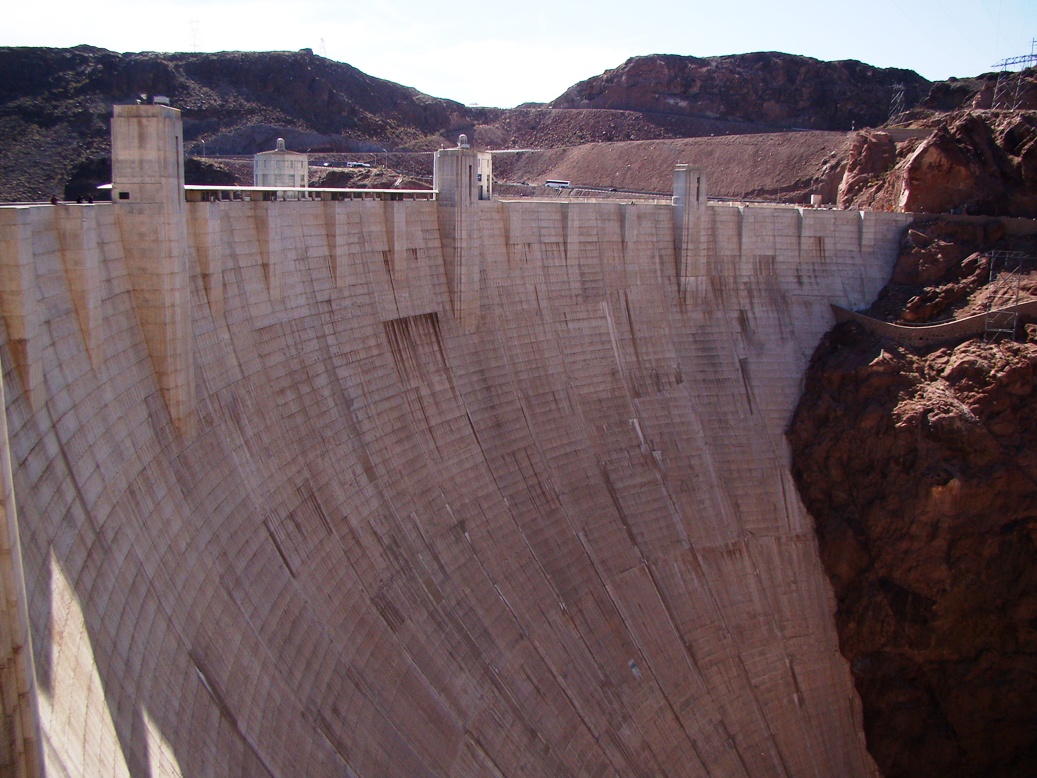
In any case, this is a dam big reservoir. It's Hoover Dam, the first of the gigantic mega-dams constructed in the U.S. back in the 1930s during the height of the Great Depression. Thousands of hungry unemployed men came from all over the country to work in the construction, and in the dangerous conditions, more than one hundred of them died. It's 726 feet high, which at the time was the highest dam in the world (it's the 18th highest now). It holds back about 30 million acre-feet of Colorado River water, equivalent to more than two years of normal stream-flow. At least, what was normal thirty years ago.
It's an astonishing achievement even if I seem to belittle it with semi-sarcastic puns. Walking across the dam is an experience in perspective. It is really big. Ultimately, some thirty million people in three states and Mexico depend on the water that it stores.
Not that it's pretentious or anything, but there are trimmings that make me think of the old USSR. Gigantic statures of winged gods greet the visitor on the Nevada side of the dam, and a loudspeaker emits a constant stream of platitudes about the glory of the achievement of making a river slow down for an instant of geologic time.
Can you guess the purpose of this golden door? Is it the entrance to the Watermaster's Throne Room, the portal into the Cathedral of Power Generation? No, it's actually the door to the men's bathroom on the top of the dam. Unfortunately it is undergoing renovation, so I can't show you the pretentiousness that awaits within (plus, I would have been arrested as some sort of creepy person).
Still, there are some dam frightening things about visiting Lake Mead and Hoover Dam. First and foremost, the dam is missing something. Water. It's missing a lot of water. It's sitting at the lowest level ever seen since the dam's floodgates closed in the 1930s. It hasn't been full as far as I know since the flooding in 1983, and prospects are not good for changing this situation in the face of ongoing drought and climate change.
Then you see stuff. Walking down the stairway from the new parking structure, there are all these square pieces of metal stuck to the cliff. What the hell? Those are rock bolts, essentially long screws encased in concrete and bolted to the rock wall for the purpose of maintaining the rock wall as an actual wall, instead of a rock fall. If the dam is built in stable rock, what do they need rock bolts for?
Then you start to notice other things. In the roadcuts across the highway from the dam there are strange looking scratch marks on the rock surface. They're called slickensides, and they develop as one block of rock grinds against another. Along a fault. Yeah, those things that cause/result from earthquakes.
Before I started researching the field seminar that I'm currently conducting, I assumed that Hoover Dam was anchored in ancient stable metamorphic and plutonic rocks. That is the kind of rock that is exposed in Black Canyon downstream from the dam. A close look at the rocks reveals a different composition: they are rhyolitic volcanic rocks, and according to the guides and the maps, they are Neogene in age, from around maybe 15 million years ago.
The volcanic rocks erupted in a complicated geologic environment of extension and transcurrent faulting that opened up spaces between crustal blocks that allowed magma to rise to the surface. They have been complexly faulted, and it turns out that a walking tour of the dam site is a nice lesson in a comparison of normal and strike-slip faulting. The dam engineers and the dam architects back in the 1930s declared the dam abutments to be safe and stable, and who am I to argue with them? I am not a dam engineer or a dam architect. It doesn't look like any leaks are occurring in the canyon walls downstream, unlike a certain other dam reservoir that I was looking at today.
The other dam thing I saw today wasn't really scary, except in my imagination. You have to realize I was looking down 200 feet at this big fish, a carp or something. It may have been three or four feet long, and for a moment it looked a dam shark! Maybe that Sharknado thing really happened, and a few landed in Lake Mead...
The dam morning was almost over, so we hit the road. We were headed towards the Grand Canyon, a much better place to appreciate the Colorado River.
Showing posts with label Slickensides. Show all posts
Wednesday, June 4, 2014
Monday, June 3, 2013
A Dam Big Dam and a Dam Big Bridge...And a Dam Frightening Problem
Oh, how mighty are the works of man...and how arrogant we sometimes get when contemplating our great works. Our first stop on our tour of the western Colorado Plateau was a visit to Hoover Dam and Lake Mead, the gigantic tower of concrete that blocks the Colorado River, and holds back 30 million acre-feet of water. It's the biggest dam reservoir in the United States. How much is 30 million acre feet? More than two years of "average" Colorado River flows for one. The largest dam in our region back home, Don Pedro on the Tuolumne, holds a paltry 2 million acre-feet.
The dam was built during the height of the Great Depression between 1930 and 1935, and just two years after the catastrophic failure of St. Francis Dam in California that killed around 600 people. Lessons learned from the failure of St. Francis led to modifications of Hoover Dam which presumably make it more or less indestructable.
Just the same, it is amazing how many faults are exposed in the canyon walls adjacent to the dam. The rocks forming the abutments are Miocene volcanic tuff, which doesn't dissolve or crumble in water (a major factor in the St. Francis event). But the rock is highly faulted, and it is a great place to explain slickensides, the scratch marks that occur when blocks of rock slide past each other. The rock is literally polished.
The visitor center is guarded by giant copper art-deco angels that made me feel like I was entering the walls of Minas Tirith in Lord of the Rings.
The thing is dam big. It's more than 700 feet high, which was the highest in the world when it was built (now it is 18th). One can drive or walk across the dam thing, but it is no longer the main highway between Kingman and Las Vegas.
In 2010, work was completed on the O'Callaghan-Tillman Bridge just downstream. It towers 880 feet above the river, and more than 200 feet above the level of the dam. Walking across the top allows the incredible perspective of the dam and lake in the top photo of this post.
Looking down the dam face is disorienting, but it looks like a great slide (although one's pants would surely catch fire from the friction...). The white thing is part of the power generating complex.
The bridge really is a stunning piece of work, although it is a bit disconcerting to feel it vibrate as the big trucks pass by...
Looking down the other face of the dam is disconcerting too. It's been a long time since the dam was full (1983 to be exact). The water level looks to be only a hundred or so feet low, but that represents perhaps half the storage capacity of the reservoir. A decade long drought has brought down the reservoir to perilous levels (13 million acre-feet), and some forecasts suggest it may never fill again. 30 million people in Los Angeles, Las Vegas, Phoenix and in many agricultural areas depend on the supply of water, but it just isn't there.
And that's dam frightening.
The dam was built during the height of the Great Depression between 1930 and 1935, and just two years after the catastrophic failure of St. Francis Dam in California that killed around 600 people. Lessons learned from the failure of St. Francis led to modifications of Hoover Dam which presumably make it more or less indestructable.
Just the same, it is amazing how many faults are exposed in the canyon walls adjacent to the dam. The rocks forming the abutments are Miocene volcanic tuff, which doesn't dissolve or crumble in water (a major factor in the St. Francis event). But the rock is highly faulted, and it is a great place to explain slickensides, the scratch marks that occur when blocks of rock slide past each other. The rock is literally polished.
The visitor center is guarded by giant copper art-deco angels that made me feel like I was entering the walls of Minas Tirith in Lord of the Rings.
The thing is dam big. It's more than 700 feet high, which was the highest in the world when it was built (now it is 18th). One can drive or walk across the dam thing, but it is no longer the main highway between Kingman and Las Vegas.
In 2010, work was completed on the O'Callaghan-Tillman Bridge just downstream. It towers 880 feet above the river, and more than 200 feet above the level of the dam. Walking across the top allows the incredible perspective of the dam and lake in the top photo of this post.
Looking down the dam face is disorienting, but it looks like a great slide (although one's pants would surely catch fire from the friction...). The white thing is part of the power generating complex.
The bridge really is a stunning piece of work, although it is a bit disconcerting to feel it vibrate as the big trucks pass by...
Looking down the other face of the dam is disconcerting too. It's been a long time since the dam was full (1983 to be exact). The water level looks to be only a hundred or so feet low, but that represents perhaps half the storage capacity of the reservoir. A decade long drought has brought down the reservoir to perilous levels (13 million acre-feet), and some forecasts suggest it may never fill again. 30 million people in Los Angeles, Las Vegas, Phoenix and in many agricultural areas depend on the supply of water, but it just isn't there.
And that's dam frightening.
Subscribe to:
Posts (Atom)