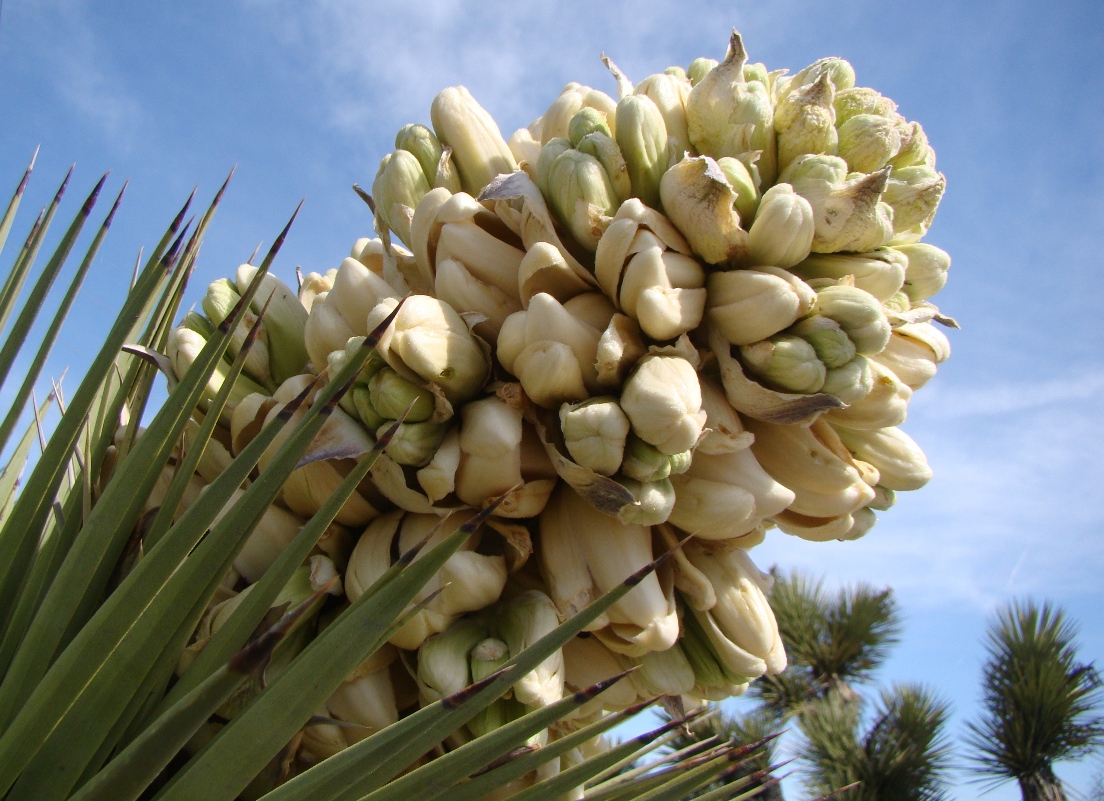
During my travels a few weeks back, I noticed a lot of Joshua trees were blooming along Highway 138. We stopped and snapped a few close-ups without giving it much thought. I knew they bloom off and on in different parts of the Mojave Desert. It has come to my attention, via the Press-Enterprise of Riverside, that the Joshua trees are actually blooming everywhere in the Mojave this year. It's unusual, with millions of the trees producing flowers.
According to the article, biologists are not in agreement about what this means. Some seem to think that the bloom is evidence of plentiful soil-water conditions because of extensive late summer-early fall rainstorms. Others point to two years of overall severe drought, and average temperatures that are 2-3 degrees above average. The trees are reproducing because of stress, a sort of last gasp to produce seed before dying.
Being a geologist, I can't speak to the precise reason for the once-in-a-lifetime bloom, but geologists have provided some perspective about the prospect for the species' survival. Global warming is in fact leading to higher temperatures across the southwest, and the trees must propagate at higher elevations to survive as a species. This has become difficult over the last few thousand years, because there are no longer any grazing animals that can consume the fruits and spread the seed via their droppings.
The last far-ranging animal that did so was the Shasta ground sloth (Nothrotheriops shastensi) , which went extinct across the southwest more than 12,000 years ago. Without the animals to spread the seeds, they can only fall to the ground underneath the parent tree. There are some fears that the Joshua tree will disappear from its namesake National Park in a few generations.
And that would be a real shame. They are beautiful trees.
Showing posts with label Shasta Ground Sloth. Show all posts
Monday, April 8, 2013
Tuesday, September 8, 2009
Holy Smokes, Batman, that crap is on fire!
Those boulders littering the floor of the cave? They ain't boulders...
I've heard of the expression being up to your neck in sh$t, but this is ridiculous...
A sampling of the bone material from Rampart CaveDespite the frivolous nature of the blog title, there are few words to describe the rage I feel towards cave vandals. And it is one thing to break off things of beauty, like stalactites and other cave decorations, in the sense that centuries and millenia from now they could conceivably grow back long after we are gone. But sometimes, that which is destroyed represents knowledge that becomes lost forever, never to be recovered, not even with the passage of time.
Such is the tragedy at Rampart Cave.
Rampart Cave, like Bat Cave, lies near the western end of the Grand Canyon. The cave was unlike many others in the region, because it was accessible to large animals who took shelter inside. For something like 40,000 years, that's what a particularly strange animal did. And it pooped. A lot.
Nothrotheriops shastensis, the Shasta Ground Sloth (picture in the previous post) would never be mistaken for its diminutive Brazilian cousin, nor for that matter, Sid, the abrasive little sloth in the animated movie "Ice Age". It was 8 or 9 feet long, and weighed a quarter ton (some of its relatives were even bigger, reaching two tons). It lived on these lower slopes of the Grand Canyon, consuming a wide variety of different plants and shrubs. Carbon dating of the deposits of the cave show it was occupied from at least 50,000 years ago up until around 11,000 years ago when all of the sloths of North America went extinct. Studying animal droppings may seem, well, a bit dirty, but think what can be learned from the practice: pollen, seeds, and plant fragments from an animal that seemed to eat just about anything provides a picture of changing environments in the late stages of the last ice age.
Equally valuable and equally disgusting are packrat middens, which were also found in the cave. Packrats are kleptomaniacal rodents who carry all manner of things into their nests, and they pee on them. The urine is highly viscous and the midden becomes a solid mass from the work of thousands of generations of animals.
Other animals either found their way into the cave, or their carcasses were dragged there by predators or scavengers. 14 total mammal species and 5 bird species have been recorded in the cave deposits, including the California Condor, which has just been reintroduced to the region.
Excavations took place in the 1930's and 1940's, and the entrance was gated to protect the resources. Around 1975, persons unknown broke through the gate, and started a fire in the cave. It defied efforts at control, and burned for months. Something like 70% of the precious resource (how strange to think of dung that way) was lost forever to science.
I am appalled that there are people this moronic and stupid. Of course they haven't gone away, either. I am hearing that the disastrous Station Fire that is burning up my childhood hiking destinations in Angeles National Forest was the result of arson, too.
Today's pictures are from the National Park Service archives.
Subscribe to:
Posts (Atom)