Showing posts with label Phytosaur. Show all posts

Sunday, August 3, 2025

Journeys in the Back of Beyond: Wait, This is a National Park?


Pack up your stuff kids! We're going to a NATIONAL PARK!

Cool! Does it have big mountains?

No.

Oh, does it have deep canyons?

No.

Can we go swimming in a lake or river?

No.

Oh, will rangers give an interesting talk around a campfire?

No, there's no campgrounds.

Does it have trees at least?

Well, yeah, but they're all dead.

What kind of a national park is this???

It is of course the national park dedicated to a bunch of long dead trees, Petrified Forest in Arizona. It was the third day of our recent exploration of the Back of Beyond, the vast geological wonderland of the Colorado Plateau. We had traveled east of Flagstaff to explore the prairies and badlands that make up much of that strange landscape. 


To most folks it's all about the petrified wood. Some might even think it's a one-note kind of place, of some interest maybe, but not worthy of a full exploration. They couldn't be more wrong! The park is a showcase of geology, archaeology, and paleontology. And it has some unique and dramatic scenery to boot.

The wood was discovered first by indigenous people thousands of years ago (evidence indicates a human presence in the region for at least 12,000 years). They made use of the petrified wood as projectile points, knives, scrapers, and even building materials (there is a reconstructed pueblo in the park made almost entirely of the agatized wood).

Petroglyph at Newspaper Rock in Petrified Forest National Park

The European colonists who always get credited for their "discoveries" came along in the 1850s. The military investigated the region first, followed by ranchers and homesteaders. The area became better known as railroads were built through the region, taking advantage of the relatively flat terrain and availability of water along the Puerco River. A hotel stop at Adamana allowed passengers to tour what was then known as Crystal Forest, and walk off with tons of petrified wood samples. Later on a stamp mill was constructed to grind up the wood to be sold as an abrasive. It concerned some people.


Often the creation of a national monument, which can be established by presidential proclamation, is a controversial affair. Such actions were taken by presidents to protect endangered resources and archaeological sites that locals were often profiting from. It's only as tourism follows that proclamation that local folks begin to accept the presence of a monument in their midst. The story seems to be somewhat the opposite in this case, as the Arizona legislature unsuccessfully proposed a Petrified Forest National Park as early as 1895 in response to local concern about the disappearance of vast amounts of petrified wood. The passage of the Antiquities Act in 1906 gave Theodore Roosevelt the power to designate Petrified Forest as the nation's second national monument that same year. Congress waited until 1962 before "upgrading" the monument to national park status (monuments have the same level of protection that national parks do, although funding sometimes lags behind). Subsequent actions in 2004 more than doubled the size of the park to 341 square miles (884 sq km). 

Despite the protective actions, it's estimated that 12 tons of petrified wood disappear from the park every year (the thieves need to read up on the curse of stolen wood). It's ironic that so much is stolen, since it can be purchased legally just outside the park.

Being petrified is not the normal fate of most trees. Most of them decay and are destroyed, but in just the right circumstances petrifaction can happen. The tree has to be isolated from the atmosphere and destructive microorganisms by being buried quickly in fine mud and clay. There needs to be a source of silica (silicon dioxide), and the movement of groundwater. At Petrified Forest, the trees were ripped from distant forests by muddy flashfloods and volcanic mudflows and transported many miles, coming to rest in river floodplains and swamps. Layers of volcanic ash provide the silica and the swamps and rivers provide the groundwater. Over time the silica fills in the cells of the wood, preserving it. Oxides of iron and other metals provide the bright coloration.


But that's not what I'm really here to talk about!

The real value of Petrified Forest National Park lies in the story contained in its multicolored strata, the Chinle formation. It records a tumultuous period in Earth's history, the middle to late Triassic Period from about 225 to 208 million years ago.

When the Chinle formation is exposed to the elements, the mud and clay is easily and quickly eroded, preventing the development of soil and inhibiting plant growth. The resulting barren desert badlands hardly look like the remains of a tropical environment of large rivers and lakes, but that is what it is. And those barren sediments hide a wealth of paleontological remains (that's short for "fossils").

Exposures of the Chinle formation in the northern portion of the park

The Mesozoic Era (252-66 million years) is often called the Age of the Dinosaurs, and of its three periods, the Jurassic is best-known (perhaps because of a certain film series), and the Cretaceous only slightly less-known, since no one ever made a movie called "Cretaceous Park". It did however gain notoriety as the ending curtain-call on the reign of the diverse and occasionally gigantic reptiles, due to a massive asteroid strike in what is today the Gulf of Mexico.

But the Triassic Period gets less attention. There are few if any dinosaurs from the Triassic in children's plastic toy collections, and yet the Triassic is the period in which the dinosaurs appeared on the planet for the first time. Few of them were large, and they didn't dominate their habitat the way their progeny in the Jurassic and Cretaceous did. There were other creatures inhabiting their world, all of whom were survivors of the greatest extinction event ever to strike our planet. And from within their ranks the first mammals emerged.

The Permian-Triassic mass extinction event was the worst devastation ever visited upon life on planet Earth, wiping out as much as 80-90% of existing species. The cause is not precisely known, but a vast outpouring of lava and ash in Siberia is thought to be a main contributor to a sudden change in the climate that caused a spike in temperatures and acidity in the oceans (carbon dioxide rose from 400 to 2,500 ppm, compared to our current historical rise from 280 to 420 ppm). A total break-down in ecosystems followed, both on land and at sea. It took millions of years for the survivors to rebuild any kind of stability (only to be disrupted again at the end of the Triassic).

And this is why Petrified Forest is so important. It gives us a picture of conditions in the middle and late part of the Triassic when some semblance of stability had returned to the world. The Chinle formation, which is exposed over most of the park, has yielded up to 200 species of plants and around 60 species of animals. Nearly a hundred of them were first discovered at Petrified Forest National Park.

The Triassic world looked little like the subsequent Mesozoic era. The Jurassic and Cretaceous periods saw the dominance of terrestrial habitats by hundreds of species of dinosaurs big and small, plant-eaters and meat-eaters alike. Mammals and smaller reptiles scurried in the underbrush while small amphibians continued to thrive in rivers and streams. 

Diorama of animals and plants of the Chinle formation, Petrified Forest National Park

The Triassic was characterized by several animal groups that competed with each other in the aftermath of the great Permian extinction. There were still large predatory amphibians up to 10 feet long, including Metoposaurus. Many years ago, one of my students found an odd specimen in the Chinle (outside the park, for the record). It looked so odd that my guesses ran the gamut from coral to alien, but it wasn't until I saw this exhibit at the park museum that I thought of Metoposaur (see a picture here and here). To be fair, some paleontologists thought of phytosaur scutes as another possibility (see below).


There were some "not-quite-reptiles" called therapsids that were once called "mammal-like reptiles" but they actually represent a distinct group of organisms that shared a common ancestry with the reptiles. They were destined to become the ancestors to the first mammals later in the Triassic. In Permian time, the Therapsids and their related groups dominated terrestrial environments with hundreds of species, but they were decimated during the extinction. A few survived into the Triassic, including the Placerias hesternus, seen below. It was a plant-eater which at up to 11 feet and a ton in weight, was one of the larger creatures of the time.

Placerias hesternus, a dicynodont therapsid, a large plant-eater

The pterodactyls made their first appearance (and no, they aren't dinosaurs either; they had a common ancestor with them). There were in fact some dinosaurs too, but they were mostly small, and most certainly didn't dominate their ecosystem. Some found in the park, like Coelophysis and Chindesaurus, were predators but being 3 to 7 feet long they were hardly the gigantic terrifying creatures of the Jurassic and Cretaceous periods.

Artist: Dr. Jeff Martz, NPS

The creatures that brought terror to the ecosystem were the Archosaurs, the reptilian line that led to the crocodiles, birds and dinosaurs. The sediments of Petrified Forest National Park have yielded up specimens of Postosuchus, which at upwards of 23 feet in length, was gigantic by Triassic standards. It was a formidable predator.

Artist: Dr. Jeff Martz/NPS

Another member of the archosaurs found in the park are the Phytosaurs. They strongly resemble the crocodiles, but are not that closely related. They are instead a marvelous example of convergent evolution, by which different lineages evolve to similar shapes (think sharks and dolphins).
Artist: Dr. Jeff Martz, NPS

Petrified Forest is far more than a collection of petrified wood pieces lying around. It's a very different world and a fascinating place to visit and explore. It's one of the best places in the world to understand the time that gave rise to the mammals, and as such, to us.

Saturday, January 16, 2016

Dreams of Summer: This is Where and When...Wait, They Made a National Park Out of This?

Why, yes. Yes they did. About two posts ago, I pointed out that there are some places where the geology is kind of...monotonous. One of those places is the vast sage plain east of Grand Canyon and Flagstaff, around the towns of Holbrook and Winslow (yes, that Winslow). The land is flat, windy and barren, hardly looking like a place of geological inspiration. And yet it is.

In the last post, we were stuck in a wayward time machine, emerging in a nightmarish swamp and river floodplain populated by strange and frightening reptiles and other creatures. I asked for help in explaining where and when we were, and the readers responded quickly and accurately (strangely enough, a bunch of readers share the same name: Anonymous!). We had landed in the Triassic Period, about 225 million years ago, in Petrified Forest National Park, Arizona.
Barren plains may be uninteresting to look at and explore, but they make for great transportation corridors, and the land that eventually would become Petrified Forest National Park was the site of a road in the 1860s, a railroad in the 1880s, and a national highway (the legendary Route 66) in the 1920s. The petrified wood was discovered by surveyor Amiel Whipple and geologist Jules Marcou, during explorations in the early 1850s (discovered by Europeans, anyway; there are ruins in the park made hundreds of years ago out of petrified wood!).

Once the railroad was constructed, travelers began to visit the area, and many removed huge amounts of petrified wood. There was even a business at one time that was prepared to ground up the "wood" for use as an abrasive. Local people began to fear that the precious mineral would disappear, and they began efforts to establish a national park to protect the resource. The first effort failed in 1895, but the passage of the National Antiquities Act in 1906 led to the proclamation of Petrified Forest National Monument the same year (Congress can establish parks, but the President can proclaim national monuments). It wasn't until 1962 that Congress established the area as a national park. In 2004, the size of the park was more than doubled, to 341 square miles (884 square kilometers). Despite the legal protection, it is estimated that tons of petrified wood are stolen every year. This, despite hefty fines and the easy availability of petrified wood outside the park boundaries.
I called the park plain and barren, but that's not at all true. The rocks here have been gently lifted and erosion has exposed the underlying shale, siltstone and mudstone layers into rapidly eroding badlands. Metals in the rock have oxidized into a veritable rainbow of colors. The northern regions of the park are known as the Painted Desert. The rocks are almost exclusively part of a single formation, the Chinle, representing a complex of river channel and floodplain deposits dating from the Triassic. Variations in the rocks have led researchers to organize the rocks in the park into four members: Mesa Redondo, Blue Mesa, Sonsela, Petrified Forest, and Owl Rock. The Chinle (or equivalent rock) is found throughout the southwest. There are something like 50 members identified, and the precise definition of the unit is controversial. To get a sense of the conflict, check out this overview: http://chinleana.fieldofscience.com/2008/11/chinle-confusion.html 
Petrified wood is one of the prettiest of Earth's minerals and rocks. The wood was originally buried in mud and volcanic ash. As the wood slowly decayed away, it was replaced by silica (the mineral quartz, SiO2), and stained by oxides of iron, manganese, copper, and other metals. The trees, some of which reached heights of 200 feet, are classed into at least three species, and as many as nine. Araucarioxylon arizonicum is the most common, and as such has been designated as Arizona's state fossil.
It turns out that Petrified Forest National Park preserves far more than fossilized wood. The extensive exposures of the Chinle have provided not dozens, but hundreds of fossil species, and not just plants. The Triassic Period was a pivotal time in the history of the Earth. It was established on the basis of a mass extinction that wiped out some 90% of the species living on the planet. The extinction decimated the dominant reptiles at the time, the mammal-like reptiles, allowing a group of diminutive archosaurs to gain ascendance in the ecosystem. The archosaurs include today's crocodiles and birds, and some relatively famous animals called dinosaurs. The late Triassic deposits of the Chinle contain some of the earliest dinosaurs known, including Coelophysis and Chindesaurus bryansmalli, a small carnivorous dinosaur found for the first time at Petrified Forest.
The rich fossil record and incredible exposures of the rocks of Chinle provide an important look at a time when the planet was getting back into some kind of ecological balance after the greatest catastrophe of all time. Petrified wood was the original attraction, but the park preserves a significant part of Earth's history.

The protection of the park has revealed another important resource. The explorations of the 1850s were hardly the first incursion of humans into the region. The presence of a secure source of water (the Puerco River) and a prairie environment populated by numerous grazing animals meant that people have lived in the region since the end of the last ice age 13,000 years ago. The park preserves hundreds of archaeological sites, including the ruins of entire villages.
The 2004 additions to the park didn't add all that much in the way of wood resources, but it did include a significantly large area of badlands wilderness in the Painted Desert. It used to be that no camping was allowed in the park, but there is a trackless region in the northwest part of the park now where one can got lost in the past.
So yes, they made a park out of this. For so many good reasons.

Friday, August 15, 2008

Time Beyond Imagining - A Brief History of the Colorado Plateau: Ash and Wood


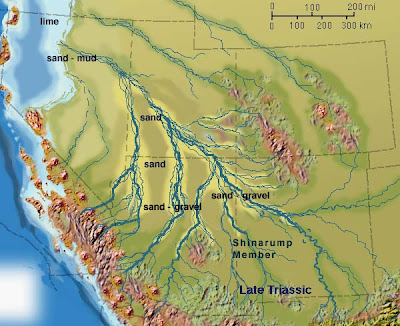
Continuing on our journey through time on the Colorado Plateau, we explore the Chinle Formation, one of the most diverse and distinctive layers in the region. It forms most of the scenery at Petrified Forest National Park, and is ubiquitous in such widespread locales as Capitol Reef and Canyonlands National Parks, Grand Staircase-Escalante National Monument, Zion National Park, and Glen Canyon National Recreation Area. The formation was laid down during the late Triassic, a time of huge changes in the world, especially in the biosphere. It was the age of the earliest dinosaurs, but the world was populated by a host of unusual reptiles and amphibians. The Chinle was an ideal environment for preserving fossils: the shales, siltstones, sandstones and conglomerates were laid down in river floodplains and channels. The headwaters of the rivers were mountains far to the southeast, but a chain of volcanoes to the southwest provided vast amounts of ash to the landscape.

When the Chinle is sandwiched between cliff-forming layers, it forms distinctive lavender and red slopes, but is often covered by debris from the cliffs above. In parts of the Navajo Reservation and the region around Holbrook (known popularly as the Painted Desert), the Chinle forms spectacular badlands topography. The bright colors result from the oxidation of various metal ions in the clay layers, especially iron.


Map courtesy of Ron Blakey of Northern Arizona University

The trees of the Petrified Forest are the most famous fossils of the Chinle. Most of the trees accumulated as logjams in the large rivers that flowed northwest through the region. Some of the logs are as much as 100 feet long. Once buried in mud and ash, silica dissolved from the surrounding rock filled cell spaces or replaced the wood material entirely. Once again, metal oxides provide the striking colors, primarily reds and yellows.

It is pretty amazing that any petrified wood remains in the park. In the early part of the century, trains would stop nearby so people could carry off samples. At least one mining venture sought to grind the wood up into abrasives. Every year park visitors carry off more, but I notice that the National Park Service doesn't discourage the rumor that bad luck befalls those who steal wood. Ironically, people pay huge fines for stealing something that can be picked up free and legally outside the park. Some of the local rock shops even give away free samples.

The Chinle Formation also contains a rich vertebrate fossil record. Phytosaurs and metoposaurs are commonly found, as well as Coelophysis, one of the earliest carnivorous dinosaurs. Hundreds of their remains have been discovered at Ghost Ranch in New Mexico. Plateosaurus and Chindesaurus are two relatively small ancestors of the giant sauropods that dominated the later Mesozoic. A rich assemblage of other fauna and flora have been discovered. A nice review of the paleontology of the Chinle can be found here.

The Chinle has another heritage, a far more insidious one...our next post will explore this in more detail.

Wednesday, August 13, 2008

Mid-week Mystery Sample: What is it? Heck if I actually know!


Well, that just beats all. We community college instructors often revel in the fact that we know a little bit about a lot of things instead of a lot about some specific things, but sometimes it helps to actually know a lot. Back when we found the mystery sample of the Chinle Formation, we wondered if it was a coral, and how a coral could have gotten into the Chinle, which is a terrestrial formation.
As I described in the previous post, I thought I had discovered the answer to the mystery when I saw a metoposaurus in the visitor center at Petrified Forest National Park (shown in the photo above), given the unique pits in the skull plates. The metoposaurs were large carniverous amphibians. I couldn't exactly make my sample line up with any particular part of the skull, but it was an adequate answer for me, the non-expert. In the best tradition of bad science, I didn't continue to explore other hypotheses once I had an answer that satisfied me. That's the kind of attitude that drives me nuts when my students are trying to identify rock and mineral specimens ("it's clear so it must be quartz, even if it cleaves").

Of course, running a blog demonstrates your ignorance to anyone who wants to pay attention, so I say thank you to an actual paleontologist, Jerry Harris, who suggested my sample could also be a phytosaur scute. So I am properly chastised for not covering my bases (y'all notice I could have said I knew it was a phytosaur all along....). I am at the same time happy to find that I might have a piece of phytosaur. They were one of the fierce predators of the Triassic: somewhat crocodile shaped, up to 30 feet long, and overall pretty cool.


Picture from Wikipedia

(This post has been revised)