Why, yes. Yes they did.
About two posts ago, I pointed out that there are some places where the geology is kind of...monotonous. One of those places is the vast sage plain east of Grand Canyon and Flagstaff, around the towns of Holbrook and Winslow (yes,
that Winslow). The land is flat, windy and barren, hardly looking like a place of geological inspiration. And yet it is.
In the last post,
we were stuck in a wayward time machine, emerging in a nightmarish swamp and river floodplain populated by strange and frightening reptiles and other creatures. I asked for help in explaining where and when we were, and the readers responded quickly and accurately (strangely enough, a bunch of readers share the same name: Anonymous!). We had landed in the Triassic Period, about 225 million years ago, in Petrified Forest National Park, Arizona.
Barren plains may be uninteresting to look at and explore, but they make for great transportation corridors, and the land that eventually would become Petrified Forest National Park was the site of a road in the 1860s, a railroad in the 1880s, and a national highway (the legendary Route 66) in the 1920s. The petrified wood was discovered by surveyor
Amiel Whipple and geologist
Jules Marcou, during explorations in the early 1850s (discovered by Europeans, anyway; there are ruins in the park made hundreds of years ago out of petrified wood!).

Once the railroad was constructed, travelers began to visit the area, and many removed huge amounts of petrified wood. There was even a business at one time that was prepared to ground up the "wood" for use as an abrasive. Local people began to fear that the precious mineral would disappear, and they began efforts to establish a national park to protect the resource. The first effort failed in 1895, but the passage of the National Antiquities Act in 1906 led to the proclamation of Petrified Forest National Monument the same year (Congress can establish parks, but the President can proclaim national monuments). It wasn't until 1962 that Congress established the area as a national park. In 2004, the size of the park was more than doubled, to 341 square miles (884 square kilometers). Despite the legal protection, it is estimated that tons of petrified wood are stolen every year. This, despite hefty fines and the easy availability of petrified wood outside the park boundaries.

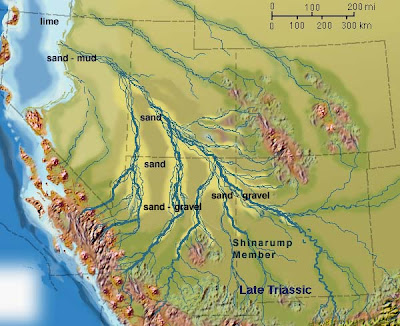
I called the park plain and barren, but that's not at all true. The rocks here have been gently lifted and erosion has exposed the underlying shale, siltstone and mudstone layers into rapidly eroding badlands. Metals in the rock have oxidized into a veritable rainbow of colors. The northern regions of the park are known as the Painted Desert. The rocks are almost exclusively part of a single formation, the Chinle, representing a complex of river channel and floodplain deposits dating from the Triassic. Variations in the rocks have led researchers to organize the rocks in the park into four members: Mesa Redondo, Blue Mesa, Sonsela, Petrified Forest, and Owl Rock. The Chinle (or equivalent rock) is found throughout the southwest. There are something like 50 members identified, and the precise definition of the unit is controversial. To get a sense of the conflict, check out this overview:
http://chinleana.fieldofscience.com/2008/11/chinle-confusion.html
Petrified wood is one of the prettiest of Earth's minerals and rocks.
The wood was originally buried in mud and volcanic ash. As the wood
slowly decayed away, it was replaced by silica (the mineral quartz,
SiO2), and stained by oxides of iron, manganese, copper, and other
metals. The trees, some of which reached heights of 200 feet, are classed into at least three species, and as many as nine.
Araucarioxylon arizonicum is the most common, and as such has been designated as Arizona's state fossil.
It turns out that Petrified Forest National Park preserves far more than fossilized wood. The extensive exposures of the Chinle have provided not dozens, but hundreds of fossil species, and not just plants. The Triassic Period was a pivotal time in the history of the Earth. It was established on the basis of a mass extinction that wiped out some 90% of the species living on the planet. The extinction decimated the dominant reptiles at the time, the mammal-like reptiles, allowing a group of diminutive archosaurs to gain ascendance in the ecosystem. The archosaurs include today's crocodiles and birds, and some relatively famous animals called dinosaurs. The late Triassic deposits of the Chinle contain some of the earliest dinosaurs known, including Coelophysis and
Chindesaurus bryansmalli, a small carnivorous dinosaur found for the first time at Petrified Forest.
The rich fossil record and incredible exposures of the rocks of Chinle provide an important look at a time when the planet was getting back into some kind of ecological balance after the greatest catastrophe of all time. Petrified wood was the original attraction, but the park preserves a significant part of Earth's history.
The protection of the park has revealed another important resource. The explorations of the 1850s were hardly the first incursion of humans into the region. The presence of a secure source of water (the Puerco River) and a prairie environment populated by numerous grazing animals meant that people have lived in the region since the end of the last ice age 13,000 years ago. The park preserves hundreds of archaeological sites, including the ruins of entire villages.
The 2004 additions to the park didn't add all that much in the way of wood resources, but it did include a significantly large area of badlands wilderness in the Painted Desert. It used to be that no camping was allowed in the park, but there is a trackless region in the northwest part of the park now where one can got lost in the past.
So yes, they made a park out of this. For so many good reasons.