Showing posts with label Iridium Anomaly. Show all posts

Sunday, January 7, 2018

Looking Back at Ten Years of Geotripping: "They're, uh...They're Not a Very Exciting People, Those Geologists"

I borrowed the quote in the title from a Cracked.com article (referenced below) as a starting point to some musings about the adventures in life that are possible for people who don't happen to be astronauts or Himalayan mountain-climbers. If there is any theme that has run through my ten years as a geoblogger, it is about the adventures that geologists and geo-fans get to have as a result of having that bit of extra geo-knowledge about the regions and landscapes they see and live in. I've been digging up the archives, and this was one of my favorite posts in 2011...

From May 9, 2011:

What does "adventure" mean to you?
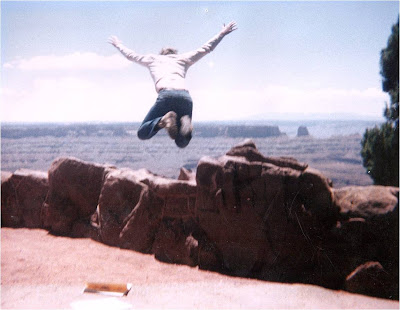
This is an adrenaline rush...
I suppose that an adventure is just about anything that breaks up the routine and exposes you to something new. For a lot of people I am guessing that adventure has a lot to do with an adrenaline rush: I think of motorcycling, rock-climbing, bungee-jumping or rides at an amusement park.

Others may think of adventure as exploration to the outer edges of space, beyond the reach of civilization, of the deep sea, the kinds of adventures that we might read about in National Geographic or history books. But how many people actually participate in that kind of adventure?

Other adventures come out of mythology; the quest, the dangerous journey with an uncertain outcome. We don't see so many of those, but I wonder if a mythological narrative will arise from recent events concerning Osama Bin Laden and those who sought to capture or kill him.

We live most of our adventures through the lives of someone else, in books and movies and so on. The vast majority of us just don't have the resources, or time, or health to be out on the cutting edge of human experience. It's for that reason that I want to talk about learning about geology as an adventure, in all of the best ways and something that almost anyone can do in some way. I think I started musing on this topic because of a cute item from Cracked.com. They do some hilarious stuff, but the last line of this post was, eh, whatever...

"They're, uh ... they're not a very exciting people, those geologists."

I grant you that I am not a very exciting person, in person. But I wouldn't trade my life as a geologist and teacher with anyone. What makes geology such an adventure? I can think of many examples, and here are a few:

Geologic hazards like volcanic eruptions and earthquakes have been fodder for movies and novels for decades. Geologists actually get to study these things as a part of their career. What a thrill to work on the flanks of an active volcano, monitoring and predicting future activity. There is certainly an adrenaline rush when standing next to flowing lava! A nice bonus? They sometimes save lives with their research. The story of the 1991 eruption of Pinatubo in the Phillippines is a nice example. The eruption was the second largest event of the 20th century, and killed some 800 people. On the other hand, tens of thousands of lives were saved because of a timely warning to evacuate the region. This is all the more remarkable considering that during the height of the eruption, a typhoon swept into the island (it was actually the cause of the majority of fatalities). Even bad screenwriters and novelists don't even think to throw typhoons on top of volcanic eruptions!
Have you ever wanted to be on an adventure to find buried treasure? Geologists and rockhounders alike know the thrill of uncovering a rare crystal. It's hard to be in the field all the time without finding the occasional opportunity to search for quartz, garnet, topaz, or any other number of beautiful expressions of atomic-level symmetry. It's the rare geologist who doesn't have a small treasure trove of gemstones (or here) on a mantle or bookcase shelf.

What about that childhood dream of finding a dinosaur? There is nothing quite like uncovering the bones of a creature that lived more than 65 million years ago. If you spend enough time in the right regions of the world, and you have enough geological background to know the age and nature of the rocks you are exploring, you can know that thrill (I'm not talking about a college education; there are geo-guides for the layperson that are full of accessible info about every region of the countryside). It's happened to my students (and myself) a fair number of times over the years. And there's no feeling quite like it. I was whooping like a kid (and promptly called the Utah Geological Survey; there's a right way to do these things).
Did you ever imagine owning a time machine, of traveling back in time? An understanding of the basic principles of geology is the tool geologists use to time-travel. It's effective; a bit of knowledge, and you can lay your hand on the surface that reveals incredible moments in the history of the world. In the picture below, I have my hand on the moment that the dinosaurs went extinct (via one of the most likely hypotheses). It is the iridium layer at Gubbio, Italy, where the Alvarez father and son team discovered evidence of a massive asteroid impact.
In the other photo, we are looking at the moment that the Long Valley Caldera erupted at the north end of the Owens Valley in the Eastern Sierra around 790,000 years ago. More than 125 cubic miles of hot rhyolite ash filled the atmosphere and blanketed the region many feet deep, killing all living things. Do you need a movie to imagine cataclysmic events? It's a whole new experience to lay your hands on the moment that such events actually happened.
A basic understanding of geology enriches one's life. National Parks are nice places to see scenery. A place like Yellowstone is interesting because you see bison and geysers. It is fascinating when you come to understand the nature of the "supervolcano" caldera eruption that produced the rocks and the active magma chamber that causes the geothermal activity. A visit to Yosemite is always nice, but it takes on a whole new dimension when you realize you are walking about inside an ancient volcanic complex not unlike Yellowstone's. You are exploring the underside of a volcano!

During your travels this summer, stop by the visitor center and pick up a "Geology of..." book and read it. It can enrich your experience, and turn a vacation into a real adventure! Or, if you are in the Modesto region, consider taking a summer field study class in geology or archaeology at MJC (more on this soon!).

Monday, April 28, 2014

Where are the Ten Most Incredible Places You've Ever Stood? My Number 7, Gubbio, Italy: Castles, Medieval Town, Roman Arena, Faults, and a Dinosaur Killer

It's not always easy, but travel whenever you can. See as much of the world as possible. I passed on both New Zealand and Hawaii three decades ago for reasons that seem trivial today. I didn't go overseas until 2001, but my life since then has been enriched in ways that I can barely comprehend. Few of us have resources enough to just leave and go somewhere, but there are sometimes cheap alternatives...like a geology field class! Yes, you have to work and stuff, but you will see wonderful things, and you'll be traveling with interesting people.

Number seven on my list of most incredible places is Gubbio, in the Umbrian Province of Italy, between Rome and Florence. What's not to like about Gubbio? It has castles, monasteries, medieval fortresses, Roman arenas, plus active faults and beautiful mountains (the Apennines). Plus one of the most significant geologic outcrops in the world (more on that a moment).
Back in 2007, we conducted a joint anthropology/geology field studies journey through Italy and Switzerland. I had never been to Italy before, so I had a lot of book learning to accomplish before I could lead students in mastering of the geology of the country. And because I had never been there, we had a tour company make the logistical arrangements. They had a canned tour which visited all the famous sites (the Colosseum! the Leaning Tower of Pisa!) and it was sometimes a bit tricky to see some of the important geology (although Pompei was a stunning exception; the trip included a hike to the summit of Vesuvius as well as a tour of the ruins). On the day that we drove from Rome to Florence, there was a scheduled visit to the Basilica of St. Francis of Assisi. 

I suppose that some people would have preferred to see the church, but we had noticed that it wouldn't be much of a diversion off our route to see Gubbio instead. It lies east of the main highway high in the Apennines Mountains, the nearly thousand kilometer range that runs down the boot length of the Italian peninsula. The mountains have risen in response to compressive forces related to a convergent boundary in the Mediterranean Sea. In the vicinity of Gubbio, late Mesozoic and early Cenozoic limestone layers have been lifted high into a mountain ridge. In more recent time, faulting formed the valley containing Gubbio. The downdropped crust is called a graben. The eroded fault scarp above the town is called a triangular facet (much of the town is built on the fault surface; see the top picture). That the faults are still active has been shown in dramatic manner, as several deadly earthquakes have shaken the region in recent decades (one of them severely damaged the Basilica of St. Francis in 1997; the L'Aquila quake in 2009 killed 300 people and resulted in some geologists going to prison).
Gubbio has been a crossroads on the Italian peninsula for thousands of years, and numerous cultures have controlled it at one time or another. Its origin dates back to at least the Bronze Age, and some tablets discovered there contain the most extensive known examples of the Umbrian language. The Romans invaded in the 2nd century BCE, and the Roman theater/arena is the second largest known.
The city became powerful and changed hands often during the Medieval period, being on the main transportation routes of the time, but today it is sort of a backwater town, retaining a great deal of its Medieval heritage, including defensive walls, castles, monasteries and churches. But as interesting as these things were, we were there for something else.

The canyon leading down into the town of Gubbio is called the Bottacioni Gorge, and it cuts deeply into the Cretaceous and Paleogene limestone deposits of the Apennines Mountains. In the late 1970s, the father and son team of Luis and Walter Alvarez were here trying to gain some insight on the rate of extinctions at the end of the Cretaceous period, the mass extinction event that did in the dinosaurs about around two-thirds of the species of life on Earth at the time. They decided to test the marine sediments for concentrations of iridium, an element rare on Earth, but relatively more abundant in meteorites. The values were small, a few parts per trillion, and it was hoped that they might provide data on the rate of sedimentation across the Cretaceous-Paleogene boundary (or the Cretaceous-Tertiary K/T boundary).

They got a big surprise. A clay layer at the boundary exposed in the Bottacioni Gorge spiked at around 3,000 parts per trillion, a huge number. In the years that followed, a similar iridium-enriched clay layer was discovered at numerous sites around the world, and researchers soon suggested that a gigantic asteroid perhaps 6 or 7 miles across hit the planet and ultimate caused the extinction of the dinosaurs and other large creatures.

And here we were, ready to lay our hands on the epic moment recorded in the rock when the way was cleared for mammals to take over terrestrial ecosystems on planet Earth. Except there were a few minor problems. For one, we didn't exactly know precisely where it was. And we didn't know if the spot would be marked or if there would be room to park a bus. And though it seems a minor issue, there were 35 people on the trip, and we didn't know where we were going to eat lunch (as all field trip veterans know, the two most important issues are "where and when do we eat?" and "where is the next bathroom?"). I had figured out that the spot was about 2 kilometers upstream from Gubbio, and that there was some kind of old medieval water canal close by.
So I was on pins and needles watching for the outcrop. The first problem cropped up on the edge of Gubbio. The sign on the road quite clearly said "no buses". Our Italian bus driver solved that problem in fine Italian style by ignoring it and driving right on past. We headed up the gorge, rounded a bend, and there was the canal, but I noted with a sinking heart that we had already passed the outcrop on the narrow road, which was pretty much not appropriate for buses (which is what the sign said, I think...). We drove for an interminable number of kilometers up the canyon (I figured about 80 kilometers, but the reality was probably 10), where the driver found a pullout that might be big enough to turn the bus around in.

Those of you who've seen the Austin Powers chase scene where he has a bit of trouble turning a golf cart around will appreciate what our bus driver did on that mountain road with a narrow pullout and a steep canyon wall. This wasn't a Y-turn. This was a Spiro-graph turn, for those of you who remember that toy. Back and forth for what felt like an hour, but was probably more like five minutes. But it finally happened and we headed back down the canyon.
The outcrop containing the iridium layer was in fact marked with a metal placard and an interpretive sign. We gathered around to have a look.
It was not unexpected I suppose that there would be precious little of the clay layer left at the site. Souvenir hunters have produced a huge cavity in the rock, but still, it was a great moment to lay one's hand on the surface where by most accounts, the dominance of the world by the dinosaurs ended. Medieval stories abound of brave knights sallying forth to slay dragons, but it seems the deed was done some 65 million years before we arrived on the planet.
One could see the drill holes left in the rock by the researchers. It is amazing that such a modest outcrop could contain a few atoms of a substance that could reveal a clue towards solving one of the greatest mysteries of the geologic sciences.
Now about the lunch and bathrooms issue. We had been driving for hours and people were getting hungry and, um, uncomfortable. It turned out that there was a single business in the Bottacioni Gorge, but it happened to be a restaurant, and the owner was quite happy to have a crowd of hungry geologists descend on his establishment. He's been catering to geologists for decades as it turns out, enough so that we were asked to sign the geologists register that was first signed by the Alvarez and his assistants!

And the food? By all accounts, the pasta and mushroom dish was the finest lunch we had on our entire journey. It was delicious! If you ever have the chance to visit the Gubbio locality, plan on eating at the Ristorante Bottacioni.

Monday, May 9, 2011

Living an Adventurous Life: Geologists...Really?

What does "adventure" mean to you?

This is an adrenaline rush...

I suppose that an adventure is just about anything that breaks up the routine and exposes you to something new. For a lot of people I am guessing that adventure has a lot to do with an adrenaline rush: I think of motorcycling, rock-climbing, bungee-jumping or rides at an amusement park.

Others may think of adventure as exploration to the outer edges of space, beyond the reach of civilization, of the deep sea, the kinds of adventures that we might read about in National Geographic or history books. But how many people actually participate in that kind of adventure?

Other adventures come out of mythology; the quest, the dangerous journey with an uncertain outcome. We don't see so many of those, but I wonder if a mythological narrative will arise from recent events concerning Osama Bin Laden and those who sought to capture or kill him.

We live most of our adventures through the lives of someone else, in books and movies and so on. The vast majority of us just don't have the resources, or time, or health to be out on the cutting edge of human experience. It's for that reason that I want to talk about learning about geology as an adventure, in all of the best ways and something that almost anyone can do in some way. I think I started musing on this topic because of a cute item from Cracked.com. They do some hilarious stuff, but the last line of this post was, eh, whatever...

"They're, uh ... they're not a very exciting people, those geologists."

I grant you that I am not a very exciting person, in person. But I wouldn't trade my life as a geologist and teacher with anyone. What makes geology such an adventure? I can think of many examples, and here are a few:

Geologic hazards like volcanic eruptions and earthquakes have been fodder for movies and novels for decades. Geologists actually get to study these things as a part of their career. What a thrill to work on the flanks of an active volcano, monitoring and predicting future activity. There is certainly an adrenaline rush when standing next to flowing lava! A nice bonus? They sometimes save lives with their research. The story of the 1991 eruption of Pinatubo in the Phillippines is a nice example. The eruption was the second largest event of the 20th century, and killed some 800 people. On the other hand, tens of thousands of lives were saved because of a timely warning to evacuate the region. This is all the more remarkable considering that during the height of the eruption, a typhoon swept into the island (it was actually the cause of the majority of fatalities). Even bad screenwriters and novelists don't even think to throw typhoons on top of volcanic eruptions!

Have you ever wanted to be on an adventure to find buried treasure? Geologists and rockhounders alike know the thrill of uncovering a rare crystal. It's hard to be in the field all the time without finding the occasional opportunity to search for quartz, garnet, topaz, or any other number of beautiful expressions of atomic-level symmetry. It's the rare geologist who doesn't have a small treasure trove of gemstones (or here) on a mantle or bookcase shelf.

What about that childhood dream of finding a dinosaur? There is nothing quite like uncovering the bones of a creature that lived more than 65 million years ago. If you spend enough time in the right regions of the world, and you have enough geological background to know the age and nature of the rocks you are exploring, you can know that thrill (I'm not talking about a college education; there are geo-guides for the layperson that are full of accessible info about every region of the countryside). It's happened to my students (and myself) a fair number of times over the years. And there's no feeling quite like it. I was whooping like a kid (and promptly called the Utah Geological Survey; there's a right way to do these things).
Did you ever imagine owning a time machine, of traveling back in time? An understanding of the basic principles of geology is the tool geologists use to time-travel. It's effective; a bit of knowledge, and you can lay your hand on the surface that reveals incredible moments in the history of the world. In the picture below, I have my hand on the moment that the dinosaurs went extinct (via one of the most likely hypotheses). It is the iridium layer at Gubbio, Italy, where the Alvarez father and son team discovered evidence of a massive asteroid impact.
In the other photo, we are looking at the moment that the Long Valley Caldera erupted at the north end of the Owens Valley in the Eastern Sierra around 790,000 years ago. More than 125 cubic miles of hot rhyolite ash filled the atmosphere and blanketed the region many feet deep, killing all living things. Do you need a movie to imagine cataclysmic events? It's a whole new experience to lay your hands on the moment that such events actually happened.
A basic understanding of geology enriches one's life. National Parks are nice places to see scenery. A place like Yellowstone is interesting because you see bison and geysers. It is fascinating when you come to understand the nature of the "supervolcano" caldera eruption that produced the rocks and the active magma chamber that causes the geothermal activity. A visit to Yosemite is always nice, but it takes on a whole new dimension when you realize you are walking about inside an ancient volcanic complex not unlike Yellowstone's. You are exploring the underside of a volcano!

During your travels this summer, stop by the visitor center and pick up a "Geology of..." book and read it. It can enrich your experience, and turn a vacation into a real adventure! Or, if you are in the Modesto region, consider taking a summer field study class in geology or archaeology at MJC (more on this soon!).

Tuesday, January 8, 2008

Picture of the Day


Touching the demise of the dinosaurs? This is the famous outcrop at Gubbio, Italy, where the Alvarez team discovered the iridium anomaly that led to the modern development of the asteroid hypothesis of the extinction of the dinosaurs and other Cretaceous creatures. The layers of limestone above and below the clay layer behind my hand contain very low amounts iridium, on the order of 6-8 parts per trillion, but the clay layer itself is over 3,000 ppt. Iridium is a relatively important constituent of asteroids, but is generally rare in the crust of the earth. Similar anomalies around the world suggest a global event. The issue, of course, is not settled, as other hypotheses explain the iridium as a result of deep mantle source volcanism, and uncertainties exist as to whether the layer actually represents the extinction event.