Showing posts with label Into the Great Unknown. Show all posts

Monday, March 2, 2020

Into the Great Unknown (Redux II): Journeying to my Roots, and to the Roots of Mountains

I was going over some of my old posts about my journey on the Colorado River in 2013 and came across this personal favorite, a post that discussed my own journey into geology back in 1976 during an earlier adventure of discovery in the Grand Canyon, on foot. It also included some of the most beautiful and dramatic rocks I have ever encountered. From August 30, 2013:
The photo above is my favorite self portrait from my journey down the Colorado River, into the Great Unknown. It's true that I appear in only a half dozen of my two thousand pictures from the trip, but this one captures best the sense of wonderment that I felt during the entire 227 mile long boating adventure. It was taken on one of the really special days of the trip, when we reached the ancients roots of a massive mountain range that today is long gone. It was also a day when I explored the roots of my own life adventure as a geologist and teacher.

And a day when I started to pay really close attention to the rapids on the river.

As a passenger on a raft (really, only a fool would allow me access to the oars in any rapid bigger than a riffle), we trust the boatmen. They are the ones who can quickly read and assess a rapid, either by standing up and observing just before entering, or by pulling ashore and scouting from above. They are the ones who make the snap decisions in the midst of chaos, deciding in an instant whether to pull left or right to get by the unexpected hole or pourover or eddy wall. They are the ones who keep their cool when the giant waves threaten to completely envelop the raft and sometimes tip it over (flipping is a highly undesirable outcome in a rapid; there's nothing fun about it at all). We trust them, and when they do their job really well, a passenger can actually become a bit complacent. If we've managed 40 or 50 rapids without problems, well, it can't really be that hard can it? And that's when things can get dicey.

Passengers play an important role in the run of a rapid, so we have to be paying attention as well. It's hard to imagine that pulling the oars makes any difference in the chaos of a rapid, but it does make a big one. Inches sometimes count. And when the raft threatens to flip over, the passengers have to be thinking fast enough to "highside", to fling themselves towards the rising side of the boat during a tip-over, using their weight to hopefully push the boat back towards the horizontal.

Why was I suddenly watching rapids with a renewed interest? We had reached the point on the river where John Wesley Powell was inspired to write one of his most famous passages, the one which also inspired the name of this blog series:

We are now ready to start on our way down the Great Unknown...We are three quarters of a mile in the depths of the earth...We have an unknown distance yet to run, an unknown river yet to explore. What falls there are, we know not; what rocks beset the channel, we know not; what walls rise over the river, we know not.

The next morning he adds:

At daybreak we walk down the bank of the river, on a little sandy beach, to take a view of a new feature in the canyon. Heretofore, hard rocks have given us bad river; soft rocks, smooth water; and a series of rocks harder than any we have experienced sets in. The river enters the granite!

We can see but a little way into the granite gorge, but it looks threatening.

He and the mountain men who served as his crew had already been on the the river system for two months, and with their inadequate clumsy boats had run or portaged many dozens of rapids that were terrifying. They were running very low on food (the diet: unleavened flour, dried apples and rancid bacon). And now the nature of the rocks exposed along the river promised rapids far worse than any they had encountered upstream.
Why were the rapids worse?

Indirectly, it was indeed the harder rocks. They were entering a part of the canyon composed of harder rocks than anywhere else along the river. It isn't the rocks themselves that make bad rapids, though. The river does not fall over ledges and waterfalls. Rapids on the Colorado River happen because of debris flows that enter the channel from the small tributary canyons. The debris in essence dams the river and forces the river channel to the side, making the cross-sectional area of the channel much smaller. Since the same amount of water in a river passes a given point in a given amount of time (cubic feet per second is one measure), the river must speed up to pass the barrier. You can see this effect in the picture above in Nevill's Rapid.

The severity of a rapid is determined by the volume and size of the boulders in the debris flows, and canyons cut into harder rocks produce larger boulders. Sprinkling a few giant boulders throughout a rapid turns a riffle into a terrifying roller coaster ride.
So that was the day we were facing. We would be entering the Granite Gorge of the Grand Canyon for the first time, and we would now need to run a gauntlet of the biggest rapids to be found on the entire river. It started with Hance (8 on a scale of 10), Sockdolager (7), and Grapevine (7). The next day would include Horn Creek (9). The day after that, Granite (8), Hermit (8), and the ultimate rapid, Crystal (10). These would be followed the same day by the seven rapids of the gemstones (Agate, Sapphire, Turquoise, Emerald, Ruby and Serpentine, ranging from 5 to 7). And 70 miles downstream (with plenty more rapids in-between) Lava Falls (10) awaited our arrival.
We came around a bend in the river, and I encountered a familiar sight in the midst of the Great Unknown. I had been here before! Not on a river rafting expedition, but on a backpacking trip in 1976. It had been one of the most important events in my young life, because it was the trip that set me on the road to becoming a geologist and teacher.

Geology of the Grand Canyon was actually one of the more difficult courses I had ever taken because not only did we need to master a lot of geology in a short time, but we also had to prepare for a challenging backpack down and then back up a series of officially unmaintained trails in the canyon (the New Hance and Grandview trails). The co-requisite for the class was a 2 unit physical education course in backcountry camping that including an entirely separate shakedown trip in the mountains of Southern California. When I came out of the Grand Canyon six days later I knew what I wanted to do with my life.

Of course, a few things have changed since 1976. Geotripper weighs, um, a lot more than that gawky teenager on the right in the picture below. Picture quality has improved, not so much because of better photographers, but it used to be expensive to take and develop pictures, so we never took very many. Plus we were using the old Kodak Instamatic cameras or something similar.

Still, seeing these pictures a few years ago on Facebook (thanks to J. Elson) brought a shock of memories, and now for the first time in forty years I was once again standing at the rapid that made a geologist out of me.
Only this time my mind was on other things. Back then when we finished, we turned around and started hiking back out of the canyon.
We were about to run a major Grand Canyon rapid in boats that suddenly seemed really small. Just like these river rafters in 1976. I noticed that the two biggest boulders haven't moved, and that the rapid was as chaotic looking as ever.

We had reached the base of the Grand Canyon Supergroup, and could now see the three formations that make up the oldest units: the Shinumo Quartzite, the bright red Hakatai Shale, and the basal Bass Limestone (intruded by basaltic dikes). The rocks are tilted about 15 degrees, giving the illusion that the river gradient is even steeper than it already seems. It can't have been a comforting sight to Powell and his men in 1869.

The Grand Canyon Supergroup sits on a mountain range of Andean proportions. Or more properly stated, the layers were deposited on the low erosional plain left behind when a mountain range of Andean proportions was completely washed away. The black schists and reddish granite intrusions once lay some five miles deep in the crust, and now they have been laid bare by the cutting of the Grand Canyon.

The rocks today are called the Granite Gorge Metamorphic Suite, and they formed in a series of collisions between a group of volcanic islands (called terranes), and the ancient North American continent around 1.7 billion years ago. The metamorphic schist and gness units were intruded by granitic magmas at intervals between 1.7 and 1.4 billion years ago. And now those rocks are exposed in the very deepest part of the Grand Canyon.
We successfully negotiated Hance Rapid (not without getting positively soaked), and looking back upstream, I could see the basalt dike that I had found so utterly fascinating on my first trip into the canyon.
The canyon was dark, but I did not feel as sense of brooding. I was exhilarated, my imagination seeing the peaks and canyons that must have existed here in the distant past, mountain slopes which would have been utterly lifeless and barren. Deep gorges must have been cut by rushing rivers that were never seen by any living thing. Entire Grand Canyons could have been carved here and we will never know of their existence. We now entered a fascinating world of exceedingly rugged vertical canyon walls. The silt and sand polished the hard granite and metamorphic rock.

Sockdolager Rapid (the word is an archaic term for knockout blow in boxing) was a fun ride, nothing like the terror-filled lining and portage in Powell's writings.

It was hard to find a spot to scout, so the boatmen checked out the rapid by standing up as they approached.
Between rapids the river was calm, and the canyon walls rose straight from the water.
The metamorphic suite was composed of the most diverse and beautiful rocks that I had seen anywhere on the trip. The polishing simply added to the beautiful sculpted appearance of the rock.
We arrived at camp in Cremation Canyon by 2:30. We had pulled in early because we would be saying goodbye to three of our fellow travelers who would be hiking out of the canyon from Phantom Ranch, and meeting three others who would take their place for the remainder of our journey.

I turned in early once again...tomorrow we faced the biggest rapids so far on the trip.

Saturday, February 29, 2020

Into the Great Unknownn (Redux): A Journey Down the Colorado River Through the Grand Canyon

As some of you remember, I took a rafting trip down the Colorado River through the Grand Canyon in 2013 with my brother's family. I later did an extended blog series on the journey, and I've compiled the posts in their original order, so you can follow whole story in one place.


I've been reliving the journey in my mind these last couple of weeks because I just finished an outstanding book called "The Emerald Mile" by Kevin Fedarko. It describes an epic river journey during the singular flood event on the Colorado River that nearly destroyed Glen Canyon Dam. Instead of just being about the race down the river, it is a fascinating history of the exploration of the Colorado and the "taming" of the river by the giant (yet vulnerable) dams that were placed in its path. And it is a nail-biter of a narrative about the efforts of engineers to contain a failing dam in the face of an unprecedented flood (there are echoes of the more recent near-disaster at Oroville Dam here in California a few years ago).
The story resonated with me for so many reasons, not the least of which is that I was imperiled by the insane raging waters of Crystal Rapid, though not at the crazy flows of 1983. I found myself reliving so many aspects of my journey down the river.

The Colorado River through the Grand Canyon is both a tourist "bucket list" thing that has become very popular (and therefore potentially dangerous for those who underestimate the river), but it also is a journey of the spirit and body through one of the great wilderness areas left on Earth.

Here are the posts...

Rafting the Colorado River: This is the original post in the series, explaining how I got there, and what I was feeling about a journey that I waited forty years to complete.

Everything you wanted to know about rafting on the Grand Canyon but were afraid to ask: A description of what's involved in a 16 day journey on a river with no stores, bathrooms or trashcans.

Cloudburst (x2)! And Off We Go: Two intense thunderstorms give us a muddy sendoff down the river. Page and other towns got pounded that week by flooding.

Passing through the Permian Period: Our first day on the river takes us through the upper layers of the Grand Canyon, the Permian-aged Kaibab, Toroweap, Coconino and Hermit formations.


Whodunnit? A Mountain Range Goes Missing: The Hermit Formation and Supai Group provide evidence of the existence of a long-eroded mountain in southwest Colorado. And I row a raft for the first time!

Visions of Paradise and a Bug's Horror: We enter Marble Canyon, dominated by the beautiful cliffs and caverns of the Redwall Limestone. A beetle has a tough day.

Exploring 300 million year old and 50 year old caves (and some fossil hunting): We explore Nautiloid Canyon and an exhumed Paleozoic cavern. We also see evidence of a bone-headed plan to dam Marble Canyon. It would have been an unspeakable crime...

Looking for the Rivers within the Rivers of Marble Canyon: The Devonian Period is represented only by the Temple Butte Formation and the exposures are discontinuous because they were originally only the fill within eroded stream valleys. Plus a cool side trip to a small waterfall.

We interrupt this scenery for a very recent flash flood and a biological disaster: The cloudbursts we experienced a few days earlier caused some flooding in the side canyons. And a look at the tamarisk tree, an invasive species.

Catching an Iconic Scene in the Grand Canyon, and a Bi-Colored River: The small Ancestral Puebloan granaries above Nankoweap Canyon are one of the more famous sights on the river, but oh, what a climb! And floodwaters in the Little Colorado change the color of the main river.

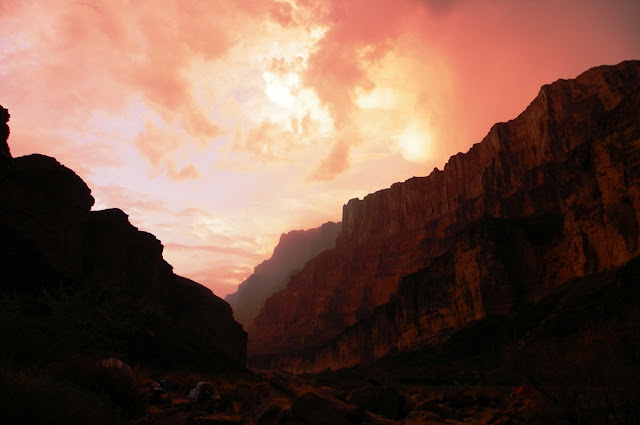
Living in a Thomas Moran Painting, and Through a Canyon Storm: A passing storm gives the canyon a dreamy impressionistic look. I get my favorite picture, and I don't get overly wet; there were too many gigantic boulders to cower under.

In the depths of the Grand Canyon there are three more Grand Canyons...Checking out the Supergroup: There is around 12,000 feet of ancient sediments and volcanic intrusions tucked in the deepest parts of the canyon, and they are only accessible by river or long hot hikes. We give them a look.

Journeying to my Roots, and to the Roots of Mountains: We reach some of the monster rapids, including Hance. It was here in 1976 that I was becoming a geology major on my very first field studies class. Who is that gawky thin kid?

Exploring the Heart of a Long-Gone Mountain Range (and words from home): In the bottom of the Grand Canyon there are the roots of a huge mountain range that formed before complex life even existed on our planet. And I hear words from home for the first time in week.

We Run the Big Rapids, Sometimes in Rafts: We run three of the biggest rapids on the Colorado River. I experience something I haven't felt in a long time: terror. We flipped on the biggest rapid and I took a long cold swim through the 10-foot waves and the Rock Garden.

The Aftermath of Chaos...Finding Beauty in the Oldest Rocks of Grand Canyon: The Granite Gorge was a terror-filled place for John Wesley Powell and his men in 1869, but for me on a day after the rapids disaster it was a beautiful place.

The Hidden Places and Putting a Hand Across 1.2 Billion Years: Every side canyon in the Grand Canyon holds a treasure. We visited two, the Elve's Chasm and Blacktail Canyon, and we laid our hands across 1.2 billion years at the Great Unconformity. We also met with a herd of bighorn sheep.

Crossing the Great Unconformity Again...But Which One? There are really two major unconformities in the depths of the canyon (and more than a dozen more minor ones). We got a glimpse of the angular unconformity, and explored the billion year old sills, intrusions of basaltic rock that lined the canyon for a few miles.

A Gigantic Failure Produces One of the Most Beautiful Sights in the Grand Canyon: Slope failure and landslides had as much to do with the formation of the Grand Canyon as the Colorado River. At Deer Creek, a landslide produced one of the most beautiful canyons and waterfalls in the entire canyon.

Mad Cats and Amoebas? Trying to Keep Names Straight in the Grand Canyon: Not many people saw this post for some reason, but Matkatamiba Canyon is one of the prettier side canyons on the river, and one of the favorites of the veterans of previous river trips.

"Disaster" in National Canyon, and the Volcanoes of Grand Canyon: An unbelievable flood last year, and an unbelievable amount of basalt lava in Grand Canyon. And just like that we are facing Lava Falls, the single worst rapid on the river, in turbulence if not length.

Zero Hour at Lava Falls: A story of courage, redemption and the triumph of the human spirit? No. I tried to ride Lava Falls in a raft, but had to swim instead. Involuntarily. See the video version!

Vulcan the fire god says "You call that little piece of concrete a dam?: Lava dams in the Grand Canyon may have stood 2,000 feet high, and may have backed up dams for three hundred miles or more upstream.

Heat...and All Things Beautiful: It was post-Lava Falls, and one of the hottest days we had on the river. And the beauty surrounded us, in the water, in the cliffs, and in the animals.

The Last Day...An Elegy for a Journey, and for a River: I didn't want to leave. The last two miles on the river were the most precious of all, drifting slowly in the current. And then it was over. We derigged and made our ways to our homes, and the Colorado just rolled on.

Wednesday, January 10, 2018

A Look at Ten Years of Geotripping: Into the Great Unknown...Blogging About the Greatest Adventure

The Greatest Adventure...

Life is funny. Experiences and events will sneak up on you, and you'll look back and say that was incredible. Sometimes you finally get a chance to see a place for the first time, and it turns out to be awesome. But then there are the moments you know will be the greatest moments of your life, and it actually turns out that way. I'll not minimize the important days like marriages, births, graduations, and those other life events, but I know now precisely what the greatest adventure was that I ever had, and quite possibly will ever have. It was the journey into the Great Unknown, a 17 day raft trip down the Colorado River through Grand Canyon National Park. Shortly afterwards I wrote the blog series that described the trip, and if I may say so, I feel it was some of the finest writing I've done on Geotripper (opinions of course may differ). I can at least say that upon revisiting the posts after four years, they represent well my experience of rafting that grand river in both the beautiful moments, and in those that were terrifying. So, if you haven't seen it before, enjoy!

From September 26, 2013...

As many of you know, I recently ended a rafting trip down the Colorado River through the Grand Canyon. I just finished a blog series on the journey, and what I've done here is to list the posts in their original order, so that if you want to catch the whole story in one place, this is where you want to start!

Rafting the Colorado River: This is the original post in the series, explaining how I got there, and what I was feeling about a journey that I waited forty years to complete.

Everything you wanted to know about rafting on the Grand Canyon but were afraid to ask: A description of what's involved in a 16 day journey on a river with no stores, bathrooms or trashcans.

Cloudburst (x2)! And Off We Go: Two intense thunderstorms give us a muddy sendoff down the river. Page and other towns got pounded that week by flooding.

Passing through the Permian Period: Our first day on the river takes us through the upper layers of the Grand Canyon, the Permian-aged Kaibab, Toroweap, Coconino and Hermit formations.


Whodunnit? A Mountain Range Goes Missing: The Hermit Formation and Supai Group provide evidence of the existence of a long-eroded mountain in southwest Colorado. And I row a raft for the first time!

Visions of Paradise and a Bug's Horror: We enter Marble Canyon, dominated by the beautiful cliffs and caverns of the Redwall Limestone. A beetle has a tough day.

Exploring 300 million year old and 50 year old caves (and some fossil hunting): We explore Nautiloid Canyon and an exhumed Paleozoic cavern. We also see evidence of a bone-headed plan to dam Marble Canyon. It would have been an unspeakable crime...

Looking for the Rivers within the Rivers of Marble Canyon: The Devonian Period is represented only by the Temple Butte Formation and the exposures are discontinuous because they were originally only the fill within eroded stream valleys. Plus a cool side trip to a small waterfall.

We interrupt this scenery for a very recent flash flood and a biological disaster: The cloudbursts we experienced a few days earlier caused some flooding in the side canyons. And a look at the tamarisk tree, an invasive species.

Catching an Iconic Scene in the Grand Canyon, and a Bi-Colored River: The small Ancestral Puebloan granaries above Nankoweap Canyon are one of the more famous sights on the river, but oh, what a climb! And floodwaters in the Little Colorado change the color of the main river.

Living in a Thomas Moran Painting, and Through a Canyon Storm: A passing storm gives the canyon a dreamy impressionistic look. I get my favorite picture, and I don't get overly wet; there were too many gigantic boulders to cower under.

In the depths of the Grand Canyon there are three more Grand Canyons...Checking out the Supergroup: There is around 12,000 feet of ancient sediments and volcanic intrusions tucked in the deepest parts of the canyon, and they are only accessible by river or long hot hikes. We give them a look.

Journeying to my Roots, and to the Roots of Mountains: We reach some of the monster rapids, including Hance. It was here in 1976 that I was becoming a geology major on my very first field studies class. Who is that gawky thin kid?

Exploring the Heart of a Long-Gone Mountain Range (and words from home): In the bottom of the Grand Canyon there are the roots of a huge mountain range that formed before complex life even existed on our planet. And I hear words from home for the first time in week.

We Run the Big Rapids, Sometimes in Rafts: We run three of the biggest rapids on the Colorado River. I experience something I haven't felt in a long time: terror. We flipped on the biggest rapid and I took a long cold swim through the 10-foot waves and the Rock Garden.

The Aftermath of Chaos...Finding Beauty in the Oldest Rocks of Grand Canyon: The Granite Gorge was a terror-filled place for John Wesley Powell and his men in 1869, but for me on a day after the rapids disaster it was a beautiful place.

The Hidden Places and Putting a Hand Across 1.2 Billion Years: Every side canyon in the Grand Canyon holds a treasure. We visited two, the Elve's Chasm and Blacktail Canyon, and we laid our hands across 1.2 billion years at the Great Unconformity. We also met with a herd of bighorn sheep.

Crossing the Great Unconformity Again...But Which One? There are really two major unconformities in the depths of the canyon (and more than a dozen more minor ones). We got a glimpse of the angular unconformity, and explored the billion year old sills, intrusions of basaltic rock that lined the canyon for a few miles.

A Gigantic Failure Produces One of the Most Beautiful Sights in the Grand Canyon: Slope failure and landslides had as much to do with the formation of the Grand Canyon as the Colorado River. At Deer Creek, a landslide produced one of the most beautiful canyons and waterfalls in the entire canyon.

Mad Cats and Amoebas? Trying to Keep Names Straight in the Grand Canyon: Not many people saw this post for some reason, but Matkatamiba Canyon is one of the prettier side canyons on the river, and one of the favorites of the veterans of previous river trips.

"Disaster" in National Canyon, and the Volcanoes of Grand Canyon: An unbelievable flood last year, and an unbelievable amount of basalt lava in Grand Canyon. And just like that we are facing Lava Falls, the single worst rapid on the river, in turbulence if not length.

Zero Hour at Lava Falls: A story of courage, redemption and the triumph of the human spirit? No. I tried to ride Lava Falls in a raft, but had to swim instead. Involuntarily. See the video version!

Vulcan the fire god says "You call that little piece of concrete a dam?: Lava dams in the Grand Canyon may have stood 2,000 feet high, and may have backed up dams for three hundred miles or more upstream.

Heat...and All Things Beautiful: It was post-Lava Falls, and one of the hottest days we had on the river. And the beauty surrounded us, in the water, in the cliffs, and in the animals.

The Last Day...An Elegy for a Journey, and for a River: I didn't want to leave. The last two miles on the river were the most precious of all, drifting slowly in the current. And then it was over. We derigged and made our ways to our homes, and the Colorado just rolled on.

Thursday, September 26, 2013

Into the Great Unknown: A Journey Down the Colorado River Through the Grand Canyon (a compilation)

As many of you know, I recently ended a rafting trip down the Colorado River through the Grand Canyon. I just finished a blog series on the journey, and what I've done here is to list the posts in their original order, so that if you want to catch the whole story in one place, this is where you want to start!

Rafting the Colorado River: This is the original post in the series, explaining how I got there, and what I was feeling about a journey that I waited forty years to complete.

Everything you wanted to know about rafting on the Grand Canyon but were afraid to ask: A description of what's involved in a 16 day journey on a river with no stores, bathrooms or trashcans.

Cloudburst (x2)! And Off We Go: Two intense thunderstorms give us a muddy sendoff down the river. Page and other towns got pounded that week by flooding.

Passing through the Permian Period: Our first day on the river takes us through the upper layers of the Grand Canyon, the Permian-aged Kaibab, Toroweap, Coconino and Hermit formations.


Whodunnit? A Mountain Range Goes Missing: The Hermit Formation and Supai Group provide evidence of the existence of a long-eroded mountain in southwest Colorado. And I row a raft for the first time!

Visions of Paradise and a Bug's Horror: We enter Marble Canyon, dominated by the beautiful cliffs and caverns of the Redwall Limestone. A beetle has a tough day.

Exploring 300 million year old and 50 year old caves (and some fossil hunting): We explore Nautiloid Canyon and an exhumed Paleozoic cavern. We also see evidence of a bone-headed plan to dam Marble Canyon. It would have been an unspeakable crime...

Looking for the Rivers within the Rivers of Marble Canyon: The Devonian Period is represented only by the Temple Butte Formation and the exposures are discontinuous because they were originally only the fill within eroded stream valleys. Plus a cool side trip to a small waterfall.

We interrupt this scenery for a very recent flash flood and a biological disaster: The cloudbursts we experienced a few days earlier caused some flooding in the side canyons. And a look at the tamarisk tree, an invasive species.

Catching an Iconic Scene in the Grand Canyon, and a Bi-Colored River: The small Ancestral Puebloan granaries above Nankoweap Canyon are one of the more famous sights on the river, but oh, what a climb! And floodwaters in the Little Colorado change the color of the main river.

Living in a Thomas Moran Painting, and Through a Canyon Storm: A passing storm gives the canyon a dreamy impressionistic look. I get my favorite picture, and I don't get overly wet; there were too many gigantic boulders to cower under.

In the depths of the Grand Canyon there are three more Grand Canyons...Checking out the Supergroup: There is around 12,000 feet of ancient sediments and volcanic intrusions tucked in the deepest parts of the canyon, and they are only accessible by river or long hot hikes. We give them a look.

Journeying to my Roots, and to the Roots of Mountains: We reach some of the monster rapids, including Hance. It was here in 1976 that I was becoming a geology major on my very first field studies class. Who is that gawky thin kid?

Exploring the Heart of a Long-Gone Mountain Range (and words from home): In the bottom of the Grand Canyon there are the roots of a huge mountain range that formed before complex life even existed on our planet. And I hear words from home for the first time in week.

We Run the Big Rapids, Sometimes in Rafts: We run three of the biggest rapids on the Colorado River. I experience something I haven't felt in a long time: terror. We flipped on the biggest rapid and I took a long cold swim through the 10-foot waves and the Rock Garden.

The Aftermath of Chaos...Finding Beauty in the Oldest Rocks of Grand Canyon: The Granite Gorge was a terror-filled place for John Wesley Powell and his men in 1869, but for me on a day after the rapids disaster it was a beautiful place.

The Hidden Places and Putting a Hand Across 1.2 Billion Years: Every side canyon in the Grand Canyon holds a treasure. We visited two, the Elve's Chasm and Blacktail Canyon, and we laid our hands across 1.2 billion years at the Great Unconformity. We also met with a herd of bighorn sheep.

Crossing the Great Unconformity Again...But Which One? There are really two major unconformities in the depths of the canyon (and more than a dozen more minor ones). We got a glimpse of the angular unconformity, and explored the billion year old sills, intrusions of basaltic rock that lined the canyon for a few miles.

A Gigantic Failure Produces One of the Most Beautiful Sights in the Grand Canyon: Slope failure and landslides had as much to do with the formation of the Grand Canyon as the Colorado River. At Deer Creek, a landslide produced one of the most beautiful canyons and waterfalls in the entire canyon.

Mad Cats and Amoebas? Trying to Keep Names Straight in the Grand Canyon: Not many people saw this post for some reason, but Matkatamiba Canyon is one of the prettier side canyons on the river, and one of the favorites of the veterans of previous river trips.

"Disaster" in National Canyon, and the Volcanoes of Grand Canyon: An unbelievable flood last year, and an unbelievable amount of basalt lava in Grand Canyon. And just like that we are facing Lava Falls, the single worst rapid on the river, in turbulence if not length.

Zero Hour at Lava Falls: A story of courage, redemption and the triumph of the human spirit? No. I tried to ride Lava Falls in a raft, but had to swim instead. Involuntarily. See the video version!

Vulcan the fire god says "You call that little piece of concrete a dam?: Lava dams in the Grand Canyon may have stood 2,000 feet high, and may have backed up dams for three hundred miles or more upstream.

Heat...and All Things Beautiful: It was post-Lava Falls, and one of the hottest days we had on the river. And the beauty surrounded us, in the water, in the cliffs, and in the animals.

The Last Day...An Elegy for a Journey, and for a River: I didn't want to leave. The last two miles on the river were the most precious of all, drifting slowly in the current. And then it was over. We derigged and made our ways to our homes, and the Colorado just rolled on.