Showing posts with label Glass Mountain. Show all posts

Thursday, May 17, 2018

Airliner Chronicles: Do You Know California's Biggest Volcano? You May Be Surprised at the Answer

The summit complex of Medicine Lake Highland, with Glass Mountain at the top, the Medicine flow center-left, and Medicine Lake at center-right.
It's a real problem for a geologist to be flying through cloud cover. One loses track of time and location so when an opening in the clouds occurs, one cannot know for sure where one is. I can pick out the essential geologic details a lot of the time, but without temporal or spatial context, I can't recognize even some of the most familiar places that I've visited many times. That's what happened last Thursday when I was flying to SeaTac. I lost sight of the ground only a few minutes out of Sacramento, and when the ground reappeared again, I was totally fooled by the scenes in these pictures. I thought I might be over Newberry Crater in Oregon, but I couldn't place Paulina Lake with the steep ridge that should have been to the right in the picture above. So I figured it must be some place in the Three Sisters area that I wasn't familiar with. But then I got home and looked at the pictures on the computer instead of the camera. I was wrong.
The Medicine Flow dates to about 2,000 years ago. It is composed of thick dacite lava flows. Frozen Medicine Lake is to the right.


It turns out I was flying right over the top of California's biggest volcano. Mt. Shasta is California's most prominent volcano, rising to 14,162 feet above sea level. It's the largest stratovolcano in the entire Cascades chain, with more bulk than even Mt. Rainier, which we looked at in our previous post.

[At this point there is a bit of uncomfortable shuffling in the back of the room as a few of the geologists look at each other and start mumbling something unintelligible.

"Ahem, is there something you would like to add to the discussion?" I say.

"But we've seen Mt. Shasta, and it looks nothing like that".

"And you would be right" I say, "but give me a chance to finish". They relent.]

But this isn't Mt. Shasta. It may be the tallest volcano in California, and it may be the biggest stratovolcano in the Cascades, but we are forty miles northeast of Shasta, looking at an entirely different kind of volcano. It's a shield volcano called Medicine Lake Highland. Although it is not even 8,000 feet high, it is much wider, with a total volume of around 130 cubic miles, compared to about 108 cubic miles for Mt. Shasta.

The view from the ground shows a gently sloping edifice covered by a variety of cinder cones and plug domes. Medicine Lake Highland (MLH)is shield-shaped like the giant volcanoes that make up the Hawaiian Islands, and is composed in large part of basalt, the fairly non-viscous lava that can flow for long distances before congealing. But MLH is different in some important ways. Some of the magma chambers beneath the volcano originate in the crust rather than the mantle (dacite or rhyolite), and the silica-rich lavas that erupt at the surface are sticky and barely flow at all.
MLH is an active volcano. There have been at least 17 eruptions in the last 11,000 years, and the Glass Mountain flow (below) erupted only about 850 years ago. There are areas of geothermal activity that have been proposed for energy development, but these have been rebuffed so far (thank goodness).
Glass Mountain at the top of Medicine Lake Highland. The flow dates to 850-900 years before present.

The top of the shield complex is a caldera (a sunken crater-like depression caused by the inward collapse of the top of the volcano). It is about the size of the Crater Lake Caldera, but is not nearly as rugged, as it is many thousands of years older and has been partially filled with subsequent lava flows. Medicine Lake sits within the caldera, but is not volcanic in origin. During the ice ages, glaciers scoured the summit area of MLH and left behind some impermeable clay deposits that prevent water from sinking into the ground (there are very few streams or rivers on the volcano, as it is highly porous; massive springs are found around the base of the volcano.).

One of America's most interesting national monuments is found on the north flank of MLH. Lava Beds National Monument preserves more than 75 miles of underground lava tubes, one of the highest concentrations of such caves in North America (and maybe in the world). The park also preserves the memory of the last stand of the Modoc people in their struggle against the U.S. military in the 1870s. They held out for months in the barren lava flows but were finally betrayed and captured. The Modoc people survive, but much of their cultural history was lost when they were banished to Oklahoma.

The clouds soon closed in again and I saw nothing more until we were over Washington.

Friday, October 18, 2013

Scenes from a Shield: Isn't This Supposed to be Basalt?

Medicine Lake Highland (from an earlier trip when it wasn't covered with storm clouds).
Medicine Lake Highland at first glance sure looks like a classic version of a shield volcano. The gently sloping flanks indicate the presence of non-viscous basaltic lava, and the lava tubes we explored were certainly composed of basalt. As we moved further up the flanks of the mountain we encountered tree molds (those were the mystery holes in the previous post, as Lockwood correctly surmised) that also occur in basalt flows. By the time we reached the summit of the volcano and the caldera at Medicine Lake we were starting to see different kinds of lava. Some gray colored andesite could be seen on the north flank of the caldera.

The most striking kind of lava was what we saw at Glass Mountain, the most recent lava flow on the mountain, dating to only 900 years ago.

Everything about Glass Mountain is a complete contrast to basalt. The steep debris-covered flanks of Glass Mountain show that the lava flow was highly viscous and barely able to flow at all. The light color of the lava contrasts sharply with the black of basalt. The mountain is composed mostly of obsidian and pumice, glassy rocks that usually have a chemical composition equivalent to rhyolite.  
Glass Mountain is a typical example of a plug dome. Such volcanoes are small, usually no more than a thousand feet tall, with steep rubble-covered sides. The lava flows from the cone are rarely very long, and are thick and very rugged.

One might wonder what rhyolite is doing on the summit of a gigantic basaltic shield volcano. Such things are not usually seen on Hawaiian shields, for instance. A bit of information about the melting points of minerals and the composition of the crust can help us to understand what happened on Medicine Lake Highland.

The minerals found in basalt have high melting points. For basalt to be in a liquid state requires temperatures of 2,000 °F or more. Rhyolite on the other hand contains minerals that melt at lower temperatures, maybe in the range of 1,300 °F.

Oceanic crust is essentially composed of basaltic rock. Continental crust is more granitic in composition, and granite is what you get if rhyolite cools very slowly (granite and rhyolite are made of the same minerals, in other words).

Medicine Lake Highland is situated on the diffuse boundary between the Cascades Province and the Basin and Range, a region that is being stretched or extended in an east-west direction. The extension is causing faults to form in the crust, and the faults are allowing basalt to approach the surface from its source in the Earth's mantle. The basalt magma, as noted, is very hot.

As the basalt rises through the thick granitic crust, the intense heat causes melting of the granite, and magma chambers form that are composed of rhyolite. The basalt and rhyolite magmas don't play well together, and don't readily mix. As a result, some eruptions are basaltic, and others rhyolitic. This phenomenon is called bimodal volcanism.

Many people don't realize that pumice and obsidian are the same thing: volcanic glass. They are the same in the way that root beer and the foam on the root beer are the same. It's all root beer, but the foam is full of air bubbles. A bit of exploration on the flow at Glass Mountain revealed intriguing flow structures with interlayered pumice and obsidian.

We finished our exploration of Glass Mountain and headed down the heavily wooded south flank of Medicine Lake Highland. Brief views through the trees offered wonderful vistas of the surrounding terrain of the Modoc Plateau.

Medicine Lake is not a "typical" Cascades volcano like Rainier or Shasta but there is at least one other massive shield complex to the north in Oregon at Newberry Crater. Both are famous for their obsidian domes.

We had one more stop for the day, on the Giant Crater Flow, a basalt flow that is comparable to the Mammoth Crater flow that produced the lava tubes in Lava Beds National Monument. One tube system from Giant Crater extends for fourteen miles down the south flank of the Highland. At Jot Dean Cave, there was an extraordinary exposure of ice.

Jot Dean Cave doesn't seem to extend all that far, or at least none of us wanted to find out. The reason is the rather steep slope at the edge of darkness that is completely covered with very slick ice, even in late September. The strangest part is the huge mass of ice on the left side of the entrance that refracts light from the outside and seem to glow internally. It's actually kind of eerie; I imagined that the ice had formed around some poor spelunker and his light was still glowing...

We got back into the vehicles and headed towards our camp for the evening at one of California's most beautiful state parks.

Saturday, January 9, 2010

The Other California: Geologists Who Live on Glass Mountains Shouldn't...(fill in moral)

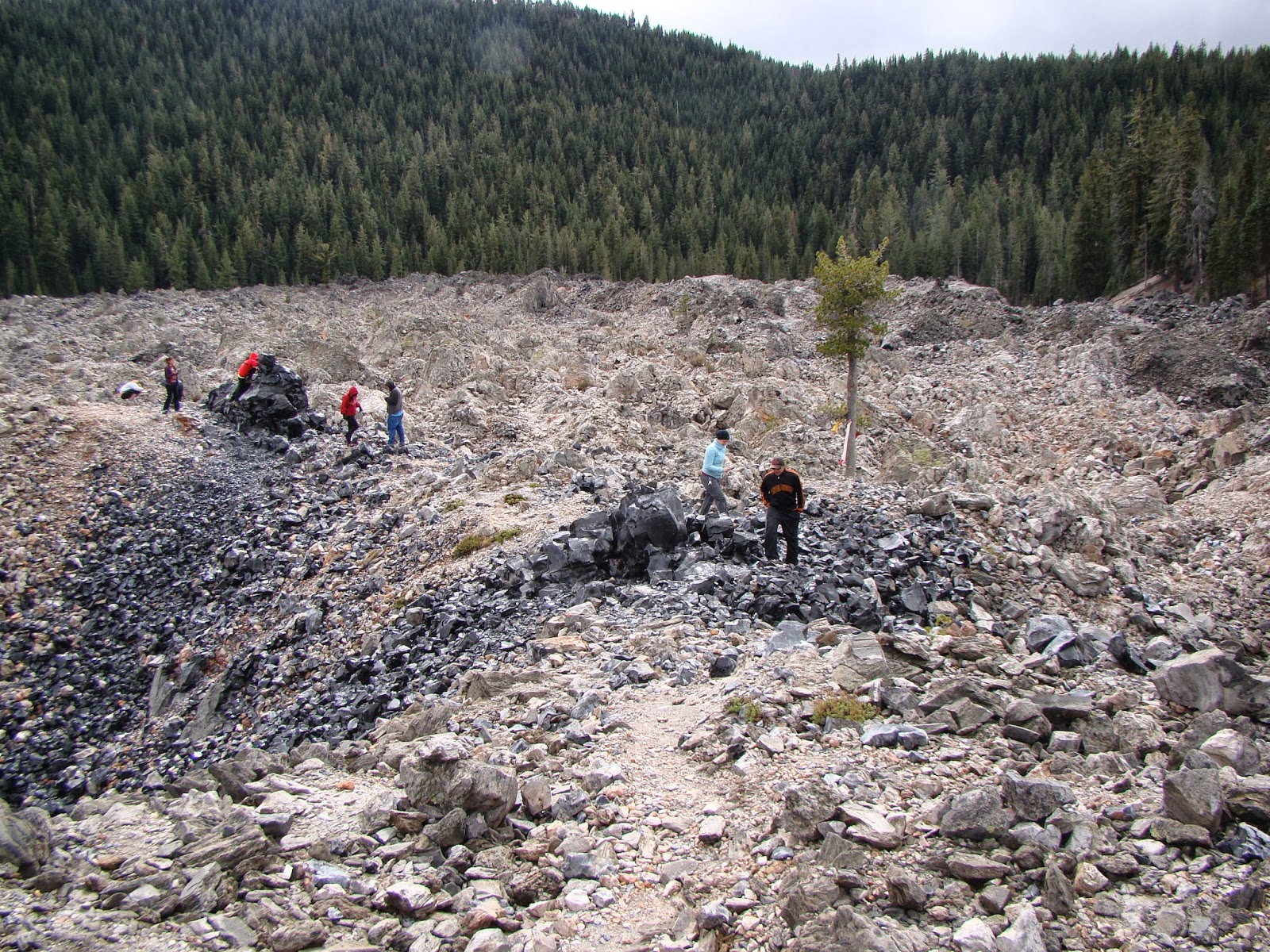
Oh, come on, who of you hasn't done the manly-man or womanly-woman thing when confronted with a mountain of pumice boulders? That's one of the cool things a person can do when visiting one of California's unknown corners, Medicine Lake Highland, the biggest volcano in the state.

In the previous post about the volcano, we were exploring the varieties of non-viscous basaltic lavas, the so-called a'a and pahoehoe flows. Basalt is a silica-poor volcanic rock that is usually derived from melting below the crust in the earth's mantle. In places like Hawaii, basalt is essentially all one will find. Medicine Lake Highland sits on silica-rich continental crust, and hot magmas rising from the mantle mix and melt the continental crust, forming a variety of more silica enriched lavas, such as andesite or rhyolite. These are the lavas that lead to the distinctive nature of the Medicine Lake Volcano. Several unique kinds of volcanic cones dot the summit region of the volcano, including Glass Mountain, shown in the pictures below (and above, for that matter). Glass Mountain is also the youngest volcano on the Highland, having erupted only 950 years ago. Note how few trees have gained a roothold on the new rock.

The silica molecules that make up much of rhyolite magmas tend to stick to each other, forming polymers, and making the lava very viscous (sticky). Atoms can't move readily and the cooling lava tends to form glass (disorganized atoms) instead of a crystalline rock. Natural volcanic glass, as many of you know, is called obsidian. This is the material used by early cultures to make spearpoints, arrowheads and other tools (it makes a sharper edge than metal and is used in surgical scalpels today). Glass can form from other lavas like basalt or andesite as a result of sudden quenching, as in water, but such glass tends to be only on the surface of the rock.

Is the foam on a mug full of root beer actually root beer or is it something else? Of course it is root beer, it just has a lot of airholes in it. Pumice has the same relationship to obsidian. It is also volcanic glass, only it has a lot of gas bubbles in it. As such the rock has very low density so that it can float for one, and out-of-shape middle-aged geologists can pretend to be really strong hefting it around for another. The two rocks are found in abundance at Glass Mountain.

The rhyolite lava is so viscous that it rarely flows at all, and instead builds steep rubble-covered cones called plug domes or silica domes. Glass Mountain is a prime example (on the right skyline in the photo above), but it includes some flows as well (below). In class, I describe the behaviour of the lava as being like toothpaste being squeezed straight up so that it just kind of flops over.

Glass Mountain is high on the east flank of Medicine Lake Highland, and nice views can be had of the Modoc Plateau in the far distance. Getting to the plug dome requires travel on some dirt roads with a few confusing junctions, but get a national forest map and follow the signs, and normal cars can get there with no problem (it is stop 4 on this sketch map). There is a rough access road that allows people to hike over the extremely rugged surface, but be forewarned: the glass is very sharp and unforgiving. Almost every field trip I take there results in a few bloody cuts. The pumice has been mined in the past, and the mine claims are current, so there are "no rock-collecting" signs here and there.

There are several plug domes in other parts of California, most notably in the Mammoth Lakes area and on the south shore of Salton Sea, but Medicine Lake Highland is one of the best places (in my opinion) to explore these fascinating landforms. Check it out!

Next: walking inside volcanoes!