Showing posts with label mammoth. Show all posts

Monday, November 8, 2021

"What We Find Belongs to the Public Domain of Science": The Boy Paleontologists and the Irvingtonian Land Mammal Stage


Mission Peak from the Sabercat Trail in Fremont, California

I can just hear the script writers arguing about one of the scenes in an Indiana Jones movie...

George Lucas says "How about 'What we find belongs to the public domain of science'?"

Someone, presumably Harrison Ford in disguise says "George, you can type this s**t, but you sure can’t say it.

Someone else pipes up and says "Shorten it to 'That belongs in a museum'" and history was made.

I'm sure it never happened that way, but "What We Find Belongs to the Public Domain of Science" was in fact the motto of the Boy Paleontologists, who prior to last weekend I had never heard of. As adventurers, they were far more real than Indiana Jones, and ended up contributing far more to science than a glorified tomb raider. And to my surprise, I learned a lot more in an unexpected moment of serendipity.

Interpretive sign on the trail describing the paleontology efforts at Sabercat Trail

To begin with, Irvington simply is not a city that I've ever heard of in California. There's Irving, Texas, and Irvine, California, but no Irvington. But there is a part of the geological time scale called the Irvingtonian North America Land Mammal Stage. And that means there's an Irvington somewhere in North America, but a moment of research reveals that there are hundreds of fossil sites of Irvingtonian age scattered across the continent (and in fact the world). I never really thought to look up the actual location (and yes I see that Irvington, NJ is a place). 

The Irvingtonian North American Land Mammal Age (NALMA) on the geologic timescale spans from 1.9 million to 250,000 years ago. The Irvingtonian is usually considered to overlap the Lower Pleistocene and Middle Pleistocene epochs (basically the middle of the ice ages). The Irvingtonian is preceded by the Blancan and followed by the Rancholabrean NALMA  (which I absolutely knew about; I wrote about it tangentially just months ago).

The beginning of the Irvingtonian is defined by the first appearance of Mammuthus south of 55° N in North America, and the beginning of the succeeding Rancholabrean is defined by the first appearance of Bison.

Source: Barnosky et al., Prelude to the Anthropocene: Two new North American Land Mammal Ages (NALMAs). The Anthropocene Review. 1. 1-18. 10.1177/2053019614547433.

So how do these land mammal stages happen? Basically someone finds a huge number of fossils in a particular locality, and the assemblage turns out to be correlated to lots of other fossil sites across the continent to the extent that any fossil site with the same assemblage can be confidently dated. 

My son has been encouraging me for months to come and visit and walk the path in a Fremont park called the Sabercat Trail. He said they dug up a bunch of fossils there and it was preserved as a historical park now. I was intrigued, but COVID cut down on the opportunities to visit so it didn't happen until last weekend.


We got there and I was confused. I was in Fremont, but I was in Irvington. It turns out that Irvington once did exist as a village, but it was incorporated into the larger city of Fremont, but retains its character as the Irvington Neighborhood. And suddenly I realized this Sabercat Historical Park was a lot more important than I took it for. It wasn't just a fossil dig, it was THE Irvingtonian fossil dig. And what a story it had!

The fossils were first reported in 1867 when a local dentist named Lorenzo Gordin Yates found bones on Mission Creek (Sabercat Historical Park is just a few blocks from Mission San Jose). He sent them to Yale University because there was no one yet on the west coast who could identify them. His samples apparently included horses, camels and mammoth bone fragments.

Decades passed, and despite being just a few miles north, paleontologists from U.C. Berkeley didn't visit the site until the 1930s. The head of the Paleontology department at Berkeley, Ruben Stirton collected an assemblage of fossils and published a report in 1939 that first referred to the Irvingtonian fauna. It was defined as a land-mammal age as a result of Don Savage's studies in 1951.

A very large mammoth tusk at the Bell Quarry. Source: Pleistocene Ecosystem (msnucleus.org) by Wesley Gordon

The Boy Paleontologists entered the scene in middle 1940s when Wesley Gordon brought his sons and several of their friends on a fossil-collecting trip to the site. By now the locality was an active gravel quarry (the mind reels at the number of specimens that must have been destroyed over the years). A weekend hobby turned into a major excavation using young volunteers from the local community. The digs continued for around 15 years, and were even the subject of a Life Magazine article. They ultimately recovered 150,000 specimens of 58 species. 

The site unfortunately lay in the path of "progress", or more specifically the 680 freeway. Most of the quarry is covered by pavement now, although the account mentions that Wes Gordon convinced CalTrans to slightly divert the route to preserve a Short-faced Bear locality. My son mentions that the Ohlone people fought a 20-year legal battle to preserve an ancient burial site from the same freeway.

What exactly did they find? Who was living in the San Francisco Bay region between 1.9 million to 250,000 years ago? The trail provides some very nice interpretations of the ecosystem that existed at the time.


The cast of creatures ranges from mammoths larger than today's elephants to frogs and toads. During the ice ages, San Francisco Bay didn't exist as such because sea level was hundreds of feet lower than today. The area was broadly similar to what it would be today, if not cooler and slightly wetter. The grazing animals were dominated by camels, horses, deer, mammoths, mastodons, peccaries, and a unique species of four-horned antelope first discovered at Irvington. There were also gigantic ground sloths many times the size of their cousins today in Brazil. Rodents and rabbits would have been as common as today, and their remains are part of the assemblage that was discovered. Because of the delicate nature of their bones, only a few birds, a Canada Goose and Mallard duck, have been found as fossils. There were undoubtedly hundreds of species as there are today.

The carnivores were diverse and imposing. Sabertooth cats have been found (hence the name of the park), as well as scimitar cats, dire wolves, coyotes, foxes, badgers, and raccoons. The most terrifying must have been the short-faced bear, which makes grizzlies look small. It is considered the largest terrestrial mammal carnivore known. 
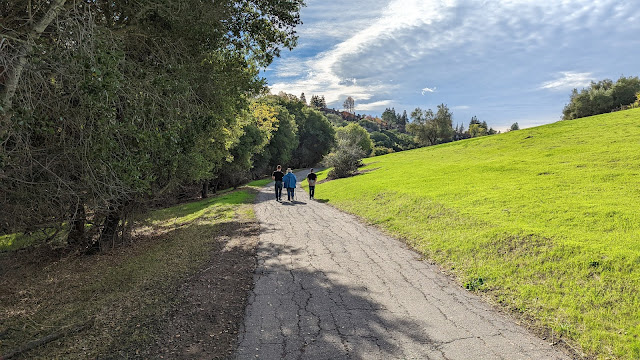

The park is a different place today. Bobcats and coyotes have replaced the bears, wolves, and sabertooth cats. It offers a network of trails that wind in and out of Sabercat Creek, and there is a smaller wilderness area in adjacent Mammoth Creek. Most all the trails are paved and accessible except for the actual remains of the quarry overlooking the freeway. Most of the fossiliferous layers were eliminated by the construction of the freeway, but the view from that end of the park is far-ranging (below).


I have a feeling that the park is an underutilized birding site. 84 species have been reported so far, but that is probably far fewer than what is actually there, given the excellent riparian habitat. We saw 18 species during our short visit including a very accommodating Western Bluebird.


I'm glad my son dragged us out to the Sabercat Trail. It was quite a revelation and answered some questions I've always wondered about!


Monday, April 19, 2010

The Other California: Mammoths and Sabertooths rise from the Prairies again!


Painting for the San Joaquin Valley Paleontology Foundation by David Douglas

Sometime back, I talked about the rich paleontological discoveries being made at the Madera County Landfill at Fairmead near the center of California's Great Valley. I mentioned the efforts to build a visitor facility, the Fossil Discovery Center, but also mentioned that I had not had the opportunity to visit the site yet. That changed today, and I am happy to report that the facility is rapidly becoming a reality. It is expected to be open for business in June.
The Fossil Discovery Center is on the corner of Road 21 1/2 and Road 19 a short distance from Highway 99, near the town of Fairmead. As can be seen, the exterior of the building is essentially complete, and when I stopped by, workers were busy putting in the high-tech connections, and working on the interior labs and classroom. I was pleased to have the opportunity to talk to Grady Billington, the President of the Board of the Directors of the San Joaquin Valley Paleontology Foundation. He kindly provided me a tour of the facility and discussed their plans for introducing valley residents to the fascinating prehistory of the region.
A full-sized mammoth skull has been hung in the central atrium. More than three dozen species of animals have been discovered at the landfill, including mammoths, mastodons, sloths, camels, horses, dire wolves, smilodon sabertooths, and short-faced bears. Skeletons of most of these animals will be part of the display when it is complete.

The original environment where the animals lived and died was a prairie with ponds and rivers flowing out of the adjacent Sierra Nevada. An outdoor pond has been constructed to recreate some of the conditions present when the Pleistocene animals were roaming the area. The hill in the background of the photo is the landfill site where the fossils were uncovered.

For more information, check out the website for the San Joaquin Valley Paleontology Foundation, or look for almost daily updates on the Fossil Discovery Center of Madera County site on Facebook.

For those who are new to Geotripper, the "Other California" is my long-running web series on the fascinating geological places in my fine state that don't usually show up on the postcards. Thanks for reading!

Friday, January 1, 2010

The Other California: The Prairies of the Past

Photo from the San Joaquin Valley Paleontology Foundation

A colleague of mine in an earlier phase of my life at Santa Barbara City College was fond of saying to field trippers that "I wouldn't take you JUST anywhere!" And a great Peanuts cartoon talked about a field trip the kids went on, and how they went and saw...a field. And that's what we have today: not just anyplace, and it is ... a field. And not just a field, it's a real dump. Well, ok, more like a municipal solid waste landfill.

My home, the Great Valley geomorphic province, is, well, a field. A really BIG field, about 400 miles long, and roughly 50 miles wide. It ranges from sea level to at most a few hundred feet above sea level, and it is exceedingly flat. I wasn't too thrilled when I first moved here; we geologists like to have some kind of topography in sight. Little remains of the original landscape, maybe 5%; most has been altered by agriculture and urban development. I discussed some of the remaining grasslands in the original post of this series.

When Europeans first came upon the valley in the 1700's, they found a prairie/ savannah environment with tule elk, deer, pronghorn antelopes, wolves, coyotes, and grizzly bears. It could actually be dangerous to be out and about without weaponry. Today the big danger is to avoid getting run over by a tractor/combine on the isolated country roads.

I always tell my students that the geological story of your home is fascinating, no matter where you live. I was challenged to make our Great Valley interesting, but just like people, the most interesting aspect is inside, beneath the surface.

In 1993, Madera county was excavating a landfill at Fairmead (about 20 miles northwest of Madera) when the big shovels uncovered bone fragments at a depth of 40 or so feet beneath the surface. Because of state regulations, a paleontologist was called in, and an intriguing story unfolded. During the ice ages around 500,000-700,000 years ago, this landscape was cooler, with a more humid climate, and shallow rivers coursed across the grasslands. And a host of wonderful and strange animals lived out their lives here. In the last 17 years, some 14,000 bones, representing 37 species have been found at the site. Numerous horse and camel species, pronghorn, giant ground sloths (three species),and Columbian mammoths are included among the plant-eaters. The carnivores include coyotes, wolves, sabertooth cats, and the hulking short-faced bear. A wide variety of smaller rodents, fish, amphibians, and reptiles rounded out the ecosystem. It turned out to be the one of the most important Irvingtonian aged fossil assemblages to be found anywhere in California.

So what is a dump operator to do? Apparently, the right thing! A foundation has been established, the San Joaquin Valley Paleontology Foundation, and construction has begun on a Fossil Discovery Center at the landfill site that will serve as an education/research facility housing many of the specimens (most are currently at Berkeley and CSU Fresno). Science education opportunities are sorely lacking in the Great Valley, and this center will be a wonderful addition to the few resources that are currently available.

So, the next time you happen to pass through Madera or Fresno (presumably on your way to someplace else), check on the progress of the Fairmead Fossil Discovery Center. It's a unique part of the geological landscape of California.

Note: I haven't been there yet. All the photos are from the website for the San Joaquin Valley Paleontology Foundation and other online sources (credited below).


Camel bones at the Fairmead Landfill, photo from the California Integrated Waste Management Board


Painting by David Douglas for the San Joaquin Valley Paleontology Foundation

Resources:
Geology and stratigraphy information about the site: http://dundaspaleolab.com/index-4.html

Preliminary 1996 report on the site

Wednesday, September 30, 2009

Time Beyond Imagining - A Final Struggle for Life on the Colorado Plateau


...the massive creature wandered slowly through the dry grasslands. It had been a long hot year, something that had been all too common during the decades the animal had been alive. Foraging was difficult, and the creature was near the point of starving. The large elephant-like animal felt vaguely lonely; it was a herd creature, but it had actually been years since he had seen another of his own kind. He was aware of the pack of predators that had been following him for several days now. They too had the look of hunger, too thin, gaunt, with intense yellow eyes following every movement of the mammoth, but not quite desperate enough to try attacking such a huge beast. They could see it was weak, and they hoped for an opening.

The elephant could smell water. There was stream nearby, maybe a promise of green grass. The trickle of water lay at the base of a dangerously steep slope, but the mammoth was becoming desperate. He carefully stepped over the ledge and started down the rocky slope towards the water. Disaster! Somehow a rock slipped, and the animal lost his footing and tumbled down the slope. There was a crunching sound, and a horrific pain shot through the creature's leg. Something was terribly wrong now, and despite his struggling, he could not stand. The wolves heard the commotion. What was a tragedy for the mammoth was the temporary salvation for the giant wolves. They moved in, and in the moments that followed, the very last individual of the elephant clan on the Colorado Plateau passed into oblivion. Though they ate their fill that day, the wolves were doomed too. In these final centuries and decades of changing climate, they would find fewer and fewer of the large creatures they had evolved to consume, and they too soon passed into oblivion...

The story I've just told is entirely fanciful, with no direct basis in reality. I'm not describing some paleontological excavation, because we don't have one that is known to be the final individual of a species. But the fact is, numerous species became extinct during the last 10,000 years, and there was a final living individual mammoth. There was a final pack of dire wolves, though not at the same precise time. My little story could just as easily have included human beings who stood over the dying mammoth instead of wolves. Anthropologists argue the point.

The last few thousand years of geologic events of the Colorado Plateau are really mostly biological in nature. And to me they represent one of the saddest episodes in the entire two billion history of life in the region. In the last two million years before the present, the canyons and mountains, mesas and buttes of the Plateau looked much as they do today with one major exception. An ice age gripped the world, with a dozen or more cold periods when ice advanced across the northern tier of the North American continent. Though the ice never reached the plateau country, the climate was cooler and wetter, and forests covered what are now sagebrush flats, and sagebrush covered what are now barren desert expanses.

In this environment of rich vegetation growth, a complex ecosystem evolved, with numerous large species of plant foraging mammals, the megafauna of North America. The species that lived on the plateau included mammoths (2nd photo), mastodons (1st photo), camels, giant sloths, bisons, horses, musk ox, bighorn sheep, and mountain goats. They were preyed upon by giant American lions (4th photo), saber-tooth cats, dire wolves (3rd photo), and occasionally by short-faced bears. The lions were bigger than their African cousins, the wolves and bears bigger than their living relatives by a factor of 50%. They had evolved to take down large prey.

These species lived across the continent, and the pictures above are actually specimens from southern California. They are examples of some of the incredible discoveries from the La Brea Tar Pits, where animals were trapped by the hundreds in the black goo. The animals thrived across the land for several million years, but around 10,000 years ago nearly all of them went extinct. Their disappearance coincided with two events: the end of the latest ice age, and the arrival of humans on the North American continent. Which brought about their end? Was it a combination of factors? We don't really know yet. There have even been some suggestions by researchers that an asteroid impact affected the North American megafauna.

In any case, I feel a sense of loss that these animals are gone. Part of the adventure of visiting a national park like Yellowstone is to see the bare remnants of this megafauna: the moose, elk, buffalo and grizzly bears. What an adventure it would have been to see mammoths and other giants wandering the mesas and buttes of the Colorado Plateau!

We've nearly reached the end. I have been exploring the geology of the Colorado Plateau for well over a year now, and one final major event in the geological story remains to be explored. Next time!