Showing posts with label Loma Prieta earthquake. Show all posts

Tuesday, October 15, 2019

Its Really Been That Long? 30th Anniversary of the Loma Prieta Earthquake on Thursday

It's Earth Science Week, and "Geoscience is for Everyone" is the theme for this year. Geoscience IS for everyone, because geology dominates the lives of everyone. No one can escape it, for better or worse. Better, when we find inspiration in the awesome forces that have made our planet, and worse for the geologic hazards that exist everywhere on the planet in one form or another. Here in California, one of the premier hazards are the earthquakes that occur here with disturbing irregularity (it would be so much nicer if they followed schedules so we could prepare). I'm writing about the anniversary of the Loma Prieta earthquake a few days early, but we had two moderate earthquakes in less than 24 hours in Northern California (magnitude 4.5 and 4.7), so seismic things are on my mind.
No photo description available.
Two good-sized earthquakes as recorded at Modesto Junior College
We can only share our stories to keep that knowledge at the forefront that will allow us to survive and recover from the major earthquakes to come. Here's my story from 1989, when my teaching career was just beginning.
No, this isn't what happens (credit: A. June)
On October 17th, 1989 at 5:04 PM, my physical geology laboratory had just finished and almost everyone had gone home to watch the World Series. A couple of students were helping me (it was Maureen and Sonny; funny how I remember the names of the first students I had better than the ones I had last semester). We were 100 kilometers from the epicenter, so when the seismic waves started to shake our building, the movement was a strong rolling motion instead of sharp vibrations. We looked at swaying TV monitors, and commented that it was an earthquake. It was a most scholarly discussion, actually. We realized the shaking was not stopping, and we thought we could sense the direction of the quake as well. We started to guess where it might be happening, but when the shaking reached the 40 second mark (the energy was spreading out, it lasted only 10 seconds or so near the epicenter), we realized it was a major event, and that fatalities were probably occurring (and unfortunately we were right). The deodar trees out the window were whipping back and forth as if they were in a high wind. The strangest part for me was the unconscious decision I was making as the shaking progressed. Despite having a quiet scholarly discussion, my body was moving from the front of the podium to the back, where there was a nice solid space to hide under. I would have dived under if the quake had lasted any longer.
Well, this can happen, but most people survive, even in the worst of quakes (credit: A. June)
In hindsight, I should have been a bit more aggressive about taking shelter under the desk. An analysis of our building a year or two later revealed an architectural weakness that suggested the building could collapse if the seismic waves hit it from a particular direction. A seismic retrofit a decade later included some massive shear walls in the lab I taught in.

Meanwhile, at the city library, my children were making me proud. At the time of the quake, there were huge sailing ship models on display, in some cases right on top of the book stacks. The stacks were not reinforced or braced, so there was a real potential for injuries if the quake was strong enough to knock those stacks over. I was told that most people were just standing there watching the bookstacks swaying, but my kids, my well-trained and intelligent kids were the only people in the room to take shelter under the sturdy study tables. Luckily, as I said before, we were on the fringes of the effects of the earthquake and no one was hurt.
The double-decker freeway in Oakland. It was not designed for the amount of shaking that occurred.

The Loma Prieta earthquake, a magnitude 6.9 event at a depth of 11 miles, was a tragedy: 63 people died, and 3,700 were injured. If the World Series game between the A's and the Giants hadn't been about to start, the death toll would have been much higher. Traffic was stunningly light that afternoon. Despite this, the Bay Area was in chaos for days, and months passed before life got back to normal. We were on the fringes, so instead of pain and suffering, we had a profound learning experience that was remembered by my students for the next decade and a half. But it has been 30 years now, and many of my students weren't born when the quake happened. Few of them have felt a quake at all. The large quakes like Loma Prieta and Northridge are ancient history, and there is less of that innate knowledge of what they should do when one hits. Few admit to having any kind of emergency kits at home, and they have no plan for what to do when the next big one hits.

Fault studies across California make it clear that more big tremors are coming, almost surely within the next decade or two. We educators must keep these past events alive in the minds of our students so they will be ready for these events when they come.

This is an abridged version of a blogpost from 2009.

Wednesday, October 17, 2018

Earth as Inspiration: Memories on the 29th Anniversary of the Loma Prieta Earthquake

It's Earth Science Week, and "Earth as Inspiration" is the theme for this year. Inspiration can take many forms. Sometimes it is awe-inspiring beauty, something our planet has in great bounty. But the earth can kill, and inspiration can be related to preparation for disasters.
No, this isn't what happens (credit: A. June)
On October 17th at 5:04 PM, my physical geology laboratory had just finished and almost everyone had gone home to watch the World Series. A couple of students were helping me (it was Maureen and Sonny; funny how I remember the names of the first students I had better than the ones I had last semester). We were 100 kilometers from the epicenter, so when the seismic waves started to shake our building, the movement was a strong rolling motion instead of sharp vibrations. We looked at swaying TV monitors, and commented that it was an earthquake. It was a most scholarly discussion, actually. We realized the shaking was not stopping, and we thought we could sense the direction of the quake as well. We started to guess where it might be happening, but when the shaking reached the 40 second mark (the energy was spreading out, it lasted only 10 seconds or so near the epicenter), we realized it was a major event, and that fatalities were probably occurring (and unfortunately we were right). The deodar trees out the window were whipping back and forth as if they were in a high wind. The strangest part for me was the unconscious decision I was making as the shaking progressed. Despite having a quiet scholarly discussion, my body was moving from the front of the podium to the back, where there was a nice solid space to hide under. I would have dived under if the quake had lasted any longer.
Well, this can happen, but most people survive, even in the worst of quakes (credit: A. June)
In hindsight, I should have been a bit more aggressive about taking shelter under the desk. An analysis of our building a year or two later revealed an architectural weakness that suggested the building could collapse if the seismic waves hit it from a particular direction. A seismic retrofit a decade later included some massive shear walls in the lab I taught in.

Meanwhile, at the city library, my children were making me proud. At the time of the quake, there were huge sailing ship models on display, in some cases right on top of the book stacks. The stacks were not reinforced or braced, so there was a real potential for injuries if the quake was strong enough to knock those stacks over. I was told that most people were just standing there watching the bookstacks swaying, but my kids, my well-trained and intelligent kids were the only people in the room to take shelter under the sturdy study tables. Luckily, as I said before, we were on the fringes of the effects of the earthquake and no one was hurt.
The double-decker freeway in Oakland. It was not designed for the amount of shaking that occurred.

The Loma Prieta earthquake, a magnitude 6.9 event at a depth of 11 miles, was a tragedy: 63 people died, and 3,700 were injured. If the World Series game between the A's and the Giants hadn't been about to start, the death toll would have been much higher. Traffic was stunningly light that afternoon. Despite this, the Bay Area was in chaos for days and months passed before life got back to normal. We were on the fringes, so instead of pain and suffering, we had a profound learning experience that was remembered by my students for the next decade and a half. But it has been 29 years now, and many of my students weren't born when the quake happened. Few of them have felt a quake at all. The large quakes like Loma Prieta and Northridge are ancient history, and there is less of that innate knowledge of what they should do when one hits. Few admit to having any kind of emergency kits at home, and they have no plan for what to do when the next big one hits.

Fault studies across California make it clear that more big tremors are coming, almost surely within the next decade or two. We educators must keep these past events alive in the minds of our students so they will be ready for these events when they come.

This is an abridged version of a blogpost from 2009.

Tuesday, October 17, 2017

28th Anniversary of the Loma Prieta Earthquake - It Was a Warning That is Still Operative

What a different world... on Oct. 17, 1989, there were no smart phones, the internet barely existed, and we still depended on things like newspapers, television and radio to keep up with the world. Most of my current students had not yet been born, and that means that most of my students have never felt or experienced a major earthquake. Today we joke that when the BIG ONE hits, the tweets and Instagram posts will outrace the P-waves across the surface of the planet (there is a small bit of truth in the joke).

Earthquakes are not a joking matter though, and it is sobering to think that damage of a magnitude 7.8 quake in Los Angeles or San Francisco will have effects that will put California into a world of hurt not all that different than what is happening now in Puerto Rico or the Virgin Islands. Although we have had 28 years since our vivid warning in the hills above Santa Cruz, we are still not as ready as we should be, and many of our fellow citizens are complacent about earthquake safety. The ongoing experiences of hurricanes and wildfires across our country remind us of the importance of being ready with water, food, first aid, communications plans, and escape routes. As has been sadly demonstrated, we cannot depend on the federal government to act on our behalf in an effective manner, given the depletion of their resources following other major disasters, and stupid politics currently infecting Washington D.C.

I have yet to be in the middle of a major tremor; I've been on the outskirts of several, including 1989, and the 1971 Sylmar earthquake in Southern California. I was on the scene of the 1992 Landers quake (magnitude 7.3) within a week to see the ripped up ground. My experiences were mostly of the learning kind, not that of personal loss. Still, there is something to be learned in every experience. What follows is an abridged version of my story from a post on the 20th anniversary.
In 1989 I was a brand-new instructor at Modesto Junior College, in my third semester. I taught classes in the old 1950's-era Science Building on our east campus, up on the second floor. I had all the modern teaching technology; there was a chalkboard, and two television monitors hung from the ceiling for showing those newfangled "videotape cassettes". The monitors also served as my decidedly low-tech seismometers. They shook noticeably during the smallest of earthquakes (most memorably during a class test on earthquakes; no one but me even noticed).

On October 17th at 5:04 PM, my physical geology laboratory had just finished and almost everyone had gone home to watch the World Series. A couple of students were helping me (it was Maureen and Sonny; funny how I remember the names of the first students I had better than the ones I had last semester). We were 100 kilometers from the epicenter, so when the seismic waves started to shake our building, the movement was a strong rolling motion instead of sharp vibrations. We looked at swaying TV monitors, and commented that it was an earthquake. It was a most scholarly discussion, actually. We realized the shaking was not stopping, and we thought we could sense the direction of the quake as well. We started to guess where it might be happening, but when the shaking reached the 40 second mark (the energy was spreading out, it lasted only 10 seconds or so near the epicenter), we realized it was a major event, and that fatalities were probably occurring (and unfortunately we were right). The deodar trees out the window were whipping back and forth as if they were in a high wind. The strangest part for me was the unconscious decision I was making as the shaking progressed. Despite having a quiet scholarly discussion, my body was moving from the front of the podium to the back, where there was a nice solid space to hide under. I would have dived under if the quake had lasted any longer.
The Cypress Structure in Oakland where 44 people died

In hindsight, I should have been a bit more aggressive about taking shelter under the desk. An analysis of our building a year or two later revealed an architectural weakness that suggested the building could collapse if the seismic waves hit it from a particular direction. A seismic retrofit a decade later included some massive shear walls in the lab I taught in.

Meanwhile, at the city library, my children were making me proud. At the time of the quake, there were huge sailing ship models on display, in some cases right on top of the book stacks. The stacks were not reinforced or braced, so there was a real potential for injuries if the quake was strong enough to knock those stacks over. I was told that most people were just standing there watching the bookstacks swaying, but my kids, my well-trained and intelligent kids were the only people in the room to take shelter under the sturdy study tables. Luckily, as I said before, we were on the fringes of the effects of the earthquake and no one was hurt.

The Loma Prieta earthquake, a magnitude 6.9 event at a depth of 11 miles, was a tragedy: 63 people died, and 3,700 were injured. The Bay Area was in chaos for days and months passed before life got back to normal. We were on the fringes, so instead of pain and suffering, we had a profound learning experience that was remembered by my students for the next decade and a half. But it has been 28 years now, and as I said, many of my students weren't born when the quake happened. Few of them have felt a quake at all. The large quakes like Loma Prieta and Northridge are ancient history, and there is less of that innate knowledge of what they should do when one hits. Few admit to having any kind of emergency kits at home, and they have no plan for what to do when the next big one hits.

Fault studies across California make it clear that more big tremors are coming, almost surely within the next decade or two. We educators must keep these past events alive in the minds of our students so they will be ready for these events when they come.
I'm sorry I can't provide a source for these photos. They are scans from a slide set that I purchased many years ago, soon after the quake occurred.

Sunday, August 24, 2014

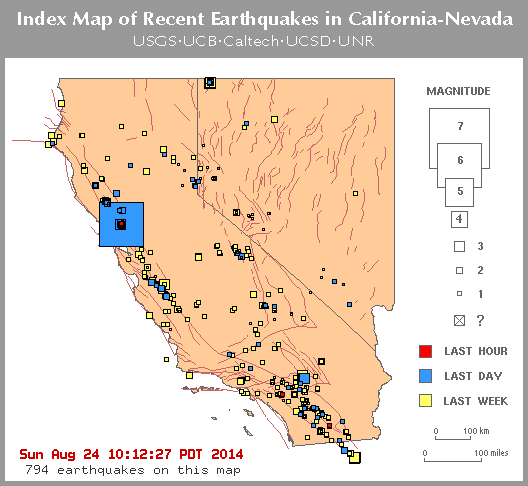
Magnitude 6.0 Quake in Northern California - Largest Bay Area Quake in 25 Years

Source: http://www.data.scec.org/recenteqs/

Northern California woke up this morning to the largest Bay Area earthquake since the 1989 Loma Prieta Earthquake (magnitude 6.9). The magnitude 6.0 quake, now being called the South Napa Earthquake, was located 6 miles (9 km) SSW of the wine country town of Napa at a depth of 6.6 miles (10.7 km). Dozens of people have been injured, three severely, and there has been a lot of structural damage, including a fire that destroyed at least four mobile homes. There are numerous gas leaks and water line breaks as well.

According to the USGS Event Page, the quake occurred along the West Napa Fault, a northwest trending right lateral strike slip fault. The first motion diagram confirms the motion. I've seen in some media reports cracks in pavement  that show broken roads that appear to have right lateral offset, although the break may have been from liquefaction or landsliding.
Source: http://earthquake.usgs.gov/earthquakes/eventpage/nc72282711#scientific_focal-mechanism
At magnitude 6.0, this quake is classed as a strong quake, but one of the unfortunate diagrams I'm seeing in media reports is that anything between a 6.0 and a 6.9 like the Loma Prieta quake are being lumped together on a bar graph as "strong". The difference between a 6.0 and 6.9 is profound, and is a reason that we are not hearing about dozens or hundreds of people killed in the event. On the magnitude scale, the amount of energy released increases by about 30 times with each whole number. In other words, a magnitude 7.0 quake is just over 30 times more powerful than a magnitude 6.0, and a magnitude 8.0 is just over 30 times more powerful than a 7.0 (this make an 8.0 around a 1,000 times more powerful than a 6.0).

The USGS is warning that aftershocks are very likely, and there have been dozens already, including a 3.6 magnitude event. It is important to point out that there is a 5-10% chance of an even larger event. It's not likely, obviously, but this could be a foreshock to a larger event. It is a reminder to us folks in California that we do live on active faults, and we have to live with the possibility of quakes reaching 7.5 magnitude, and maybe even magnitude 8.0. If you live in the state, make sure you are prepared with water, first aid supplies, food, and most importantly, an emergency plan.

Another issue related to today's quake is in the "near-miss" category. The earthquake took place uncomfortably close to the Sacramento Delta, one of California's most vulnerable environments. It is the region where the Sacramento and San Joaquin rivers converge and flow into San Francisco Bay, forming nearly three dozen islands.  Because of groundwater withdrawals, oxidation of soils and other factors, most of these islands are now below sea level, and are protected from flooding by a series of century-old levees and dikes.

Had water levels been high, such as during spring runoff, the levees would have been saturated with water, and subject to collapse from liquefaction during the quake. The islands could have been inundated, drawing salt water from San Francisco Bay well into the delta environment. The most serious effect would be the fouling of the intakes for the California Water Project that provides water for tens of millions of people in central and southern California.

Friday, October 16, 2009

Has it Been That Long Already? Loma Prieta Earthquake 20 Years Ago Today

It's been quite a week, this year's Earth Science Week, starting with a record-breaking storm in California, suffering cuts in the geology field studies program at our school, and the 20-year anniversary of the Loma Prieta Earthquake on October 17. I hate to be missing the GSA meeting starting this week in Portland; many members of the geoblogosphere will be there.

Andrew Alden at About.com: Geology and the Berkeley Seismological Laboratory are asking for our stories about the quake. In 1989 I was a brand-new instructor at Modesto Junior College, in my third semester. I taught classes in the old 1950's-era Science Building on our east campus, up on the second floor. I had all the modern teaching technology; there was a chalkboard, and two television monitors hung from the ceiling for showing those newfangled "videotape cassettes". The monitors also served as my decidedly low-tech seismometers. They shook noticeably during the smallest of earthquakes (most memorably during a class test on earthquakes; no one but me even noticed).

On October 17th at 5:04 PM, my physical geology laboratory had just finished and almost everyone had gone home to watch the World Series. A couple of students were helping me (it was Maureen and Sonny; funny how I remember the names of the first students I had better than the ones I had last semester). We were 100 kilometers from the epicenter, so when the seismic waves started to shake our building, the movement was a strong rolling motion instead of sharp vibrations. We looked at swaying TV monitors, and commented that it was an earthquake. It was a most scholarly discussion, actually. We realized the shaking was not stopping, and we thought we could sense the direction of the quake as well. We started to guess where it might be happening, but when the shaking reached the 40 second mark (the energy was spreading out, it lasted only 10 seconds or so near the epicenter), we realized it was a major event, and that fatalities were probably occurring (and unfortunately we were right). The deodar trees out the window were whipping back and forth as if they were in a high wind. The strangest part for me was the unconscious decision I was making as the shaking progressed. Despite having a quiet scholarly discussion, my body was moving from the front of the podium to the back, where there was a nice solid space to hide under. I would have dived under if the quake had lasted any longer.

In hindsight, I should have been a bit more aggressive about taking shelter under the desk. An analysis of our building a year or two later revealed an architectural weakness that suggested the building could collapse if the seismic waves hit it from a particular direction. A seismic retrofit a decade later included some massive shear walls in the lab I taught in.

Meanwhile, at the city library, my children were making me proud. At the time of the quake, there were huge sailing ship models on display, in some cases right on top of the book stacks. The stacks were not reinforced or braced, so there was a real potential for injuries if the quake was strong enough to knock those stacks over. I was told that most people were just standing there watching the bookstacks swaying, but my kids, my well-trained and intelligent kids were the only people in the room to take shelter under the sturdy study tables. Luckily, as I said before, we were on the fringes of the effects of the earthquake and no one was hurt.

The Loma Prieta earthquake, a magnitude 6.9 event at a depth of 11 miles, was a tragedy: 63 people died, and 3,700 were injured. The Bay Area was in chaos for days and months passed before life got back to normal. We were on the fringes, so instead of pain and suffering, we had a profound learning experience that was remembered by my students for the next decade and a half. But it has been 20 years now, and many of my students weren't born when the quake happened. Few of them have felt a quake at all. The large quakes like Loma Prieta and Northridge are ancient history, and there is less of that innate knowledge of what they should do when one hits. Few admit to having any kind of emergency kits at home, and they have no plan for what to do when the next big one hits.

Fault studies across California make it clear that more big tremors are coming, almost surely within the next decade or two. We educators must keep these past events alive in the minds of our students so they will be ready for these events when they come.