 |
| Grand Tetons National Park, Wyoming |
Be forewarned. This post is a TRAP! It is designed to draw you in, weaken your defenses, and cause you to do something different than everyday life. Warning given...
Have you ever dreamed of hitting the open road and finally seeing those places you've dreamed about, but haven't acted on that dream yet? What if you found out about an excursion that doesn't just tour, but allows you to learn the geology and history of those wild places? A tour on which you can even earn college credit? AND, a tour that is affordable? Maybe this is the one...
 |
| Mt. Shasta, a Cascade volcano in northern California |
From June 18-July 2, 2026, the geology and anthropology departments of Modesto Junior College will be conducting a field studies course (Geology 192/Anthropology 192) in the Pacific Northwest and Northern Rocky Mountains. It will be a six semester unit course designed for our community college clientele: first year geology/anthropology majors, potential majors, as well as community members (especially teachers) and life-long learners interested in geology, archaeology, and natural history. We will develop the necessary geological/anthropology background prior to and in the early days of the trip, so people of all backgrounds are encouraged to attend. The total cost is $850 which will include all food, camp fees, entrance fees, transportation costs for the trip. The tuition cost for the six units of semester credit will be around $380 (out of state tuition is higher). The only additional costs should be for showers, laundry, books and other souvenirs, and junk food (we provide healthy food for the most part; if you want Twinkies you are on your own!). We will be camping each night, and the school provides the transportation (vans). The excellent meals are planned by our professional volunteer staff, and cooked by the participants under their watchful eyes.
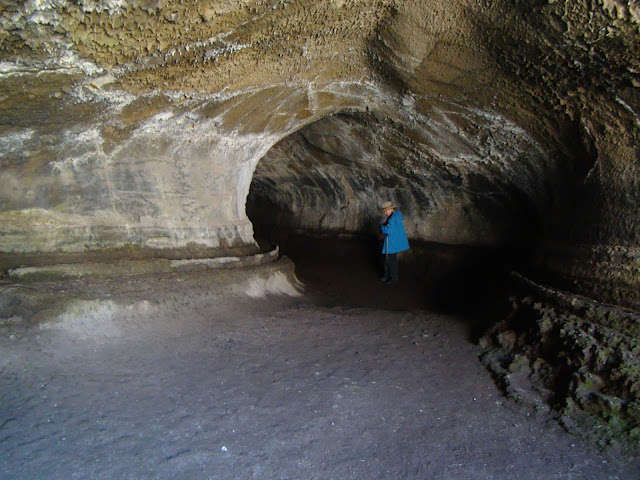 |
| Lava Tube in Lava Beds National Monument |
What will you see and experience? On the 18th we'll leave MJC and drive north through the Great Valley of California and arrive at the south end of the Cascades Range. The huge edifice of Mt. Shasta looms over the north state at 14,163 feet, and still is potentially active. It last erupted in 1786. Depending on snow conditions, we'll climb to the 8,000 feet level at the old ski bowl and have a close look at the rock and ash deposits. We'll continue north and end the day at Lava Beds National Monument near the Oregon border. There will be chance to explore some lava tubes while we are there.
 |
| The view from Smith Rock State Park in Oregon |
We drive through Oregon the next day, with possible stops at Crater Lake National Park and Newberry Crater (depending, once again, on snow conditions). Camp will be at Tumalo State Park. The following day we will explore Smith Rock State Park (above), Mt. Hood, and the Columbia River Gorge (if there is time we will climb Beacon Rock in the gorge). The third camp will be at Seaquest State Park at the foot of Mt. St. Helens in southern Washington.
 |
| Mt. St. Helens in Washington. It erupted in 1980 and 2004 |
The following day will be devoted to the exploration of Mt. St. Helens (weather allowing!). We'll then move on to the Pacific Coast and the temperate rainforests of Olympic National Park. We'll visit some tribal lands near the westernmost point of the lower 48 states and explore Hurricane Ridge at Olympic's north side.

We'll then descend the eastern flank of the Cascades (including a close look at Mt. Rainier) and drive onto the Columbia River Plateau, a vast basalt plain that covers much of eastern Washington and Oregon. Camp will be at Sportsman's State Park in Yakima.
 |
| Dry Falls State Park in Washington. The floodwaters covered this entire landscape to a depth of 300 feet during the Spokane floods. |
The next day we will view the evidence for vast floods that swept across the plateau during the Pleistocene ice ages. The discovery of these floods by J Harlan Bretz in the 1920s and the long road to acceptance of the hypothesis by the geological community is one of the great stories in the history of geology as a science. We'll have a look at the Channeled Scablands, Soap Lake, and Dry Falls as we travel east through Washington. We'll spend the night at Riverside State Park in Spokane, Washington.
We'll head through the copper mining districts of Idaho and into Montana where we'll see more evidence of the ice age floods. We'll drive east to Lewis and Clark Caverns and stay near Bozeman, Montana. We'll check out the Museum of the Rockies and move on to explore Yellowstone, America's oldest national park. We'll spend two days exploring this incredible park.
 |
| Yellowstone Falls in the Grand Canyon of the Yellowstone River |
There is the Grand Canyon of Yellowstone, and a menagerie of incredible animals, including elk, bison, moose, bighorn sheep, and if we get
really lucky, wolves.
 |
| Wolf near Norris Geyser Basin, Yellowstone National Park |
Then there are geothermal features for which Yellowstone is so famous. Grand Prismatic Spring, for instance, and 70% of the world's geysers (there's lots more besides just Old Faithful!).
 |
| Grand Prismatic Spring, Yellowstone National Park |
We'll then head south and spend two days at Grand Tetons National Park with time for some spectacular hikes. Then we start the road home with a drive through northern Nevada.
 |
| Big Geyser (not Old Faithful!) in Lower Basin, Yellowstone National Park |
It's hard to describe the wonders that exist across the Pacific Northwest and Northern Rocky Mountains without getting an overwhelming urge to get up and leave right away. If you are in the Modesto region, we are having our first information meeting on Monday, March 23 in the Science Community Center on the west campus of the Modesto Junior College at 7 PM in SCC 325 (attendance is not mandatory to go on the trip). We hope you will join us!


No comments:
Post a Comment