Sunday, September 19, 2021

Yeah, I'm Rather Dense Too...A Weighty Matter in Mineralogy


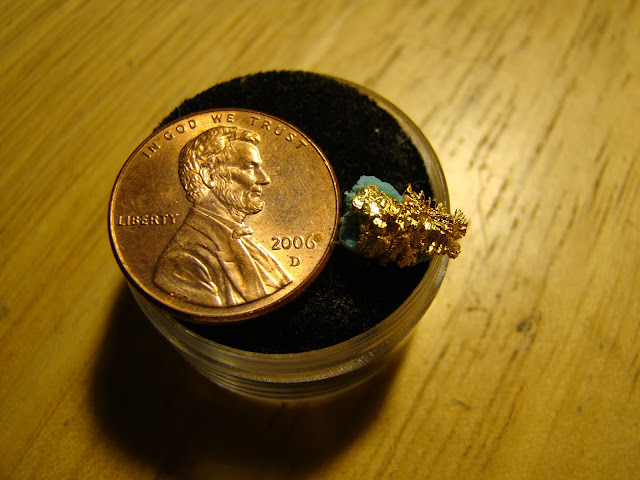
All that glitters is not gold...and even if it is gold, there's no way I would pass a large nugget of it around the lab, no matter the teaching value of something that could illustrate density so well. That's hardly an issue of course, since the largest sample of gold that I have is only a gram (about 1/28 of an ounce). You can feel the heaviness a little, but not really. There's also a sample of crystalline gold, but it is so small that you can't really feel the weight of it at all.
Still, it would be nice to have a sample like gold around in the classroom to provide a tactile example of extreme density. But even a single ounce of gold is just not feasible.

The density of a mineral is the ratio of mass to volume, often measured as grams per cubic centimeter. The higher the density, the heavier an object will feel. In a physical geology laboratory on minerals, we refer to the density as the "heft" of the mineral. In other words, does the mineral feel heavier or lighter than expected? We tend to expect metals to be heavier, and translucent or transparent minerals to feel lighter. Water has a density of 1 gram per centimeter, and most non-metallic minerals have a density of between 2.5 and 3.5. That is therefore close to the density of many rocks, since rocks are composed of a solid mixture of minerals most of the time. 

Galena, a sulfide of lead, is one of the densest of the reasonably common minerals, at 7.6 grams per cubic centimeter. Pyrite (otherwise known as fool's gold) is also relatively dense at 5.02. But none of those minerals come anywhere close to the density of the heaviest metals.
So why not some chunks of common metals? I have a 1-inch sphere of copper in the classroom and several samples of native copper. They're fairly hefty at 8.92, but that's barely ahead of the mineral galena. Iron is even less at 7.87. Silver and pure lead are getting up there at 10.49 and 11.34 respectively, but the toxic nature of lead is well-known. What I would hope for is something really heavy, among the most dense of all the metals.

What are those densest metals? And are any of them useful or appropriate for a classroom? Here are the ten densest metals:

Densest Metals

Mercury 13.55 g/cm3

Americium 13.67 g/cm3

Uranium 18.95 g/cm3

Gold 19.32 g/cm3

Tungsten 19.35 g/cm3

Plutonium 19.84 g/cm3

Neptunium 20.2 g/cm3

Platinum 21.45 g/cm3

Iridium 22.4 g/cm3

Osmium 22.6 g/cm3


It's an interesting list. I've wondered if any of them could ever be considered as a classroom demonstration model.

Mercury is the kind of stuff that kids aren't allowed to play around with for clear toxicological reasons, but in the days of my youth, it was far more accessible, but no less toxic. I had a toy once, a maze that had a bead of mercury in it that you would tilt back and forth. In high school, the chemistry lab storage area had a plastic flask containing several pounds of the stuff. The kids had full access to it if the teacher wasn't paying attention. It's amazing that any of us made it to adulthood, and mercury poisoning perhaps explains some of the strange quirks of my generation.

Americium is unique, as it only exists in human-made form. It's not found in nature, but it is probably present in your fire detector. Even if it were in a mass large enough to feel, it is clearly not appropriate for a classroom demonstration of heft!

Platinum, iridium and osmium are the densest of all, but all of them are rarer and more expensive than gold. They're out of the running in my lab...

Plutonium and neptunium are both highly radioactive and not natural to the Earth except in extremely small amounts. It is of note that I got to use some plutonium once in a chemistry lab. We irradiated something (copper, I think) with plutonium, and then recorded the decline of the radiation on a graph to better understand the concept of radioactive half-lives. The plutonium was highly shielded, however. We couldn't even actually see it.

There isn't much left, is there? Uranium seems a possibility in some respects since it is used in depleted form in weapons and armor. "Depleted" refers to the fact that it has been processed to remove the most radioactive isotope (Ur235, used in weapons. Isn't that comforting?). The Ur238 is less radioactive, but it is still radioactive. I got to hold a 1-lb slug of uranium once, and wished I could have one for the classroom, but it just isn't going to happen.
My new sample of tungsten with a stack of dimes (nickel-copper) and pennies (mostly zinc) that each weigh as much as the cube.
So it comes down to one last metal in the top ten, and example of how one can learn things even at such an advanced age of my own. I've known about tungsten for a very long time. As a teen I hiked through the grounds of Pine Creek tungsten mine in the Sierra Nevada that once provided more than 90% of U.S. production. Over the years I've enjoyed searching for the principle ore of tungsten, a unique fluorescent mineral called scheelite. I've known for years that it was used as the filament in incandescent light bulbs, and that it was alloyed with iron to make a stronger armor. But something I did not know until last month was that pure tungsten is denser than gold!

It's not only denser than gold, but it is not particularly toxic except in rare instances. And it's not overly expensive. I got a sample cube a half inch on the side for a few tens of dollars online, and ever since it arrived last week it has been my newest 'worry' stone. I can't help but heft it and realize that at long last I have a sample to demonstrate extreme density in the laboratory. 

That is, if I ever get to have a laboratory class again. I'm getting really tired of the pandemic.


Sunday, August 29, 2021

The Other California: There's More Out There Than The The Tar Tar Pits (and The Doing of a Good Thing at the Carpinteria Bluffs)


The first thing to know in this post is that this was once my home. My small growing family spent three years in the cramped condominiums across Highway 101 from this spot on the Santa Barbara coast near Carpinteria. It was the 1980s shortly after I finished my degree and I was working as a lab teacher at Santa Barbara City College. They were good years, and many may wonder why I moved to a dusty farm town in the Central Valley for my 30 year career. It's a fair question, but I've never regretted it.

Be that as it may, Carpinteria turned out to be a nice place to visit 30 years on, and I was pleased that while some things have changed, others have not. When we lived there, it was a pleasant 1/4 mile walk to the Carpinteria Bluffs, a roughly 60-acre tract that had somehow escaped development over the years. Given the level of the land utilization along the coastal terraces from Goleta to Ventura, this stood as some kind of minor miracle. It's also a minor geological miracle that the flatland even exists at all. The Santa Barbara coastline is a prime example of a "geologically active" place.

The Santa Barbara coast really stands out on a map of California. While most of the state's coasts are oriented towards the north-northwest, the stretch from Point Conception to Ventura is distinctly east-west, paralleling the orientation of the Channel Islands, several tens of miles offshore. Geologists call this region the Transverse Ranges for this reason. This strange structural knot in southern California extends eastward to the San Bernardino Mountains and Joshua Tree National Park.

The origin of the structural twist is wild...when the San Andreas fault originated, it mostly carried crust to the northwest, but the part of the crust that is now the Transverse Ranges was twisted nearly 90 degrees to the east-west orientation that it has today (you can see a great animation and explanation of the process at this link). Getting caught in the machinery of the fault was not gentle either. Compressional forces pushed the crust upwards into mountains more than 10,000 feet high, and caused the crust to sink in other places. The Ventura and Santa Barbara basins contain tens of thousands of feet of marine sediments deposited in just a few million years. The region contains some of the thickest Cenozoic-aged sediments known from anywhere in the world. And the sediment contains prodigious amounts of petroleum and natural gas, with some consequences that will be noted later in this post.
The fact is that most of coastal Central California is mountainous, and in many places the mountains rise directly from the sea, leaving little or no flat surfaces for either settlement or transportation routes. Flat terraces are prime real estate, and most of these were developed early on. Carpinteria was only the latest of settlements over the last several thousand years. The Chumash had a village noted by Cabrillo in 1541 called Mishopshnow. They were canoe-builders, and the woodworking that was going on there is the reason for the name Carpinteria ("carpentry shop").

The terraces were also the result of active geological processes. Thousands of years of waves washing back and forth flattened the beach areas forming a wave-cut bench. These benches were lifted out of the water by continued tectonic uplift (no doubt accompanied by occasional severe earthquakes).
I'll never quite know why the Carpinteria Bluffs escaped industrial development during the last century. When we lived there in the 1980s, we heard of ambitious plans for the "barren" terrace, and it seemed a sure thing that this pleasant stretch of coast would disappear soon after we moved away, yet when we returned last month for a visit, I was thrilled to see it remained much as it was. I learned that the 1990s was a contentious period during which the people of Carpinteria fought a pitched battle to keep the bluffs as open space. In 1998, the volunteers managed to raise just short of 4 million dollars to purchase the land to form a permanent nature preserve. 
The Santa Ynez Mountains rise dramatically above Carpinteria. They are composed of sandstone, siltstone, and shale layers that were on the bottom of the sea only a few million years ago.
The preserve can hardly be described as a wilderness, given its location between the 101 Freeway and the busy railroad tracks, but a short series of walks reveal incredible views of the coastline, beaches, and the Channel Islands far offshore. During particularly heavy storms I can remember hearing the concussion of the huge waves that pounded the cliffs from a quarter mile away in our condo.
A section of the beach has been seasonally closed to provide a safe haven for Harbor Seals who use the beach for birthing their pups. Around a hundred of them utilize the area.
When we first moved there, we found another reason that one might avoid walking on this particular beach. At the conclusion of our walks we would find that there was a considerable amount of tar covering our shoes, or worse, our feet. It was hard to get off, and seemed omnipresent. It was easy to blame the offshore oil rigs or the onshore petroleum processing facility just to the west, but the truth was the tar was natural. Which brings us to the other subject of the day concerning Carpinteria: the tar!
The Spanish Language is beautiful. It's been said that reading a grocery list in French sounds sexy, but Spanish is muy bonita. The place names in California attest to this fact. For example in my area alone we have poetic place names like Merced, Madera, Manteca, Los Banos, and Escalon. Merced translates into the equally poetic name "Mercy", but the others are in order "Wood", "Lard", "The Bathrooms", and "Step".

And sometimes we kind of mix up our translations into unnecessary repetition. Most specifically, the La Brea Tar Pits. The most literal translation is "The The Tar Tar Pits". The La Brea Tar Pits in the Hancock Park area of Los Angeles are justly famous for the fossil collections that have come from one of what are said to be only five natural tar pits in the world (I can't confirm this claim, but I'm going with it). And...it's not the place I'm talking about in this post. It turns out that two of the other four tar pits are in California, and they are obviously far less known. One is in McKittrick near Bakersfield, and the other is in, of all places, Carpinteria.
File:Layers of stone and tar at Carpinteria, CA.jpg - Wikimedia Commons
Tar results when petroleum escapes to the surface and loses some of its volatile components, becoming a sticky gooey mess. In the coastal cliffs at Carpinteria, the near vertical layers of the Monterey Shale give way to the horizontal layers of the coastal terraces. The Monterey is the source of much of the oil that is pumped from the ground in California, but at Carpinteria, it is emerging from the rocks like a very, very slow spring. The tar deposits are present over dozens of acres in the area, but are mainly exposed in the sea cliffs and on the beach just west of the Carpinteria Bluffs, and within the lands of Carpinteria State Beach. 
Tar Pits Park (Carpinteria) - 2021 All You Need to Know BEFORE You Go (with Photos) - Tripadvisor
The tar was utilized by the Chumash people for centuries, and as such can be described as the first petroleum enterprise in North America. The tar was traded for use as an adhesive, caulking, and waterproofing. The Chumash made use of the material in their construction of their plank canoes. 

European colonizers and invaders also made use of the tar deposits, and in the late 1800s and early 1900s it was used to pave roads in the area. Eventually the pits were abandoned and utilized as a garbage dump. 

Some paleontologists came to realize that the tar was an important fossil resource. Excavations between 1926 and 1928 revealed 25 plant species, 55 species of birds and 26 species of mammals according to the Carpinteria Valley History Society. The animals are similar to those found at La Brea, including Mammoths or Mastodons, Saber tooth Cats, Dire Wolves, Giant Ground Sloths, horses, and camels. The birds are even more diverse, due to being a coastal habitat, unlike the plains at La Brea. The plant fossils include eight conifer species showing that the during the ice ages the coastal environment was cooler and more moist, much like the Monterey Coast to the north.
Source: California State Parks

When I worked at SBCC there was no internet, and I was only vaguely aware that there had been tarpits somewhere in the area. So it was that I never realized the value of the irritating pollutant on the beach that ruined a number of pairs of my shoes. If you visit and mess up your own shoes, just remember, it's important history!

The Other California is my long-running series of places to see in our state when you've seen all the places on the postcards!


Friday, August 20, 2021

The Other California: Catch it While You Can, the Devil's Slide

California is nothing if not audacious. Our state possesses so many incredible landscapes known throughout the world: alpine mountain ranges, volcanoes, deserts, and of course the legendary California coastline. The coastline in particular has garnered a lot of attention over the years to the extent that roadbuilders tried to provide vehicular access to practically all of it. There are only a few short stretches of coast, especially in the north state, where wilderness reigns instead of highways. Highway 1 is a spectacular engineering feat for better or worse, providing some of the most astounding views a driver could ever hope to see.

But this incredible feat of engineering didn't come without serious costs and continuing hazards. Hardly a year goes by in which some portion of Highway 1 isn't shut down by mudflows and landslides. The Big Sur section of the coast has been especially hard hit in recent years. But there is one part of the highway that we Californians constantly heard about in the news, but not any longer. It just sort of disappeared from the public consciousness. It's a section between Pacifica and Half Moon Bay called the Devil's Slide.

One needs only to look at the Google Earth image (above) to see the insanity of trying to build and maintain a road across the coastal cliffs here. The near total lack of vegetation is an immediate clue to the instability. A closer look at the geology of the rocks exposed in the cliff reveals a complex mess. To the right is the bold cliff labeled on the map below as Devil's Slide, although that particular rock is not the source of the problem. It's a relatively coherent intrusive complex called the Granitic Rock of Montara Mountain. The unit consists of granite and quartz diorite, which to most humans looks like granite. It formed about 86 to 93 million years ago as part of the Sierra Nevada batholith. Being found along the coast, it seems a bit out of place, and it truly is. It was sliced off the south end of the Sierra Nevada by the San Andreas fault system and transported several hundred miles north at the furious rate of about 2 inches per year. 

The problem child of this geologic mess is the gray colored unit labeled Tss on the geologic map below. It is an unnamed sequence of sandstone, shale, and conglomerate of Paleocene age, from around 55-60 million years ago, just after the great extinction that wiped out the non-avian dinosaurs and many other species. These weakly consolidated sedimentary rocks have been severely deformed and sheared by nearby fault zones into a jumbled mass of unstable blocks prone to sliding. The main slide surface is about 150 feet beneath the surface, and the entire unstable block is 4,000 feet long, and as much as 900 feet high.

It was a treacherous slope, but engineers (well-educated or not) love a challenge. The first attempt at building a road came in the late 1800s when a road was carved about 100 feet above the present trail. Landslides and slope failures soon commenced, and by 1914 the road was abandoned in favor of a winding route on the other side of San Pedro Mountain (which serves today as a fire lane). 

Then the railroad designers took their turn, putting in a railway on the lower part of the cliff in the early 1900s. The slopes disagreed with the railway, and the tracks were abandoned by 1920 (the 1906 earthquake did not help). Then in 1936, the roadbuilders were ready to try again. Highway 1 was being constructed along much of the Central Coast of California, and the engineers decided they simply must have a highway across the Devil's Slide. It was finished in 1937.
The problems of course began right away. Slope failures caused major closures of the highway, in some instances for days, in others weeks, and in 1995, five months. Numerous fixes were proposed, but most would have caused severe environmental disruptions in the marine ecosystem below, and unwanted urban growth above (an improved and widened freeway would have brought commuters to Half Moon Bay). So the status quo continued (fix the breaks and keep the damaged road open as much as possible). Driving the highway was an exhilarating and bumpy experience, and for geologists it was a frustrating adventure because there was no safe place to stop and study the geology of this fascinating case study in slope failure. 

Another solution gained steam in the early 2000s: a tunnel bypass. What was proposed were two single lane tunnels underneath San Pedro Mountain. At 4,000 feet each, they would be among the longest of tunnels in California, and would end up costing 'only' a third of a billion dollars. The Tom Lantos Tunnels were completed in 2013, and the transportation saga of traversing the Devil's Slide appeared to be over. 
So what to do with the old highway? It could have simply been abandoned like the nearby WWII defense installations, but a better idea emerged: convert the old highway into a hiking trail. San Mateo County took over the property and converted the highway into a 1.3 mile long hiking and biking trail, complete with parking at both ends, restrooms, and a series of useful interpretive signs. It opened in 2014, but I didn't get a chance to explore it until last week.
The paved trail was in excellent condition. Maybe the lack of heavy truck traffic eases some of the pressure on the slope. There are great exposures of the rocks on the mountain side, and glorious ocean views on the cliff side. More than 150 bird species have been observed along the trail since its opening in 2014, but there is the potential for many more as birders have access that wasn't possible prior to the construction of the tunnels.
The trail also offers some close-up examples of slope mitigation methods as well. A section of the cliff has been covered in a metal mesh to prevent boulders from injuring people. 

One might argue that this locality is not in the spirit of "The Other California", since it has been a famous section of Highway 1 for many decades, but it's only been the last few years that anyone could actually walk and study this fascinating spot, and only a relative few people know about the trail. If you visit the Bay Area it is well worth a visit.

But you might consider doing it soon! There is less stress on the slope from heavy traffic, but the fundamentals of the slide are still in place, and it can't be predicted when new damage might occur...

For the park brochure and trail map of the Devil's Slide Trail, use this link:

DSTrailBrochure-Nov2018-FINAL-web-formatted.pdf (smcgov.org)

For a geology road trip along the coast south of San Francisco check out this link:

Microsoft Word - chapter8.doc (usgs.gov)

For engineering details on the slide, check out the following USGS Bulletin:

USGS Bulletin 2188, chapter 7

For a geologic map that covers the slide area, check out:

Microsoft Word - smgeo.doc (usgs.gov)

USGS Open-File Report 98-137

Wednesday, August 4, 2021

A Different Kind of "Other": Yosemite of the Pandemic

Half Dome from Sentinel Bridge
I've spent a fair amount of time writing about "The Other California", the spectacular places we have in our state that don't tend to show up on postcards. But sometimes there are decent reasons to visit the places that are on the postcards. This is especially true with Yosemite Valley and Yosemite National Park. There are few places on Earth as spectacular as the granite cliffs and towering waterfalls. But summer isn't that time. It's hot and dusty, the waterfalls are dry or nearly so, and the crowds and traffic are...simply awful. It's my least favorite time of year.

But sometimes events conspire. A pandemic continues to rage across the country in large part because a significant proportion of the population refuses to mask up or get a vaccination. As a result, the National Park Service instituted a reservation system at Yosemite National Park, limiting the number of daily visitors. And despite the desperately dry conditions caused by the intense drought, there were a number of monsoon-related thunderstorms in the High Sierra in the last few weeks. Mrs. Geotripper and I decided to give the valley a chance, so I carefully watched the reservation site (recreation.gov) and caught a cancellation. We headed up the hill on Monday. 

The view from Swinging Bridge of Yosemite Falls
It was a different world in Yosemite Valley. Two years ago we paid a visit on Labor Day weekend (our out-of-town visitors couldn't come any other time), and it was absolute mayhem. There was an hour-long wait at the entrance station, and a two-hour long traffic jam that resulted in a single parking spot for the day with no chance for exploration (the trams were stuck in traffic too). But Monday there was no waiting to get into the park, and there were parking spots available everywhere, even the ones usually most impacted, like Swinging Bridge, and Sentinel Bridge. The weather was warm, verging on hot, but the ground was moist, the meadows still green, and Yosemite Falls was flowing. It was the kind of day that every visitor to this beautiful place deserves, and it was the kind of day that had become exceedingly rare in recent years.

There is usually a gaggle of photographers standing on Sentinel Bridge (the top picture) because of the artful possibilities of catching the reflection of Half Dome on the Merced River. We had the bridge to ourselves. Swinging Bridge (which for the record does not swing) was crowded as always, but even there the bridge was empty for a few moments and I was able to score a shot of Yosemite Falls without the aforementioned crowds in the picture.

There are lesser-known viewpoints like the one above of the Cathedral Rocks and Cathedral Spires, and on most days the three parking spots are taken. But once again we had the pullout to ourselves, and got a wonderful view of these cliffs that would qualify for national park status in any other place, but which barely catch the attention of travelers on their way out of the valley.

Another crowded spot on a normal day is Valley View at the west end of the valley. The small parking lot is usually packed, but once again there were spots available. El Capitan (left) and the Cathedral Rocks and the wispy, nearly invisible Bridalveil Falls (right) reflected on a slow-moving stretch of the Merced River.

I was going to write about the need to come to Yosemite on a weekday if at all possible, but it occurs to me that a better discussion is whether to implement a reservation system permanently. The concessionaires and surrounding communities of course depend on as many visitors as possible to thrive and maintain their profit margins. But the quality of the experience of visitors is radically diminished when they spend most of their time waiting in lines and being jostled by crowds on the trams and the trails. People expect that sort of thing at an amusement park, but that's not what our national parks were meant to be. Consider the mission of the parks: to preserve unimpaired the natural and cultural resources and values of the National Park System for the enjoyment, education, and inspiration of this and future generations. That simply doesn't happen in our most popular parks like Yosemite, Zion, Arches, and others that are bursting at the seams with tourists.

Our park system has not expanded with our population, and the budget of the park service is cut seemingly every year. The last administration actually cut the size of a number of precious parks. We need to expand the opportunities of people to experience the parks in the best way possible. 

Tuesday, July 27, 2021

Some Otters for the Dog Days of Summer on a Special River

The Tuolumne River is at a low ebb these days. It has been flowing at a mere 97 cubic feet per second for what seems like months now, a level that barely keeps the river flowing at all. It's not a natural flow of course; an entire series of dams control the amount of water present in the river. In non-drought years, the river might be allowed to flow 3 to 5 times what it is doing right now.
But water is life, and the narrow thread of the river, while perhaps too warm for trout and salmon (there are reports of disastrous fish kills on rivers like the Klamath farther to the north) is still allowing animals and insects to survive this hottest part of the summer. I was out walking the river trail this morning as is my tradition watching for birds. I was delighted to see a crowd of Greater Yellowlegs and Least Sandpipers in the water with a watchful Osprey in the Cottonwood tree above. A pair of Black Phoebes were chasing flies just over the water. And then I saw a serpentine shape crest in the water.
I don't see River Otters (Lontra canadensis) all that often on the Tuolumne River. I know they are there, but they range widely up and down the river, and months may pass between sightings. They are usually pretty far off, but today I was just sitting as a family of four of them casually swam by. Enjoy the video!


The Tuolumne River is a majestic presence in Yosemite National Park, with a canyon that rivals the Grand Canyon in depth, and a valley that once rivaled Yosemite Valley at Hetch Hetchy before the dam was built. But don't discount the lower parts of the river where it flows through the Central Valley. It is this part of the river that supports the greatest diversity of animal and plant life. I've seen otters, bobcats, foxes, coyotes, raccoons, deer, and evidence of beaver in recent years, and nearly 150 species of birds have been reported on the two miles of river trail that I follow every day. It's a special place.


Saturday, July 24, 2021

The Other California: A Bit of the Rarest Ecosystem in SoCal at the North Etiwanda Preserve


This is ultimately a story about what may be the steepest mountain in the world (although I cannot yet confirm this). But the story involves a little bit of a journey down memory lane if you can bear with me a bit!

When I was a kid in Ontario, California in the 1960s, we possessed one of those wonderful things that kids don't have enough of today: a big backyard. There was room enough for a big lawn for ball games, large hedges and trees, and climbable walls around the lot. And enough bare ground that a kid could dig nice deep holes, looking for fossils or buried treasures. But what I found when digging those holes was a lot of rocks. Big rocks, cobbles really, of granite and gneiss and schist, although I didn't know those terms at the time. But I did wonder where the rocks came from.

Earth science wasn't much of a thing in my primary education in the 1960s, but I knew enough to think the somewhat rounded rocks came from a river. But there were no rivers to speak of in the Inland Empire east of Los Angeles. I got an education about that in 1969 when the biggest floods in nearly two generations hit the valley. Streets turned into rivers, and numerous houses and buildings were destroyed by mudflows coming out of the nearby San Gabriel Mountains. Nearby Day Canyon recorded an outflow corresponding to 33 inches of precipitation across its small drainage basin in 24 hours on February 25, a state record. 

The perspective of this photo may deceptive; all the road you see here is sloping downhill for the entire 14 miles

And then, in the 1970s, it was high school and the cross-country team. A favorite training route was to run up Euclid Avenue in Ontario and Upland (AKA State Route 83). It still is one of the prettiest city roads in the state, with a wide median planted in Pepper Trees and numerous architecturally distinctive homes dating from the early 1900s. It runs for 14 miles in a straight line from San Antonio Heights to the Chino Hills. 

On the easy days we needed only to run a four-mile out-and-back practice to Foothill Avenue, but when the coaches were bearing down, we needed to run all the way up to Baseline or further (6-8 miles). The thing is, the farther one ran up the hill, the steeper it got. Thus was my introduction to the geometry of alluvial fans. During the mudflows and flashfloods that produce the fans, the coarser debris drops out first, and finer-grained materials get carried further out into the plains below. A fan has a concave profile, becoming steepest at the top. 

Some days, the coaches would drive us up into the barrens at the top of the fan, and our runs included a series of breathtaking terraces (and I mean this in the literal sense, as we were breathless by the time we climbed them). I had no idea at the time why they were there. It seemed like alluvial fans should have a smooth profile, not a terraced one.

In the late 1970s I was in college, and my education about alluvial fans and earthquake faults became a bit more complete. These alluvial fans that I had exhausted myself on during cross-country practice were textbook examples of alluvial processes, and maps of them were indeed a part of my laboratory exercises. I also learned that the terraces were actually fault scarps, produced in the last few thousand years by titanic earthquakes that have been lifting the San Gabriel Mountains. They've been uplifted so rapidly that the mountain ridge that includes Ontario and Cucamonga Peaks may be one of the steepest mountain slopes in the world (I heard this statistic at a conference, but I have not been able to locate the reference). The mountains are so steep that mass wasting is a far more dominant form of erosion than river flow. And the mountains are indeed massive, rising 7,000 feet from their base to the highest peaks.

Thus it was that when I left the region in the middle 1980s, the cities below were growing, but the alluvial fans above them had defeated attempts at agricultural development (the lower slopes were ideal for vineyards and citrus orchards). The surfaces were ignored, or used for garbage dumping, shooting, and off-road vehicle travel. They were considered wastelands. Someone had had the bright idea of putting Chaffey College up there, miles away from the main population centers in the valley (it's visible in the lower left corner of the map above), but the college stood apart, surrounded by scrublands.

Sometimes, the lands that seem so barren do in fact have value, and the more they disappear, the more precious the remainder becomes. So maybe it is a good time to ask: what are alluvial fans good for anyway? Here are my thoughts in no particular order:

Artesian wells near San Bernardino in the early years of settlement. Source unknown, but found at you have water mail: artesian wells in San Bernardino, California

Alluvial fans are a vast sponge that could hardly be designed better to capture water and store it underground, safe from evaporation. The Inland Empire became an agricultural powerhouse in the last century on the basis of the citrus fruit industry. It was a desert climate that very rarely froze, and yet had a wealth of water underground. Sometimes at the distal end of fans, artesian springs produced fountains of water that could be easily utilized in the vineyards and orchards (artesian springs and wells are those that flow due to underlying pressure and don't have to be pumped to bring water to the surface).

Urbanization robs much of the fan surface of the ability to absorb water, given that pavement and buildings tend to shunt floodwaters into the concrete flood channels. They in turn are designed to carry water downstream without damaging buildings. If they have enough capacity, that is.
The south slope of Cucamonga Peak, Can anyone see a viable climbing route? I don't think chocks and pitons would work in the rotten rock, but I suppose you could anchor to the trees. That's how I climbed a similar (but shorter) canyon in my youth.

Alluvial fans are a buffer from huge mass wasting events. The mountains above the Inland Empire are, as pointed out previously, among the steepest mountains on the planet. In addition, the rocks that make up the steep cliffs are badly fractured and jointed from the intense faulting and pressure resulting from their uplift. I can't find many records of people climbing the mountain from the south other than up a ridge after a wildfire had cleared the brush. These slopes are exceedingly unstable, and landslides and slope failures are a constant hazard. 
The Blackhawk Slide on the north side of the San Bernardino Mountains. Credit: Kerry Sieh of the U.S. Geological Survey

It may be an extreme example, but the Blackhawk Slide on the north side of the nearby San Bernardino Mountains is a gigantic debris avalanche that traveled 5.6 miles across the surface of the alluvial fan about 17,400 years ago. It was probably set off by a large earthquake, and traveled on a cushion of compressed air. Such huge events are extremely rare, but not out of the realm of possibility.

Mudflows are also considered a form of mass wasting, and the upper parts of alluvial fans are the danger zone for the flows containing the largest boulders (which can be ten feet or more across in extreme instances). 
Mudflow that followed wildfires in the San Bernardino Mountains in 2004. Courtesy: U.S. Geological Survey

Wildland-urban interfaces are a rising concern as urbanization spreads into once wild landscapes. Among the greatest concerns are the incidences of wildfires spreading into cities because of their proximity to chaparral-covered slopes. I'm not speaking as an expert here, but it seems to me that alluvial fan surfaces are a more defensible surface than rugged slopes. Housing developments that butt up against the hillsides would seem to be in the greatest danger in our new normal of drought, rising temperatures and increasing wildfires.

Finally, alluvial fans are a unique and rapidly disappearing ecosystem. The alluvial fans hosted a wide variety of shrubs, grasses, and wildflowers, along with excellent habitat for all manner of mammals, birds, reptiles, and amphibians. Some of the Southern California species are found nowhere else in the world. This rare ecosystem has a name, the Riversidian Alluvial Fan Sage Scrub (RAFSS). It is limited to the alluvial fans along the southern exposures of the Transverse Ranges, including the San Gabriel, San Bernardino, and San Jacinto Mountains. Those fans are as much as 90% urbanized now. There is very little of the original landscape left.
Satellite image of the alluvial fans north of Interstate 210 at Upland and Rancho Cucamonga. The blue marker shows the location of the North Etiwanda Preserve
And so we come to the present day. I returned to the landscape of my youth on a trip last week, and the changes were astounding. I knew that urban development had been creeping up onto the fans, but I never had a good look at the magnitude of the changes. Housing developments and shopping centers have swept up like a tsunami onto the upper reaches of the alluvial fans. Chaffey College has been engulfed by the wave of development and is surrounded by housing tracts.


Despite my dismay at the magnitude of urban development, I found out that a significant portion of the RAFSS has been preserved as the North Etiwanda Preserve. The relatively recent extension of the 210 Pasadena Freeway into San Bernardino had destroyed a significant part of the RAFSS, and as mitigation, 762 acres were given to San Bernardino County for preservation in 1998. Other land acquisitions brought the size of the preserve to 1,176 acres (nearly two square miles). Even better, the lands preserved were contiguous with the slopes leading up Cucamonga Peak, providing an intact ecosystem connected to the nearby trees and chaparral of San Bernardino National Forest.

A three mile long trail winds through the preserve, with numerous interpretive signs detailing the geology, biology, archaeology and recent human history of the region. I didn't have time to walk the entire route, but I was able to see (to my tectonic delight) a perfectly pristine fault scarp running across the preserve. You can see the terrace in the pictures above and below. The last major earthquake probably happened one or two thousand years ago, and may have ranged as high as magnitude 7.5.
Cucamonga Peak is a southern California treasure, a fact not always appreciated by those who live on the alluvial fans below. It is a dangerous neighbor as well, with earthquakes, fires, and floods a serious concern. The North Etiwanda Preserve is a wonderful resource for learning about this unique landscape, and is one of the few places where one can get a sense of the landscape that existed before urbanization swallowed it up. 

On a final note, when I was at Chaffey College in 1976, the geology department got a call from a gravel quarry just east of where the preserve is today. They had found a bone of some sort. It turned out to be a fragment of a tusk from a Columbian Mammoth, one of the many megafauna species that wandered these alluvial fans during the last ice age (although no glaciers came close to this place). One could almost imagine the Columbian Mammoths, Dire Wolves, Sabertooth Cats, Giant Ground Sloths, Short-faced Bears, Horses, and Camels that once roamed across Southern California while strolling the trail at the preserve.
For more information about the natural history of the North Etiwanda Preserve, check out this website at the The San Bernardino County Museum (sbcounty.gov).

This post is part of The Other California blog series I've been writing since 2009.


Tuesday, July 20, 2021

The Other California: What to See When You've Run Out of Postcard Destinations (Reprise)

(published by Scope Enterprises, Inc)
My earliest blog project was an exploration of the geologically interesting places in California that don't always show up on the postcards (the earliest post is here). I've been working on this project off and on for a dozen years. If you've followed my blog at all, you know I have a type of Geologist Attention Deficit Disorder Syndrome (GADDS), that as soon as I start concentrating on one subject, something interesting pops up somewhere else, and I explore it for a few weeks, and then get distracted again.

Geologists divide California into eleven geomorphic provinces, areas that share unique geologic histories, rock types and topography that are distinct from the surrounding areas. I generally refer to the province when I am describing a particular feature or place. I am categorizing the posts that exist thus far in the same way:
THE INTRODUCTION
The Other California: The Things it is Not: the first post describing what I am up to with this series: most people know about Yosemite, Sequoia, Death Valley and other famous places, but California has so much more...things and places that don't appear on the postcards
The Other California: Now This is a Postcard!: A brief overview of the geology of the state as it is represented on geologic maps and and introduction to the idea of provinces.
Come to California and You Could Die a Fiery Death! : A short introduction to volcanism in California

THE STATE SYMBOLS
Although the original idea came with a post about California's prairie lands, I pretty much first started out by describing the geologic significance of some of our state symbols.

The Other California: Already Off on a Tangent: A review of the familiar symbols, the Golden Poppy, the California Quail, the California Grizzly Bear, and our state mineral, Gold!
The Other California: Geology and our Other State Symbols: A look at the state mineral, the state rock, and the state gemstone, the one hardly anyone has heard of.
The Other California: Geology and our State Symbols Part 1: a discussion of the evolutionary history of our state fish, the Golden Trout
The Other California: Geology and the other State Symbols II: the incredible journey of our two state trees, the Sequoia and Coast Redwood
The Other California: Geology and the other State Symbols III: a look at our state fossil, the saber-tooth cat Smilodon Californicus.
The Other California: Geology and the other State Symbols IV: California has some unique Gold Rush-era towns, but nothing is quite like Bodie, off in the high desert east of the Sierra Nevada.
The Other California: Geology and the other State Symbols V : The strange politics that led to the establishment of the official California Silver-Rush Ghost Town.
Say Hello to California's New State Dinosaur, Augustynolophus morrisi: The first dinosaur discovered in California was found in our county, Stanislaus.

THE GREAT VALLEY
A huge 400 mile long valley filled with thousands of feet of sediments deposited over 160 million years, and one of the most fertile agricultural regions in the world

The Prairie Lands: California has its own version of savannahs, both present and past.
The Prairies of the Past: An exploration of the most important Pleistocene fossil quarry in central California, the Fairmead Landfill
The Prairie Lands and a Transforming Fault: A journey through Carrizo Plains National Monument and the best exposures of the San Andreas fault to be found anywhere
Back on the Prairielands: A springtime return to the prairies, now green and full of life
Mammoths and Sabertooths rise from the Prairies Again!: The Madera Fossil Discovery Center was almost complete and expected to open in June. Here is a preliminary look
Sharktooth Hill: That's about it...thousands and thousands of shark teeth and a great many other species. 

THE SIERRA NEVADA
The Sierra Nevada is the largest single mountain range in the United States, more than 400 miles long and averaging 50 miles wide. It also has the highest peak in the lower 48 states. Although composed mostly of granite, it also has large exposures of metamorphic and volcanic rocks that tell a remarkable story of traveling continents and terranes, as well as tales of violent eruptions.

A Gorge Deeper than the Grand Canyon: An exploration of little-known Pine Creek on the east side of the Sierra Nevada, and one of the most important mines in the country
The Other Yosemite at Hetch Hetchy: There was a counterpart to the Yosemite Valley, but we dammed it.
The Other Side of the Sierra, down the West Walker River: The West Walker River flows down the east side of the Sierra, and hosted the longest glaciers to be found on that side of the mountains.
An Enigmatic Gorge, the West Walker River Canyon: A strange entombed forest, and a deep gorge with a violent geologic temper.
The Day of the Fiddlenecks (A Trip Through the Mother Lode): A brief foray for wildflowers on Highway 132 in California's Mother Lode
There's an Endemic in those Red Hills! Life and evolution on one of California's unique environments, the serpentine soils. Exploring the Red Hills Area of Critical Environmental Concern
The California State Mineral Exhibit-This is art, darnit! One of the best ways to see the incredible mineral wealth of California is to explore the state mineral exhibit in Mariposa at the south end of the Mother Lode. Because of the morons in the state legislature, it is about to shutter its doors
It's a Real Grind...Chaw'se State Historical Park: A look at more grinding mortars than you'll ever see anywhere else, the Miwok culture, and some interesting metamorphic rocks
The Other California Goes Underground: Hella Hot Helictites at Black Chasm Cave: Never heard of helictites? That's because they are the first cave features to be destroyed. But we have a world class collection of them in the Sierra foothills
What do you do with a Used Forest?: The Sierra Nevada between Yosemite and Kings Canyon National Parks is terra incognita for most Sierra travelers. The region has been logged, mined, and grazed...and is still spectacular. We take an excursion on the Sierra Vista Scenic Byway
Why Worry About Yellowstone? We've got our own "supervolcanoes" in California. Some are active. Some have been extinct for tens of millions of years. At the Minarets we can explore one from the inside out


THE CASCADE RANGE
The Cascadia Subduction Zone is a place of geological violence: The crust underlying the Pacific Ocean is sinking beneath the western edge of the North American Continent, producing earthquakes, mountain-building, and volcanism. Two of California's most familiar volcanoes formed here, and the largest volcano in the state sits astride the boundary with the Modoc Plateau

Exploring California's Biggest Volcano: An introduction to the Medicine Lake Highland, one of California's most active volcanoes.
Geologists Who Live on Glass Mountains Shouldn't....: Looking at volcanic glass, obsidian and pumice, on the Medicine Lake Highland, with a view towards the Modoc Plateau, too.
A Land of Fire and Ice (but mostly ice): California's largest glaciers
Five For the Price of One: California's most prominent volcano is really five volcanoes, with a violent past.
A Monday Mystery: A river that comes out of nowhere, and a gratuitous picture of a deer family
A Mystery Solved, and One of California's Prettiest Little Waterfalls: McArthur Burney Falls is California's second oldest park, and is one unusual waterfall.
Lassen Peak, A Volcanic Afterthought: A well-known volcano that sits on the remains of a much older, much larger volcano, Mt. Tehama
Getting all excited about natural disasters: an eyewitness account of some of the events surrounding the 1914-15 eruption of Lassen Peak.

THE MODOC PLATEAU
The Modoc Plateau is a high flat region underlain by thick flows of basalt lavas in the remote northeast corner of the state. It is one of the least-known areas of California, but has some nice geological surprises.

California's Biggest Volcano: here is the first surprise; the biggest volcano is not named Shasta or Lassen!
Waiter, There's A'a in My Pahoehoe!: A comparison of basalt lava flows at Lava Beds National Monument
The Volcano Underground: the formation of lava tubes (via a short excursion in Hawaii) and Lava Beds National Monument
Exploring the Volcano Underground: Walking and crawling through the most extensive lava tube system in the continental United States
Whispers From the Past: Huge explosions from 270,000 years ago, and the largest petroglyph panel in the United States
Cries From the Past: A tale of rebellion, resilience and betrayal; the Modoc Indian War of 1872-73. And why armies should study geology before fighting wars.

THE KLAMATH MOUNTAINS
In northwest California, a series of mountain ridges reveal stories of continental and oceanic fragments that were crushed into the western edge of North America. The rocks bear a close resemblence to the Sierra Nevada, although they are offset more than sixty miles.

Flotsam and Jetsam: An introduction to the Klamath Mountains as a series of accreted terranes, tracts of crust and old ocean floor that traveled hundreds or thousands of miles.
Havin' fun with Sasquatch: a discussion of the legendary and mythological creature that supposedly dwells in the Klamaths
I've seen these mountains before! The Big Ripoff: Viewed on a geologic map, the Klamath Mountains look like a continuation of the Sierra Nevada, but lie sixty miles farther west.
A Journey to the Center of the Earth (sort of): A review of the some of the rocks from the deep crust and mantle that are found in the terranes of the Klamath Mountains
Taking Stock of Castle Crags: One of the most imposing sights (besides Shasta) to be seen on a journey north on Interstate 5, the Castle Crags are towers and domes of granite, surrounded by more easily eroded metamorphic rocks
THE COAST RANGES
The series of mountain ranges that roughly parallel California's coastline are one of most diverse areas of the state from a geologic standpoint. There are thick sequences of sedimentary rocks including the Great Valley Group and elements of the Franciscan Complex, and there are plutonic and metamorphic rocks of the Salinian Block (and parts of the Franciscan). There are even volcanic rocks and potentially active volcanoes.

I Need This Like I Need a Hole in the Head: Scenic Bodega Head at Bodega Bay was the nearly the site of one of the most mind-bogglingly stupid energy developments ever conceived by the minds of engineers
Baymouth Bars - It's Five O'Clock Somewhere? Along the incredibly rugged north coast amid the violent surf there are long, perfectly straight sand bars that seem to defy explanation. They're explained here Humboldt Lagoons State Park
A Mystery Photo For a Saturday: A look at San Francisco from a unique angle, Monte del Diablo
The Thicket of the Devil (the mystery photo revealed): An introduction to a place with an incredible view, Mt. Diablo. How it got its name and why every landowner in Central California should care
Limekiln State Park Part 1, Part 2, and Part 3: Limekiln is a beautiful gem of a state park on the Big Sur Coastline. Unfortunately we have morons in the state legislature and this park is closing. See what is being taken from us (PS: It was eventually saved)
Catch it While You Can- The Devil's Slide: You can no longer drive over one of the most notorious rockslides on Highway One. But you can walk it! 

BASIN AND RANGE
The crust of the earth east of the Sierra Nevada and Peninsular Ranges is being torn apart by horizontal extensional forces that have produced an alien landscape of deep fault valleys (grabens) and high mountain fault blocks (horsts)

The West Walker River and the Antelope Valley: A deep fault valley becomes an important ranching and farming region
Dammed if we do Dam, Dammed if we don't Dam: An unusual reservoir without a dam, Topaz Lake stores Walker River water, but has great fishing too. Why is it there?
Damned if we do Dam, Damned if we don't Dam: A slightly modified name, and a much bigger issue - What are we going to do about Walker Lake? It's dying. It's also in Nevada, but it is a California river.

MOJAVE DESERT
Often ignored or tolerated by tourists on their way to Las Vegas, the Mojave Desert is one of the most geologically diverse regions of California

The Calico Mountains: An exploration of a unique mountain range, well beyond the confines of the tourist trap ghost town.
Prairies past and Some Great Folds: A closer look at a parking lot in a tourist trap
A Wandering Volcano and a Floral Outburst: The Antelope Valley has a springtime show of wildflowers that is simply audacious, and the underlying rocks include half of a volcano. The other half is nearly 200 miles away...
Caught in the Vise (the Western Mojave Desert): A discussion of complex fault relationships in the western Mojave and another chance to show some wildflower shots.

COLORADO DESERT

THE TRANSVERSE RANGES
A diverse series of mountain ranges that run against the grain, trending east-west instead of north-south. These include some of the highest mountains in southern California

The Other California: A Friday Fun Foto: A first glance at San Gorgonio Peak, the highest mountain in southern California, and the southwesternmost glaciated peak in the United States
Scarps to the Left of Me, Sag Ponds to the right, Here I am, Stuck in the Middle with You!: The San Andreas fault cuts across many of California's province. In this post we look at some fault features at the top of the Grapevine in the Transverse Ranges
A Monday Mystery Photo: A quick introduction to the Cajon Pass country where the San Andreas fault splits the San Gabriel Mountains from the San Bernardino Mountains
Cajon Pass and No Strange Sci-Fi Creatures: Cajon Pass, the major freeway access route into the Los Angeles basin, is filled with strange looking sedimentary rocks tilted this way and that. But it's not where Captain Kirk fought the Gorn...
The Mountains of My Youth: The eastern San Gabriel Mountains aren't all that familiar to people from outside the state, but they are spectacular and they were the mountains where I grew up. We explore an extraordinary gorge, San Antonio Canyon
Hemming and Hawing on the Hogback: The San Gabriel Mountains are the steepest mountains in the world. Often the only flat spots are on dangerous stream floodplains and on top of landslides. Several examples from San Antonio Canyon include the Hogback and Cow Canyon Saddle
A Canyon as Deep as the Grand, and a Road For No Reason: The Glendora Ridge Road offers some of the greatest panoramas of any road in southern California, and there doesn't seem to be a reason for it being there. I suspect I know what the reason is
The Forbidden Valley: An introduction to the San Dimas Experimental Forest
A Minor Challenge: A quiz to introduce the unusual geology of the Santa Clarita Valley
Dreams of Avarice and the First Gold Rush: You thought the gold rush started in the Sierra Mother Lode? There was a rush six years earlier, but the Mexican miners kept their secrets better (and there wasn't very much gold, either)
The Oldest Rocks (Well, maybe...): The San Gabriel Mountains have very old rocks, maybe the oldest in the state. But it depends on how you define "oldest". A short introduction to radiometric (isotopic) age dating
A Bit of the Rarest Ecosystem in SoCal at the North Etiwanda Preserve This is what happens when the schist hits the fan. Literally, there is schist, and there is a fan. Also, learn about the Riversidian Alluvial Fan Sage Scrub (RAFSS) ecosystem...
It's Not The The Tar Tar Pits, and Saving the Coast a Bit at a Time: The story of the Carpinteria Bluffs Nature Preserve and the "other" tar pits.


PENINSULAR RANGES
A granitic mountain block vaguely similar to the Sierra Nevada, but also very different. The "peninsula" refers to Baja California, which makes up the bulk of the province

The Other California: Another Friday Fun Foto: A brief introduction to San Jacinto Peak, the highest mountain in the Peninsular Ranges, and one of the most prominent mountains in the state, with a 10,000 foot slope in one area.
A Mystery Photo for the Day: A view of a rock that looks like it belongs somewhere in the Sierra Nevada, but that is not where it is...
When is a Peninsular Range Not a Peninsula? Baja California is a peninsula, but the rocks continue into Alta California. This post explores the village of Idylwild next to the highest part of the province at San Jacinto Peak.
The Deepest Pass in North America, and Finally Taking THE Tramway: Well, sure, the Palm Springs Aerial Tramway is on a lot of postcards, but how many of them tell you the geological story?


I clearly have lots of ground to cover, and will update this page as necessary.