Showing posts with label lava flow. Show all posts

Sunday, January 7, 2018

Looking Back at Ten Years of Geotripping: "They're, uh...They're Not a Very Exciting People, Those Geologists"

I borrowed the quote in the title from a Cracked.com article (referenced below) as a starting point to some musings about the adventures in life that are possible for people who don't happen to be astronauts or Himalayan mountain-climbers. If there is any theme that has run through my ten years as a geoblogger, it is about the adventures that geologists and geo-fans get to have as a result of having that bit of extra geo-knowledge about the regions and landscapes they see and live in. I've been digging up the archives, and this was one of my favorite posts in 2011...

From May 9, 2011:

What does "adventure" mean to you?
This is an adrenaline rush...
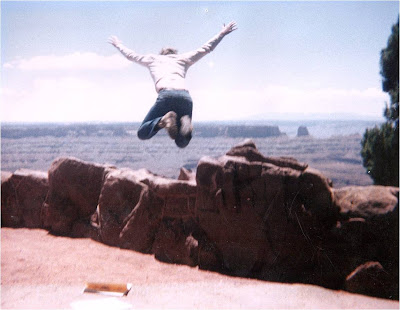
I suppose that an adventure is just about anything that breaks up the routine and exposes you to something new. For a lot of people I am guessing that adventure has a lot to do with an adrenaline rush: I think of motorcycling, rock-climbing, bungee-jumping or rides at an amusement park.

Others may think of adventure as exploration to the outer edges of space, beyond the reach of civilization, of the deep sea, the kinds of adventures that we might read about in National Geographic or history books. But how many people actually participate in that kind of adventure?

Other adventures come out of mythology; the quest, the dangerous journey with an uncertain outcome. We don't see so many of those, but I wonder if a mythological narrative will arise from recent events concerning Osama Bin Laden and those who sought to capture or kill him.

We live most of our adventures through the lives of someone else, in books and movies and so on. The vast majority of us just don't have the resources, or time, or health to be out on the cutting edge of human experience. It's for that reason that I want to talk about learning about geology as an adventure, in all of the best ways and something that almost anyone can do in some way. I think I started musing on this topic because of a cute item from Cracked.com. They do some hilarious stuff, but the last line of this post was, eh, whatever...

"They're, uh ... they're not a very exciting people, those geologists."

I grant you that I am not a very exciting person, in person. But I wouldn't trade my life as a geologist and teacher with anyone. What makes geology such an adventure? I can think of many examples, and here are a few:

Geologic hazards like volcanic eruptions and earthquakes have been fodder for movies and novels for decades. Geologists actually get to study these things as a part of their career. What a thrill to work on the flanks of an active volcano, monitoring and predicting future activity. There is certainly an adrenaline rush when standing next to flowing lava! A nice bonus? They sometimes save lives with their research. The story of the 1991 eruption of Pinatubo in the Phillippines is a nice example. The eruption was the second largest event of the 20th century, and killed some 800 people. On the other hand, tens of thousands of lives were saved because of a timely warning to evacuate the region. This is all the more remarkable considering that during the height of the eruption, a typhoon swept into the island (it was actually the cause of the majority of fatalities). Even bad screenwriters and novelists don't even think to throw typhoons on top of volcanic eruptions!
Have you ever wanted to be on an adventure to find buried treasure? Geologists and rockhounders alike know the thrill of uncovering a rare crystal. It's hard to be in the field all the time without finding the occasional opportunity to search for quartz, garnet, topaz, or any other number of beautiful expressions of atomic-level symmetry. It's the rare geologist who doesn't have a small treasure trove of gemstones (or here) on a mantle or bookcase shelf.

What about that childhood dream of finding a dinosaur? There is nothing quite like uncovering the bones of a creature that lived more than 65 million years ago. If you spend enough time in the right regions of the world, and you have enough geological background to know the age and nature of the rocks you are exploring, you can know that thrill (I'm not talking about a college education; there are geo-guides for the layperson that are full of accessible info about every region of the countryside). It's happened to my students (and myself) a fair number of times over the years. And there's no feeling quite like it. I was whooping like a kid (and promptly called the Utah Geological Survey; there's a right way to do these things).
Did you ever imagine owning a time machine, of traveling back in time? An understanding of the basic principles of geology is the tool geologists use to time-travel. It's effective; a bit of knowledge, and you can lay your hand on the surface that reveals incredible moments in the history of the world. In the picture below, I have my hand on the moment that the dinosaurs went extinct (via one of the most likely hypotheses). It is the iridium layer at Gubbio, Italy, where the Alvarez father and son team discovered evidence of a massive asteroid impact.
In the other photo, we are looking at the moment that the Long Valley Caldera erupted at the north end of the Owens Valley in the Eastern Sierra around 790,000 years ago. More than 125 cubic miles of hot rhyolite ash filled the atmosphere and blanketed the region many feet deep, killing all living things. Do you need a movie to imagine cataclysmic events? It's a whole new experience to lay your hands on the moment that such events actually happened.
A basic understanding of geology enriches one's life. National Parks are nice places to see scenery. A place like Yellowstone is interesting because you see bison and geysers. It is fascinating when you come to understand the nature of the "supervolcano" caldera eruption that produced the rocks and the active magma chamber that causes the geothermal activity. A visit to Yosemite is always nice, but it takes on a whole new dimension when you realize you are walking about inside an ancient volcanic complex not unlike Yellowstone's. You are exploring the underside of a volcano!

During your travels this summer, stop by the visitor center and pick up a "Geology of..." book and read it. It can enrich your experience, and turn a vacation into a real adventure! Or, if you are in the Modesto region, consider taking a summer field study class in geology or archaeology at MJC (more on this soon!).

Monday, February 27, 2017

Volcanoes in the Mist (and underground): Travels in Death Valley

The Inyo Mountains, in any other setting in the world, would be considered a major mountain range, preserved as a national park perhaps, and celebrated as scenic wonderland. But just like an accomplished sibling overshadowed by a more famous brother or sister, the Inyos lie across the valley from the most spectacular part of the Sierra Nevada, and south of the higher White Mountains. For better or worse (mostly better), only a few roads penetrate the range, including the main western highway into Death Valley National Park, State Route 190. That was the road we followed on our recent exploration of Death Valley.
As was noted in the previous post, we attempted our trip during the Bombogenesis storm that wreaked havoc across Southern California. This kind of storm can often result in disaster as highways get closed or damaged by landslides, but we were lucky and were able cross the Inyo Mountains and Darwin Plateau without problems. But we did get the opportunity to see some great geology, and even were able to add a new stop to our itinerary (because we missed a different one, but I'm not complaining).

Our first sight as we approached the mountains was the snow covering the desert peaks (first picture above), a hint to the seriousness of the storm we were challenging. The tilted rocks are Paleozoic-aged (300-550 million years) limestone layers. They recall a time when California was very different, completely submerged under a shallow tropical sea. We would be seeing more of these fascinating rocks later on. The road crossed the flat uplands of the Darwin Plateau, and then plunged down a steep incline towards the Panamint Valley.

We actually had fog in this arid environment, since the clouds were crowding against the edge of the steep mountains. As we passed the Father Crowley Vista Point, the clouds briefly parted and we had a view into the deep gorge of Rainbow Canyon. At this point, the slopes and flats are covered with basaltic lava flows ranging in age from 8 to 4 million years old. The immediate question becomes, why volcanoes? Why right here?

In a sense, volcanism is possible almost anywhere on the planet. It's not that there is magma everywhere, but that a hundred miles beneath our feet there is a zone, the asthenosphere, where the rock is almost molten, but not quite (perhaps 5-10% liquid). To melt this rock and create volcanic activity would require raising the temperature (as happens at hot spots like Hawai'i), or releasing pressure (pressure keeps the rocks from melting in the same way that pressure cookers prevent water from boiling). There aren't any hot spots in the immediate vicinity, but the crust across the Basin and Range Province has been stretched and thinned, allowing pockets of basaltic magma to form and rise into the rocks above, often following fault zones to the surface.
Although we couldn't see it through the clouds, there are basaltic lavas across the Panamint Valley that are of the same age and the same exact composition as those at the vista point. In addition, the rocks across the deep valley have no obvious source (the picture below is from last year, a decidedly drier trip). The best explanation for these rocks is that the lavas flowed across an original surface that was later broken up by faulting when the Panamint Valley formed. Since the youngest volcanic rocks are just 4 million years old, the Panamint Valley is younger still. The Panamint Valley is more than a mile deep and 65 miles long! That's a lot of geologic activity in a short period of time.
Looking across the Panamint Valley towards Hunter Mountain. The dark rocks on the left summit area are identical to the rocks at Father Crowley Vista Point.
We made a stop along the road descending into the Panamint Valley to check out some spectacular exposures of the dikes and sills that once fed the eruptions of the basaltic lavas (most years we are in too much of a hurry to get a camping spot at Stovepipe Wells). The magma was following whatever weakness in the surrounding rock that could be exploited by the molten rock. In some cases, vertical fractures allowed the magma to rise, forming dikes. In other cases, the molten rock flowed between limestone layers, forming sills. This extraordinary roadcut (below) showed textbook examples of both kinds of intrusions in the same outcrop. The usually black basalt has been oxidized (rusted) to produce the strange reddish-brown color.
There's a saying that one should never blindly sit on the ground in the desert. There are just too many things with fangs, stingers, or spines. The barrel cacti were looking to grow quickly in these rare wet times!
We headed down the highway. We had reached Death Valley National Park, and we faced whatever Bombogenesis was going to throw at us...

Saturday, May 21, 2016

Pele is a Capricious Goddess (reprised)...Part Two

Continuing the story from the previous post, I had a second chance to see a volcano in action in 2004. I was the newly elected president of the Far West Section of the National Association of Geoscience Teachers, and for my first conference, I had persuaded someone to sponsor a meeting in Hilo, Hawaii. The volcano on the Big Island at Pu'u O'o had continued to be active over the previous two years and was still going strong as the date of the conference approached. Lava was still traveling from the cinder cone on the east rift zone of Kilauea and traveling through lava tubes to the ocean. I was thrilled that a bunch of fellow teachers would be able to see an active lava flow!
Except (and there always seems to be some kind of terrible "except" to stories like this)...as the final days approached, the flow activity started to wane. The HVO reported that blockages had started to occur in the upper reaches of the lava tubes that were feeding the ocean entries, and the lava flows were slowing considerably, declining to almost nothing. Every morning I went online to check on the latest HVO reports, and got a sinking feeling.
My daughter arrived on the island a day before me, and hiked out to see the lava flows. It was down to a single dribble, no wider than a pencil, falling into the sea. No wider than a pencil. And then it stopped...
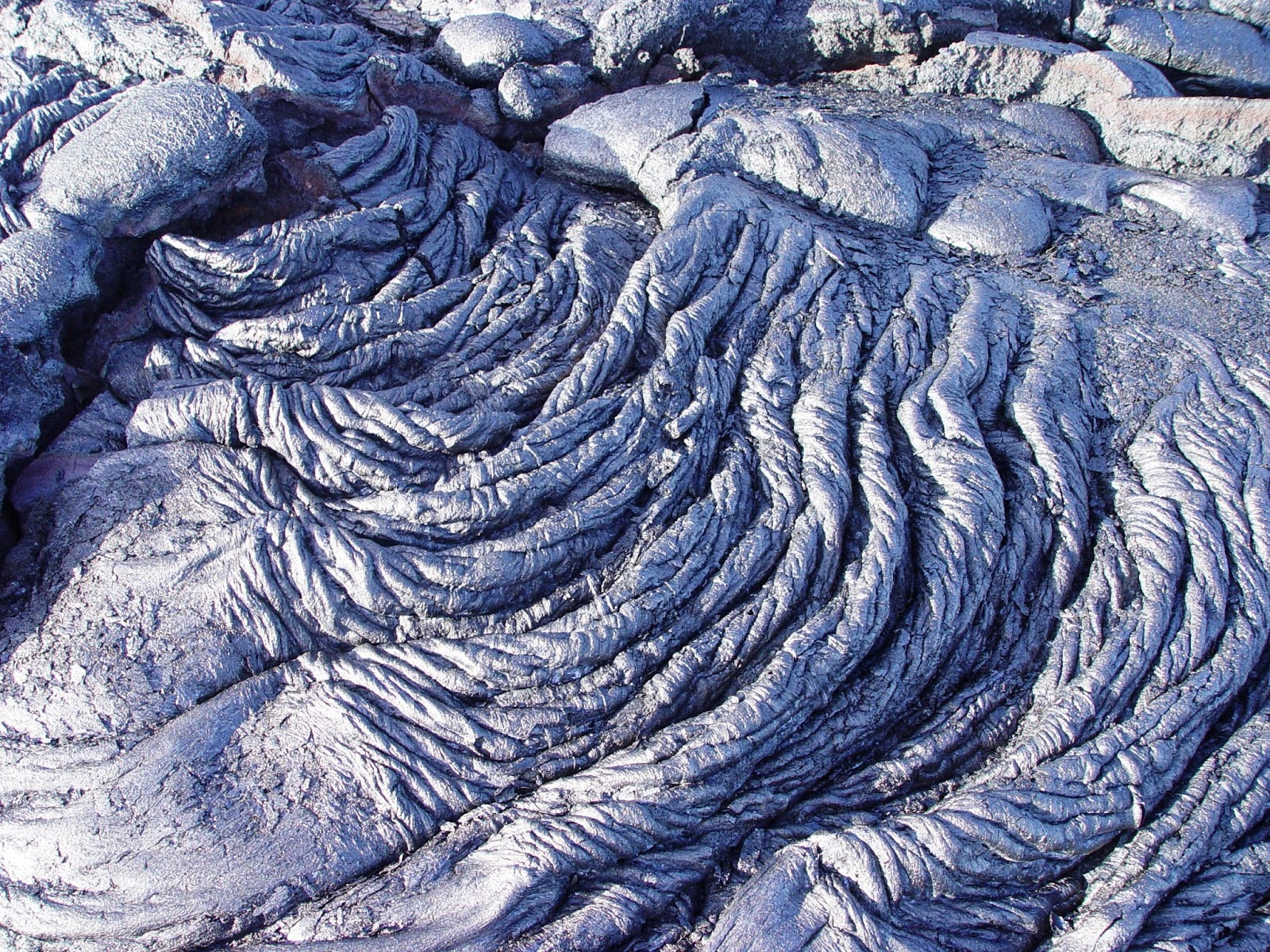
The next day, I hiked out to the flow as fast as I could, and saw...well, I saw what you can see in the picture above: steam from a recently ended flow. I searched desperately for any kind of small break out, any sign of active lava, but all there was was steam rising from cracks here and there. All I got for my trouble was a badly scraped arm and palm when I slipped and fell onto a day-old lava flow. I was not aware until that day that fresh basalt flows are usually covered with a thin veneer of obsidian (volcanic glass) that gives the lava flow a silvery metallic appearance. The glass starts to break up right away, forming jagged shards that are like small razors lying about the surface.
Still, there is great beauty in new rock. The patterns in the pahoehoe lava surfaces are endlessly fascinating, and there is a grandeur in the barren surfaces of a day old lava flow. It is an absolutely sterile surface that has never before existed. A new beginning...
Lava flowing into seawater has a tendency to explode on contact, forming fine sand-sized particles. Kilauea had already destroyed one of the most cherished black sand beaches in Hawaii, but a new beach, however impermanent, had appeared to replace it.

Pele had given the gift of new land on the island, but I was not privileged in this instance to see it happen. But patience is a virtue. It would be another two years before I made it to the islands, but it was worth the wait. That story will have to wait for the next post!
This is an expanded version of a 2009 blog post that preceded the first field studies course that I ever taught on the Hawaiian Islands. We're leaving in a week for the islands for our second-ever course, so I'm thinking volcanic subjects these days.

Monday, May 9, 2011

Living an Adventurous Life: Geologists...Really?

What does "adventure" mean to you?

This is an adrenaline rush...

I suppose that an adventure is just about anything that breaks up the routine and exposes you to something new. For a lot of people I am guessing that adventure has a lot to do with an adrenaline rush: I think of motorcycling, rock-climbing, bungee-jumping or rides at an amusement park.

Others may think of adventure as exploration to the outer edges of space, beyond the reach of civilization, of the deep sea, the kinds of adventures that we might read about in National Geographic or history books. But how many people actually participate in that kind of adventure?

Other adventures come out of mythology; the quest, the dangerous journey with an uncertain outcome. We don't see so many of those, but I wonder if a mythological narrative will arise from recent events concerning Osama Bin Laden and those who sought to capture or kill him.

We live most of our adventures through the lives of someone else, in books and movies and so on. The vast majority of us just don't have the resources, or time, or health to be out on the cutting edge of human experience. It's for that reason that I want to talk about learning about geology as an adventure, in all of the best ways and something that almost anyone can do in some way. I think I started musing on this topic because of a cute item from Cracked.com. They do some hilarious stuff, but the last line of this post was, eh, whatever...

"They're, uh ... they're not a very exciting people, those geologists."

I grant you that I am not a very exciting person, in person. But I wouldn't trade my life as a geologist and teacher with anyone. What makes geology such an adventure? I can think of many examples, and here are a few:

Geologic hazards like volcanic eruptions and earthquakes have been fodder for movies and novels for decades. Geologists actually get to study these things as a part of their career. What a thrill to work on the flanks of an active volcano, monitoring and predicting future activity. There is certainly an adrenaline rush when standing next to flowing lava! A nice bonus? They sometimes save lives with their research. The story of the 1991 eruption of Pinatubo in the Phillippines is a nice example. The eruption was the second largest event of the 20th century, and killed some 800 people. On the other hand, tens of thousands of lives were saved because of a timely warning to evacuate the region. This is all the more remarkable considering that during the height of the eruption, a typhoon swept into the island (it was actually the cause of the majority of fatalities). Even bad screenwriters and novelists don't even think to throw typhoons on top of volcanic eruptions!

Have you ever wanted to be on an adventure to find buried treasure? Geologists and rockhounders alike know the thrill of uncovering a rare crystal. It's hard to be in the field all the time without finding the occasional opportunity to search for quartz, garnet, topaz, or any other number of beautiful expressions of atomic-level symmetry. It's the rare geologist who doesn't have a small treasure trove of gemstones (or here) on a mantle or bookcase shelf.

What about that childhood dream of finding a dinosaur? There is nothing quite like uncovering the bones of a creature that lived more than 65 million years ago. If you spend enough time in the right regions of the world, and you have enough geological background to know the age and nature of the rocks you are exploring, you can know that thrill (I'm not talking about a college education; there are geo-guides for the layperson that are full of accessible info about every region of the countryside). It's happened to my students (and myself) a fair number of times over the years. And there's no feeling quite like it. I was whooping like a kid (and promptly called the Utah Geological Survey; there's a right way to do these things).
Did you ever imagine owning a time machine, of traveling back in time? An understanding of the basic principles of geology is the tool geologists use to time-travel. It's effective; a bit of knowledge, and you can lay your hand on the surface that reveals incredible moments in the history of the world. In the picture below, I have my hand on the moment that the dinosaurs went extinct (via one of the most likely hypotheses). It is the iridium layer at Gubbio, Italy, where the Alvarez father and son team discovered evidence of a massive asteroid impact.
In the other photo, we are looking at the moment that the Long Valley Caldera erupted at the north end of the Owens Valley in the Eastern Sierra around 790,000 years ago. More than 125 cubic miles of hot rhyolite ash filled the atmosphere and blanketed the region many feet deep, killing all living things. Do you need a movie to imagine cataclysmic events? It's a whole new experience to lay your hands on the moment that such events actually happened.
A basic understanding of geology enriches one's life. National Parks are nice places to see scenery. A place like Yellowstone is interesting because you see bison and geysers. It is fascinating when you come to understand the nature of the "supervolcano" caldera eruption that produced the rocks and the active magma chamber that causes the geothermal activity. A visit to Yosemite is always nice, but it takes on a whole new dimension when you realize you are walking about inside an ancient volcanic complex not unlike Yellowstone's. You are exploring the underside of a volcano!

During your travels this summer, stop by the visitor center and pick up a "Geology of..." book and read it. It can enrich your experience, and turn a vacation into a real adventure! Or, if you are in the Modesto region, consider taking a summer field study class in geology or archaeology at MJC (more on this soon!).

Tuesday, August 17, 2010

Dispatches from the Road: 90 Seconds on a Lava Flow

I really had no idea what to expect. Pu'u o'o vent on the east rift zone of Kilauea on the Big Island of Hawai'i has been putting out vast amounts of lava for most of the last 27 years, and day to day the location of the flows can change. For months at a time the active flows can remain high on the palis, far from any trailhead, and other times the lava can flow almost entirely through tubes, emerging for only a few seconds at the coastline before being consumed by waves. Unfortunately the flows can suddenly break out in new directions, leading to destruction of homes, roads and sacred archaeological sites. Scheduling a trip hoping to see active lava flows is always a crapshoot, and I have learned not to expect great conditions. Sometimes it just isn't gonna happen.

My trip to the Big Island this week was no exception. Over the last few weeks the volcano goddess Pele has been unusually active, and a huge flow threatened homes in what remains of Kalapana (most of the town was overrun by lava in 1990). One home was destroyed, and lava came within a hundred feet or so of several other houses.

Such spectacles bring spectators, and there have been complaints from property owners of tourists (and tourons) crossing property lines and leaving messes. The county responded by establishing a viewing area, but the view is often limited. I was one of those tourists who showed up, and I respect the needs of the homeowners, but the desire to see active lava is a powerful impulse in a geologist. So I arrived at road's end not knowing what to expect.
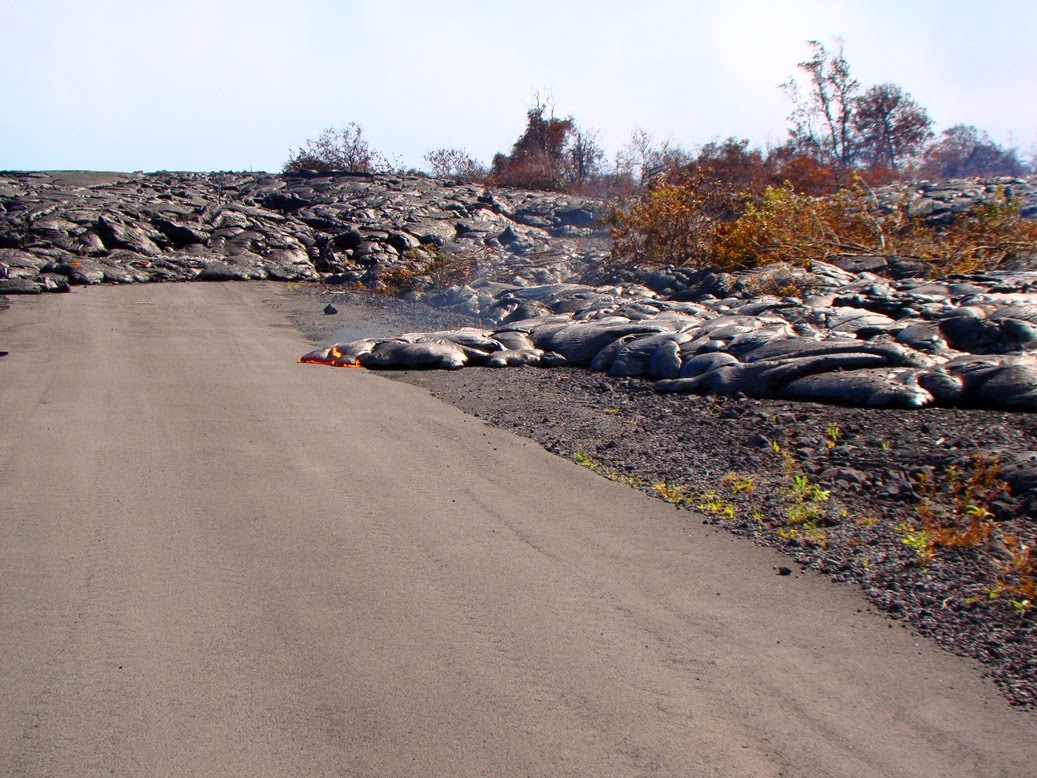
Sometimes the stars line up just right, and sometimes there is the small print. I arrived at the viewing area early in the day, and just a few people were walking down the road. The lava was mostly at a distance, but I had read of a new breakout near the end of the road, and when I arrived, I was given a very brief chance to cross the lines and check out the leading edge of the flow just as it started to consume some of the old highway. The deal was that I move back behind the lines when someone else showed, and that lasted all of 90 seconds. I didn't complain. It was enough to stand four feet away from the blazing hot rock and snap off a few photographs. Enjoy!

Even had I not seen the lava up close, the other sights were fascinating. Above, on the pali, I could see the pathway of the lavas as a wall of steam and smoke along the tubing system that was bring the lava from the vent at Pu'u o'o six or seven miles away.Visitors at night would see the glow of incandescent lavas on the slopes.
Towards the coast, I could see the steam rising from where the lava was pouring into the sea (this ocean entry was saving homes in Kalapana by draining lava away from the village). At night the steam will glow orange. That's fresh lava from the last week in the foreground; the brown plants were burned by the passage of the flow.

Lest we forget, there are actually two areas where volcanism is occurring on the Kilauea shield. In 2008, a vent opened in Halemaumau below the park visitor center and laboratories, and lava has been simmering in a 600 foot deep hole ever since, with the occasional explosive outburst. The shot above is how it appeared this morning.

It was a great day! My pictures hardly do justice to the lava, by the way. To see some great photography and get some on-site descriptions from someone who lives there, check out Leigh's sight, Hawaiian Lava Daily.

Wednesday, June 10, 2009

Report from the Road: Hawaii volcanoes


In the field this week with 26 students, on the Big Island of Hawaii. Lots to talk about, and I will when I find a bit of time, which hasn't been easy. If you are wondering what you can see from the ground right now, well, I will try and show you!

Kilauea volcano is erupting in two places right now, at a cone called Pu'u O'o on the east rift zone, and just lately at Halemaumau, the main caldera at the top of Kilauea.

We walked the half-mile journey across the older lava flows to the Hawaii Civil Defence viewing area, which is about 2,000 feet from the ocean entry. This lava has flowed something like 7 miles from Pu'u O'o, and is pouring from a lava tube into the surf. It is a spectacular sight! The picture shows a distant view, and a lucky zoom shot that shows flowing lava. It took about 50 attempts to catch visible lava between the steam plumes.
More soon!

Wednesday, June 3, 2009

Pele is a Capricious Goddess...Part Four: What's Next?

And now part four of my mini-series on the goddess Pele. The volcano goddess resides in Halema'uma'u, the pit seen above in a photo from 2006. I've arrived on the islands to prepare the way for my two dozen students, and we are set to visit Pele's realm next week. There has been a great deal of interesting activity of late, and I have hopes that we will be able to witness some aspect of Pele's fire.

But as I said before, Pele is a capricious goddess. For many months now, lava has poured from Pu'u O'o, traveling through the lava tube system for 6-7 miles before pouring into the sea. And in March, Pele got upset about something, because for the first time since 1924 she exploded in anger at Halema'uma'u, causing a pit to form in the area below the parking lot at the edge of precipice. Chunks of rock three feet across landed in the viewing area, where gifts are generally offered to the goddess. Lava is bubbling at the bottom of the pit, and vast amounts of steam and sulfur dioxide are pouring out of the vent.

Several weeks ago I contacted the Hawaiian Volcanoes Observatory about arranging a tour, and I joked about how the 24 year-long eruption sequence was going to end about June 5, because we were coming to the islands to look at the volcano on June 6.

Pele monitors e-mail...

I signed on yesterday to the daily report at HVO, and on the same day the glow in the Halema'uma'u pit was declining, AND the lava tubes had stopped pouring into the sea. Just like that. Just eerie, if you ask me.

The report this morning was better. Apparently a blockage in the tube system broke free, and the lava is flowing once more, and the glow in the Halema'uma'u pit is bright again. Message received. In any case, I know to be appreciative of the gift of Pele, whether we see actual lava flows or not. It is a spectacular sight to see, no matter what is happening when you arrive. Students, take note!

Tuesday, June 2, 2009

Pele is a Capricious Goddess...Part Two


Continuing the story from the previous post, I had a second chance to see a volcano in action in 2004. I was the newly elected president of the Far West Section of the National Association of Geoscience Teachers, and for my first conference, I had persuaded someone to sponsor a meeting in Hilo. The volcano had continued to be active over the previous two years and was still going strong as the date of the conference approached. I was thrilled that a bunch of fellow teachers would be able to see an active lava flow!

Except...

As the final days approached, the activity started to wane. The HVO reported that blockages had started to occur in the upper reaches of the lava tubes that were feeding the ocean entries, and the lava flows were slowing to a trickle.

My daughter arrived on the island a day before me, and hiked to see the lava. It was down to a single dribble, no thicker than a pencil, falling into the sea.

The next day, I hiked out to the flow as fast as I could, and saw...well, I saw what you can see in the first picture above: steam from a recently ended flow. I searched desperately for any kind of small break out, any sign of active lava, but all there was was steam rising from cracks here and there. All I got for my trouble was a badly scraped arm and palm when I slipped and fell onto a day old lava flow. I was not aware until that day that fresh basalt flows are usually covered with a thin veneer of obsidian (volcanic glass) that gives the lava flow a silvery metallic appearance. The glass starts to break up right away, forming jagged shards that are like small razors lying about the surface.

Still, there is great beauty in new rock. The patterns in the pahoehoe lava surfaces are endlessly fascinating, and there is a grandeur in the barren surfaces of a day old lava flow. And absolutely sterile surface that has never before existed. A new beginning...
Next: Pele's gift

Pele is a Capricious Goddess...Part One

Note to my Geology 174 Students: this IS NOT a picture from my current visit. Lava is NOT flowing this way right now. I offer NO GUARANTEES that anything we see on our trip next week will be anything like this. The reasons are described below....

Pele is the volcano goddess on the Hawaiian Island, and she is a powerful deity in the lives of the islanders. Think about it: the only substantial piece of land above sea level for thousands of miles in all directions is the result of volcanic eruptions that built the islands up from ocean crust lying beneath 3 miles of ocean water. All existence on the islands starts with volcanic creation, and all is lost when the volcanoes ultimately die out and fall prey to the waves and weathering. These beliefs demand a certain amount of respect when paying a visit to the islands.

The title of my post is meant in a slightly humorous vein, but my experiences in four trips make me start to wonder. Let me explain...

My first trip to the islands was in 2002, and I was full of hope that I would get a chance to see a lava flow, even though there seemed little chance of it from reading the 2002 status reports from the Hawaii Volcanoes Observatory. Lava had not reached the ocean for many months, with activity confined to the region around Pu'u O'o many miles from any roads or trails. Then, just prior to my plane flight, lava started flowing rapidly down the slopes of the shield, and began pouring in a spectacular manner over the Pulama Pali (a 500 foot fault scarp/cliff) and onto the coastal plain...only a mile from the end of Chain of Craters Road! At one point seven streams of lava were pouring over the cliff! And the lava was now crossing the coastal plain on the way to the sea. I was going to see an incredible show!

But....

The lava flow had started the largest forest fire to occur in the park in 15 years. And the fire fighters had to close Chain of Craters Road to provide access for their fire-fighting equipment. I was not going to see the lava flow! I was crushed, frustrated beyond reason!

But...

Being a Californian, I expect that firefighters work day and night to fight fires, but Hawaii was different. The crews shut down at 5:00 PM, and went home for a nap. The road opened. I, and hundreds of other people drove the road in one long stream of cars, and started hiking over the older flows towards the new flows, now only a quarter mile from the ocean. We could walk right up to the edge of the oncoming flow and feel the intense heat. It was not moving fast, only a few inches a minute, but it was hypnotic. There is nothing quite like standing at the edge of a new creation, knowing that this was how these islands came to exist, one flow after another, after another until they are tens of thousands of feet thick, finally emerging from the sea, providing a platform for the survival of the living flotsam and jetsam that once every few thousand years washed up on the island, and building a unique ecosystem.

Shortly: Pele gets moody...

Thursday, January 10, 2008

Picture of the Day

Another one of the great moments of a geologist's/teacher's life...watching as a new breakout of lava reaches the sea for the first time. I was in Hawaii in August 2006, and had the chance to walk across several miles of new lava to see what I could of the Pu'u' O'o flow off the Kilauea shield at night. Safety barriers prevented the close viewing of any flows and I was ready for some disappointment. Just about the time I was going to give up and head back to the parking area, other hikers said something exciting was happening another quarter mile down the coast. I arrived just in time to see a new tongue of basalt break out from a lava tube, flow across 100 meters or so of the lava shelf, and then over the edge, into the surf. My camera was one day old, and I was scrambling to find a way to get some decent pictures in the dark with a fading flashlight, but a few turned out reasonably well.

I was overdue back at the hotel (by about three hours or so), and so am lucky to still be married, but what a great moment it was. It both stunning, and yet hypnotic watching the newest rocks on the planet forming in front of me.