Showing posts with label Kilauea. Show all posts

Saturday, June 15, 2024

Geotripper on How to Plan a Perfect Volcanic Eruption, Hawai'i Style!

So you want to demonstrate a volcanic eruption for your field geology course, and are unsure how to proceed? Let the crew (of one) here at Geotripper help you to plan out the very best eruption experience for your students! There are several important steps and considerations:

1) Pick a volcano

This is a pretty important first step. Some volcanoes can be very dangerous, and we at Geotripper feel that safety is a hugely important consideration. We have chosen the Big Island of Hawai'i for our demonstration, as eruptions there TEND to be on the quiet side, although there are important exceptions.

Kilauea Caldera and Kilauea Iki in the distance

2) Do a site evaluation

Take a hike out to the potential eruption site. This is kind of critical, because we want to choose a site that is isolated and away from buildings and populated areas. Yet we also want the site to be visible once the eruption begins, since this is the whole point of planning such things.

Hiking out to the Ka'u Desert ("Footprints Trail") on May 29, 2024

3) Consult with the local volcanic deities:


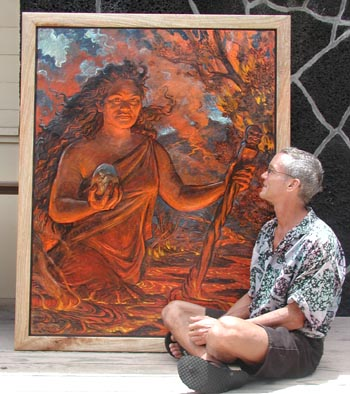
Painting of the Hawaiian goddess Pele at the Kilauea Visitor Center with the artist, Arthur Johnson (Source: NPS).

Once again a critical factor. One doesn't conduct eruptions without the permission and cooperation of the deities that inhabit the place. In our current example we are dealing with Pele, also known as Pele-honua-mea ("Pele of the sacred land") and Ka wahine ʻai honua ("The earth-eating woman"). 

A side note: the gist of this post is tongue-in-cheek, but I take Pele pretty seriously. Check out my interaction with a mysterious woman on the flanks of Kilauea a few years ago. Who was she??

4) Start the Field Trip

Taking twenty students to the Hawaiian Islands for two weeks is no small task, and we here at Geotripper strongly suggest planning the trip many months in advance of the eruption. Remember to consider such logistics as hotels, transportation, airline flights, food, and group interpersonal interactions.

5) Educate your students on the basics of volcanoes and vulcanism

There are many ways to do this. One of my favorites is to pay a visit to the 
Hawaiian Volcano Observatory (currently based in Hilo, Hawai'i after their original home on the brink of the Kilauea caldera was damaged by an eruption in 2018). Our expert host provided an excellent introduction to the methods and technology of volcano monitoring.

6) Subtly prepare the group for the experience of the eruption

This step requires some public relation skills. We don't want to have the experience spoiled by high expectations and the like. We want our group to be both surprised and prepared when the eruption happens. There are a number of ways to do do this. For instance, have them look at seismic records and see if they notice the uptick in earthquakes in recent days. Ask a Hawaii Volcanoes National Park ranger leading questions like "why did you close the Devastated Area Trail yesterday?" You can make jokes, like "Wouldn't it be interesting if an eruption were to happen while we are on the trip?". Don't overdo it, though.

7. Conduct the Eruption

In many ways this is the easiest step, since the Earth does all the work. If you arrange for the eruption overnight, you can plan on an early departure from the hotel to beat the tourists to all the best overlooks. If you have prepared in the way that we have put forth here, your students will be duly impressed even if they can't stick things into the lava flow or even see spewing lava. Seeing the ash and steam rising from the distant rift zone will be more than enough!

Oh, I see a hand in the back...what was your question? How do we actually cause the eruption to happen at the perfect time? Oh, it's kind of complicated. We don't really have time enough to explain...

8. Provide a cooling down period

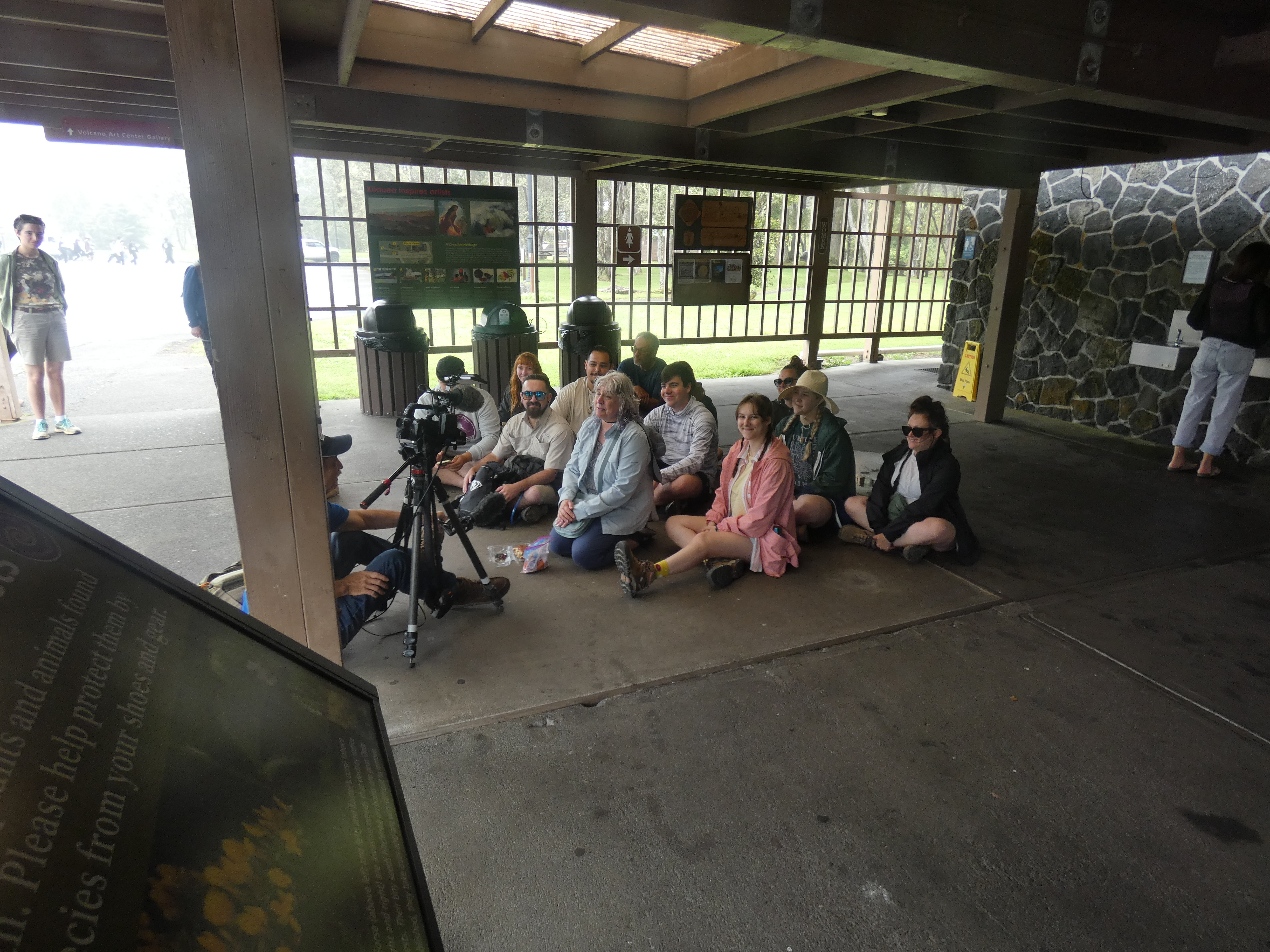
Go to the national park visitor center and hang around for awhile. Get interviewed by the local news media. Use the restrooms. Then continue on the rest of your trip, wondering how you'll ever top this experience!

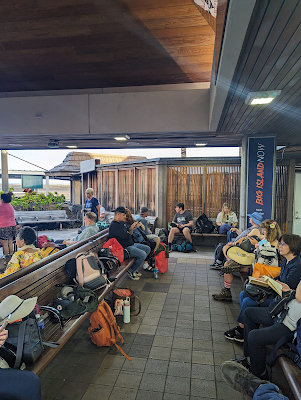
So yeah, it pretty much happened this way while we were in Hawai'i recently (except for the actual organizing of any eruption). Our students and my co-leader were in fact interviewed on local Hawaiian news (see the story here: HVO: Eruption at Kilauea’s summit has paused, but activity in region remains dynamic (hawaiinewsnow.com)).

The eruption itself was somewhat of a surprise. There had been upticks in the seismicity and uplift in some nearby areas, but the precise spot where the rift opened up was unexpected. It was a very short-lived eruption, lasting only about 12 hours, and the volume of lava was limited. You can see the USGS review of the eruption here: https://www.usgs.gov/observatories/hvo/science/recent-eruption.

Source: USGS Hawaii Volcanoes Observatory
All things considered, it was one of the most satisfying moments of my teaching career... 


Here's my video of the eruption from the site of the old Jagger Museum and Hawaiian Volcano Observatory: https://vimeo.com/959288135?share=copy

Here's the direct access: 


Tuesday, May 18, 2021

41st Anniversary of the Eruption of Mt. St. Helens: It Still Matters and So Does Science


It is the 41st anniversary of the eruption of the St. Helens volcano and as I think of those days, I realize that even though a majority of the population wasn't even alive at the time, the volcano still matters. Not because of the potential for future eruptions (although that remains a distinct possibility), but because of the way we process and deal with the natural hazards that we all face, no matter where we live. This is kind of a recurring post that I've modified over the years.


When the volcano began rumbling and sending ash into the atmosphere, we had only a few avenues to get information, mainly television news, radio, and newspapers. I think now how limiting these sources were compared to the nearly instantaneous delivery of news over the internet in the present day. We can look up earthquakes just moments after they happen, and webcams allow us to monitor volcanoes around the world in real time. There is both good and bad in this profound change. There were terrible sources of news in those olden days, like the Weekly World News or the National Enquirer, but they pale in comparison to the sewage found on the internet today. Back then, national news outlets and newspapers practiced careful journalism in most instances, but it often seems today that the only reward for excellence and honesty in reporting is decreased ratings and falling revenues. To get attention in a crowded internet environment media outlets have to dress their stories as shiny objects and provide them with the worst possible clickbait titles. In the olden days we often had to wait impatiently for information about natural disasters, but the information that came through the media was more likely to be vetted and checked for accuracy. The journalistic filters today are completely gone in many media sources, and it can be difficult to distinguish between the trash and the truth.


There are so many conspiracy theories floating around today about natural disasters and potential disasters. The eruptions of Steamboat Geyser in Yellowstone National Park numerous times after years of quiescence caused a blizzard of posts on the internet pondering whether Yellowstone has been disturbed and may blow as a "supervolcano" eruption soon (and we'll all die). The same has happened after a number of recent small earthquakes. But a reading of the reality-based data says that Yellowstone caldera has not had a lava flow or eruption of any kind in 70,000 years, and no knowledgeable geologist sees any evidence of precursors to any new eruptions. A few years back, an earthquake and an internet video of a group of bison running "away" from Yellowstone caused the same kind of internet speculation (it turns out the bison were running towards the caldera).


Of course it is true that the Yellowstone caldera was born in one of the most colossal eruptions ever recorded. Learning the story of the eruption of the Huckleberry Tuff is fascinating. It brings an entirely new appreciation of the incredible scenery to be observed in a place that contains 70% of all the world's geysers. It should be enough. But there are so many individuals out there who would like to make a buck by scaring people needlessly. And there are too many gullible and ignorant people out there who can't pick rational accounts out of the confusing mix of conspiracy theories that exist on the internet.


And then there is the Big Island of Hawai'i. There were some serious and tragic things going on in 2018 when the longest eruption in recorded history reached a climax. The activity endangered lives and destroyed homes as Kilauea underwent major changes from the "norm" of the eruptions that had been ongoing for the last 35 years. One of the truly awesome sights I have ever seen was the collapse of a portion of the Kilauea Caldera into a gigantic pit that reached a depth of 1,800 feet. It stabilized for a year or so, even forming a lake (of water) at the bottom, but then a few months ago the eruptions started again, filling the pit with 700 feet of roiling molten basalt. 

The U.S. Geological Survey and Hawaiian civil defense authorities did a pretty good job of providing up-to-date information about the latest activity, but that didn't stop all kinds of stories from popping up on the internet about the "Ring of Fire" which has nothing at all to do with Hawai'i. It was just too easy to pick up stories of eruptions in Alaska and Indonesia and think there was a pattern of increasing volcanism or earthquake activity (OMG, a magnitude 6 quake in the Kermadec Islands and an eruption at Mt. Cleveland in Alaska! It's a pattern and therefore Seattle will fall into the sea very soon!). The problem is one of perspective: if you had signed up for earthquake notifications and volcano advisories from the USGS or other geologic research institutions, you would have realized that these things happen all the time, and that a cluster of events is not unusual.


It's one thing to make up stories about normal volcanic activity to scare people. One can argue that they are ultimately harmless because the eruptions aren't actually taking place or hurting anyone. But there are real-world consequences of ignoring journalistic standards. Many of those who make their money with false headlines about such things will also traffic in climate change denial. When science becomes a matter of believing whatever one wishes, the very real problem of global warming becomes just another "scare" story, and the alarm bells being sounded by climate scientists become just more noise in an internet full of noise. But the predicted real-world consequences are happening now, and action is needed to counteract the changes or to stop them. But it has become too easy to ignore the problem because it is so incremental and slow-acting. It just can't compete with the shiny baubles and clickbait on the web.
People in Hawai'i mostly trusted the geologists who studied the volcanoes all their lives and thus made the correct decisions about evacuating homes and businesses. In the same way they trusted the seismologists when a tsunami threatened the islands in 2011 after the massive earthquake in Japan. No lives were lost when the tsunami hit because people had evacuated the low-lying areas. The wave surge was 8 feet deep in places and caused millions of dollars of damage. Many people could have been killed, but they accepted the authority of the scientists who predicted the timing and magnitude of the seismically induced waves.

There has been one characteristic about the natural disasters that I've described above. They were local events that profoundly changed lives, but in large and yet limited regions. When earthquakes and volcanic eruptions strike, survivors can turn to other regional state and national governments for support, since those entities were not so badly affected. Now we face a different set of natural disasters: those that affect the entire planet. Pandemics and climate change affect all of us. Witness the spread of the COVID-19 virus last year to literally every corner and every country of the planet in a matter of weeks.

Scientific experts have long predicted the emergence of dangerous new strains of viruses, and previous administrations used the best scientific minds to prepare for their inevitable arrival. But those administrations were replaced by one that denigrated scientific expertise and fired the experts who could have crafted an appropriate national response to the COVID-19 virus. And last year we saw the result: nearly 600,000 deaths in the U.S. with more to come, lack of critical medical supplies in the critical early months, and no coordinated federal response, even once vaccines became available. Even worse was a propaganda campaign that convinced people that the disease was not as bad as it clearly was, and worse still, that the vaccines were some kind of insidious plot. Other countries listened to their scientists and saved countless lives. I thank the heavens that the country ultimately elected an administration that is being guided for the most part by science in their decision-making processes.

And that's why the Mt. St. Helens eruption of 1980 matters today. Scientific expertise matters. The pandemic (and others to come) will be a continuing problem in our interconnected world. Climate change is proving to be an even more profound danger to society than any virus, earthquake or volcanic eruption. We need people to give climate scientists the same kind of respect they give geologists when volcanoes are rumbling and smoking. They are the ones to listen to, not the hucksters on the internet who are out to make a buck, or trying to protect those industries that make their profits off of producing greenhouse gases. We seem to talk little these days about integrity and striving for excellence, but scientific researchers are among those who still have those traits. There are always exceptions, but I would trust a scientist over a politician every time (unless it is clear that the politician knows how to listen to a scientist).


There is a sign seen at some of the March For Science protests that have been happening around the country: "At the start of every disaster movie there's a scientist being ignored". Unfortunately, it is too true in real life as well.

This has been an abridged and updated version of my St. Helen eruption anniversary reflection.

Monday, May 18, 2020

The Eruption of Mt. St. Helens at 40 years: Why it Still Matters and Why Science Matters


It is the 40th anniversary of the eruption of the St. Helens volcano and as I think of those days, I realize that even though a majority of the population wasn't even alive at the time, the volcano still matters. Not because of the potential for future eruptions (although that remains a distinct possibility), but because of the way we process and deal with the natural hazards that we all face, no matter where we live.


When the volcano began rumbling and sending ash into the atmosphere, we had only a few avenues to get information, mainly television news, radio, and newspapers. I think now how limiting these sources were compared to the nearly instantaneous delivery of news over the internet in the present day. We can look up earthquakes just moments after they happen, and webcams allow us to monitor volcanoes around the world in real time. There is both good and bad in this profound change. There were terrible sources of news in those olden days, like the Weekly World News or the National Enquirer, but they pale in comparison to the sewage found on the internet today. Back then, national news outlets and newspapers practiced careful journalism in most instances, but it often seems today that the only reward for excellence and honesty in reporting is decreased ratings and falling revenues. To get attention in a crowded internet environment media outlets have to dress their stories as shiny objects and provide them with the worst possible clickbait titles. In the olden days we often had to wait impatiently for information about natural disasters, but the information that came through the media was more often vetted and checked for accuracy. The journalistic filters today are completely gone in many media sources, and it can be difficult to distinguish between the trash and the truth.


There are so many conspiracy theories floating around today about natural disasters and potential disasters. The eruptions of Steamboat Geyser in Yellowstone National Park numerous times after years of quiescence caused a blizzard of posts on the internet pondering whether Yellowstone has been disturbed and may blow as a "supervolcano" eruption soon (and we'll all die). The same has happened after a number of recent small earthquakes. But a reading of the reality-based data says that Yellowstone caldera has not had a lava flow or eruption of any kind in 70,000 years, and no knowledgeable geologist sees any evidence of precursors to any new eruptions. A few years back, an earthquake and an internet video of a group of bison running "away" from Yellowstone caused the same kind of internet speculation (it turns out the bison were running towards the caldera).


Of course it is true that the Yellowstone caldera was born in one of the most colossal eruptions ever recorded. Learning the story of the eruption of the Huckleberry Tuff is fascinating. It brings an entirely new appreciation of the incredible scenery to be observed in a place that contains 70% of all the world's geysers. It should be enough. But there are so many individuals out there who would like to make a buck by scaring people needlessly. And there are too many gullible and ignorant people out there who can't pick rational accounts out of the confusing mix of conspiracy theories that exist on the internet.


And then there is the Big Island of Hawai'i. There were some serious and tragic things going on summer before last when the longest eruption in recorded history reached a climax. The activity endangered lives and destroyed homes as Kilauea underwent major changes from the "norm" of the eruptions that had been ongoing for the last 35 years. The U.S. Geological Survey and Hawaiian civil defense authorities did a pretty good job of providing up-to-date information about the latest activity, but that didn't stop all kinds of stories from popping up on the internet about the "Ring of Fire" which has nothing at all to do with Hawai'i. It was just too easy to pick up stories of eruptions in Alaska and Indonesia and think there was a pattern of increasing volcanism or earthquake activity (OMG, a magnitude 6 quake in the Kermadec Islands and an eruption at Mt. Cleveland in Alaska! It's a pattern and therefore Seattle will fall into the sea very soon!). The problem is one of perspective: if you had signed up for earthquake notifications and volcano advisories from the USGS or other geologic research institutions, you would have realized that these things happen all the time, and that a cluster of events is not unusual.


It's one thing to make up stories about normal volcanic activity to scare people. One can argue that they are ultimately harmless because the eruptions aren't actually taking place or hurting anyone. But there are real-world consequences of ignoring journalistic standards. Many of those who make their money with false headlines about such things will also traffic in climate change denial. When science becomes a matter of believing whatever one wishes, the very real problem of global warming becomes just another "scare" story, and the alarm bells being sounded by climate scientists become just more noise in an internet full of noise. But the real-world consequences are happening now, and action is needed to counteract the changes or to stop them. But it has become too easy to ignore the problem because it is so incremental and slow-acting. It just can't compete with the shiny baubles and clickbait on the web.
People in Hawai'i mostly trusted the geologists who studied the volcanoes all their lives and thus made the correct decisions about evacuating homes and businesses. In the same way they trusted the seismologists when a tsunami threatened the islands in 2011 after the massive earthquake in Japan. No lives were lost when the tsunami hit because people had evacuated the low-lying areas. The wave surge was 8 feet deep in places and caused millions of dollars of damage. Many people could have been killed, but they accepted the authority of the scientists who predicted the timing and magnitude of the seismically induced waves.

There has been one characteristic about the natural disasters that I've described above. They were local events that profoundly changed lives, but in large and yet limited regions. When earthquakes and volcanic eruptions strike, survivors can turn to other regional state and national governments for support, since those entities were not so badly affected. Now we face a different set of natural disasters: those that affect the entire planet. Pandemics and climate change affect all of us. Witness the spread of the COVID-19 virus to literally every corner and every country of the planet in a matter of weeks.

Scientific experts have long predicted the emergence of dangerous new strains of viruses, and previous administrations used the best scientific minds to prepare for their inevitable arrival. But those administrations were replaced by one that denigrated scientific expertise and fired the experts who could have crafted an appropriate national response to the COVID-19 virus. And today we see the result: nearly 100,000 deaths in the U.S. already with many more to come, lack of critical medical supplies and stockpiles, and no coordinated federal response. Even worse is a propaganda campaign that is convincing people that the disease is not as bad as it clearly is. Other countries listened to their scientists and saved countless lives. We are instead loosening critical restrictions even as the numbers in many areas of the country continue to rise.

And that's why the Mt. St. Helens eruption of 1980 matters today. Scientific expertise matters. Pandemics will be a continuing problem in our interconnected world. And climate change is an even more profound danger to society than any virus, earthquake or volcanic eruption. We need people to give climate scientists the same kind of respect they give geologists when volcanoes are rumbling and smoking. They are the ones to listen to, not the hucksters on the internet who are out to make a buck, or trying to protect those industries that make their profits off of producing greenhouse gases. We seem to talk little these days about integrity and striving for excellence, but scientific researchers are among those who still have those traits. There are always exceptions, but I would trust a scientist over a politician every time (unless it is clear that the politician knows how to listen to a scientist).


There is a sign seen at some of the March For Science protests that have been happening for the last two years around the country: "At the start of every disaster movie there's a scientist being ignored". Unfortunately, it is too true in real life as well.

This has been a highly abridged and updated version of last year's St. Helen eruption anniversary reflection.

Saturday, May 18, 2019

The Eruption of Mt. St. Helens at 39 Years: Why It Still Matters


It is the 39th anniversary of the famed eruption of the St. Helens volcano and as I think of those days, I realize that even though a majority of the population wasn't even alive at the time, the volcano still matters. Not because of the potential for future eruptions (although that remains a distinct possibility), but because of the way we process and deal with the natural hazards that we all face, no matter where we live.


When the volcano began rumbling and sending ash into the atmosphere, we had only a few avenues to get information, mainly television news, radio, and newspapers. I think now how limiting these sources were compared to the nearly instantaneous delivery of news over the internet in the present day. We can look up earthquakes just moments after they happen, and webcams allow us to monitor volcanoes around the world in real time. There is both good and bad in this profound change. There were terrible sources of news in those olden days, like the Weekly World News or the National Enquirer, but they pale in comparison to the sewage found on the internet today. Back then, national news outlets and newspapers practiced careful journalism in most instances, but it often seems today that the only reward for excellence and honesty in reporting is decreased ratings and falling revenues. To get attention in a crowded internet environment media outlets have to dress their stories in shiny objects and provide them with the worst possible clickbait titles. In the olden days we often had to wait impatiently for information about natural disasters, but the information that came through the media was more often vetted and checked for accuracy. The journalistic filters today are completely gone, and it can be difficult to distinguish between the trash and the truth.


There are so many conspiracy theories floating around today about natural disasters and potential disasters. The eruptions of Steamboat Geyser in Yellowstone National Park numerous times after years of quiescence has caused a blizzard of posts on the internet pondering whether Yellowstone has been disturbed and may blow as a "supervolcano" eruption soon (and we'll all die). The same has happened after a number of recent small earthquakes. But a reading of the reality-based data says that Yellowstone caldera has not had a lava flow or eruption of any kind in 70,000 years, and no knowledgeable geologist sees any evidence of precursors to any new eruptions. A few years back, an earthquake and an internet video of a group of bison running "away" from Yellowstone caused the same kind of internet speculation (it turns out the bison were running towards the caldera).


Of course it is true that the Yellowstone caldera was born in one of the most colossal eruptions ever recorded. Learning the story of the eruption of the Huckleberry Tuff is fascinating. It brings an entirely new appreciation of the incredible scenery to be observed in a place that contains 70% of all the world's geysers. It should be enough. But there are so many individuals out there who would like to make a buck by scaring people needlessly. And there are too many gullible and ignorant people out there who can't pick rational accounts out of the confusing mix of conspiracy theories that exist on the internet.


And then there is the Big Island of Hawai'i. There were some serious and tragic things going on last summer as the longest eruption in history reached a climax. The activity endangered lives and destroyed homes as Kilauea underwent major changes from the "norm" of the eruptions that had been ongoing for the last 35 years. The U.S. Geological Survey and Hawaiian civil defense authorities did a pretty good job of providing up-to-date information about the latest activity, but that didn't stop all kinds of stories from popping up on the internet about the "Ring of Fire" which has nothing at all to do with Hawai'i. It was just too easy to pick up stories of eruptions in Alaska and Indonesia and think there was a pattern of increasing volcanism or earthquake activity (OMG, a magnitude 6 quake in the Kermadec Islands and an eruption at Mt. Cleveland in Alaska! It's a pattern and therefore Seattle will fall into the sea very soon!). The problem is one of perspective: if you had signed up for earthquake notifications and volcano advisories from the USGS or other geologic research institutions, you would have realized that these things happen all the time, and that a cluster of events is not unusual.


It's one thing to make up stories about normal volcanic activity to scare people. One can argue that they are ultimately harmless because the eruptions aren't actually taking place or hurting anyone. But there are real-world consequences of ignoring journalistic standards. Many of those who make their money with false headlines about such things will also traffic in climate change denial. When science becomes a matter of believing whatever one wishes, the very real problem of global warming becomes just another "scare" story, and the alarm bells being sounded by climate scientists become just more noise in an internet full of noise. But the real-world consequences are happening now, and action is needed to counteract the changes or to stop them. But it has become too easy to ignore the problem because it is so incremental and slow-acting. It just can't compete with the shiny baubles and clickbait on the web.
People in Hawai'i mostly trusted the geologists who studied the volcanoes all their lives and thus made the correct decisions about evacuating homes and businesses. In the same way they trusted the seismologists when a tsunami threatened the islands in 2011 after the massive earthquake in Japan. No lives were lost when the tsunami hit because people had evacuated the low-lying areas. The wave surge was 8 feet deep in places and caused millions of dollars of damage. Many people could have been killed, but they accepted the authority of the scientists who predicted the timing and magnitude of the seismically induced waves.

And that's why the Mt. St. Helens eruption of 1980 matters today. Scientific expertise matters. Climate change is an even more profound danger to society than any earthquake or volcanic eruption. We need people to give climate scientists the same kind of respect they give geologists when volcanoes are rumbling and smoking. They are the ones to listen to, not the hucksters on the internet who are out to make a buck, or trying to protect those industries that make their profits off of producing greenhouse gases. We seem to talk little these days about integrity and striving for excellence, but scientific researchers are among those who still have those traits. There are always exceptions, but I would trust a scientist over a politician any day of the week (unless it is clear that the politician knows how to listen to a scientist).


There is a sign seen at some of the March For Science protests that have been happening for the last two years around the country: "At the start of every disaster movie there's a scientist being ignored". Unfortunately, it is too true in real life as well.

This has been a highly abridged and updated version of last year's St. Helen eruption anniversary reflection.
Friday, May 18, 2018

The Mount St. Helens Eruption at 38 years, and Why it Matters Today

I'd love to say I got these photographs of Mt. St. Helens last week when I flew to Seattle, but we flew right over the volcano, so you'll have to settle for the pictures I got on a flyover back in 2006. I did get pictures of Mt. Rainier and Medicine Lake Highland though. In any case, it is the 38th anniversary of the famed eruption of the volcano and as I think of those days, I realize some disturbing things.
When the volcano began rumbling and sending ash into the atmosphere, we had only a few avenues to get information, mainly television news, radio, and newspapers. I think now how limiting these sources were compared to the nearly instantaneous delivery of news over the internet in the present day. We can look up earthquakes just moments after they happen, and webcams allow us to monitor volcanoes around the world in real time. There is both good and bad in this profound change. There were terrible sources of news in those olden days, like the Weekly World News or the National Enquirer, but they pale in comparison to the sewage found on the internet today. Back then, national news outlets and newspapers practiced careful journalism in most instances, but it often seems today that the only reward for excellence and honesty in reporting is decreased ratings and falling revenues. To get attention in a crowded internet environment media outlets have to dress their stories in shiny objects and provide them with the worst possible clickbait titles. In the olden days we often had to wait impatiently for information about natural disasters, but the information that came through the media was more often vetted and checked for accuracy. The journalistic filters today are completely gone, and it can be difficult to distinguish between the trash and the truth.

There are so many conspiracy theories floating around today about natural disasters and potential disasters. The eruption of Steamboat Geyser in Yellowstone National Park five times in two months (after four years of quiescence) has caused a blizzard of posts on the internet pondering whether Yellowstone has been disturbed and may blow as a "supervolcano" eruption soon (and we'll all die). The same has happened after a number of recent small earthquakes. But a reading of the reality-based data says that Yellowstone caldera has not had a lava flow or eruption of any kind in 70,000 years, and no knowledgeable geologist sees any evidence of precursors to any new eruptions. A few years back, an earthquake and an internet video of a group of bison running "away" from Yellowstone caused the same kind of internet speculation (it turns out the bison were running towards the caldera).

Of course it is true that the Yellowstone caldera was born in one of the most colossal eruptions ever recorded. Learning the story of the eruption of the Huckleberry Tuff is fascinating. It brings an entirely new appreciation of the incredible scenery to be observed in a place that contains 70% of all the world's geysers. It should be enough. But there are so many individuals out there who would like to make a buck by scaring people needlessly. And there are too many gullible and ignorant people out there who can't pick rational accounts out of the confusing mix of conspiracy theories that exist on the internet.

And then there is the Big Island of Hawai'i. There are some serious things going on during the current phase of the eruption. The activity is endangering lives and destroying homes as Kilauea undergoes some major changes from the "norm" of the eruptions that have been ongoing for the last 35 years. The U.S. Geological Survey and Hawaiian civil defense authorities have been doing a pretty good job of providing up-to-date information about the latest activity, but that hasn't stopped all kinds of stories from popping up on the internet about the "Ring of Fire" which has nothing at all to do with Hawai'i. It is just too easy to pick up stories of eruptions in Alaska and Indonesia and think there is a pattern of increasing volcanism or earthquake activity (OMG, a magnitude 6 quake in the Kermadec Islands and an eruption at Mt. Cleveland in Alaska! It's a pattern and therefore Seattle will fall into the sea very soon!). The problem is one of perspective: if you sign up for earthquake notifications and volcano advisories from the USGS or other geologic research institutions, you would realize that these things happen all the time, and that a cluster of events is not unusual.
It's one thing to make up stories about normal volcanic activity to scare people. One can argue that they are ultimately harmless because the eruptions aren't actually taking place or hurting anyone. But there are real-world consequences of ignoring journalistic standards. Many of those who make their money with false headlines about such things will also traffic in climate change denial. When science becomes a matter of believing whatever one wishes, the very real problem of global warming becomes just another "scare" story, and the alarm bells being sounded by climate scientists become just more noise in an internet full of noise. But the real-world consequences are happening now, and action is needed to counteract the changes or to stop them. But it has become too easy to ignore the problem because it is so incremental and slow-acting. It just can't compete with the shiny baubles and clickbait on the web.
People in Hawai'i right now are largely trusting the geologists who have studied the volcanoes all their lives and are thus making the correct decisions about evacuating their homes. In the same way they trusted the seismologists when a tsunami threatened the islands in 2011 after the massive earthquake in Japan. No lives were lost when the tsunami hit because people had evacuated the low-lying areas. The wave surge was 8 feet deep in places and caused millions of dollars of damage. Many people could have been killed, but they accepted the authority of the scientists who predicted the timing and magnitude of the seismically induced waves.

And that's why the Mt. St. Helens eruption of 1980 matters today. Science and scientific expertise matters. Climate change is an even more profound danger to society than any earthquake or volcanic eruption. We need people to give climate scientists the same kind of respect they give geologists when volcanoes are rumbling and smoking. They are the ones to listen to, not the hucksters on the internet who are out to make a buck, or trying to protect those industries that make their profits off of producing greenhouse gases. We seem to talk little these days about integrity and striving for excellence, but scientific researchers are among those who still have those traits. There are always exceptions, but I would trust a scientist over a politician any day of the week (unless it is clear that the politician knows how to listen to a scientist).

There is a sign seen at some of the March For Science protests that have been happening for the last year and a half around the country: "At the start of every disaster movie there's a scientist being ignored". Unfortunately, it is too true in real life as well.

If you are searching for good updates on Hawai'i volcanic activity, check out the USGS Twitter account at https://twitter.com/USGSVolcanoes or on Facebook at https://www.facebook.com/USGSVolcanoes/

Friday, July 7, 2017

Would You Go? The Pit Craters of Kilauea Volcano

Eddie Aikau is a Hawai'i legend. Born in 1946, he was an ancestor of Hawaiian kings, who in antiquity were the only ones allowed to surf. Eddie trained himself to become one of the great surfers of his day, but more importantly he was the first state paid lifeguard on the North Shore of Oahu. He ultimately saved 500 people, often under terrifying conditions. He lost is life in 1978 trying to rescue a crew of a Polynesian-style voyaging canoe. They were trying to travel 2,500 miles to Tahiti, but only made it 12 miles offshore of Molokai before floundering. Eddy, who had volunteered as a crew member, offered to swim for help. The crew was later rescued, but Eddy was never found. Not long afterward, the phrase "Eddie would go" was heard throughout the islands.

I thought of Eddie when I encountered Devils Throat on Chain of Craters Road in Hawai'i Volcanoes National Park. Devils Throat is a stark example of a pit crater. There are a number of them along Chain of Craters Road (you didn't guess that one, did you?), Some of them are hundreds of feet deep. They are odd because there are no lava flows associated with their origin. They form when underground magma chambers on the rift zone of Kilauea drain, causing the land above to suddenly collapse inwards.
Devils Throat is unique in that it formed in historical time, in 1912. When discovered, the opening was only 20 feet across, but it was found to be more than 250 deep. The Eddie connection? When it was discovered, a man was lowered by rope into the dark pit. What do you think? Would you have gone?

What he found inside was an immense inverted cone more than 200 feet across at the bottom. All the walls of the pit were overhanging. Given the fragmented nature of basaltic lava flows, such overhangs are extremely unstable. Boulders started falling essentially from the moment the pit formed. Over time, debris filled the bottom of the pit so that today it is 161 feet deep, and the opening has expanded to 164 feet. The National Park Service has never really publicized the existence of the pit over fears that people would get too close to the edge and have the rock collapse beneath them.
Today, the vertical walls of the pit may be a bit more stable, but who can really say? It's a fascinating place to visit if you can find it (a bit of map work is all it takes; it's just a few hundred feet from Chain of Craters Road).

Friday, June 9, 2017

Volcanic Flows in Hawai'i: Life Finds a Way (to destroy rocks)

Ohi'a Lehua (Metrosideros polymorpha) clinging to a crack in a 1974 lava flow on Kilauea
I had kind of a schizophrenic (split-brain) response in regards to what I wanted to accomplish with this post. A couple of weeks ago while still in Hawai'i, I did a post on what I considered the ultimate wilderness on planet Earth, the nearly lifeless high-altitude basalt flows of Mauna Loa on the Big Island. At first, as a follow-up, I was thinking of the idea of how life finds a way to propagate even in the most barren settings. As I went along though, I started to think about how rock is destroyed, and how often life has something to do with the destruction. Whatever way this post decides to go, the unique Hawaiian tree Ohi'a Lehua (Metrosideros polymorpha) is going to have something to do with it.
Ohi'a Lehua (Metrosideros polymorpha). The trees are threatened by Rapid Ohia Death disease.

The Ohi'a is one of the most remarkable tree species on the planet. The Latin name polymorpha ('many shapes') provides a clue why: it can grow in a stunning number of deeply contrasting environments. Ohi'a trees can be found as the first pioneering species on fresh lava flows, as in the pictures above. They can be found on the near-desert leeward slopes of the island's volcanoes. They form the canopy of most of the island's rainforests, growing to heights approaching 100 feet (30 meters). They grow in near alpine conditions at 8,000-9,000 feet on Mauna Loa and Mauna Kea. And stunted trees, barely shrubs, survive in the high altitude bogs on Kauai where the rainfall exceeds 300 inches a year. I know of no other tree species that is capable of such feats.

It's true that you could try and cultivate Ohi'a trees in these kinds of environments elsewhere in the world and they might not do very well in competition with other established species. On Hawai'i, though, all they have to do is survive, because the isolation of the islands has meant that only a handful of other tree species ever arrived. So it is that in the unending battle between rock and life in Hawai'i, the Ohi'a tree is often the main combatant.

The Ohi'a trees aren't entirely alone as colonizers of barren landscapes in Hawai'i. The ʻŌhelo ʻai (Vaccinium reticulatum) is a shrub that can be found on new cinder cones, ash fields, lava flows and alpine slopes. The berry is edible, and is a treat for the nēnē, the native Hawaiian Goose. The geese in fact have a lot to do with spreading the seeds in the inhospitable environments of volcanic landscapes (they leave the seeds in their droppings). I'm trying to think of any other plant or shrub that produces mature fruit when it is only an inch or two high (as in the picture below).
ʻŌhelo ʻai (Vaccinium reticulatum)
There are a number of native fern species as well, growing in the most inhospitable environments I can imagine. Those below are growing in a pit on the flank of Mauna Ulu, which came into existence during a series of eruptions from 1969 to 1974.
And then there were the "furry rocks" I saw on Saddle Road at the pass between Mauna Loa and Mauna Kea. The mosses and lichens survive on the surface of the rock itself, and draw out nutrients directly from the minerals. The acids produced by the plants contribute to the alteration of the basalt to various clay minerals that end up producing pockets of soil that support numerous other plants. Forest succession eventually produces mature rainforests over time (at least with the cessation of constant lava flows as some of the volcanoes go dormant).
I guess "life finds a way" ended up as the predominate theme as I wrote. I was musing, though, about those high slopes of Mauna Loa at 11,000 feet where I saw no visible life. All the normal ways that rock is destroyed don't seem to apply up there. There are no plants to aid in the production of soil. There are no rivers to carry away sediment (any water seeps into the cracks and fractures of the lava flows and emerges far downslope). There are no glaciers. Snow falls on both Mauna Loa and Mauna Kea, and there were glaciers thousands of years ago, but they have little influence in the present day (one of the talks at the conference I attended concerned the permafrost at the summit of Mauna Kea). Waves can't attack the rocks until the islands have subsided enough, a process taking millions of years. Mass wasting has little effect on the gentle slopes of the giant shields, although gigantic megaslides eventually destroy the flanks of the volcanoes and ultimately lead to their destruction. The barren lava fields on the high flanks of Mauna Loa seem permanent until one realizes that they will no doubt be covered by new lava flows in a matter of decades or centuries. And when the volcano goes dormant or extinct, time (and life) will indeed destroy the rocks.
Life creeps ever higher towards the barren summit of Mauna Kea