If you've had a geology or earth science course, do you remember what you learned about basalt? Basalt, the low-silica volcanic rock, the one that flows instead of exploding. The one that isn't all that dangerous. Even if you haven't had such a class, you've heard that visiting volcanoes on the Hawaiian Islands is one of the things tourists can do. Helicopters fly over the lava flows, and people watch lava pouring into the sea from a few hundred yards (or feet) away. Basalt is the black volcanic rock with holes in it.
Pele's Hair collected near the edge of Kilauea Caldera
In my last post, I provided a bit of a mystery, a series of circles found in the barren plains near the summit of the Kilauea caldera on the Big Island. I'm going to provide the answer (and yes, someone accurately solved it), but first I'd like to show you some unusual things you'll see if you get access to some parts of the Kilauea volcano complex.
First off, the stuff in the first two pictures. These fibers are found around the summit area of Kilauea, and in protected hollows they can accumulate in large masses. It's called Pele's Hair, and it's made of natural volcanic glass, otherwise known as obsidian. Glass is not usually associated with basalt in the minds of most people, but glass can form around any lava that cools so quickly that crystals can't readily form. This odd feature develops around spattering edges of lava lakes like that which currently resides in the crater of Halemaumau. As globs of liquid are thrown into the air, some of the liquid trails behind as a thin fiber, which then breaks off and floats away in the turbulent hot air currents. If you visit the Big Island, you can usually find some near the Jagger Museum on the crater rim.
Reticulite from Kilauea Caldera
Then there is this weird material that can also be found around the summit region of Kilauea. It made me think of old weathered sponge rubber, but it is no such thing. It is a rock. It's composed of volcanic glass, and could be described as a sort of golden pumice, but it is distinctly different from any pumice I've ever seen. It's lighter, for one thing, and that is hard to believe, even while holding it in your hand. Most pumice is between 64-94% air bubbles, but this material exceeds 95% air. The walls of the bubbles are so thin that many are open, and this rock will not float the way that pumice can because it fills with water too quickly. It is called reticulite. It's so light that it can be blown a long ways from a crater by high winds. It is so delicate it can be crushed between one's fingers, and it can't be expected to last long in most geological environments.
Close up of reticulite from Kilauea
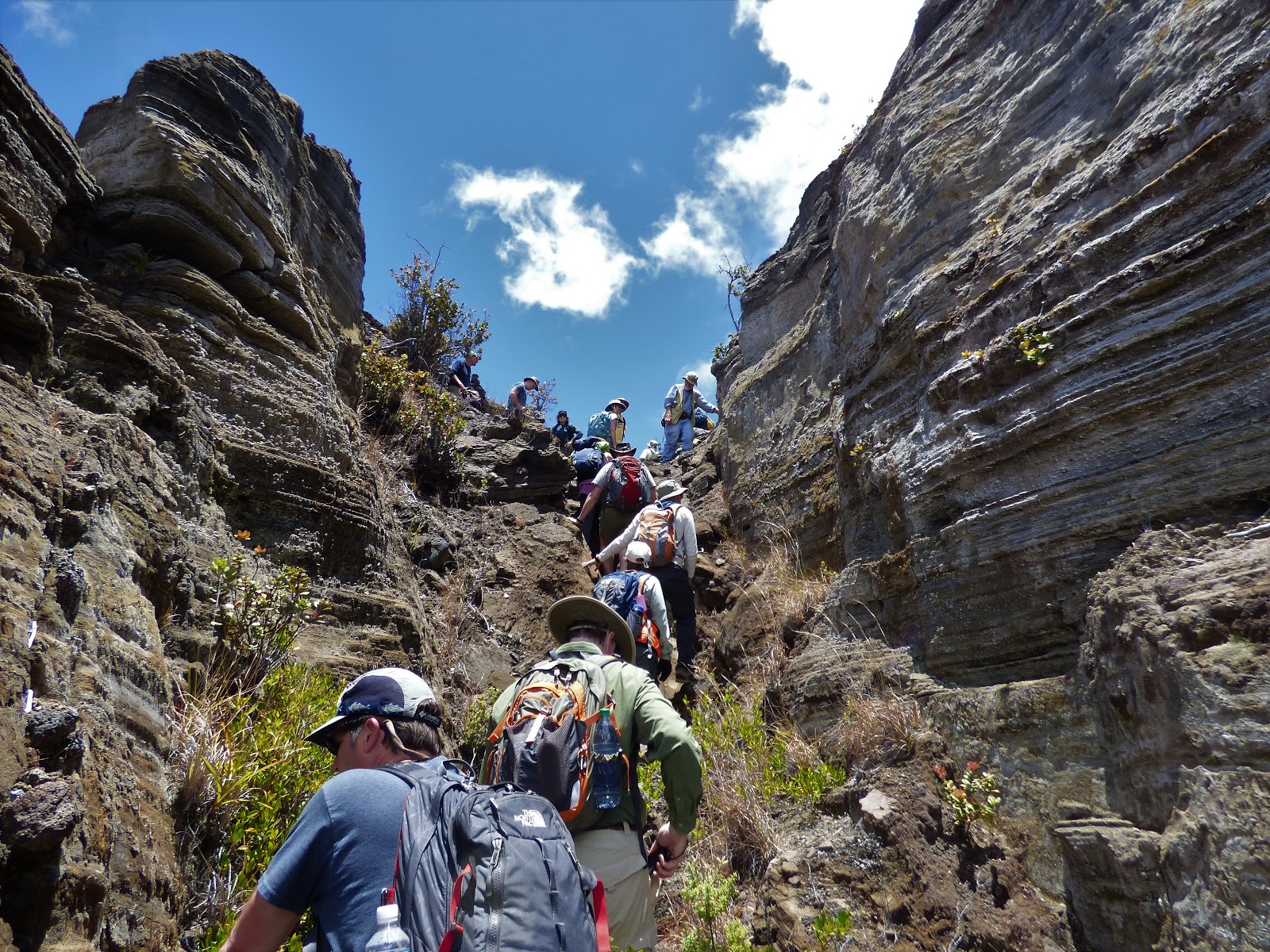
And finally there is this rock outcrop on the rim of Kilauea Caldera. It looks, well, almost like sedimentary layers! That is most decidedly not the kind of thing one expects to find on the edge of a basaltic shield volcano, the edifice that is supposedly constructed by multitudes of basaltic lava flows. What the heck is going on here, and what does it have to do with the strange circles of our little mystery?
A closer look reveals that these are layers of volcanic ash and scoria, the smaller particles that are associated with explosive eruptions, the kind we expect to find on the slopes of a Mt. St. Helens or a Mt. Shasta, the stratovolcanoes found on continental landmasses near subduction zones. What was going on here? The layers are more than 30 feet thick, and have been named the Keanakāko‘i Tephra.
Keanakāko‘i Tephra partially covered by a 1983 basalt flow.
It's clear that what we get taught about basaltic lava is not the entire story. Sometimes basalt erupts violently, and as such it can be exceedingly dangerous. An eruption in 1790 killed several hundred Hawaiian warriors on the eve of a major battle, and the event changed Hawaiian history, as the tragedy was seen as the judgment of the gods. These deposits were once thought to be the results of the 1790 eruption, but it turns out that they include dozens of explosive eruptions that took place between about 1500 and the early 1800s.
Exposures of the Keanakāko‘i Tephra on the margin of the Kilauea Caldera. A 1983 basalt flow can be seen below on the right.
What caused this explosive activity? In a word: water. When rising magma encounters groundwater, the water can flash to steam, causing intense explosions. Apparently the caldera collapsed to a depth great enough to reach the regional water table, and huge explosions ensued. Something like this happened at Kilauea in 1924 (see the picture below), but the massive explosions totaled only about 1% the volume of the 1790 and earlier eruptions. There have been some seriously dangerous eruptions throughout time on this volcano.
And that brings us to the strange circles of the mystery. In 1924 some huge blocks were thrown out of Halemaumau crater and were thrown a thousand or more meters. When they landed, they produced bowl-shaped craters. One of the biggest from 1924 weighed 8 tons, and can be seen in the picture below.
Subsequent eruptions produced Pele's Hair, reticulite, and small cinders or coarse ash. All of these particles blew across the landscape, and accumulated in the shallow craters. The blocks remain visible in the centers of some of the craters, while others are buried. The filled craters in some cases trap water more efficiently than other surfaces, so plants are able to gain a foothold (roothold?) in the craters.
The evidence of 300+ years of explosive eruptive activity around Kilauea is sobering. Such eruptions have the potential to do serious damage to surrounding communities around the caldera and in the Puna District to the east. Current research is seeking to better understand the cycle of activity surrounding these periods of violence.
It was a real privilege to explore the flanks of Kilauea Caldera with Don Swanson, Tina Neal, and Frank Trusdell of the Hawai'i Volcano Observatory during my visit to the islands last week. It was a fascinating learning adventure. More stories to come!
We were on a desolate plain on the south side of Kilauea Caldera on the Big Island exploring the ongoing volcanic activity. The smoking pit of Halemaumau Crater with her bubbling lake of molten lava was only a half mile or so north of us, so yes, we were in a closed area (but legally in this instance!).
Given that no part of the exposed Kilauea shield is older than about 1,000 years, it's almost needless to point out that this is a young geological landscape. You can see that a thick forest can be seen off in the distance, but only a few shrubs and spindly trees are present at our feet. I saw just a few bugs when I got on my hands and knees for a closer look at the gravel.
Circles occur in nature for plenty of reasons. I don't want to provide a list because this isn't a multiple-choice test: it's a thought question! Where did the circles come from?
The middle of the circles are composed of relatively uniform particles about 1-2 millimeters across. The intervening edges are made of larger unsorted fragments. As you can see in the pictures, there is sometimes a single rock in the middle of the rings, and sometimes there is a shrub.
A couple of other background information items: Kilauea is a broad shield volcano composed of thousands of basalt lava flows. It is highly active, and indeed there has been a non-stop eruption going on one place or another on Kilauea since the early 1980s, the longest sustained eruption in recorded history. The lava lake in Halemaumau has been active since 2008. One further point to consider...should we be seeing gravel here, so close to the summit of Kilauea?
So there you go: don't be afraid to speculate! Give us some ideas in the comments section...
The ongoing eruptive activity at the summit caldera of Kilauea on the Big Island of Hawai'i.
You aren’t hearing this from me (well, okay, you are), but sometimes teaching is just a little bit
like carnival barking. You have to be entertaining about something that
actually isn’t all that unusual or interesting. And sometimes you have to
reveal just a little at a time to keep the interest going until the dramatic
finish (“the butler did it!”). During our recent exploration of the Hawaiian
Islands, I chucked all that. We started our trip in Hilo on the Big Island, we
were only thirty miles from Hawai’i Volcanoes National Park, the volcano was
erupting, so our first morning as a group we headed up the highway to see an
erupting volcano. It was a first for everyone on the trip.
When was the last time you saw a class paying complete attention to the subject?
There's a secret to keeping the attention of a class of students. It's easy really...just put them in front of an erupting volcano! What we could see was astounding: a lava pit that has been erupting continuously since 2008, on a volcanic shield that has been erupting continuously since 1983! The shield volcano is called Kilauea, and the crater within the summit caldera is called Halemaʻumaʻu. The crater is said to be the current home of Pele, the volcano goddess of Hawai'i.
The current volcanism of Hawai'i is occurring only on the Big Island, and only on two of the five volcanoes that make up the island: Mauna Loa, and Kilauea. Mauna Loa is clearly visible on a physiographic map of the island (above), while Kilauea is less so (refer to the map below to see where it is). Mauna Loa is gigantic, covering half of the island, reaching an elevation of
13,679 feet (4,169 m) with a volume measured at more than 10,000 cubic miles. From her base on the sea floor, Mauna Loa is the highest mountain on the planet at 31,000 feet. Kilauea is less massive, rising to only 4,091 feet (1,247 m). Mauna Loa and Kilauea produce roughly similar amounts of lava, but Mauna Loa tends to produce lots of volume in periodic eruptions (the last was in 1984), but Kilauea has become known for continuing eruptions that simmer along for years, with occasional outbreaks that flow down to the coast (or unfortunately through nearby villages).
Source: USGS
The eruptions don't come just from the summit calderas. Most of Kilauea's activity is actually elsewhere along rift zones, especially at a cone called Pu'u O'o (watch for a future blog discussion). There are two rift zones extending from each volcano, trending roughly northeast to southwest. It's tricky to determine the age of the volcanoes, since younger eruptions are constantly covering older eruptions, but Mauna Loa has probably been erupting for around 700,000 years (the oldest exposed flows are 200,000 years old), while Kilauea is perhaps 600,000 years old, with exposed rocks ranging from around 70,000 to 43,000 years ago.
Halemaʻumaʻu in 2002 before the present eruptive activity
This is a view that is no longer accessible for visitors to the park. In 2008, the lava pit in Halemaʻumaʻu exploded and tossed foot-wide boulders at this overlook, and since then noxious and poisonous gases have made this spot dangerous. The frozen lava in the main crater dates to the 1920s when a molten lake of lava filled the crater floor. The gifts left at the crater rim show that many take the existence of the volcano goddess Pele quite seriously.
For this blog series on the "Hawai'i That Was", I'm intending to follow the itinerary we followed as a class, but I want to skip ahead a couple of days. In the daytime, the view of the lava pit in Halemaʻumaʻu was awe-inspiring, especially to those in our group who had never seen an active volcano (mainly all of them except Mrs. Geotripper and my fellow professor), but what happened three days later left me stunned.
Halemaʻumaʻu at twilight in 2009
When I was last on the island with students in 2009, a few of us waited for the sunset at Kilauea, long enough to see the glow of the lava lake in the twilight (it's overwhelmed by sunlight). It was neat, but not earth-shakingly spectacular, as can be seen above. At the time, the pit was maybe 200 feet across and 500-600 feet deep. We made arrangements to stay through the evening again, and I wasn't expecting much, but as we pulled up into the parking lot, I could see something was very different. The sky was glowing brightly long before we could see the crater (below).
The pit today is 500-600 feet across now, and in the weeks prior to our arrival on the islands the lava lake had been at a depth of 100-150 feet. But on the night we arrived, the lava had risen to within 88 feet of the floor of the crater, and the lava was splashing about over the rim. It was, as I said before, a stunning spectacle. We ran to the edge of the observation deck.
The lava lake was about a mile away. We couldn't hear anything, but what we saw was beautiful.
It was difficult in the dark to catch photographs of the fountaining lava, but the video did. I posted this a few weeks ago, but it's one of my favorite geology moments ever, so here it is again.
Coming up: explorations in a rapidly changing national park!
Halemaumau, on the Kilauea volcano in Hawaii, is a crater within a caldera that has been simmering away for most of the last seven years. The pit is around 600 feet across, and a few hundred feet down (on most days) there is a roiling lake of molten basalt. On the rarest of occasions the level of the lava lake will rise, and some basalt will flow across the flats, but most of the time the lava lies hidden.
Halemaumau is said to be the habitation of Pele, the volcano goddess of the islands. I've had just enough interesting experiences with flowing lava to think of Pele as a tangible personality with moments of jealousy, but also with a penchant for granting precious gifts at particular moments.
By day, little can be seen of the lava. What glow there is is crowded out completely by sunlight, and although our students were sufficiently impressed by the sight, I was hoping that an opportunity would arise for the group to see Halemaumau at night. The weather was not being cooperative, with a constant threat of rain the last few days, but we took the gamble and headed up to Hawaii Volcanoes National Park in the late afternoon to see if the rain clouds would clear for us a bit. It turned out that Pele had a grand surprise ready for us.
The glow was there, as expected, and it was spectacular, literally filling the sky with color. But as we watched we realized that something else was happening: there was some fountaining going on, and lava was exploding into the air above the crater rim. This is not a common sight, so it was a thrill to see it happening. Given the low ebb of activity on the volcano over the last several months, I was pretty sure our students wouldn't see any actual lava at all. I was wonderfully wrong!
It's hard to catch a fountain of lava with a still photo, so I took a minute of video (actually seven of them, but only one turned out) to give you a feel for the action. Enjoy! We did...
More excitement from Hawaii Volcanoes National Park in today's post. The pictures are from days ago, but trip organizing and conducting is a very busy business, especially when the trip leader fails to triple check some of the logistical arrangements. Someday I may talk about it...
Halemaumau is a pit crater in the caldera of Kilauea volcano on the Big Island. It is reputed to be the home of Pele, the Hawaiian volcano goddess. I'm beginning to think she is watching over us, in a good way. There had been not a whisper of activity in the crater for most of the last quarter century, but in late March 2008 an explosion and collapse of a pit within the pit (which is itself a pit within a bigger pit, kind of like a Bushka doll) showed that activity was resuming. In the last few days, lava has been detected at the bottom of the pit, sloshing back and forth. The ever-present steam plume has begun glowing at night, causing a local sensation as hundreds come up the mountain at night to see the eerie looking orange light.
I kinda cheated, and I hope my students don't really notice this. I was done hiking only an hour before sunset, so instead of heading back to Hilo with everyone else, I wandered back to the Jagger Museum, and watched the glow for a bit while the moon rose. It was eeriely beautiful ('eerie' is a common word for the day).
I'm so glad to be here and seeing these precious gifts of nature! And even better is that I am able to share the experience with 26 of my students.
And now part four of my mini-series on the goddess Pele. The volcano goddess resides in Halema'uma'u, the pit seen above in a photo from 2006. I've arrived on the islands to prepare the way for my two dozen students, and we are set to visit Pele's realm next week. There has been a great deal of interesting activity of late, and I have hopes that we will be able to witness some aspect of Pele's fire.
But as I said before, Pele is a capricious goddess. For many months now, lava has poured from Pu'u O'o, traveling through the lava tube system for 6-7 miles before pouring into the sea. And in March, Pele got upset about something, because for the first time since 1924 she exploded in anger at Halema'uma'u, causing a pit to form in the area below the parking lot at the edge of precipice. Chunks of rock three feet across landed in the viewing area, where gifts are generally offered to the goddess. Lava is bubbling at the bottom of the pit, and vast amounts of steam and sulfur dioxide are pouring out of the vent.
Several weeks ago I contacted the Hawaiian Volcanoes Observatory about arranging a tour, and I joked about how the 24 year-long eruption sequence was going to end about June 5, because we were coming to the islands to look at the volcano on June 6.
Pele monitors e-mail...
I signed on yesterday to the daily report at HVO, and on the same day the glow in the Halema'uma'u pit was declining, AND the lava tubes had stopped pouring into the sea. Just like that. Just eerie, if you ask me.
The report this morning was better. Apparently a blockage in the tube system broke free, and the lava is flowing once more, and the glow in the Halema'uma'u pit is bright again. Message received. In any case, I know to be appreciative of the gift of Pele, whether we see actual lava flows or not. It is a spectacular sight to see, no matter what is happening when you arrive. Students, take note!