Showing posts with label Pele. Show all posts

Wednesday, June 22, 2016

The Hawai'i That Was: The Abode of the Gods and Creation at Kilauea

The ongoing eruptive activity at the summit caldera of Kilauea on the Big Island of Hawai'i.

You aren’t hearing this from me (well, okay, you are), but sometimes teaching is just a little bit like carnival barking. You have to be entertaining about something that actually isn’t all that unusual or interesting. And sometimes you have to reveal just a little at a time to keep the interest going until the dramatic finish (“the butler did it!”). During our recent exploration of the Hawaiian Islands, I chucked all that. We started our trip in Hilo on the Big Island, we were only thirty miles from Hawai’i Volcanoes National Park, the volcano was erupting, so our first morning as a group we headed up the highway to see an erupting volcano. It was a first for everyone on the trip.
When was the last time you saw a class paying complete attention to the subject?

There's a secret to keeping the attention of a class of students. It's easy really...just put them in front of an erupting volcano! What we could see was astounding: a lava pit that has been erupting continuously since 2008, on a volcanic shield that has been erupting continuously since 1983! The shield volcano is called Kilauea, and the crater within the summit caldera is called Halemaʻumaʻu. The crater is said to be the current home of Pele, the volcano goddess of Hawai'i.

The current volcanism of Hawai'i is occurring only on the Big Island, and only on two of the five volcanoes that make up the island: Mauna Loa, and Kilauea. Mauna Loa is clearly visible on a physiographic map of the island (above), while Kilauea is less so (refer to the map below to see where it  is). Mauna Loa is gigantic, covering half of the island, reaching an elevation of  13,679 feet (4,169 m) with a volume measured at more than 10,000 cubic miles. From her base on the sea floor, Mauna Loa is the highest mountain on the planet at 31,000 feet. Kilauea is less massive, rising to only 4,091 feet (1,247 m). Mauna Loa and Kilauea produce roughly similar amounts of lava, but Mauna Loa tends to produce lots of volume in periodic eruptions (the last was in 1984), but Kilauea has become known for continuing eruptions that simmer along for years, with occasional outbreaks that flow down to the coast (or unfortunately through nearby villages).
Source: USGS

The eruptions don't come just from the summit calderas. Most of Kilauea's activity is actually elsewhere along rift zones, especially at a cone called Pu'u O'o (watch for a future blog discussion). There are two rift zones extending from each volcano, trending roughly northeast to southwest. It's tricky to determine the age of the volcanoes, since younger eruptions are constantly covering older eruptions, but Mauna Loa has probably been erupting for around 700,000 years (the oldest exposed flows are 200,000 years old), while Kilauea is perhaps 600,000 years old, with exposed rocks ranging from around 70,000 to 43,000 years ago.
Halemaʻumaʻu in 2002 before the present eruptive activity
This is a view that is no longer accessible for visitors to the park. In 2008, the lava pit in  Halemaʻumaʻu exploded and tossed foot-wide boulders at this overlook, and since then noxious and poisonous gases have made this spot dangerous. The frozen lava in the main crater dates to the 1920s when a molten lake of lava filled the crater floor. The gifts left at the crater rim show that many take the existence of the volcano goddess Pele quite seriously.

For this blog series on the "Hawai'i That Was", I'm intending to follow the itinerary we followed as a class, but I want to skip ahead a couple of days. In the daytime, the view of the lava pit in Halemaʻumaʻu was awe-inspiring, especially to those in our group who had never seen an active volcano (mainly all of them except Mrs. Geotripper and my fellow professor), but what happened three days later left me stunned.
Halemaʻumaʻu at twilight in 2009

When I was last on the island with students in 2009, a few of us waited for the sunset at Kilauea, long enough to see the glow of the lava lake in the twilight (it's overwhelmed by sunlight). It was neat, but not earth-shakingly spectacular, as can be seen above. At the time, the pit was maybe 200 feet across and 500-600 feet deep. We made arrangements to stay through the evening again, and I wasn't expecting much, but as we pulled up into the parking lot, I could see something was very different. The sky was glowing brightly long before we could see the crater (below).

The pit today is 500-600 feet across now, and in the weeks prior to our arrival on the islands the lava lake had been at a depth of 100-150 feet. But on the night we arrived, the lava had risen to within 88 feet of the floor of the crater, and the lava was splashing about over the rim. It was, as I said before, a stunning spectacle. We ran to the edge of the observation deck.
The lava lake was about a mile away. We couldn't hear anything, but what we saw was beautiful.
It was difficult in the dark to catch photographs of the fountaining lava, but the video did. I posted this a few weeks ago, but it's one of my favorite geology moments ever, so here it is again.

Coming up: explorations in a rapidly changing national park!

Monday, June 6, 2016

Pele is a Capricious Goddess...Today She Dispensed a Gift

Halemaumau, on the Kilauea volcano in Hawaii, is a crater within a caldera that has been simmering away for most of the last seven years. The pit is around 600 feet across, and a few hundred feet down (on most days) there is a roiling lake of molten basalt. On the rarest of occasions the level of the lava lake will rise, and some basalt will flow across the flats, but most of the time the lava lies hidden.

Halemaumau is said to be the habitation of Pele, the volcano goddess of the islands. I've had just enough interesting experiences with flowing lava to think of Pele as a tangible personality with moments of jealousy, but also with a penchant for granting precious gifts at particular moments.

By day, little can be seen of the lava. What glow there is is crowded out completely by sunlight, and although our students were sufficiently impressed by the sight, I was hoping that an opportunity would arise for the group to see Halemaumau at night. The weather was not being cooperative, with a constant threat of rain the last few days, but we took the gamble and headed up to Hawaii Volcanoes National Park in the late afternoon to see if the rain clouds would clear for us a bit. It turned out that Pele had a grand surprise ready for us.
The glow was there, as expected, and it was spectacular, literally filling the sky with color. But as we watched we realized that something else was happening: there was some fountaining going on, and lava was exploding into the air above the crater rim. This is not a common sight, so it was a thrill to see it happening. Given the low ebb of activity on the volcano over the last several months, I was pretty sure our students wouldn't see any actual lava at all. I was wonderfully wrong!
It's hard to catch a fountain of lava with a still photo, so I took a minute of video (actually seven of  them, but only one turned out) to give you a feel for the action. Enjoy! We did...

Sunday, May 22, 2016

Pele is a Capricious Goddess...Part Three, a Precious Gift from a Mysterious Woman


One of the most awe-inspiring moments of my life
I've been celebrating my impending return to the Hawaiian Islands by revising and expanded a few posts I did in 2009 about the volcano goddess Pele, and my experiences with the ongoing eruption of Kilauea.  My third chance to see Pele's beauty came about in 2006 as a result of a family reunion that included a cruise of four of the Hawaiian islands. We arrived a few days early on the off-chance that there would be something to see on the Pu'u O'o flow that continued to erupt over the years. It had been a mostly quiet year, with lava flowing through tubes for seven miles before spilling into the sea.
The 2006 lava flow ocean entry from 3,000 feet above and 20 miles away on Chain of Craters Road

I was not really expecting to see much. The problem is that the coastal cliffs around a lava entry are dangerously unstable. As the lava hits the water, it shatters and forms thick layers of unstable cinders while being covered by lava flows. Every so often, the cinders slide downward, and the lava bench suddenly collapses into the sea. A number of people have been killed because they were standing on the benches when they collapsed. So, the national park service had erected a rope barrier to keep people from the most dangerous areas. Unfortunately, there was no view possible of the lava itself, according to reports. Just the bright orange glow of the steam rising from the turmoil below the coastal cliff.
The glow of moonlight on the ocean, and the glow of lava on the steam.

Still, it was worth a try. I told my wife and son and nephews that I would hike out, be safe, look at the glow of the invisible lava, and be back to the hotel by 9 PM or so. I took water, a flashlight, extra batteries, and my brand-new camera that I had bought that morning, and was just beginning to learn to use.

The hike was longer than I expected. There were so many people parked at the end of Chain of Craters Road that I literally had to walk an extra mile just to reach the trailhead. The flows were entering the sea two miles away, over trail-less pahoehoe flows. The sun set way too quickly and for route-finding I was down to my flashlight, and flashing beacons set up every quarter mile or so. Plenty of people were walking back with their flashlights, so the route was clearly evident. Most of the people I talked to expressed disappointment. Nothing to see but glowing steam. There were a few idiots who crossed the barriers, but even they couldn't get close enough to see anything. I was getting very tired. Pahoehoe may be smooth, but is still very uneven, and it only takes a single misstep to twist or break an ankle. I made it to the rope barrier, and could now see the glow and the steam. It was actually an awe-inspiring moment, as the moon had risen and was reflecting off the ocean behind the steam plumes. But no lava.
And then things got different in a hurry

I realized that it had become very lonely. The only others about were four people in a party, and a single flashlight off in the distance headed back to the road. I hung with the four people and a lady appeared out of the darkness (it only occurred to me later that she didn't have a flashlight). She hinted that we might want to walk to the far eastern end of the rope barrier, another quarter mile away. And then she disappeared into the darkness again. I looked at my watch. Already 9:00 PM. I was going to be way overdue. But, what was out there? What was the lady talking about?

Curiosity got the best of me, and I set off for the far end of the barrier. After 20 minutes or so, I surmounted a small cliff and looked down, and saw one of the most beautiful sights I have ever seen.

I was standing at the top of a thirty-foot cliff that marked the edge of the latest bench collapse (The safe edge, if you are wondering). No more than 30 minutes earlier, a lava tube had broken through, and lava was starting to pour across the bench to the 15-foot high beach cliff a mere hundred yards away. I stood entranced as the lava flowed like syrup across the slope below me. The finger of lava flowed slowly to the edge of the cliff and spilled over into the surf.

The five of us were the only people out of hundreds of visitors that day who saw the glorious scene before us. Except that mysterious woman...Needless to say, I was in a heap o' trouble when I walked into the hotel lobby after midnight. But I can never forget the incredible gift of that magical sight of lava pouring into the sea. And that mysterious woman in the darkness.

PS: I found a USGS photograph of the coast taken on the same day I was there. The parking was in the distant brown area, the black is recent lava flows, and the gray foreground area is the active lava delta. The rope barrier is hard to see, but it was uphill from the lava delta. The new lava breakout that I saw happened at the bottom of the picture at the edge of the gray delta.

PSS: I did manage to figure out the video function on the new camera, but of course I should have taken more.

Saturday, May 21, 2016

Pele is a Capricious Goddess (reprised)...Part Two

Continuing the story from the previous post, I had a second chance to see a volcano in action in 2004. I was the newly elected president of the Far West Section of the National Association of Geoscience Teachers, and for my first conference, I had persuaded someone to sponsor a meeting in Hilo, Hawaii. The volcano on the Big Island at Pu'u O'o had continued to be active over the previous two years and was still going strong as the date of the conference approached. Lava was still traveling from the cinder cone on the east rift zone of Kilauea and traveling through lava tubes to the ocean. I was thrilled that a bunch of fellow teachers would be able to see an active lava flow!
Except (and there always seems to be some kind of terrible "except" to stories like this)...as the final days approached, the flow activity started to wane. The HVO reported that blockages had started to occur in the upper reaches of the lava tubes that were feeding the ocean entries, and the lava flows were slowing considerably, declining to almost nothing. Every morning I went online to check on the latest HVO reports, and got a sinking feeling.
My daughter arrived on the island a day before me, and hiked out to see the lava flows. It was down to a single dribble, no wider than a pencil, falling into the sea. No wider than a pencil. And then it stopped...
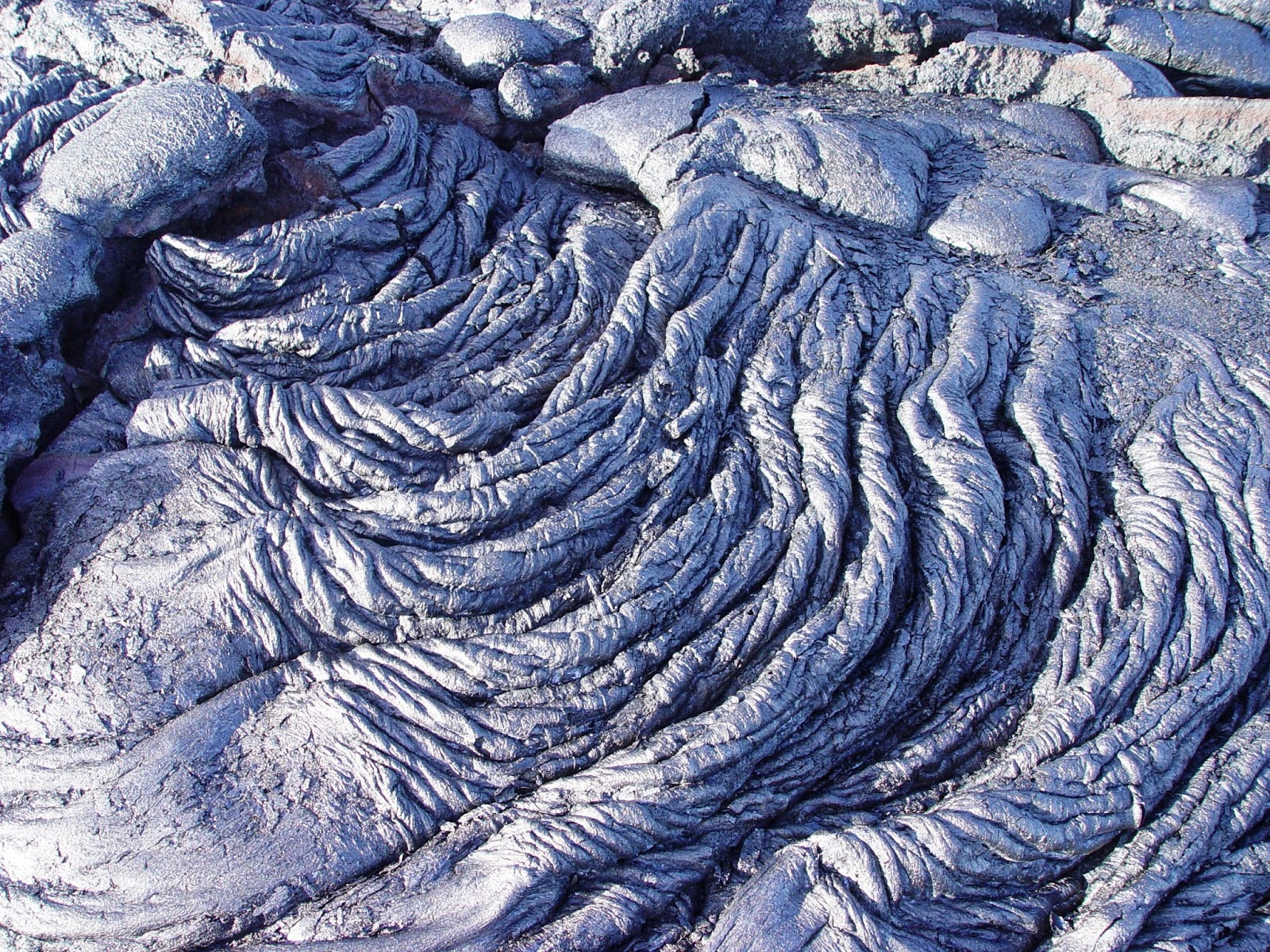
The next day, I hiked out to the flow as fast as I could, and saw...well, I saw what you can see in the picture above: steam from a recently ended flow. I searched desperately for any kind of small break out, any sign of active lava, but all there was was steam rising from cracks here and there. All I got for my trouble was a badly scraped arm and palm when I slipped and fell onto a day-old lava flow. I was not aware until that day that fresh basalt flows are usually covered with a thin veneer of obsidian (volcanic glass) that gives the lava flow a silvery metallic appearance. The glass starts to break up right away, forming jagged shards that are like small razors lying about the surface.
Still, there is great beauty in new rock. The patterns in the pahoehoe lava surfaces are endlessly fascinating, and there is a grandeur in the barren surfaces of a day old lava flow. It is an absolutely sterile surface that has never before existed. A new beginning...
Lava flowing into seawater has a tendency to explode on contact, forming fine sand-sized particles. Kilauea had already destroyed one of the most cherished black sand beaches in Hawaii, but a new beach, however impermanent, had appeared to replace it.

Pele had given the gift of new land on the island, but I was not privileged in this instance to see it happen. But patience is a virtue. It would be another two years before I made it to the islands, but it was worth the wait. That story will have to wait for the next post!
This is an expanded version of a 2009 blog post that preceded the first field studies course that I ever taught on the Hawaiian Islands. We're leaving in a week for the islands for our second-ever course, so I'm thinking volcanic subjects these days.

Friday, August 13, 2010

Definitely not the Other California: Dispatches from Paradise

Several of you correctly surmised my destination from the obscure clue I provided in yesterday's post. That strange object in the hand is a piece of Pele's Hair. Pele is of course the deity that lives in the actively erupting volcanoes of the Hawaiian Islands. When globs of basaltic material are tossed into the air as bubbles pop during eruptions, some of it stretches into long glassy fibers. They literally are strands of obsidian.

I could lie and say I am on some kind of noble research into the volcanism of the lovely isles, but it has been a very long time since Mrs. Geotripper and I have had a real vacation. So posts may be a bit sketchy for a few days. On the other hand, Kilauea has been unusually active in the last few weeks, and if houses aren't being threatened, we may just go take a look at what is going on with the lava flows.

Y'all hold down the fort back there on the mainland (or off-island as they say around here). Here is the view from our lanai on the windward side of Oahu. More later!

Saturday, June 13, 2009

Report from the Road: Hawaii volcanoes 3


More excitement from Hawaii Volcanoes National Park in today's post. The pictures are from days ago, but trip organizing and conducting is a very busy business, especially when the trip leader fails to triple check some of the logistical arrangements. Someday I may talk about it...

Halemaumau is a pit crater in the caldera of Kilauea volcano on the Big Island. It is reputed to be the home of Pele, the Hawaiian volcano goddess. I'm beginning to think she is watching over us, in a good way. There had been not a whisper of activity in the crater for most of the last quarter century, but in late March 2008 an explosion and collapse of a pit within the pit (which is itself a pit within a bigger pit, kind of like a Bushka doll) showed that activity was resuming. In the last few days, lava has been detected at the bottom of the pit, sloshing back and forth. The ever-present steam plume has begun glowing at night, causing a local sensation as hundreds come up the mountain at night to see the eerie looking orange light.

I kinda cheated, and I hope my students don't really notice this. I was done hiking only an hour before sunset, so instead of heading back to Hilo with everyone else, I wandered back to the Jagger Museum, and watched the glow for a bit while the moon rose. It was eeriely beautiful ('eerie' is a common word for the day).

I'm so glad to be here and seeing these precious gifts of nature! And even better is that I am able to share the experience with 26 of my students.

Wednesday, June 3, 2009

Pele is a Capricious Goddess...Part Four: What's Next?

And now part four of my mini-series on the goddess Pele. The volcano goddess resides in Halema'uma'u, the pit seen above in a photo from 2006. I've arrived on the islands to prepare the way for my two dozen students, and we are set to visit Pele's realm next week. There has been a great deal of interesting activity of late, and I have hopes that we will be able to witness some aspect of Pele's fire.

But as I said before, Pele is a capricious goddess. For many months now, lava has poured from Pu'u O'o, traveling through the lava tube system for 6-7 miles before pouring into the sea. And in March, Pele got upset about something, because for the first time since 1924 she exploded in anger at Halema'uma'u, causing a pit to form in the area below the parking lot at the edge of precipice. Chunks of rock three feet across landed in the viewing area, where gifts are generally offered to the goddess. Lava is bubbling at the bottom of the pit, and vast amounts of steam and sulfur dioxide are pouring out of the vent.

Several weeks ago I contacted the Hawaiian Volcanoes Observatory about arranging a tour, and I joked about how the 24 year-long eruption sequence was going to end about June 5, because we were coming to the islands to look at the volcano on June 6.

Pele monitors e-mail...

I signed on yesterday to the daily report at HVO, and on the same day the glow in the Halema'uma'u pit was declining, AND the lava tubes had stopped pouring into the sea. Just like that. Just eerie, if you ask me.

The report this morning was better. Apparently a blockage in the tube system broke free, and the lava is flowing once more, and the glow in the Halema'uma'u pit is bright again. Message received. In any case, I know to be appreciative of the gift of Pele, whether we see actual lava flows or not. It is a spectacular sight to see, no matter what is happening when you arrive. Students, take note!

Pele is a Capricious Goddess...Part Three, a Precious Gift


My third chance to see Pele's beauty came about in 2006 as a result of a family reunion that included a cruise of four of the Hawaiian islands. We arrived a few days early on the off-chance that there would be something to see on the Pu'u O'o flow that continued to erupt over the years. It had been a mostly quiet year, with lava flowing through tubes for seven miles before spilling into the sea.

I was not really expecting to see much. The problem is that the coastal cliffs around a lava entry are dangerously unstable. As the lava hits the water, it shatters and forms thick layers of unstable cinders, while being covered by lava flows. Every so often, the cinders slide downward, and the lava bench suddenly collapses into the sea. A number of people have been killed because they were standing on the benches when they collapsed. So, the national park service had erected a rope barrier to keep people from the most dangerous areas. Unfortunately, there was no view possible of the lava itself, according to reports. Just the bright orange glow of the steam rising from the turmoil below the coastal cliff.

Still, it was worth a try. I told my wife and son and nephews that I would hike out, be safe, look at the glow of the invisible lava, and be back to the hotel by 9 PM or so. I took water, a flashlight, extra batteries, and my brand-new camera that I had bought that morning, and was just beginning to learn to use.

The hike was longer than I expected. There were so many people parked at the end of Chain of Craters Road that I literally had to walk an extra mile just to reach the trailhead. The flows were entering the sea two miles away, over trail-less pahoehoe flows. The sun set way too quickly and for route-finding I was down to my flashlight, and flashing beacons set up every quarter mile or so. Plenty of people were walking back with their flashlights, so the route was clearly evident. Most of the people I talked to expressed disappointment. Nothing to see but glowing steam. A few idiots who crossed the barriers. I was getting very tired. Pahoehoe may be smooth, but is still very uneven, and it only takes a single misstep to twist or break an ankle. I made it to the rope barrier, and could now see the glow and the steam. It was actually an awe-inspiring moment, as the moon had risen and was reflecting off the ocean behind the steam plumes. But no lava.

I realized that it had become very lonely. The only others about were four people in a party, and a flashlight off in the distance. I hung with the four people and a lady appeared out of the darkness. She suggested that we might want to walk to the far end of the rope barrier, another quarter mile away. And then she disappeared into the darkness again. I looked at my watch. Already 9:00 PM. I was going to be overdue. But, what was out there?

Curiosity got me, and I set off for the far end of the barrier. After 20 minutes or so, I surmounted a small cliff and looked down, and saw one of the most beautiful sights I have ever seen.

I was standing at the top of a thirty-foot cliff that marked the edge of the latest bench collapse. No more than 30 minutes earlier, a lava tube had broken through, and lava was starting to pour across the bench, to the 15-foot high beach cliff a mere hundred yards away. I stood entranced as the lava flowed like syrup across the slope below me. The five of us were the only people out of hundreds of visitors that day who saw the glorious scene before us. Except that mysterious woman...

Needless to say, I was in a heap o' trouble when I walked into the hotel lobby at midnight. But I can never forget the incredible gift of that magical sight of lava pouring into the sea.

Tuesday, June 2, 2009

Pele is a Capricious Goddess...Part Two


Continuing the story from the previous post, I had a second chance to see a volcano in action in 2004. I was the newly elected president of the Far West Section of the National Association of Geoscience Teachers, and for my first conference, I had persuaded someone to sponsor a meeting in Hilo. The volcano had continued to be active over the previous two years and was still going strong as the date of the conference approached. I was thrilled that a bunch of fellow teachers would be able to see an active lava flow!

Except...

As the final days approached, the activity started to wane. The HVO reported that blockages had started to occur in the upper reaches of the lava tubes that were feeding the ocean entries, and the lava flows were slowing to a trickle.

My daughter arrived on the island a day before me, and hiked to see the lava. It was down to a single dribble, no thicker than a pencil, falling into the sea.

The next day, I hiked out to the flow as fast as I could, and saw...well, I saw what you can see in the first picture above: steam from a recently ended flow. I searched desperately for any kind of small break out, any sign of active lava, but all there was was steam rising from cracks here and there. All I got for my trouble was a badly scraped arm and palm when I slipped and fell onto a day old lava flow. I was not aware until that day that fresh basalt flows are usually covered with a thin veneer of obsidian (volcanic glass) that gives the lava flow a silvery metallic appearance. The glass starts to break up right away, forming jagged shards that are like small razors lying about the surface.

Still, there is great beauty in new rock. The patterns in the pahoehoe lava surfaces are endlessly fascinating, and there is a grandeur in the barren surfaces of a day old lava flow. And absolutely sterile surface that has never before existed. A new beginning...
Next: Pele's gift

Wednesday, March 19, 2008

Did someone forget their offering to Pele?


Steam rises from the interior of Kilauea caldera in 2006

Following up on notes from Ron Schott (Kilauea Summit Activity) and an amusing headline juxtaposition noticed by Andrew Alden (Headline Funny), the news of the day is activity in the main summit caldera of Kilauea, Halema`uma`u. An explosion in the wall tossed chunks of old lava up to a cubic meter over an area of about 75 acres (sorry for mixing measurement methods), damaging some of the parking areas and trails near the caldera rim.

I am often fascinated by the intrinsic connection between earth events and regional religious beliefs. The native Hawaiians had an excellent understanding of the basic geological relationships of the islands in their stories of Pele's search for a home in the isolated islands in the middle of the Pacific. In a similar way, the legends of native Americans in southern Oregon explained the formation of Crater Lake more accurately than some early geological interpretations.

I love the Hawaiian islands, and visit them whenever I can. I am an unusual tourist I suppose, avoiding Waikiki and Honolulu as much as possible, and spending as much time as possible in the island interiors rather than the beach. A story I once assumed was very simple (shield; hot spot, lava) has become delightfully complex: shield evolution, new hot spot interpretations, giant mega-tsunamis and landslides, evolutionary mysteries with the honey creepers, ravens, hawks, owls, and nene, the Hawaiian goose, and incredible diversity of landscapes from tropical rainforests to alpine barrens. And, there is nothing in the world quite like standing next to flowing basalt.


Many Hawaiians take the story of Pele very seriously, and there is almost always an offering left on the crater rim of Halema`uma`u. I have enjoyed Pele's beautiful gifts, and intend to leave an offering of my own next time I get the chance to stand at the edge of her home on the Big Island.


For the latest information on Kilauea and the new flows on the eastern flank of Pu'u'O'o and their recent entry into the sea, check out http://volcano.wr.usgs.gov/kilaueastatus.php