Showing posts with label Obsidian. Show all posts

Friday, October 18, 2013

Scenes from a Shield: Isn't This Supposed to be Basalt?

Medicine Lake Highland (from an earlier trip when it wasn't covered with storm clouds).
Medicine Lake Highland at first glance sure looks like a classic version of a shield volcano. The gently sloping flanks indicate the presence of non-viscous basaltic lava, and the lava tubes we explored were certainly composed of basalt. As we moved further up the flanks of the mountain we encountered tree molds (those were the mystery holes in the previous post, as Lockwood correctly surmised) that also occur in basalt flows. By the time we reached the summit of the volcano and the caldera at Medicine Lake we were starting to see different kinds of lava. Some gray colored andesite could be seen on the north flank of the caldera.

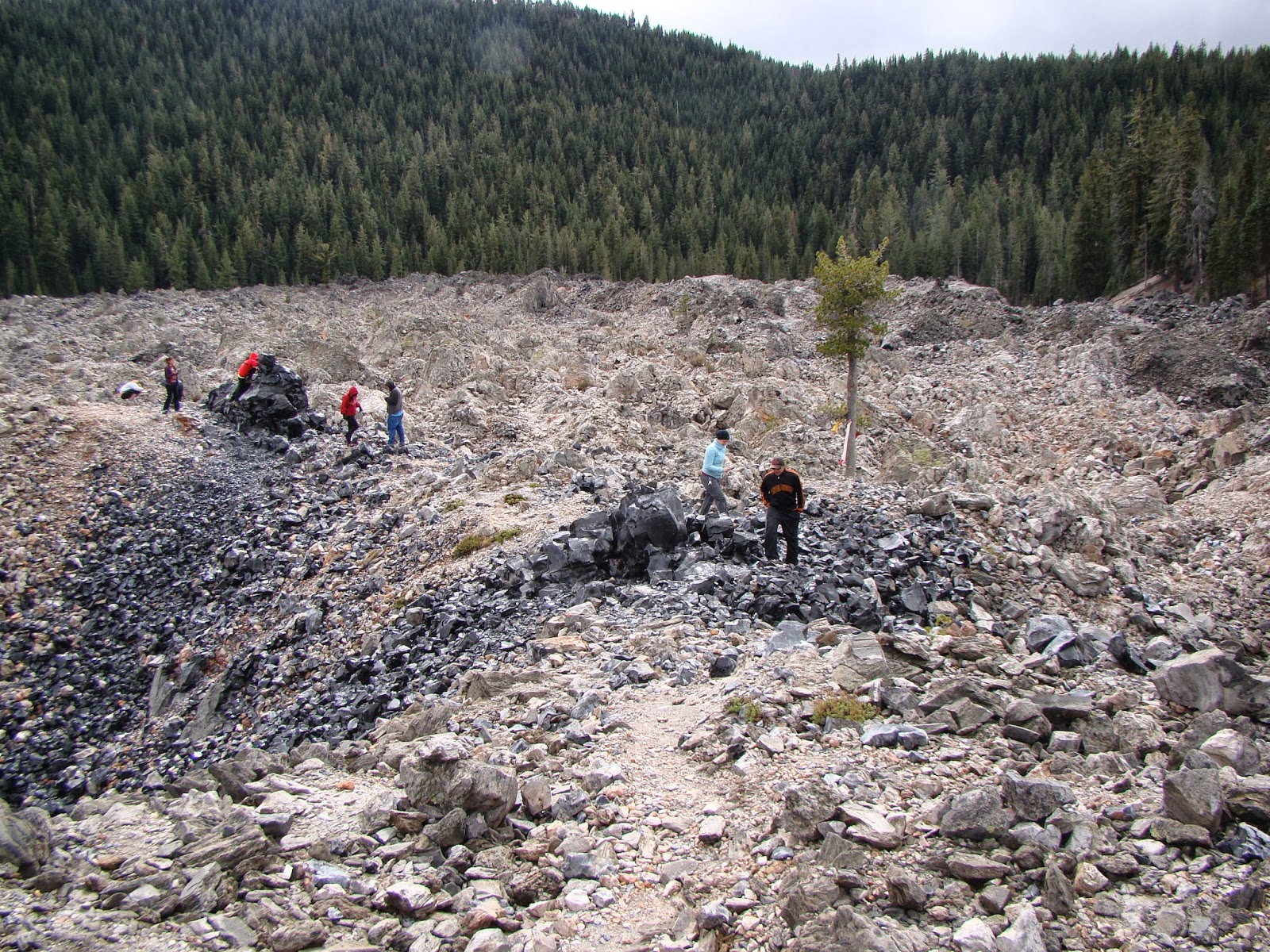
The most striking kind of lava was what we saw at Glass Mountain, the most recent lava flow on the mountain, dating to only 900 years ago.

Everything about Glass Mountain is a complete contrast to basalt. The steep debris-covered flanks of Glass Mountain show that the lava flow was highly viscous and barely able to flow at all. The light color of the lava contrasts sharply with the black of basalt. The mountain is composed mostly of obsidian and pumice, glassy rocks that usually have a chemical composition equivalent to rhyolite.  
Glass Mountain is a typical example of a plug dome. Such volcanoes are small, usually no more than a thousand feet tall, with steep rubble-covered sides. The lava flows from the cone are rarely very long, and are thick and very rugged.

One might wonder what rhyolite is doing on the summit of a gigantic basaltic shield volcano. Such things are not usually seen on Hawaiian shields, for instance. A bit of information about the melting points of minerals and the composition of the crust can help us to understand what happened on Medicine Lake Highland.

The minerals found in basalt have high melting points. For basalt to be in a liquid state requires temperatures of 2,000 °F or more. Rhyolite on the other hand contains minerals that melt at lower temperatures, maybe in the range of 1,300 °F.

Oceanic crust is essentially composed of basaltic rock. Continental crust is more granitic in composition, and granite is what you get if rhyolite cools very slowly (granite and rhyolite are made of the same minerals, in other words).
Medicine Lake Highland is situated on the diffuse boundary between the Cascades Province and the Basin and Range, a region that is being stretched or extended in an east-west direction. The extension is causing faults to form in the crust, and the faults are allowing basalt to approach the surface from its source in the Earth's mantle. The basalt magma, as noted, is very hot.

As the basalt rises through the thick granitic crust, the intense heat causes melting of the granite, and magma chambers form that are composed of rhyolite. The basalt and rhyolite magmas don't play well together, and don't readily mix. As a result, some eruptions are basaltic, and others rhyolitic. This phenomenon is called bimodal volcanism.

Many people don't realize that pumice and obsidian are the same thing: volcanic glass. They are the same in the way that root beer and the foam on the root beer are the same. It's all root beer, but the foam is full of air bubbles. A bit of exploration on the flow at Glass Mountain revealed intriguing flow structures with interlayered pumice and obsidian.

We finished our exploration of Glass Mountain and headed down the heavily wooded south flank of Medicine Lake Highland. Brief views through the trees offered wonderful vistas of the surrounding terrain of the Modoc Plateau.

Medicine Lake is not a "typical" Cascades volcano like Rainier or Shasta but there is at least one other massive shield complex to the north in Oregon at Newberry Crater. Both are famous for their obsidian domes.

We had one more stop for the day, on the Giant Crater Flow, a basalt flow that is comparable to the Mammoth Crater flow that produced the lava tubes in Lava Beds National Monument. One tube system from Giant Crater extends for fourteen miles down the south flank of the Highland. At Jot Dean Cave, there was an extraordinary exposure of ice.

Jot Dean Cave doesn't seem to extend all that far, or at least none of us wanted to find out. The reason is the rather steep slope at the edge of darkness that is completely covered with very slick ice, even in late September. The strangest part is the huge mass of ice on the left side of the entrance that refracts light from the outside and seem to glow internally. It's actually kind of eerie; I imagined that the ice had formed around some poor spelunker and his light was still glowing...

We got back into the vehicles and headed towards our camp for the evening at one of California's most beautiful state parks.

Friday, August 13, 2010

Definitely not the Other California: Dispatches from Paradise

Several of you correctly surmised my destination from the obscure clue I provided in yesterday's post. That strange object in the hand is a piece of Pele's Hair. Pele is of course the deity that lives in the actively erupting volcanoes of the Hawaiian Islands. When globs of basaltic material are tossed into the air as bubbles pop during eruptions, some of it stretches into long glassy fibers. They literally are strands of obsidian.

I could lie and say I am on some kind of noble research into the volcanism of the lovely isles, but it has been a very long time since Mrs. Geotripper and I have had a real vacation. So posts may be a bit sketchy for a few days. On the other hand, Kilauea has been unusually active in the last few weeks, and if houses aren't being threatened, we may just go take a look at what is going on with the lava flows.

Y'all hold down the fort back there on the mainland (or off-island as they say around here). Here is the view from our lanai on the windward side of Oahu. More later!

Saturday, January 9, 2010

The Other California: Geologists Who Live on Glass Mountains Shouldn't...(fill in moral)

Oh, come on, who of you hasn't done the manly-man or womanly-woman thing when confronted with a mountain of pumice boulders? That's one of the cool things a person can do when visiting one of California's unknown corners, Medicine Lake Highland, the biggest volcano in the state.

In the previous post about the volcano, we were exploring the varieties of non-viscous basaltic lavas, the so-called a'a and pahoehoe flows. Basalt is a silica-poor volcanic rock that is usually derived from melting below the crust in the earth's mantle. In places like Hawaii, basalt is essentially all one will find. Medicine Lake Highland sits on silica-rich continental crust, and hot magmas rising from the mantle mix and melt the continental crust, forming a variety of more silica enriched lavas, such as andesite or rhyolite. These are the lavas that lead to the distinctive nature of the Medicine Lake Volcano. Several unique kinds of volcanic cones dot the summit region of the volcano, including Glass Mountain, shown in the pictures below (and above, for that matter). Glass Mountain is also the youngest volcano on the Highland, having erupted only 950 years ago. Note how few trees have gained a roothold on the new rock.

The silica molecules that make up much of rhyolite magmas tend to stick to each other, forming polymers, and making the lava very viscous (sticky). Atoms can't move readily and the cooling lava tends to form glass (disorganized atoms) instead of a crystalline rock. Natural volcanic glass, as many of you know, is called obsidian. This is the material used by early cultures to make spearpoints, arrowheads and other tools (it makes a sharper edge than metal and is used in surgical scalpels today). Glass can form from other lavas like basalt or andesite as a result of sudden quenching, as in water, but such glass tends to be only on the surface of the rock.

Is the foam on a mug full of root beer actually root beer or is it something else? Of course it is root beer, it just has a lot of airholes in it. Pumice has the same relationship to obsidian. It is also volcanic glass, only it has a lot of gas bubbles in it. As such the rock has very low density so that it can float for one, and out-of-shape middle-aged geologists can pretend to be really strong hefting it around for another. The two rocks are found in abundance at Glass Mountain.

The rhyolite lava is so viscous that it rarely flows at all, and instead builds steep rubble-covered cones called plug domes or silica domes. Glass Mountain is a prime example (on the right skyline in the photo above), but it includes some flows as well (below). In class, I describe the behaviour of the lava as being like toothpaste being squeezed straight up so that it just kind of flops over.

Glass Mountain is high on the east flank of Medicine Lake Highland, and nice views can be had of the Modoc Plateau in the far distance. Getting to the plug dome requires travel on some dirt roads with a few confusing junctions, but get a national forest map and follow the signs, and normal cars can get there with no problem (it is stop 4 on this sketch map). There is a rough access road that allows people to hike over the extremely rugged surface, but be forewarned: the glass is very sharp and unforgiving. Almost every field trip I take there results in a few bloody cuts. The pumice has been mined in the past, and the mine claims are current, so there are "no rock-collecting" signs here and there.

There are several plug domes in other parts of California, most notably in the Mammoth Lakes area and on the south shore of Salton Sea, but Medicine Lake Highland is one of the best places (in my opinion) to explore these fascinating landforms. Check it out!

Next: walking inside volcanoes!