Showing posts with label Saurolophus. Show all posts

Monday, May 2, 2022

Are You Sure That Enclosure Will Be Enough? New Dinosaur at MJC's Great Valley Museum!

I couldn't help but recall a certain famous movie opening: guys in hardhats unloading a dinosaur at a new park named after a geological time period...Cretaceous Park or something like that. Things went scarily wrong, and movie history was made.
Today's experience didn't end badly though, since the dinosaur in question was a plant-eating Parasaurolophus and it wasn't a living specimen. It was one of the final additions to the Great Valley Outdoor Nature Lab at the Great Valley Museum on the campus of Modesto Junior College.

The exhibit commemorates a little-known fact about our county: it was the site of the first reported discovery of dinosaurs in California. Back in 1936 17-year-old Al Bennison was exploring Del Puerto Canyon in the Coast Ranges along the western part of Stanislaus County looking for shell fossils when he found bones scattered on a slope. He showed them to his science teacher who reported them to the paleontologists at U.C. Berkeley. It proved to be the partial remains of a Saurolophus, which was one of the last dinosaurs that ever lived on our planet, one the last groups in existence when the gigantic asteroid hit the planet (or when the volcanoes blew, or whatever else did them in). They lived in the latest part of the Cretaceous Period, which is well represented by sedimentary rocks in our region. The rocks are marine in origin, which tend not to be good places to search for dinosaurs, but sometimes a carcass would float out to sea, as this one did.

The creatures were gigantic, on the order of thirty to forty feet long, weighing several tons (our model is a 1/2-sized replica at 16 feet long). They were plant-eaters, with teeth well-adapted to grinding twigs and leaves. Whether they swam or not has been a topic of discussion and debate. Some argue that they had few other defenses from predators, so that swimming was necessary to escape from being eaten. Others suggest that they lived in herds that provided protection. California designated a species of Saurolophus, Augustynolophus morrisi, as the state dinosaur in 2017.
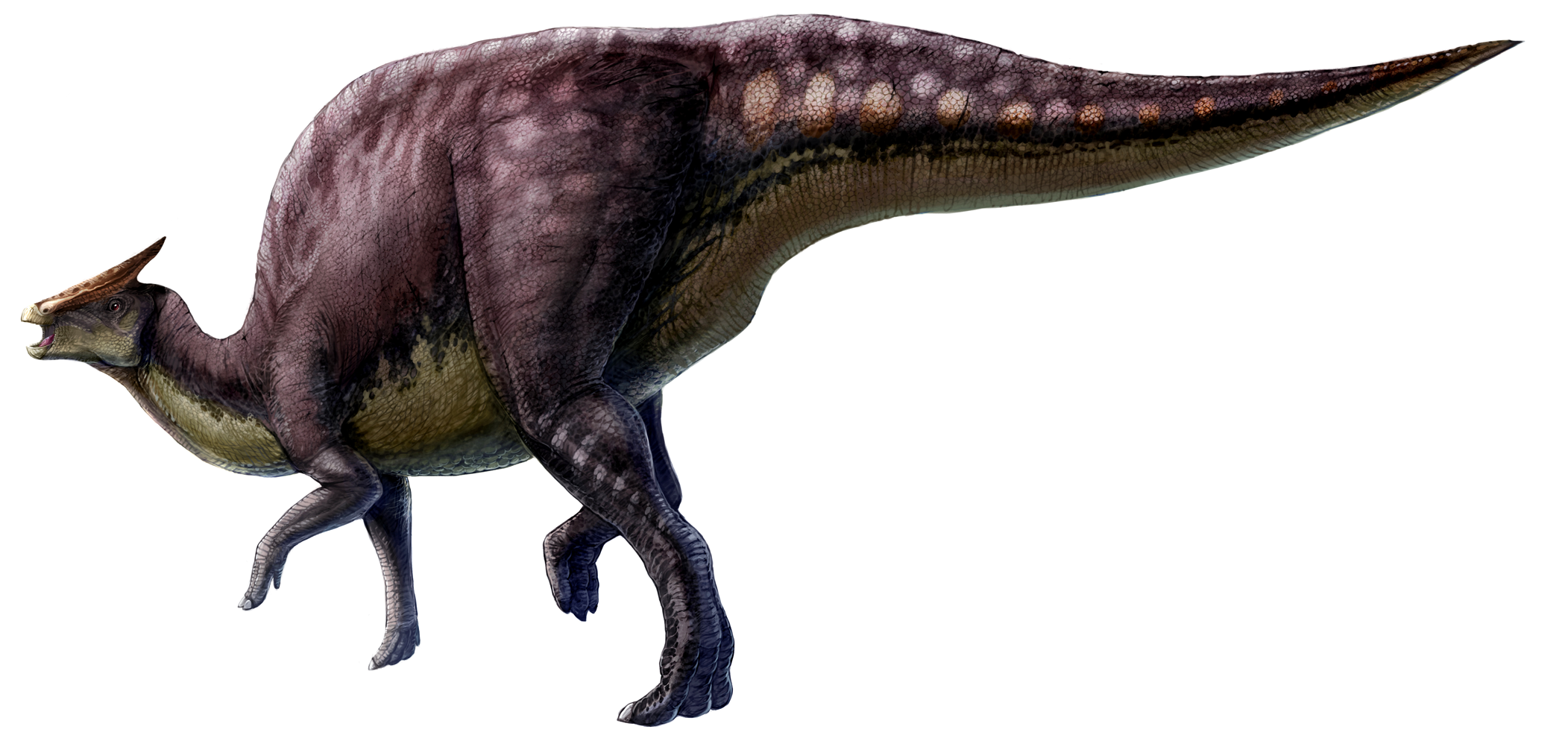
For comparison purposes, here is what the Saurolophus looked like. Source: http://en.wikipedia.org/wiki/Saurolophus
We thought it was important to put a dinosaur on display as we planned for the new Great Valley Outdoor Nature Lab. Dinosaurs certainly capture the imagination of our children (and not a few of our adults), and it is a good thing for our students to know that our county played an important part in the paleontological discoveries in our state. When students realize that one of their own (however long ago) made an important find, they also can visualize themselves as a paleontologist or geologist making important contributions to science. The concrete squares covered by orange tarps are mock paleontological digs where students can experience the sense of discovery that all paleontologists live for.
So why a Parasaurolophus, and not the Augustynolophus morrisi or other 'real' Saurolophus? That's easy: none of the marketers of dinosaur replicas offer any for sale, at least far as I could find. We figured that a similar species was better than none at all...
Trying hard not to be trampled to death 
What a great day for geological education in our county. I just hope the containment structure works! It just won't do to have wild dinosaurs running around on our campus...
 

Friday, January 24, 2020

Our Dinosaur is Here (More or Less). Stanislaus County's Secret is Soon to be Out!

Parasaurolophus

We are anxiously awaiting one of the last fixtures in our Great Valley Museum's Outdoor Nature Lab...our dinosaur! I hear that it is sitting in Receiving awaiting its placement near the paleontology mock dig. It's a scaled down version of the original creature, but will still be 16 feet long and 8 feet high. The model is a Parasaurolophus, which is serving as a stand-in for California's actual state dinosaur, the Augustynolophus morrisi. It turns out that our state dinosaur is rare enough that suppliers don't seem to offer them yet.

The Augustynolophus was a plant-eating dinosaur of the Hadrosaur family, the duck-billed dinosaurs. It has been found in Central California in the Late Cretaceous Moreno Formation, which is extensively exposed along the eastern margin of the Diablo Range, including Del Puerto Canyon in our county. The type specimens were found south of Stanislaus County, but fragmentary remains found in Del Puerto in 1936 are considered likely to be the same species. The 1936 discovery by teenager Allan Bennison was the first time dinosaur remains had ever been found in California. The Moreno Formation where the dinosaur remains were found was a marine environment, so the find could be considered unusual (dinosaurs were terrestrial creatures). What likely happened is that the animal was overwhelmed by a river flood off to the east where the Sierra Nevada is today, and the carcass floated out to sea where it finally sank to the bottom and was buried. Bennison found the bones, recognized their significance and reported them to his teacher in Gustine. The teacher notified paleontologists at U.C. Berkeley, and they eventually excavated 500 bone fragments, including 29 tail vertebrae and parts of the hind feet. The remains apparently reside in the University of California Museum of Paleontology (and wouldn't I love to get pictures one day!).
Augustynolophus Morrisi

The discovery site is on private land that is not accessible, but it can be viewed from the road in Del Puerto Canyon. It is perhaps very relevant to mention that plans are afoot to inundate the lower part of Del Puerto Canyon with a largely useless and possible dangerous reservoir, and the presence of this dam will make it more or less impossible to even see the location. It's a shame that one of the most important paleontology sites in California doesn't even merit a mention in the draft environmental impact report for Del Puerto dam.

There is time to have some impact on whether this dam is ever built. If you would like to be involved, please check out this Facebook site: https://www.facebook.com/groups/463664377903706/?multi_permalinks=478825349720942&notif_id=1579883197857937&notif_t=group_activity. There are some important meetings of regulatory committees coming up, and the public comments period on the draft EIR ends on January 27.


Sunday, September 24, 2017

Say Hello to California's New State Dinosaur: Augustynolophus morrisi

This one really got past me. I have to admit that the whole business of establishing a California State Dinosaur flew way under my radar. But it happened, Jerry Brown signed the bill, and Augustynolophus morrisi is our newest state emblem (along with our state fabric, denim). Although much of the attention on this Saurolophus species is directed towards two specimens found in the Panoche Hills of Fresno County in 1939-40, few people are aware of the story of California's first dinosaur discovery. It happened in 1936, and it was found in our own county of Stanislaus. I've written about this story before, so what follows is an abridged version.

OMG! Somebody caught Jar Jar Binks! Okay, not really. But what the heck is this thing?
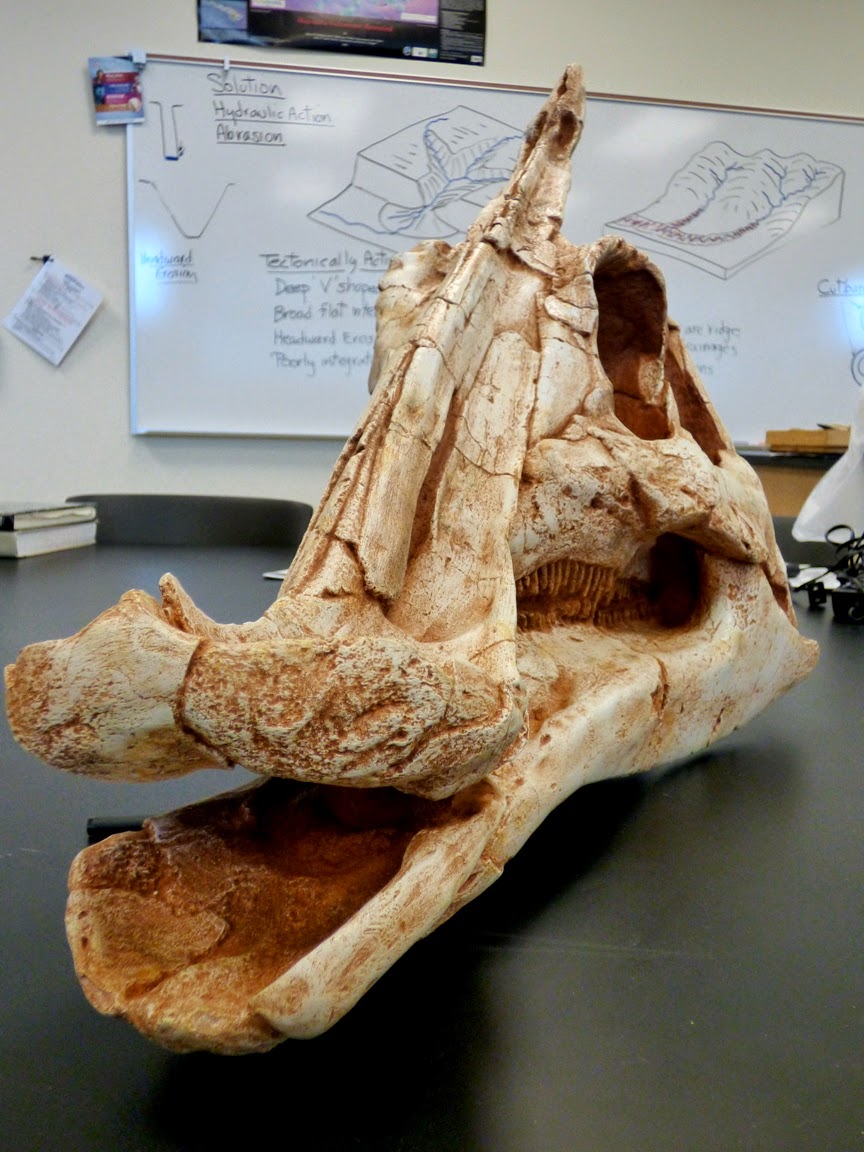
This is a skull replica of Saurolophus angustirostris, a closely related species from Mongolia
Say hello (sort of, since my skull is a closely related species) to Augustynolophus morrisi, our newly designated official state dinosaur!

We have half a million people in our county, and I'm willing to bet that 99% of them don't know what it is or why it's important to them. Only one person got to be the first to find a dinosaur bone in California, and that was 17-year-old Al Bennison in 1936. He was exploring Del Puerto Canyon in the Coast Ranges along the western part of Stanislaus County looking for shell fossils when he found bones scattered on a slope. He showed them to his science teacher who reported them to the paleontologists at U.C. Berkeley. A year later Bennison discovered the most complete mosasaur skull ever found in California (see below). The mosasaur species even bears his name. It may not be much of a surprise that he went on to become a paleontologist. I had the privilege of meeting him in 1996, when he took us to his original discovery site, shown above.
The Saurolophus was one of the last dinosaurs that ever lived on our planet, one the last groups in existence when the gigantic asteroid hit the planet (or when the volcanoes blew, or whatever else did them in). They lived in the latest part of the Cretaceous Period, which is well represented by sedimentary rocks in our region. The rocks are marine in origin, which tend not to be good places to search for dinosaurs, but sometimes a carcass would float out to sea.
Source: http://en.wikipedia.org/wiki/Saurolophus

The creatures were gigantic, on the order of thirty to forty feet long, weighing several tons. They were plant-eaters, with teeth well-adapted to grinding twigs and leaves. Whether they swam or not has been a topic of discussion and debate. Some argue that they had few other defenses from predators, so that swimming was necessary to escape from being eaten. Others suggest that they lived in herds that provided protection.
Our skull collection is now a powerful tool for teaching the students in our region about the heritage of the land that they live on. In the picture above, one can compare the Cretaceous plant-eater with the skull of a Short-faced Bear, which lived in our area during the Ice Ages during the last two million years. It may have been the single largest mammalian land predator that ever lived, with a standing height of 11 feet. It would have made a grizzly bear look small in comparison.
The picture above shows our other recent arrival, the Mosasaur, similar to the one found by Al Bennison during the 1950s in the Coast Ranges just south of our county. It was not a dinosaur but was instead a seagoing reptile from the Cretaceous Period that may have snacked on sharks. It was around thirty feet long. It is probably the most formidable predator ever to inhabit our region.
To give a sense of scale, we have the Mosasaur nosing an Ice Age Sabertooth Cat skull (the cats weighed 700 pounds), and one of those wimps of the early Cretaceous, Velociraptor (which came out of Mongolia, not the Americas).

Dinosaurs certainly capture the imagination of our children (and not a few of our adults), and it is a good thing for our students to know that our county played an important part in the paleontological discoveries in our state. When students realize that one of their own (however long ago) made an important find, they also can visualize themselves as a paleontologist or geologist making important contributions to science.


Source: http://upload.wikimedia.org/wikipedia/commons/4/4b/Saurolophus_scalation.png


Augustynolophus has its own Twitter handle, so check out developments at https://twitter.com/augustynolophus/. The Wikipedia page has been updated as well. For the best source of information on dinosaurs and other Mesozoic reptiles of California, check out this book by Richard Hilton of Sierra College.

Monday, December 14, 2015

Driving to the Center of the Earth in Del Puerto Canyon...Sideways

Okay, not really to the center, but deeper than any drill or mine shaft ever went. Del Puerto Canyon in the California Coast Ranges provides a window into the Earth's mantle, while passing through more than ten miles of crustal material. Allow me to explain! We were there last weekend, a group of our students gathered together after finals to explore the canyon.

The Great Valley began as a forearc basin, a sequence of sedimentary layers lying on oceanic crust between a subducting trench and the edge of the North American continent. The sediments were derived from the erosion of the Ancestral Sierra Nevada, which at the time was a string of volcanoes not unlike the Andes or Cascades of today.
Source: https://commons.wikimedia.org/wiki/File:Franciscan_subduction_model.gif

What a fascinating time this was! Huge volcanoes were erupting every few decades, while large rivers were constantly eating away at the mountains. A diverse group of dinosaurs roamed the forests on the flanks of the volcanoes including hadrosaurs (duckbilled dinosaurs). Raptors and carnivores similar to T-rex and Deinonychus (the American version of the velociraptors) lurked in the trees and along the rivers. Various species of Pterosaurs flew overhead.
The first dinosaur found in California was discovered on this ridge above the landslide.
The very first dinosaur fossil ever discovered in California was found in this very canyon, by a teen named Al Bennison in 1936. The creature was a Saurolophus, a plant-eater that had been caught in a river flood. The carcass floated out to sea, and was eventually entombed in the sediments of the Great Valley forearc basin.
Fall colors in Del Puerto Canyon. Unlike the rest of the country, we believe in enjoying the fall until winter actually begins on the calendar.
Like the adjacent coastline, the sea teemed with life. There were creatures much like those of today, clams and snails (pelecypods and gastropods), fish, and sharks. And then there were the sea-going reptiles: the Plesiosaurs (the suspected "Loch Ness Monster" creature, unfortunately), the Ichthyosaurs (large dolphin-like reptiles), and Mosasaurs (35-foot-long swimming Komodo Dragon relatives). A new species of Mosasaur was discovered by Al Bennison just a few miles away from Del Puerto Canyon.


The sediments accumulated to an incredible thickness, more than 25,000 feet. The sediments were later twisted upwards to form the eastern flank of the Coast Ranges. The road in Del Puerto Canyon winds for more than 10 miles through the sandstone, siltstone, and shale that once formed the ocean floor. We were driving up canyon, but deeper down into the crust. We were looking for the Tesla-Ortigalita fault that marks the boundary between the so-called Great Valley Group, and the underlying Coast Range Ophiolite, a slice of oceanic crust.
We soon reached the rocks near the base of the Great Valley Group, and found the exposure of the fault zone (it cuts diagonally upwards to the left in the picture above). I visited this spot nearly twenty years ago with Al Bennison, who by then was long retired. He described the structural relationships to us, and pointed out that ammonite fossils (cephalopods related to the Pearly Nautilus and the Octopus) could sometimes be found in the shale on the right side of the fault. He walked over, glanced at the cliff for a moment and said "here's one", handing me the delicate fossil. I've been to that darned outcrop another twenty times or so over the years, and I've never found one for myself!
So of course, what happens when I take our Geology Club students to the outcrop last Saturday, students who have never seen this spot, some of whom haven't even learned about ammonites yet? Yes, they found one. Durn it all....
At this point we've driven 10 miles into the canyon, and passed through five miles of seafloor sediments. We've reached the top of the oceanic crust, known in this area as the Coast Range Ophiolite, one of the most complete such sequences in all of California. For the next part of the journey we sought to pierce the crust and travel into the Earth's mantle below. We continued up the canyon...

Tuesday, October 13, 2015

National Fossil Day is Tomorrow! Do You Know the Paleontological Heritage of Your Region?

A hadrosaur skull similar to Saurolophus, the first dinosaur ever found in California
Tomorrow is National Fossil Day, which if anything, is of far greater interest than a holiday concerning an Italian explorer discovering a Caribbean island a few hundred years ago. One of the really exciting changes in our region is that our fossil heritage is being celebrated, pretty much for the first time. We finally have a museum with the room to adequately showcase the incredible paleontological history of the Great Valley of California. If you've read my blog at all, you'll know it's the Great Valley Museum at Modesto Junior College.
Two fossils here, but one of them isn't quite dead yet. The other is a Mosasaur
The Great Valley of California has a rich history of fossil discovery. Sediments were accumulating here in Jurassic and Cretaceous time, so dinosaurs and other reptiles have been discovered here, although not in concentrations like those of the continental interior. The first dinosaur ever discovered in California was found in our county. It was a Saurolophus, a variety of duck-billed dinosaur (the hadrosaurs). It was found by a teenager exploring Del Puerto Canyon in the 1930s.
Even more interesting, especially in light of a certain dinosaur movie last summer, are the Mosasaurs, large marine reptiles that were the terrors of the Cretaceous seas. One of them, Plotosaurus bennisoni, was discovered by the same kid who found the Saurolophus. It may have been 35 feet or longer in length.
Some fossils are more mundane, but they're exciting because I found them. Those would include these Jurassic wood fragments from the Sierra Nevada foothills. They were carried into the ocean by turbidity currents in the vicinity of the subduction zone that was once active here.
The most diverse and plentiful fossils are those of the creatures that grazed and hunted up and down our valley in Pleistocene time. The Fossil Discovery Center in the Madera area a few miles south of us has the best collection on display of these animals. The animals include the sometimes terrifying Short-faced Bear, Saber-tooth Cat, American Lion, and Dire Wolf. The grazers included a number of species of horse, camel and antelope, as well as mammoths and giant ground sloths. Many other smaller animals have been found in the quarry at Madera (which doubles as the sanitary waste disposal pit).
Few people in our county and region have had a venue in which they could learn about this fascinating fossil history, which is why the newly opened Great Valley Museum is such a wonderful opportunity. We have a full-sized skeleton of a Saber-tooth Cat, and a life-sized Mosasaur skull.
The newest exhibit highlights the research being done in Miocene sediments of the Mehrten Formation near Turlock Lake by the faculty and students of California State University, Stanislaus. Former MJC student Jake Biewer designed the current exhibit. The students are investigating some of the fossil sites where six-foot long "saber-toothed" salmon remains were found, along with tortoises the size of those found on the Galapagos Islands. Other exhibits are currently in the planning stages.
It's hard to describe how exciting it is to finally have a place to tell the story of the fascinating animals that lived here before us. The response from the children of our valley has been infectious. They love finding out that their home was once the home of that terrifying creature from the dinosaur movie, but also that they themselves could be the one who makes the next great discovery.

Have a great fossil day tomorrow! Learn something new about the place that you live!

Monday, May 18, 2015

Driving Through the Most Dangerous Plate Boundary in the World: Into the Realm of the Drowning Dinosaurs

The sediments of the Great Valley Group form the parallel ridges trending diagonally across the photograph.
California has a lot of potential for geological mayhem, with the San Andreas and many other faults, mountain-building, and volcanoes of many kinds. But it once was worse. During the Mesozoic era and the early part of the Cenozoic, the entire California coast was rimmed by a massive subduction zone. The huge earthquakes produced as the plate sank beneath the western edge of the continent would have produced horrific tsunamis. The sinking plate eventually produced bodies of molten rock that found their way to the surface, producing huge volcanoes, much like those found in the Andes Mountains today.

We've been making our way on a blog journey through this most dangerous plate boundary. The remains of the subduction zone have been lifted and exposed by erosion in the Coast Ranges. So far we have been observing the rocks of the accretionary wedge, the intensely deformed material that has been churned up within the trench of the subduction zone (see this post for an example). In our last post, we crossed through the oceanic crust of the Coast Range Ophiolite in Del Puerto Canyon in the Diablo Range. At the end of that post we crossed the Tesla-Ortigalita fault and entered into the exposures of the sediments of the Great Valley Group. We are now in the rain shadow of the Coast Ranges, and the slopes are barren of trees.
This large slump in the lower part of Del Puerto Canyon is the location of the discovery of the first dinosaur fossil ever found in California, in 1937.
The rocks of the Great Valley Group were deposited in a sea that lay between the trench and the western shoreline of the North American continent. The shallow ocean environment is called a forearc basin. The sediments consist of primarily of sandstone, siltstone, and shale that cascaded off the submerged edge of river deltas along the shoreline. The underwater landslides were called turbidity currents. The sediments pushed on the crust, and subsidence allowed vast thicknesses of sediment to accumulate. In the region around Del Puerto Canyon east of the Bay area, the layers total as much 25,000 feet. At the south end of the valley near Bakersfield, the rocks are around twice that.
All in all it doesn't sound like a good place to search for dinosaur fossils. The rocks are the right age, Cretaceous, but the dinosaurs were terrestrial creatures. They no doubt roamed the slopes of the the volcanoes and coastal plains of the continent, but few are known to have spent much time in the oceans. Finding a dinosaur fossil here seems about as likely as finding a cow or coyote skeleton at the bottom of the sea in the modern day. 
So, a hypothetical question: what if you did find a cow or a coyote skeleton on the sea floor? Could you explain it? It might take a moment, but one could imagine an intense flash flood along one of the rivers that flow off the Sierra Nevada and through the Great Valley, trapping and drowning a few cows or other creatures along the way. Their carcasses would have floated downstream, and eventually the bones could have sunk to the sea floor. I bring up this point because the sediments of the Great Valley Group have in fact yielded a few dinosaur fossils, and they probably did originate in a river flood.
Source: http://upload.wikimedia.org/wikipedia/commons/4/4b/Saurolophus_scalation.png
The first dinosaur ever found in the state was found in 1936 in our own county, Stanislaus, by a 17 year old boy named Al Bennison. He was searching for shell fossils in Del Puerto Canyon near the landslide seen in the photo above when he found some bone fragments on the hillside. They proved to be the remains of a duck-billed dinosaur (or hadrosaur), possibly a creature called a Saurolophus.
These were big creatures, as much as 30 or 35 feet long. They were plant-eaters, and were among the last of the dinosaurs, along with Triceratops and the tyrannosaurs. Bennison's discovery made news at the time, but few people in our county are aware of the awesome paleontological heritage of our region today. I'm hoping that will be changing soon as we prepare a display for the new Great Valley Museum of Natural History at Modesto Junior College.
Source: http://en.wikipedia.org/wiki/Saurolophus
But Bennison wasn't done yet. A year later in another canyon nearby he found the remains of a fearsome marine reptile called a mosasaur. Mosasaurs were probably the top predators of the Late Cretaceous seas, possibly even consuming sharks (yeah, that's a mosasaur you are seeing in the Jurassic World movie trailers, acting like a Sea World Orca). They are descended from ancient terrestrial lizards similar to the Komodo Dragon.
Bennison's mosasaur was a new species and now bears his name: Plotosaurus bennisoni. Like the hadrosaur, few people are aware that they once lived in this region. We have a four-foot long skull of a mosasaur on display in the museum, and a more extensive display is in the planning stages.
Another species of mosasaur, Plotosaurus Tuckeri, was found a few years later a bit further to the south. As can be seen in the diagram below, these creatures approached the size of whales, and would be a terror if they lived in today's oceans.

There have been many other discoveries of Mesozoic dinosaurs and other reptiles like plesiosaurs and ichthyosaurs. The best resource for learning about these fascinating creatures is the book Dinosaurs and Other Mesozoic Reptiles of California by Richard Hilton of Sierra College. Check it out!
From Dinosaurs and other Mesozoic Reptiles of California, by Richard Hilton
I reached the mouth of Del Puerto Canyon and was met with a disturbing sight that was emblematic of the conflict between humans and the natural landscape that we inhabit. More on that in the next post.


Monday, November 17, 2014

Dinosaurs, Volcanoes, Monsters of the Deep, and Other Stories Told by a Pile of Rocks. And Disneyland.

One of my most vivid childhood memories was Southern California Gas Company's Disneyland Night. My dad worked for the company at the time. Once a year the company rented Disneyland and practically every employee and their family showed up. It's hard to explain why this is so extraordinary, but let me try. Have you ever heard the expression "E ticket ride", referring to an event almost too exciting to bear? Disneyland used to require the purchase of a ticket book which was used to buy your way onto the rides. The A, B, C, and D tickets were for the boring slow rides like Storybook Land, It's a Small World, or the Swiss Family Robinson Tree. They were okay, but the E tickets were for the good stuff, mainly the Bobsleds. So why was Disneyland Night so incredible? They didn't dole out tickets that night. You could ride any ride you wanted, as many times as you wanted. For us kids, this was better than Christmas and Halloween combined.

On those long evenings, we would ride every ride possible, and around midnight we would be exhausted. Everything was starting to close up, but there was one last ride we could do...the train. It passed through the diorama of the Grand Canyon and then it passed onwards into the Primeval World. I'm pretty sure that every misconception I ever had about dinosaurs and ancient life was shaped by the scenes that passed before me in that dark tunnel. If you've never had the opportunity, someone (probably many, really) has it posted on YouTube (thank you, Dan Smith):


One of the associations that was imprinted on my mind was the T-Rex battling a Stegosaurus with an erupting volcano in the background. I look at the diorama today and see Apatosaurs lolling in swamps (they didn't), Tyrannosaurs standing like tripods (they didn't), and other misconceptions, but it was always the lavas in the distance behind the battling dinosaurs that I remember so well. So, what possible connection could there be between childhood memories of Disneyland and yesterday's class field trip to the Coast Ranges? Bear with me!

Our first stop of the day was at San Luis Reservoir, a major storage site for the California Water Project. Water is drawn from the Sacramento River Delta and pumped into the reservoir where it is eventually sent south through an extensive canal system. It is the largest "off-river" reservoir in the country. Shoreline erosion has removed the extensive coating of soil, exposing the underlying rocks, a unit known as the Panoche Formation, a complex of conglomerate, sandstone, silt, and claystone that was deposited in Late Cretaceous time, the final years of the Mesozoic, the dinosaur era.

The rocks seemingly defy explanation. They formed in thousands of feet of water, in the forearc basin that developed on the landward side of a vast subduction zone/trench system that existed on the west coast of North America for millions of years. The subduction zone was eventually replaced in central California by the San Andreas fault, a transform boundary between the Pacific and North American plates. The thing about these rocks is that on an ocean bottom one tends to expect to find mud and silt. Sand, pebbles, and boulders don't make sense. There are no strong currents on the ocean floor like there are in rivers. Or are there?

On river deltas and on the edge of the continental shelf where shallow ocean floor gives way to steeper slopes leading to abyssal depths sediments may be shaken loose, by earthquakes for instance. In this situation sediment gravity flows and turbidity currents form, fast-moving bottom-hugging masses of sediment moving very fast into deeper water. These masses are capable of considerable feats of underwater erosion, carving deep submarine canyons into the continental shelf. There are many examples of these along the present-day coast of California, the Monterey Canyon being one of the most famous.
Source: U.S. Geologic Survey

So, dinosaurs and volcanoes? The boulders in the Panoche Formation contain the occasional piece of granite derived from the deep erosion of the Sierra Nevada. The granite cobble is a fragment of what once were the magma chambers for a vast system of volcanoes that would have closely resembled the Andes or the Cascades. Yosemite Valley and the other exposures of granite across the Sierra Nevada were once situated miles beneath volcanoes. In Cretaceous time. Meaning dinosaurs once wandered the flanks of volcanoes right here in California!

That's kind of a stretch, isn't it? Is there actually any evidence of the actual volcanoes? And what about the dinosaurs?
The volcanoes are the easiest to prove. Most of the rocks in the photos above are volcanic in origin. They are the eroded pieces of lava flows that once adorned the summit ridges of the Sierra Nevada much as Lassen Peak and Mt. Shasta do today in the Cascades. It really stokes my imagination to pick up one of these rocks and to realize it started as a mass of molten rock that was erupted onto the flanks of a large stratovolcano off to the east. The lava flow was eventually eroded and removed, the bits and pieces being carried in a river and dumped onto a river delta at the edge of the continent. One day the edge of the continental shelf was shaken by an earthquake, and the chunk of rock disappeared into the depths, carried along by a turbulent mix of water and sediment. It came to rest on the deep ocean floor. Eventually intense compression folded and lifted up the rocks, and finally a last bit of soil washed away and the rocks were once again exposed to erosion and trampling by the feet of geologists.
Proving the dinosaurs were here is a bit harder, but it happened. In the 1930s, a young teenager from Gustine was exploring Del Puerto Canyon in the Coast Ranges looking for fossil shells. What he found instead were the remains of a Saurolophus, a duck-billed dinosaur. It was the first dinosaur fossil ever found in California. How much more exciting can that be? The dinosaur was apparently drowned in a river flood, and the carcass floated out to sea where it eventually sank to the seafloor. 
The great thing is, the fact that you can find an occasional dinosaur bone in these hills isn't even the best thing one can hope to discover. There were other creatures living in the sea, and they were terrifying. Al Bennison, the boy who found the dinosaur, also eventually discovered the remains of a Mosasaur.
The Mosasaurs were relatives of the varanid lizards, a group that also includes the Komodo Dragons that still live today in Indonesia. They were fearsome marine predators, swimming with flippers instead of clawed legs, perhaps even attacking and consuming sharks (or unwary geology professors). They reached lengths of more than 30 feet.
And that is the story told by a pile of rocks along a nearly empty reservoir in central California!
Plotosaurus is one of the genera of Mosasaurs. P. bennisoni was the species found in the California Coast Ranges.

For a description of some recent research on the conglomerates of the Panoche formation check out: http://www.searchanddiscovery.com/abstracts/html/2013/90162pacific/abstracts/green.htm