Showing posts with label Sabertooth cat. Show all posts

Monday, November 8, 2021

"What We Find Belongs to the Public Domain of Science": The Boy Paleontologists and the Irvingtonian Land Mammal Stage


Mission Peak from the Sabercat Trail in Fremont, California

I can just hear the script writers arguing about one of the scenes in an Indiana Jones movie...

George Lucas says "How about 'What we find belongs to the public domain of science'?"

Someone, presumably Harrison Ford in disguise says "George, you can type this s**t, but you sure can’t say it.

Someone else pipes up and says "Shorten it to 'That belongs in a museum'" and history was made.

I'm sure it never happened that way, but "What We Find Belongs to the Public Domain of Science" was in fact the motto of the Boy Paleontologists, who prior to last weekend I had never heard of. As adventurers, they were far more real than Indiana Jones, and ended up contributing far more to science than a glorified tomb raider. And to my surprise, I learned a lot more in an unexpected moment of serendipity.

Interpretive sign on the trail describing the paleontology efforts at Sabercat Trail

To begin with, Irvington simply is not a city that I've ever heard of in California. There's Irving, Texas, and Irvine, California, but no Irvington. But there is a part of the geological time scale called the Irvingtonian North America Land Mammal Stage. And that means there's an Irvington somewhere in North America, but a moment of research reveals that there are hundreds of fossil sites of Irvingtonian age scattered across the continent (and in fact the world). I never really thought to look up the actual location (and yes I see that Irvington, NJ is a place). 

The Irvingtonian North American Land Mammal Age (NALMA) on the geologic timescale spans from 1.9 million to 250,000 years ago. The Irvingtonian is usually considered to overlap the Lower Pleistocene and Middle Pleistocene epochs (basically the middle of the ice ages). The Irvingtonian is preceded by the Blancan and followed by the Rancholabrean NALMA  (which I absolutely knew about; I wrote about it tangentially just months ago).

The beginning of the Irvingtonian is defined by the first appearance of Mammuthus south of 55° N in North America, and the beginning of the succeeding Rancholabrean is defined by the first appearance of Bison.

Source: Barnosky et al., Prelude to the Anthropocene: Two new North American Land Mammal Ages (NALMAs). The Anthropocene Review. 1. 1-18. 10.1177/2053019614547433.

So how do these land mammal stages happen? Basically someone finds a huge number of fossils in a particular locality, and the assemblage turns out to be correlated to lots of other fossil sites across the continent to the extent that any fossil site with the same assemblage can be confidently dated. 

My son has been encouraging me for months to come and visit and walk the path in a Fremont park called the Sabercat Trail. He said they dug up a bunch of fossils there and it was preserved as a historical park now. I was intrigued, but COVID cut down on the opportunities to visit so it didn't happen until last weekend.


We got there and I was confused. I was in Fremont, but I was in Irvington. It turns out that Irvington once did exist as a village, but it was incorporated into the larger city of Fremont, but retains its character as the Irvington Neighborhood. And suddenly I realized this Sabercat Historical Park was a lot more important than I took it for. It wasn't just a fossil dig, it was THE Irvingtonian fossil dig. And what a story it had!

The fossils were first reported in 1867 when a local dentist named Lorenzo Gordin Yates found bones on Mission Creek (Sabercat Historical Park is just a few blocks from Mission San Jose). He sent them to Yale University because there was no one yet on the west coast who could identify them. His samples apparently included horses, camels and mammoth bone fragments.

Decades passed, and despite being just a few miles north, paleontologists from U.C. Berkeley didn't visit the site until the 1930s. The head of the Paleontology department at Berkeley, Ruben Stirton collected an assemblage of fossils and published a report in 1939 that first referred to the Irvingtonian fauna. It was defined as a land-mammal age as a result of Don Savage's studies in 1951.

A very large mammoth tusk at the Bell Quarry. Source: Pleistocene Ecosystem (msnucleus.org) by Wesley Gordon

The Boy Paleontologists entered the scene in middle 1940s when Wesley Gordon brought his sons and several of their friends on a fossil-collecting trip to the site. By now the locality was an active gravel quarry (the mind reels at the number of specimens that must have been destroyed over the years). A weekend hobby turned into a major excavation using young volunteers from the local community. The digs continued for around 15 years, and were even the subject of a Life Magazine article. They ultimately recovered 150,000 specimens of 58 species. 

The site unfortunately lay in the path of "progress", or more specifically the 680 freeway. Most of the quarry is covered by pavement now, although the account mentions that Wes Gordon convinced CalTrans to slightly divert the route to preserve a Short-faced Bear locality. My son mentions that the Ohlone people fought a 20-year legal battle to preserve an ancient burial site from the same freeway.

What exactly did they find? Who was living in the San Francisco Bay region between 1.9 million to 250,000 years ago? The trail provides some very nice interpretations of the ecosystem that existed at the time.


The cast of creatures ranges from mammoths larger than today's elephants to frogs and toads. During the ice ages, San Francisco Bay didn't exist as such because sea level was hundreds of feet lower than today. The area was broadly similar to what it would be today, if not cooler and slightly wetter. The grazing animals were dominated by camels, horses, deer, mammoths, mastodons, peccaries, and a unique species of four-horned antelope first discovered at Irvington. There were also gigantic ground sloths many times the size of their cousins today in Brazil. Rodents and rabbits would have been as common as today, and their remains are part of the assemblage that was discovered. Because of the delicate nature of their bones, only a few birds, a Canada Goose and Mallard duck, have been found as fossils. There were undoubtedly hundreds of species as there are today.

The carnivores were diverse and imposing. Sabertooth cats have been found (hence the name of the park), as well as scimitar cats, dire wolves, coyotes, foxes, badgers, and raccoons. The most terrifying must have been the short-faced bear, which makes grizzlies look small. It is considered the largest terrestrial mammal carnivore known. 
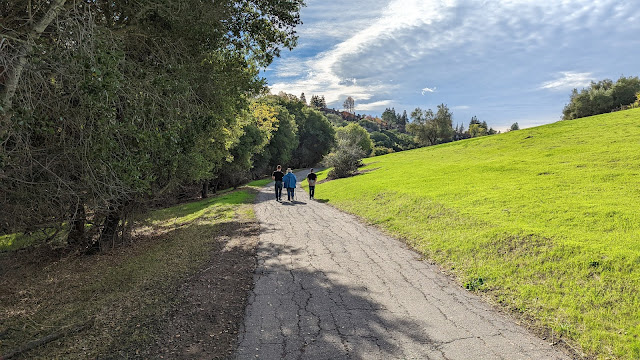

The park is a different place today. Bobcats and coyotes have replaced the bears, wolves, and sabertooth cats. It offers a network of trails that wind in and out of Sabercat Creek, and there is a smaller wilderness area in adjacent Mammoth Creek. Most all the trails are paved and accessible except for the actual remains of the quarry overlooking the freeway. Most of the fossiliferous layers were eliminated by the construction of the freeway, but the view from that end of the park is far-ranging (below).


I have a feeling that the park is an underutilized birding site. 84 species have been reported so far, but that is probably far fewer than what is actually there, given the excellent riparian habitat. We saw 18 species during our short visit including a very accommodating Western Bluebird.


I'm glad my son dragged us out to the Sabercat Trail. It was quite a revelation and answered some questions I've always wondered about!




Sunday, September 24, 2017

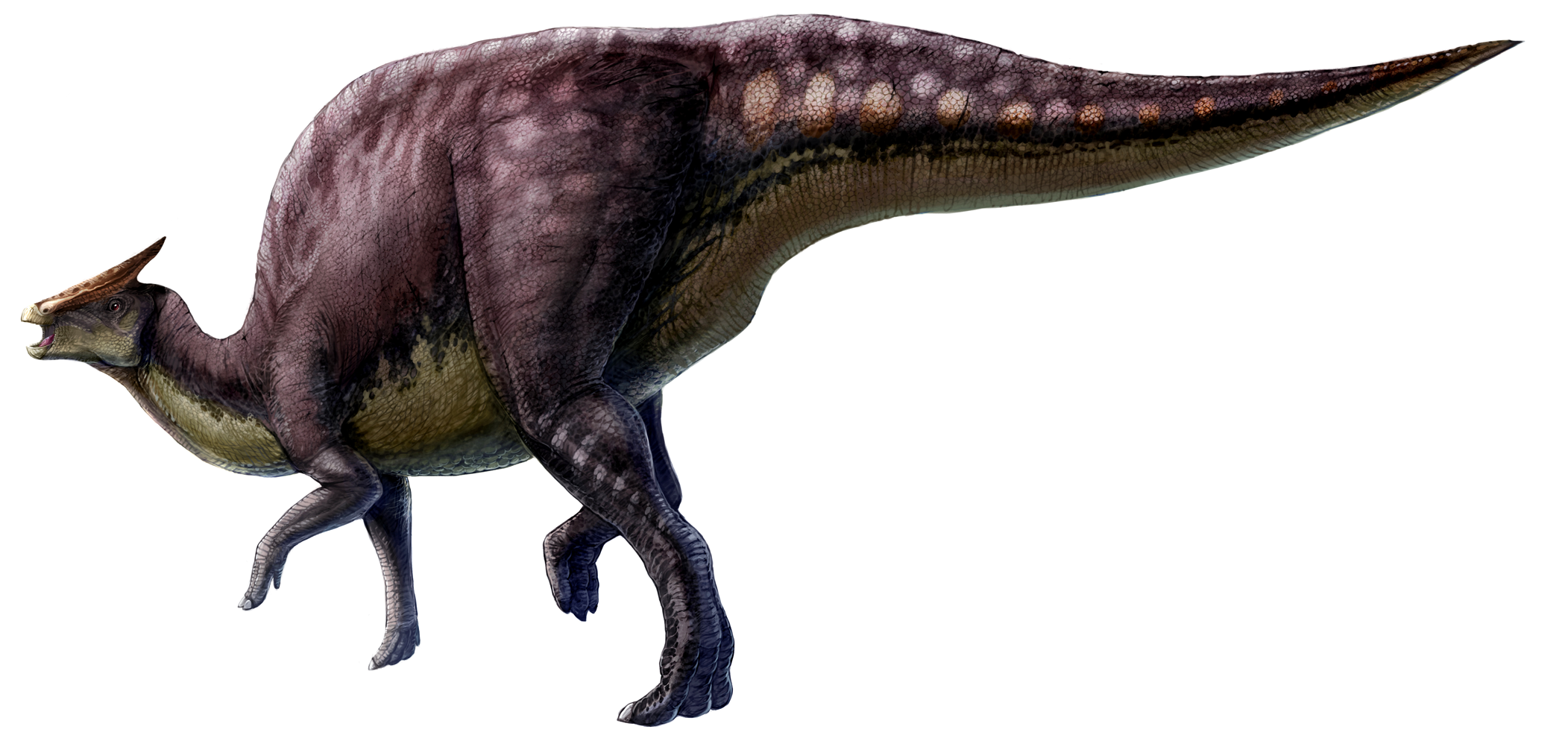
Say Hello to California's New State Dinosaur: Augustynolophus morrisi

This one really got past me. I have to admit that the whole business of establishing a California State Dinosaur flew way under my radar. But it happened, Jerry Brown signed the bill, and Augustynolophus morrisi is our newest state emblem (along with our state fabric, denim). Although much of the attention on this Saurolophus species is directed towards two specimens found in the Panoche Hills of Fresno County in 1939-40, few people are aware of the story of California's first dinosaur discovery. It happened in 1936, and it was found in our own county of Stanislaus. I've written about this story before, so what follows is an abridged version.

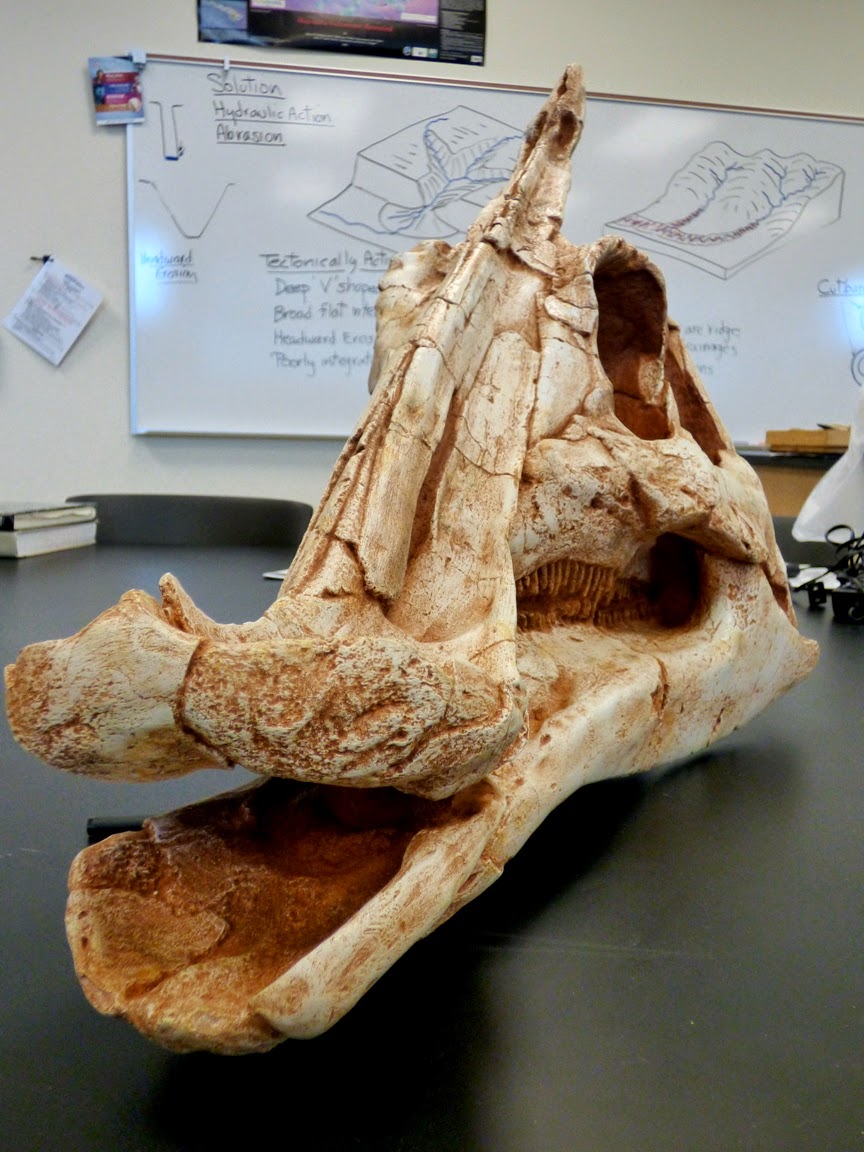
OMG! Somebody caught Jar Jar Binks! Okay, not really. But what the heck is this thing?
This is a skull replica of Saurolophus angustirostris, a closely related species from Mongolia
Say hello (sort of, since my skull is a closely related species) to Augustynolophus morrisi, our newly designated official state dinosaur!

We have half a million people in our county, and I'm willing to bet that 99% of them don't know what it is or why it's important to them. Only one person got to be the first to find a dinosaur bone in California, and that was 17-year-old Al Bennison in 1936. He was exploring Del Puerto Canyon in the Coast Ranges along the western part of Stanislaus County looking for shell fossils when he found bones scattered on a slope. He showed them to his science teacher who reported them to the paleontologists at U.C. Berkeley. A year later Bennison discovered the most complete mosasaur skull ever found in California (see below). The mosasaur species even bears his name. It may not be much of a surprise that he went on to become a paleontologist. I had the privilege of meeting him in 1996, when he took us to his original discovery site, shown above.
The Saurolophus was one of the last dinosaurs that ever lived on our planet, one the last groups in existence when the gigantic asteroid hit the planet (or when the volcanoes blew, or whatever else did them in). They lived in the latest part of the Cretaceous Period, which is well represented by sedimentary rocks in our region. The rocks are marine in origin, which tend not to be good places to search for dinosaurs, but sometimes a carcass would float out to sea.
Source: http://en.wikipedia.org/wiki/Saurolophus

The creatures were gigantic, on the order of thirty to forty feet long, weighing several tons. They were plant-eaters, with teeth well-adapted to grinding twigs and leaves. Whether they swam or not has been a topic of discussion and debate. Some argue that they had few other defenses from predators, so that swimming was necessary to escape from being eaten. Others suggest that they lived in herds that provided protection.
Our skull collection is now a powerful tool for teaching the students in our region about the heritage of the land that they live on. In the picture above, one can compare the Cretaceous plant-eater with the skull of a Short-faced Bear, which lived in our area during the Ice Ages during the last two million years. It may have been the single largest mammalian land predator that ever lived, with a standing height of 11 feet. It would have made a grizzly bear look small in comparison.
The picture above shows our other recent arrival, the Mosasaur, similar to the one found by Al Bennison during the 1950s in the Coast Ranges just south of our county. It was not a dinosaur but was instead a seagoing reptile from the Cretaceous Period that may have snacked on sharks. It was around thirty feet long. It is probably the most formidable predator ever to inhabit our region.
To give a sense of scale, we have the Mosasaur nosing an Ice Age Sabertooth Cat skull (the cats weighed 700 pounds), and one of those wimps of the early Cretaceous, Velociraptor (which came out of Mongolia, not the Americas).

Dinosaurs certainly capture the imagination of our children (and not a few of our adults), and it is a good thing for our students to know that our county played an important part in the paleontological discoveries in our state. When students realize that one of their own (however long ago) made an important find, they also can visualize themselves as a paleontologist or geologist making important contributions to science.


Source: http://upload.wikimedia.org/wikipedia/commons/4/4b/Saurolophus_scalation.png


Augustynolophus has its own Twitter handle, so check out developments at https://twitter.com/augustynolophus/. The Wikipedia page has been updated as well. For the best source of information on dinosaurs and other Mesozoic reptiles of California, check out this book by Richard Hilton of Sierra College.

Wednesday, May 20, 2015

Driving Through the Most Dangerous Plate Boundary in the World: In the Pleistocene, a Different Kind of Danger


An Egret and Tule Elk at the San Luis National Wildlife Refuge near Los Banos
The Great Valley began as a shallow sea (a forearc basin) between the Mesozoic subduction zone and the Ancestral Sierra Nevada volcanic arc. As noted in the previous post, the sea filled with thousands of feet of sediments, and as the subduction zone transitioned to a transform boundary, the sea gave way to land, and the one of the most fertile valleys in existence emerged. The Great Valley has become one of the most important agricultural regions on the planet. 95% of the original landscape has been altered to grow food and feed. If the land isn't covered by crops, it's covered by pavement and cities.
The Cosumnes River Preserve north of Stockton

As I said in the previous post, the agricultural development isn't necessarily a bad thing. With an increasing population of mouths to feed in the world, it would be silly not to utilize the richest soils on the planet. But we do live in a highly interconnected ecosystem, and we need to preserve what we can of the richness and diversity of life in our world. A few wetlands have been protected from development to allow the survival of some of the migratory birds that overwinter in our valley, like the Sandhill Crane, the Ross's Goose, the Snow Goose, and many others. Some of the rivers flowing through the valley are still allowed to reach the sea, preserving salmon and other aquatic species. There is a great deal of conflict about where to define the limits of water and land use, especially in this horrific drought year.
The Cosumnes River north of Stockton

This past year I spent as a new birder has been a revelation as I have sought out those small corners and edges of the valley that preserve something of the original ecological richness. I was stunned to find that flocks of tens of thousands of cranes and geese spend their winters just a few miles from my home near Modesto.
Snow Geese and Ross's Geese at the Merced National Wildlife Refuge
Tule Elk, among the largest members of the deer family (aside from the Moose), used to live in the valley by the millions as well. One subspecies was down to a single breeding pair in the late 1800s, but they were protected by a rancher, and several thousand now survive in some widely separated refuges. The wolf was driven to extinction, as was the terrifying California Grizzly Bear. Other species retreated into the Coast Ranges and Sierra Nevada foothills.
The Tule Elk herd at the San Luis National Wildlife Refuge

This blog series has mostly been about the "most dangerous plate boundary" in the world, referring to the geologic hazards inherent in living near an active subduction zone: earthquakes, tsunamis, and volcanic eruptions. But a different kind of danger lurked in the Great Valley when humans first arrived: the so-called "megafauna": an ecosystem of large mammals that mostly went extinct just 10,000 or so years ago.
Wooly Mammoth at the Paige Museum
One of the most imposing creatures would have been the mammoths. These elephant relatives were widespread across Asia, Europe and North America, and passed into oblivion only a few thousand years ago. They were gone from the continents by 10,000 years ago, but a small population (both in stature and in numbers) survived on Wrangell Island in eastern Russia until 4,300 years ago.
There were giant ground sloths (above), and camels. Lots of camels, so much so that they are one of the two most common animals found in the Fairmead paleontological site near the Great Valley town of Madera. The Fairmead excavations have been the most important source of fossil material on the valley floor (the fossil species are also well known from the La Brea Tar Pits in Los Angeles.

The other common fossil is the horse. Most people think horses came to America with the Spaniards in the 1500s, but they actually evolved in North America and spread to other parts of the world before going extinct in their ancestral home around 10,000 years ago. There were also species of deer and pronghorn, and the buffalo roamed the valley as well.

Though any of these creatures could have injured humans in self-defense, it was their predators that would have made life in the valley terrifying. There were huge Sabertooth Cats. There were Jaguars and American Lions (pretty much the same as African Lions).

The California Grizzly Bear was dangerous enough, but even larger bears lived in the valley as well. The Short-faced Bear was a good 50% larger than a Grizzly, and may have been the largest terrestrial mammal predator ever. They were five feet high at the shoulder, and stood 11-12 feet tall if they chose to. Terrifying indeed.

They were smaller than the cats or bears, but the Dire Wolves hunted in packs, and that made them perhaps even more dangerous than the others. They were 25% larger than today's wolves.

The Great Valley would have been a dangerous place for humans when they arrived 13,000 years ago or earlier. It's possible that the megafauna is extinct today because humans had tools for hunting and defense, but the connection is not yet clear. Climate change could have played a role too, or disease, or any other number of possible explanations. In any case, I feel a sense of loss when I wander through the few remaining pieces of original habitat imagining the creatures that used to live here. A sense of loss, but at least I am not so fearful of being maimed or killed.

Are you interested in seeing more of these creatures? If you are ever traveling in the Great Valley for any reason, make the time to stop at the Fossil Discovery Center in the Madera area. The very famous La Brea Tar Pits are the other great source of information on the extinct megafauna. The Paige Museum at the tar pits is an excellent place to visit when you are in Los Angeles.

Tuesday, May 19, 2015

Driving Through the Most Dangerous Plate Boundary in the World: The Sea Floor that Became the Greatest Agricultural Region on Earth


Welcome to one of the strangest places on the planet! It's the size of West Virginia, but flatter than the Mississippi River Valley. It was once America's Serengeti, but 95% of the original landscape has been altered. It originated as the bottom of a sea, but now grows most of the nation's produce, and practically all of the nation's walnuts, almonds, and pistachios. It has been a major oil and natural gas producer. It is the Great Valley of California.
The Great Valley originated as a forearc basin, the seaway that is sometimes present between an oceanic trench/subduction zone and the margin of the continent. Tens of thousands of feet of sediment were deposited between the Jurassic Period and the mid-Cenozoic. As noted in the last post, the sediments have yielded up a fascinating collection of fossils over the years, including mosasaurs, plesiosaurs, ichthyosaurs, and even the fragmentary remains of a few dinosaurs. The valley was a seaway for the better part of 200 million years.

It is no longer a seaway. In the last few million years, California's tectonic framework underwent huge changes. The subduction zone was extinguished in the central and southern parts (subduction continues in the north state). A new plate boundary emerged: the San Andreas transform fault. Compressional forces along bends in the fault line raised the Coast Ranges, and the seaway of the Great Valley slowly gave way to river deltas, and then alluvial fans. In the last five million years, the Great Valley has been a terrestrial environment, with numerous river channels, gigantic lakes and vast grasslands. Large herds of grazing animals wandered the plains, pursued at times by terrifying predators (look for them in the next post of the series). Countless millions of birds made use of the wetlands during their long seasonal migrations.

The biggest and most far-ranging change in the Great Valley during the last five million years may have been that which took place only in the last 150: agricultural development. Millions of acres of grasslands, lakes and wetlands were drained and plowed. The rivers were dammed and diverted into artificial watercourses that took them hundreds of miles from their natural channels. Thousands of wells were drilled that brought prehistoric groundwater to the surface. Parts of the valley subsided thirty feet or more as the water was withdrawn. A mere 5% of the valley floor retains its natural character. Most of the animals are gone, shot to extinction (the California Grizzly Bear, for instance), or pushed to marginal environments in the Sierra Nevada or the Coast Ranges. The migratory birds are crowded into a few precious wildlife refuges up and down the valley.
I'm not really writing this to criticize the agricultural development of the valley. We have billions of people on the planet, and they insist on eating, so it would be foolish not to utilize some of the richest soils on the planet. I would even suggest to people who don't live in the valley that they might have a bit more respect for the people who work hard for low wages to plant and harvest the food that you eat. On the other hand, we do a lot of things wrong in our approach to agricultural development, and the waste of water is one of those things. The ongoing four-year drought has exacerbated the problem. There are problems with the overuse of pesticides and antibiotics, and with agricultural waste disposal. In many ways we are fouling (and paving over) our nest.

Still, living here does have some benefits. Given our journey through the most dangerous plate boundary on the planet, the Great Valley doesn't exactly look geologically menacing. It is relatively far away from the most active earthquake faults of the state, and is even farther away from the most dangerous of the state's volcanoes. We don't get hurricanes, violent thunderstorms or blizzards, and tornadoes are exceedingly rare. The idea of dangers from landslides is laughable (except that I know of at least one fatality in Modesto caused by a slide). But we do have two threats: droughts and flooding.We are in the midst of the worst drought in recorded history, but with the development of an El Nino weather pattern in the Pacific, we could have catastrophic floods in only a few months. We can never really predict what can happen. In 1861-62 the floods were widespread that the state capitol had to be removed to San Francisco for a few months. The valley was a gigantic lake twenty miles wide in places.
Flooding on the San Joaquin River in 2006.

The map below shows what could happen if we get a repeat of the 1861-62 floods, an event the meteorologists call an atmospheric river storm (ARKStorm). They also refer to this as the "other big one", because the potential for damage is greater than that of a major earthquake, at least in the Great Valley.
In the Great Valley, geology conspired to transform a sea floor into the richest agricultural region on the planet. For all the flat lands, it is an interesting place to study. In the next post we'll take a look at the strange things we've found just beneath the surface. In a garbage dump of all places.

Wednesday, April 2, 2014

Oh no, it's Jar Jar Binks! No, It's Far More Special Than That...


Omigod! Somebody caught Jar Jar Binks! Okay, not really. But what the heck is this thing?

Say hello to Saurolophus, our home-grown California dinosaur! It is the last of the new teaching materials that we were able to purchase as part of renewing the teaching of science at Modesto Junior College. We ordered it months ago, but I guess there was a backlog of skull orders or something. It was like Christmas opening the box this morning.

Being last isn't what made it special. We have half a million people in our county, and I'm willing to bet that 99% of them don't know what it is or why it's important to them. Only one person got to be the first to find a dinosaur bone in California, and that was 17-year-old Al Bennison in 1937. He was exploring Del Puerto Canyon in the Coast Ranges along the western part of Stanislaus County looking for shell fossils when he found bones scattered on a slope. He showed them to his science teacher who reported them to the paleontologists at U.C. Berkeley. It was the first dinosaur ever found in our state. Bennison went on to a career in geology, and a few decades later discovered the most complete mosasaur skull ever found in California (see below). The mosasaur species even bears his name.
The Saurolophus was one of the last dinosaurs that ever lived on our planet, one the last groups in existence when the gigantic asteroid hit the planet (or when the volcanoes blew, or whatever else did them in). They lived in the latest part of the Cretaceous Period, which is well represented by sedimentary rocks in our region. The rocks are marine in origin, which tend not to be good places to search for dinosaurs, but sometimes a carcass would float out to sea.
Source: http://en.wikipedia.org/wiki/Saurolophus

The creatures were gigantic, on the order of thirty feet long, weighing several tons. They were plant-eaters, with teeth well-adapted to grinding twigs and leaves. Whether they swam or not has been a topic of discussion and debate. Some argue that they had few other defenses from predators, so that swimming was necessary to escape from being eaten. Others suggest that they lived in herds that provided protection.
Our skull collection is now a powerful tool for teaching the students in our region about the heritage of the land that they live on. In the picture above, one can compare the Cretaceous plant-eater with the Short-faced Bear skull, which lived in our area during the Ice Ages during the last two million years. It may have been the single largest mammalian land predator that ever lived, with a standing height of 11 feet. It would have made a grizzly bear look small in comparison.
The picture above shows our other recent arrival, the Mosasaur, similar to the one found by Al Bennison during the 1950s in the Coast Ranges just south of our county. It was not a dinosaur but was instead a seagoing reptile from the Cretaceous Period that may have snacked on sharks. It was around thirty feet long. It is probably the most formidable predator ever to inhabit our region.
To give a sense of scale, we have the Mosasaur nosing an Ice Age Sabertooth Cat skull (the cats weighed 700 pounds), and one of those wimps of the early Cretaceous, Velociraptor (which came out of Mongolia, not the Americas).

Dinosaurs certainly capture the imagination of our children (and not a few of our adults), and it is a good thing for our students to know that our county played an important part in the paleontological discoveries in our state. When students realize that one of their own (however long ago) made an important find, they also can visualize themselves as a paleontologist or geologist making important contributions to science.


Source: http://upload.wikimedia.org/wikipedia/commons/4/4b/Saurolophus_scalation.png


For the best source of information on dinosaurs and other Mesozoic reptiles of California, check out this book by Richard Hilton of Sierra College. It's the best resource out there for our state.

Saturday, October 2, 2010

Fossil Discovery Center in Madera County is Opening!

Painting by David Douglas for the Fossil Discovery Center

If you live anywhere near the geographical center of California, there is some exciting paleontology news! Since the early 1990's Fairmead Landfill has been the source of thousands of specimens of a diverse Pleistocene fauna, including horses, camels, mammoths, sabertooth cats, giant ground sloths and many other fascinating inhabitants of the Central Valley thousands of years ago (I've posted several items about the excavations here and here). For years the San Joaquin Valley Paleontology Foundation has been planning to develop a center where students and visitors can learn about the intriguing history of our valley. And their plans are coming to fruition.

The San Joaquin Valley Paleontology Foundation is sponsoring the Grand Opening Celebration of the Fossil Discovery Center of Madera County. The journey began in 1993 with the discovery of a seven-foot mammoth tusk. Today their expedition into a pre-historic era continues, opening the past to students, scientists and community. Come and be a part of this historical event.

Wednesday, October 13, 2010

Ribbon Cutting -10:00 a.m.

Reception—5:30 p.m. to 7:30 p.m.

Fossil Discovery Center of Madera County
19450 Avenue 21 ½
Chowchilla, CA 93610
Take the Hwy 99 Exit 164, SW corner of Road 19 ½ & Avenue 21 ½

Refreshments will be served & tours provided.
--
San Joaquin Valley Paleontology Foundation
Board of Directors
sjvpaleo@gmail.com
http://www.maderamammoths.org/

Come and check it out!