Showing posts with label almond orchards. Show all posts

Saturday, March 2, 2019

The Other Snowstorm in California Right Now, and a Water Problem of a Different Kind

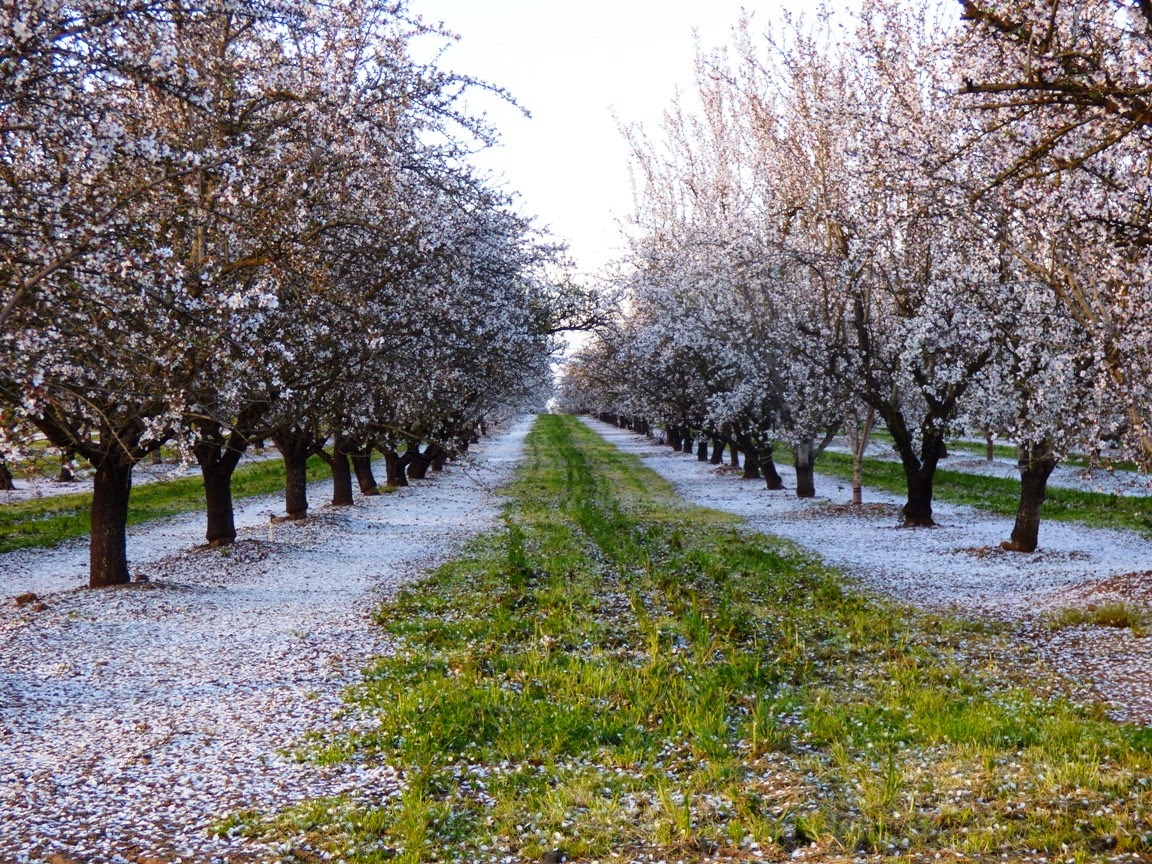
The Sierra Nevada and Cascades are buried under record amounts of snow right now, but that's not the only "snow" falling in the state just now. More than a million acres of the state are covered in a blizzard of flower petals from blooming almond trees. The vast blanket of snow is a measure of the health of the water supply in California, but in a way, so is the blizzard of almond blossoms.

Almonds have become one of the leading cash crops in the state of California, which produces around 80% of the world supply. When world prices for almonds jumped a few years ago, agribusiness responded by putting in hundreds of thousands of acres of almond orchards, sometimes replacing other kinds of crops, and sometimes breaking new ground in less productive soils around the margins of the Great Valley. 25 years ago 400,000 acres were planted in almonds. Today it's 1.3 million acres, about 2,000 square miles. The problem is that almonds require a lot of water, around three to four feet per year. The new orchards in my county, several tens of thousands of acres, are getting their water from underground aquifers. The water they are tapping into will not be easy to replace.
I'm not sure we've adequately considered the conflicts of water use and almond expansion. People were paying a lot of attention during California's crippling drought of a few years ago, but those voices have quieted after a few wet years. The thing is, the trees in an orchard must have a fixed amount of water. One can't let a field lie fallow if water is in short supply like one can do with annual crops. The vast increase in almond orchards is adding to the "structural drought" in California, a situation in which even years of "normal" precipitation don't provide enough water to meet the minimum needs. Increasing temperatures related to global climate change will exacerbate the problem as we roll into the future. But as always, money talks.

Unfortunately, I don't see a good end to the haphazard and poorly planned expansion of almond orchards into the prairies of the Sierra Nevada foothills. The blooming trees that look so beautiful today may be abandoned snags before too long. The water is an intractable problem that will not be solved by the building of new dams. There aren't many good places left to put them, and there has to be enough precipitation to fill the dams and that's not assured in our changing climate.

But those trees are really beautiful right now!

POSTSCRIPT: I went up into the foothills today to do some birding and got some pictures of the almond groves covering many hillsides. It's shocking to me that the trees are planted in straight rows that have furrows leading downslope. It's an open invitation for very serious soil erosion, a lesson I thought we learned in the Dustbowl years.


Thursday, April 28, 2016

Damn Fool California Farmers Bringing on a New Dust Bowl


The video is very short, but in eight seconds it shows the stupidity of bad agricultural practices in Central California, practices that have led to disaster in the past, and maybe into our immediate future as well.
Muddy runoff from an almond orchard east of Modesto. That's soil going away, never to return
I want to make it clear that I'm not condemning all farmers. The traditional small farmers were known for caring for the lands. In flat lands where winds can carry away topsoil, these people planted trees to serve as windbreaks, trees that wouldn't be mature until long after they had passed on. They were careful to prevent soil erosion by plowing with the topography, to prevent destructive runoff. They let fields lie fallow in some years to let soil recover. They were looking out for their descendants, but it was also an act of self-preservation. If they lost the land, they could literally starve.
Unfortunately, it's been a long time since "small" farmers provided the economic backbone of our country. Most farming today is performed by giant agribusinesses that are more concerned with the bottom line and short-term profits. There isn't much in the way of forward thinking in a corporate boardroom.

So why is it that I'm ranting on this subject today? We had a freak storm roll through the area this afternoon. In about twenty minutes we accumulated 0.5 inches of rain, and the sky was alive with thunder and lightning. We even had a funnel cloud over our village east of Modesto (video here). The skies cleared and the storm drifted east. I decided to make a slight detour on my way to work, so I headed east on Lake Road towards Turlock Reservoir and came across a shocking scene (for our region anyway): a hail-covered landscape.
A few moments later I encountered an even bigger problem, a flooded roadway. The water was very muddy, and I could immediately see the reason. The soil was washing off the adjacent slopes. It shouldn't be happening this way. The natural landscape in this area should be a short-grass prairie, and the water should have been absorbed into the soil, and the grassroots should have been holding the soil in place. Of course a heavy rain can flood a road, but it shouldn't be bury the road in sediment.
The problem is the high commodity prices for almonds due to intense demand for nuts in Asia. California produces most of the world's almonds, and for the last few years, tens of thousands of acres of grasslands have been ripped up and replaced by tree saplings. The orchards are already controversial because the trees require vast amounts of water, and there is no irrigation infrastructure to provide it in sufficient amounts. The orchards are being watered by newly drilled wells, and the water they are using is largely irreplaceable, as the water use far exceeds natural recharge. The wells are tapping into aquifers that provide water for Modesto and other cities in the Great Valley.
But another serious problem caught my attention this afternoon. The grass is gone, and herbicides are clearly being used to keep the soil barren in the rows between the trees. And the trees are in perfectly straight rows, no matter the shape of the topography.

In other words, these "farmers" (really investment groups) are breaking one of the most important lessons of the Dust Bowl era. To farm in a sustainable manner, one needs to work with the land, not against it. One of the main causes of soil loss in the Dust Bowl days was erosion of furrows that sloped towards the gullies and valleys because of an insistence on plowing in perfectly symmetrical rows no matter the underlying topography.
The soils of the eastern Great Valley and in the Sierra Foothills are much older and less fertile than those on the floor of the valley. They've not been replenished by river floods since the end of the last ice age some 13,000 years ago. As a result, there are fewer nutrients, and thick accumulations of clay prevent groundwater infiltration unless grass or other vegetation slows the water down. So today, with the grass cover stripped away, we are seeing increased soil erosion that seems to intensify with every storm.

The problem was made most clear as I was driving south on Hawkins Road (below). On the right side of the road, you can see the recently planted orchard, and the muddy water that is washing off the slope. In the foreground, the water on the road is clear. That's because the slope to my right was covered with prairie grass, not orchard.
This is what we get when farming gets taken over by corporate interests. One would think that in this modern era we would take steps to prevent soil loss. Soil is life itself, and is irreplaceable in human lifetimes. But...money talks. It yells. It shouts. And the land therefore suffers.

Tuesday, May 19, 2015

Driving Through the Most Dangerous Plate Boundary in the World: The Sea Floor that Became the Greatest Agricultural Region on Earth


Welcome to one of the strangest places on the planet! It's the size of West Virginia, but flatter than the Mississippi River Valley. It was once America's Serengeti, but 95% of the original landscape has been altered. It originated as the bottom of a sea, but now grows most of the nation's produce, and practically all of the nation's walnuts, almonds, and pistachios. It has been a major oil and natural gas producer. It is the Great Valley of California.
The Great Valley originated as a forearc basin, the seaway that is sometimes present between an oceanic trench/subduction zone and the margin of the continent. Tens of thousands of feet of sediment were deposited between the Jurassic Period and the mid-Cenozoic. As noted in the last post, the sediments have yielded up a fascinating collection of fossils over the years, including mosasaurs, plesiosaurs, ichthyosaurs, and even the fragmentary remains of a few dinosaurs. The valley was a seaway for the better part of 200 million years.

It is no longer a seaway. In the last few million years, California's tectonic framework underwent huge changes. The subduction zone was extinguished in the central and southern parts (subduction continues in the north state). A new plate boundary emerged: the San Andreas transform fault. Compressional forces along bends in the fault line raised the Coast Ranges, and the seaway of the Great Valley slowly gave way to river deltas, and then alluvial fans. In the last five million years, the Great Valley has been a terrestrial environment, with numerous river channels, gigantic lakes and vast grasslands. Large herds of grazing animals wandered the plains, pursued at times by terrifying predators (look for them in the next post of the series). Countless millions of birds made use of the wetlands during their long seasonal migrations.

The biggest and most far-ranging change in the Great Valley during the last five million years may have been that which took place only in the last 150: agricultural development. Millions of acres of grasslands, lakes and wetlands were drained and plowed. The rivers were dammed and diverted into artificial watercourses that took them hundreds of miles from their natural channels. Thousands of wells were drilled that brought prehistoric groundwater to the surface. Parts of the valley subsided thirty feet or more as the water was withdrawn. A mere 5% of the valley floor retains its natural character. Most of the animals are gone, shot to extinction (the California Grizzly Bear, for instance), or pushed to marginal environments in the Sierra Nevada or the Coast Ranges. The migratory birds are crowded into a few precious wildlife refuges up and down the valley.
I'm not really writing this to criticize the agricultural development of the valley. We have billions of people on the planet, and they insist on eating, so it would be foolish not to utilize some of the richest soils on the planet. I would even suggest to people who don't live in the valley that they might have a bit more respect for the people who work hard for low wages to plant and harvest the food that you eat. On the other hand, we do a lot of things wrong in our approach to agricultural development, and the waste of water is one of those things. The ongoing four-year drought has exacerbated the problem. There are problems with the overuse of pesticides and antibiotics, and with agricultural waste disposal. In many ways we are fouling (and paving over) our nest.

Still, living here does have some benefits. Given our journey through the most dangerous plate boundary on the planet, the Great Valley doesn't exactly look geologically menacing. It is relatively far away from the most active earthquake faults of the state, and is even farther away from the most dangerous of the state's volcanoes. We don't get hurricanes, violent thunderstorms or blizzards, and tornadoes are exceedingly rare. The idea of dangers from landslides is laughable (except that I know of at least one fatality in Modesto caused by a slide). But we do have two threats: droughts and flooding.We are in the midst of the worst drought in recorded history, but with the development of an El Nino weather pattern in the Pacific, we could have catastrophic floods in only a few months. We can never really predict what can happen. In 1861-62 the floods were widespread that the state capitol had to be removed to San Francisco for a few months. The valley was a gigantic lake twenty miles wide in places.
Flooding on the San Joaquin River in 2006.

The map below shows what could happen if we get a repeat of the 1861-62 floods, an event the meteorologists call an atmospheric river storm (ARKStorm). They also refer to this as the "other big one", because the potential for damage is greater than that of a major earthquake, at least in the Great Valley.
In the Great Valley, geology conspired to transform a sea floor into the richest agricultural region on the planet. For all the flat lands, it is an interesting place to study. In the next post we'll take a look at the strange things we've found just beneath the surface. In a garbage dump of all places.

Tuesday, March 3, 2015

California's Precious Disappearing Prairies: A trip to the Willms Road Pond


One of California's precious landscapes is being lost, again. The state once had a vast prairie extending for 400 miles from Redding to Bakersfield. The grasslands were of course put to the plow, and agriculture rules the environment today. Less than 5% of the original grasslands of the Great Valley remain, and they've been under renewed assault in just the past few years.
The problem is nuts, and specifically almonds. The valley and nearby hills produce 80% of the world's supply, and they constitute the largest agricultural export we produce right now. The trees use prodigious amounts of water, but that hasn't stopped a vast expansion of the orchards into the remaining prairies on the east side of the valley where the Sierra Nevada foothills begin. With a crippling drought and no reservoir irrigation possible, the landowners are simply drilling wells and pumping the water from the ground. The supply of groundwater is limited and in severe decline. I am pretty sure these wells cannot provide more than a few year's worth of water before they'll be dry.
Still, the prairies aren't gone yet, and I took a break from taxes this weekend to catch the sunset from Warnerville and Willms Roads east of Oakdale. We drove through miles of newly planted orchards, and into some of the grazing lands beyond. It was a stunning reversal from the appearance last year of dead grass and dry streambeds. We've had adequate amounts of rain on the valley floor, with upwards of 10 inches in December, and a few good storms in February to make up for a record dry January. The grass was green and growing, and the ephemeral streams and vernal pools were filled with water. We just need more snow higher up in the mountains to get well from the drought, as the snowpack is less than 20% of normal right now, with the end of the rainy season looming.
We were following on the heels of an unusually active thunderstorm system. Our weather is pretty benign most of the time, but this storm dropped upwards of a foot of snow in the high country. The clouds were an incredible sight in the last glow of the dying sunset.

There were animals out and about. The Western Meadowlarks were present in large numbers, trying to attract some mates. They have a most beautiful song, which I captured on a brief video that you can listen to at my Geotripper's California Birds site (click here).
The story was the same with the Red-winged Blackbirds. There were dozens, if not hundreds, at our favorite little stock pond on Willms Road. They were strutting about displaying their bright red and yellow shoulder patches.
If some of the smaller animals weren't paying careful attention, they might not have noticed the hawk lurking in the almond trees. I almost didn't see it myself as we passed.
The biggest surprise came as we passed the small cliff along the creek that crossed Warnerville Road. I was expecting or hoping to see some burrowing owls, but the biggest hole was occupied by the raccoon seen below. When it noticed us, it just up and disappeared into the burrow.

The remaining prairies have persisted because no one could think of how to make money from them other than grazing cows or sheep. Now that almonds are a lucrative source of money, there is a target painted on the ranchlands in the Sierra Nevada foothills. I hope the state gets around to writing the groundwater regulations so we can get a handle on the unrestrained development that is taking place right now. It's clearly unsustainable in the long run.

Thursday, February 26, 2015

A Different Kind of "Snow" in California, and a Coming World of Hurt


 There is a different kind of snow falling in California right now. It might look vaguely like that cold stuff that has been falling back east, but the resemblance stops at "white". The almond orchards of the Great Valley have been blooming for the last two weeks or so, and the flower petals are starting to fall to the ground as the buds break out into an explosion of green (green leaves now, and green piles of money later).

The almond blossoms are one of the earliest fruit and nut trees to bloom. The pink peach blossoms are just getting started. Things look great right now. The valley floor is green with grass and the ground is moist, because here in the valley, our rainfall totals are actually ahead of normal in some places. In Modesto so far this year, 10.70 inches of rain has fallen, when 8.45 inches is normal. Last year at this time, we had received a paltry 3.26 inches.

So this is good news, right? Not really. It's good that the orchards didn't need a February "drink" from the irrigation system. It's good that the ranches in the foothills have some of the best grazing conditions in a couple of years. But it won't last. The normal rainfall in our valley was not matched by normal precipitation in the Sierra Nevada, and that is where the precipitation counts. The snowpack in the Sierra is barely a quarter of normal right now, meaning very low runoff in the spring, and almost no irrigation water available for the hot summer months.
We are in a world of hurt. The state is in the fourth year of drought, and there are just not a lot of alternative sources of water to fall back on. We've used way too much groundwater, and it isn't being replaced at all. What are we going to do?

These are hard questions, and they will have to lead to some hard choices. In the meantime, I'm going to enjoy my very colorful commute through the blooming fields and orchards. Spring is always a time of hope and rebirth, and there are still six or seven weeks left in the rainy season. Who knows what could happen?

Wednesday, November 19, 2014

Oh, Nuts. What a Great Reason to Destroy the Remaining 5% of the Original California Prairie


Vernal swales on the summit area of Table Mountain. These have some similarity to vernal pools on the valley floor but are also different in some important respects. Click on this post for more info.
Word comes today in the Modesto Bee that a local "farmer" has been fined $160,000 and ordered to purchase conservation easements worth $1,000,000 after he oversaw the destruction of 33 acres of prime vernal pool habitat. He was in the process of converting 850 acres of leased grazing acreage to an almond orchard when his tractors "deep-ripped" 380 acres, including the vernal pools. He had been warned to get a ground-working permit from the U.S. Army Corps of Engineers, but he didn't do so. He was confronted by officials on September 12 who stopped the tractors, but the damage had been done. The investor responsible said only that "I want to farm. That's all I want to do". No, he wanted to cash in, pure and simple. He knew he was flouting the law, and the penalty is appropriate.
Vernal swale on Table Mountain above Jamestown in the Sierra Nevada foothills
Vernal pools are one of the most unique aspects of the California prairie of the Great Valley and lower foothills of the Sierra Nevada. Many endemic species thrive in the pools, and they provide an incredible show of wildflowers in the spring (See this post for an example of the richness of the environment). They are a precious resource that deserve protection, and indeed many of the remaining pools are being preserved, at least on paper. They are defenseless against lawless land-developers, apparently.

There is very little of the original California prairie left, no more than five or ten percent. A lot of what is left has already been altered by grazing, but such lands are not getting particularly worse under that form of land use. It seems we hear that this new development or that one will only take only a few more acres, and a few more. Repeat over and over, and the last of the pools will be gone, especially if the politicians go through with their plans to restrict the power of the Environment Protection Agency and other government organizations to do their jobs and enforce the law.
Vernal pool east of Modesto
As the Bee article points out, People can comment on the proposed penalty by Dec. 18 by emailing r9hearingclerk@epa.gov or sending mail to Steven Armsey, U.S. Environmental Protection Agency, Region IX, 75 Hawthorne St., San Francisco, CA 94105. I hope you will consider writing and supporting the penalty. The water pirates are trying to cash in on the almond craze, and this landscape can ill-afford to be abused in this way. The water isn't there for the long term, and the orchards will die. But not before they've pulled every little bit of short-term profit they can.

Read more here: http://www.modbee.com/news/local/oakdale/article4005292.html#storylink=cpy
So many trees, so little water to keep them alive. But profit is profit.
It's a crime that the last vernal pools are being destroyed this way, and it is ultimately for a money-making scheme that is futile anyway. I talked about the groundwater issue a few months ago, and I am cutting and pasting the information below. Water is the ultimate controlling factor that will leave this as a wasted, barren landscape.

From March 14, 2014: The Water Pirates: A Can a Day is All We Ask (plus 107 million gallons)
New orchard on the California prairie
It's a sad and familiar story for California: there is a valuable resource in the ground, free for the taking. There are those who come to exploit the resource, tearing up the land and leaving behind a wake of destruction. There are no laws to control the behavior of the miners, except for a few arcane rules from a previous century. In the end the resource is gone, and so is the chance for any sustainable use of the land for future generations. In the end, it was all about money, which landed in the hands of a few powerful people. It certainly didn't benefit the ones who did all the physical work.

This could describe the effects of the California Gold Rush of the 1850s, but unfortunately it is not. It is a story that is happening right now in my neck of the woods (prairie?), and the worst of the destruction still lies ahead. And right now, there isn't a whole lot anyone can do to stop it. It's not gold, it's water. And despite the fact that gold is worth somewhere around $1,000 an ounce, the water is far more valuable.

Our local paper, the Modesto Bee, has been running a series of reports recently including this one by reporter J.N. Sbranti that should receive much wider exposure. Almonds have become a valuable and profitable commodity these days, and there is a wild rush on to plant as many acres of almonds as possible. In many cases farmers are simply switching from corn or other yearly crops and putting in orchards. The most destructive aspect, however is the planting of some 30,000 acres of almonds and other nut trees on the former prairie and grazing lands east of Modesto adjacent to the foothills of the Sierra Nevada.

The problem with the trees on the valley floor is that one can't let the fields lie fallow in the driest of years like the one we are now suffering through. The trees must be watered or they die, and they require 4 acre-feet of water per acre each year. If the water gets prohibitively expensive, so what? They'll have to pay the price.
California's version of "snow". The almonds are beautiful when they are blooming.

What's worse are those almond orchards in the foothills. They can't be irrigated by normal means, as there is no infrastructure to deliver water there from the local irrigation district. The only source of water is from the ground, and there are few if any rules regarding the use of the groundwater. The large agribusinesses simply buy up the cheap grazing lands, put in the trees, and start pumping vast amounts of groundwater to water them. According to the Sbranti report in the Bee, the 30,000 acres of new orchards are consuming 39 billion gallons of groundwater each year, which is more than is currently pumped for domestic use across the entire county. The groundwater resource is limited, and will likely be depleted in the service of these orchards. When the water runs out, the orchards will die, but the owners will have gotten their cash. All legally of course, and damn the consequences.

It's all well and good to complain about government regulations, but theoretically government exists to watch over the well-being of the citizens. When there is no governance, the pirates take over, and we all lose. There oughta be a law, but I don't hear about anyone working on it. Much too arcane a political issue. At least until the wells run dry...

Tuesday, March 4, 2014

The Water Pirates: A Can a Day is All We Ask (plus 107 million gallons)

New orchard on the California prairie
It's a sad and familiar story for California: there is a valuable resource in the ground, free for the taking. There are those who come to exploit the resource, tearing up the land and leaving behind a wake of destruction. There are no laws to control the behavior of the miners, except for a few arcane rules from a previous century. In the end the resource is gone, and so is the chance for any sustainable use of the land for future generations. In the end, it was all about money, which landed in the hands of a few powerful people. It certainly didn't benefit the ones who did all the physical work.

This could describe the effects of the California Gold Rush of the 1850s, but unfortunately it is not. It is a story that is happening right now in my neck of the woods (prairie?), and the worst of the destruction still lies ahead. And right now, there isn't a whole lot anyone can do to stop it. It's not gold, it's water. And despite the fact that gold is worth somewhere around $1,000 an ounce, the water is far more valuable.

Our local paper, the Modesto Bee, has been running a series of reports recently including this one by reporter J.N. Sbranti that should receive much wider exposure. Almonds have become a valuable and profitable commodity these days, and there is a wild rush on to plant as many acres of almonds as possible. In many cases farmers are simply switching from corn or other yearly crops and putting in orchards. The most destructive aspect, however is the planting of some 30,000 acres of almonds and other nut trees on the former prairie and grazing lands east of Modesto adjacent to the foothills of the Sierra Nevada.

The problem with the trees on the valley floor is that one can't let the fields lie fallow in the driest of years like the one we are now suffering through. The trees must be watered or they die, and they require 4 acre-feet of water per acre each year. If the water gets prohibitively expensive, so what? They'll have to pay the price.
California's version of "snow". The almonds are beautiful when they are blooming.

What's worse are those almond orchards in the foothills. They can't be irrigated by normal means, as there is no infrastructure to deliver water there from the local irrigation district. The only source of water is from the ground, and there are few if any rules regarding the use of the groundwater. The large agribusinesses simply buy up the cheap grazing lands, put in the trees, and start pumping vast amounts of groundwater to water them. According to the Sbranti report in the Bee, the 30,000 acres of new orchards are consuming 39 billion gallons of groundwater each year, which is more than is currently pumped for domestic use across the entire county. The groundwater resource is limited, and will likely be depleted in the service of these orchards. When the water runs out, the orchards will die, but the owners will have gotten their cash. All legally of course, and damn the consequences.

It's all well and good to complain about government regulations, but theoretically government exists to watch over the well-being of the citizens. When there is no governance, the pirates take over, and we all lose. There oughta be a law, but I don't hear about anyone working on it. Much too arcane a political issue. At least until the wells run dry...